U.S. Rep. Don Young, R-Alaska, in his office in Washington, D.C., in 2017. (Photo by Liz Ruskin/Alaska Public Media)
It took some doing, but U.S. Rep. Don Young squeezed the House for votes Thursday night and got an amendment into an agriculture bill to exempt Alaska forests from the Forest Service’s roadless rule.
It was a feat that played out on the House floor like political cinema.
During debate earlier in the day, Young said the rule severely curtails logging and hampers timber management in the Tongass National Forest.
“I’m saying this roadless rule takes away the opportunity for people to survive for their family and take and have a sustainable silvicultural industry, taking care of our forests in Southeast Alaska,” Young said.
The drama came a few hours later, during the vote, when it looked like Young, the most senior member of Congress, might lose. He stalked the aisles with his list, shouting the names of colleagues he needed to get on board. The vote clock ran to zero and he was still short, but the rolls were held open for about 12 extra minutes.
“I need four more votes,” Young shouted at one point.
Young got one yea. Then another. Then Rep. Ryan Costello, R-Pennsylvania, made a big show of changing his vote, from no to yes. Costello looked over at Young, to ensure the favor was noted.
And then Young had it: 208-207. He raised both arms in victory. A few minutes later he and other Congress members were at the elevators to leave for the night.
How did Young get the votes?
“It’s what you call kindness. Kindness,” Young said. “I can be nice.”
Congress members laughed as the elevator doors closed.
The roadless rule has been a thorn in the side of Alaska’s congressional delegation since 2001. Environmental groups and their allies among Southeast Alaska fishermen and business owners say it preserves habitat and protects old-growth trees.
The agriculture bill still has a long way to go. It includes restrictions on food stamps that Democrats oppose. The House is expected to vote on the full bill Friday. The Senate is writing its own version.
Conservation groups and a tourism operator are suing the U.S. Forest Service over the Kuiu Island timber sale. The lawsuit was filed on Wednesday in Alaska’s federal district court.
In 2016, the wood from the parcel was approved for export, but the forest service received zero bids in the sale.
On May 5 of this year, the timber sale went out for bid again. This time, with less acreage than what was originally planned. The forest service removed some of the more sensitive watershed areas.
The plaintiffs in the lawsuit allege the forest service’s environmental analysis is outdated and violates federal environmental protections. They’re concerned the logging would still damage important salmon habitat and wreck the view, which tour operators have come to rely on. The original environmental assessment was conducted by the forest service 11 years ago.
The forest service is accepting bids on the Kuiu Island timber sale until June 5.
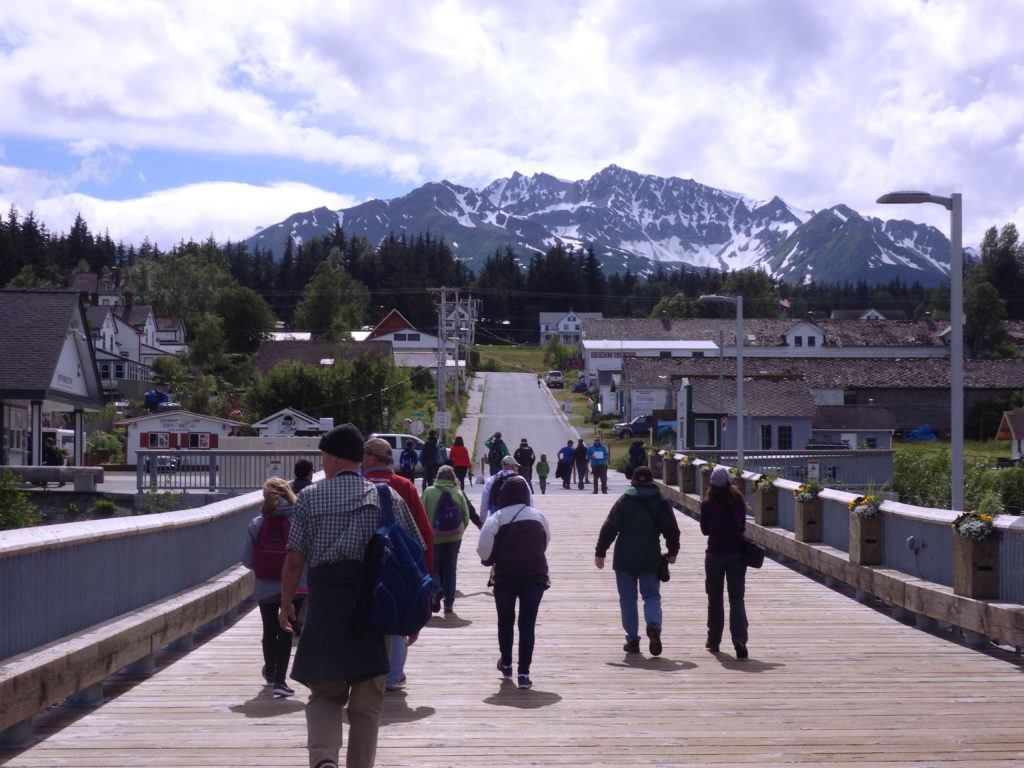
Tourists walk on the cruise ship dock towards Haines’ Fort Seward. (Photo by Emily Files/KHNS)
Self-employment is rising in Haines, and personal income growth locally is slightly ahead of the state as a whole, according to an 80-page report on local economic data.
It’s the start of a five-year economic development plan for the community.
The newly formed Haines Economic Development Corporation is working with the consulting firm McDowell Group to better understand the local economy.
The first step in that process: a baseline economic report, a foundation looking at where the economy stands now and where it’s headed, to help create a five-year economic development plan.
McDowell Group managing principal Jim Calvin spoke this week at a community meeting in Haines.
“You can get a pretty good picture of the condition of the economy, the forces that are at work in the economy, the trajectory of the economy. That’s what we’re trying to do,” Calvin said. “We just want to understand where we are today and how we got here as a community so we can better understand where we’re likely to be in five years or ten years in the absence of any really proactive economic development effort.”
The report is lengthy, but a working draft, while more data is collected and community members are surveyed. But, here are some of the important conclusions, so far:
From 2007 to 2016, personal income growth in Haines was slightly ahead of the state in general.
In Haines, it increased by 9 percent over the past five years. That’s compared to a growth of 3 percent in Alaska.
Most of that growth has come from non-employment related income.
Self-employment is rising in Haines. It increased 10 percent from 2012-2016.
About a third of residents who filed income taxes reported income from small businesses.
Haines has a very seasonal economy. The number of winter jobs just about doubles by mid-summer.
According to Calvin, population can be a good indicator of economic health.
“Some of the real take home points about Haines population is it’s just sort of steady as she goes,” Calvin said.
The report also looks to the future, at things that could potentially alter the economy, such as cruise ship traffic.
“We project that between 2017 and 2019 there’s going to be a 33 percent growth in cruise related visitation to the community,” Calvin said.
And, resource-related developments, such as a potential hard rock mine in the Chilkat Valley.
The Canadian company Constantine Metal Resources is conducting mineral exploration known as the Palmer Project in the Upper Valley.
The McDowell report said the project employed 64 workers in 2017, half of which are based in Haines.
Constantine reportedly spent $3.3 million in goods and services in Haines from 2013-2017.
McDowell also looks at a 10-year negotiated timber sale, recently announced by the University of Alaska.
The university estimates the sale to generate 150-million board feet and $10 million in revenue.
It’s unclear at this point how the local economy will be impacted.
According to the McDowell report, the university estimates 55-60 local jobs will be created over those 10 years.
Both projects are points of contention within the community.
Commercial fishing, the visitor industry and the arts also play big roles in the current economy of Haines.
As data continues to be generated, the Haines Economic Development Corporation also is surveying the community, and incorporating the results of that survey into the five-year plan.
The survey is open until the end of April.
The HEDC got its footing last year, after receiving $95,000 in borough funding.
The development corporation is paying McDowell $49,500 for the economic assessment and development plan.
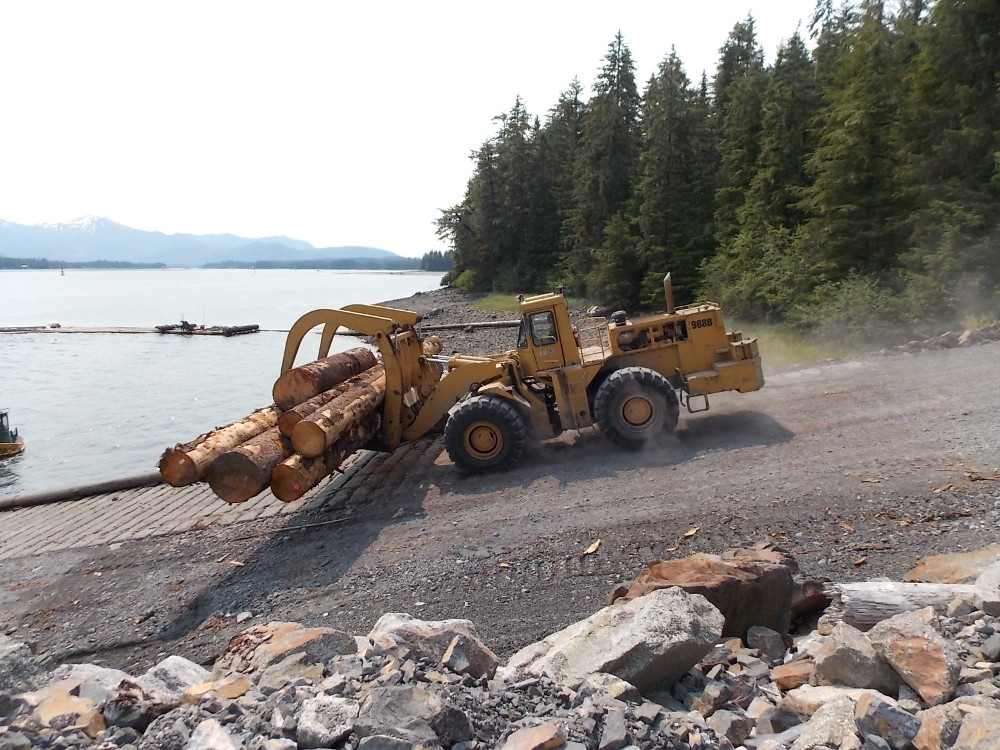
Logs are brought to the Tonka log transfer facility on Kupreanof Island 10 miles south of Petersburg in the summer of 2013. (Photo by Joe Viechnicki/KFSK)
An environmental advocacy organization says the U.S. Forest Service doesn’t appear to be taking steps to correct costly problems in Tongass timber contracts.
The federal agency has released thousands of pages in response to its Freedom of Information Act lawsuits, Public Employees for Environmental Responsibility says.
But those documents don’t describe any significant changes.
PEER published a review last year of two Tongass timber sales done in 2016 by Washington office staff of the Forest Service.
The document listed problems with appraisal and oversight of the Big Thorne timber sale on Prince of Wales Island and the Tonka sale on Kupreanof Island near Petersburg.
PEER asked for other agency records and then filed lawsuits when it said the federal agency did not respond to those requests.
Staff Counsel Adam Carlesco, who has been litigating the two lawsuits, said one seeks background information and documentation on the appraisals for the sales and how the agency made decisions on valuing timber.
“We saw that high-profit trees like Sitka spruce were removed, whereas the subsidized ones that were supposed to be removed, namely hemlock, were left within the forest by the harvester, against the forest plan prescription and whatnot,” Carlesco said. “We wanted to get documentation as to how this sort of thing happened.”
A second suit seeks information about what changes have been made to address problems found in the 2016 Washington office review.
The Forest Service has been responsive to the lawsuits and has released thousands of pages of documents, Carlesco said.
“In terms of producing material, yes, we’re getting material, it’s coming to us,” he said. “In terms of getting the answers that we’re looking for, we haven’t exactly seen the material there that would show us specifically what’s been done, what amendments have been made to make sure these sorts of things don’t come again and we’re not seeing the level of accountability that we were hoping for in this production.”
The 2016 agency review found the way the sales are appraised and has cost the agency revenue.
The review stated, “If the hemlock saw timber volume is not being removed, then sale value based on what is actually occurring on-the-ground has been under-represented.”
On one of the sales it noted that difference exceeded $1.7 million. It also stated, “Given the low-value to non-existent market for this material, the results from appraising this material will often (and maybe always) result in a deficit sale.”
The review recommended an independent evaluation of Big Thorne to follow up the issues identified with sale preparation and administration.
PEER is hoping the documents produced in the two lawsuits will be enough to convince the U.S. Agriculture Department’s inspector general to audit Tongass timber sales.
The Forest Service is part of that department.
PEER asked for such an audit but was denied last year.
Carlesco explained PEER wants to make sure the problems are not being repeated in new timber sales.
“There really is not clear evidence that there have been programs to prevent this sort of thing,” Carlesco said. “In actuality, we’ve been looking at documentations from contracts that have gone into place since this review has come in and we’re seeing some of the errors that were highlighted within this Washington office review be repeated. So we’re not really entirely sure specifically what the Tongass office is doing to ensure this sort of thing does not happen in the future.”
Citing the ongoing litigation, a Tongass National Forest Service spokesman declined to answer questions on the lawsuits, the timber sale review and steps taken to fix appraisal problems.
In court filings, the U.S. attorney’s office denies violating the federal law for release of the records.
Government attorneys also deny how PEER is characterizing the Washington office review of the timber sales.
The agency responded last year to PEER’s release of documents saying the Forest Service prepared an action plan to address the review’s findings and was implementing that plan.
The Forest Service said it had updated the appraisal process and administration of timber sales.
Tongass forest supervisor Earl Stewart was asked about the Washington office review at a March 7 meeting on the Central Tongass Landscape Level Analysis in Petersburg.
“A lot of this is still going on so there’s really not an absolute answer on different components of it,” Stewart said. “That’s why I say it’s a really long conversation, because now there is a whole national forest products modernization effort that’s going on that are just having sub-teams identified now. So literally you’re talking about a year and half to two years of ongoing effort.”
Both timber sales were Integrated Resources Timber Contracts, with the proceeds kept on the Tongass and used to pay for stewardship work such as replacing culverts or repairing hiking trails.
Two pickups passing on Oilwell Road, where locals are concerned that significantly larger timber trucks will make such encounters dangerous. (Photo courtesy Donna Massay)
The Mat-Su Borough Assembly approved Tuesday a five-year contract for a large timber harvest in the Trapper Creek area.
Under the contract timber will be cut, trucked to Port MacKenzie and shipped to China.
More than a dozen Trapper Creek residents and property owners attended the two hours of testimony and debate. Nearly all of them shared concerns about the contract.
While almost everyone testifying said harvesting the timber could be a good thing, they also believe that the road infrastructure, specifically Oilwell Road, is simply not up to the task.
Its construction was one of expedience in the oil drilling days, said Chris Wood, who lives on Oilwell Road.
“They cut trees down, laid them across a road on top of frost heaves, and put dirt on top of it. If the trucks didn’t sink through, they moved to the next spot,” Wood said. “That is Oilwell Road; 105,000 pounds (the estimated gross weight of a loaded timber truck) isn’t going to fly.”
Those trucks also will need about 12 feet of space to maneuver safely down the road.
Oilwell Road isn’t much wider than that in many places, making passing difficult.
Plans for turnouts and clearing to increase visibility have has not been made public.
The public process in general also is a cause for criticism for some in the area of the timber harvest.
Donna Massay, who serves on the Trapper Creek Road Service Area advisory board, said the locals should have been a bigger part of the process for the new contract.
“Why can’t we have a public hearing in our community with the community council — be listened to?” Massay said. “If it had happened at the beginning of this, we would not be there tonight. It would have been solved on a local level. You would have had a good process. This is not a good process.”
What happened last time Chijuk Creek was leased is a third source of criticism.
Evidence of poor execution of the last timber contract is right out in the open as you travel the road, said Ronnie Bell, who owns property on Oilwell Road.
“You’ve seen all the logs laying out there, all the waste, and it’s still laying there,” Bell said. “Is this going to be a summary of the next thing? It’s going to happen again?”
Not everyone spoke against the contract.
Mat-Su Economic Development Corporation president Don Dyer said revenue from the contract, particularly to Port Mackenzie, is very important.
“A million dollars a year of revenue to this borough, revenue that supports the lifestyle in Trapper Creek and Talkeetna,” Dyer said. “For the rest of the borough, it pays for our schools.”
The public testimony had a clear impact on the borough assembly.
Assembly Member George McKee supports the concept of the contract, but that there are too many unanswered questions.
“It has been fast-tracked, and there are real problems that could have been addressed and should be addressed,” McKee said. “The transportation problem is something that has to be addressed.”
Once the borough’s planning department approves a transportation plan the approved contract will go into effect.
A lengthy debate surfaced over whether that approval should rest with the assembly instead of staff.
Borough Manager John Moosey promised to report on the public feedback regarding the plan before its approval, which was enough to sway all but Assembly members George McKee and Jim Sykes.
The public has 30 days to comment when the borough releases the proposed transportation plan.
The Haines Borough is asking for more information about a major timber sale in the Chilkat Valley, recently announced by the University of Alaska.
At a regular meeting Tuesday, the Assembly voted to send a letter to the university prior to a community meeting at the end of April.
The letter drafted by Borough Manager Debra Schnabel reads, “We are challenged to appreciate the enormity of this development and the impact it would have on our community.”
It requests more information specific to the development plan.
“The main thing that I would want to say is we’d like to be stakeholders,” Schnabel said. “There’s the state, there’s the university, there’s Mental Health, and there’s the borough. Why can’t we be part of a four-legged stool instead of a three-legged stool?”
Schnabel writes, “We appreciate that the proposed timber harvest would change the nature of this community forever. For this reason it is right to recognize the Borough as a stakeholder and that the University, Mental Health, DNR, and the Borough engage in frank and sincere discussion toward a win-win outcome.”
In March, the university announced it is negotiating a timber sale on 13,000 acres of its land in the Haines Borough. The 10-year deal is estimated to produce 150 million board feet.
Many residents spoke up, both for and against it, at an Assembly meeting earlier this month.
And, more came forward at Tuesday’s meeting.
“I’m here to comment tonight to ask you to please cooperate with the timber sale – the proposed timber sale,” Paul Nelson said. “I believe that this is a very valuable renewable resource. And if we work with the people that have a market for this timber and are promoting it, it can be a resource for generations to come.”
Haines Chamber of Commerce executive director Tracey Harmon said, “The chamber urges the Haines Borough, and the Haines Borough Assembly, to work with the University of Alaska to allow their proposed timber harvest to go through in the borough.”
Jo Goerner asked the Assembly to encourage “responsible” resource extraction.
“There’s any number of issues that clear-cutting can really affect,” Goerner said. “I would just encourage the Assembly, as you are working with the university to do this sale, that you remind them that responsible extraction is far better than this kind of, let’s just gobble it up and send it off into 10 years’ worth of money and after that we’re left with the scars.”
The letter also says, “We want to encourage a partnership that builds community by providing set-aside sales for local entrepreneurs and incentives and investment for local processing of wood product.”
Mud Bay Lumber Company co-owner Sylvia Heinz spoke to that.
“I think that you as an Assembly and you as individuals would benefit by advocating for the local timber industry,” Heinz said. “Because it is economically sustainable, socially sustainable and environmentally sustainable.”
The Assembly voted 5-1 to send the letter. Brenda Josephson was opposed.
She pushed back on some of the details of the letter and spoke about the opportunities the sale could provide.
“A sale of this side that they’re talking about may be what an investor needs to put a chip mill with a long term potential to stabilize the timber industry of Haines,” Josephson said. “This is huge opportunity for Haines. Job training for local youth and forest industry is going to be an awesome benefit.”
An open house with the Department of Forestry and representatives from the University of Alaska is scheduled for April 26 in Haines.
Close
Update notification options
Subscribe to notifications
Subscribe
Get notifications about news related to the topics you care about. You can unsubscribe anytime.