Timber

University of Alaska extends comment period for proposed timber sale near Haines, Klukwan

University of Alaska announced Monday that it is extending the deadline for comment on a controversial timber sale near Haines and Klukwan by 10 more days, until May 7.

The extension for comment on the proposed 13,000-acre timber sale on university lands comes after a well-attended special Assembly meeting April 3, which resulted in requests for more time from the borough and Klukwan Tribal Council.
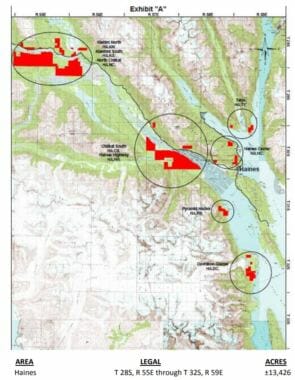
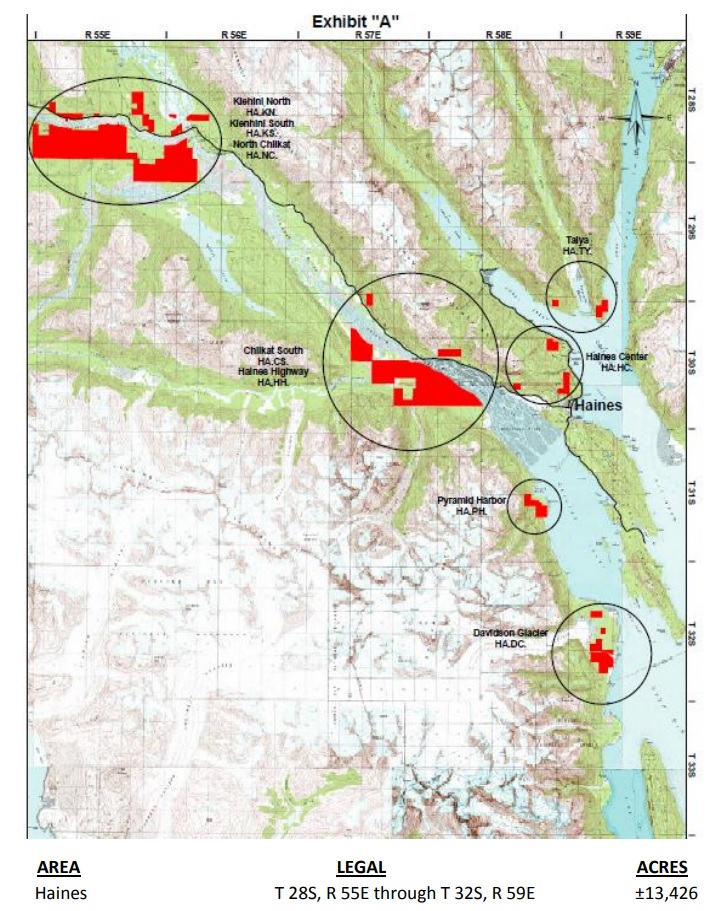
This map shows 13,426 acres of land scattered throughout the Haines Borough that the University of Alaska owns and is negotiating a timber sale of.
This map shows 13,426 acres of land scattered throughout the Haines Borough that the University of Alaska owns and is negotiating a timber sale of. (Courtesy of the University of Alaska)

Haines Borough Assembly Chambers were packed Tuesday evening for the special meeting to gather input on the largest proposed timber sale in the area in recent history.

Many residents expressed concerns about a rushed timeline for the project.

“The beauty of the Chilkat Valley is why I live here and what brings tourists here,” Haines resident Thom Ely said.

Ely was one of several residents that said clear-cutting and industrial scale logging would harm tourism.

“I have had a tourism business for 30 years,” Ely said. “We run tours on the Haines Highway and one of these areas is right along the highway up in the upper Valley there.”

The Borough should look into a land exchange with the university, Ely said, or a buyout of the timber rights.

Resident Haines Tormey said logging could bring much-needed jobs to the region and also be a part of the tourism economy.

“In Ketchikan, one of the main tourist attractions is the lumberjack show. Tourists don’t flee from timber and clearcutting, they’re interested in it,” Tormey said. “It is what makes Alaska, Alaska. We mine, we fish and we log.”

Tony Strong, a Tlingit man from Klukwan, said his community is very concerned that the proposed timber sale would worsen the situation of Chilkat River king and sockeye salmon, traditional foods for his people, and damage the overall ecology of the area.

“How often do we have to lose everything we have for a little bit of money, for a little bit of job for a few people? We cannot continue to do that,” Strong said. “I think we have to ask, figure out some way to make sure that we don’t lose all those resources—not just the timber but the value that comes with that, the inherent ecology.”

Klukwan Tribal Council President Kimberly Strong sent a note that was read aloud at the meeting, informing the borough that Klukwan also was requesting an extension of the comment period.

Strong wrote that Klukwan objects to the sale due to lack of information.

Logging began in the Haines area in the late 1800s and grew in the 1900s with mills operating along the waterfront into the mid-20th century.

While the last large mill closed here in the early ’80s, small-scale lumber operations continue to this day.

The local economy now relies mostly on tourism and fishing.

The University of Alaska is a land-grant university, which means the federal government gave the state land to benefit the university

The acreage was originally selected by the state in 1954, prior to statehood and the Alaska Native Claims Settlement Act and was eventually deeded to the University of Alaska in the 1980s.

The university announced March 28 it was entering into a negotiated timber sale on 13,400 acres of that land scattered throughout the borough.

The 10-year deal is estimated to produce 150 million board feet.

It comes on the heels of the university’s attempted 400-acre timber sale on the Chilkat Peninsula. No bids were received on that controversial proposal.

The university said it will develop that land for a residential subdivision.

The most common refrain at Tuesday’s meeting was that Haines residents need more information about the university’s plans. Some felt the University was fast-tracking the project.

University of Alaska President Jim Johnsen recently said the university system cannot withstand continued budget cuts.

The university’s annual budget has declined by more than $60 million since 2014.

Kathleen Menke said at Tuesday’s meeting that she was alarmed by the lack of process.

“For the university to say that they are coming here on the 26th after the deadline for public comment is just not adequate public process,” Menke said.

The university had set the date of April 19, for public comment to be received and has now extended it until after a April 26 meeting with the Alaska Department of Forestry with representatives of the university and the public in Haines.

University officials said they recognize that extending the deadline for comments until after the scheduled open house meeting will allow more opportunity for the public to make informed comments on the project.

Many at Tuesday’s meeting said they worry about the University’s plan to award a contract so quickly, including John Norton.

“I’m not against the idea of logging, but what raised some level of concern for me was that idea, when I read that they were going to award the contract for this cut in July,” Norton said.

The university plans to award a contract for the timber sale by the end of July.
Sealaska Corporation announces multimillion dollar deal to keep trees in the ground

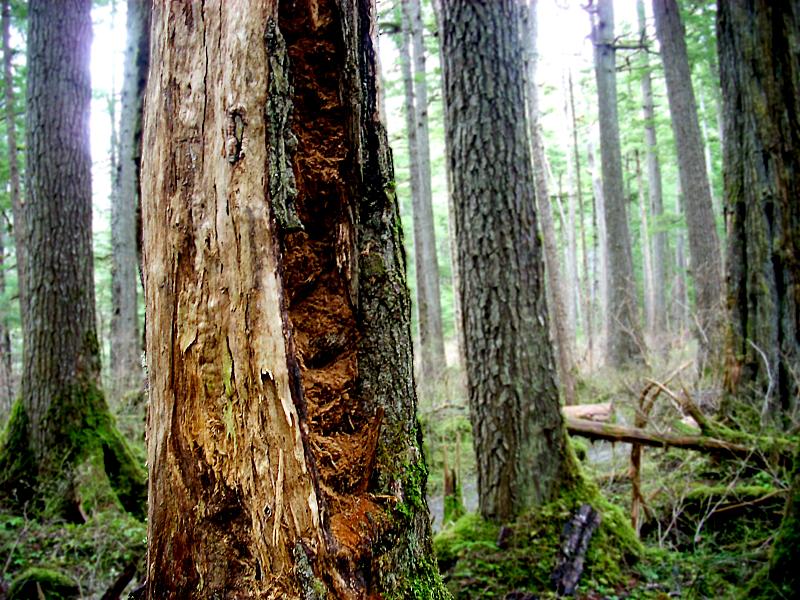
A fire left its mark on this Tongass National Forest tree trunk, as seen in 2008.
Alaska was invited to participate in the California cap-and-trade market in 2015 after lobbying from the Chugach Alaska Corporation. Chugach is also working on developing its own carbon offset credits. (Creative Commons photo by Xa’at)

Big greenhouse gas emitters in California are now able to buy carbon offset credits based in Alaska. The Southeast regional Native corporation Sealaska is using some of its lands for carbon sequestration. Thousands of acres of old growth trees will stay intact for over 100 years. It’s the first carbon bank in the state to be approved for the market.

Sealaska says its another way of securing a future for shareholders.

On the fourth floor of Sealaska Plaza, there’s a board room with an amazing view. A long glass window overlooks the Gastineau Channel. Beyond that, you can see a canopy of evergreens.

Anthony Mallott gestures to the landscape.

“We think we live in a very protected, amazing sacred place on this Earth,” Mallott said. “But there’s room for economic activity.”

Mallott is Sealaska Corporation’s President and CEO. At 42 years old, he’s one of the younger leaders. This morning he went skiing. But he jokes he doesn’t always feel so youthful with a bad knee.

Mallott began working at Sealaska over a decade ago.

“I started in a time period where we could see effectively the end of our timber harvests without getting additional news lands,” he said.

Sealaska President Anthony Mallott poses for a photo in his office. The Juneau-based regional Native corporation is distributing $10.6 million to its 22,000 members this month. (Photo by Ed Schoenfeld, CoastAlaska News)
Anthony Mallott in his Juneau office. (Photo by Ed Schoenfeld, CoastAlaska News)

The corporation manages around 360,000 acres in Southeast Alaska, and Mallott says developing the natural resources, like timber, was an important part of creating the first dividends for its shareholders.

But he says the original land allocation Sealaska received only represents a small part of the region.

“It wasn’t the be all and end all,” Mallott said. “It was something that allowed us to move forward. But it hasn’t fulfilled all the expectations.”

The corporation is expected to make money for its shareholders. But it’s already cut close to a third of its trees, and not all of the sites left are ideal for logging, like old growth stands next to salmon streams.

So, Mallott says the corporation faced a challenge. How do you protect those sensitive areas and still make money for shareholders?

“It was really the need to stretch our harvest and diminish our harvest from a higher level that put us in this framework thinking, ‘OK, what really is sustainability for Sealaska?” Mallott said.

Enter the California cap-and-trade program. 

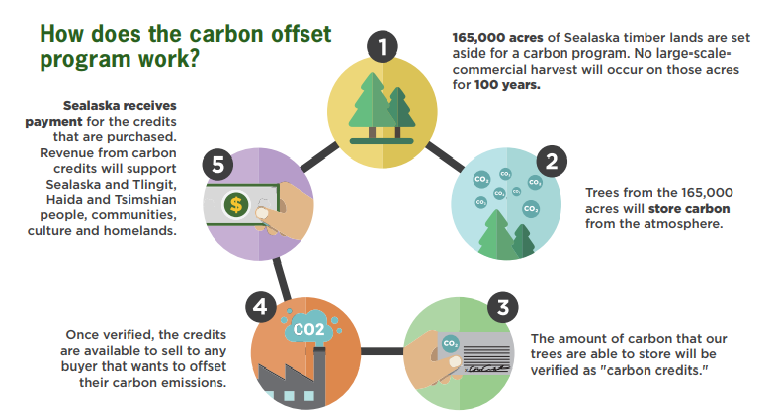
Basically, big polluters in the Golden State receive an allowance to release a planned amount of carbon each year. To account for each metric ton of carbon, companies can use that allowance or buy carbon offset credits. Those credits represent an actual, tangible thing: carbon stored in trees — in this case, trees belonging to Sealaska.

Image courtesy of Sealaska Corporation
Image courtesy of Sealaska Corporation.

Mallott says carbon sequestration looked like the right opportunity. The money generated would help shareholders and nearly half of the trees on Sealaska land could stay in the ground.

He’s quick to point out this land isn’t locked up. The corporation can can still develop parcels for tourism or mineral exploration.

He says the project has already attracted a buyer. It’s too early to put a dollar figure on the deal. But he thinks the amount could be huge.

“Multiple millions,” Mallott said. “The financial benefit of this is very significant for Sealaska.”

In the past, conservation groups have been critical of the rate Sealaska has clear cut its forests.

Buck Lindekugel is a grass roots attorney for the Southeast Alaska Conservation Council, and he says that old model of logging doesn’t make sense for the region’s economy today. He welcomes the corporation’s new venture.  

“We’re excited that Sealaska is seizing this opportunity to explore those options,” Lindekugel said. “We think it’s good for their shareholders, and it’s certainly good for all of us who care about the forest.”

But Mallott says Sealaska has always cared about sustainability and the bottom line.

“The carbon project. Is it a shift? It’s a recognition in the way we’ve always thought,” Mallott said.

He says the corporation isn’t going to stop logging on its remaining land. But it’s also planning to allocate more acreage to carbon sequestration in the near future.

As for what happens to the trees after the 110 years is up, Mallott says that’s up to a younger generation to decide.

Editor’s Note: The explanation about the California cap-and-trade has been updated. A spokesperson from the California Air Resource Board said companies aren’t allowed to go over the set cap, even with  allowances and carbon offset credits. 

Federal spending bill does not include Tongass policy riders

A bill to fund the federal government emerged Wednesday night in Congress, and environmental groups are celebrating that it does not include policy riders to advance old-growth logging in the Tongass National Forest.

U.S. Sen. Lisa Murkowski is a champion of the Tongass logging industry, and she would like to see the forest exempted from the “roadless rule,” a ban dating to the Clinton administration on new logging roads.

But the massive spending bill does not appear to contain the exemption Murkowski favors.

Nor does the bill have a provision blocking the 2016 Tongass Land Management Plan, which calls for a transition to young-growth timber.

The plan has support in Southeast Alaska from a coalition that includes fishermen and tourism-based business owners.

Murkowski said the transition would be too fast to keep the sawmills in business.

Though the pro-logging policies aren’t in the bill, a report that accompanies the legislation tells the Forest Service not to implement a final transition away from old-growth timber until it completes a tree inventory.

Bill reports are non-binding but agencies typically adhere to them.

Congress has to pass the spending bill by Friday to avoid a government shutdown. It would fund the government until the end of September.

University plans major, 13,000-acre timber sale in Chilkat Valley

This map shows 13,426 acres of land scattered throughout the Haines Borough that the University of Alaska owns that's in negotiations for a timber sale.
This map shows 13,426 acres of land scattered throughout the Haines Borough that the University of Alaska owns and is negotiating a timber sale of. (Courtesy of the University of Alaska)

The University of Alaska is negotiating a timber sale on more than 13,000 acres of its land in the Haines Borough. The estimated volume of the 10-year deal is far greater than any timber sale in the Haines area in recent history.

The university’s 13,426 acres are scattered throughout the borough. Most of that acreage is located across the Chilkat and Klehini Rivers or across the Chilkat Inlet from Haines.

That includes a piece of land near the Davidson Glacier and a few smaller portions close to town.

The university says it received interest in the timber on its Haines parcels, and is entering into a 10-year negotiated sale.

Christine Klein is the chief facilities and lands officer at the university. She spoke at a Facilities and Land Management Committee meeting on Tuesday.

“We have received a formal letter of interest from an international buyer for our holdings in the area for really the long term, for a 10-year term,” said Klein.

The sale is estimated at around 100 million board-feet.

Lynn Canal Conservation’s Executive Director Elsa Sebastian calls that number “alarming.”

“A hundred million board-feet means that we’re not talking about a local sale,” Sebastian said. “We’re talking about an outsider coming in, cutting our trees and likely exporting as many as possible overseas.”

That goal trumps the size of other recent Haines-area timber sales. In 2015, the state Division of Forestry moved forward with the Baby Brown Timber Sale. At 855 acres and 20 million board-feet, it was set to be the largest sale in the Haines State Forest in 20 years. That sale was delayed after a successful appeal of the land use plan. The state is preparing to put it back out to bid.

The Board of Regents approved the development and disposal plan for the university sale at a meeting this week, authorizing it to move forward.

The university acreage includes Sitka spruce, western hemlock, cottonwood and birch. Klein said the market for cottonwood is new.

“It’s for an existing market species, as well as for a new market for cottonwood type hardwoods for furniture,” said Klein.

Sebastian said the harvest of cottonwood is concerning.

“We are somewhat concerned to hear the potential for large scale harvest of cottonwood,” Sebastian said. “Especially so near the bald eagle preserve, considering that cottonwood is important habitat used by nesting bald eagles.”

According to Klein, the details are still being negotiated. She couldn’t say who the interested buyer is or how the timber will be harvested.

Klein clarified this sale is different from one on the Chilkat Peninsula that the university put out to bid in 2017.

“This is not the area, the Chilkat 400 acres that you saw in the fall,” said Klein. “This is a separate development program.”

That sale, in Haines’ Mud Bay neighborhood, was introduced amid a local conversation about whether to limit resource extraction.

It drew concerns from throughout the community. But the university didn’t receive any bids. Ultimately, it decided to develop that land for a residential subdivision.

Klein said interest in that sale led to this negotiation. It’s expected to generate $10 million in revenue.

The university is accepting comments on the development and disposal plan for the sale through April 19. Klein said her office is also planning to schedule an information session in Haines in the next few months.

The university plans to award a timber contract by the end of July.

New state Forest Service leader has Alaska experience

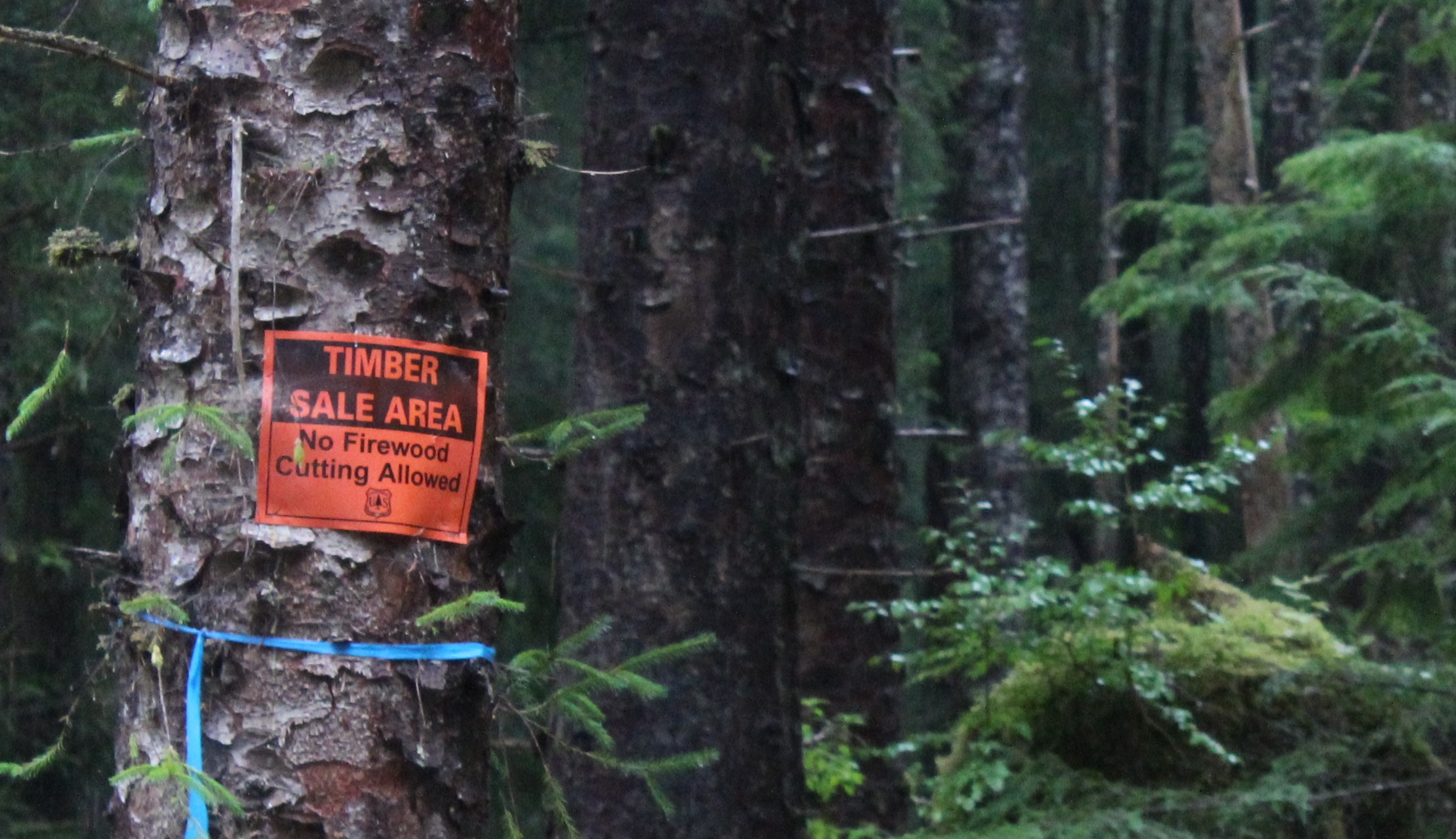
A timber sale sign is posted in the Tongass National Forest on Prince of Wales island. (KRBD file photo)
A timber sale sign is posted in the Tongass National Forest on Prince of Wales Island. The new Forest Service regional forester for Alaska, who takes over in April, was a district ranger on the island. (KRBD photo)

The U.S. Forest Service controls 22 million acres in Alaska, including most of Southeast. It’s overseen by a regional forester, whose staffers manage logging, mining, recreation and fish habitat.

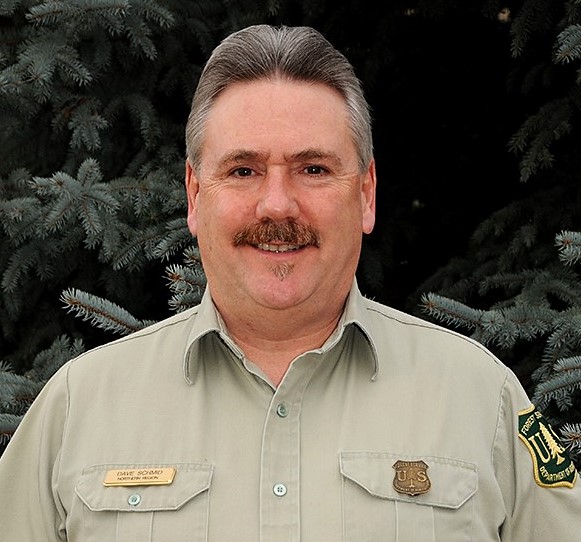
The agency is getting a new top official in April. David Schmid will have to deal with a particularly controversial land management plan that’s under attack.

David Schmid

Schmid began his Forest Service career in Alaska. He and his wife moved here in the early 1980s for his first agency job, in Southcentral’s Chugach National Forest. Later, he worked in the Tongass in Southeast.

“Over the years I think we spent 23 years together in Alaska and just having an opportunity to come back and re-engage with folks and work on Alaska issues has just been a dream of mine,” he said.

He’s leaving his post as deputy regional forester for the agency’s Northern Region, based in Missoula, Montana.

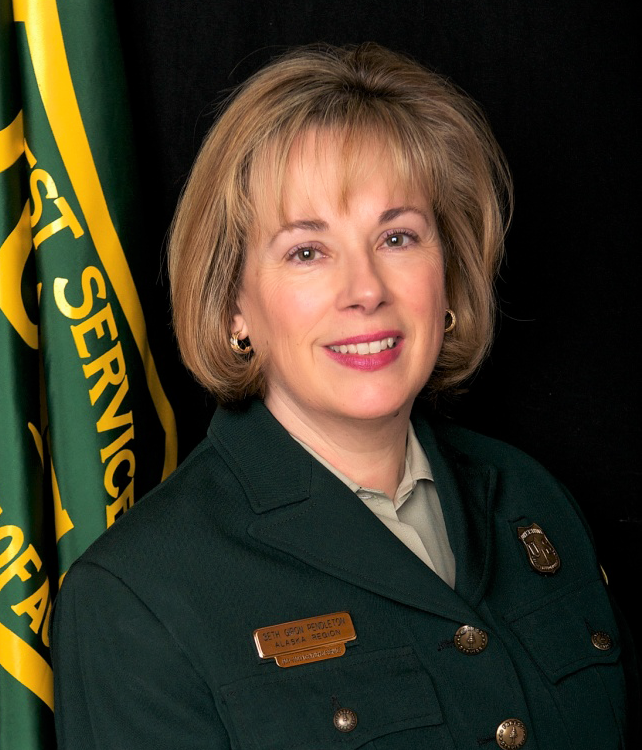
He’ll take over the Juneau-based Alaska Region job from Regional Forester Beth Pendleton, who’s retiring after eight years in the position. She’s spent about 30 years in the Forest Service, two-thirds of it in Alaska.

Pendleton served as acting associate chief of the nationwide agency during the transition to the Trump administration. And recently, the agency’s chief stepped down amid allegations of sexual misconduct.

Despite shakeups at the top, she said there was no pressured to leave.

“My plans to retire were in 2018. So this is per my choice to retire at this time,” she said.

Beth Pendleton

Pendleton oversaw the Forest Service’s Alaska region during development of the most recent Tongass Land Management Plan. It’s been challenged in court and in Congress, largely because it begins the phase-out of old-growth logging.

She believes the plan will survive because it’s flexible and can absorb change.

“We’ve been really focusing on that transition to young-growth harvests and renewable energy. There is an adaptive management component that’s associated with the plan, where there’s room … to further amend the plan in the future if needed,” she said.

She said she’ll bring her replacement up to speed before she leaves the office.

Schmid hasn’t been part of this version of the Tongass planning battle. But he’s familiar with the issues from his days as district ranger for Thorne Bay, on Prince of Wales Island. Before the big mills closed, it was a center of Alaska’s timber industry.

He said he’s dealt with similar conflicts in his current job.

“I think I’ve had something like 75 or 80 objection resolution meetings here in Montana and Northern Idaho and North Dakota. And often times, mostly around tribal planning or large vegetation management, I would say it was almost identical to my experiences in Alaska with some very polarized issues,” he said.

A March 15 Forest Service press release announcing the transition said Schmid will be acting regional forester. But he said he’ll be here for the long haul.

The Forest Service has nine regional offices. Not a lot are overseen by women.

But Pendleton said she’s not unique.

“I would say in the last 10 to 15 years we’ve seen more women and minorities come into some of these leadership positions. And I have had nothing but support and encouragement as I have worked in the agency and as I have served here in Alaska,” she said.

A recent investigation showed a pattern of gender discrimination, bullying, sexual harassment and assault against women in fire crews and some other sections of the Forest Service.

Alaska’s top Forest Service official is retiring

Alaska Regional Forester Beth Pendleton is retiring in April. Her replacement will be Montana’s David Schmid, who worked in Alaska’s Tongass and Chugach National Forests for more than 20 years. (Photo courtesy U.S. Forest Service)

The top official overseeing Alaska’s national forests is leaving her job.

Regional Forester Beth Pendleton will retire in April after eight years in the position. She oversaw the U.S. Forest Service’s Alaska region during development of a controversial Tongass Land Management Plan that’s being challenged in Congress.

Pendleton also served as acting associate chief of the agency during the transition from the Obama administration to the Trump administration.

Forest Service officials announced her retirement plans Friday in a press release.

Officials also named David Schmid as her replacement, in an acting capacity.

Schmid is deputy regional forester for the agency’s Northern Region, based in Montana. He also worked in Alaska’s Tongass and Chugach national forests for more than 20 years. He begins his new Alaska job in mid-April.

The state’s two national forests total 22 million acres of land in Southeast and Southcentral Alaska.

Site notifications
Update notification options
Subscribe to notifications