Tourism

Juneau Assembly pushes sales tax exemption for cruise ships

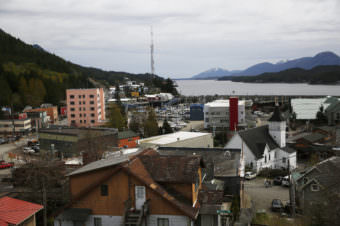
Three cruise ships dock in downtown Juneau on July 14, at the height of the tourist season (Photo by Ed Schoenfeld/ CoastAlaska News)
Three cruise ships dock in downtown Juneau on July 14, 2016, at the height of the tourist season. (Photo by Ed Schoenfeld/CoastAlaska News)

The Juneau Assembly is moving ahead with a proposal to exempt the cruise industry from sales tax for goods and services sold on board while ships are in port.

The finance committee voted 8-1 Wednesday evening to approve a motion by Mayor Ken Koelsch to amend the tax code and formalize the exemption.

The tax exemption isn’t a done deal.

The proposed ordinance will have to be drafted and brought to a public hearing before it can be enacted.

Deputy Mayor Jerry Nankervis said he strongly supported the mayor’s initiative.

“Having the cruise industry in Juneau has been very beneficial for this community,” Nankervis said. “I think with the potential job loss of state employees looming in the very near future it behooves us to try and be good neighbors with the folks that like to come here and do business and try to continue to keep them coming here and doing business.”

A long-standing agreement requires third-party tour operators aboard cruise ships to pay sales tax and that would not change, the city’s Finance Director Bob Bartholomew told the committee.

The mayor’s initiative will certainly be welcomed by the cruise line industry, which says its passengers pay nearly $8 million in sales tax while onshore in Juneau, but has historically not paid sales tax for goods and services sold aboard its vessels.

“The cruise lines believe the practices for the last 15 years have been correct; that incidental sales on board the vessels, while in port, are exempt from sales tax,” John Binkley, Cruise Lines International Association Alaska president, said in a written statement before the meeting.

He noted a similar exemption exists in Ketchikan and claimed it created an incentive for cruise ships to dock longer in a community.

Cruise ships close their shops while ships are in port, Binkley added.

The lone dissenting voice came from Assembly member Jesse Kiehl, who argued that it was a question of fairness.

“My barber has to collect and remit sales tax and bars around here have to collect and remit sales tax,” Kiehl said. “It’s only fair to ask others who provide those goods and services in the borough to do the same thing.”

Meanwhile, a lawsuit brought against the borough by the cruise ship industry over the spending of a $5 per head tax remains pending in federal court.

Judge revokes probation of former gift shop owner who pocketed CBJ sales taxes

A former Juneau gift shop owner was ordered to spend almost two months in jail after pocketing nearly $200,000 in sales taxes and then falling behind on repaying the City and Borough of Juneau.

Larry Lee Lynd, 61, testified by phone from the Anchorage area during his Dec. 16 hearing in Juneau District Court.

“I’m just behind the eight ball right now,” Lynd said. “I’m trying to catch up. That’s all it is.”

This is not the first time that Lynd that has gotten into trouble for not paying sales taxes.

Lynd was operator of Woolly Mammoth Gifts and Sourdough Larry’s in 2011 when he was charged with 33 misdemeanors related to failing to file and remit city sales taxes going back to 2005.

In 2012, Lynd pleaded guilty to five misdemeanors as part of a deal to stay out of jail and resume paying taxes. The other 28 charges were dismissed.

Lynd was ordered to serve 10 years on probation and pay $191,799 in restitution. For each of the remaining five charges, he received a suspended jail term of 180 days and a suspended fine of $1,000.

Lynd was required to make monthly payments of $700 to the CBJ. But sales tax administrator Clinton Singletary testified during December’s court hearing that Lynd only made seven payments over the last 19 months.

“Then he fell off for essentially a whole year. Until September 2016, he didn’t send any other payments,” Singletary said.

Singletary testified that it seemed like the city would get payments when it warned of court action.

The total amount of restitution that Lynd has to pay has now increased to $204,000 even at the relatively low interest rate of 3.75 percent.

During the December hearing, Lynd testified for over 30 minutes about his flood-damaged home, which he claimed was worth at least $250,000 at one time. But the house remains gutted and unrepaired. He’s three years behind on the $50,000 mortgage, and he thinks there are several hundred-thousand dollars’ worth municipal liens from Anchorage and Juneau, and a private Juneau business.

Lynd also said he has about $80,000 in bills stemming from a heart attack in 2015, and he owes the Internal Revenue Service thousands in back taxes.

Throughout much of his testimony, Lynd said he didn’t know exactly how much was owed to whom or which agency. Lynd apparently did not prepare for the court hearing, and tried to blame his faulty memory and poor record keeping on an uncooperative former accountant.

“If I could pay, I definitely would. It’s very important to me. I do appreciate the patience and I will be paying,” Lynd said. “I have a couple things that are going on that have potential where I’m going to have better cash flow. I don’t like this holding over me. I’m going to pay. I just need a little time. And, I pay when I can.”

Lynd said he made a little money, about $15,000 a year, by making “things” for private clients, but he never specified what it was that he made.

Lynd also admitted that he never tried to find a job.

CBJ attorney August Petropulos said what Lynd did was essentially theft. He simply kept the sales taxes that he collected from tourists and other customers instead of passing it on to the city.

“If they thought about it after looking at their receipts, then they thought ‘OK, this is sales tax. I’ve got sales tax where I live. So, this is probably going to water, sewer, trash, whatever, streets, police, etc.’ All of the things that makes society run,” Petropulos said. “It wasn’t going there. It was going into the pockets of Mr. Lynd.”

Petropulos said Lynd has been dodging his sales tax obligation for years.

Juneau District Court Judge Thomas Nave revoked Lynd’s probation and ordered him to serve 10 days in jail on each of the five convictions.

Lynd had been ordered to report to jail by Friday, Jan. 6. But Nave signed off on a one-month extension. Lynd’s attorney is seeking arrangements for electronic monitoring.

Another cautionary tale of Mendenhall Lake’s dangerously thin ice

James Brooks walks his dog, Cookie, and a malamute friend along Mendenhall Lake on Dec. 3 in Juneau. Shortly before New Year’s, Cookie fell into the lake after the ice beneath her gave way and she never resurfaced. (Photo courtesy Rashah McChesney)

It’s the stuff of nightmares. Watching a loved one fall through the ice and being unable to save them.

It happened recently to one Juneau man who lost his 4-year-old dog shortly before New Year’s. James Brooks, 31, and a friend were walking their dogs on Mendenhall Lake near Nugget Falls.

“There was a lead of open water at the time and the other dog jumped in. My dog is not much of a swimmer,” Brooks said. “She likes to wade but she doesn’t like to swim.”

The first dog was a husky mix. Brooks’ 60-pound rottweiler/beagle mix named Cookie, went over to watch.

“She walked up to the edge to see what he was doing and the ice just gave way under her front paws and my initial reaction was to smile because I assumed that she would come up splashing, paddling — maybe a little panicked — but I’d be able to reach in and pull her out without any trouble,” Brooks said. “But she never came up.”

(Courtesy Mendenhall Glacier Visitor Center)

Brooks’ friend stripped down and jumped into the water. But neither man could find any trace.

Not even bubbles.

“I walked along the edge to see if I could see anything but there was nothing there,” Brooks said. “It just happened in a split second.”

“It was as if a cosmic eraser had come in and just erased her from existence,” he said. “Because there was no trace after she slipped in. It was there one moment and gone the next.”

Rescuers in Juneau say the ice around the Mendenhall Glacier area can be risky.

“Three people that I know of now have gone through the ice and fell in — all around the face of the glacier and over by Nugget Falls,” said Jayme Johns, an engineer with Capital City Fire/Rescue.

Johns is the lead water rescuer for the department and will be demonstrating rescue techniques at 1:30 p.m. Saturday at the Mendenhall Glacier Visitor Center.

“When other people venture out, other people see that and think the ice is safe,” he said. “We’re just going to give them some pointers and some clues on ice that’s not safe and stuff that they can look for if they do fall in or if someone does fall in what they can do to help out.”

Brooks and friends held a memorial recently for his dog.

No trace of her was found.

He says the experience was tragic but also instructive.

“It could happen at any time without any warning because I had no warning,” Brooks said, “and there’s no way to tell from one moment to the next what might happen in the next second.”

A few weeks before Brooks’ dog perished in the lake, a Juneau man fell through the ice.

Houston Laws, 31, went into the water last month.

Fortunately he was able to pull himself to safety and assist a 61-year-old grandmother who had ventured into dangerous territory.

The area where he’d slipped is a popular one for selfies.

And like Brooks, he said there had been no warning.

Juneau’s cruise ship head tax spending pitches due next week

Three cruise ships dock in downtown Juneau on July 14, at the height of the tourist season (Photo by Ed Schoenfeld/ CoastAlaska News)
Three cruise ships dock in downtown Juneau on July 14, at the height of the tourist season. (Photo by Ed Schoenfeld/CoastAlaska News)

Proposals to spend Juneau’s cruise ship passenger fees are due next Monday, and so far, the city hasn’t received many pitches.

The city charges a $5 per passenger tax on large vessels that stop in Juneau. With about a million cruise ship passengers a year, it generates about $5 million. Under federal law, that money can only be spent on projects and programs that address both cruise ship passengers’ safety and accessibility.

Susan Phillips, an executive assistant to the city manager, said, as of Tuesday, the city has only received nine project proposals from five entities. The submissions period opened Dec. 2.

Typically, the city receives dozens of pitches for things like seasonal emergency services personnel, waterfront infrastructure improvements, crossing guards and more public restroom cleaning and maintenance.

Meanwhile, Cruise Lines International Association’s lawsuit alleging Juneau misspends that money is pending in federal court.

Neither the city attorney nor a representative of the cruise line association could be reached for comment, but Juneau Deputy City Manager Mila Cosgrove said the case is in the discovery phase.

Cosgrove said the looming lawsuit won’t affect the spending process this year.

“Business as usual. We’ll just move forward with using the same process we’ve always used, as you’re aware,” Cosgrove said. “It’s a public process where we ask people to submit, and then we go through — traditionally, we have met with industry representatives to discuss the proposals and hear their thoughts about them, and we will do the same thing this year.”

Juneau’s Marine Passenger Fee Proceeds Committee vets the initial list of spending proposals. Its recommendation go to the Juneau Assembly, which gets the final say on the projects that make the cut. The assembly discussion is expected in the spring for the budget year that begins in July.

Weak snowpack heightens avalanche danger in Southcentral Alaska

(Graphic by the Chugach National Forest Avalanche Information Center)

Heavy snow over the weekend in parts of Southcentral Alaska has forecasters urging caution in the backcountry because of heightened avalanche danger.

Wendy Wagner, with the Chugach National Forest Avalanche Information Center, said the avalanche danger in the area is still high.

“Statistically speaking, the considerable danger happens after a storm,” Wagner said. “This is when the most fatal avalanche accidents occur.”

Wagner said that’s because the calm after the snowstorm can lure people into a false sense of security.

And especially with Turnagain Pass recently opening to snowmachines for the season, Wagner urged backcountry users to stay out of avalanche terrain.

“Because we do expect snowmachiners and skiers to be able to trigger large avalanches,” Wagner said. “And these are the dangerous kind; these are three feet deep and they can bury and kill a person.”

Wagner said the general rule of thumb is to let the snow settle for about two days after a storm before venturing out into the mountains.

But for this storm, she said it needs more time.

“That old surface was really weak; that snow is like a layer of marbles sitting on the mountain,” Wagner said. “So we are expecting the snowpack to take a week, potentially.”

Wagner said hazardous conditions are likely to persist until the next snowstorm rolls through.

The weak snowpack, however, is not limited to the Chugach.

Jed Workman, with the Hatcher Pass Avalanche Information Center, said a thin base layer of snow and varying weather conditions have set a dangerous precedent for the rest of the season.

“The early season snowpack that came in October rotted-out due to cold, calm, clear conditions, and that will be a persistent weak layer for the entire season,” Workman said. “All the snow that comes from now until the end of the season will be sitting on that very weak base and it’s not something that’s just gonna go away.”

Predicting the weather in Hatcher Pass, particularly for precipitation, is difficult.

Workman said the avalanche information center will be getting some reinforcements in late January, as the National Weather Service adds the area to its recreational forecast.

“It means we’re gonna a higher level of accuracy and more regular information about the weather for that very specific area,” Workman said. “They’re gonna put a higher level of attention to it.”

National Weather Service already produces a recreational forecast for the Chugach Range and Thompson Pass, giving area- and altitude-specific information for snowfall, temperature and wind.

So far, it’s been a very dry winter for Hatcher Pass. If the weather pattern changes, though, and the area gets a big dump of snow, Workman said avalanche conditions would worsen dramatically.

“It would get scary really fast because of this deep, persistent weak layer at the base of the snowpack,” Workman said.

Workman emphasized that there are some big differences between the snowpack in Hatcher Pass and the snowpack in the Chugach.

“Hatcher Pass is more like Colorado; it has a very weak snowpack, generally speaking, and it can be safe to play in, but when there are problems they tend to stay for a long time and they’re not always easy to discover or evaluate,” Workman said. “Whereas in the Chugach it’s more of a maritime snowpack; instabilities come in, and they are problematic for a day, a week, but then they heal.”

Storms and new snow are predicted later in the week for both Hatcher and Turnagain Pass.

Walker proposes stable Fish and Game budget

A state Department of Fish and Game staffer works on sampling fish for a study on toxic metal concentrations in Tulsequah and Taku river fish. (Photo courtesy Department of Fish and Game)

Gov. Bill Walker proposed cutting about 45 positions and $3.5 million from the Alaska Department of Fish and Game’s 2018 budget last week, significantly smaller than the $11.5 million in cuts over the last two years.

But, Walker’s proposal calls for no additional changes to the agency’s Southeast operations.

Fish and Game has taken about a 36 percent cut to its dedicated state funding over the past two years. The commercial fisheries division is one of the more susceptible divisions to state budget cuts because state funding is its largest revenue source.

Southeast fishery funding under Walker’s proposal remains about the same as in the 2017 budget.

The division would be able to sustain its Southeast operations under the proposal, Commercial Fisheries Director Scott Kelley said.

“Basically the projects across the board that we’ve got in Southeast Alaska for Commercial Fisheries Division are going to be the same as what we had in this fiscal year,” Kelley said.

The budget calls for four Southeast commercial fishery positions to be eliminated. Kelley noted that will be done through attrition, but said more positions could be cut after the budget is finalized.

“As you well know, there were special sessions and ultimately things were very different from the governor’s request,” he said. “The FY17 request was not what the FY17 management plan and the allocations look like. Things could change is the bottom line.”

Kelley said the commercial fisheries division cut 45 positions statewide over the past two years.

Most of those positions were eliminated last year.

“We basically look at each and every position as it becomes vacant,” he said.

Commercial fisheries also stopped collecting data in 2015 for several Southeast herring fisheries that haven’t opened in recent years.

Herring fisheries near Craig and Sitka are still being managed. Several other projects were on the chopping block as well.

“They included a golden king crab observer project, some miscellaneous shellfish dive assessment, quite a bit less aerial surveys, and then some personnel cuts,” Kelley said.

Fish and Game’s sportfishing and wildlife conservation divisions don’t expect any major changes during the next fiscal year. Both divisions are primarily funded through national taxes on fishing and hunting gear.

Hunting and fishing license fee increases will also take effect in January.

Hunting licenses about doubled and sportfishing licenses increased $5, up from $24. Net sales for tags and licenses were at about $29.5 million in 2015.

Both divisions took large state funding cuts over the past two years, but tax revenue and license fees have been able to supplement those loses.

Site notifications
Update notification options
Subscribe to notifications