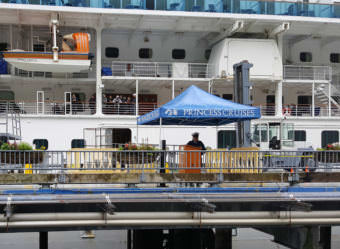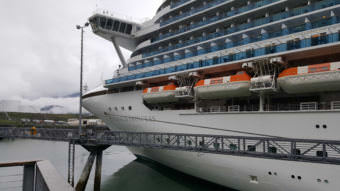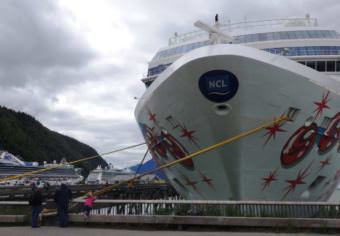
A scale model of the humpback whale sculpture at the University of Alaska Southeast campus, Aug. 14, 2015. A life-size version is installed in a soon-to-be-built waterfront park in downtown Juneau that’s at the center of a lawsuit brought by the cruise ship industry. (Photo by Jeremy Hsieh/KTOO)
At the heart of the federal lawsuit is how the city spends port development and marine passenger fees paid by cruise ship passengers. The industry argues that a shoreline park on Gastineau Channel featuring a bronze whale sculpture is inappropriate and an illegal use of the funds.
The money was transferred to a legal defense fund without comment from elected Assembly members or the public at a Monday evening public hearing. The $100,000 was drawn from the city’s sales tax fund levied on merchants within the city.
It comes less than a month after the Juneau Assembly voted 7-1 to formally exempt onboard sales and services on cruise ships in port. The city’s Finance Department has projected the exemption would cost about $100,000 annually — the same amount now being transferred from the local sales tax fund to defend itself in the lawsuit.
In other business, the Assembly approved a change in how small boats will be charged for potable water at public docks and harbors. The new rate will be 1.5 times the normal utility rates assessed for commercial customers. That would replace the old rate of $4.67 per 1,000 gallons.
The first phase of downtown street improvements will be to South Franklin Street. (Courtesy City and Borough of Juneau)
After several weeks of delay due to snowy weather, the City and Borough of Juneau’s revamping of South Franklin Street resumed Monday with crews expected to continue work through June, the city said in a news release.
The project will progress a block at a time starting from Manila Square to Ferry Way. From mid-April the work is slated to move from Ferry Way to Front Street. There will be no on-street parking where crews are working and pedestrian access will be limited to one side of the street.
Crews are scheduled to work from 7 a.m. to 5 p.m. every day except Sunday. On some days work may be extended as late as 9 p.m., the news release said. This first phase is projected to cost $1.2 million and is funded by a combination of marine passenger vessel fees, sales tax and water utility funds.
Attendance numbers have spiked at Eaglecrest Ski Area thanks to fresh snowfall. (Photo courtesy John Erben)
Record snowfall in Juneau has created some hazards and headaches but it’s also been a boon for the Eaglecrest Ski Area.
The National Weather Service reported more than 7 inches of snow at Juneau International Airport on Tuesday — breaking a record set in 1969.
North Douglas received 9 inches in 24 hours and fresh powder has been bringing people in droves to the mountain.
Record snowfall Tuesday in #Juneau. Another stat of interest: Snowfall Sunday-Tuesday added up to 20.8 inches at the Juneau Airport. #akwxpic.twitter.com/srKRs9rsCT
“It’s been a great season so far,” Eaglecrest’s marketing director Jeffra Clough said Thursday. “Today, we have over 2 feet of new snow since Monday and the parking lot looks more like a weekend than a Thursday.”
February’s cold and clear conditions had made it challenging to draw skiers, but this month the tide has turned.
“March over previous years has been great,” she said. “We’ve had great snow conditions. Right now our attendance up through March 6 has been approximately 4,500 people.”
That’s compared with just 2,400 skiers last March and a paltry 1,000 in 2015.
Two previous poor snow years had spooked many skiers and season pass sales suffered.
With this latest burst of snow, Eaglecrest’s fans are coming back — a day at a time.
“Day tickets definitely have been increasing and I think that’s where you are seeing people who used to be season pass holders,” interim General Manager Nate Abbott said. “Since they’re concerned about those previous seasons, they probably didn’t buy a season pass.”
Eaglecrest is owned by the City and Borough of Juneau, which subsidizes its operations.
This spike in ticket sales could keep the ski area on budget and and he hopes it’ll boost skiers’ confidence in the mountain, Abbott said.
“Hopefully with this snow, people keep coming up and skiing and it ends up being a great end of the season,” he said. “And everybody next year, when they think back, they’ll be like, ‘The 16-17 season was great!’ and they’ll have a little bit more confidence that winter’s back and we had a couple of bad seasons but those were flukes and it does snow at Eaglecrest.”
A solo rider crests the summit during the 2016 Kluane-Chilkat International Bike Relay. (Photo by Jillian Rogers/KHNS)
Controversy from a recent Haines Parks and Recreation Advisory Committee meeting carried into the committee’s most recent gathering as well.
But this time, the topic of debate was whether Haines should pursue a “bicycle friendly community” designation. Questions were once against raised about conflicts of interest on advisory committees.
Several residents spoke out against parks committee member Thom Ely taking part in the biking discussion.
“I think Thom has a direct conflict of interest in this because he has a bicycle shop,” Don Turner Jr. said.
Turner said Ely might benefit financially from the bike-friendly designation.
Ely owns Sockeye Cycle, a bicycle tour business in Haines and Skagway.
But the parks and rec committee members pushed back.
Chair Rich Chapell pointed out that it’s an advisory group. He compared the situation to the Port and Harbor Advisory Committee, which has boat owners, and the Tourism Advisory Board, which has tourism entrepreneurs.
Ultimately, Ely voluntarily recused himself for the sake of the discussion going forward.
But the disagreement didn’t end there.
“What’s happening is you’re promoting one user group over other user groups,” Brenda Josephson said. “I believe you’re disenfranchising other user groups.”
Audience members also raised concerns about how much the bike-friendly designation would cost the borough in terms of new infrastructure and staff time.
Sockeye Cycle General Manager Dustin Craney tried to address some of those questions in his presentation to the committee.
“The purpose is to find a way to increase local cycling while decreasing conflicts with other user groups,” Craney said. “There’s certainly no prioritization of bicycling over other user groups. I think that would a failure on the part of bicycle friendliness.”
Craney said Sitka, Juneau and Anchorage all have bicycle-friendly designations. He said municipalities submit applications to the League of American Bicyclists, which determines whether the community qualifies as bicycle friendly and gives feedback for improvements.
“I think with our limited but amazing road resources here it’s a great place to ride bikes, I’d love to see more people riding bikes here,” Craney said. “I’d love to see anybody that has a negative view of bicyclists be involved in the conversation and find ways to decrease that negative view and use the roads together and enjoy the area we live.”
Craney offered to fill out the bike friendly application so that it wouldn’t cost the borough in staff time.
The parks and rec committee voted to ask representatives in Sitka for a presentation on their experience becoming a bike friendly community.
The next committee meeting is April 3.
At that meeting, the committee will have new member Dave Long at the table. Chapell said he was happy to see Long apply for the seat.
“I think Dave will represent a new user group that we don’t hear from enough on this committee,” Chapell said.
Long was one of about 150 people who showed up to a parks and rec committee meeting in February to oppose creation of a winter recreation map.
Many of them worried the map would restrict motorized uses, including snowmachining. The committee members said they were never planning on limiting motorized use.
That meeting brought a new level of scrutiny to the parks and rec committee.
Before, its meetings usually drew just a couple audience members. But at the most recent meeting, there were more than a dozen people in attendance, many to speak out against the bike-friendly initiative.
The band Soviet Soviet. (Photo courtesy of the artist)
Friday afternoon, the Italian trio Soviet Soviet posted a lengthy statement on Facebook explaining why it would not be keeping its U.S. tour dates this week and next: It had been deported.
The band, which is based in the city of Pesaro, landed in Seattle on Wednesday afternoon. It was traveling under ESTA (also known as the Visa Waiver Program), which allows citizens of nearly 40 countries to travel to the United States without having to obtain a visa.
Such visas are frequently used by bands coming to the United States when they only are slated to play unpaid showcases, as paid work while traveling on an ESTA is prohibited.
According to the group, its three members were carrying a letter from its American record label explaining that the musicians were scheduled to perform a number of “promotional,” nonpaid performances in the U.S., including a live performance at member station KEXP, as well as a showcase at the South by Southwest festival in Austin, Texas.
The band says that its three musicians were questioned for several hours, and “agents” (presumably U.S. Customs and Border Protection officers) denied them entry into the country. From the airport, the band says, the three were taken to a jail and held overnight before being escorted to a plane and sent back to Italy. The three say that they were treated “like criminals.”
In its statement, Soviet Soviet says that the agents’ refusal to permit the band’s entry seems to have stemmed from the fact that the agents believed that the group needed work visas to enter the U.S., because two of the venues at which Soviet Soviet was slated to perform were going to charge audiences entry fees — even though the band says that its musicians were not going to earn any money while in the U.S.
This afternoon, KEXP published a short statement about the situation, saying:
“Yesterday, Thursday, March 9th, Italian trio Soviet Soviet were scheduled to perform live on The Morning Show on KEXP. Their sophomore album Endless was released on felte Records back in December, and with its dark, anthemic, post-punk sound, quickly became a favorite on the KEXP airwaves. Unfortunately, the in-studio — as well as their scheduled performances at Kremwerk, SXSW, and venues along the west coast — had to be canceled. … KEXP sincerely hopes we’ll be able to reschedule a session with the band in the near future.”
It remains to be seen whether other musicians will face similar circumstances as they arrive at U.S. border points of entry in the coming days. This period is a particular pressure point as SXSW gets underway on March 13; nearly 600 foreign acts were showcased there during the 2016 festival. Just a week ago, the festival’s organizers faced intense scrutiny over their contractual statements regarding international artists coming into the U.S. to play in Austin, which led to an official apology and a promise to revise SXSW’s language.
On Tuesday, prominent immigration attorney Brian Taylor Goldstein, whose practice is centered on working with artists seeking to tour the U.S., published a lengthy article advising international musicians about the current — and shifting — challenges regarding immigration policy under the Trump administration. Goldstein wrote:
“Given that the new Order specifically requires heightened vetting and screening of those ‘who seek to enter the United States on a fraudulent basis’, there is going to be even more scrutiny and less forgiveness than ever before with regard to artists attempting to enter the US on visitor visas (B-1/B-2) or through the Visa Waiver Program (‘ESTA’). We are already receiving reports of artists being held and detained for hours upon entering the US to determine whether or not they are performing. Even artists entering as visitors for the purpose of attending a conference or ‘performing a showcase’ are being pulled aside and, in many cases, being refused entry. Artists entering with B-1/B-2 visas or through the Visa Waiver Program (ESTA) are being pulled aside the moment they say that they are ‘entertainers’, ‘performers’, or ‘artists.’ … In short, an Immigration Officer has the unfettered authority and discretion to deny entry to any artist from any nationality for any reason. To what extent this authority will be exercised remains to be seen.”
In a more hotly contested portion of his post, Goldstein also said that ESTA and visitor visas don’t provide artists enough cover, even for unpaid work, and that their continued use by bands could spur serious consequences:
“Artists cannot perform on visitor visas (B-1/B-2) or through the Visa Waiver Program (“ESTA”) regardless of whether or not they are being paid and regarding of whether or not tickets are sold. Except in the most narrowly defined circumstances, US immigration law has always defined “work” as it pertains to artists, as any kind of performance. Artists denied entry on the basis of fraud, will have a denied entry on their record, impeding future visas and travel.”
Goldstein instead urged visiting bands to get “O” or “P” work visas designed for working entertainers.
Copyright 2017 NPR. To see more, visit http://www.npr.org/.
Visitors stop by the new waterfront visitor center in Juneau in 2012. Roughly 1 million people visit Juneau by cruise ship each summer. (Photo by Heather Bryant/KTOO)
Cruise ships will now be exempt from Juneau’s sales tax while in port. An overwhelming majority of Assembly members said the exemption sends a business-friendly message to the industry. This comes as the City & Borough of Juneau is proposing to use sales tax revenue to defend itself in a lawsuit brought by the cruise ship industry.
Assembly members lauded the cruise ship industry as an invaluable partner for the local economy and said the sales tax exemption was an important incentive.
“This isn’t a tax we’re forgoing this is a tax that we are not collecting because we haven’t done it in the past and I support trying to encourage businesses to do business in Juneau,” Deputy Mayor Jerry Nankervis said.
Only one cruise ship company had been paying sales tax — now all will be officially exempt in time for the first docking in May. The city’s finance department wrote in a staff report that levying sales tax on cruise ships would raise up to $100,000 a year.
The ordinance passed easily on a 7-1 vote. Only Assembly member Jesse Kiehl was opposed.
At the hearing, leaders in the tourism industry spoke in favor of the exemption.
“I do understand — or I’m led to believe that we are in negotiations right now with the cruise lines on the lawsuit issue,” said Bob Janes, owner of a whale watching and guiding company.
The “lawsuit issue” he referred to is a court challenge brought by the Cruise Lines Industry Association over how the city spends fees collected on cruise ships docking in port. So far there’s been no indication from public statements that the sales tax exemption and this ongoing litigation are linked.
But Janes said the exemption could help the city resolve the lawsuit.
“I think we need to step forward with our best foot here and show that we do cooperate, we can cooperate and we will cooperate with the cruise lines,” he said.
There were also a few critics at the public hearing. Guy Archibald said turning away sales tax money wasn’t responsible.
“A hundred thousand dollars or 10 cents per person is not going to change anybody’s vacation plans. But $100,000 is $100,000 less of a tax burden that the city is going to have to find somewhere else,” Archibald said.
As a matter of fact the city is looking for another $100,000. A separate ordinance proposed Monday evening would earmark $100,000 in sales tax revenue to keep paying lawyers retained specially for the cruise industry lawsuit.
City staff and Assembly members have declined to comment citing the pending litigation. Briefings are done by the city attorney in closed executive sessions.
But that doesn’t mean a lot isn’t happening behind the scenes. Court filings show the city and cruise industry are headed for a jury trial at the end of the year. And to date, the city has spent more than $280,000 on legal counsel. The city so far has relied on passenger and port development fees to pay these lawyers. In other words, it’s been using fees levied on the cruise industry to defend itself from the cruise industry.
Whether that’s a stroke of legal genius or a reckless maneuver really depends on who prevails in court.
The city manager’s office wrote in a brief report that the city strongly supports and welcomes cruise ship tourism, but at the same time needs the $100,000 in sales tax revenue to defend its marine passenger and port development fees now being challenged in federal court.
Why the city is no longer willing or able to finance its legal fight using marine passenger fees isn’t clear. City Manager Rorie Watt declined to elaborate aside from what he’d written in the staff report. The ordinance is now scheduled for a public hearing and vote at the Assembly’s April 3 meeting.
Close
Update notification options
Subscribe to notifications
Subscribe
Get notifications about news related to the topics you care about. You can unsubscribe anytime.