Tourism

White Pass railroad company wants 20 more years on lease to make way for urgent Skagway port improvements

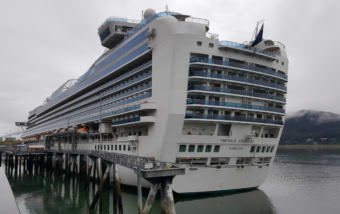
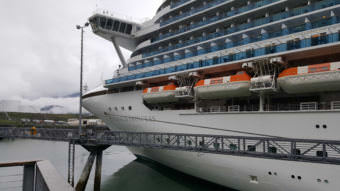
Cruise ships dock in Skagway’s port. (Photo by Emily Files/KHNS)

The private company that controls more than half Skagway’s port wants a 20-year lease extension in order to make way for pressing waterfront improvements.

White Pass and Yukon Route Railroad is a major tourist attraction in Skagway. Since 1968, it has controlled a significant portion of Skagway’s tidelands and uplands through a lease with the city.

White Pass gave the municipality a new lease extension proposal this June.

The offer is preliminary. White Pass and municipal officials are at the beginning of negotiations.

White Pass President John Finlayson said the potential contract would continue a “great partnership.”

“If you look at the last 25 years, the town’s economy has experienced unprecedented growth,” Finlayson said. “I think a lot of that has to do with White Pass’ investment.”

Finlayson shared the entirety of the new proposal with KHNS on Monday. He agreed to release the document following a borough Assembly meeting in which some key details were revealed publicly.

White Pass’s offer is broken into three parts: an amendment to the current tidelands lease, a new lease picking up after the original expires, and an environmental remediation agreement.

These new contracts are on the table about two years after voters rejected a 35-year lease extension.

The situation has become more critical since then.

In two years, larger cruise ships will sail to Alaska. Skagway could miss out on a significant share of the market if it doesn’t renovate its port to accommodate the vessels.

Skagway Mayor Mark Schaefer supported the 2015 lease that was thrown out by voters.

“It’ll be a miracle if we don’t lose this boat, it really will be,” Schaefer said. “When we do lose it, its not gonna be such a fun time I don’t think.”

There are a few key differences between the 2015 proposal and the new one:

  • Length of the lease: White Pass is asking for a new, 20-year lease following the expiration of the current contract in 2023.

    At a recent meeting, Assembly member Orion Hanson suggested the municipality try to negotiate the term down to 15 years, so that the agreement would end in 2038.

  • Clear the way for an estimated $15 million floating addition to the ore dock: This is perhaps the most urgent piece of infrastructure. Skagway’s ability to welcome larger cruise ships hinges on it. White Pass proposes it take the lead on building the floating dock, while splitting the cost 50/50 with the municipality.

    Finlayson said the railroad building the infrastructure is simply more expedient than the government taking it on. The railroad needs a lease extension in order to move forward with the ore dock modification.

  • The annual rent payments: Right now, White Pass pays the city about $130,000 per year. The company suggests raising that to $200,000 annually. That offer is lower than the 2015 proposal. Those proposed payments started at $250,000 and increased to $400,000 over the 35-year period.

    Hanson has suggested negotiating those numbers up to $250,000 at the start of the lease, increasing by $50,000 every five years.

    The rent payments are key in terms of whether this lease will need to go to a public vote. Skagway code stipulates that any lease worth $5 million or more must go to the voters for approval. White Pass’ proposal doesn’t reach the $5 million mark this time.

Hanson advocated for a public vote once the city and White Pass are done negotiating.

“I didn’t feel totally comfortable that we could execute this without a vote,” Hanson said. “And I think voting is one of the most important things we have as Americans.”

Schaefer and Finlayson say they worry about how a referendum would affect the tight timeline.

Port consultant Moffatt & Nichol has said that if the city wants to have a floating dock in place by the time bigger ships arrive in 2019, they’ll need to start design and permitting work by late summer or early fall.

Unlike the 2015 lease proposal, White Pass is looking to separate environmental remediation from the rest of the contract.

Skagway’s ore basin is polluted with decades-old contamination.

The railroad proposes paying $2.5 million and the municipality chipping in $1.5 million toward an estimated $4 million cleanup. If it costs more, the two parties would meet and decide how to split the cost.

Finlayson said White Pass’ contribution to remediation is contingent on the lease extension.

There are some things that have not changed between the 2015 and 2017 proposals.

White Pass would give up a significant portion of the lands it leases, only retaining control over the areas directly beneath the ore dock and Broadway dock.

Cruise ships berth at both facilities.

The municipality and White Pass would share the ore dock, with the railroad getting cruise revenue and the city getting revenue from industrial and other uses.

The Assembly is set to discuss the lease proposal at its meeting this Thursday. From there, negotiations are likely to continue.

Glacier visitor center burglary suspect arrested

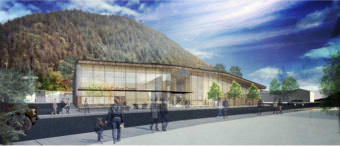
Mendenhall Glacier Visitor Center, Juneau, is pictured in the distance at the top of a hill. (Creative Commons photo courtesy USDA Forest Service Alaska Region)

Juneau police have arrested a man suspected in the break-in Sunday of Mendenhall Glacier Visitor Center.

Officers were investigating a tripped alarm when they heard noises inside the visitor center, according to police. When they tried to setup a perimeter around the building, police said they saw the suspect, identified as Mack Parker, 51, run away into the woods.

A car tied to Parker also was found at the scene.

A ground-level window was broken in the incident and multiple items were reported missing. Police said security camera footage from inside the visitor center appears to show Parker stealing property.

They don’t know the total value of the missing items.

Parker was arrested this afternoon for 2nd-degree burglary when officers found him inside a home near James Boulevard.

Parker is being held without bail at Lemon Creek Correctional Center.

Forest Service employees stand ready to turn visitors away from the Mendenhall Glacier Recreation Center on Sunday.
Forest Service employees stand ready to turn visitors away from the Mendenhall Glacier Recreation Area on Sunday. (Photo by Quinton Chandler/KTOO)

Police and Forest Service rangers conducted a search Sunday for Parker after he fled the visitor center. The Forest Service decided to close the road to the Mendenhall Glacier Recreation Area during the investigation.

Forest Service spokesman Paul Robbins Jr. said the district ranger wasn’t sure it was safe to keep the area open because he didn’t know whether the intruder was still in the area.

Robbins estimated about 3,500 visitors could’ve been affected by the closure.

Update: Glacier visitor center reopened; police continue search for break-in suspect

District Ranger Brad Orr standing behind the barricade blocking the Mendenhall Glacier Recreation Area to traffic.
District Ranger Brad Orr standing behind the barricade blocking the Mendenhall Glacier Recreation Area to traffic, Sunday. (Photo by Quinton Chandler/KTOO)

Update | 3:00 p.m. Sunday

The U.S. Forest Service has reopened the Mendenhall Glacier Visitor Center and most of the trails connected to it.

Forest Service spokesman Paul Robbins Jr. said every trail is open except for the Dredge Lakes trail system. Those trails were closed before the alleged break-in after a bear attacked a dog walker on Friday.

According to a Forest Service news release, security cameras recorded the suspect breaking into the Discovery Southeast bookstore inside the visitor center.

The Forest Service is directing all questions about the break-in to Juneau Police Department.

Police Lt. David Campbell said the suspect is still at large. Police are using the security camera footage to confirm the suspect’s identity, he said.

Robbins estimated that up to 3,500 people could’ve been affected by today’s closure. He said on average, about 5,000 people come to the visitor center every day during the summer.

Update | 11:15 a.m. Sunday

A line of plastic orange cones and U.S. Forest Service employees are turning disappointed visitors away from the Mendenhall Glacier Recreation Area, while law enforcement search for an alleged suspect in a break-in of the visitor center.

“We have sustained a little bit of property damage,” said Brad Orr, district ranger for the U.S. Forest Service in Juneau. “Our initial indications are (that) it’s not that serious.”

The intruder was noticed about 4:30 a.m., Orr said. The Mendenhall Glacier Visitor Center is secured by cameras and an alarm system.

The visitor center unit is closed to the public, until law enforcement finishes their investigation, he said.

“That would be everything from the big blue sign at the entrance to the national recreation area all the way up to the visitors center,” he said. “That whole area has been closed temporarily.”

He said the Forest Service may eventually reopen the recreation area, but keep the visitor center closed.

The Mendenhall Glacier Visitor Center was built in 1962. It was the first US Forest Service visitor center in the country. Located just north of Juneau, Alaska, Mendenhall Glacier is the most popular and accessible glacier in the state. Mendenhall Glacier has been retreating since the mid-1700's at a rate of 100 to 150 feet a year.(Creative Commons photo by Jasperdo)
(Creative Commons photo by Jasperdo)

Original Story | 9:31 a.m. Sunday

Early Sunday morning, a security camera recorded a possible break-in at Mendenhall Glacier Visitor Center, according to the Alaska Region Forest Service.

In a series of tweets, the Forest Service said that the road to the glacier was closed and that law enforcement is asking everyone to avoid the area. Police are currently searching for the suspect.

Editor’s note: This story will be updated.

Skagway port consultants recommend $14.5 million ore dock modification

A Disney cruise ship tied up at Skagway’s ore dock. (Photo by Emily Files/KHNS)

Skagway’s most profitable economic sector, cruise ship tourism, is at risk.

That was the message port consultants delivered to borough leaders last week.

The consultants were hired to make a recommendation about what Skagway can do to ready its port for larger cruise ships by 2019.

They’re suggesting the municipality act as soon as possible on a $14.5 million modification to the ore dock.

Skagway doesn’t have time to spare. That’s one key point from Moffatt & Nichol’s Shaun McFarlane.

“The larger ships are coming to Skagway,” McFarlane said. “What is important to know and remember is that if you’re not able to accommodate these larger vessels, there’s not a slightly smaller vessel waiting at anchor to come in if you can’t accommodate that one. So there’s not a ‘do nothing’ scenario for Skagway that results in the same level of visitors.”

The time crunch had a strong influence on McFarlane and colleague Scott Lagueux’s recommendation.

They had to find a way for one of Skagway’s docks to accommodate larger ships in less than two years.

They looked at possible renovations to the railroad dock, ferry dock and ore dock. The ore dock options rose to the top.

McFarlane’s team recommends a 50-by-175-foot floating dock be built to the north of the existing dock. It would go with a pedestrian drive-down gangway.

This renovation would allow the larger vessels to tie up there.

The ore dock already is used for cruise ships and it’s caused concern for residents to have industrial and tourism uses so close. Visitors coming off the ship have to walk under the ore loader.

McFarlane said that is a downside.

“It’s not an ideal place to bring people off in the middle of a facility, with the ore operations,” McFarlane said. “It’s difficult to separate the industrial and the tourism operations there.”

Another potential obstacle is long-standing contamination in the ore basin.

McFarlane said environmental regulators told his team that the work should be able to happen despite the contamination.

But there’s a catch: Skagway doesn’t have full control of its port. It leases much of the tidelands to the largest tourism attraction in town: the White Pass and Yukon Route Railroad.

That is why progress on the waterfront has stalled for years.

In 2015, voters rejected a 35-year lease extension with White Pass that would have given the municipality access to complete a list of port renovations.

In the about two years since then, port progress has been in limbo. That’s why the borough hired these consultants.

In order to construct the $14.5 million ore dock modification, the municipality will need White Pass’s cooperation. Although the municipality owns the facility, it’s part of the railroad’s lease, which doesn’t expire until 2023.

“We believe that it is in the best interest of White Pass to operate in good faith to allow that access to occur without any other means of agreements or requirements,” Lagueux said. “We believe that this improvement is beneficial to all. So we’re hopeful this allows the two parties to come together.”

Skagway Port Commission Chair Tim Bourcy asked, What if the municipality doesn’t find a path forward with White Pass?

“Where we are now is we have all our eggs in a basket, and we’re hoping we’re gonna get there, and I’m hoping we get there as well,” Bourcy said. “But I don’t see the fallback position on this.”

Bourcy said he would like to see a backup scenario in Moffatt & Nichol’s final report.

There is some indication that White Pass is ready to get moving on some kind of plan.

Company president John Finlayson wrote a brief letter to the mayor and assembly last week. White Pass is working on its own proposal to address waterfront issues, he said, which they plan to present to a borough negotiating team soon.

Whether that plan is in line with Moffatt & Nichol’s recommendation remains to be seen.

The clock is ticking.

McFarlane and Lagueux said in order to complete the ore dock addition in time for larger ships, the borough needs to start permitting and design work by late summer or early fall.

Even then, it’s going to be tight.

Now it’s up to town officials to decide whether they want to move forward with the ore dock plan.

FAA addresses aircraft noise concerns in Homer

Floatplanes on Beluga Lake.
Floatplanes on Beluga Lake in Homer. (Photo by Aaron Bolton/KBBI)

Floatplanes and other aircraft are taking off from Beluga Lake and Homer’s airport several times a day. With more than a handful of flightseeing, bear viewing and air taxi operations in town, some residents are concerned about low flying aircraft and the noise that accompanies them.

Homer City Council member Donna Aderhold started hearing complaints last year during a meeting about a floatplane access road. She started working with City Manager Katie Koester to see what the city could do to mitigate the issue. She added residents also suggested their own measures.

“There was a suggestion of a no-fly zone over Homer, changing traffic patterns, things like that,” Aderhold explained.

Aderhold and Koester asked Ken Thomas with the Federal Aviation Administration what could be done.

Ken Thomas works with the FAA’s Flight Standards Division. He was in Homer last month to hold a general safety meeting but returned Thursday for a community discussion. Thomas told the few in attendance that he’s heard the complaints.

“Over the past couple of years, I’ve heard a lot of different instances. ‘They’re 200 feet over my house, 500 feet over my house, the noise is rattling the dominos on my table,’” Thomas said, listing general complaints called into the FAA. “I know those are real, but what it boils down to for flight standards to get involved is a safe operation, and 200 feet over somebody’s house is not a safe operation.”

Thomas explicitly said the FAA’s primary concern is safety. It does not hold any direct authority over small aircraft noise but can impose measures when safety and efficiency are a concern. Its Airports Division also can guide airports through a few initiatives to mitigate noise.

Thomas notes that if pilots are following safety standards, noise should be minimal. Homer is considered a congested area, and planes should gain a minimum of 500 feet before making any turns away from the airport’s traffic pattern and must climb to 1,000 feet after takeoff.

“There’s plenty of room in Homer to get that 1,000 feet prior to turning towards the bluff. To take off and make the decision over the west end of the airport to turn towards the bluff immediately, that would be a really poor choice,” Thomas explained, “from the noise factor flying right over town, but we never climb into rising terrain.”

Planes flying over towns and crowds are required to fly 1,000 feet over the tallest object within a 2,000-foot radius. Thomas said pilots can fly along the coast to gain that altitude before passing over Diamond Ridge.

FAA inspectors need proof to identify any problem pilots. Thomas said pictures and video are best, but identification numbers on the aircraft, time and direction of flight are all important.

Pilot and flight instructor Tom Young said he’s seen problems as well but adds it’s generally pilots from out of town that are the issue.

“They’ll not follow the traffic pattern or fly over the ridge low, just conflicts with traffic sometimes,” Young said. “Generally it’s people who aren’t familiar with the area.”

The FAA does mandate that pilots obtain information about the airport they’re flying to. Thomas said he’ll keep tabs on the Homer area going into the future and plans to hold another pilot safety meeting this fall.

Defibrillators installed in the North Tongass Service Area

Members of the NTVFD and Alaska State Troopers installing AEDs.
Members of the NTVFD and Alaska State Troopers installing AEDs. (Photo courtesy KRBD)

The North Tongass Volunteer Fire Department recently purchased 34 automated external defibrillators, or AEDs, and is finishing installation of the units. Fire chief Jerry Kiffer says the project was funded through a Commercial Passenger Vessel grant due to the large number of cruise ship passengers bused into the service area.

He says time is critical if someone goes into cardiac arrest, and to be effective, defibrillation need to happen within five minutes of a heart attack. Kiffer says in the best-case scenario, after receiving a call, it will take emergency responders at least five to eight minutes to reach the scene.

“Our answer to that was, well, we need to move the defibrillator closer to the area in which these large groups of people are going to be taken. So we came up with the idea that the only way we can do that is to actually station the unit, and train people to use it, in those locations.”

Kiffer says 28 of the units have been mounted so far from Ward Cove to Settlers Cove, and two more will be mounted when approved by property owners. He says most are located at sites frequented by tourists.

“Knudson Cove Marina. The zip-line tours. The go-cart tours. Places that the tourists are actually being bused into. But we also have them stationed at Ward Cove Market, the post office, and in areas that the buses will be driving by.”

He says four units also were provided to Alaska State Troopers to be carried in patrol vehicles.

“They’re out patrolling the service area and, quite frankly, island wide. But, they’re mobile and a lot of times in a cardiac event, a State Trooper may be the first on scene.”

Kiffer says the AEDs have simple instructions and can be operated by anyone in the event of an actual emergency.  Though easy to operate, he says unit-specific training is provided to employees where the AEDs are located to ensure pads are applied correctly.

“So when an ambulance shows up, we don’t have to take the AED pads off the patient and put our pads on. What these pads do, is they give the medics the ability to look at what the underlying heart rhythm is while CPR is in progress.”

Kiffer says the units are clearly labeled and mounted in public places. He says the goal is to have an AED within five minutes of anyone in the North Tongass Service Area.

Site notifications
Update notification options
Subscribe to notifications