Tourism

Prince Rupert signs 10-year deal with private operator to grow cruise port

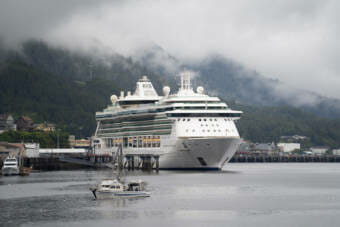
An aerial photo of a cruise ship in Prince Rupert.
This undated photo shows a Royal Caribbean ship moored at Prince Rupert’s cruise port. (Creative Commons photo by Province of British Columbia)

The northern British Columbia city of Prince Rupert is looking to an international partner to grow its cruise ship port as the Alaska market continues to expand.

The U.K.-based firm Global Ports Holding announced last week that it had signed a 10-year agreement with an optional 10-year extension with the Prince Rupert Port Authority to manage cruise services.

Head of business development Colin Murphy says they aim to grow Prince Rupert’s tourism sector.

“One of the challenges they have there is that because the volumes have been reasonably low, it’s been difficult for local tour providers and stakeholders to comfortably invest in improving the guest experience by providing more tourism or experiences and so on. So that’s a point of emphasis for us going forward to help Prince Rupert be more successful,” Murphy said in a phone interview Monday.

He says the deal doesn’t commit Global Ports Holding to any infrastructure investments up front, but otherwise declined to discuss the financial terms.

Prince Rupert has welcomed about 41,000 cruise passengers this year, and that’s expected to double next year. Murphy says the one-berth port has already booked calls from cruise company giants Carnival and Princess.

Murphy says he doesn’t expect Prince Rupert to grow as large as some of the massive Alaska cruise ports that welcome more than a million passengers each year — at least, not for a while. But he says Prince Rupert is poised to take advantage of increasing congestion at existing ports, both in Alaska and further south.

“In the long term, we think all of the cruise lines are going to be more focused on finding berths for their ships, so having a port somewhere so close to the Alaska market in Prince Rupert for us is very key,” he said.

Murphy says he expects Prince Rupert to serve primarily as a transit port, rather than somewhere that passengers start or end their cruises. But he says there has been some interest from smaller cruise operators in making Prince Rupert a turnaround port.

Global Ports Holding was one of two companies that bid to take over management of Ketchikan’s port as the community considered a public-private partnership. Ketchikan’s City Council ultimately rejected the bid and chose to keep the port under city management in a 4-3 vote last year. The Prince Rupert deal is the U.K. company’s first investment in the Alaska market.

NOAA recognizes 3 cruise ships as contributors to program meant to reduce whale strikes

Passengers disembarking from the Norwegian Encore in Ketchikan. The Encore was responsible for nearly a third of all reports to the Whale Alert Alaska program. (Molly Lubbers/KRBD)

Three cruise ships that visited Southeast Alaska this summer received awards for reporting whale sightings as part of a federal program.

The National Oceanic and Atmospheric Administration recognized the top three contributors to the effort: the Norwegian Encore, the Cunard ship Queen Elizabeth and Holland America’s Nieuw Amsterdam.

Some 927 whale sightings were reported by Alaska cruise lines this year.

Crewmembers from the Norwegian Encore hold a certificate from the Whale Alert Alaska program. (Photo courtesy of NOAA).

The Encore was responsible for nearly a third of them — the Norwegian Cruise Line vessel reported 280 sightings. The Queen Elizabeth submitted 192, and the Nieuw Amsterdam tallied 76.

The reports were all made through the Whale Alert Alaska program. It’s an app that launched in 2012 to help ships avoid whale strikes. NOAA and Glacier Bay National Park expanded it for use in Southeast Alaska in 2016. The app can be used by mariners or pilots.

Carley Lowe is one of the NOAA biologists running the program.

We have sort of a live map that shows where all the whales are, and that way people can look at the map before they take off to see what the sightings were around their area, and hopefully, try to avoid some of the whales in the area that they’re going through,” Lowe said.

The app replaces a previous program where Cruise Line Agencies of Alaska would send out maps of recent whale sightings once a week through email.

We’re trying to just really make it as easy as possible for people to use, and that way, it’s not burdensome, and it’s just seamless into their other programs,” Lowe said.

Lowe said this was the first year that NOAA gave out awards for the most reports to come from a vessel.

And we’re hoping to continue with that program, just some friendly competition,” she said.

The Encore’s first navigation officer, Bodgen Ciordas, also received an award for his specific reports, as did Lauren Peach, a lookout onboard the Queen Elizabeth.

In new lawsuit, Alaska attempts to claim portions of Mendenhall Lake and River

Tourists trying to glimpse the distant terminus of the Mendenhall Glacier from the beach at the end of the Nugget Falls trail on Oct. 6, 2022 in Juneau. (Photo by Ian Dickson/KTOO)

The State of Alaska sued the federal government one week before Election Day, seeking ownership of part of Alaska’s most-visited tourist destination.

Filed Tuesday at U.S. District Court in Anchorage, the case asks a federal judge to award ownership of the land beneath Mendenhall Lake and Mendenhall River to the state. Located in Juneau’s residential Mendenhall Valley, the lake rests at the base of the Mendenhall Glacier, within the Tongass National Forest, and is seen by more than 700,000 tourists annually, more than Denali National Park and Preserve.

The lake is currently under the jurisdiction of the U.S. Forest Service, and a successful lawsuit could bring significant changes. For example, motorboats and (in winter) snowmachines are barred from the lake.

The state has no ban in place, and earlier this year, Gov. Mike Dunleavy suggested the state would legally defend someone who uses a motorized vehicle in the area.

The Forest Service is also planning a major expansion of visitor facilities at the site. It was not immediately clear whether that expansion will be postponed by the lawsuit.

Erica Keene, a spokesperson for the Forest Service’s Alaska region, said the agency cannot comment on topics under litigation and that the federal government will respond to the lawsuit in court.

State officials, who announced the lawsuit by email, said it is part of a broader campaign by Dunleavy, whose administration filed a similar lawsuit over waterways in Lake Clark National Park and Preserve earlier this year. Another lawsuit was filed in October 2021.

The broader campaign, announced as “Unlocking Alaska” in 2021, is a multimillion-dollar effort to claim state ownership of areas currently controlled by the federal government.

Critics, including some of Dunleavy’s opponents in this year’s election, have said the campaign amounts to state-paid grandstanding ahead of this year’s vote.

Prior governors have directed similar cases, including one involving the Chena River, which runs through downtown Fairbanks. The state won that case.

Tuesday’s lawsuit is the first in the Unlocking Alaska campaign to involve a river running through a major city.

Environmental groups have expressed concern about the initiative; administration officials said in 2021 that the state plans to seek ownership of river bottoms along the route of the proposed Ambler Road and other development projects in an effort to speed their progress.

Officials at the Southeast Alaska Conservation Council did not have an immediate comment on this week’s lawsuit.

A unanimous 2019 U.S. Supreme Court decision acknowledged Alaska’s right to manage navigable waterways, but the federal government and state government continue to disagree on the definition of navigability.

Tuesday’s lawsuit, and the cases that have preceded it, hinge on that definition.

If a river or lake was navigable at the time of statehood in 1959, ownership of the land beneath it should have been transferred to state control, unless it had already been transferred to another owner.

In Tuesday’s lawsuit, the state claims both the Mendenhall River and lake have not been improved to allow better transportation since statehood, and that since they are navigable today — capable of “use by wooden and skin boats, log and inflatable rafts, power and jet boats, and canoes providing transportation for individuals and supplies, for subsistence and recreational guided and non-guided hunting and fishing activities,” they should be considered navigable.

The suit also claims that even though the adjoining glacier has retreated, exposing more of the lake since statehood, the court should award the entire lake, including portions that remain below the glacier. The glacier is expected to melt past the lake’s edge sometime before 2050.

The federal government has yet to reply to the lawsuit, but in the October 2021 case, which deals with portions of the Koyukuk River and two tributaries, it sought to dismiss the case, in part on the grounds that the rivers were not navigable at statehood.

Judge Sharon Gleason rejected most of the federal government’s dismissal request on Aug. 16, except for small portions of rivers that flow through Native allotments.

That case, along with the case dealing with Lake Clark and Tuesday’s newly filed case, remains unresolved.

Study looks at the return of tourism’s impact on whale stress levels

Suzie Teerlink holding a whale blubber sampling dart. Sept. 16, 2022. (Photo by Yvonne Krumrey/KTOO).

The pandemic offered a unique chance for scientists to sample stress levels in whales while there was minimal tourism activity in Juneau’s waters. Federal biologists took advantage and took samples in 2020 and 2021.

In 2022, tourism was almost back to pre-pandemic levels, so samples taken this year will show the difference in the whale’s stress levels when there are and aren’t boats in the water all summer. 

Suzie Teerlink studies whales and coordinates whale watching practices with NOAA’s Whale SENSE program in Juneau. 

For the study this year, researchers collected samples of the stress hormone cortisol from whales in Juneau waters. Teerlink said they take those samples from blubber, which stores the hormone longer than blood does. 

“In blubber, it takes weeks and months to accumulate,” she said. “And so we’re getting more of a cumulative average of what their physiological stress environment has been in the weeks and months prior.” 

That also makes sure that the sample doesn’t reflect the whale getting temporarily stressed out by the dart that takes the sample. Teerlink said the whales often show that they feel it a little bit, sort of like a bee sting.

“Generally speaking, after we take a biopsy sample, we do monitor whales for some period of time,” she said. “And by and large, they go back to what they were doing before, so we think that it’s a pretty small impact.”

A 2019 study used instruments posted on land that observed the whales without influencing their behavior. The instruments record respiratory rates, dive patterns and speeds of whales. This tracked the more immediate behavior differences, minute by minute.

“And what they found is that, especially as the number of boats increased, they did see faster swimming speeds, faster rates of respiration, longer downtimes, and changes in direction,” she said.  

That study was led by Heidi Pearson with the University of Alaska Southeast. Pearson is also the lead investigator for this year’s stress study. 

Pearson said they biopsied 24 whales in total and will use photographic data to track which whales are coming and going. 

“We’re also trying to determine if there’s a change in residency, or how long whales are here each year,” Pearson said. “And also how many whales are here each year, because we predict that there might be changes in how many whales are here, or how long they stay, depending on the vessel traffic.”

Teerlink, Pearson and their research group are expecting results from this latest round of data next spring, which will be just in time to help better inform whale watching practices in Juneau for next season. 

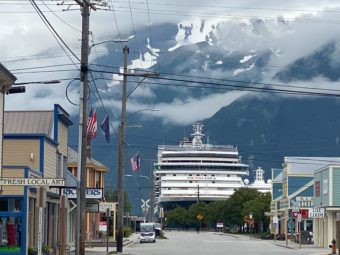
Skagway’s plans for large cruise ships at Ore Dock may be scrapped

Skagway’s Ore Dock. (Photo by Mike Swasey/KHNS)

Skagway’s hopes of berthing up to four cruise ships a day in 2023 took a full step backward this week as results from a simulation project steered at least one major cruise line company away from agreeing to use a reconfigured Ore Dock.

At its last regularly scheduled meeting, Skagway’s Assembly agreed to a walkaway deal with White Pass and Yukon Route that would allow the municipality early access to start improving the Ore Dock prior to the expiration of the 55-year waterfront lease with the railroad company next March.

The deal allows for White Pass to leave the infrastructure in place at the Ore and Broadway Docks while the municipality takes over the contaminated Ore Basin remediation project for costs of up to $15 million.

But this week the alternative mooring plan to expand the Ore Dock to allow post-Panamax size cruise ships — built too large to pass through the Panama Canal — to dock there in 2023 no longer looks viable.

At a special budget meeting on Wednesday night, Borough Manager Brad Ryan told the Assembly that Royal Caribbean Cruise Lines was the first company to say they won’t use the Ore Dock Alternative Mooring Plan as it’s currently designed.

“It’s not that they can’t come in and dock it, they did it in the simulation, they just don’t like the clearance distance between the wings of those larger ships and the Broadway ship,” said Ryan.

RCL has suggested adding another 132 feet of dock length to extend the Ore Dock further south than the Alternative Mooring Plan suggests. But that means installing a deep-water dolphin that could drive the cost of the project from the original estimate of $6 million to upwards of $26 million.

“That puts piles in 155 feet of water. And we believe that’s about a $10 million dolphin out there,” said Ryan.

Without permits or sourced materials, Ryan doesn’t believe that’s something that can be achieved by next season. So that could leave the chance for Skagway to host four cruise ships a day next year dependent on the rockslide mitigation project above the Railroad Dock.

A special Assembly meeting was held Friday afternoon. Audio of that meeting can be found at Skagway.org.

Cruise season ends in Juneau, with an estimated 1.15 million passengers

The first cruise ship of the 2022 season arrives in Juneau on April 23, 2022. (Photo by Paige Sparks/KTOO)

The last cruise ship of the season left Juneau’s docks on Tuesday. 

The final tally of passengers who came through Juneau this year hasn’t been released yet, but Cruise Lines International Association is projecting it to be 1.15 million. They haven’t counted people who came in October yet, which is why the number is still a projection. 

The estimate represents about 74% of the capacity for all the ships that sailed to Juneau this year. 

Alexandra Pierce, the city’s tourism manager, thinks the projection is accurate. The city anticipates having official numbers at the end of the month. 

Back in February, the city’s best guess for the season was about one million tourists

“[City finance director] Jeff Rogers and [city manager] Rorie Watt and I were wagering how many passengers we thought, when we came to that number in the spring,” Pierce said. “And we all guessed — our most popular guess was a million to 1.25 — and I think that’s about where we’ll fall.”

Their guesses were based on the capacity of cruise ships sailing in other parts of the world and on bookings that had already been made for cruises that stopped in Juneau. 

The start of the season was slow, though. The first ship that came to Juneau in April was at half capacity

Cruises had high vaccination rates this year — around 90% — but they still saw high rates of COVID, and that impacted travel. Staff shortages meant that people weren’t getting the service they expected, and passengers were often kept in the dark about COVID cases on board.

In July, the CDC stopped sharing COVID case counts for individual ships.

A month later, KTOO reported that  Holland America was not allowing COVID-positive passengers to board cruise ships in Skagway. Instead, the company helped book them ferries and flights out of Alaska, while they were still sick.

In the end, though, Pierce thinks the season allowed Juneau to get used to cruise tourism again. 

“I also think that it was a bit of a blessing in disguise that things operated at about 74% of capacity,” she said. “It gave us the ability to bust the rust off.” 

If the ships had been at 100% capacity, the number would have exceeded the 1.3 million people who came in 2019, the last season before the pandemic. 

The city is currently conducting its annual survey on the public’s opinion on tourism.

Site notifications
Update notification options
Subscribe to notifications