Tourism

Norwegian Cruise Line is giving a Juneau waterfront parcel to Huna Totem after buying it for $20M

A large, mostly empty waterfront lot with Gastineau Channel in the background
Part of the Juneau waterfront area known as the subport on Aug. 23, 2022. (Photo by Claire Stremple/KTOO)

Norwegian Cruise Line Holdings spent $20 million for nearly three acres of prime waterfront property in 2018, beating out the City and Borough and Juneau and other bidders with an offer that was more than five times the appraised value of the land.

Yesterday Norwegian gave that property to Huna Totem Corporation, an Alaska Native corporation tied to Hoonah that’s headquartered in Juneau.

Norwegian shared its ideas for the property in 2020, but it hasn’t been developed yet. Huna Totem plans to work with Juneau-based Goldbelt, Inc. and other Alaska Native corporations to complete the project.

“This is an astonishing gift for Juneau and our Goldbelt shareholders,” said Goldbelt President and CEO McHugh Pierre in a press release. “Giving ownership back to the Tlingit people is a tremendous way to honor the culture of this community.”

Mickey Richardson, Huna Totem’s head of marketing and public relations, said the corporation likes to invest in local projects, and the majority of its shareholders live in Juneau.

“Being locally owned and operated, we hope that the project will reflect the values of the Native people from Juneau and also the community of Juneau,” he said.

The corporation aims to submit plans to local planning officials for a tourism facility and dock by the end of the year. Richardson said the goal is to complete the project for the 2025 cruise season.

Alexandra Pierce, Juneau’s tourism director, says the change is unlikely to lead to an overhaul of Norwegian’s concept.

“We have been told that they’re planning to maintain the core elements as presented to the community: the underground parking, public open space and ocean center,” she said. “But we haven’t seen a revised plan yet.”

Pierce has worked with Norwegian on its plans since the company purchased the property. She said Huna Totem will need to show the Juneau Planning Commission that its plans are consistent with the goals and criteria set forward by the Visitor Industry Task Force.

She says the next step for Huna Totem will be to apply to the Planning Commission for a conditional use permit. That will be the public’s next opportunity to provide comments.

Huna Totem and Goldbelt still need permission from the city to develop and operate in the city-owned tidelands around the property. The Coast Guard and NOAA must also be on board if the project impacts their water access.

Pierce said she’s looking forward to having a definitive answer on what development at the parcel will look like so the city’s own long-range planning can move forward.

“We’re just looking forward to having an answer, yes or no, on this project,” she said. “We have a lot of plans and ideas that hinge on whether or not a fifth cruise ship dock is constructed.”

Norwegian did not immediately respond when KTOO asked why the company gave away land it spent millions to acquire. But in a press release, a Norwegian executive said the company wanted the project to be integrated with the local community and that it became “abundantly clear” that Huna Totem should lead the effort.

Norwegian and Huna Totem have worked together before. This March the companies agreed to develop a dock in Whittier.

This is a developing story and may be updated.

Ketchikan City Council approves seasonal sales tax to capitalize on summer tourism

Passengers from the mega ship Norwegian Joy disembark in May 2019 at Ketchikan’s Berth 3 downtown. (Photo by Leila Kheiry/KRBD)

Ketchikan’s City Council on Thursday approved a new seasonal sales tax system to take advantage of the summer tourism season. Within city limits, the sales tax will go up in April and then down again the following October.

The plan raises the city’s sales tax by 1.5% in the summer to 5.5%. Add that to the  borough’s sales tax, and consumers will pay a total of 8% sales tax from the beginning of April until the end of September. Then, in the offseason the sales tax will return to 5.5%.

The tax increase is projected to raise $1.9 million per year to fund pay increases for city workers.

Council Member Judy Zenge, who manages the Plaza Mall, said that she’d heard positive feedback on the plan from community members.

“When people come to visit me at the mall, it’s usually to complain — and I was expecting that,” she said. “I had more people come and visit me about this tax thing and tell me, ‘Finally you guys are getting it.’ So by and large, people are excited that we’re finally doing something that they actually understand, and they like it.”

Council Member Lallette Kistler offered qualified support for the measure. She said she liked the idea of extracting more revenue from tourists, but the variable rate would make accounting difficult. She proposed giving some businesses an option to pay the average of the summer and winter rate year-round.

But Council Member Janalee Gage pointed out that Ketchikan isn’t the first Alaska community to institute a seasonal sales tax.

“I would suggest that businesses contact people in other communities that are already doing it, like Kenai, who have been doing it for the last 25 years,” Gage said.

Acting City Manager Lacey Simpson said the council could amend the tax system at any time to address any issues that arise.

Kistler ultimately supported the seasonal sales tax plan, which passed in a 5-2 vote. Council Members Jai Mahtani and Council Member Riley Gass voted no.

Gass said he saw the seasonal tax plan as the best of several bad options to address the need for more city revenue but did not support the measure.

“I think next time this could be a lesson for us as a group. Next time we make huge expenditure decisions, we’ve got to have the revenue first,” he said.

In other business, the council unanimously voted to hold this year’s fall sales tax holiday on Oct. 1, concurring with Ketchikan’s Borough Assembly. The annual tax-free shopping day typically coincides with Permanent Fund dividend distributions, which are scheduled to begin the week of Sept. 20.

The council also unanimously approved a second sales tax holiday for March 25. Ketchikan’s Borough Assembly will consider whether to waive its 2.5% tax for that day at a future meeting.

Rockslides are battering a Skagway cruise ship dock and crushing the town’s economy

The cruise ship berth directly below the rockslide is empty for the rest of the 2022 season. Aug. 3, 2022. (Photo by Claire Stremple/KTOO)

Skagway Mayor Andrew Cremata calls the most visible boulder above the rockslide path the “Death Rock of Doom.” It’s about the size of a small house, and it teeters above Skagway’s busiest cruise ship dock.

After leading the town of 1,000 people through the pandemic, he has a dark sense of humor about the latest threat to Skagway tourism. The town depends on a million visitors coming every year — it’s practically the only industry in town.

“What people think is the Death Rock Of Doom is just a tiny, tiny fraction of what’s looming up here,” Cremata said. “It’s not just a rock, it’s a mountainside.”

He pushed through some hemlocks on the ridge above town to survey the collection of loose boulders that hang far above the White Pass and Yukon Route Railroad dock. Down there, in a typical season, half a million tourists meet their tour guides or board buses and trains. City-hired geologists say there could be a catastrophic slide here with little to no warning.

“The side of this mountain will come down,” Cremata said. “It’s just a matter of when.”

There have been four serious rockslides on the dock since June. Boulders have punched a hole right through the concrete and rebar, so you can see the water below. Others damaged a cruise ship docked there. Residents say cruisers and local children selling newspapers were in the impact zone just minutes before the rocks came down.

Newspaper owner Melinda Munson says if the June slide happened 15 minutes earlier, it could have hit the children who help her sell the local paper on the dock. Aug. 3, 2022. (Photo by Claire Stremple/KTOO)

Now, some ships are skipping Skagway and taking their business to Sitka or Hoonah. And instead of four ships, the city can accommodate only three at a time.

It’s easy math. The closed dock is one that can take the biggest ships. That means a loss of almost a quarter of the traffic — or about 100,000 passengers for the rest of the season.

The town is scrambling to fix the problem and salvage its economy.

Skagway Mayor Andrew Cremata Surveys the slide zone with his dog Rufous just hours before another rockslide hit the dock. Aug. 3, 2022. (Photo by Claire Stremple/KTOO)

The view from where Cremata stands on top of the slide path is stunning. A glacier-carved fjord reflects a jagged crown of mountains to the south. To the north are the town’s brightly painted, Gold-Rush era buildings. The port is studded with three huge cruise ships. Everything looks tiny below — people are just specks on the dock. A few small rocks tinkle down the slide.

“Look at all the loose rock up here. Look at that one. That one right there destroys the dock,” Cremata said, pointing at smaller boulders. “That one punches a giant hole in it.”

He gestures at the town’s fuel tanks and the helicopter pad and says he’s worried that if enough rock came off the mountain, a massive slide could take out everything. He says the city needs to do something about the slide so it can get back to the full load of cruise ships its economy depends on. And that needs to happen fast.

“We’re going to have to mitigate that rockslide. It’s gonna be very expensive. But come next April, we need to be able to put four ships here and make sure that our business owners have the best chance they can have of making as much money as possible as the cruise industry rebounds,” he said.

The city could build a new dock, but officials say that would cost even more than a plan to reshape the mountain — a possible solution with a price tag in the tens of millions of dollars.

Hard choices

The loss of ships has been partly voluntary — after the latest geotechnical report was released, the city assembly asked the railroad company that runs the dock to close one berth. The decision was unanimous, even though the assembly knew what it would do to the economy.

“We’re between a rock and a hard place. I mean, there was no winning,” said assembly member Rebecca Hylton.

She said her phone blew up with calls and texts after the municipality posted the geotechnical report online. The landscape hadn’t changed, but the town’s understanding of the risk had.

A good cruise season brings up to a million visitors to Skagway, population roughly 1,000. Aug. 3, 2022. (Photo by Stremple/KTOO)

The direct financial impact is to the White Pass and Yukon Route Railroad, which is privately owned but leases land from the city. The scenic train ride up the historic Klondike Gold Rush route is the biggest attraction in town. It draws the cruise tourists that fuel the town’s economy.

“We’re just coming off of years of a pandemic. And our economy has been in dire straits, because we are completely reliant on the cruise ships coming in,” Hylton said. “It reaches every aspect, from the population of our school to the municipal employees that rely on the sales tax money that runs our government here.”

Hylton said a major or lethal rockslide could destroy the town’s tourism prospects long-term. That possibility would be worse, in her opinion, than the economic hit the town is taking now.

Safety and the bottom line

Billi Jo Clem owns Smart Bus and Klondike Tours, which has suffered since the dock closed.

“It has been financially devastating for us,” she said.

Billi Jo Clem says the dock shutdown has been hard on her tour and bus companies. Aug. 3, 2022. (Photo by Claire Stremple/KTOO)

Her buses used to wait right at the dock for passengers to get off the ships. That’s not happening now, since the remaining cruise ships are sending people ashore on small boats.

Clem said tourists struggle to find her buses as they get rerouted around the slide area. She estimates that the changes have cut her earnings in half, and she’s had to lay off four drivers.

“We just didn’t have any financial means of keeping them on if we don’t have the tours and we don’t have the people from the ships,” she said. “We just can’t afford to keep them, and we’ve cut everybody else’s hours down.”

Business owners further downtown are feeling the pinch, too. Tina Cyr owns and operates an art gallery several blocks from the railroad dock.

“We’re happy to be open, we’ve got business and it feels good to be ringing up the register. But really, our sales are way down,” Cyr said, surrounded by bright watercolors, silver baubles and carved bone.

She estimates sales are down by more than a third. She says it takes longer for visitors to get down to her shop, and they leave earlier because they have to stand in line to get on a small boat back to the cruise ship.

“We’ve never been where people are tendering and taking the small boats. And so that just sucks up a lot of time for people,” she said.

Gauging risk 

It’s about a half mile walk from the dock below the rockslide to the White Pass and Yukon Route Railroad station. Throngs of tourists wait to board one of the trains that run hourly up the winding rail to the White Pass summit.

The railroad — now a joint venture including Ketchikan’s Survey Point Holdings and the Carnival Corporation — has been the town’s largest employer for nearly 125 years. The company says the city’s geotechnical survey overstates the imminent risk of a rockslide.

“It’s been an ongoing issue for a lot of years,” said Tyler Rose, executive director of human resources and strategic planning for the railroad.


Rocks are still falling from the historic 2017 slide path on the left. Geologists say there’s risk of “catastrophic failure.” The smaller slide to the right came down in June. Aug. 2, 2022. (Photo by Claire Stremple/KTOO)
Image courtesy of the city of Skagway.

Rose said White Pass identified a slide risk as early as the 1990s and started monitoring the area in earnest after a 2017 earthquake let loose two rockslides. The company repurposed shipping containers as a protective tunnel for cruise ship passengers to walk through and put up barriers to catch falling rocks.

That appeared to solve the problem, until the rockslides this June. The ensuing geological report said that this new, smaller slide zone was likely a one-off, but it put a new spotlight on the much larger historic slide area that’s right next to it, aimed at the same dock.

“For us, it’s not a heightened concern, because we’ve always taken it very seriously,” Rose said.

The railroad also contracts with geologists, and they released a memo in response to the city geologists’ report. It said that their research has been more extensive than the review the city’s consultants gave the area, and that the “risk of catastrophic failure of the rockslide is not elevated compared to previous years of monitoring.” It also said the instrumentation on the mountain would forewarn the railroad of any movement indicating a rockslide was imminent.

White Pass and Yukon Route Railroad has sent cruise visitors through a protective walkway since slides in 2017. Aug. 2, 2022. (Photo by Claire Stremple/KTOO)
One of the walkway’s shipping containers after taking a hit in a recent slide. (Image courtesy of the city of Skagway.)

Rose had hoped to reopen the dock this season. It’s clear now, after several more slides came without warning, that that’s not going to happen. July rockfall smashed holes through the railroad’s protective walkway, so now cruisers take small boats into the harbor.

“We want to work closely with the municipality to both solve this problem and seek funding wherever we can, because it will be a financially challenging proposition for both of us,” Rose said.

How to move a mountain

Before managing the city of Skagway, Brad Ryan was manager and facilities director in Haines. In 2020, landslides there killed two people, destroyed homes and devastated that community. He said what happened in Haines is a strong reminder of the consequences of natural disasters.

“You’re talking about a road that had a few people, you know, 30 people living on it, versus half a million people walk down that dock in a year,” he said.

City-hired geologists say there’s risk of catastrophic failure at this slide zone above the Railroad Dock. Aug. 2, 2022. (Photo by Claire Stremple/KTOO)

He says there will be time and space to figure out a long term plan after the tourist traffic clears out this fall.

“That’s a very expedited timeline, considering this project is in the tens of millions of dollars,” he said. “And so we’re lobbying for funds, but we’re also pushing the engineers that we’re working with to get this done. And then we’ll just have to figure out how to fund it.”

A hole in the Skagway railroad dock left by a rockslide on June 23, 2022. (City of Skagway photo)

They don’t have the money yet, but Ryan said the plan would be to fly heavy machinery up to the top of the mountain by helicopter and start taking pieces of it down “five yards at a time.” The goal is to decrease the steepness of the mountainside so rocks don’t tumble off. A team of design contractors will be in Skagway next week to see how — or if — it can be done.

“I don’t think there’s any choice. We have to mitigate that rock and figure out what we’re going to do to save the infrastructure below it,” Ryan said.

The plan sounds fanciful, and it might not even be enough to secure the dock. But the 2023 season is just a winter away, and Skagway’s future depends on a safe, open port.

Ironman Alaska athletes likely spent millions while they were in Juneau

Ironman Alaska finishers Richard Secretaria and Joseph Paray with medals 2022 08 08
Ironman Alaska finishers Richard Secretaria of New Jersey, left, and Joseph Paray of New York pose for a photo with their medals at Centennial Hall in Juneau on Aug. 8, 2022. (Photo by Jeremy Hsieh/KTOO)

Funny thing about people who subject themselves to swimming in 56-degree water, biking 112 miles in the rain and running a marathon on the same day: they grin as they talk about it.

“It was wet all the way, pouring down, rain was pouring,” said Joseph Paray, a registered nurse from New York who completed his first full Ironman triathlon in Juneau last Sunday. “The wind was brutal. The elevation of the climb is brutal.”

His friend Richard Secretaria, a medical tech from New Jersey, was also a finisher. He was almost giddy as Paray talks about it. Secretaria said his bike got so dirty, it looked like he was mountain biking instead of racing on the road.

It almost sounds like they’re complaining, but they really enjoyed their time in Juneau. In part because they said they were representing the Philippines when they raced. When they first arrived, they introduced themselves on an Ironman Alaska Facebook group.

“Everybody’s sending us messages, like, ‘How can we meet each other?’ Like, we feel like we’re celebrities here,” Secretaria said, laughing.

“The support of the Filipino communities in Juneau? They rock, man,” Paray said. “It was like it was like back home. They were everywhere!”

Of course, they’re supporting Juneau, too, with their visit. Last year, when a local travel organization was negotiating to host the Ironman Alaska triathlon, boosters predicted up to 1,500 athletes would come, plus friends, family and support staff. It would be an economic boon.

The number of people to actually attempt the inaugural Ironman Alaska ended up falling well short of that. Ironman said there were 850 athletes, of whom 62 were locals.

And yet, another early estimate — that the event would pump $7 to $9 million into the local economy — appears to be on the money.

Like most of the athletes, Paray and Secretaria didn’t come alone. An Ironman official said that on average, each participant brought about three people with them. Paray and Secretaria brought their significant others, and they were here for seven nights.

The two couples split a hotel room and car rentals that they booked early on, before registration for the race had even opened. At first, they booked six nights, but later decided to add a seventh. By then, the per-night rate had doubled to almost $350.

Besides Ironman events, they visited the Mendenhall Glacier, rode the Goldbelt Tram and ate at local restaurants.

“Not to mention, you still have to buy, you know, some stuff. You know, souvenirs,” Secretaria said.

“Souvenirs, yeah!” Paray said. “You’ve been to Alaska! You need some remembrance.”

They figure each couple spent around $4,000 on the trip.

City Finance Director Jeff Rogers was also an Ironman finisher. On Monday, he was browsing the swag at a pop-up shop at Centennial Hall.

“I got a jacket and a hat, ‘cause the hat I run in is falling apart, and a couple of water bottles,” Rogers said.

The cashier rang him up for just under $200, which includes about $10 of city sales tax.

From hosting Ironman, Rogers is expecting a noticeable bump in the city’s revenue from sales tax and the extra 9% tax on hotel rooms and short-term rentals.

“I think a big weekend of a couple thousand people in town certainly has an impact, not only on city revenue but just on the health of local businesses. And certainly a lot of people rented out their houses, trying to help and be generous, but also put a little money in their pockets,” he said. “So I think the economic impact will be big.”

City officials and race organizers aren’t aware of any formal economic impact studies underway around the event. But Meilani Schijvens, who runs the economic publications firm Rain Coast Data in Juneau, was personally interested in the race. She had the athlete tracking app, was following threads about it on Facebook and was game to share a rough economic impact estimate of her own.

“To be clear, I have not done a study on this, right?” she said. “These are just my numbers, because I obsess over all these things, and I love, like, trying to figure these things out.”

But she has done robust analyses in the past, backed by surveys and more ground-truthing, to get at what the typical independent traveler spends during a visit. To build some spending assumptions for this event, Schijvens looked at the Ironman schedules, participant numbers, Facebook chatter — even the weather.

“A typical independent traveler, we would assume they all went on an excursion,” Schijvens said. “And I just decided 20% of them went on excursions, partly because we had an atmospheric river. And a lot of the excursions were closed down, like the helicopter tours people definitely would have gone on.”

All together, she figures the out-of-town participants and their travel companions put roughly $8 million directly into Juneau’s economy.

The race organizers also spent a lot in the community. Liz Perry runs Travel Juneau, the city’s destination marketing organization. It partnered with Ironman to host the event.

Perry said the Ironman organizers used local vendors as much as possible, from the logo design by local artist Crystal Kaakeeyáa Worl to the port-a-potties from Alaska Waste.

Which means some of the athletes’ registration fees and the licensing fee Travel Juneau paid Ironman to host the event also came back to the community. Travel Juneau paid $50,000 this year, and will pay $125,000 in 2023 and again in 2024.

Perry said volunteers representing local nonprofits may also get some cash grants from the Ironman Foundation. And there were a lot of volunteers — Ironman said more than 1,400.

“So the entire community has benefitted from this, from top to bottom,” Perry said. “So that ripple effect is going to be really impactful for the whole city.”

There’s even free word-of-mouth from all the proud Ironman participants themselves. Paray and Secretaria both said they plan to come back.

“Maybe not for the race, but for vacation,” Paray said. “Yeah, this is a must. I must tell my friends, I will tell everyone who I meet, ‘Yeah, go to Juneau, go to Alaska. It’s a really nice place.’”

They said their triathlon club back home is eager to hear how it went.

Registration for next year’s Ironman Alaska triathlon in Juneau opens Aug. 15.

Families of tourists killed in 2021 Misty Fjords floatplane crash sue Holland America and Southeast Aviation

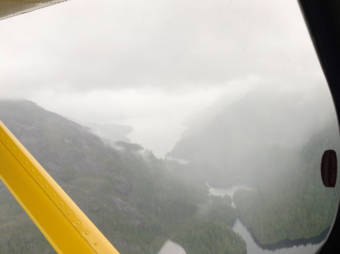
A view from a plane of steep slopes, with poor visibility
This photo shot from the left side of the plane showing a portion of Ella Lake is timestamped 10:47 a.m., three minutes before the crash. (NTSB)

The families of four cruise passengers killed in a floatplane crash near Ketchikan last year are suing Holland America Line in federal court. They’re also suing the floatplane operator and the estate of the pilot.

The families of Andrea McArthur, Rachel McArthur, Jacquelyn Komplin and Janet Kroll accuse the cruise line of pressuring floatplane companies to operate unsafely and failing to warn passengers of the risks.

Just over a year ago, a bright yellow-and-blue DeHavilland Beaver floatplane crashed into treetops on a steep slope in Misty Fjords National Monument Wilderness, about 12 miles northeast of Ketchikan. The crash killed the pilot and all five passengers aboard, who had arrived in the region on the Holland America ship Nieuw Amsterdam.

Now, families of four of the passengers are suing Holland America Line. Their suit was filed Aug. 1 in the Western District of Washington in Seattle. An attorney for the families, Heather Cover, says the cruise line was required to inform passengers that floatplane tours could be hazardous.

“Under maritime law, Holland America has a duty to warn its passengers of known dangers,” Cover said in a phone interview on Friday. “And here, where the seaplane accident occurred, actually has a pretty prolific history of seaplane crashes and deaths.”

She’s referring to the fact that at least 21 people have died in plane crashes in the area in the past seven years. That includes a 2015 crash that killed eight people.

“In that case, the NTSB, the National Transportation Safety Board, had actually written a letter to the cruise ship industry, including Holland America, warning that the schedules of the cruise ships could actually be contributing to this dangerous condition whereby you are having so many crashes and fatalities,” she said.

The NTSB found the operator in the 2015 case, Promech Air, had a culture that encouraged pilots to fly in hazardous weather — in part because of scheduling pressures from cruise lines.

But unlike that crash, Holland America says the 2021 floatplane tour wasn’t sold or advertised by the cruise line.

“We were incredibly saddened by this tragedy and our hearts go out to the families of those who died. This floatplane excursion was independently operated and purchased separately by the impacted guests and not sold through or advertised by Holland America Line. Safety is of utmost importance to us, and our contracts with tour operators emphasize it as a top priority,” the company said in a statement.

What caused last year’s crash isn’t clear — the NTSB’s Clint Johnson said the agency is reviewing its final report and expects to release it soon. But search and rescue aircraft and other nearby pilots reported poor visibility and low clouds around the time of the crash.

The families are also suing Southeast Aviation, the small, family-run carrier that operated the fatal flight. Cover, the attorney for the families, says the company didn’t do enough to make sure the pilot was good to go after a prior accident.

“Just a couple of weeks before this incident, the pilot was taking off and actually ran into a buoy and flipped his plane,” Cover said. “He was taken out of rotation for a couple of weeks, and then came back — no additional training, no nothing. It was just kind of a matter of if he felt that he was able to come back to work, and he was permitted to do so.”

Southeast Aviation did not return a call for comment.

The pilot, Rolf Lanzendorfer, had worked for Southeast Aviation seasonally since 2015 and had logged about 8,000 hours flying similar aircraft. His estate is also named in the lawsuit. The plaintiffs accuse him of failing to account for poor weather conditions.

The families are seeking unspecified monetary damages in the wrongful death lawsuit.

Holland America, Southeast Aviation and the pilot’s estate are due to file their responses in court later this month.

Landslides close dock, cause cruise stop cancellations in Skagway

""
The Coral Princess cruise ship docked in Skagway on August 23, 2015. (Photo by Anne Raup/ADN archive)

Several landslides have closed the cruise ship dock in Skagway for the rest of the summer, causing what’s expected to be at least three dozen vessels to skip the tourism-dependent port by the end of summer.

The municipality issued an emergency declaration last week, citing the need to shore up the slide-damaged areas and the loss of more than 100,000 cruise passengers to cancellations and rescheduling.

A mid-July report from a geotechnical and environmental consulting firm showed “significant risk” of “catastrophic failure” of the mountainside above the dock that poses “significant risks to life and property.”

landslide in June damaged the deck and east side of the dock at the south end of the north berth, according to Tyler Rose, the executive director of the White Pass and Yukon Route Railroad, which owns the dock. Two additional landslides last week at the north chute damaged Conex containers and part of a security building, he said.

No one was injured in the slides that sent rock, dirt and vegetation down the mountainside above the dock.

The entire dock is closed to passengers and vehicles, Rose said. The south berth is accepting ships and tendering guests, but the north berth is closed, he said.

The closure means the port has only been able to accommodate three large cruise ships at the same time, said Jaime Bricker, Skagway’s municipal tourism director.

“Anytime we had something listed for four large cruise ships to port, the fourth has been rerouted,” Bricker said.

Twelve cruise ships skipped Skagway after the June landslide, according to Bricker. Another 24 sailings have been removed from the upcoming schedule, she said. Rose said there has been a large reduction in traffic, but the full effect won’t be known until the end of the season.

“It’s obviously impactful anytime we have a decrease in passengers,” Bricker said. “I think each business is going to feel an effect from that.”

Skagway’s economy is largely driven by tourism, and the cruise cancellations are “already negatively impacting the general economy of our community,” Skagway Mayor Andrew Cremata wrote in an emergency declaration issued Thursday.

Skagway was hit especially hard by the downturn in tourism during the last few years driven by the COVID-19 pandemic. Now, the diversion of cruise ships is again causing hardships for the town, Cremata wrote.

The area also saw two significant landslides in 2017 and has seen continued movement at the rockslide face away from the mountain a rate of 2 1/2 inches over the last year, an acceleration from the prior rate of 1 1/2 inches a year, according to the declaration.

The railroad is working with teams of engineers and the municipality to mitigate the landslides. It’s unclear how much that will cost, but Rose described it as substantial. In the emergency declaration, Cremata wrote that the work is expected to cost “tens of millions of dollars.”

The city is seeking assistance from federal and state agencies.

The goal is to reopen the dock for the 2023 cruise ship season, which begins in May.

This story was originally published by the Anchorage Daily News and is republished here with permission.

Site notifications
Update notification options
Subscribe to notifications