Tourism

Ocean Ranger repeal moves out of Senate committee

""
The cruise ship Bremen anchored near Petersburg’s Sandy Beach in July of 2017. (Photo by Joe Viechnicki/KFSK)

Gov. Mike Dunleavy’s proposal to overhaul environmental regulation of cruise ships has passed a key Senate committee. But the bill would also permanently repeal the Ocean Ranger program passed by voters in 2006.

That would eliminate the independent observer program on cruise ships. It would be replaced with direct oversight by the Alaska Department of Environmental Conservation and rely on self-reporting of wastewater discharges permitted by the state.

Sen. Jesse Kiehl, D-Juneau, proposed a compromise, a scaled back program with Ocean Rangers on one of every five ships.

“I think there were some strong arguments made by the administration that just as we don’t have a police officer on every single corner in town, they have built out capacity so that they don’t strictly need an Ocean Ranger on every single cruise voyage in Alaska,” Kiehl said. “But deleting them entirely I think we’ve heard from strong public comment is not what Alaskans are looking for in this self-funded program.”

A fee charged to cruise companies paid for the program for licensed marine engineers onboard the majority of voyages by the larger ships. However, Gov. Dunleavy has vetoed money for it and it last operated during the 2019 season.

Written public testimony has been overwhelmingly in support of keeping or even expanding independent oversight by the marine engineers. The Petersburg borough passed a resolution asking to reinstate funding. Dozens of Alaskan fishermen and processors have signed on to a letter highlighting their importance.

Senate president Peter Micciche, R-Soldotna, supported the state’s plan to end the Ocean Rangers and opposed Kiehl’s amendment during a Wednesday, April 20 hearing of the Senate Resources Committee.

“The Ocean Ranger program was a great program,” Micciche said. “I think what it did was demonstrated that we have a compliance program that works. I think they were engaged and I know that it’s popular, but frankly I think that what’s in this bill has the potential to deliver much greater performance than the previous program.”

State regulators made a pitch for the governor’s plan. DEC Water Division Director Randy Bates told lawmakers his state agency is expanding and hiring staff to review discharge records and take samples when vessels are in Alaska waters.

“We’re going to be on vessels 100 percent of the time, 100 percent of all vessels early in the season, those first three or four weeks,” Bates said. “We’re going to follow up with scheduled and unscheduled inspections as necessary and we’re going to do, for those vessels, large vessels, discharging in state waters, we will do a ride along.”

The state agency projects 41 large cruise ships and 18 small cruise ships to operate in Alaska this year, bringing an estimated 1.6 million passengers to the state.

Kiehl’s amendment to keep Ocean Rangers deadlocked at 3-3 and failed before the bill ultimately advanced.

At first the committee didn’t have the votes to move the bill out of committee, but a late arrival helped it pass. The vote was 4-3, with Micciche, Natasha Von Imhof of Anchorage, committee chair Josh Revak of Anchorage and Click Bishop of Fairbanks, who showed up late, voting yes. No votes were Scott Kawasaki of Fairbanks, Jesse Kiehl of Juneau and Gary Stevens of Kodiak.

The legislation would also establish a new fund to pay for sewage treatment plant upgrades for Alaska communities and eliminate citizens’ right to sue companies for pollution.

Next stop for the bill is the Senate Finance Committee. But its ultimate trajectory is less clear in the House. That’s because the companion bill has not advanced, with time running short for this legislative session.

With no Ocean Rangers for a second year running, the DEC says it plans to inspect cruise ships during the season in port and while underway — both large and small ships. The Ocean Rangers program only focused on ships that carry more than 250 people.

Bridge plan moves forward as Denali Park Road landslide speeds up

A group of workers stand at the edge of a steep drop in a gravel road along a mountainside
Officials inspect a 40-foot drop on the Park Road at mile 45 where a worsening landslide has prompted a plan to span it with bridge. (National Park Service photo)

A slumping section of the Denali National Park road dropped an unprecedented amount over the winter, underscoring the need for a planned bridge over the unstable stretch of road near Polychrome Pass.

The Pretty Rocks landslide is the result of movement — accelerated by climate change — of what’s known as a rock glacier underlying the road.

Denali National Park acting superintendent Brooke Merrell says crews clearing snow from the road earlier this month found significant new slumping at the site.   

“It was really sobering to arrive on scene and see that 40-foot cliff on that eastern side of the slump this year,” she said.          

Merrell says the drop is in line with the slide’s multi-year progression.

“Its just over twice as far as it slumped the year before, which is consistent. We’ve been watching it since about 2016, and each winter it sloughs about twice as far as the year before,” she said. 

Park crews have filled the slump with gravel for years to keep the road drivable. But last August, acceleration of the slide forced closure of the road and serious consideration of a permanent fix. 

The NPS conducted an environmental review of a proposal to span the slide area with a 400-foot bridge anchored on solid ground on either side. That plan was approved last month.

There’s $25 million in the federal infrastructure law to pay for the first part of the estimated 2-year project, which also includes some other Polychrome area road work.

“Our partners at Federal Highways are getting ready to issue a request for proposals for contractors to submit their design build proposals for this bridge,” Merrell said.     

Merrell says the timing should allow earthwork and site preparation to get underway this summer. Additional funds will be needed to construct the bridge, but how much depends on the selected contractor’s design. 

Until the bridge is completed, Merrell says park visitor buses will only be traveling to the East Fork River, at mile 43.

“We’ve been working on making a safe spot for both transit and tour buses to turn around at the site,” she said. 

Merrell says the only visitor access beyond mile 43 will be by air.

“You can fly to Kantishna. We’ve got several of our inholder lodges are operating as fly-in operations this year,” she said. 

Merrell says the Park Service will not be operating its Wonder Lake campground near the end of the Park Road, but visitors can still apply for backcountry permits. She notes that Denali visitation is forecast to rebound to pre-pandemic levels this summer.

“Indicators are that we’ll likely be as busy as we were in 2019, which was a record-setting year for us,” she said.        

Denali had over 6,000,000 visitors in 2019.   

Cruise lines expect early-season ships to be 30-50% full, Ketchikan officials say

The Royal Caribbean ship Serenade of the Seas approaches Ketchikan during a test cruise with volunteer passengers on July 9, 2021. (Eric Stone/KRBD)

Officials in Ketchikan are expecting a soft start to the cruise season despite industry projections that passenger numbers could be nearly as high as pre-pandemic seasons.

Earlier this month, an executive with Cruise Lines International Association told KHNS in Haines that Alaska could expect some 1.5 million cruise passengers to visit this summer.

But that assumes ships would be running at near capacity. Acting Ketchikan City Manager Lacey Simpson told the City Council Thursday that in recent meetings with industry figures, cruise lines are telling officials that their vessels could be more than half-empty at the beginning of the season.

“From what we’ve heard from industry, including CLIA, which is maybe no surprise, the start of the season will definitely be a soft start. The onboard capacities of vessels are much lower than we were initially anticipating,” she said. “This is proprietary information, so lines are not super disclosing of that information, but we’re hearing anywhere from 30% to 50% capacity to start out for the season.”

But Simpson says cruise lines are still optimistic that ships will fill up as the season wears on. She says the industry is expecting ships to be about 90% full towards the end of the season.

Last month, Juneau’s visitor’s bureau head  told KRBD that cruise ships are running at between 60% and 70% capacity worldwide.

The Alaska cruise season kicks off on Monday when the Norwegian Bliss visits Juneau. The Bliss is scheduled to tie up in Ward Cove on Thursday for Ketchikan’s first port call of the year.

Juneau’s first large cruise ship arrives with uncertainty

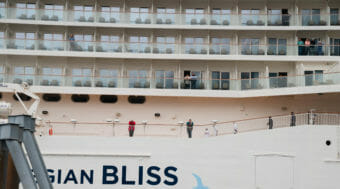
The Norwegian Bliss prepares to leave Juneau on June 5, 2018.
The Norwegian Bliss prepares to leave Juneau on June 5, 2018. (Photo by Adelyn Baxter/KTOO)

The first large cruise ship of the 2022 season arrives in Juneau on Monday afternoon. The Norwegian Bliss, which can accommodate 4,000 passengers, docks at 1:30 p.m. However, it’s unknown how many people will actually be on board. Predictions range from as low as 30% to 75% occupancy. 

Some of Juneau’s elected officials will be on the docks to meet disembarking tourists. 

This year is forecast to be the busiest cruise season since before the pandemic, but the exact numbers of passengers are still unclear. The busiest days, according to the city, will be Tuesdays and Wednesdays. Locals can expect to find tour groups at the Mendenhall Glacier, on the water near Auke Bay and on popular hiking trails around town.

All large cruise ships in Alaska are bound to port agreements with the communities where they dock. The COVID measures agreed upon include a 95% vaccination rate for passengers and crew and plans for dealing with sick passengers on board.

A rally in support of more environmental regulation of the cruise industry planned is also planned for Monday at the Capitol. Local groups aim to draw attention to the lack of environmental oversight in the cruise industry.

New COVID surge hits Skagway the week before this year’s first cruise ship visit

Quiet streets in Skagway in September, 2020. (Photo by Claire Stremple/KHNS)

Less than a week before the scheduled start of the summer cruise season, Skagway’s community health clinic announced a new local surge of COVID-19 cases. That comes on the heels of a federal judge’s decision to strike down mask mandates in the transportation industry.

Skagway’s Dahl Memorial Clinic’s Medical Director Brent Kunzler says the town is in one of its largest outbreaks of the pandemic, with upwards of 30 residents testing positive since the first week of April.

“What I have seen is mostly kids, some adults. Seems like it affects the kids a little harder this time,” Kunzler said.

He says it’s difficult to know the exact number of cases due to the increased use of home tests.

On Wednesday the clinic advised residents to wash their hands thoroughly, get vaccinated and boosted and wear masks in places where social distancing is difficult to maintain.

On Monday, a federal judge struck down the transportation mask mandate. The Alaska Marine Highway System and many airlines promptly announced masks would be optional moving forward.

With Skagway’s cruise season set to start next week, that leaves residents in charge of their own health safeguards as government entities have mostly dropped mandatory public health measures.

Kunzler says he’s not sure which variant could be responsible for the current surge in Skagway, but he stresses that COVID is still very much present.

“I don’t see it going away anytime soon. And it sure hasn’t, has it?” Kunzler said.

There are no public masking requirements in place in Skagway, including at City Hall. Businesses have the option to require masks on-premises.

The CDC still recommends isolating for five days after the onset of symptoms or a positive COVID test, followed by five days of wearing a mask in public for most people. It also still recommends wearing masks on public transportation.

Cruise ships visiting Alaska this summer will require most passengers to be vaccinated

Royal Caribbean’s Serenade of the Seas docked at Ketchikan’s Berth 4 in 2021. (Eric Stone/KRBD)

Federal COVID-19 protocols that were mandatory for last year’s cruise season are now optional, but cruise lines visiting Alaska are still expected to follow the voluntary guidelines for the coming season.

Ketchikan’s acting city manager, Lacey Simpson, says in a memo that all cruise lines scheduled to visit Ketchikan’s city-run downtown port have indicated they plan to follow the Centers for Disease Control and Prevention’s COVID-19 protocols. Norwegian Cruise Line, which is scheduled to tie its ships up at a privately run port north of town in Ward Cove, has also said publicly that it’s opting in to the program.

As part of the voluntary program, cruise lines are encouraged to sign agreements with the ports they plan to visit outlining their COVID-19 protocols. One agreement between Royal Caribbean and a wide range of Alaska ports is up for Ketchikan City Council approval Thursday.

Under the proposal, 95% of crew and all eligible passengers 12 and older are required to be vaccinated against COVID-19. Passengers would be required to present a negative COVID-19 test before boarding. Shoreside workers who interact with cruise passengers and crew are also “highly encouraged” to be vaccinated.

With the start of the cruise season fast approaching, Ketchikan city officials are asking the council for the authority to sign similar agreements with other cruise lines.

Cruise Lines International Association executive Brian Salerno told KHNS last week that the cruise industry expects some 600 voyages to bring roughly 1.5 million passengers to the state this summer.

Large foreign-flagged cruise ships, which bring most passengers to Alaska, are also required to stop in Canada by federal law. Canadian authorities require all passengers 12 and older to be vaccinated and present a negative test.

Site notifications
Update notification options
Subscribe to notifications