Tourism

As tourists arrive for whale watching in Southeast Alaska, officials remind visitors to keep their distance

A pod of orcas traveled into the Wrangell Narrows in front of Petersburg the last week of April. (Photo by Joe Viechnicki/KFSK)

Tourist season is beginning in Southeast Alaska, which likely means around a half million people will be hoping to see whales. Residents also look forward to encounters out on the water. But sharing space with the marine giants isn’t always easy.

Mike Schwartz of Petersburg, who is 80 years old, has been around whales his whole life. As a fisherman and outdoorsman, he’s had many close encounters. Once, while watching a group of humpbacks bubble feeding, he ended up a little closer than he wanted.

“One whale started bubble feeding on the far side, and then opposite him, maybe a hundred feet, another whale started bubble feeding,” Schwartz said. “So, the two of them bubble fed all the way into a circle.

Schwartz found his boat in the middle.

“It was a little bit unsettling to realize you’re inside the bubble circle,” he said. “And what do I do now? And then all of sudden they’re there, they’re all there. And of course, the herring are all squirting out of their mouth.”

Humpback whales are common in the region, even in high-traffic areas. Orcas or killer whales show up too. Schwartz remembers traveling with his wife from Ketchikan to Petersburg when they discovered they weren’t alone.

“It was rain thick and when everything lifted we realized we were in the middle of the biggest pod of killer whales we’d ever seen,” Schwartz said. “We quit counting at 80 and they would come up right alongside the boat.”

It’s not always intuitive how to act around whales, says Suzie Teerlink, a marine mammal specialist with the Protected Resources Division of the National Oceanic and Atmospheric Administration.

“It is really difficult to interpret the behaviors because all the behaviors that you might see could be occurring for lots of different reasons,” she said.

The Marine Mammal Protection Act protects whales from harassment. Teerlink says that can mean anything that might change their natural behavior.

In 2019, NOAA issued eight on-site citations, according to the law enforcement office in Juneau. In an email, the office says they have fined a tour company nearly $9,000 for dropping off paddleboarders to approach humpback whales. They fined another company nearly $4,500 for approaching killer whales head-on in a narrow pass causing the whales to turn around and swim away.

In general, though, it can be very difficult to prove wrongdoings just from complaints. Instead, NOAA likes to focus on education.

Teerlink says when people encounter whales in the wild, they should remember that the animals are busy doing something, often feeding, nursing, resting or socializing.

“They have an agenda, they have things they need to be doing,” Teerlink said. “And it might not be visible from the surface of the water.”

She discourages people from trying to interpret whales’ behaviors. A tail slap, for example, could mean several things like a sign of distress or a form of communication within the pod.

Teerlink says they may be behaving in an interesting way but it’s not for the sake of people. They aren’t — as some people like to say — “putting on a show”.

“There isn’t a part of their biology that is driven to perform,” Teerlink said. “There isn’t a show; they’re not trying to pull in humans to, you know, participate. It isn’t for entertaining boats.”

Over 20 years ago, a rule was established in Alaska requiring whale watchers to be 100 yards from humpback whales. Teerlink says it’s a good practice for all marine mammals.

But sometimes judging proximity is hard. Whales can swim underwater and surface near a boat, something that Mike Schwartz knows all too well.

And for him, it’s often unforgettable and emotional.

“For me it’s a deeply, deeply spiritual experience,” he said. “It’s hard to put into words.”

Whales are intriguing for residents, tourists and tour guides alike. Teerlink says one thing that could benefit tour companies is signing up for the whale SENSE program. It promotes stewardship and education for responsible whale watching.

Optimism abounds as Ketchikan kicks off cruise season

Passengers leaving a large cruise ship
Passengers disembark from the Norwegian Bliss on Thursday, April 28, 2022. (Photo by Eric Stone/KRBD)

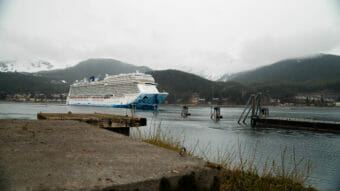
Bagpipes greeted the first passengers of the 2022 cruise season in Ketchikan as they stepped off the megaship Norwegian Bliss. Visitors filed inside Ward Cove’s former pulp mill warehouse that’s now restyled as a cruise terminal.

Inside, Erika D’Monty was waiting for a kayak trip to the Tatoosh Islands after disembarking from the Bliss. Though the ship is carrying just about 2,000 people — about half of its capacity — the Vancouver, B.C. resident says the ship doesn’t feel like it.

“I’m really surprised at how full it is. It’s really crowded. I guess everyone’s looking forward to going on cruises again,” she said.

City officials in Ketchikan say they’re expecting early-season ships to bring about 30-50% of their typical capacity, though passenger numbers are expected to rise to nearly 90% by the peak of the summer.

Allen Marine sales manager Erik Schoeppner says the slow start is a bit of a blessing in disguise. He says the tour company had to lay off much of its staff during the pandemic.

“I have a lot of new crew, so I have a lot of them with me here today, and it’s a good way to train them up and not be too crazy yet until next week,” he said.

Many Ketchikan residents seem to be jazzed about the return of the large ships, too. Bob Thomas says from outside a local grocery store that he’s glad tourists are returning to Ketchikan, which relies on visitors to fuel much of the economy.

“We need the revenue. I’ve been here all my life and I’m glad to see them come back,” Thomas said.

Outside the Sourdough Bar, resident Aaron Shull says it’s a good time to be looking for work.

“I think wages are up for everybody around here, too, this year. (There’s a) lack of employees, still, so if you guys need a job show up, come on out and get it,” he said.

Though it’s not clear how full the ships will be, the Ketchikan Visitors Bureau is projecting a record 637 port calls by 48 ships this year. That’s about six times as many port calls as last year. And about 12% more than 2019, which was a record-setting season with nearly 1.2 million passengers.

Alaska’s cruise season is scheduled to run through Oct. 21 when the last cruise ship ties up for the year.

Scrubbers are supposed to clean cruise ship stack emissions. Critics say they pollute the water instead.

The Holland America cruise ship Zaandam docked in Juneau on June 22, 2018. (Photo by Adelyn Baxter/KTOO)

Cruise ships are now returning to Alaska for the first full-length season since the pandemic. It’s a relief for coastal port economies whose visitor sector has struggled.

But more ships also means more pollution from these large ships — to the air, the water or both — even as the industry says it’s committed to net zero emissions by 2050.

For the past several years there’s been a debate among regulators over what to do about a controversial anti-air pollution device called scrubbers. Scrubbers dissolve chemicals from ships’ exhaust into seawater, allowing them to burn cheaper, dirtier fuels.

A two-year CoastAlaska investigation uncovered dozens of reports from independent cruise ship monitors alerting state authorities to foamy discharges from the kind of scrubber systems used by ships owned by Carnival Corp. and its subsidiaries, which make up a large portion of the Alaska cruise ship fleet.

State and federal authorities didn’t take steps to curb the emissions. State environmental regulators in Alaska say they don’t regulate scrubber discharges. Meanwhile, a federal law meant to protect the owners of small fishing boats from massive fines has, in practice, prevented state officials on much of the West Coast from clamping down on water pollution from scrubbers aboard cruise ships.

Critics say it’s a weakness in environmental regulations that for years has allowed the cruise industry to pollute Alaska’s waters.

‘Air pollution to water pollution’

The devices — which are formally called exhaust gas cleaning systems — are commonly known as scrubbers because they use seawater to “scrub” sulfur from an engine’s exhaust. They’re required by the International Maritime Organization, which has mandated lower sulfur emissions in the atmosphere. Regulators say sulfur emissions are harmful to human health and a major driver of acid rain.

For the cruise industry, scrubbers are a way to save money by allowing ships to burn cheaper, dirtier fuels. But the toxic chemicals removed from smokestack exhaust don’t just disappear.

A video shot from the deck of the Holland America Line cruise ship Amsterdam in the summer of 2019 captured a churning and bubbling of water spewing from the ship’s starboard side. By 7 a.m. — about 1 minute 22 seconds into the video — what appears to be a sea lion swims through the oily water.

Former Ocean Ranger Robert Layko was on a different ship that day. But he says he saw these kinds of oily discharges all the time.

“If they were running their open-loop scrubbers in port, you could see a sheen — black, like soot — on the side of the ship where their discharge was coming out,” Layko said.

The Ocean Rangers were an independent monitoring program unique to Alaska. And for years they tracked all manner of pollution and reported them to the ship’s deck officers and state regulators.

The Ocean Ranger that summer morning in Hoonah logged a report with state regulators. It sat in a file until it was turned over in a records request to CoastAlaska that included the June 22, 2019 video, which said the sheen was likely generated by the Amsterdam’s scrubbers.

Carnival Corp. and its subsidiaries, like Holland America, first installed these systems in 2014. Dark billowing smoke from the ship’s stacks led to widespread complaints but little action by state regulators.

“We’re supposed to report any pollution incident we see,” Layko said, who spent eight seasons as an Ocean Ranger. “When I was on the ships, I would tell them that I’m going to report those because it’s my job and it’s pollution to me, and they say their scrubbers are all in compliance.”

Some scrubbers run a closed-loop system. The washwater gets heavily filtered, leaving a thick sludge that’s sent to landfills in the Lower 48.

But in the open-loop systems used by Carnival, Holland America and Princess ships, there’s no sludge to be hauled away at the end of a voyage. The seawater used to dissolve sulfur, arsenic and other potentially harmful contaminants goes right back overboard.

Shipping industry critics say scrubbers have allowed the shipping industry to skirt regulations by exchanging one form of pollution for another.

“What would normally be emitted as air pollution and dispersed in the atmosphere is now being concentrated and dumped directly overboard,” said Bryan Comer, a maritime expert with the International Council on Clean Transportation in Washington D.C. who has written about open loop scrubbers.

Congress preempts states from scrubber regulation

Layko reported the oily sheens he saw to the Alaska Department of Environmental Conservation. But there’s little states can do to control discharges from exhaust scrubbers.

That’s because states like Alaska lost much of their authority to regulate scrubber discharge through an act of Congress. Alaska’s delegation were champions of legislation called the Vessel Incidental Discharge Act.

Sen. Lisa Murkowski (R-Alaska) says it was over concerns for the commercial and charter fishing fleet.

“What we really set out to do with VIDA was to address the incidental discharge off of fishing vessels,” Murkowksi told CoastAlaska in 2019.

She says her office got involved to protect the skippers of fishing boats from fines under the Clean Water Act. When deckhands spray down their boats, sometimes the water that washes overboard includes some oily residue.

A small group of environmental demonstrators gather near the Capitol in downtown Juneau on April 26, 2022 to protest pollution from large cruise ships. (Photo by Paige Sparks/KTOO)

But some state regulators say the 2018 law’s definition of “incidental” goes far beyond small fishing boats and cripples the ability of state water quality monitors to regulate ships the size of office buildings that discharge hundreds of thousands of gallons of scrubber water every hour.

Washington State Department of Ecology’s Amy Jankowiak, a supervisor in its water quality section, told CoastAlaska there’s specific language in the law “that preempts states from regulating quite a few of the different types of discharge types coming off of vessels.”

But the law’s passage was just the first step in a complex process. The EPA now has to write the regulations that say exactly how and when scrubbers can discharge in U.S. waters, which fall to the U.S. Coast Guard to enforce. But today, four years after the law was passed, it has yet to do so as the regulations remain to be finalized.

Jankowiak says Washington’s Ecology Department has done its own research into scrubber discharges. Not only were they acidic — which can harm sea life — state scientists also found a host of contaminants.

“Polycyclic aromatic hydrocarbons, or PAHs, were significantly high,” she said, “and toxics including some metals, arsenic, cadmium, copper, nickels, selenium, zinc — all were higher than our water quality criteria.”

Washington state is calling on the EPA to ban scrubbers while more research is done. California has banned heavy fuel oils near its coastlines since 2008, making scrubbers unnecessary.

“We believe that there are enough concerns for the water for water quality, not just in our waters, but in other states’ waters,” Jankowiak said.

Alaska state regulators mum on scrubbers

Alaska state regulators have attended listening sessions on the debate over scrubbers in U.S. waters, EPA records show. But DEC officials have declined to wade into the debate themselves. The state of Alaska’s cruise ship program has a public-facing website that explains the technical aspects and notes that it’s up to the EPA to regulate scrubbers.

“The department has not taken any regulatory action regarding scrubbers,” DEC spokeswoman Laura Achee wrote in an email.

But DEC has a lot of data in its files. Ocean Rangers routinely monitored scrubbers and their performance and passed them on to cruise ship program staffers. Between 2017 and 2019, the marine engineers collectively logged at least 80 oily sheens and referred them to state’s Spill Prevention and Response Division for potential enforcement.

SPAR officials say they logged 24 scrubber discharge reports in 2017, 38 reports in 2018 and 18 reports in 2019. No further action was taken, staffers at the agency confirmed.

DEC is supposed to forward reports of scrubber water pollution to the U.S. Coast Guard.

A records request by CoastAlaska found that of the 18 documented observations by Ocean Rangers in 2019, only one was forwarded to the Coast Guard for potential action. But again, there’s no record of enforcement by either agency.

The pandemic erased the 2020 cruise season. And in 2021, Ocean Rangers were removed from cruise ships after Gov. Mike Dunleavy shut down the program. (He vetoed the money from cruise ship passengers that funded it.)

The Dunleavy administration has been hostile to the program, saying no other industry has that kind of 24/7 scrutiny.

“Most of these Ocean Rangers were not even Alaskans,” DEC Commissioner Jason Brune said during an appearance on a state-sponsored podcast last November. “They were retired marine engineers from the Lower 48 that were getting a free vacation on these cruise ships.”

He reiterated that the Dunleavy administration wants agency staff to inspect vessels and permanently end the program that was created by a 2006 voter initiative and remains popular among coastal communities.

The Legislature is still hearing the governor’s bills that would formally end the program.

Scrubber manufacturers tout systems’ potential

The shipping industry insists scrubbers are both safe and effective. Donald Gregory heads the Exhaust Gas Cleaning Systems Association in the U.K., which represents global manufacturers. He predicts one day that all large ships will be outfitted with the technology.

“But it won’t be fitted to remove the sulfur dioxide, necessarily,” Gregory said. “It’ll be fitted to take out black carbon, and to take out some of these other compounds. And that’s where the real benefits will be.”

That would also allow the shipping industry to delay switching to cleaner, more expensive alternatives to fossil fuels.

Gregory also dismisses concerns about water pollution.

“What’s going overboard is going overboard anyway — through the funnel — if it’s not being scrubbed,” he said in an interview from Greater London.

But without the scrubbers, ships wouldn’t be allowed to burn the dirtier fuels in the first place.

Cruise industry says scrubbers are ‘interim solution’

CoastAlaska repeatedly requested interviews from Cruise Lines International Association. The industry group declined.

But the topic does come up when cruise execs attend public forums. During an appearance last summer on Wrangell public radio station KSTK’s Talk on the Rock, CLIA executive Brian Salerno said scrubbers perform well.

“They do meet all the international standards,” he told KSTK interviewer Sage Smiley. “They meet the EPA standards for the U.S., there have been quite a few tests on them, particularly with the washwater.”

CLIA touted last year the fact that 76% of the large cruise ship fleet is equipped with scrubbers.

“I realize not everybody is prepared to look at them in the same way,” Salerno said. “But as an interim solution for now, they’re doing the job. I think long term, though, you know, we need new solutions.”

Scrubbers save Carnival ships in Alaska $150,000 a week

In court filings, Carnival Corporation says its brands have spent at least $500 million on installing scrubbers on its fleet. So why the huge investment? It says it’s to cut costs.

“The exemption gives us the flexibility to use whatever fuel source we determine. And that’s significant for us because it gives an economic value,” Carnival spokesman Roger Frizzell told CoastAlaska in 2013 when the scrubbers were first being installed ahead of more stringent sulfur limits in marine fuel.

Carnival reported to the EPA that switching its vessels in Alaska to cleaner-burning marine gas oil would be too expensive.

At 2019 prices, it says burning lower-sulfur fuels would increase a ship’s fuel bill by an extra $150,000 a week.

Jim Gamble, the Arctic program director for conservation group Pacific Environment, is pushing for a ban on heavy fuel oil in Alaska waters and, by extension, scrubbers that allow bunker oil on board ships in U.S. waters.

His organization is part of the Clean Up Carnival campaign — a coalition of environmental groups urging the Miami-based cruise giant to stop burning heavy fuel oil on its ships.

“A company like Carnival can easily afford to come into Alaskan waters and follow every regulation,” Gamble said.

He says the environmental cost is higher than the money Carnival saves by running scrubbers to burn cheaper fuels.

EPA allows Carnival ships in Alaska to discharge scrubber water that’s two, three times as acidic

Carnival has received special permission for its open loop scrubbers to exceed water pollution rules while in Alaska waters. That’s according to waivers obtained through a Freedom of Information request filed by CoastAlaska. The EPA has green-lit discharging scrubber washwater with a pH more acidic than what’s allowed under its 2013 permits.

“The pH scale is logarithmic,” explained Bryan Comer of the ICCT Marine Program, in an email. “That means that allowing Carnival to emit washwater with a pH of 5.7 instead of 6.0 is really allowing them to emit water that is twice as acidic. And on the occasions where they emit contaminated washwater with a pH of 5.5, that’s 3.2-times more acidic than if it had a pH of 6.0.”

Scrubber discharges aren’t always obvious but critics say the volumes are significant. Some estimates by Washington state say they churn out around 475,000 gallons every hour.

Cruise ships may avoid extra scrutiny by not running them in port where the sheens are more visible. And since last year, there have been no Ocean Rangers on board to watch and record them.

Robert Layko, the retired Ocean Ranger, says he’s worried scrubber water pollution will now go unreported.

“If we’re not watching them, it’s up to the public to watch them and the public — they’re not engineers,” Layko said. “It seems to me like the state kind of dropped the ball a little bit.”

DEC confirmed that in 2021 it received three public complaints about cruise ships, two for air quality and one for water. The agency says none of the complaints resulted in action.

A Carnival spokesperson confirmed that its fleet would continue to operate under its waivers for the 2022 cruise season. The EPA declined to comment on progress of its exhaust gas cleaning system regulations which are expected to be finalized at the end of the year.

In Alaska, the public can report suspected cruise ship pollution to the state Department of Environmental Conservation’s cruise ship program by emailing: DEC.WQ.Cruise@alaska.gov

In some Southeast Alaska communities, COVID cases are rising as cruise season starts

A cruise ship approaches Juneau
The Norwegian Bliss, the first large cruise ship of the 2022 season, arrives in Juneau on April 25, 2022. (Photo by Paige Sparks/KTOO)

COVID cases are rising across the country as out-of-state travelers make their way to Alaska on cruise ships.

“There’s a lot of different people coming from a lot of different places,” state epidemiologist Dr. Louisa Castrodale said at a public health presentation on Wednesday. “There’s some really good measures that you should be taking, regardless of COVID, anytime you’re going on a cruise ship.”

Those measures recommended by the CDC include frequent hand-washing as well as staying up to date on flu shots, measles vaccines and other immunizations.

Nationally, COVID-19 case counts rose by 22% this week.

Overall, Alaska saw a 4% decrease this week, with 1,435 cases reported over the last seven days. But some of the highest case rates and sharpest increases were in communities — like Skagway, Petersburg, and Sitka — that will see a lot of visits from cruise ships. And their COVID cases have been rising just as cruise season is getting underway.

Skagway’s case rate was 959 per 100,000 residents over the last seven days. For Sitka, that number was 997, and for Petersburg it was 1,034. The case counts don’t include home tests.

The first big cruise ship to visit Southeast this year was the Norwegian Bliss, which arrived in Juneau on Monday with about 2,000 passengers on board.

State epidemiologist Dr. Eric Mooring said Alaskans living in more remote communities should pay attention to hospital capacity in their regions. He said travel within regions can contribute to community spread.

“When we see higher levels of COVID in one part of Southeast Alaska, we sometimes also see them in other areas around the same time as well,” he said. “Despite the lack of roads, people are clearly moving around.”

The CDC has an online dashboard tracking COVID outbreaks on cruise ships. Cruise lines on the dashboard opted into the CDC’s COVID program. So far, 76 of the 97 ships on the dashboard have reported cases.

State health officials are also watching for a subvariant of the BA.2 omicron variant, BA2.12.1. State epidemiologist Dr. Joe McLaughlin said that so far, that subvariant has not yet reached Alaska, though it makes up 9.9% of cases in the region that includes Alaska, Idaho, Oregon and Washington.

The subvariant accounts for more than half of all current cases in the region that includes New York and New Jersey, according to the CDC.

Norwegian Bliss docks in Juneau half full on first day of cruise season

Cruise passengers on the Norwegian Bliss on April 25, 2022 in Juneau. The ship was the first large cruise ship to dock in Juneau this season. (Photo by Paige Sparks / KTOO)

After two summers of little to no business, Juneau’s tourist shops, tour operators and other local businesses are eager for visitors. A crowd gathered on Monday afternoon to greet the Norwegian Bliss — the first large cruise ship to dock in Alaska in 2022.

It was a typical Juneau spring day — rainy and chilly — as throngs of passengers disembarked and made for nearby tourism shuttles. 

Laura McDonnell was among those gathered at the dock to meet them. She owns Caribou Crossings, a shop that’s been in Juneau for 25 years. It’s staffed by locals and sells art from 60 Alaskan artists.  

“If it’s 10 people we’re excited. If it’s 3,000 people we’re super excited,” McDonnell said. “Just to see happy people on the streets again and visitors getting to come enjoy my hometown is the best.” 

The larger number was closer. The Bliss had around 2,000 passengers on board or 50% of the ship’s capacity. 

Juneau’s Mayor Beth Weldon was there, too, greeting passengers as they got off the ship. She says the first ship of the season is symbolic. 

“It means ‘welcome back, Juneau!’ It means our economy should be springing up from here. And we’re pretty excited about that,” she said. 

Local business owners greet tourists getting off the Norwegian Bliss in Juneau on April 26, 2022. It was the first ship to dock in Juneau for the year. (Paige Sparks / KTOO)

Acting City Manager Robert Barr said he has faith in the COVID-19 port agreements Juneau made with cruise lines, like the requirement that 95% of passengers would be vaccinated. 

“Those were successful last season,” he said, noting that last year’s season was an abbreviated one — only 10% of the usual number of cruise ship visitors came to Juneau. 

“So we’re often cautiously optimistic, I think is how I would put it, that we’ll see similar sorts of success this season. But undoubtedly, there will be work to do,” he said.

By dinnertime, the Red Dog Saloon — an iconic bar for locals and tourists alike — had been transformed for the season. The floor was covered with sawdust, and the servers were wearing gold-rush era costumes. The women were in red satin dresses, and the men had those garters on their sleeves.  

“Yes, we have what we call our summer outfit on,” said Eric Forst, one of the bar’s owners. 

He’s also cautiously optimistic about what the first day might mean for the rest of the summer.

“It’s day one. That’s only one cruise line. Each cruise line is going to handle things differently. So I’ll feel a little more comfortable after a couple of weeks,” Forst said.

But he’s still hoping locals will come in and keep business going, on those rare summer nights when there’s no cruise ship in port.

Slow start to cruise season is even slower for Juneau Filipino businesses

A food stand in Juneau's Marine Park is a collection of tables, grills and coolers under a white tent. A vertical banner says "Filipino BBQ" in blue, yellow and red -- the colors of the Philippines flag.
Carrillo’s and Bernadette’s food stands in Juneau’s Marine Park on April 25, 2022 — the first day of the year with a large cruise ship in port. Both businesses cater to Filipino and Indonesian cruise ship workers. (Photo by Jennifer Pemberton / KTOO)

A megaship called the Norwegian Bliss was the first large cruise ship to come to Juneau this year. It tied up at the dock farthest from downtown, but at Bernadette’s barbecue stand, Dannie Lazaro was grilling a pile of chicken skewers in the hopes that people would start heading his way.

He wasn’t waiting for tourists, though. Most of his business is with the workers on the ship who largely hail from the Philippines or Indonesia and are often hankering for a taste of home.

Last year, COVID-19 restrictions meant that the crew more often than not couldn’t get off the ships in port at all, so that means Bernadette’s and other businesses in town that cater to crewmembers, did practically zero business. Bernadette’s offered delivery. Local longshoremen would pick up the food and take it to the crew stuck on the boats, but that hardly made up for the hundreds or thousands of workers that used to pass by his stand every day before the pandemic.

More than an hour after the ship docked, it was still unclear if the crew would get off the Norwegian Bliss. Lazaro was waiting for all the passengers to get off and then for the crew to board a van that would bring them closer to town.

Lazaro also owns a gift shop on touristy South Franklin Street in Juneau. It’s closer to the ship and people who looked like passengers were starting to trickle in. But no crew. Lazaro’s son Dan was working at the store.

“We have money remittance service, so we rely on them to come down,” he said.

The shop is one of several downtown that offers overseas workers a way to wire money back home. It doesn’t make its money from T-shirts and mugs.

Frontier Gifts on South Franklin Street in Juneau on April 25, the first day of the 2022 cruise season. The store relies on revenue from cruise ship workers wiring money to their home countries. (Photo by Jennifer Pemberton / KTOO)

Eventually, the street started to fill up with tourists. And finally the van that usually shuttles the crew around town pulled up in front of Bernadette’s barbecue stand. But it was empty. The crew wouldn’t be getting off the ship after all. But a local office worker on his lunch break walked up and ordered some chicken skewers.

“How many you want? A thousand?” Lazaro joked.

The slow start to the cruise season was expected. This ship was about half full, but city officials in Juneau have budgeted for a million passengers to come through town this year, knowing that the steady stream of ships will become more and more full as the season progresses.

Each cruise line has its own rules about who gets off the boat and where. Norwegian is notoriously strict. But there are two more ships coming this week and more than a dozen coming every week after that, so Dannie Lazaro will keep the grill hot and keep the chicken skewers coming in the hopes that those hungry crew members will eventually stop by.


This story is part of KTOO’s participation in the America Amplified initiative to use community engagement to inform and strengthen our journalism. America Amplified is a public media initiative funded by the Corporation for Public Broadcasting.


Filipinos in Alaska

KTOO is amplifying the voices of Filipinos in Alaska. We want to hear from you. What stories would you like to share or learn more about?

Name(Required)
Site notifications
Update notification options
Subscribe to notifications