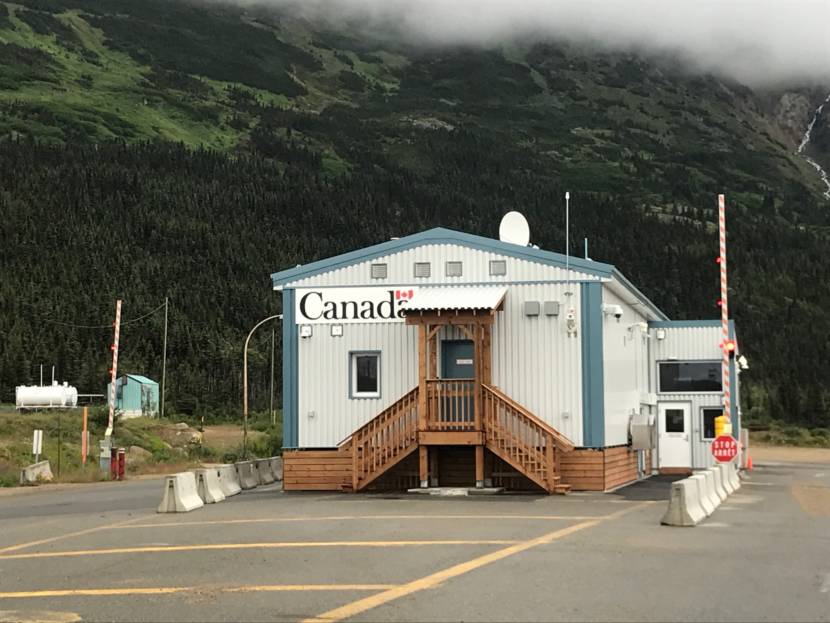
The Fraser Border Crossing in Fraser, B.C. (Photo by Mike Swasey/KHNS)
Canadian officials have announced that COVID-19 testing will no longer be required for fully vaccinated travelers entering Canada by land, water or air.
Right now, travelers entering or returning to Canada must have a negative PCR or rapid antigen COVID-19 test that’s clinically administered. That changes on April 1.
Haines Tourism Director Steven Auch says it’s a major change that will ease travel across the border.
“People here that want to go into Canada or Canadians who want to come down and return, it makes it easier for them to be able to do so,” Auch said.
Canada will also still require U.S. travelers to complete the ArriveCAN process and show proof of vaccination to enter the country.
Auch says Haines is ready to welcome Canadian travelers — and anyone traveling between the Alaska Marine Highway into Canada and up to Alaska.
“Hopefully, we’ll see more people come down,” Auch said. “And the big part for the summer, too, is that it makes it a lot easier for anybody, not just Canadians, but anybody wanting to do any road travel, to be able to drive through Canada to get here.”
Although fully vaccinated travelers will be allowed to enter Canada, questions remain about how tour companies will handle the ArriveCan requirement for tour groups.
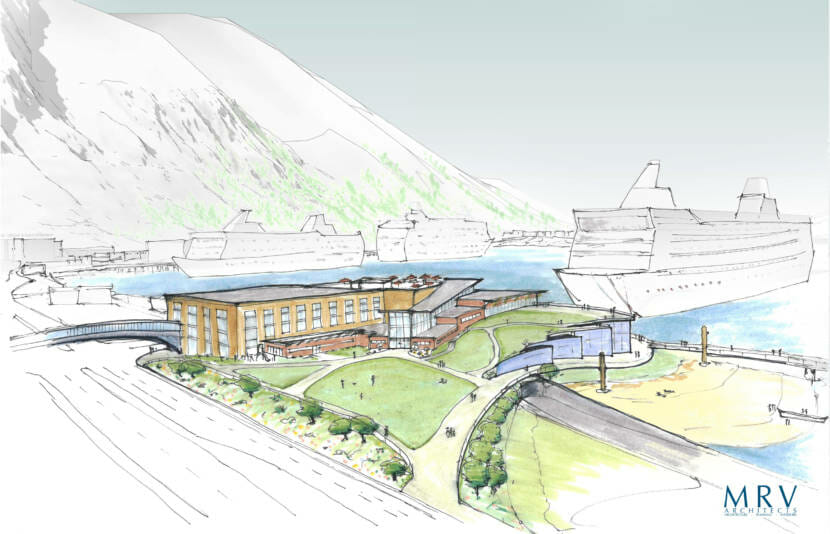
Initial designs for the subport lot in downtown Juneau. (Illustration courtesy of MRV Architects)
The Juneau Assembly has made a change to the city’s long range waterfront plan, allowing for the development of a fifth cruise ship dock in town.
At their regular meeting Monday night, members voted seven to one to modify the plan.
Prior to the vote, several members of the public testified against the change. Some said that even though the change doesn’t guarantee the construction of a new Norwegian Cruise Line dock, it does set the stage for one.
Juneau resident Laura Stats said she was concerned that a new dock would go against the city’s plan to lower Juneau’s greenhouse gas emissions.
“Given the crisis that our climate is in, unless local government leaders rapidly prioritize serious change in reducing our greenhouse emissions, methane, reducing our carbon footprint at a community level, we’re missing the only opportunity that we have left,” Stats said.
Other residents were worried about the potential for increased traffic downtown, and that not enough feedback had been collected from the public.
Assembly member Christine Woll proposed the amendment. She explained her reasons behind the changes at the meeting.
“I was afraid that if this ordinance passes, that people would take it to mean that a cruise ship dock being built at the cruise ship dock at the sub port was a foregone conclusion,” Woll said.
Woll said she wanted to make it clear that the assembly would continue to consider community input before moving forward with another dock.
Assembly member Alicia Hughes-Skandijs said she was concerned they were putting the cart before the horse by taking another step toward a new dock without fully considering the pulse of the community.
“I ask myself what is the rush here,” Hughes-Skandijs said. “From Norwegian’s perspective, I understand entirely, and I appreciate their desire to build and begin, but we’re not here to represent Norwegian’s interest. We’re here to represent the entire community’s interests.”
Hughes-Skandijs was the only member to vote against the change.
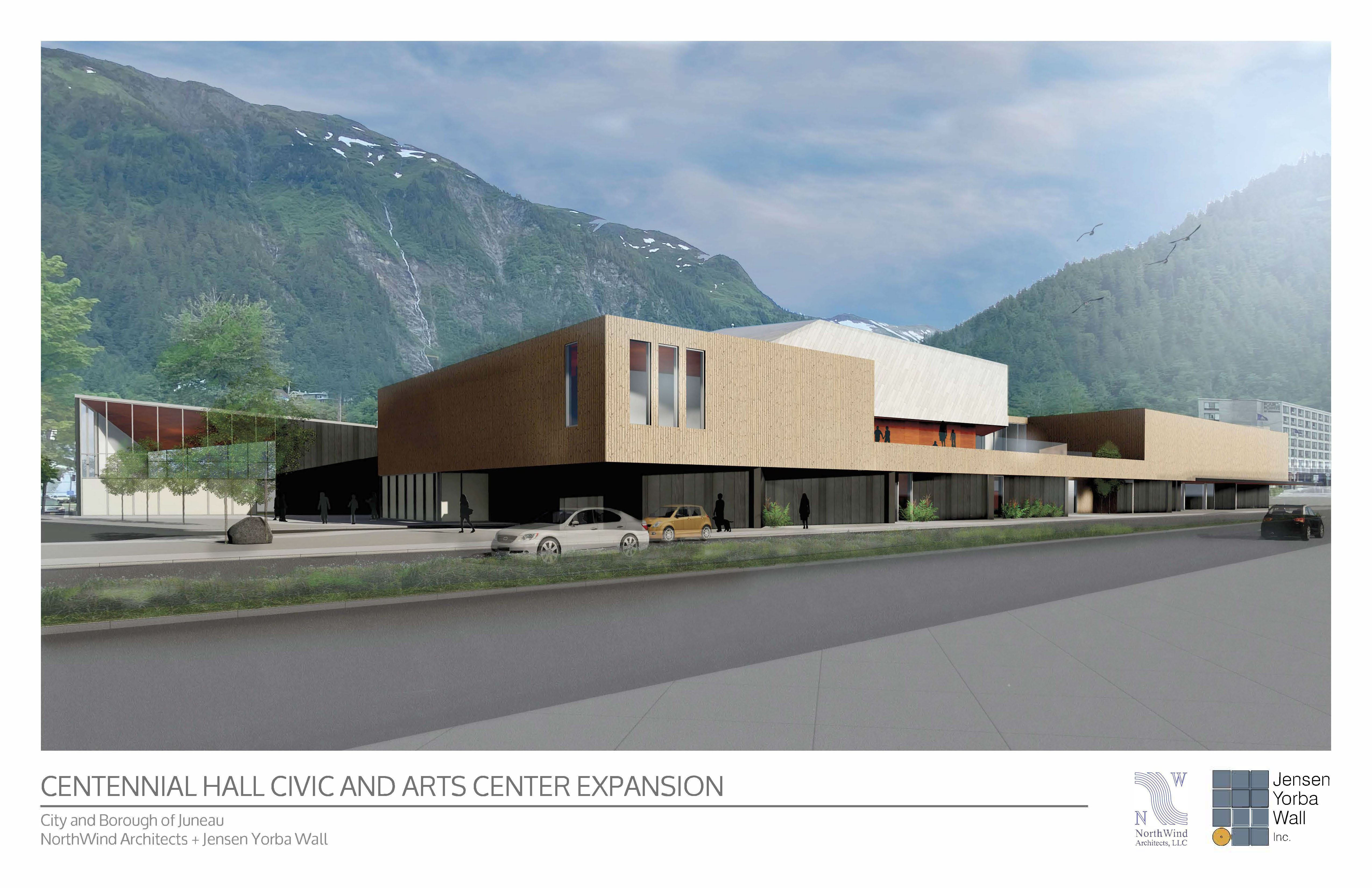
Local architectural firms produced this conceptual rendering of a Capital Civic Center for the City and Borough of Juneau. The idea is to expand Centennial Hall and replace the Juneau Arts and Culture Center.
Juneau cruise ship passengers will foot a big chunk of the bill for a new, integrated convention center and performing arts venue.
Bob Banghart is the executive director of what’s called “The Partnership,” a local nonprofit that originally began to raise funds for a standalone replacement for the aging Juneau Arts and Culture Center.
Juneau voters shot down a grant request for that proposed facility, called the New JACC, in 2019. The Capital Civic Center concept has support from groups that weren’t supportive of the New JACC. It’s got a ballpark cost of $75 million and The Partnership doesn’t intend to ask the City and Borough of Juneau to pay for any more of that.
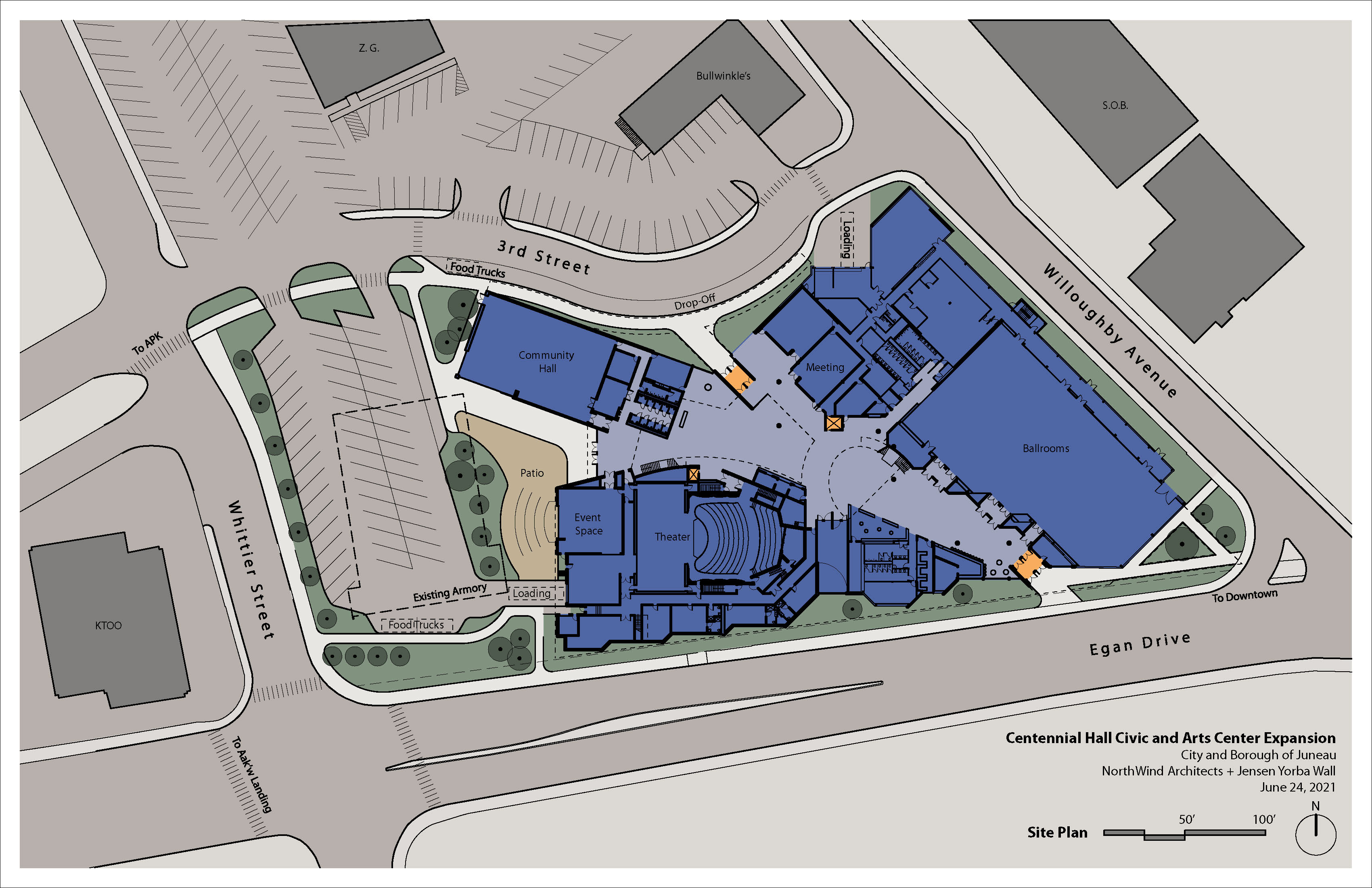
Local architectural firms produced this conceptual floor plan for a Capital Civic Center for the City and Borough of Juneau. The idea is to expand Centennial Hall and replace the Juneau Arts and Culture Center.
“If it all comes to pass, and this process that we’ve been pursuing, there wouldn’t be any subsequent contribution from CBJ,” Banghart said. “They’ve already done what they’ve said they’re going to do.”
That is, the city is working on voter-approved renovations to Centennial Hall. Those improvements are compatible with the Capital Civic Center concept.
“What we’re doing as a nonprofit, is bringing a complement to that effort and the money, from a number of sources that aren’t necessarily the city,” Banghart said.
Banghart said philanthropic donors will help pay for it. And, because it would be wholly owned by the city, there’s potential for federal funding. He said he thinks they’re in good position to start and finish the project in the next three to four years.
Banghart said the cruise industry’s become supportive because it needs indoor space. Small cruise lines and tour operators could use rooms there as a beginning and end point for their activities.
Banghart said a miniature, Pike Place-style market of local vendors there would be an attraction for visitors. And, Banghart said the pandemic has shown it’s a valuable space for large-scale emergencies.
This story was updated after the resolution was approved.
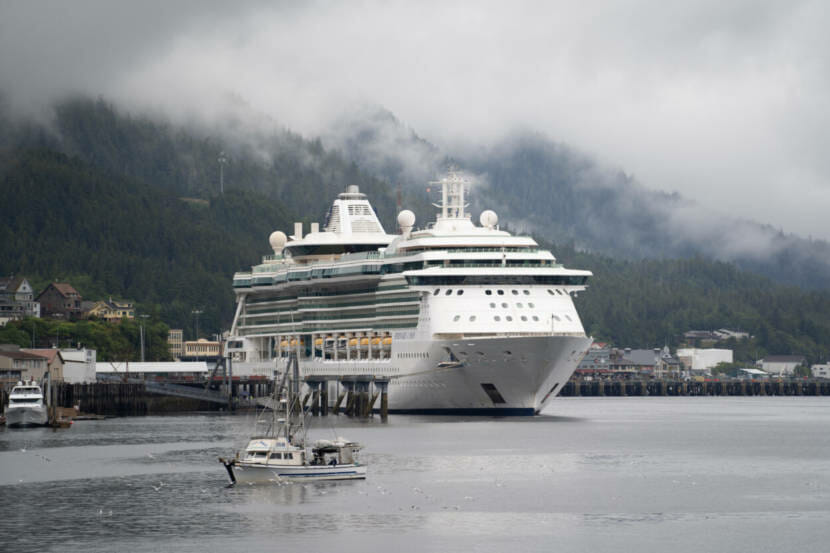
Royal Caribbean’s Serenade of the Seas docked at Ketchikan’s Berth 4 in 2021. It was the first large cruise ship to sail to Alaska since October 2019. (Eric Stone/KRBD)
Alaska’s visitor industry representatives are bullish on the 2022 cruise season. But there are still questions about how many visitors will really arrive on the ships this summer.
After two years of little to no cruise traffic, Travel Juneau President and CEO Liz Perry says she’s excited to get back to something resembling a normal summer.
“I think all of our operators are really optimistic that they’re going to see better returns the season for 2022 than they have seen in a long time,” Perry said in a phone interview Thursday.
But this summer, cruise ship schedules are packed — on some days, Ketchikan and Juneau are expecting as many as seven ships in port at a time.
“The big question for us is how full the ships are actually going to be when they arrive,” Perry said.
If all of the ships on the schedule this year were full, it would be a record year: an emailed statement from Cruise Lines International Association Alaska says the ships planning to visit this summer have a rough capacity of 1.5 million passengers — upwards of 2019 levels.
“I know that worldwide, cruising has been operating at about 60-70% capacity. What that means for the Alaska cruise season, we’re just not sure,” she said.
The city of Ketchikan’s port and harbors department is expecting ships to be about 70% full. That’d be just shy of a million passengers. Skagway Mayor Andrew Cremata, for his part, says he expects ships to fill up as the season progresses.
“We’re cautiously optimistic. I think after the last couple of years, it’s a good approach. However, what I’m hearing from the cruise ship companies is that it may be a little bit of a slower start than everybody had hoped,” Cremata said by phone Thursday.
For a couple of reasons: First, Cremata says the omicron variant put a damper on cruise bookings, though lately he says they’ve bounced back. Second, he says there’s still some uncertainty about how Canada’s rules could affect Alaska’s cruise season.
Canada’s rules matter because this year, unlike last year, all cruise ships have to stop in Canada because of a 19th-century federal law. The Passenger Vessel Services Act was waived for Alaska cruises last year after a push by Alaska’s congressional delegation. But that waiver expires at the end of March.
“There’s always the threat that the PVSA moratorium expiring could have an effect on some of the ships, but mostly what we’re hearing from Canada is positive as well,” Cremata said.
A proposal to extend the waiver is pending on Capitol Hill but likely won’t pass in time for the beginning of the season.
The Canadian government announced updated COVID-19 rules for cruise ships this month. Passengers must be vaccinated, with limited exceptions for kids under 12 and a few other exemptions. Passengers have to be tested before boarding, and cruise lines must have plans in place for outbreaks aboard. Masks will often be optional.
Cruise Lines International Association Alaska, the largest regional cruise industry group, welcomed the news.
“We’re encouraged by the recent announcement as it provides a level of certainty for a full Alaska season,” Renée Limoge Reeve of Cruise Lines International Association Alaska wrote in an email to KRBD.
In a statement, Holland America compared the Canadian protocols to the U.S. government’s COVID-19 policies, which were made voluntary earlier this year.
Skagway’s Mayor Cremata spends his summers on the cruise docks selling tours. And he says he’s ready for the hustle and bustle again.
“I like the tourists. I like it when it’s busy,” he said. “And that might sound a bit crazy to people who avoid those types of scenarios, but it is part of what makes our community unique.”
The first Alaska port call of the season is set for April 25, when the nearly 4,000-passenger Norwegian Bliss is scheduled to tie up in Juneau as part of its cruise of Southeast Alaska.
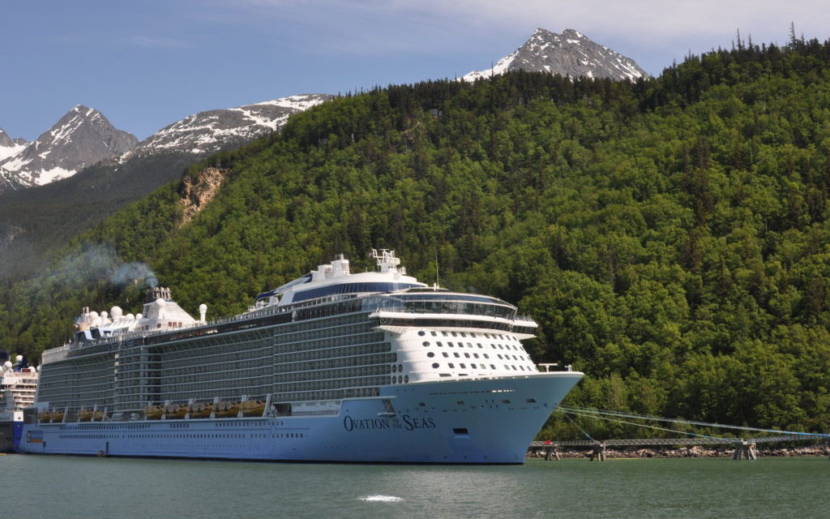
Royal Caribbean International’s Ovation of the Seas, a quantum-class cruise ship, in Skagway’s port. (Photo by Claire Stremple/KHNS)
The first cruise ship of the 2022 season is scheduled to arrive in Skagway on April 26. And starting in early May, the community is expecting three to four cruise ships a day.
But Skagway businesses are struggling to figure out how many staff they’ll need — or how to attract workers to Southeast Alaska in today’s tight labor market.
Skagway is the 18th-most-visited cruise ship port in the world, but over the last two years, visitor numbers have plummeted. The port community drew over a million visitors per summer pre-pandemic, but close to zero in 2020 and well under 100,000 in 2021.
Many owners have had to shutter their businesses to survive, and those that stayed open have operated with a reduced staff.
And after two years with little to no tourism, there are still some major unknowns — like how full cruise ships will be this year, or if land tours will be allowed to enter Canada.
One of Skagway’s largest employers is the Westmark Hotel. They have two full restaurants on-site, an upstairs lounge and the town’s largest hotel. General Manager Jim Sager says he doesn’t even know if he’s fully staffed at this point.
“I don’t think anybody truly knows exactly what the 2022 season has in store for us,” he said.
Sager says it all depends on the number of visitors that actually show up.
“If we anticipate in the neighborhood of 60-70% of what the cruise ships’ capacity is, and that’s where it comes in, then I’m probably fully staffed. But if things come in closer to 90% or 100% of what the ships’ capacity are, then perhaps I’m a bit understaffed,” he said.
Neal Fried is an economist with the Alaska Department of Labor’s research section. He says Alaska’s labor market is closely aligned with the national labor market, which is showing low unemployment numbers. He says it will be a challenge for businesses to attract seasonal workers who’ve found full-time work since the pandemic started.
“Of course, that also depends on what the pay is and how that compares to the pay closer to home and that’s gotten more difficult because Alaska is just not paying the premiums that we used to,” Fried said. “And you know, nationally, wages have gone up significantly.”
There are almost 20 open jobs posted on Skagway’s municipal website, from clinic jobs to trail crew to a museum assistant. Last week the mayor suggested to the assembly that they should consider increasing wages $5 an hour across the board to stay competitive in the market. That would raise an entry-level employee’s wage from about $10 an hour to about $15 an hour.
Beth Smith owns a bar, restaurant a hotel in Skagway. She says she’s only staffed at about 25% at her restaurant, the Station Bar and Grill, though typically she’d be fully staffed by this point in the season. She says that the increased wages she’ll need to pay to attract employees will force her to raise prices.
“Our prices are going to have to go up, and that’s kind of scary as well because I think everyone in town is gonna see that,” Smith said.
Nicholle Chandler owns two souvenir gift shops. She says she was lucky to lure back a previous manager with a big salary increase, but she’s struggling to fill the rest of her open positions.
“At this point, I’m just hoping that more people apply, and I’m anticipating that being college students,” she said.
Chandler expects to be short-staffed during the shoulder seasons but hopes those college students fill in the gaps by mid-summer.
Meanwhile, some potential employees are seeing this season as a boon. Natasha Kraus worked as a tour guide for one season before the pandemic, then found other temporary jobs for the last two years. She says she spoke with half a dozen employers before settling on the same company she had worked with in 2019.
“I definitely feel wanted. I had a few options. Ultimately, I actually had to make my decision on who I was going to work with based on housing,” Kraus said.
She says she’s getting a big pay increase, housing at a reduced rate, an end-of-season bonus and the chance for more bonuses based on performance reviews.
Stacy Gould from Chilkoot Charters says she’s got plenty of employees waiting for her call in the lower 48 to get back to work, but she doesn’t know if she’ll be able to open up at all. That’s because of Canadian border restrictions that would make it nearly impossible for the company to drive tours into nearby Canada.
“Staffing is not the issue for us. It’s the COVID testing at the border. So we’re diligently keeping our ear to the ground and waiting for any sign that Canada will lift those testing requirements. When that happens, we’re good to go,” Gould said.
Liz Lavoie from the Red Onion Saloon says her team of historic brothel actors is in place thanks to an industry site called Backstage. But the restaurant side of the business is still short several employees.
“We didn’t have a full staff last year, or the year before,” she said. “So we’re just kind of starting with a light bench.”
The Serenade of the Seas in Sitka on July 21, 2021, the first port call of the curtailed 2021 cruise season. The 632 passengers had room to spare on the ship, which has a capacity of almost 2,500. (Photo by Tash Kimmell/KCAW)
A pair of documentary filmmakers is examining the implications of the rapid growth in cruise tourism projected for Sitka.
Their film “Cruise Boom” depicts significant worry about the community’s future amid the dramatic increase in cruise passengers. Parts of the film are already available to watch online.
Sitka is expected to see upwards of half-a-million cruise passengers in the 2022 season. Before this, the most in one summer was 280,000 – and many remember the congested intersections, the overflowing sidewalks and the inability to run simple errands downtown during peak hours.
And if you’re a business owner, how do you prepare for the surge, especially when — as COVID-19 has shown — there’s no guarantee that the big numbers will materialize?
Linda Anderson is one of many downtown Sitka merchants who outlasted the slowdown of the pandemic only to be faced with an altogether different problem: the rebound.
“Every business in town is looking for people,” she says in the documentary. “It’s not just little clerk jobs. There’s a lot of jobs out there that aren’t filled now.”
Filmmaker Atman Mehta says that the rapid expansion of cruise tourism puts Sitka into its own category.
“I think that while there are broad implications,” Mehta explained, “I think Sitka is unique in a way because of the kind of rise in Sitka is going to be much quicker than other places.”
“Preparation,” is one of two films that filmmakers Mehta and Ellen Frankenstein have offered online. The other is called “Benefits and Impacts.”
Frankenstein is the CEO of Sitka-based ArtChange, Inc., which is producing “Cruise Boom.” In addition to covering main street, they’ve been to municipal planning meetings, toured Sitka’s cruise facility, and visited some of the popular nonprofit venues for cruise tourism in Sitka.
Frankenstein feels that Sitkans in the front lines are rising to the challenge.
“It’s been really amazing to go behind the scenes,” said Frankenstein. “Both of us have no experience in the tourism world. And there’s a lot of thinking going on. A lot of hard work and a lot of collaboration that’s really impressive.”
In “Cruise Boom,” Sitka Sound Science Center director Lisa Busch says the community’s nonprofit tourist venues are collaborating on summer staffing, housing, and training. (ArtChange, Inc., image capture)
There’s also a lot of uncertainty in both short films — and a lot of worry. In one clip, Sitka Sound Science Center Director Lisa Busch worries about whether the community is prepared for what’s coming.
“I’m worried about how we’re going to get this all done in time, and the worst case scenario is that we’re not ready, and the experience is not good,” she says in the documentary. “The best case scenario is this remains a wonderful visitor destination and a great community to live in.”
Mehta believes the anxiety felt by Busch and others is justified, based on what has happened elsewhere in the world where cruising has shouldered its way in.
“What often happened in other cruise destinations is that when there is such a rise in tourism, is that you see generic stores selling jewelry and trinkets — stores which are often owned by either cruise companies or other very powerful and rich institutions,” Mehta said. “They tend to show up and price out local businesses and local residents. They drive rents up and property prices up. And I think it’s important to ensure not only that the flavor of town doesn’t change, but also that Sitka doesn’t become sort of a hyper-seasonal economy, in which most of the businesses cater only to tourists. I think it’s going to be important for town to avoid that.”
Mehta cautions that the COVID-19 pandemic demonstrated how volatile the cruise industry is, and that becoming too dependent on the cruise sector could prove devastating if companies chose to one day alter their routes and bypass Sitka altogether.
The producers say that they’ll be filming “Cruise Boom” throughout the summer in Sitka, with a premiere screening sometime in the late fall.
Close
Update notification options
Subscribe to notifications
Subscribe
Get notifications about news related to the topics you care about. You can unsubscribe anytime.