Tourism

Kodiak is slated to see its first cruise ships since 2019

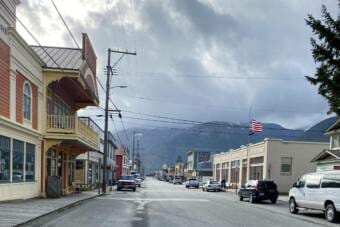
View from the Near Island Bridge. (Photo by Mitch Borden/KMXT)
View from Kodiak’s Near Island Bridge. (Photo by Mitch Borden/KMXT)

Kodiak is slated to see its first cruise ships since 2019. Nick Szabo is the resident port agent for Kodiak with Alaska Maritime Agencies. He says 15 large and small cruise ships are scheduled to call in Kodiak — unless COVID-19 or the situation in Ukraine disrupts those plans.

“If we have another variant that is as severe as some of the others, the CDC is probably going to put a no-sail order out,” said Szabo. “But if things keep getting better, then I expect we will have a cruise ship season.”

Kodiak Island doesn’t see as many cruise ships as places like Skagway and Ketchikan do. Szabo says in a normal summer, about 25 ships carrying summer tourists dock in Kodiak. And back in 2019, 30 cruises visited the island.

But COVID isn’t the only thing that might affect cruise operations this summer.

“Some of the cruise ships in the past, they stop at Russian ports,” said Szabo. “So, that’s not going to happen for sure. And then there’s a lot of apprehension about just how this whole Ukraine thing is going to play out.”

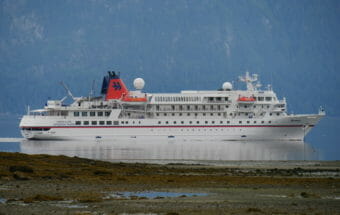
The situation in Ukraine could affect island’s first cruise ship of the season. The Minerva, a 152-passenger cruise ship, is scheduled to dock in Kodiak on May 19 before making its way to Russia and ultimately Japan.

Juneau Assembly OKs buying used gondola for Eaglecrest Ski Area

Looking up Log Jam and the west side of Eaglecrest Ski Area, seen on Wednesday 2/23/2022. (Photo by Mikko Wilson/KTOO)
Skiers and snowboarders ride up the Ptarmigan chairlift at Eaglecrest Ski Area on Douglas Island with views of the Log Jam run on the west side of the mountain on Feb. 23, 2022. An aerial gondola system could replace the Ptarmigan chairlift, or go to a new highpoint over the west bowl. (Photo by Mikko Wilson/KTOO)

In a 5-4 vote, the Juneau Assembly agreed on Monday to commit up to $2 million for the purchase of a used gondola system for the city-owned ski area.

Eaglecrest Ski Area officials say an enclosed mountain lift is the cornerstone of concepts for expanding summer operations and ending the need for local taxpayers’ support.

Assembly members on both sides have reservations about it. There were concerns about making a rushed decision, a lack of public buy-in, and unfairly leapfrogging other established priorities.

The Assembly’s action does not mean that the gondola system is a done deal for Eaglecrest.

“I have switched to a yes vote,” said Mayor Beth Weldon, who’s been skeptical of the concept. “But my vote is yes because I want to give you more time. Doesn’t mean that I’m going to pay for anything further. After buying a gondola, I may … tell you to sell it after we bought it. But I’m trying to give you more time.”

Eaglecrest General Manager Dave Scanlan laid out the timeline he anticipates for next steps. It’s all subject to change, and hasn’t been written up in a purchasing agreement yet.

First, as a down payment Eaglecrest must pay a third of the cost of the gondola system, about $450,000. At that point, no other buyer will be able to scoop it up.

After Eaglecrest closes for the season, Scanlan said he and some engineering consultants would go to the ski resort in Austria where the gondola is finishing up its final season there. They’d inspect the system in person. If it checks out, they’d make a second payment before it is dismantled. Scanlan says this would be in mid-April.

Scanlan said the final payment will be due when the system is loaded and ready to transport. Assembly member Maria Gladziszewski convinced most of her colleagues to add another review around this point. Eaglecrest officials must update the Assembly before spending money to transport it out of Europe.

“It gives us an opportunity to say, ‘OK, if some disaster happens, and it turns out to be — doesn’t fit on mountain, the pro formas turn out to have an error in them — ’ I mean, we’ve just done this really quickly. It will give us the chance to say, ‘OK, leave it over there, and sell it from there,’” Gladziszewski said.

There’d still be transportation and storage costs within Europe. Scanlan said putting it in storage in Croatia for a year would cost about $200,000, and make reselling it easier. Bringing it to Juneau would cost about $450,000. He thinks that decision must be made at the end of May.

Assembly members Greg Smith, Wade Bryson and Michelle Hale enthusiastically voted yes. Weldon and Gladziszewski voted yes with reservations.

Gladziszewski said pre-pandemic conceptual plans for different tiers of summer operations at Eaglecrest called for $20 million to $50 million in upfront costs.

“The amount of money on the table was astonishing,” she said. “And I just thought, the City of Juneau is never going to come up with that kind of money, there’s no way citizens of Juneau are going to spend that kind of money on Eaglecrest.”

She said securing this used gondola means the initial investment in summer operations is relatively small, and eliminates the need to find a deep-pocketed partner to share costs — and control — with.

Assembly member Carole Triem voted no. She said she doesn’t oppose summer operations at Eaglecrest, but, “This is the Assembly saying yes to summer operations at Eaglecrest before we’ve had that conversation with the public. And I really hesitate about that.”

After chairing the city’s Visitor Industry Task Force, she said she knows people have very strong feelings about summer operations at Eaglecrest. In public testimony before the Assembly vote, 10 people spoke in favor of the purchase and four against it.

Eaglecrest staff produced a report in 2019 with ideas for cashing in on summer tourism, most of which hinged on installing a brand new gondola lift. But the pandemic largely stalled follow-up discussions with the Assembly. Until now, the Assembly has never adopted a plan, in whole or part.

Barbara Wáahlaal Gíidaak Blake voted no because it felt like a piecemeal decision. She also said locals’ access to Eaglecrest isn’t universal.

“Our mountain is not accessible by every single demographic in Juneau,” she said. “You have to be of a certain wealth class in order to be able to ski. In order to buy a season pass was a struggle as a single mom, for my son. Thank goodness for some of the programs that the city does offer to get up on that mountain, get our kids up on that mountain.”

Assembly members Christine Woll and Alicia Hughes-Skandijs also voted no.

Assembly member Greg Smith chairs a task force on summer operations. He voted yes and said he thinks the purchasing timeline will give Eaglecrest officials enough time to resolve unanswered questions and get the public on board.

“And I will do the work to try to get that sense from the community that this is the right way forward. And if we get the sense from the community that this is not the way forward? Well, Mr. (City Attorney Rob) Palmer will be going to Croatia and selling a gondola,” he said.

Smith said it’s a bit of a leap of faith, but he doesn’t want to regret passing on this deal.

The Forest Service is working to increase access to an underused Southeast bear-viewing site

A small black bear walks along a large fallen log in a green forest
A black bear at Anan Wildlife Observatory. (Photo by Sage Smiley/KSTK)

The U.S. Forest Service says one of Southeast’s best bear-viewing sites has been under-utilized for decades, but the agency is updating infrastructure and re-tooling visitor permits to increase access.

Located about 30 miles south of Wrangell on the U.S. mainland, Anan Wildlife Observatory sits on Anan Creek, which hosts a large pink salmon run and a lot of fauna that rely on those fish. Black bears, brown bears, bald eagles and harbor seals all congregate around historic Lingít fish camp sites to feed.

But despite the beautiful scenery and wildlife viewing, Wrangell District Ranger Clint Kolarich says that the annual visitor capacity — which is based on sustainability studies — has never been met.

“That’s due to things outside of our control: a cruise ship gets canceled, or the weather’s bad, or a boat breaks down. Those things will always happen,” Kolarich said.

After almost two decades of data collection, the Forest Service is opening up more Anan permits to commercial outfitters or guiding services, which he says hopefully will allow more people to see Anan.

“We’re just trying to compensate a little bit for those unknowns by getting the permits into the hands of the folks that have a higher probability of getting customers down there,” he said.

In the past, 60 people had been allowed at the wildlife observatory each day during the viewing season, which runs from July 5 to Aug. 25. That total number isn’t going to change.

But recreation staff officer Tory Houser says that just under two-thirds of the permits went to commercial guiding companies.

“From our research, we found that over 80% of people came to Anan with an outfitter guide, because it’s hard to get there,” she said. “You need a boat, and not everybody has a boat and can get there. So we said ‘Well, let’s get these permits to the people who can help get folks to Anan.’”

""
Anan Lagoon, looking towards Anan Bay. (Photo by Sage Smiley/KSTK)

Houser says that the new prospectus, which is open through April 14, allows new tour groups to get in on Anan guiding and current outfitter guides to expand their trips to the observatory.

“Currently, we have a group of companies that were awarded use days — or permits — for Anan, and just those companies are allowed to bring clients there at this point. So we have some more capacity; we didn’t raise our numbers that can go to Anan, but we are going to allow more of those numbers to be commercial than previously,” Houser said.

The new permit structure will open up an additional 1,354 permits to commercial guiding companies each year.

“It doesn’t take any of the days away from folks that have them currently — they keep what they have,” Houser said. “And they have an opportunity to get more.”

It’s an overbooking strategy based on visitor data going back to 2003. With the number of permits that go unused because of unforeseen circumstances, Forest Service officials say they won’t be pushing the site’s capacity limits. Twelve permits a day will still be available for members of the public who want to visit Anan on their own, without a commercial guiding service.

Restructuring the permit system isn’t the only movement on Anan Creek. The Forest Service also expects to see the fruits of an almost million-dollar contract to redo the upper observatory viewing deck.

A wooden walkway and platform in a forest
The Anan Observatory deck, which will be replaced in the coming months. The structure in the center will be moved back to allow visitors to access the guardrails over the creek. (Photo by Sage Smiley/KSTK)

This first phase of the Anan deck replacement project will make the upper observatory deck all one level and move a historic shelter away from the edge of the platform to give visitors a clearer view of the creek.

Houser says the contractors will be working on a tight timeline.

“We really want to have the entire top deck completed for our operating season that starts on July 5, and we have kind of a timeline: we’re hoping by June 15, we’ll have it done,” Houser said.

Petersburg-based Rainforest Contracting will build the new deck, hopefully starting by March 14, Houser says. That’s the same company that built the new Raven’s Roost cabin on the Petersburg Ranger District.

The Forest Service is also working to secure around $700,000 in funding for the second phase of the project, which will involve building a spiral staircase down to a new photo blind deck just above the waters of Anan Creek. It’s part of the Anan master plan, which included recent improvements to the Anan Creek Trail and the site’s outhouses, as well as a proposal for a larger, more permanent floating dock in Anan Bay.

This isn’t the first time the Anan Wildlife Observatory has been renovated. The observatory deck was first built in 1967, rebuilt and renovated in 1983, and the deck was further enlarged a decade later.

Businesses interested in applying for guiding permits at Anan Wildlife Observatory can submit proposals between March 1 and April 14 through the Wrangell Ranger District office.

Seward plans to welcome its first cruise ships since 2019

""
Seward is expecting a full schedule of cruise ships this summer. (Photo by Sabine Poux/KDLL)

Seward plans to welcome back its first cruise ships this summer since 2019.

But there’s a lot that could happen between now and May 9, when the first ship is slated to dock in town.

“I’m going to try to remember how that works,” said Kat Sorensen, executive director at the Seward Chamber of Commerce.

She said she’s cautiously optimistic about the return of cruises. Seward was burned in 2021 due to COVID-19-related restrictions from Canada.

“Last year, we had a first cruise ship that was supposed to arrive in Seward,” Sorensen said. “And the day kept getting pushed back or canceled until, all of a sudden, the season was over. And it’s like, ‘OK, we’re not getting any cruise ships this year.’”

Seward’s economy relies heavily on tourism from cruises. And the effects of two canceled seasons in a row extend throughout the region — cruises support an estimated 20,000 jobs in Southcentral every season.

Last year, Norwegian Cruise Line sent Seward and several other communities $1 million each in an attempt to fill in some of the gaps left behind by the no-show.

But the season wasn’t a total loss in Seward. Independent travelers still filled Seward’s streets last year, said Amy Haddow, a Seward-based vessel manager with Cruise Lines Agencies of Alaska. Her job is to connect the ships with services on land like customs and groceries.

She said Seward bustled with visitors from Alaska last year, but also from the Lower 48 and overseas. That’s reflected in Seward’s 2021 sales tax revenue, which rebounded and surpassed 2019 numbers.

Haddow also said Seward is different from communities in Southeast in that it’s typically the first or final destination on passengers’ trips. Many go straight between the bus or train and the ship.

“The vast majority of passengers leave Seward,” she said.

So even if some of the businesses down at the dock are impacted by quiet seasons, many local stores and restaurants may not be as hurt when cruise ships don’t come into town.

Cruises or not, Seward relies on an influx of seasonal workers each summer.

Finding housing for those workers is always an issue, but Sorensen says it might be especially tough this year.

“And usually we start seeing posts on our Seward housing Facebook page around February or March,” she said. “But this year we’ve been seeing them since November, of people desperate for a place to live for the summer.”

Still, Sorensen and Haddow hope ships are a go for this summer. The schedule is chock full of voyages, from May through October. Sorensen says the chamber is operating with the assumption, for now, that things will be normal.

But she won’t say anything with complete certainty, at least not until the first ship of the season pulls up to the dock.

Bill from Alaska delegation would extend waiver allowing cruises to bypass Canada ports

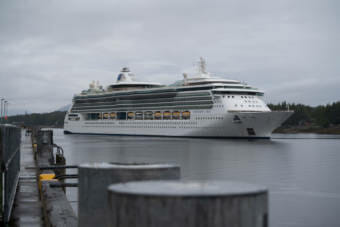
Royal Caribbean International’s Ovation of the Seas, another quantum-class cruise ship, in Skagway’s port. (Claire Stremple/KHNS)

Alaska’s congressional delegation wants to extend the waiver of a law that makes Alaska-bound cruise ships stop in Canada.

Sens. Lisa Murkowski and Dan Sullivan and Congressman Don Young have a new bill that would provide a one-year exemption of a requirement in the Passenger Vessel Services Act. That 1886 law says foreign ships can’t transport people between two U.S. ports directly. The cruise ships that sail to Alaska are nearly all foreign-flagged but they make a stop in Canada to get around the law.

Then the pandemic disrupted the arrangement. In 2020, Canada stopped allowing cruise ships to visit their ports. It has since lifted the ban, but the Alaska delegation wants more certainty.

“Alaskans cannot gamble again on the goodwill and commonsense of our Canadian neighbors, who failed us last year,” Sullivan said in a statement announcing the bill.

The new bill extends the expiration date of the previous waiver for 59 cruise ships that are regulars on the Alaska route.

Cruise lines are predicting a record year, but Southeast Alaska is proceeding with caution

A view from above of a large cruise ship docked in Juneau with Douglas Island in the background
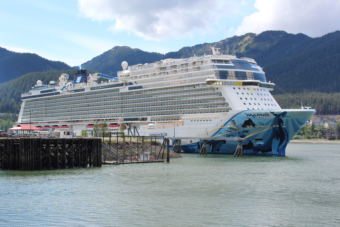
A view from the Goldbelt Tram of a Princess Cruises ship docked in Juneau on Aug. 31, 2021. (Photo by Jennifer Pemberton/KTOO)

Some cruise lines are making bold predictions about a record breaking year for tourism in Southeast Alaska. After two years of pandemic, Alaskans are more cautious.

If you ask the cruise ship industry, this summer is going to be big.

“Really our biggest and best Alaska season yet,” said Josh Carroll, a VP with the Royal Caribbean Group, on a videoconference with Alaska businesses and reporters last week.

“We have, as a Royal Caribbean group, and as an industry, we have the most ships deployed to Alaska that we’ve ever had in our history,” Carroll said.

Carroll said Royal Caribbean is getting more bookings now than they were at this time in 2019, though he wouldn’t share the numbers. He attributed the interest in Alaska to a push towards domestic travel this year.

But he added a serious caveat.

“That’s assuming the protocols allow the the operation of that volume,” he said.

Holly Johnson, who has run Wings Airways and Taku Glacier Lodge in Juneau for the last two decades, said she loves the optimism, but she hasn’t been hearing that from other cruise lines.

She said she also got great pre-season bookings this year. She hasn’t operated for the last two seasons. Even though some cruise ships came in 2021, it was only about a tenth of pre-pandemic crowds.

“We’ve just been sort of holding things together with duct tape, as you do up here,” she said.

Johnson’s pre-season booking are just one indicator of the season to come. She won’t know for sure how many visitors she gets until they’re on the dock. But she has to decide how many planes to insure and how many people to hire now. She says that feels like a gamble while her coffers are empty.

“It’s hard. It’s terrifying. And people are making real business decisions at this point with a lot of hope, but with no concrete knowledge of what the season is going to look like,” Johnson said.

She says she plans to operate at about 60% this season — with the potential to increase if there’s demand. She called it a rebuilding year.

Dennis McDonnell with Alaska Coach Tours isn’t ramping up to full speed either.

“We’re hopeful and expecting a season, probably 20 to 30% better than it was last year,” he said.

Southeast governments need to predict how many tourists will visit, too. In Juneau, Tourism Manager Alexandra Pierce says city leaders plan to make $13 million dollars on cruise ship passenger head taxes. It will take a million passengers to make that, which is close to pre-pandemic numbers.

Pierce says that’s the city’s best educated guess. But Juneau has enough savings that they can afford to be wrong.

“I don’t know what capacity the ships will come at,” Pierce said. “But I think after a year of no cruise season, and last year with an extremely, extremely limited one, this will feel like business as usual for Juneau residents.”

About one hundred miles north, Skagway can’t afford to be as wrong. The city’s economic model is built on tourism, and the last two years took a bit out of savings.

Mayor Andrew Cremata says his municipality is budgeting for only half the season they saw in 2019. He said the municipality is being “prudent.” There are two major concerns on his mind for this summer. One is labor — fewer than 1,000 people live in Skagway. In a typical cruise season, that number at least doubles with seasonal workers.

“There are a lack of workers all over the nation,” Cremata said. “We’re gonna have to get people to come up to Alaska after having essentially two years with little to no business.”

He says it’s extra tough because most seasonal workers make a low wage.

The other concern is Canada. Skagway is just about 15 miles from the border. Tours cross it, and there’s usually a robust stream of visitors from the Yukon.

He and others in the tourism sector have their eyes on Canada’s policy around foreign-flagged ships this year. Large cruise ships have to stop in Canada on their way from a U.S. port like Seattle to another U.S. port like Ketchikan or Juneau. That’s an old U.S. maritime law.

When Canada closed its ports to cruise ships in 2020, it effectively ended the Alaska cruise season. It lifted those restrictions on cruise travel last fall. At Southeast Conference last week, Renee Limoge Reeve with Cruise Lines International Association said that Canada’s border being open is a good sign.

“But we still face challenges. We’re all aware of them,” she said.

She said her group is in frequent talks with the Canadian government. But she, along with businesses and municipalities, is concerned Canada could quickly rescind access again—and doom the cruise season.

Holly Johnson from the flight tour company Wings says that even though there’s plenty of uncertainty between now and this summer, there’s one thing she knows for sure.

“The world is ready to travel again,” she said. “Some of these guests have rescheduled over the last couple years. And they’re just determined to come back.”

She says she’s ready to be back in business, too. Even if it’s a modified amount of business.

Site notifications
Update notification options
Subscribe to notifications