University of Alaska

University of Alaska and Interior Department partner to increase access to jobs for Alaska Native students

Representatives from the Alaska Native Science & Engineering Program joined Secretary of the Interior Deb Haaland in Washington, D.C., on July 13, 2023, to sign an agreement that will increase access to employment opportunities for Alaska Native students in science and engineering fields. (Photo courtesy of ANSEP)

Students from University of Alaska Anchorage’s Alaska Native Science and Engineering Program will have increased opportunities for federal jobs after a partnership with the U.S. Department of the Interior.

The agreement will streamline the application process for Alaska Native Science and Engineering Program students. The program started in the 1990s with one university student, and has expanded to include 3,000 students as early as fifth grade.

Beth Spangler, a senior director with the program, said she’s been working towards this agreement since she joined the group 14 years ago.

“I feel just elated for the students because it is such a great opportunity,” she said. “Our Alaska Native and rural students should be part of the workforce in the communities that they live in. It is just an amazing opportunity for the students and I’m honestly very excited for their futures.”

Spangler joined the program after several years working with the federal government in order to promote diversity in federal jobs in the state.

The agreement, which was signed this month, includes a “direct hire authority,” which means ANSEP students, after working for the state’s university for a set number of hours and obtaining their degree, can be hired non-competitively for Department of Interior jobs for two years. A noncompetitive hire doesn’t have to compete with the general public for a job.

The program has already worked with the Interior Department to place students in internships and full time jobs with the U.S. Forest Service and the Bureau of Safety and Environmental Enforcement. The new partnership should open those opportunities to more students.

The jobs are primarily in Alaska, Spangler said, but can be anywhere in the United States. ANSEP has students in Washington, D.C., with the National Fish and Wildlife Foundation; in Washington state working for Boeing; and in Rhode Island and Texas. But she said she’s most excited about the local possibilities because it’s important to have Alaska Native students be able to work for the federal agencies that operate “in their backyards.”

“It’s going to be not only good for the community, but good for the resources, good for Alaska,” she said. “Our students have the academics, like a master’s or bachelor’s degree in natural resources or whatever their position is, but then they also have the local knowledge. They have an understanding that’s so much deeper.”

The agreement takes effect immediately, but Spangler said in practice it is likely to take off next season, as a result of agencies making fall hires for next summer.

This story originally appeared in the Alaska Beacon and is republished here with permission.

University of Alaska picks Philadelphia-sized section of Interior Alaska to own under new law

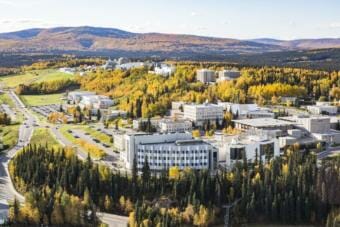
The campus of the University of Alaska Fairbanks is seen from the air on Sept. 20, 2022. (Photo by James Brooks/Alaska Beacon)

The University of Alaska has begun using a new federal law to take over unused land, and its first pick is spooky.

According to a public notice posted Wednesday, the University has requested to take over about 100,000 acres near Spooky Valley, west of the Dalton Highway in the Ray Mountains of Interior Alaska. It’s a stretch of land about the size of the city of Philadelphia.

The land was previously selected for transfer to the state from the federal government, and the state is preparing to relinquish that request in order to have the Bureau of Land Management transfer the property directly to the university, part of a long-running plan to fulfill the University of Alaska’s federal land grant.

“We’re definitely celebrating, because it’s a big deal, but it’s only one step in the process,” said Jonathon Taylor, the University of Alaska’s director of public affairs.

A clause in the $1.7 trillion federal omnibus budget law signed last year calls for the university to receive 360,000 acres of federal land before 2027.

The university is identifying its preferred options in chunks of about 100,000 acres apiece, and the Spooky Valley property is its first selection.

“We’ve been really grateful for support from the governor, and obviously the congressional delegation, Sen. Murkowski, but also DNR, to work through this process and work through the public process so that we can hit that date,” Taylor said.

It isn’t yet clear what the land will be used for. The university is planning a carbon sequestration program that preserves land from development in exchange for compensation payments. It also leases land for mining, logging and construction.

“These lands were selected for potential conveyance because we think that they are a good fit for this really large portfolio of potential use,” Taylor said.

When the university does have a plan for using the land, that will be subject to a separate public notice and public discussion process, he said.

Correction: This article has been updated to reflect the fact that the university is not yet operating a carbon sequestration program and to correct the wording of a quote from Taylor, that the lands were selected for potential conveyance.

Alaska Gov. Mike Dunleavy appoints figure behind illegal loyalty-pledge scheme to university board

A statue of Charles Bunnell, the first president of the Alaska Agricultural College and School of Mines, as the University of Alaska Fairbanks was once known, is seen on Sept. 18 on the UAF campus. An administrative order issued by Gov. Mike Dunleavy removes college-degree requirements for most state jobs. (Photo by Yereth Rosen/Alaska Beacon)

Gov. Mike Dunleavy has appointed Tuckerman Babcock, a longtime Republican and former aide, to the University of Alaska Board of Regents. Babcock, together with the governor, orchestrated an illegal loyalty pledge scheme, a federal judge ruled two years ago.

The governor’s office announced Babcock’s appointment late Wednesday after the Alaska Legislature rejected a prior pick for the office. Lawmakers failed to confirm Bethany Marcum to the 11-person board in May.

Several sitting legislators said they believe Babcock is unlikely to be confirmed by the Legislature when it meets next spring.

In Dunleavy’s first year, Babcock was a supporter of the governor’s plan to sharply cut spending on state services, including the university. Marcum’s support for those cuts in 2019 was cited as a reason for her failed confirmation this year.

Whether or not he is confirmed, Babcock will sit as a member of the board in the meantime, participating in the university’s annual budgeting process and debates on policies.

“Tuckerman’s experience serving in numerous statewide government positions and 10 years in business management makes him a great fit for the University of Alaska’s Board of Regents,” Dunleavy said in a prepared statement. “I am grateful for his continued service and commitment to the state of Alaska. I am confident that Tuckerman’s expert knowledge of public service and leadership will continue to help Alaska for the better.”

During his time as Dunleavy’s chief of staff, Babcock was found to have illegally fired three state employees as part of an illegal loyalty pledge scheme.

The state agreed to pay almost half a million dollars to two Alaska Psychiatric Institute doctors to resolve a lawsuit stemming from the scheme. A separate case, involving former state attorney Libby Bakalar, is scheduled for a damages trial later this year.

Babcock ran unsuccessfully for state Senate in 2022, losing to fellow Republican Jesse Bjorkman in the race to replace Sen. Peter Micciche, R-Soldotna. He previously served as head of the Alaska Republican Party and as a member of the Alaska Oil and Gas Conservation Commission.

This story originally appeared in the Alaska Beacon and is republished here with permission.

Legislature narrowly votes down Dunleavy’s University of Alaska Board of Regents nominee

Sen. Löki Tobin told the Legislature she opposed Bethany Marcum’s nomination to the University of Alaska Board of Regents. “Ms. Marcum has shown that she cannot uphold the public trust,” Tobin said. (Lex Treinen/Alaska Public Media)

The state Legislature denied one of Gov. Mike Dunleavy’s nominees for the University of Alaska Board of Regents on Tuesday. Bethany Marcum’s nomination was narrowly defeated at a joint session of the House and Senate.

Several legislators raised concerns about Marcum’s role in the state’s redistricting board as well as her defense of the governor’s steep budget cuts to the university system in 2019.

Last year, a judge struck down the map the board approved, writing at the time that the majority, including Marcum, didn’t make a good faith effort to incorporate public feedback, which resulted in an “arbitrary and capricious” map. Rep. Andrew Gray, D-Anchorage, told the floor Marcum’s work on that board was part of the reason he would vote against her.

“This nominee drove what has been ruled a partisan gerrymander that would have disenfranchised the voters of East Anchorage. And she did it twice,” Gray said.

Lawmakers who voted no also pointed to Marcum’s support of Dunleavy’s steep budget cuts to the university system in 2019 when she led the Alaska Policy Forum, a conservative think tank.

“To have a person with the background and experience of supporting cuts like this on our higher education speaks ill of what this means and what impact this will have for higher education, for workforce development and critically for stopping outmigration,” Rep. Ashley Carrick, D-Fairbanks.

But Marcum’s defenders countered that her policy positions don’t affect her ability on the Board of Regents, which acts as a board of directors for Alaska’s public university system, including the University of Alaska Anchorage, University of Alaska Southeast and University of Alaska Fairbanks.

Rep. Kevin McCabe, R-Wasilla, called Marcum “smart, driven, and hard working.”

“I’ve read through the statutory duties of the UA Board of Regents and I don’t recall anywhere in the statutes related to this appointment or any other that we are supposed to hold someone’s policy position and opinions of their employer against them,” McCabe said.

Several Republican senators joined Democrats in opposing Marcum, and her nomination was defeated in a 31-29 vote. She needed 30 votes to be confirmed.

Dunleavy’s office didn’t respond to a request for comment about the vote. His other nominees for department heads and members of public boards and commissions were all approved, though some faced tight votes.

Brett Huber, a former advisor to Dunleavy, was appointed to the Alaska Oil and Gas Confirmation Commission by a 34-26 vote. Some legislators said Huber, who was also previously Dunleavy’s campaign manager, was too political for the role, which oversees oil and gas drilling in the state. Huber has served on the board since he was appointed in January with an annual salary of $150,000.

Adam Crum, the previous commissioner of the Department of Health and Social Services, skated through his nomination to lead the Department of Revenue by a 55-5 vote, despite objections over his handling of the food stamp backlog.

Board of Education nominee James Fields also faced criticism for his role in passing a resolution that would prohibit students whose sex at birth isn’t female from participating in girls’ sports. His nomination was ultimately approved by a 35-23 vote.

Antibiotic-resistant microbes lurk in poop of Anchorage moose, UAA research finds

Three moose rest on a lawn in a Midtown Anchorage neighborhood on Oct. 14, 2022. More than 1,000 moose live in or travel through Anchorage, and many of them are leaving antibiotic-resistant microbes in the scat that they drop around town, University of Alaska Anchorage research shows. (Photo by Yereth Rosen/Alaska Beacon)

The moose that amble through Alaska’s largest city are leaving more in their wake than piles of nugget-shaped feces.

Within that scat, researchers from the University of Alaska Anchorage have discovered, is something troubling: microbes that are resistant to several varieties of antibiotics.

Antibiotic-resistant Escherichia coli, a pathogen commonly abbreviated as E. coli, and other antibiotic-resistant microbes have been found in moose scat collected from locations throughout Anchorage and in some areas beyond – by waterways, in parks, in backyard in residential neighborhoods, in parking lots near medical facilities and elsewhere. Possibly most concerning is the discovery of antibiotic resistance in moose scat collected from wooded areas used for camping by homeless people, said Grace Leu-Burke, the assistant UAA College of Health professor leading the research project. That is what has struck her students, Leu-Burke said. “They’re really worried about the homeless people. Because the first thing is they don’t have access to clean water. And it’s right there,” she said.

Grace Leu-Burke, UAA assistant professor, stands on March 13, 2023 at a trail site near her office where she and her students collect moose scat for testing. (Photo by Yereth Rosen/Alaska Beacon)

Among the hot spots for moose scat collection is a wooded pathway just south of the UAA Health Sciences Building, where her office and lab are located. There, by a bridge that crosses a small creek on a sunny March morning, was a small pile of food containers and other trash left, evidence of a makeshift campsite.

“When I see this, I just worry,” Leu-Burke said, indicating the debris. She and her students have even found drug-injecting needles in some scat-collection sites, she said.

More than 1,000 moose live in or walk through Anchorage, it is estimated. There is no sign that the presence of antibiotic-resistant microbes is causing any health problems for them, Leu-Burke said.

But the pathogens could make their way to people, and the most likely transmitters would be dogs, she said.

Three moose stand in deep snow on Feb. 13 and graze on trees in a Midtown Anchorage neighborhood. (Photo by Yereth Rosen/Alaska Beacon)

Pharmaceutical antibiotics have been in use for about a century. In 1928, penicillin derived from mold was found to kill many bacteria that historically led to illness and death. Over time, their use expanded beyond human health to agricultural purposes, including mass-scale dosing of livestock. While antibiotics are valuable for human and animal health, their widespread use has an unfortunate side effect: evolution of resistant bacteria that do not respond to various types of antibiotics. That has led medical and agricultural policymakers around the world to develop more careful protocols for antibiotic use. There are now national and international programs working on ways to combat the spread of antibiotic resistance.

Antibiotic resistance has caused health problems for people in Anchorage, as has been the case elsewhere. Six Alaska hospital patients have been identified since the start of 2022 with serious infections of antibiotic-resistant pathogens, according to a recent bulletin from the state Division of Public Health’s epidemiology section. A decade ago, antibiotic-resistant infections were linked to deaths of some Alaska hospital patients.

Leu-Burke, who is program director of medical laboratory science at UAA’s School of Allied Health, started her UAA moose surveillance work in 2018. For consistency, samples are collected at the same time of the year, in the spring, when snow is softening. Samples are frozen for a year before being cultured. As of this spring semester, there will have been over 300 scat samples cultured, she said.

Results from samples collected from 2018 to 2020, which Leu-Burke presented on February 28 at a One Health conference hosted by the University of Alaska Fairbanks, show about 40% of the collected scat had E. coli that survived the year of freeze. Among those, there was resistance to all types of antibiotics tested.

Moose scat is seen on April 15 on the groomed Besh Loop ski trail in South Anchorage. Ongoing research at the University of Alaska Anchorage is tracking the prevalence of antibiotic-resistant microbes in the moose scat distributed around town. (Photo by Yereth Rosen/Alaska Beacon)

Those findings may be disheartening, but they are not surprising, said Christina Ahlstrom, a geneticist with the U.S. Geological Survey’s Alaska Science Center who has been studying antibiotic resistance in Alaska birds.

“It’s not good. But I think this is just the world that we are living in at the moment,” said Ahlstrom, who has been working with USGS colleagues to track gulls at various Alaska locations.

What they have found in their studies of gulls is consistent with other studies: Where there is more human presence, such as in cities with big, open, bird-attracting landfills, there is more likelihood that that gulls will carry antibiotic-resistant microbes. Gulls can also carry those microbes over long distances as they migrate, the USGS scientists have found.

Even Arctic terns, which fly between the Arctic and Antarctic and are the world’s longest-distance migratory birds, can carry antibiotic-resistant microbes, other research has found.

While Ahlstrom said she does not know of any studies of antibiotic resistance in Alaska mammals other than Leu-Burke’s work, there have been studies of mammals in somewhat similar environments.

A moose crosses the Tony Knowles Coastal Trail near Earthquake Park on April 28, 2022. Moose are commonly encountered on local trails. (Photo by Yereth Rosen/Alaska Beacon)

A 2021 study detailed “widespread” presence of antibiotic-resistant microbes in harbor seals and harbor porpoises in Washington state’s Salish Sea, for example. A 2021 Swedish study of wild bears that analyzed both modern animals and museum specimens dating back as far as 180 years found a pattern reflecting human use of antibiotics. There was some good news in the study: It found that antibiotic resistance levels in bears decreased in recent years, suggesting that recent controls on antibiotic use and management have had a positive effect.

Ahlstrom pointed out that there is some natural antibiotic resistance in the environment, but it is usually associated with bacteria that does not carry diseases that infect people or animals. When the resistance shows up in bacteria like E. coli, it has probably been introduced by humans in some way, she said.

“It really shouldn’t be there, and we really don’t know what the consequences are for the ecosystem,” she said.

Tracking the precise pathways of human-introduced antibiotic resistance is difficult.

For Anchorage moose, likely deliverers are birds like those being monitored by the USGS scientists, Leu-Burke said. “That’s the most common, and that’s really a strong indicator,” she said.

That is logical, she said: Birds fly around source sites like local wastewater streams and, if they have migrated from the south, big agricultural operations, and they share space in Anchorage with moose. Evidence of the link is in the discoveries made by her team of overlap in the type of antibiotic-resistant microbes carried by moose and birds, especially along waterways.

A moose grazes on April 16 near the FedEx terminal at the Ted Stevens Anchorage International Airport. Moose are found throughout Anchorage. (Photo by Yereth Rosen/Alaska Beacon)

But her group has also found some differences in the bacterial types, indicating non-bird sources. Leu-Burke said it makes her wonder if there are possible effects to bark-eating moose from pesticides being sprayed on trees to protect them from beetle infestations.

On the positive side, the work has become effective hands-on education for enthusiastic student researchers, who are able to do lab work that goes beyond an academic exercise and has real-life significance, Leu-Burke said. Her students carry fecal-collection kits in their backpacks, even during spring break, a prime collection period, and she is also busy during that time of the year. “That’s why I’m never off on spring break,” she said.

Though moose in highly traveled Anchorage remains the main focus, some students have branched out to other locations and to other mammals.

Caribou scat samples collected by one student from the Tok and Chicken areas, for example, produced results that were inconclusive but raised enough questions to warrant further investigation. Bear scat collected by another student by Eklutna Lake tested positive for some antibiotic resistance microbes.

As the surveillance work continues, important lessons are emerging, she said. One is to consider environmental factors as well as risks of prescription-medicine overuse.

“What I try to impress upon the medical community is that we have to stop thinking that all our antimicrobial resistance is coming from misuse of antibiotics,” she said.

Grace Leu-Burke, a University of Alaska assistant professor leading the project that is monitoring antibiotic resistance in moose scat, holds one of the cultured petri dishes in her lab. The bacteria on the dish, seen March 13, is Klebsiella ozaenae, a gram-negative bacilli in the Enterobacteriaceae family. This isolate is resistant to multiple antibiotics: penicillin, cephalosporins and macrolides. (Photo by Yereth Rosen/Alaska Beacon)

Another lesson is that Anchorage-area residents should handle moose scat in the same way they handle any potential infectious agent, she said. That means the Alaska tradition of using moose nuggets as garden fertilizer might no longer be a good idea, she said.

“I don’t think it’s a safe use for compost at this time, at least in the Anchorage Bowl area,” she said. “I’m all one for doing natural stuff, but it’s got more things in it than I suspected.”

That goes for another once-accepted use of moose nuggets — the crafting of them into gift items like necklaces and cocktail swizzle sticks.

“There is no zero-risk anymore, is what I’m saying. We can no longer make jewelry out of moose scat,” she said.

This story originally appeared in the Alaska Beacon and is republished here with permission.

Students in UAS Northwest Coast Arts program will showcase their work on Friday

Lukwil Gatgyeda T’aamtsooyax James Williams shows the work he’s completed in Wayne Price’s beginning carving class on April 18, 2023. (Photo by Yvonne Krumrey/KTOO)

The University of Alaska Southeast will showcase student work made in the school’s Northwest Coast Art program this Friday.

Earlier in the week, students were making paddles in a basement workshop on campus. Lukwil Gatgyeda T’aamtsooyax James Williams was working away at one for master carver Wayne Price’s class.

“I can’t quite get it to look the way I want it. So I’ve been fiddling around with it. And different designs,” he said.

Several of Price’s beginning carving students were working intently, hunched over their paddles with chisels or paint brushes. No one was chatting.  

Price says they’re almost ready to show their work.

“Everybody’s counting how many days to go and how much work they got to get done,” Price said over the sound of carving. 

Guná Megan Jensen’s project is already finished. She’s an instructor in the Arts department but took Price’s class because she admires his work.

“Because he’s a boss. He’s the best,” she said.

Guná Megan Jensen paints a paddle that Wayne Price carved on April 18, 2023. (Photo by Yvonne Krumrey)

Price said the students have been putting in a lot of hours out of class, too. And he says the weekend show offers a good chance for them to learn how to present their work

“Based on my own personal experiences, doing art shows, they’re tough,” Price said. “Some people are really, really good at it. But it didn’t happen right away, for me. It was a slow climb to the top.”

Price’s advanced class will bring their work too, including masks and clan hats. 

The gallery is open to the public from 4 to 8 p.m. on Friday in Egan 225 in same building as the UAS campus library. 

Site notifications
Update notification options
Subscribe to notifications