University of Alaska

A year after Russia invaded Ukraine, a walrus discovery is caught up in geopolitics

Cape Serdtse­-Kamen’, a headland on the northeastern coast of Chukotka, has been reported as a walrus haulout since the 1920s. (Anatoly Kochnev)

Last October, research biologist Tony Fischbach made a startling discovery. Using satellite imagery, Fischbach and his team counted 200,000 Pacific walruses on one Russian beach at Cape Serdtse­-Kamen’, bordering the Chukchi Sea.

It suggests that the most recent population estimate, which measured about 260,000 Pacific walrus in the world, may have been an undercount.

A year ago, Fischbach would have been able to quickly confirm the finding with his Russian colleagues. But since the U.S. severed many research ties with Russia at the start of the Ukraine invasion, he doesn’t know when that will happen.

Fischbach studies walrus populations for the U.S. Geological Survey, a federal agency that studies natural resources and the hazards that threaten them.

For decades, stretching back to the Cold War, Russian and American scientists have been close partners on Pacific walrus research. U.S. and Soviet researchers began flying joint aerial surveys to count the animals in 1975.

“Even during my career — almost 30 years — there are people I’ve worked with the entire time,” said Fischbach. “They’ve been on ships with us shoulder to shoulder working closely together. We gathered data together, we published it together, that’s been our tradition.”

Walrus are an important subsistence animal for coastal Bering Sea communities. But as climate change speeds sea ice loss, the habitats and migration patterns of these massive marine mammals are changing in new and unpredictable ways.

But walrus don’t recognize international borders. And after Fischbach and his American colleagues made their exciting population discovery last year, it’s been hard to move the research forward without Russian input.

Since Russia invaded Ukraine last February, the U.S. imposed sanctions and began to cut off government funding and research relationships with Russian government-affiliated research institutions.

As a result, Fischbach, a federal employee, has had no communication  with his colleagues across the Bering Strait.

“We don’t want them to be put in any danger for communicating with Americans. And due to our sanctions, we also need to step back and not have direct communication,” he said.

There is a caveat to the count that Fischbach needs his Russian colleagues to clear up. The 200,000 estimate relied on walrus density measurements made in Alaska — that is, how closely the walrus pack together when they haul out on shore.

Fischbach said they won’t know their measurement is correct until Russian scientists publish their own density data and confirm Fischbach’s team accurately interpreted the satellite images.

“Our approach is to continue doing what we can and hope that they can do what they can,” Fischbach said. “We’ll publish our findings and our data. They can access that, they can publish their findings and their data. And we can move our science forward.”

This new format for scientific progress is like playing a long-distance game of telephone through formally published findings.

The strained relationship between Russia and the U.S. has also slowed research at the university level.

Vladimir Romanovsky, a Russian-born permafrost scientist at the University of Alaska, Fairbanks, said increased tension with the outside world has made it riskier for Russian scientists to work with foreign agencies. It’s a tricky path to navigate, he said, because the government also wants international recognition for their science.

“On the one hand, they push [Russian scientists] to work with Western scientists and publish in Western literature. But on the other hand, if you’re doing it, you always have a chance to get in trouble,” Romanovsky said. “That’s Russia.”

Romanovsky said Russian scientists who accept funding from abroad also risk being labeled a “foreign agent” by their government.

“Which is very serious in Russia. You can go to jail for that,” Romanovsky said.

Universities aren’t subject to the same sanctions that federal agencies like USGS are, so Romanovsky can still communicate virtually with his Russian colleagues. But meeting in person has proved difficult as the international scientific community has moved to exclude Russia from conferences in the last year.

Romanovsky said while it’s still possible to continue ongoing projects with his Russian colleagues, starting any new collaborations will be difficult.

“It’s hurting, not immediate right now. But [in] the future, definitely, there is much more problems with the future,” he said.

Romanovsky wants to bring some of his colleagues to Alaska for a research visit in the fall, but he said getting them visas will be nearly impossible.

Meanwhile Fischbach is waiting to see if his Russian colleagues confirm the giant walrus count with their own scientific paper. There’s no way to know when the publication is coming, but he said he trusts they’re working on it.

UAS student uses his love of cooking to celebrate Black History Month

Ty Rapp-Cortese holding the poster for the UAS Black History Month event he planned. Feb. 3, 2023. (Photo by Yvonne Krumrey/KTOO)

Ty Rapp-Cortese loves cooking, and he’s bringing his favorite hobby and his cultural pride together for Black History Month at the University of Alaska Southeast. 

This is Rapp-Cortese’s second year cooking soul food for a campus Black History Month event. He said he loves cooking for friends and family, and grew up sharing food as a way to share community. 

“People love to eat,” he said. “It’s good food. So like, why not?”

With the help of the Student Activities Board, he plans to make gumbo and chicken-fried cauliflower MORE.

Events like these give him the avenue to build community around food. A soul food buffet is Rapp-Cortese’s favorite way to share his culture and upbringing.

“You can read a book, but you can’t taste a meal through a book like that. And so it’s really cool to be able to, like, bring that to people that never got to experience it.”

Rapp-Cortese was born in Southeast Alaska, and grew up eating Puerto-Rican food like arroz con pollo, but he spent his adolescent years in rural Texas where he stood out as a Black kid. 

“I had two lesbian grandparents, a Black Puerto Rican kid, in this town of less than 200 people, 250 people. It’s not the best recipe,” he said.

From Texas he moved to stay with other relatives in Georgia, who taught him how to make soul food. 

Rapp-Cortese said he used to feel a lot of internalized racism while growing up, but food helped him learn how to embrace his background. He came back to Juneau to work for a family business a couple of years ago, but soon found himself in school, studying history. 

“When I came up here, I was like, ‘I don’t want to leave.’ And so I didn’t,” he said.

Now, as a sophomore at UAS, he is ready to share the parts of his culture he used to hide. 

“If there’s other Black kids around campus, it’s not their job to share their culture, but for me, I always feel like it’s one of my favorite things to do is share it,” he said.

His soul food buffet will be Feb. 24 and is open to UAS students and faculty.

Master carver Wayne Price is back at UAS teaching carving and formline

Wayne Price works on a 12 foot tall totem pole in his Haines studio. (Photo by Emily Files/KHNS)

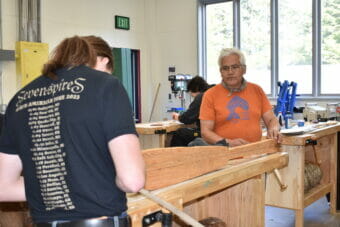
Lingít Master Carver Wayne Price is returning to the University of Alaska Southeast as part of its Northwest Coast Arts program. 

“The attention being paid to all branches of Northwest Coast Native art. I really feel the support out here at UAS,” Price said.

He will be teaching carving courses and formline design classes.

Both art forms have beginning, intermediate and advanced curriculums, but some of the classes are combined. Price says the formline class is intensive. 

“In my formline class, they were sweating,” Price said. “It seems they were trying so hard.”

Price said he only found out last week that he would be teaching this term, but he thinks his classes will fill up fast. Students in the beginning carving class will be making paddles, while intermediate and advanced students can choose their projects. 

“So they have the benefit of an artist who’s got 50 years of Northwest coast art under my belt. And I bring that all here to the University of Alaska, at Áak’w,” Price said. 

Price has taught at UAS before. Since then, he has carved dugout canoes — or yaakw — with high schoolers across Southeast Alaska and most recently unveiled a healing totem at Twin Lakes in Juneau, which was built in remembrance of missing and murdered Indigenous women. 

Price lives in Haines with his wife, but he moved to Juneau for the semester. He said he doesn’t yet know if he’ll teach in the fall.

“I’m just taking it one semester at a time,” he said. “And let’s see how it goes.”

A UAS spokesperson said that anyone interested in taking one of Priceʼs classes can call the registrar’s office to ask if there is space.

Panel picks five nominees for new chancellor of University of Alaska Southeast

Photo of the UAS sign in Juneau
The main University of Alaska Southeast campus is located near Auke Bay in Juneau. (Photo by Bridget Dowd/KTOO).

A search committee has picked the chairman of Sealaska Corp. and four education officials as finalists to serve as the chancellor of the University of Alaska Southeast, one of three main branches of the University of Alaska System.

On Monday, the university announced the shortlist of candidates for the job that will open when current chancellor Karen Carey retires at the end of June:

  • Lisa Parady, executive director of the Alaska Council of School Administrators
  • James Taylor, senior associate vice president at Utah State University
  • Aparna Palmer, vice president of Front Range Community College in Colorado
  • Cathay LeCompte, division director of the Alaska Vocational Technical Center in Seward
  • Joe Nelson, chairman of the board of directors of Sealaska Corp

The chancellor of UAS serves as the university’s chief executive officer and will be appointed by University of Alaska President Pat Pitney.

In a brief statement online, Pitney said the finalists “are all leaders chosen from a pool of diverse and highly qualified candidates.”

UAS has a main campus in Juneau and satellite campuses in Ketchikan and Sitka; with about 2,000 students, 170 faculty, and 170 staff, it’s the smallest of the trio that includes the University of Alaska Fairbanks and the University of Alaska Anchorage.

The five finalists will visit the campuses  in Juneau, Ketchikan and Sitka in late January and early February, and a final selection will be made after those visits, likely in the middle or end of February, Pitney said.

‘Black Lives in Alaska’ highlights more than 150 years of African American history

The cover of the book Black Lives in Alaska, showing two Black men dressed partly in furs.
“Black Lives in Alaska: A History of African Americans in the Far Northwest” is written by Ian Hartman and David Reamer. (Courtesy of the University of Washington Press)

Despite their small population, Black Alaskans have a history in the state that stretches back more than a century.

That history is the topic of a new book, “Black Lives in Alaska: A History of African Americans in the Far Northwest,” written by Ian Hartman and David Reamer.

Author and historian Hartman says while most of early Alaska history focuses on territorial days and the Klondike Gold Rush, Black people lived and worked in the region long before.

Listen:

The following transcript has been lightly edited for clarity.

Ian Hartman: You’re not really talking about Alaska really coming under U.S. control until the 1860s and 70s. But there is an Alaskan Black presence that predates even the treaty of purchase that I think people would be a little bit curious about. And that really has to do with the whaling industry. And so, if we think of the high era of North Pacific whaling in the 1840s, ’50s, and ’60s, and into the ’70s and ’80s even, the whaling crews would have been exceedingly diverse. And among the whalers would have included a pretty sizable population of Black whalemen.

Wesley Early: In recent years, one of the more storied pieces of Black Alaskan history has to do with the building of the Alaska Highway by Black soldiers in World War II. But your book highlights a lot of other contributions around that same time period, including during the Aleutian Islands campaign. Can you talk a little bit about those soldiers in Attu and Adak?

A black and white photo of two men using a bulldozer to build road through boreal forest.
Black soldiers were segregated and marginalized in the lead-up to World War II, but they proved their mettle with their work on the Alaska Highway. (U.S. Army/University of Alaska archives)

Ian Hartman: Yeah. So as you pointed out, oftentimes, we think about the Alaska-Canadian Highway having somewhat of a sizable Black troop presence to build that. But there is this other component, which would have been the Aleutian campaign. And so if we, even kind of shift our view, farther to the West, we see that Black troops were involved in that campaign, mostly in a logistical capacity. Remember, this is still very much so a segregated military. So the troops that were there were somewhat mistreated. They did not receive the same level of accommodations as their white counterparts. But nonetheless, they were really central in retaking the islands from the Japanese in 1942. And so they were involved in building runways and creating some of the infrastructure for the campaign.

Wesley Early: How do you think the post-war experience of Black Alaskans compared to black people living in the rest of the country?

Ian Hartman: What does make Alaska exceptional when we’re referring to the African American population is that, of course, the largest kind of visible minority population in Anchorage and through much of Alaska in the 20th century, of course, is the Alaska Native population. And then of course, you have an Asian American, Pacific Islander population. The Black population has kind of been in that mix in this broader pantheon of diversity. And so I think when you’re writing about Alaska’s Black population, it is different from say, writing about maybe Detroit or Chicago, or where I’m from in Pittsburgh, Pennsylvania, where the Black population is really the single largest minority population. And so I think, discussing Black history in Alaska, you have to kind of do so in correspondence with these other populations, as well.

A man sitting by a microphone
University of Alaska History professor Ian Hartman. (Wesley Early/Alaska Public Media)

Wesley Early: As a non-Black person writing about Black history in Alaska, could you describe your process for making sure that your writings were reflective of those communities’ lived experiences?

Ian Hartman: When I started this project, it was really intended to be kind of a one-off, like a one chapter project. And it became quickly clear to me that it’s an incredibly rich history that really merited a far more extensive treatment. And so I think once I realized the depth of the history and the amount of people who contributed to it, it became… it kind of took on a new life. And at that point in time, I think your concern or your question becomes really important, which is how do you get community stakeholders involved? How can you bring elders into this to really share their story? And so I think the way that I’ve really tried to do that is to reach out to folks in the community to make sure that the history is, A: correct, but even more than that, that their voices are being included. And so I think oral history becomes very important to a project like this. Rather than just kind of going through newspapers and getting a sense of what was written about people, actually including the people who live that history in the book itself. And that’s been something that I’ve really taken away from this project. I think probably the most important part of it is almost that it’s collaborative and community based, rather than just kind of unidirectional about me going through archives or, you know, writing about experiences. But actually finding the folks who live this history who’ve contributed to the community and ensuring that their voices are represented.

Wesley Early: You talked a little bit about the sort of misconceptions around Alaska exceptionalism and the history that a lot of people commonly accept as Alaskan history. What do you think Alaskans would be most surprised about in your book?

Ian Hartman: Well, I, you know, I think it would be a combination of things. The first is that yes, there is this vibrant history of social mobilization and social movements here in Alaska. It’s also the case that Alaska has some of the same strains of racism and discrimination that one finds elsewhere. But again, I mean, people aren’t simply reactive. They’re community builders, right? And so it’s not simply the case that people are always kind of dealing with one wave of hostility or racism, but it’s instead that people are kind of proactively building community and building resistance. And so I think that that’s a really important piece of this that maybe isn’t always represented in Alaska’s history when we just look at say, the “great men” right? The legislative leaders, the folks who were responsible for the statehood movement. I think that there’s a whole other history of Alaska that is about the people and it’s about our diverse communities. And I think sometimes we forget how that diversity has really shaped our history.

University of Alaska graduate student employees seek to unionize

The University of Alaska Anchorage campus on Dec. 30, 2021. (Lyndsey Brollini/KTOO)

University of Alaska students who do academic research, teaching and support work are seeking to unionize. The Alaskan Graduate Workers Association would represent 425 academic student employees, about 80% of whom work at the University of Alaska Fairbanks.

UAF biology graduate student and research assistant Abigail Schiffmiller, one of the organizers, says the union would mostly represent graduate students who work as research, teaching and support assistants. She says compensation is a key driver of the effort.

“The cost of living in Fairbanks and Anchorage has increased a lot in recent years, but the pay increases through the university have been minimal and sporadic,” Schiffmiller said.

She said a union could also address health care and working conditions.

“There’s also concern about kind of grievance procedures and workload and transparency,” Schiffmiller said. “But ultimately, baseline is that we want to have a seat at the table. We want to be involved in (the) decision making process for decisions that affect our lives.”

According to a news release, the Alaskan Graduate Workers Association is the first academic student employee group in the state to file for union recognition, and the University of Alaska is the only high-level research institution on the west coast that does not have a student employee union.

Schiffmiller says they are organizing under the umbrella of the UAW, a national labor organization which already represents 100,000 higher education workers. She says organizers gauged interest by sending out cards to them this fall.

“We actually got a supermajority to sign cards,” she said.

Schifmiller says an authorization petition was submitted to the Alaska Labor Relations Agency Dec. 9, and on the same day a letter was sent to University of Alaska President Pat Pitney requesting voluntary recognition of the union.

In a written response, UA associate vice president of public affairs Robbie Graham said Tuesday that the university is “reviewing the petition, to better understand definitions, who would be covered in the bargaining unit and the needed level of support.”

If the university does not voluntarily recognize the union, Schiffmiller says the Alaska Labor Relations Agency will verify the list of employees in the group, and a formal vote on unionization will follow.

Site notifications
Update notification options
Subscribe to notifications