Suzie Teerlink holding a whale blubber sampling dart. Sept. 16, 2022. (Photo by Yvonne Krumrey/KTOO).
The pandemic offered a unique chance for scientists to sample stress levels in whales while there was minimal tourism activity in Juneau’s waters. Federal biologists took advantage and took samples in 2020 and 2021.
In 2022, tourism was almost back to pre-pandemic levels, so samples taken this year will show the difference in the whale’s stress levels when there are and aren’t boats in the water all summer.
Suzie Teerlink studies whales and coordinates whale watching practices with NOAA’s Whale SENSE program in Juneau.
For the study this year, researchers collected samples of the stress hormone cortisol from whales in Juneau waters. Teerlink said they take those samples from blubber, which stores the hormone longer than blood does.
“In blubber, it takes weeks and months to accumulate,” she said. “And so we’re getting more of a cumulative average of what their physiological stress environment has been in the weeks and months prior.”
That also makes sure that the sample doesn’t reflect the whale getting temporarily stressed out by the dart that takes the sample. Teerlink said the whales often show that they feel it a little bit, sort of like a bee sting.
“Generally speaking, after we take a biopsy sample, we do monitor whales for some period of time,” she said. “And by and large, they go back to what they were doing before, so we think that it’s a pretty small impact.”
A 2019 study used instruments posted on land that observed the whales without influencing their behavior. The instruments record respiratory rates, dive patterns and speeds of whales. This tracked the more immediate behavior differences, minute by minute.
“And what they found is that, especially as the number of boats increased, they did see faster swimming speeds, faster rates of respiration, longer downtimes, and changes in direction,” she said.
That study was led by Heidi Pearson with the University of Alaska Southeast. Pearson is also the lead investigator for this year’s stress study.
Pearson said they biopsied 24 whales in total and will use photographic data to track which whales are coming and going.
“We’re also trying to determine if there’s a change in residency, or how long whales are here each year,” Pearson said. “And also how many whales are here each year, because we predict that there might be changes in how many whales are here, or how long they stay, depending on the vessel traffic.”
Teerlink, Pearson and their research group are expecting results from this latest round of data next spring, which will be just in time to help better inform whale watching practices in Juneau for next season.
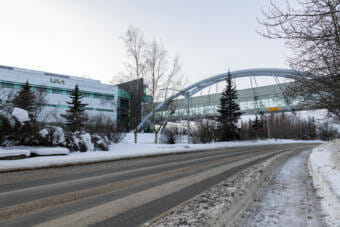
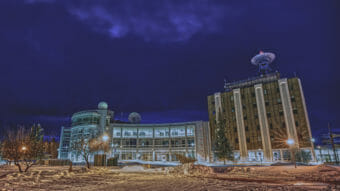
The main University of Alaska Southeast campus is located near Auke Bay in Juneau. (Photo by Bridget Dowd/KTOO).
The University of Alaska’s administration and its faculty union reached a tentative agreement on a new contract Monday, ending 14 months of negotiations. The sometimes contentious process resulted in both parties filing unfair labor practice complaints, which are still ongoing.
Faculty union president Abel Bult-Ito said he’s “relieved” negotiations are over, “but I don’t think anybody’s very happy about the outcome.” Bult-Ito is professor of neurobiology and neurophysiology at the University of Alaska Fairbanks.
“The raises are not what they should be. We’re looking at 8% cost of living increases and, you know, the best we were able to do was 3% in the first year,” he said.
The contract includes increases of 3%, 2.75% and 2.5% over three years, which are slightly higher than the administration’s original “best and final offer” of 3%, 2.5% and 2%. The contract is retroactive to July 1, 2022. To provide back pay for the salary increase, the university will request as a supplemental budget item in the coming legislative session, according to the university’s press release issued Tuesday. The overall compensation increases will be included on the university’s budget request submitted to the Legislature for funding approval.
“Financially speaking, it’s a minimal package, but it’s the best we could do,” Bult-Ito said. The union, United Academics, conceded to the administration’s salary offer at the end of July.
The union had originally sought salary increases of 5%, between 3% and 7%, and between 3% and 6% over three years, with the latter two years’ increases determined by the consumer price index. Union members have received one 1% increase over the past six years.
Several steps need to occur before the agreement is enacted. For United Academics, the tentatively agreed upon contract needs to go through the union’s executive board and the representative assembly before going to a vote of the membership. For the university administration, next steps include approval by the Board of Regents and the Alaska Department of Administration.
“We are thankful that this process is resolved,” University of Alaska President Pat Pitney said in the release. “We value our faculty and want to ensure a stable working and learning environment.”
Aside from increases to faculty pay, the university said that the tentative agreement includes increases to the pension wage base, expands the use of faculty development funds and provides for changes to the dispute resolution process.
For a few months, both parties’ negotiating teams had been meeting in federal mediation sessions. To get to this tentative agreement, Bult-Ito said the parties were communicating over email.
He said he hopes United Academics’ membership ratifies the tentative contract, which includes this clause: Any future, higher raises given to other employee groups will also be given to United Academics faculty.
“So we have an opportunity to hopefully work with the university and the Legislature to get some more raises for all employees of the university, which is really necessary,” Bult-Ito said. “I’m hoping we can repair our relationship with the administration and move forward together so that we can properly compensate all employees at the university.”
Both the union and the administration filed unfair labor practice complaints with the Alaska Labor Relations Agency – the union in August and the administration in September. The state agency is still collecting briefings for both complaints. Once they’re all in, the hearing officer will be able to complete investigations and issue findings.
“Probable cause that an unfair labor practice occurred will either exist or not. And if she finds that it exists in one or both cases, then she will engage in conciliation with the parties and try to see if they can settle this that way informally,” said Nicole Thibodeau, Alaska Labor Relations Agency administrator and hearing examiner.
If probable cause is found but not reconciled informally, then the Alaska Labor Relations Agency board will conduct a full hearing and issue a decision determining whether an unfair labor practice has occurred and what the remedy is.
A group of students gather to observe Fairbanks Transit Bus 142 at the Engineering, Learning and Innovation Facility Wednesday, October 6, 2021 at the Fairbanks campus. (JR Ancheta/UAF)
A $500,000 federal grant will help the University of Alaska Museum of the North preserve Bus 142, popularized by the book and movie “Into the Wild.”
The funding comes from the National Park Service and the Institute of Museum and Library Services, through the Save America’s Treasures program. Angela Linn, a museum collections manager, said the award will help cover the costs for preserving the 1940s-era Fairbanks public transit bus.
“Freeze it and document it in its current state, because the most famous part of it was from 1992 when Chris McCandless was there,” Linn said.
McCandless’ death from starvation at the bus 30 years ago drew travelers from across the world, at least two of whom died trying to reach it. In 2020, a helicopter removed the bus from a spot near Denali National Park and Preserve and moved it to Fairbanks.
Linn said the first step in the preservation process is stabilizing the bus’ structure.
“Making it safe for people to walk around in it, for us to move the bus to the exhibit site,” Linn said. “But it’s also about preserving the surface of the bus both inside and outside, so that we can preserve all the graffiti and all the epitaphs that have been placed on the surface of the bus.”
Linn said the grant will cover the cost of hiring a preservation company to do the work.
“This very well-known and well-respected conservation team out of Pennsylvania, BR Howard and Associates,” Linn said. “And they’re the one who came last summer and did the condition assessment of it and prepared a proposal to us and we used that proposal to get the funding.”
Although the project is focused on preserving the bus as is, Linn notes that because it will eventually go on display outside, missing and broken windows will be replaced. The plan calls for exhibiting the bus behind the museum on the University of Alaska Fairbanks campus, in a fenced area protected by a shelter.
“So that the direct sun and the snow and the rain and the heavy-duty element exposure will be a little bit lessened,” Linn said.
Linn said another grant is being applied for to build the bus shelter. The museum is also working with the nonprofit group Friends of Bus 142 to raise money. Linn said the museum hopes to open the bus exhibit in 2024.
In the meantime the public can view the bus as it’s being worked on inside UAF’s Usibelli Building, as well as via webcam.
The upper atmosphere-heating facility named HAARP is located on about 5,000 acres between the small Alaska towns of Glennallen and Tok. (Photo by Ned Rozell.)
The University of Alaska Fairbanks is operating the High Frequency Active Auroral Research Program facility, or HAARP, for 13 projects this month. The projects are the latest made possible by federal support for the ionospheric research facility in Gakona.
In 2021, the University of Alaska Fairbanks received a five-year, $9 million grant to establish and operate the Subauroral Geophysical Observatory for Space Physics and Radio Science at HAARP.
HAARP research support services lead Evans Callis says this month’s research campaign is funded by the National Science Foundation.
“They help us with the funding aspect to make the program happen, and we work directly with the scientists to make their work happen,” Callis said.
Callis calls the 10-day campaign, which runs through Oct. 28, unprecedented.
“The most experiments that we’ve had under our NSF grant that we’re currently operating under,” he said. “Also, the most diverse set of experiments that we’ve had.”
And it’s not all hard science. Among the projects is part two of an endeavor that uses HAARP’s high-power radio transmitter for art. It involves transmitting a signal into the ionosphere which can be picked by ham radio operators around the world and decoded into low-resolution TV images.
“Narrow band television video art — it also includes spoken word and sound art,” Callis said. “It’s kind of a collaborative work between the artist and the amateur radio community to kind of make the artwork happen.”
Canadian artist Amanda Dawn Christie first transmitted art via HAARP in 2019. The other dozen projects being conducted using the HAARP facility are scientific, including a NASA experiment that involves bouncing a signal off the moon.
“Very similar to ground penetrating radar actually,” Callis said. “You know we use that here on earth, but we’re applying it to figuring out the composition of asteroids, the moon, things like that.”
Another HAARP experiment aims to better understand a low-altitude, aurora-like atmospheric glow known as Strong Thermal Emission Velocity Enhancement, or STEVE. Callis says the experiment uses HAARP’s transmitter to send out so-called hot electrons thought to cause STEVE.
“And if we see that air glow and it matches the wavelength of light that we see from naturally occurring STEVE, that would give us indication that the hot electrons are playing some role in the formation of STEVE,” he said.
HAARP was built to conduct experiments in the earth’s ionosphere, but another project happening this month employs it to probe a similar electrically charged region over Jupiter, the giant gaseous planet 374 million miles away.
“This is a first-of-its-kind experiment (which) at least to my knowledge has never been attempted before,” Callis said. “We transmit several different frequencies from HAARP directed at Jupiter. We listen for the echo that returns, and that should be able to tell us something about electromagnetic conditions around Jupiter.”
The wide array of projects underscores the enduring scientific research value of HAARP, which began in 1993.
Callis says it remains the most powerful and flexible instrument of its kind in the world, and attributes this month’s research campaign to the NSF funding which provides for maintenance and prolonged viability of the facility.
“And the sense of security that brings helps scientists feel more comfortable coming up with a proposal to make use of the facility,” he said.
Scientists with NASA, the Naval Research Laboratory and Los Alamos National Lab, as well as numerous universities, are involved in this month’s HAARP research campaign.
The defense table, at left, and the prosecutors, right, listen to Superior Court Judge Thomas Temple (not pictured) describe sentencing for Steven Downs.(Screenshot)
Steven Harris Downs was sentenced yesterday to 75 years in jail for the 1993 rape and murder of Sophie Sergie in a dormitory bathroom at University of Alaska Fairbanks.
The case baffled investigators for decades and became notorious because of the circumstances: a young woman stabbed and shot while she was visiting friends at college in Fairbanks right before finals week that spring. Among the potential hundreds of witnesses in the dormitory complex, no one had enough evidence to give Alaska State Troopers a solid suspect.
In 2018, DNA science provided a breakthrough. A sample on the victim was matched to Downs, who was living in Bartlett Hall that semester, one floor up from where the victim was found.
“The murder and rape took place in a woman’s restroom on the UAF campus in the woman’s floor of a dormitory, and the women’s restroom is an area where women are likely at their most vulnerable, but this is the location Mr. Downs chose to invade and commit his crimes,” said Superior Court Judge Thomas Temple.
Temple presided over the trial last January and listened Monday to pre-sentence reports from prosecutor Jenna Gruenstien and Defense attorney James Howaniec.
Gruenstein asked the judge to consider factors to influence a longer sentence: the use of multiple weapons in the crime, both a knife and a gun, as well as using a murder to prevent the reporting of a sexual assault.
“Whether they’re aggravators by analogy, or just factors that the court considers and places weight on (for) implementing the appropriate sentence — so in this case, the court has very wide discretion in the murder in the first degree sentence, 20 to 99 years to impose,” she said.
The judge said he would use the 1993 sentencing guidelines.
“To the charge of sexual assault in the first degree, the court is required by law to impose exactly an eight-year term of incarceration, and the court has no discretion to deviate from that number according to the laws in effect in 1993,” Temple said.
Defense attorney Howaniec asked the judge to consider Downs’ health and approach sentencing from a more “practical” approach.
“I’ll be honest, Judge. The way we’ve approached this is really more on a practical plane. Steve is 48 years old now. He’s over 400 pounds. He’s got very high blood pressure. I think that his life expectancy is not gonna be, you know, 103 years old here. Anything in excess of a 20-year sentence, that’s gonna be bringing him to near the end of his life under the best of circumstances,” Howaniec said.
Downs attended University of Alaska Fairbanks from 1992 to 1996. He lived in Arizona for a while and returned to his home state of Maine. Both the state and the defense noted Downs had no criminal record before, and had no known criminal activity since.
“We asked the court to consider the intervening nearly 30 years. He’s been nothing but a model citizen. He became a nurse, one who cared for hundreds if not thousands of patients. He’s really been a model prisoner at the Fairbanks Correctional Center. He’s helped his fellow prisoners there with everything from their GEDs to help helping to counsel them if they’re dealing with depression or substance abuse issues. He was on the Dean’s List multiple semesters for the remainder of his four years at UAF and then went on to be successful, without a criminal history for the next 30 years,” Howaniec said.
The victim’s brother, Alexi Sergie, was on the phone from Western Alaska before Monday’s hearing began, but the call was dropped before he could testify about the effects his sister’s death had on his family. He did not rejoin the hearing, even after a recess. Friends of the victim were ready to testify, but Judge Temple said it was not appropriate for this hearing.
“I will note that there’s no sentence this court could impose that there be adequate restoration to Ms. Sergie’s surviving family or her extended support network. There’s nothing the court could do to restore those folks,” Temple said.
Steven Downs, himself, did not say anything at the hearing. Howaniec says Downs maintains that he is innocent of the crimes.
“With regard to murder in the first degree, the court imposes a sentence of 67 years. Time to serve court is imposing the eight years of time for the sexual assault consecutive to the 67 years for murder in the first degree. The composite sentence is going to be 75 years,” Temple said.
Under Alaska law, Downs could be released after he serves one-third of his sentence, or 25 years.
During a recent open house, visitors walk their dogs beneath an antenna field used to heat the upper atmosphere during space physics experiments at a facility known as HAARP between Glennallen and Tok. (Photo by Ned Rozell.)
In this wild place where dump truck drivers once tipped load after load of gravel onto the moss to make roads and building pads, scientists rolled open an iron gate one recent Saturday afternoon.
They invited in conspiracy theorists, reality-TV hosts and salmon fishermen from Chistochina to the grounds of a mysterious antenna field. It’s a facility that some claim has caused caribou to walk backward. It has been rumored to activate earthquakes and to hold human souls in a sort of northern purgatory.
Scientists were a bit to blame for all the allegations of weirdness out here between the Copper and Gakona rivers. First off, they used an acronym to name it — HAARP, which stands for High-frequency Active Auroral Research Program.
That acronym added to the mystery of the field of antennas, which can heat a region of space far above our heads with radio waves powered by five powerful diesel generators, each the size of a fuel truck.
The science of studying a region we can’t see by perturbing it with enough electricity to power a small city — located in a place where wolves and bears pad along silently across its few gravel roads — is hard to wrap your head around.
A few people really do understand HAARP, though. They were standing on those smoothed piles of gravel that Saturday, when the foreboding metal gate clicked open.
My former boss, Sue Mitchell (now retired), initiated this “open house” a few years ago. She was there again in 2022, greeting people at the first table of the first building visitors walked into. I asked her why.
“So we could be as transparent and open as possible,” she said. “Throw open the gate, and show people what’s here.”
When she worked at the Geophysical Institute, Mitchell took the considerable hit of answering phone calls about the HAARP facility. She had no answers for people who were sure the antenna field was somehow controlling their minds.
“My hope has been, by showing people what really goes on, the facts will speak for themselves,” she said. “That doesn’t always work. People sometimes make decisions emotionally, not always based on the facts.”
It doesn’t help when the facts are so hard to understand. Here’s a try:
The antenna field at this 5,408-acre site, far from any Alaska town, was first a chunk of black-spruce forest and wetlands that U.S Air Force officials purchased from the Native corporation Ahtna in 1989. The idea was to use the location to build an over-the-horizon radar that would allow technicians to observe bombers or missiles that might be headed for America over the pole.
Due to the end of the Cold War, that radar was never built. Instead, Air Force workers installed a field of 18 antennas that broadcast high-frequency waves up to the ionosphere, the region of space that is home to the aurora.
The antenna field over the years grew to 180, each powered by two transmitters. A researcher has called it the world’s largest ham radio.
The upper atmosphere-heating facility named HAARP is located on about 5,000 acres between the small Alaska towns of Glennallen and Tok. (Photo by Ned Rozell.)
HAARP is a group of high-frequency radio transmitters (in the ham-radio band) powered by five diesel generators — four from tugboats and one from a locomotive. When activated, the transmitters send a focused beam of radio-wave energy into the ionosphere, 50-600 miles overhead.
Since it opened in 2003 with funding the late Sen. Ted Stevens helped secure, HAARP has hosted many scientists doing basic science on the auroral zone.
Others used it to do applied research for the military. In one study, researchers used the antenna array to heat a part of the ionosphere that in turn acted as a low frequency antenna that could send an ocean-penetrating signal to a submarine. That ping could tell a submarine captain to surface in order to receive conventional radio communications.
This place almost fell to bulldozers in 2012, when the Department of Defense wanted to get out from under the cost of running the facility — which includes about $250,000 each year just to heat the dozens of transmitter buildings in the winter.
About then, Bob McCoy, the director of the Geophysical Institute and a space physicist himself, lobbied for the institute to take over the site. Scientists rallied around him, as did the university president at the time.
At the same time, leaders of the National Research Council held a workshop about HAARP. They wrote a 70-page report on science that could be accomplished with the facility.
“Even though it’s esoteric and hard to understand, it’s the best,” McCoy said in 2015.
The university administration gave McCoy a loan to keep HAARP running. He gambled that he could pay it back by drumming up business from scientists. They would use the transmitters and pay for it with grants from funding agencies. That gamble is paying off, with a new 5-year grant from the National Science Foundation.
McCoy was there at the entrance to HAARP, too, answering questions from people like Michael Lewis of Anchorage.
Geophysical Institute Director Bob McCoy poses with visitor Michael Lewis from Anchorage during a recent open house of the ionosphere-heating facility known as HAARP between Glennallen and Tok. (Photo by Ned Rozell.)
Lewis, who wore a baseball hat he had covered with tin foil (apparently for fun), said he had always wanted to see the facility. McCoy posed for a photo with him.
Visitors were allowed all over the grounds of the facility during the open house. Swampy ground limited them to driving and walking the few miles of road and gravel pad, including the dormant transmitter array.
Scientists and engineers were stationed at strategic points to explain what the complicated equipment did when it was on. A few guests were ham-radio enthusiasts, but most seemed to be just curious people.
After the five-hour open house ended, the black gate shut behind the final car. Then, HAARP reverted to what it is most of the year: a silent pile of gravel sprouting with antennae. There, songbirds on their way south flitted through the spruce and on the ground beneath the antenna masts.
Close
Update notification options
Subscribe to notifications
Subscribe
Get notifications about news related to the topics you care about. You can unsubscribe anytime.