University of Alaska

Iconic Fairbanks satellite dish helps map floods thousands of miles away

Two research buildings on a hill. The one on the right is older and has a large satellite dish on its roof, pointed up.
The Elvey Building (right) on the University of Alaska Fairbanks campus is home to the Geophysical Institute and Alaska Satellite Facility. The Akasofu Building (left), houses the International Arctic Research Center. (McKade Sorensen/Alaska Satellite Facility)

A German American scientist has flown from Fairbanks to present at a conference in Chicago about satellite research of the Himalayas, as well as Central and South America.

If that all sounds rather global, well, that’s exactly the kind of collaborative and far-reaching work happening at NASA’s Alaska Satellite Facility, based at the University of Alaska Fairbanks’s Geophysical Institute.

Franz Meyer is a professor of remote sensing at UAF and the Satellite Facility’s chief scientist. Like many other researchers, he’s at the American Geophysical Union’s annual conference this week.

As Meyer explains, the work he’ll present is about the benefits of using satellites to map what’s happening on the ground in flood-prone areas, even if they’re covered by trees or clouds.

Listen:

The following transcript has been lightly edited for clarity.

Franz Meyer: It has these capabilities to penetrate through clouds and observe during day and night. So the communities in, say, Central, South America and Hindu Kush Himalaya, they are very interested in using these datasets and using them mostly for disaster management, food security and ecosystem stability monitoring. So, you know, there’s a local interest, of course, for local food security. These events affect the availability of food resources in the area, and also livelihoods. You know, how many people and what population is affected, etc. But on a global scale, one of our other partners in these projects, for instance, is the U.S. Department of Agriculture, and specifically the Foreign Agricultural Service. They need to know impacts of weather events on agriculture to understand things like food availability, market prices for different crops, etc., for these bigger events, like the monsoon rains in the Hindu Kush Himalaya. It has global implications on prices and availability of certain resources.

Casey Grove: Tell me about why that particular type of satellite is valuable for the work that you’re doing.

Franz Meyer: So radar remote sensing is useful because at microwave wavelength, signals can penetrate through the atmosphere, even during cloudy conditions. The 24/7 capabilities is great for Earth observation. So we put these radar systems on satellites and let them image and look at the surface. And we can use repeated observations to look for changes of the earth environment, both changes of the structure such as deforestation, agriculture growth, urban sprawl, etc. But we can also look very closely at surface displacement. If you think of, you know, volcanic eruption, or active volcanoes, or earthquakes or permafrost domes, the ground in these areas is going up and down and moving with the geophysical activity. And radar is just really good at measuring distances. And so by looking at and tracking distances over time, we can measure millimeter to centimeter scale surface displacements that relate to a lot of natural hazards and to a lot of the geophysical phenomena that we have here in Alaska.

Casey Grove: Gotcha, yeah. So now I’m going to ask you, why is someone based in Fairbanks doing this kind of work? And, I mean, maybe that gets to the technology and how the satellites work, and why the Alaska Satellite Facility is where it is. But why you? Why Fairbanks?

Franz Meyer: Part of this is because of the Alaska Satellite Facility. ASF was created originally as what’s called a ground station. So we operate a number of NASA-owned communication antennas to communicate with Earth observation satellites. And because these satellites are passing usually over the pole, the further north you are in latitudes, the more often you can see these satellites. So putting a ground station at high latitudes makes sense, because you have more contact, and you can download more data and an uplink more commands to the satellites than in lower latitudes. And so Fairbanks was picked at the time in the 1990s because it was the northernmost U.S. city that had stable power.

Casey Grove: Franz, I wanted to ask you just about the the blue dish on top of the Geophysical Institute. I know that the Satellite Facility uses other dishes, and that’s not the only one. But that’s kind of an iconic thing at this point, right? When you look up at West Ridge at the University of Alaska Fairbanks and you see that, it’s just part of that skyline, right?

Franz Meyer: Yeah, Casey, that’s a very good point. So, you know, a lot of people in Fairbanks and maybe in Alaska recognize the blue dish on the university campus on top of the GI building. It was put on the roof in the 1990s. We, overall, we operate currently four dishes, but this is the one that’s known to most people. It was actually replaced a few years ago, upgraded to have more broadband capabilities and be able to download more datasets. And one of the funny things we got from from the community here in Fairbanks is to make sure that the dish is blue again. It, sort of, was so iconic, that people didn’t want that to change. So that was one of the main input we got from Fairbanks itself was to make sure that the new dish that we put up there is blue. And of course it is again.

Casey Grove: Why was it blue to begin with?

Franz Meyer: So I was not around at the time, but my understanding is that it was to have it blend in more with with the sky and be a little bit less visible. You know, people didn’t initially like the idea of having this dish on the building. And so that helped, a little bit, alleviate people’s concern. But I think now it’s just an established part of the skyline here in in Fairbanks.

Casey Grove: Yeah. Well, so, we’ve talked a little bit about the past for the Alaska Satellite Facility, and then what you’ve been working on here, you know, currently that you’re gonna go present at the AGU conference. What’s the future for ASF? What, you know, I guess in the near term, what are you looking forward to?

Franz Meyer: Yeah, so, ASF, actually already over the last few years, we have been preparing ourselves for a very large upcoming mission that is being launched by NASA. There is a mission that’s called NISAR. So that mission is a collaboration between NASA and India. And it’s going to be launched in 2024. And it’s going to provide unprecedented data for monitoring dynamic signals on the planet. It’s going to provide unprecedented data volumes. The mission will provide about 50 petabytes of data per year. And so over three years, to give you sort of a scaler, this mission alone will provide more data than NASA currently holds in all of our archives combined. And we at ASF are the ones that will hold all these datasets. We’re also a downlink station for NISAR, so we’ll bring some data directly down through the dishes in Fairbanks into our archives.

Mislabeled photos, newly discovered at UAF, bolster 1910 Denali summit claim

A man points at a map and photos on a laptop.
Professor of geophysics Matthew Sturm points to the Sourdough expedition’s path in summiting Denali 1910 from studying newly found photographs located at the Elmber E. Rasmuson Library archives. (JR Ancheta/UAF-GI)

There’s new proof of the success of a pioneering ascent of Denali. Historic photographs from the 1910 Sourdough expedition were found this fall at the University of Alaska Fairbanks.

The black and white images provide hard copy evidence that Alaskans Pete Anderson, Billy Taylor, Charlie McGonagall and Tom Lloyd — known as the Sourdough expedition — got members to the top of Denali’s 19,400-foot North Peak in April 1910 — a feat that’s long been subject to skepticism.

“They went,” said UAF geophysics professer Matthew Sturm, who found the photos. “They did the climb, but they were not good about documenting it.” 

A black-and-white photo of two men in historic winter gear with snow goggles standing on a mountain.
In this photo, previously unpublished as far as is known, Charlie McGonagal, left, and Pete Anderson, two of the four-man Sourdough expedition that ascended Denali’s North Peak, are shown in a mislabeled photograph. (Photo from UAF Rasmuson Library archive)

Sturm says he came across the Sourdough expedition photos in October while doing research for an unrelated mountaineering book at the UAF Rasmuson Library archive. He says he was looking through a box of materials and found a folder with a label that included the words 1911 McKinley climb.

He said he “got a tingly sense that maybe something good could come of this,” even though the date on the folder was off by a year.

Museum of the North Director Pat Druckenmiller and Senior Collections Manager Angela Linn with the alpine stock used by Pete Anderson and Bill Taylor 1920 ascent. (JR Ancheta/UAF-GI)

Sturm says one of the photos in the folder shows two climbers he immediately recognized.

“I’m a bit of an amateur history buff for climbing in Alaska and the Yukon, and I thought — whoa, that’s Charlie McGonagall and Pete Anderson from the Sourdough climb,” he said.

Sturm says he worked with University of Alaska Fairbanks archive and Museum of the North staff to confirm the identities of the pictured Sourdough climbers, including Taylor and Anderson, who he says made it to the north peak’s summit.  He says he figured out where the photos were taken by comparing them with modern images of the mountain.

“We could place them quite high on the route,” he said. “The highest one is near around 16,000 — and we’d never been able to place them anywhere near that before — for marvelous sort of insight into an event that has been revered by some climbers and doubted by others for a hundred and ten years.”  

Sturm says the photos add to another piece of evidence that the Sourdough expedition climbed Denali’s North peak: a spruce flag pole the climbers set up a little below the summit, which members of the 1913 Hudson Stuck expedition reported seeing. They were the first to reach the top of Denali’s higher south peak.

A black-and-white panoramic photo of a climber in the distance, high on a ridge on Denali
A climber is seen in the distance at about 13,000 feet on what today is known as Karstens Ridge. Indentations to the left are believed to be from a 14-foot spruce flagpole. (Photo from UAF Rasmuson Library archive)

“I think it moves it from shadowy, maybe it did or didn’t happen, right into the mainstream,” he said. “It happened.”

Sturm says the Sourdough expedition photos were donated to the UAF archive in the 1980s by the daughter of an early 19 hundreds Fairbanks newspaper editor who was friends with Sourdough expedition climber Billy Taylor. 

This photograph, made at about 16,500 feet, looks down the 20,310-foot mountain. Matthew Sturm and colleague Philip Marshall used maps and digital software to pinpoint the locations where the photographs were made. This photo is mislabeled as March 1911. (Photo from UAF Rasmuson Library archive)

“She donated a lot stuff to the archives, and they logged it in, and it would have taken an expert to know what it was,” he said.

Sturm says it remains a mystery why the photos weren’t used by expedition members to prove their summit claim. Sturm plans to write an article for a mountaineering journal about the photos.

University of Alaska faculty union ratifies contract

""
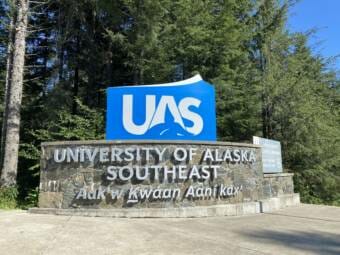
The entrance of the University of Alaska Southeast in Juneau as seen on May 25, 2022. (Photo by Lisa Phu/Alaska Beacon)

The University of Alaska faculty union membership has ratified a tentative contract agreement with the University of Alaska administration. United Academics certified the ratification vote results Monday.

The two parties reached the tentative contract agreement at the end of October, ending 14 months of negotiations. The sometimes contentious process resulted in both parties filing unfair labor practice complaints, which are still ongoing.

The union membership ratification is another step in the process toward implementing the contract. The Board of Regents approved the tentative contract during its November meeting. The final step is approval from the Alaska Department of Administration.

The tentative agreement includes faculty salary increases of 3%, 2.75% and 2.5% over three years, which are slightly higher than the administration’s original “best and final offer” of 3%, 2.5% and 2%. The contract is retroactive to July 1, 2022. To provide back pay for the salary increase, the university will request it as a supplemental budget item in the coming legislative session. The overall compensation increases will be included in the university’s budget request submitted to the Legislature for funding approval.

“Salary increases do rely on legislative appropriation and the Governor’s signature on the budget,” said Robbie Graham, University of Alaska associate vice president of public affairs, speaking on behalf of the administration in an email.

Faculty union President Abel Bult-Ito has “no doubt” that the legislature will fund it. He said ratifying the contract “provides some stability for the next couple of years” and shows “the unity of the union.”

About 50% of the union’s 677 eligible voters — or 344 members — voted. Of those, 324, or 94%, voted to approve the tentative agreement. Normally, only 30 to 40% of the membership votes, said Bult-Ito. But he thinks having part of the negotiation process open to the union members through Zoom increased interest. “Of course, we would like to see everyone vote but, you know, over 50% is a good deal,” he said.

Bult-Ito said the relationship between the union and administration is “still very strained but hopefully agreeing to the contract takes the pressure off a bit and improves it.”

During the lengthy negotiation process, both the union and the administration filed unfair labor practice complaints with the Alaska Labor Relations Agency — the union in August and the administration in September. The state agency is still collecting briefings for both complaints.

The two parties are due to be back at the negotiation table in August 2024.

This story originally appeared in the Alaska Beacon and is republished here with permission.

UAA to permanently expand master’s in social work program with $1.5M grant

Nine people stand on a stage, seven of them holding giant checks.
Representatives of various institutions that pitched in for a $1.5 million grant to the University of Alaska Anchorage’s School of Social Work pose for photos with oversized checks during a press conference at the university’s Fine Arts Building on Tuesday. The institutions represented include the Alaska Department of Health, Recover Alaska, Providence Alaska, Premera Blue Cross Blue Shield of Alaska, Alaska Mental Health Trust Authority, Southcentral Foundation and the Rasmuson Foundation. UAA Chancellor Sean Parnell and College of Health Dean Debbie Craig represented the university. (Photo by Jeremy Hsieh/Alaska Public Media)

After years of budget cuts to Alaska’s public university system, there aren’t many higher education programs that are growing. But on Tuesday, the coalition Recover Alaska announced it had put together $1.5 million to dramatically expand enrollment for master’s degree students at the University of Alaska Anchorage’s School of Social Work.

Recover Alaska works to reduce excessive alcohol use and harm. Executive Director Tiffany Hall said the nonprofit identified a chronic shortage of qualified social workers as a key issue perpetuating the state’s worst-in-the-nation status for alcohol-attributed deaths.

“For a person in active addiction, it is incredibly challenging to admit the problem and ask for help,” said Hall. “When they do, we need to be ready. But a lack of qualified providers throughout our state prevents people from accessing help when they need it.”

Right now, UAA’s School of Social Work has capacity for 35 students seeking master’s degrees with a clinical license, and graduates about 25 a year. The plan is to step up enrollment gradually, up to 85 students five years from now. The university plans to continue delivering the program online only.

Southcentral Foundation is one of the organizations funding the grant, and one of the biggest employers of behavioral health and substance use treatment providers in the state. The lack of qualified social workers stresses the existing system and hampers expansion, said Michelle Baker, executive vice president of behavioral health services for the Alaska Native-owned nonprofit health care organization.

“Southcentral Foundation alone has 20 master’s level therapist vacancies, primarily due to four program expansions that we’ve launched in the last year,” Baker said.

Rasmuson Foundation CEO Diane Kaplan said her institution and others that contributed funding are all potential employers. Someone with a master’s degree in social work can work in a variety of settings, from philanthropy to preventative therapy to crisis care.

“Employer-led initiatives like this are appealing to potential students because they know there’s a job at the end of the education,” Kaplan said. “And a choice of jobs, and good jobs and well-paying jobs in a competitive environment in the state for employees.”

The grant money is a one-time gift, but university officials said the expanded master’s program will be financially self-sustaining through student tuition.

Other donors include Premera Blue Cross Blue Shield of Alaska, Providence Alaska, the Anchorage Assembly, the Alaska Department of Health and the Alaska Mental Health Trust Authority.

Former UAS professor Sol Neely honored with a fire dish memorial in Juneau

Mourners gather at Noyes Pavilion at the University of Alaska Southeast campus for a fire dish ceremony honoring former professor Sol Neely. Nov. 12, 2022 (Photo by Andrés Javier Camacho/KTOO)

Sol Neely used to give lectures around a fire at an outdoor pavilion on the campus of the University of Alaska Southeast –— even on cold and wet November days. On Saturday, dozens of people gathered at that same spot to remember Neely at a fire dish memorial, a Lingít cultural ceremony.

Neely was a professor at UAS for more than a decade. He taught English literature and was a community advocate for criminal justice reform through programs like the Flying University, a higher education program inside Lemon Creek Correctional Center.

He died in October on a backpacking trip in Washington state, where he was living. Even though he left Juneau in 2020, there was still a large group of people left at UAS and throughout the community who wanted to gather and celebrate his life here.

Alaska Native Languages professor X̱’unei Lance Twitchell was a close friend of Neely’s. He led the fire dish ceremony, which serves as a way to give those who recently died food and messages of strength to prepare them for their long journey after death. The offerings are passed through the fire. 

“For our guests that are here that we share love with and courage, sometimes we offer abbreviated versions of our cultural ceremonies with them,” Twitchell said. “The way that we grieve, the ways that we move on as Lingít peoples. So we thought we’d offer a fire dish.”

Twitchell invited those in attendance to write names of anyone else they would like to honor on notecards to be added to the fire.

“Because we’re inviting them to come. The things that we offer to our ancestors we give to the fire,” Twitchell said.

Fellow educators and former students say Neely always approached his work with love for people and for place.

Éedaa Heather Burge was a student of Neely’s who now teaches Lingít language classes at UAS.

“He started reconnecting with his own Indigenous family identity and understanding at the same time I did,” Burge said. “He was an incredible example for what that looked like, as an adult, to build that community, to build those places, to build those relationships with people, both where you were transplanted and where you where you came from.”

She asked all of his former students to stand with her, and a dozen or so rose. 

“I’m not quite sure what we’re going to do now that he’s gone,” Burge said. “Aatlein gunalchéesh, Sol, for everything you’ve given us. You’ve laid a foundation, we’re going to keep building on it.”

Will Geiger said it was fitting that Neely’s memorial be held at the Noyes Pavilion, when he attended each class of Neely’s postcolonial literature class outside, even on cold November nights like this one.

“I’ve been thinking lately that Sol often talked about how, based off something Cornel West said, he considered time to be a gift and a giver, rather than a limitation placed on what we’re able to accomplish,” Geiger said. “And so I’ve been thinking about what a gift we all received, having Sol here with us, rather than an impediment it is that he left us sooner than we would have wanted him to.”

Many people talked about how much Neely loved his daughter. Neely’s wife and daughter were at the ceremony, but neither spoke.

Director of new film ‘Till’ got her start in Fairbanks

Director Chinonye Chukwu speaks to actor Jalyn Hall, who plays Emmett, on the set of “Till.” (Photo by Lynsey Weatherspoon/Orion Pictures)

The director of the recently-released movie “Till” studied film at the University of Alaska Fairbanks.

Chinonye Chukwu produced her first feature film in 2012 when she was a student at the University of Alaska Fairbanks. Her professor, Maya Salganek, said she came to UAF after finishing college elsewhere, to pursue writing.

“And (she) had taken some classes and ended up on a film set with me,” Salganek said.

Salganek’s students were making the film “Chronictown” in the winter of 2006.

“It was a tough shoot, and it was being outdoors all the time,” Salganek said. “And then there was sort of the, you know, it’s the boys club a lot of times in film. And I remember very clearly Chinonye and I having a real heart-to-heart at a tough moment, just saying, ‘Don’t let other people define you. Don’t let their version of you stop you from being the filmmaker you wanna be.’ And from there she decided, ‘Yeah, I don’t wanna be a screenwriter, I wanna be a filmmaker.’”

Chukwu went on to graduate school, returning to UAF in 2011 to produce the feature film “AlaskaLand” about the Nigeria to Alaska immigrant experience.

In 2019, she made “Clemency” about a prison warden dealing with executions and won the dramatic grand jury prize at the Sundance Film Festival, the first Black woman to take the top prize.

Now Chukwu has directed “Till,” about Mamie Till-Mobley and her efforts to get justice for her 14-year old son, Emmett Till, who was lynched in Mississippi in 1955.

Salganek has already seen the movie here in Fairbanks.

“There was one reporter whose review of it I read who said, ‘You need to see it, and you need to bring a teenager,’” Salganek said. “I think that was really insightful. I sat in the theater holding the hand of my own 14-year-old … and knowing how (far) we’ve come as a nation and yet how far we still have to go is very self-evident in the film.”

Speaking in an interview with National Public Radio’s Tonya Mosley this week, Chukwu described how her choices as a director for the film focused on justice, rather than the crime.

“A key was to show him in a humanizing way through Mamie’s emotional point of view, as opposed to the camera taking on a voyeuristic lens and objectifying him,” Chukwu said. “And so that’s why when Mamie’s looking at Emmett’s body in the funeral home, his body is obstructed and we’re just preserving the private, intimate moment that Mami is having in silence with her child. And then when we do start to see parts of his body, it’s seeing Mamie’s loving embrace of him.”

Salganek worked with Goldstream Cinema to hold a question and answer session after the film’s regular 3 p.m. showing on Sunday. She invited guests from the NAACP to talk about the way Emmett Till’s killing and his mother’s quest for justice framed the civil rights movement.

“We’ll be able to watch the film together in solidarity and in community,” she said. “It’s a tear-jerker, so being able to watch it with people is a powerful effect.”

Site notifications
Update notification options
Subscribe to notifications