Climate Change

As climate change alters berry production in Alaska, communities find ways to adapt

Elizabeth Lakshmi Kanter holds freshly-picked salmonberries on her land in Homer. (Rachel Cassandra/Alaska Public Media)

About 10 years ago, Genelle Winter noticed that berries in Metlakatla were much smaller than normal. So did a lot of other people in the community. Some berries were completely dried up and some bushes produced a second or even third set of flowers to try to reproduce. She said it was one of the early warning signs of what was officially deemed a regional drought in 2018.

“And then all of a sudden, all of those indicators that we had been taking note of made sense,” Winter said. “It all kind of fell into place.”

Winter, who works for the Metlakatla Indian Community in Southeast Alaska, said she’s also noticed other changes in berries since moving to Metlakatla three decades ago. She said service berries or saskatoon are thriving.

“We’re seeing more and more and more of it,” Winter said. “And I’m purely speculating that it’s because it prefers the drier conditions… It also likes more sunlight. So it’s moving into the developed areas.”

Wild Alaska berries are one of the most nutritious and antioxidant-rich foods available. But Metlakatla is just one of many Alaska communities noticing dramatic changes in berry production. In the past few years, people have reported late salmonberries in Seldovia, insects on cloudberries in Trapper Creek, oddly shaped low-bush cranberries in Anchorage and early blueberries in Fairbanks.

The changes impact berry harvests that Alaskans rely on for nutrition, culture and connection to their environment. Berries are expensive to import, so many Alaskans can’t replace them in their diet if they have a low harvest year. And any changes in berries also impact the animals that eat them, like ptarmigan, voles and bears.

Climate change is altering many different aspects of where, when and how berries grow. For the past two decades, researchers at the University of Alaska Fairbanks, or UAF, have been studying berries in Alaska.

Katie Spellman, an expert on Alaska’s wild berries and a researcher at UAF, said she hears reports on changes in berries from communities throughout the state.

“In some places it’s changing abundance or timing of the berries,” Spellman said. “And in some places, it’s increasing insect pests on their plants, or flowers frying up due to wind or drought conditions.”

Spellman and her colleagues have been collecting reports from Alaskans about berry growth and harvest. They’re also collecting data on berry size and quality, life cycle timing and impacts of snow pack to help Alaska better understand and respond to the impacts of climate change. Some of their data for blueberries dates back to 100 years ago. Their aim is to make sure Alaskans can pick both wild and cultivated berries in the decades to come.

The good news, Spellman said, is that Alaska berries are not going to disappear.

“None of them are going extinct,” Spellman said. “They might shift their regions so that we have to start using other berries as substitutes for the ones that we’ve traditionally picked.”

But she said because of climate change, Alaska now experiences more variation year-to-year in temperature, rainfall and snowfall. All of those factors impact berries in a wide variety of ways. One of the more sensitive berries, she said, is cloudberry.

“[It] used to be way more common when I was little growing up here and now, you dare not tell anybody where you found your cloudberry,” Spellman said.

Because climate change impacts are unpredictable, Spellman said the best way communities can adapt is to have a diversity of berry plants. UAF works with interested communities to gather data about how berries are growing near them and to come up with plans about how to adapt as climate change shifts berry habitats.

She said communities are getting creative to make sure they have access to berries long-term. One solution she said she loves is for blueberries in Hoonah.

“They’re actively managing the canopy in certain patches on the north side and south side of slopes,” Spellman said. “So that in hot years, the north side is more productive, and in cold years, the south side is more productive, so that they always have some sort of berry patch for their community to go to.”

In Metlakatla, Genelle Winter is part of a team working to increase community resilience and food security.

Because the community has noticed serviceberries are thriving, they’re including the species in their unfolding food forest plan. Winter said they’re planting as many fruiting and edible plants as they can throughout the community, swapping them out when ornamentals need replacing.

“We’re all really working hard to try to make sure that we’re preserving these species for future use, as well as trying to document the knowledge associated with how to use and how to preserve the various berries,” Winter said.

She and her colleagues are working with kids to plant, harvest, and gather data about berries and other fruit in Metlakatla. They hope that means people in Metlakatla can harvest berries for many generations to come.

UAF is holding a free online class on Aug. 28, from noon-1 p.m, for Alaskans who want to learn more about climate change impacts on berries and how their communities can adapt.

Heat pump incentive program aims to lower home heating bills in Gustavus

An air-to-air heat pump can provide a more efficient alternative for heating a home, particularly in regions of Alaska with less dramatic temperature swings like Southeast. Because they run off of electricity, they can also reduce greenhouse gas emissions in communities that use renewable alternatives like hydropower or solar. (Erin McKinstry/KCAW)

A new program in Gustavus will provide residents with money for heat pumps.

Incentive payments of up to $500 will be available for homeowners, businesses, agency offices and city buildings to replace their oil-based heating systems with an electric heat pump, thanks to a $20,000 grant awarded by the National League of Cities. Gustavus was one of a dozen cities nationwide selected for the organization’s Advancing Economic Mobility Rapid Grant program.

Gustavus City Councilman Mike Taylor worked on securing the grant for the community of about 600 people. He says heat pumps have been gaining popularity in town for several years. Taylor has installed a heat pump at his own home, and the city invested in one for City Hall.

“We’re a community that really cares about the environment and thinks about climate change and the role of carbon emissions,” Taylor said. “So a lot of people are looking for ways to reduce their impact, and heat pumps are a good way to do it.”

Heat pumps use electricity and refrigerants to cool air in the summertime and warm air in the winter. Because heat pumps run on electricity instead of fossil fuels, many experts consider them a key climate solution. In Gustavus, heat pumps will tap into renewable power from the Falls Creek hydroelectric project, which supplies nearly 90% of the community’s electricity needs.

Heat pumps are also generally more energy efficient than oil-burning systems, which means installing one can cut down on home energy bills. Taylor said that’s especially important in Southeast communities like Gustavus, where heating oil is barged in at costs as high as $6 a gallon.

The cost to install a heat pump typically starts at $5,000, according to the Juneau-based nonprofit Alaska Heat Smart. There are several funding sources that could help to cover those costs. Gustavus’ local utility, Alaska Power and Telephone, offers an additional $500 heat pump incentive payment, and Sealaska shareholders are eligible for another $500 on top of that, funded by the Sealaska Corporation. The federal government also offers tax credits and rebates for heat pump installation through the Inflation Reduction Act.

Taylor says he hopes that all that funding combined will be enough to motivate residents to install a heat pump.

“We’re hoping to make the most of it and maybe get as many as 40 new installations in the community by January,” he said.

Residents can apply to the incentive program now through January 20th, 2025. More information can be found on the City of Gustavus’ website.

Juneau Assembly approves emergency funds for flood recovery, lays out plans to investigate flood mitigation

Water continues to rose along the Mendenhall River during Juneau’s annual glacial outburst flood on Monday, Aug. 5, 2024. (Clarise Larson/KTOO)

On Monday evening, Juneau Assembly unanimously passed an emergency resolution, freeing up more than a million dollars of city funding for more flood response and recovery after the record-breaking glacial outburst flood earlier this month.

Most of the money will go toward debris removal, as well as repairs to the Mendenhall Wastewater Treatment Plant and the city stormwater system, but $150,000 will go toward studying ways to prevent catastrophic flooding in the future.

Juneau resident Elizabeth Figus said her home on View Drive has flooded two years in a row. She testified at Monday’s meeting, and said she’s frustrated that the city didn’t do more after last year’s devastating flood. 

“I did witness the city and all of you on the Assembly do a lot of hand waving and make a series of statements on the record that mitigation would be too expensive or too difficult,” she said. “So I’m very heartened to hear that some real motion is hopefully taking place.”

During the meeting, deputy City Manager Robert Barr laid out some ideas for flood mitigation.

A couple suggest tackling the problem at its source. A little more than a decade ago, the rapid retreat of the Mendenhall Glacier due to human-caused climate caused one portion of the glacier break off and recede, which revealed a rocky depression known as Suicide Basin or K’óox Ḵaadí Basin. Dammed by the remaining terminus of the Mendenhall Glacier,  the basin fills with rain and meltwater each year until it drains, causing flooding downstream in the Mendenhall River.

By creating a bore hole through the mountains, it may be possible to proactively drain water into Nugget Creek. It was also suggested that the basin could be filled in with rock, so that it would not collect water in the first place.

Barr said other ideas include modifying Mendenhall Lake. Draining some of the existing lakewater could potentially make room for the basin drainage next year, or some combination of dikes, dredging and pumping could control and slow the flow of water as it moves from the lake to the river.

Another possibility is to dredge new channels for the Mendenhall River, to allow water from Suicide Basin to drain to the ocean more quickly than it does right now.

People help pick-up trash from their flood damaged homes on Emily Way on Wednesday, Aug. 7, 2024. (Clarise Larson/KTOO)

None of these options have been studied extensively, and all come with major technical, financial and legal challenges. Both the basin and the lake are on U.S. Forest Service land, so any modifications to them would be subject to federal permitting processes. And all of these options would have multi-million-dollar budgets which would likely require federal funding to cover. Barr said that federal projects like this usually take years.

“If we want to see measurable action, something that works towards the goal of prevention and mitigation by next year, that is something that can only be done via political mandate,  really at the congressional, federal level,” he said.

Though an act of Congress is possible, it is unlikely, and it would require unprecedented political pressure from the Alaska delegation. Barr said any mitigation that the City and Borough of Juneau does pursue could be a liability.

“When we change something in the natural environment, whether it has to do with flooding or landslides or other natural disasters or potential natural disasters, we have to struggle with that challenge, ” he said. “When we change something, we may be liable for the potential negative impacts of that thing that we changed and the potential unintended consequences” he said.

Assembly member Christine Woll expressed doubt that the city could pull any mitigation project before that happens, or before flooding happens again.

“I just worry that we are setting false expectations for our community members who are going to have to be making decisions soon about what to do about their properties,” she said. “I’d like to be proven wrong that there’s a solution out there, but my gut tells me there isn’t, on any timeline before the system changes completely.”

As the Mendenhall Glacier continues to recede and thin, the ice dam on Suicide Basin will eventually disappear, though it will take decades. But scientists say there is another spot, further up the Mendenhall Glacier, where a glacial lake could form in the future and create a whole new source of flooding. 

In a letter to the U.S. Army Corps of Engineers on Monday, the City and Borough of Juneau and the Central Council of the Tlingit & Haida Indian Tribes of Alaska proposed a working group made up of local experts, Federal agencies and members of the Alaska delegation, to continue investigating possible mitigation measures.

Record-high temperatures bake Deadhorse and other sites on Alaska’s North Slope

The sticker-covered wall outside the Prudhoe Bay General Store, a landmark in the community of Deadhorse, is seen on Aug. 22, 2018. Behind it is an oil equipment and oil-related facilities sited at Deadhorse, just outside of the Prudhoe Bay field. On Tuesday, temperatures reached 89 degrees at the industrial camp community, the highest ever recorded there and likely the highest ever recorded at this latitude anywhere in North America. (Photo by Yereth Rosen/Alaska Beacon)

A scorching hot day in Alaska’s Arctic set multiple records on Tuesday, according to the National Weather Service.

At Deadhorse, the industrial camp community next to the Prudhoe Bay oil field, the temperature hit 89 degrees. It was not only an all-time high for Deadhorse but appears to be the highest temperature ever recorded at any site above 70 degrees latitude in North America, said Brian Brettschneider, a National Weather Service climatologist.

The 89-degree reading beat the previous Deadhorse record of 85 degrees, set on July 13, 2016. And it beats the previous Deadhorse August record of 84 degrees, set almost exactly a year ago.

It is possible that areas at similar latitudes in Russia have had higher temperatures than 89 degrees, but Russian information is not reliable, Brettschneider said.

The heat was the product of a combination of factors, including Chinook winds from the south, winds that prevented cooler air from seeping in from the sides and a variety of upper-atmospheric conditions, Brettschneider said. “If you would have asked me two weeks ago, ‘What would it take for Deadhorse to hit 90 degrees?’, I would have described what happened,” he said.

While extreme weather can emerge on any individual day, more such events can be expected on the North Slope and elsewhere because of climate change, Brettschneider said.

An arch made of whalebones, along with the frame of a traditional umiat, are displayed on the beach at Utqiagvik, the northernmost U.S. community. The cultural items, seen on Aug. 2, 2022, are at the edge of the Arctic Ocean. Tuesday’s high temperature of 74 degrees set a record for this time of year in Utqiagvik. (Photo by Yereth Rosen/Alaska Beacon)

“In a warming world, you can now set records when the conditions aren’t so extreme, and it’s easier to achieve extreme events,” he said.

Across the North Slope, average annual temperatures rose by 5.8 degrees Fahrenheit from 1969 to 2018, according to researchers at the University of Alaska Fairbanks. While all of Alaska has warmed, the North Slope had the biggest increase in average temperature over that period, according to the UAF scientists.

Meanwhile on Tuesday, other high-temperature records were set elsewhere on the North Slope, according to the National Weather Service.

At Barter Island, which lies east of Deadhorse and is near the Canadian border, Tuesday’s temperature of 74 degrees was a new record for August, the service said. The temperature at Utqiagvik, the nation’s northernmost community, also hit 74 degrees, setting a similar record, according to the National Weather Service.

For people doing physical labor in that part of the state, especially those wearing heavy safety gear, the unusually warm conditions could be bothersome, Brettschneider noted.

ConocoPhillips, one of the main operators in the North Slope oil fields, has worker-safety procedures that include water supplies and regular water breaks that can be adjusted as needed, said Rebecca Boys, a company spokesperson. There also are medical services available and communications systems to relay information about any medical need, she said.

State, federal and local leaders work together following ‘devastating’ glacial flooding in Juneau

Gov. Mike Dunleavy, Juneau Mayor Beth Weldon, Alaska Sen. Jessie Kiehl and U.S. Sen. Lisa Murkowski listen to Lisa Wallace as she describes the flood damage to her home on Emily Way on Wednesday, Aug. 7, 2024. (Clarise Larson/KTOO)

Gov. Mike Dunleavy and U.S. Sen. Lisa Murkowski toured the Juneau neighborhoods that experienced record-breaking flooding earlier this week. 

On Wednesday, they met with residents who are beginning to recover and assess the damage, like Janet Coffin. When they arrived, water was gushing from a tube outside of her house.

The water was being pulled from the flooded crawl space of her home on Killewich Drive.

The flood happens every year, but the past two years have been unprecedented. This year’s flood happened almost exactly a year after the last catastrophic event.

Coffin didn’t think it could get worse from last year. 

“When it burst last year, it only went from the curb six feet into the yard and driveway,” she said.

Janet Coffin talks with Gov. Mike Dunleavy and Mayor Beth Weldon about the damages to her home following the glacial outburst flood on Wednesday, Aug. 7, 2024. (Clarise Larson/KTOO)

But it was worse. This year, it flooded her crawlspace and car and soaked everything in her garage. On the tour of other houses though, some people had it much worse. The city estimates at least a hundred homes and buildings were damaged. 

On Emily Way, it looked like everyone in the neighborhood was having a garage sale. Clothes, furniture and books were splayed out in the yards. But, a closer look revealed that the pages were wet and the clothes were covered in silt. 

Clothing, furniture and appliances dry in the sun outside of Lisa Wallace’s home on Wednesday, Aug. 7, 2024. (Clarise Larson/KTOO)

The flooding started due to the rapid retreat of the Mendenhall Glacier, fueled by human-caused climate change. 

Each year, a basin behind the glacier fills with rain and meltwater before bursting downstream into the Mendenhall Lake and River. Last year’s flood pushed the Mendenhall River to nearly 15 feet. This year, the river rose even higher, setting a new record of 15.99 feet early Tuesday morning.

On Tuesday afternoon, the Juneau Assembly passed a resolution to declare the flood a local emergency. Dunleavy swiftly followed with a state declaration.

During the tour on Wednesday, he said the quick turnaround of the declaration means recovery money at the state level is already on its way. 

“It allows us, over the next 30 days, to do whatever we can in terms of regulation, and suspension to help expedite clean up,” he said. “It also frees up money from the state’s coffers to help out.”

And, the state’s declaration may draw attention from the Federal Emergency Management Agency. Murkowski said though this year’s flood in Juneau is a wake-up call for Alaska, FEMA aid is already stretched thin nationwide.

“As devastating as this is for many families here, we have disasters all over the country that federal agencies are looking at and trying to address at the same time that this is unfolding,” she said. 

U.S. Sen Lisa Murkowski comforts residents whose homes were damaged by the glacial outburst flooding in Juneau on Wednesday, Aug. 7, 2024. (Clarise Larson/KTOO)

But, she said this can’t keep happening. It’s going to take a collaborative effort between the city, state and federal government to find ways to prevent a disaster of this magnitude from happening again. 

“We don’t want the people of Juneau to be dreading Aug. 5 and 6 every year,” she said. “That’s not the way to move forward.”

The Central Council of the Tlingit and Haida Indian Tribes of Alaska continues to provide emergency shelters to tribal members displaced by the flooding. 

Kus.een Jackie Pata with the tribe said it’s important that people support one another during this time. 

“Yesterday, it was emotional for everybody, and it’s a crisis that people are dealing with,” she said. “We want to take care of them physically as well with their body and soul.”

Other resources like free sump pumps, debris cleanup, distress hotlines and food distribution are also available. 

KTOO’s Anna Canny contributed to this report. 

Mendenhall River neighbors recount narrow escapes after record-breaking glacial outburst flood

The flooded Mendenhall River filled Valley neighborhoods, around sunrise on on the morning of Tuesday, August 6th 2024 (Photo courtesy of Rich Ross)

Weston Holland went to bed in his apartment on Emily Way on Monday evening, but in the early morning hours on Tuesday he woke to water on the floor. So he went to investigate. 

“In the process of doing that, the front door had this look of water coming through the side — like the Titanic,” he said. “And then the bottom of the frame of the door broke in and a wall of water came.”

Water from the swollen Mendenhall River rushed into the basement apartment. The force of it pushed Holland back and floated kitchen appliances like the stove and the fridge. 

“It went from just a couple inches on the floor to about my navel in, I would say, about a minute and a half. It was just coming in quick,” he said. “And with that much time, the only thing you can think about is getting everybody out.”

Holland turned to wake up his wife and their four sons so that they could evacuate.  

“The youngest one was petrified,” Brittany Holland said. 

“He fought us,” Weston Holland said. 

Their son is just seven years old and autistic, so he didn’t understand what was happening. They didn’t either. The Hollands knew that glacial outburst flooding was underway in the Mendenhall Valley, but during last year’s catastrophic flood, their home didn’t even take on enough water to activate the sump-pumps. 

This year was different. They got their youngest out the door by floating him out on top of the refrigerator. Brittany Holland was momentarily trapped on their porch by the rushing water, but she was able to climb up on top of a wall in the front yard, where a friend was able to pull her to safety.

The Hollands left some ducks, a cat, a lizard and a beloved pet dog behind. They arrived at the city’s emergency shelter at Floyd Dryden Middle School, soaked with ice cold glacial water, around the time when flood waters were cresting just after 3 a.m. on Tuesday.

Standing water remained on Long Drive, where cars were stranded on the afternoon of Tuesday, August 6th, 2024. (Clarise Larson/KTOO)

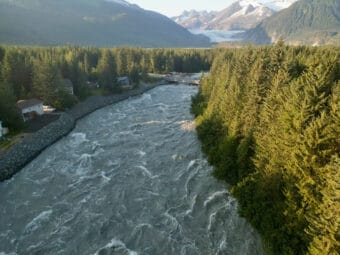
Glacial outburst floods happen every year in Juneau. The rapid retreat of the Mendenhall Glacier due to human-caused climate change is to blame. About a decade ago, one portion of the glacier broke off and receded, which created a depression known as Suicide Basin. Each year, the basin fills with rain and meltwater before bursting downstream into the Mendenhall Lake and River. 

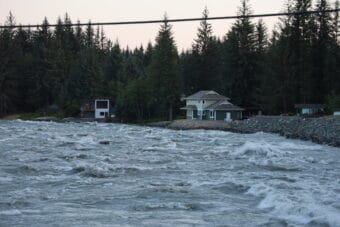
But the last two years of flooding have been unprecedented. Last year’s flood pushed the Mendenhall River to nearly 15 feet. This year, the river rose even higher, setting a new record of 15.99 feet. 

Deputy City Manager Robert Barr said the water pushed much further into the Mendenhall Valley this time, but the city is still trying to figure out how many houses were impacted. 

“I think many homes experience some level of flooding, some significant I think somewhere in the vicinity of a 100, maybe hundreds,” Barr said on Tuesday morning. “We just don’t really have a good handle on that yet.”

Water continues to rise along the Mendenhall River during Juneau’s annual glacial outburst flood on Monday, August 5, 2024. (Clarise Larson/KTOO)

Though he says the type of damage is different from last year’s flood. Many riverside properties were damaged by severe erosion last year, which undermined foundations and destroyed two houses entirely. 

“We saw much less erosion this year,” Barr said. “I don’t have complete reports yet, but the significance of the impact of this year is related to standing water.”

The city issued an evacuation notice on Monday evening, but not everyone left their house in time. Last year, Debbie Penrose Fischer’s house on Gee Road barely saw any flooding. 

“Last year we saw the water, but it wasn’t anywhere near,” she said. 

So she stayed put as the Mendenhall River rose on Monday, even as Alaska Electric Light and Power cut power to her neighborhood. By the time she realized that this year’s flood might be different, it was too late. 

 “We were completely surrounded,” Penrose Fischer said. “And it wasn’t just still water, it was kind of like a pretty heavy flow. And let me tell you something, that water was ice cold.”

Debbie Penrose Fischer was rescued by Capital City Fire/Rescue after flood water surrounded her home on Gee Street early Tuesday morning. (Photo courtesy of Debbie Penrose Fischer)

Bound to her wheelchair, she wasn’t sure how to escape. Penrose Fischer relies on a supply of oxygen, and she watched as the batteries on her tank started running low. Just past 7 a.m., she made a call to Capital City Fire/Rescue. 

“I was trapped. I didn’t know what to do,” she said. 

A rescue team was able to pick her up in the raft and take her to the shelter, where she joined more than 40 other evacuees. 

Juneau Mayor Beth Weldon visited the shelter just before noon. She had spent the morning patrolling flooded neighborhoods.

“Instead of a few inches in people’s houses, they had feet in people’s houses,” Weldon said. “So taking lots of pictures to hopefully help with a National declaration of disaster.” 

In a special Assembly meeting on Monday, the City and Borough of Juneau passed a resolution to declare the flood a local emergency and put in requests for state and federal aid. 

Governor Mike Dunleavy followed suit by declaring a state disaster emergency on Monday afternoon. Those declarations will free up recovery money at the state level and potentially draw attention from the Federal Emergency Management Agency.

In a statement, Sen. Dan Sullivan said he’s been in touch with FEMA’s top administrator. Weldon said she’s spoken to Sen. Lisa Murkowski too. 

“We’re already talking about what can we do to prevent this,” Weldon said. “Because it was a foot higher than last year’s, ironically on the same date.” 

But she says it will take federal help to get there.

KTOO’s Clarise Larson contributed to this report. 

Site notifications
Update notification options
Subscribe to notifications