Climate Change

America’s first Arctic ambassador was just confirmed weeks ago. Now he could be out of a job.

Mike Sfraga, then chair of the U.S. Arctic Research Commission, speaks on April 10, 2024, at the Arctic Encounter Symposium in Anchorage. He later became U.S. ambassador-at-large for Arctic Affairs. (Photo by Yereth Rosen/Alaska Beacon)

Earlier this month, a crowd gathered at a Fairbanks venue to celebrate the confirmation of U.S. Ambassador-at-Large for Arctic Affairs Mike Sfraga — an Alaskan and the first-ever person to hold the newly created position.

Sfraga’s confirmation was a priority of Republican U.S. Sen. Lisa Murkowski, who pushed for the creation of the Arctic ambassador post and was seen personally lobbying her colleagues on the Senate floor during the vote.

It took more than a year after Sfraga’s nomination for the U.S. Senate to confirm him, amid opposition from some Republicans. But now, not even three months in, he may soon be out of a job.

Sfraga was appointed by President Joe Biden, and it’s typical for politically appointed ambassadors to resign their posts during presidential transitions; others, like those serving as ambassadors to Kenya and South Africa, have already announced their departures.

Sfraga, a geographer who has also worked at a think tank and University of Alaska Fairbanks, has not publicly made such an announcement.

A spokesperson for Sfraga declined to comment, as did a spokesperson for Murkowski.

Republican U.S. Sen. Dan Sullivan said in a brief interview that Sfraga’s fate is likely up to Donald Trump.

“The tradition is, when a new administration comes in, most ambassadors, they just resign or step down,” said Sullivan, who missed Sfraga’s confirmation vote due to a trip to the United Nations. “But I have no idea. I truly don’t.”

Sfraga’s nomination faced close scrutiny from some Republicans, who criticized his links to Russia and China.

Republican U.S. Sen. James Risch of Idaho, the ranking member of the Senate Committee on Foreign Relations, said Sfraga had spoken at one Russian government-sponsored conference headlined by Vladimir Putin and also at a panel sponsored by a “sanctioned, state-owned Russian energy company.”

Sfraga, at a Senate hearing, called Russia “half of the Arctic” and said that because the region is a small community, “you must engage.”

“Indeed, at one of those conferences, President Putin did provide a keynote address,” he said. “But I had no interaction with President Putin at all.”

Among those voting against Sfraga’s confirmation was the man who would be his new boss, Republican U.S. Sen. Marco Rubio of Florida, whom Trump has chosen to be the new Secretary of State.

Many of Sfraga’s friends and allies are hoping to see him remain on the job. Fran Ulmer, a former Alaska lieutenant governor who served with Sfraga on the U.S. Arctic Research Commission, said Sfraga has spent many years working on Arctic issues and science, and establishing relationships with officials from other nations.

“He has a kind of credibility with them that would help the U.S. when it comes to pursuing a particular Arctic agenda,” she said. “Those relationships matter, and those relationships don’t happen overnight — they happen over years. So, it would be to the next administration’s advantage to have someone in there who has that kind of credibility but also those connections.”

Another friend of Sfraga’s, Mark Myers, a federal government veteran who is a former head of the U.S. Geological Survey, said that “if you were to bet, the bet would be against him.”

“But has some strong support,” added Myers.

Myers said the Fairbanks celebration of Sfraga’s confirmation drew dozens of people, including some from Alaska’s university system and the military and even Murkowski, who teleconferenced in.

“At his core, he is our neighbor, our friend — and he is just so important,” Murkowski told the audience, according to the Fairbanks Daily News-Miner.

Nathaniel Herz welcomes tips at natherz@gmail.com or (907) 793-0312This article was originally published in Northern Journal, a newsletter from Herz. Subscribe at this link.

One year after landslide, Wrangell’s community reflects on change and healing

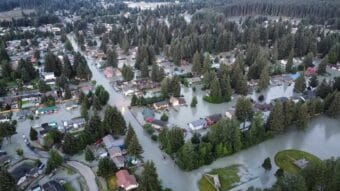
Wrangell’s landslide 11 months after on Oct. 13, 2024. (Colette Czarnecki/KSTK)

Jamie Roberts was home when she heard the landslide come down, but through luck, its deadly pathway just missed her house. Since Nov. 20, 2023, she hasn’t stayed in her home on Zimovia Highway.

“The event was so sensory-overwhelming, that I knew for myself I would have a hard time being there and feel relaxed and have it be my refuge,” she said.

Over the past year, she and her husband, Greg, decided to leave town, not only because of feeling unsafe in their home but also because of the housing crisis that Wrangell faces.

“I have a lot of mixed feelings about it, but yeah, it will be good,” she said.

She’s lived in Wrangell for about 26 years. She said that’s half her life and the community has shaped her into who she is.

“I came here for a summer job,” Roberts said. “I call it one of the happy detours in life.”

Even though the landslide happened 11 miles south of town a year ago, it was detrimental to the community. The six lives lost were beloved community members.

The response was immediate the night of the slide. Search and Rescue and their canines searched for bodies and the State Department of Transportation cleared up and fixed the road – although it ultimately took weeks. The Wrangell community also went into action in the following days, boating residents from the south side of the slide into town. Rooms at Wrangell’s lodgings were made available to anyone who didn’t feel safe and community members gathered donations to help those in need.

State geologists reported that the slide was caused by excessive amounts of rain in a short amount of time, even for a rainforest.

Roberts and her husband raised their children in Wrangell, and she said she has always felt it was a safe place for her family. But over the year, since the landslide, she’s kind of been in autopilot mode.

Roberts said that they’ve moved five different times because the housing has been temporary.

“If people offered us a place for a month, we took it and then just looked for the next thing,” she said, adding that it’s been a lot of packing up, unpacking, renesting, trying to settle into life before it was time to pick up and do it all over again.

“I feel like I’ve really been in just fast forward motion,” Roberts said.

She said emotionally processing what happened has been slow.

“When I finally take time to slow down, I’m sure I’ll be able to, you know, have some healing happen over the last year,” Roberts said. “Definitely some compiled losses. But I don’t know, it’s a good thing I guess, I’ve had something to really keep me busy and keep me focused on being of service.”

She said being of service has helped her healing process, though. She’s a swim coach and recently has been substituting as a teacher at the school. Over the years she’s also served as a volunteer firefighter, EMT Search and Rescue and a coach of almost all sports.

Roberts and her husband decided to buy a house just outside of Eugene, Oregon. But she wanted to stay in Wrangell until the end of swim season if enough kids signed up. The season just ended this past weekend.

“I thought, ‘well, then I’m so close to the one year anniversary of the slide, so why not stay for that,’ in hopes that maybe there was some kind of community event or a healing circle or something,” she said. “I actually have my flight arranged to leave the day after.”

She said her new place in Oregon is different than Wrangell. For one, there’s a lot of sun. Roberts said that’s always a bonus. Plus, things are probably going to be more accessible, like fresher food at the farmers markets and more nature trails.

“Easier travel to see my family,” she said. “Options to to do some exploring that is more affordable as well.”

She said this move might give her the space to process the past year, but she still imagines she will find ways to be of service in her new community.

“I think my patterns of dealing with either grief or trauma … that it’s going to be ok because I’m going to have time where,” Roberts said. “I mean everything that I’m involved in and that keeps me busy. You know, how many hours a day is just all going to go away.”

Another Wrangellite that the landslide severely impacted is Christina Florschutz. She was the only survivor and lost her husband and house during the catastrophic event. Rescuers found her near the slide debris the following day. Florschutz left Wrangell just a few weeks ago to live in Kodiak with her son.

She wasn’t available for a recorded interview, but through an email she said that the compassion Wrangellites gave her helped her tremendously in her healing process. And like Roberts, being of service also helped her. Florschutz returned to working at the school, which brought her joy and satisfaction.

In addition, she said she’s coped with the loss by the care and counsel of other widows.

Florschutz wrote that they have taught her that “God’s timing is perfect,” even if it’s not something she would have chosen.

Another form of self-care that has helped Florschutz over the past year is getting enough exercise, like riding her bike. She said it helps her sleep at night. Additionally, reading has helped, especially reading about science. She said that this taught her that actions can influence feelings. One example is purposefully smiling, which has brought her feelings of happiness.

She doesn’t know what’s in her long-term agenda moving forward, but she suspects more business with cleaning up the past year’s mess.

As for Kodiak, she said it reminds her of Sitka because of the U.S. Coast Guard base, commercial fishing fleet and windy weather. But one thing is different, the bear problems are worse in Kodiak than in Wrangell. She said to never leave groceries in the car.

Florschutz created a website to share her story and wants others to share their stories too.

As for the community of Wrangell, Borough Manager Mason Villarma said that without the grit and support of local residents, we wouldn’t be where we are today.

“What makes this community so remarkable is everybody supports each other and we get through tough times and build back better,” he said. “And we did exactly that over this last year. It’s an emotional time coming up on the one year mark, obviously the scar is still in the mountainside when we all go past it.”

He said the borough has done a lot in public safety that corresponded to the landslide, like actively updating its Emergency Operation Plan.

Villarma said that the Nixle enrollment, which signals registered users, has significantly expanded. That can be found on the borough’s website.

As Wrangellites reflect over the past year since the landslide, the community has shown its resiliency to carry on.

Richer countries are starting to pay poorer ones for climate change damages

More than 1,000 people died in 2023’s Cyclone Freddy and hundreds of thousands more were displaced in Malawi. Many low-income nations are bearing disproportionate impacts from more intense storms. (Amos Gumulira/AFP via Getty Images)

It was 2 a.m. when floodwaters started pouring into Christopher Bingala’s house. Cyclone Freddy, the longest-lasting tropical cyclone ever recorded, brought a deluge of rain to southern Malawi in 2023. He managed to get his six kids to higher ground but lost his house and livestock.

As a subsistence farmer, Bingala didn’t have the resources to start over. But then he got a payment of about $750, which he used to build his family a new house.

The payment is one of the first examples of “loss and damage” compensation, a new kind of funding specifically for climate change-related disasters. Low-income countries are bearing the brunt of more intense storms and droughts but have done little to produce the pollution that’s heating up the planet. So last year, wealthier countries agreed to create a fund specifically to pay for the damages from climate change.

So far, about $720 million has been pledged from countries, like the European Union, U.S. and United Arab Emirates. But climate experts warn that with hurricanes and floods only getting worse, that amount will fall far short.

At the COP29 climate summit underway in Baku, Azerbaijan, countries are negotiating how much is owed to developing nations, as part of a larger “climate finance” package that includes loans and investments.

“We just hope that the global north and the nations whose economy is fueled by the emissions – they come to the plate and take up their responsibility to look at what they’re causing us,” says Philip Davis, prime minister of the Commonwealth of the Bahamas.

Finding a way to start over

The havoc from Cyclone Freddy was widespread across several countries, displacing 650,000 people from their homes in Malawi alone. The country received six months of rain in just six days.

After their house collapsed in the floodwaters, Bingala and his family took refuge on higher ground, but the situation quickly deteriorated. They started running out of food.

Christopher Bingala, a farmer in Malawi, stands outside his new home. After losing his house in Cyclone Freddy, he received a payment from a new fund for the damages from climate-related disasters. (Henderson Mhone)

“We got to a point where we would eat meat from animals that had died from the cyclone because we lacked food,” Bingala says. “This was a very difficult moment in my life.”

Along with thousands of others, he and his family were relocated to temporary camps. But as a small-scale farmer and fisherman, Bingala had no safety net to fall back on. Then he received the cash payment, which allowed him to move to a new village and build a better house. There are still challenges – Bingala is still trying to get his kids back in school and he’s hoping to get a few livestock again. But he’s glad his family is living in a less flood-prone region.

“They are better off here because they are not in danger of the water challenges we had back in Makhanga,” Bingala says. “This is a dry and upper land, so my children are ok and they’re happy. They’re living a happy life.”

Piloting a system to pay damages

The payment Bingala received came from the government of Scotland, the first country to dedicate funding specifically for loss and damage. The funds have gone to several countries so far. In Malawi, they were given out by GiveDirectly, a non-profit that specializes in providing cash grants to those in need with no strings attached.

About 2,700 families got payments of around $750, which can be equivalent to two years of income in Malawi. Many used the money to rebuild homes, while others invested in seeds, fertilizers and livestock, or putting their kids back in school.

“Low-income households in low-income countries have far less protections from extreme events,” says Yolande Wright, vice president of partnerships at GiveDirectly. “They may not have any sort of insurance. There may not be any insurance products available, even if they wanted to buy them.”

The program in Malawi is a pilot, in a sense, for a larger system to pay for loss and damage. Last year, countries agreed to create the fund as a way to compensate lower-income countries, which have low greenhouse gas emissions overall. Almost half of all emissions since the Industrial Revolution have come from the U.S. and Europe.

“The very poor, low-income households in Malawi have contributed the least to the climate problem,” Wright says. “Many of them are not connected to electricity. They don’t own a car or even a motor bike.”

A ballooning need for loss and damage funding

Increasingly severe hurricanes, storms and droughts pose a massive financial burden on developing countries, especially those already in debt. In the Bahamas, Prime Minister Davis says his country’s national debt went up after Hurricane Dorian hit in 2019.

“For me to recover and rebuild, I have to borrow,” Davis says. “Forty percent of my national debt could be directly attributed to the consequences of climate change.”

So far, the majority of $720 million pledged for loss and damage has yet to start flowing. At the COP29 summit, countries finalized the paperwork to create the fund, which will be housed at the World Bank. The fund’s guidelines have yet to be set up, like determining which countries will receive funding and for what kinds of damages.

Many low-income countries have argued the funding should go to more than just disaster recovery. Some could be used to relocate villages in the path of sea level rise, or to compensate countries for the loss of important cultural sites or ecological resources, like coral reefs.

The need for loss and damage funding is only expected to balloon as disasters get more extreme. One recent study found it will reach $250 billion per year by 2030. Davis says he hopes richer countries will contribute more in “enlightened self-interest,” since many humanitarian crises do not stay confined to country borders.

“If they do nothing, they will be the worst for it,” Davis says. “When my islands are swallowed up by the sea, then what do my people do? They’ll either become climate refugees or they’ll be doomed to a watery grave.”

State argues court should dismiss climate lawsuit from eight young Alaskans

Our Children’s Trust attorney Andrew Welle argues that the Alaska Constitution protects the right to a livable climate in an Anchorage courtroom on Oct. 15, 2024. (Matt Faubion/Alaska Public Media)

The state of Alaska is asking a court to dismiss a lawsuit by eight young Alaskans arguing that efforts to build a North Slope natural gas pipeline violate the state constitution.

The lawsuit is the latest effort by young Alaskans to establish a right to a livable climate. The lawsuit was filed by the Oregon-based nonprofit Our Children’s Trust, which has pursued climate-related litigation against the federal government and in states across the country, including MontanaUtah and Hawai’i, with mixed results.

The case, known as Sagoonick v. State of Alaska II, zooms in on one specific state policy: the law creating the Alaska Gasline Development Corp., the state agency pursuing investment in a pipeline that would bring liquefied natural gas from Prudhoe Bay to Southcentral Alaska for in-state and out-of-state use.

Attorney Andrew Welle argued that the eight youth plaintiffs between the ages of 12 and 23 are already suffering the effects of climate change, ranging from faltering salmon runs to flooded homes. He told Anchorage Superior Court Judge Dani Crosby that the Alaska LNG project would exacerbate the harms of climate change.

“Yet, with full knowledge of these dangers, their government has enacted and is actively carrying out a statutory mandate to advance and develop the Alaska LNG project, which, in the face of the climate emergency that is harming these plaintiffs, would more than triple Alaska’s greenhouse gas emissions of climate pollution for decades, locking in irreversible and escalating harms for these youth,” he said.

The Alaska LNG project has so far failed to attract enough investor interest for the $44 billion project to go forward.

Attorneys for the state say even if it is built, the impacts of the project are speculative. They say natural gas produced by the project may displace other, dirtier fuel sources, or it may have too small an impact on its own to have a meaningful impact on global average temperatures.

“To get where the plaintiffs are going in this case, the impact of that project on the access to fish and wildlife resources in the future, involves predictions upon predictions upon predictions,” said Assistant Attorney General Margaret Paton-Walsh. “Looking into a crystal ball and trying to determine how present-day decisions will shape the future is the work of policymakers, not courts.”

The state argues that the governor’s administration and the Alaska Legislature should be tasked with balancing the costs and benefits of the state’s climate policies — and that like the previous lawsuits, this one should be dismissed.

The latest Alaska lawsuit follows two earlier court challenges dating back to 2011 that were dismissed as overbroad and ill-suited for the court system.

Judge Crosby did not set a timeline for a decision on whether the case should be allowed to go forward.

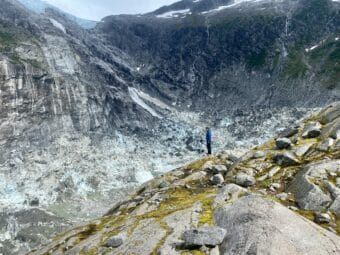
Update: Water levels in Suicide Basin have stabilized, with no flooding in the immediate forecast

Cameras deployed above Suicide Basin captured this image of the basin filled with water and icebergs on Oct. 10, 2024. (Photo from the National Weather Service Suicide Basin monitoring page)

Update, Thursday 5 p.m.:

A Thursday evening update from the National Weather Service indicates that a glacial dam release is not happening. 

Earlier in the day, laser sensors indicated that water levels in Suicide Basin were dropping, which can signal the start of a glacial outburst flood. Now, water levels are back on the rise

Over the last 24 hours, levels in the Mendenhall Lake downstream have remained stable, and no outburst flooding is expected in the immediate future. 

Thursday morning’s drop was minor, with the water levels decreasing from 1,231 feet to just over 1,230 feet. Meteorologist Brian Bezenek said there are many things that could have caused that. 

Icebergs calving off the face of the Mendenhall Glacier can make water levels fluctuate up or down. It’s also possible that a temporary drainage channel opened in the face of the glacial-dam.

“It could have found a crevice in the ice, that cracked, and the water rushed in and lowered the levels a little bit. It could have been a touch of a release, and then the gap closed back up,” Bezenek said. “We’re not entirely sure, but we are maintaining a close eye on that as usual.”

Original story:

The National Weather Service Office in Juneau said water levels in Suicide Basin dropped Thursday morning, indicating potential for a second glacial outburst flood this year. Based on current levels in the basin though, the flood would be far less damaging than this past summer’s flood.

On Aug. 6, 2024, water released from the basin brought the Mendenhall Lake and River to record flood stages. The river crested at 15.99 feet, and flooding damaged 289 homes in the Mendenhall Valley.

But this time around, the basin is far less full. National Weather Service hydrologist Aaron Jacobs said that means if a release happened right now, flooding of the Mendenhall River would be much less severe. 

“At this time, it would be right around an 11-foot crest from our calculations. That would be over a moderate flood stage,” Jacobs said

At a moderate flood stage, low-lying areas will flood. There could be more than a foot of water on Skater’s Cabin Road and the West Glacier trail, and up to three feet of water in parts of the Mendenhall Campground.

View Drive would be flooded and impassable at a moderate flood stage, with some homes along the river taking on water. Homeowners along Meander Way may see water seeping into their backyards, while most homes in the Mendenhall Valley would be spared from flooding.

But the volume of water in the basin is just one of the factors that shapes flooding. The other is the speed of the release, said University of Alaska Southeast hydrologist Eran Hood. 

“Something that the public needs to understand is that we will put out an initial forecast based on what we know with the initial volume,” Hood said. “Then, as the event is unfolding, we can get a better idea of how that release of water is taking place, and adjust the forecast accordingly.”

Hood says a release right now could be a good thing. Water levels in the Mendenhall Lake and River are low, much lower than they typically are in the summer. 

“So that also gives us more of a buffer,” he said. 

The Mendenhall River would be able to absorb more water before reaching a major flood stage. And draining water from the basin now would prevent it from filling up all the way and triggering a larger flood later on. 

“The sooner, the better. Get it out of there and, you know, be done with it,” Hood said. “People will get a little nervous, but I don’t think it would do any damage.”

The drop in the basin’s water levels Thursday morning was detected by laser sensors deployed at Suicide Basin. Experts from the National Weather Service, the University of Alaska Southeast and the U.S. Geological Survey are evaluating the data to see if the water levels will continue to drop, indicating the start of a release.

If that happens, the National Weather Service will put out an official flood forecast. The latest updates can be found on the Suicide Basin monitoring page. 

Spruce Root’s ‘green bank’ receives $10 million boost for clean energy projects

Anchorage Solar owner Ben May secures a solar panel on Lisa Pekar’s garage roof. He said business has increased almost eight-fold since he opened in 2016. “You caught me mid-way through a costume change,” he said. “I wear many hats.” (Photo by Erin McKinstry/Alaska Public Media)
Anchorage Solar owner Ben May secures a solar panel. (Photo by Erin McKinstry/Alaska Public Media)

A Native-led economic development nonprofit based in Juneau has received $10 million toward projects that will help Southeast Alaska communities ditch fossil fuels. 

The money comes to Spruce Root via the Coalition for Green Capital. They’re a national group that first partnered with Spruce Root last year to establish a “green bank” — a type of bank that supports projects to promote clean energy or otherwise reduce greenhouse gas emissions to fight human-caused climate change. 

Michael Ching manages finances for Spruce Root’s Community Development initiatives. He says the money will support a wide variety of projects.

“From heat pump installers and solar equipment providers to innovative startups — perhaps renting EV scooters for tourists,” Ching said. “Green banks play a crucial role in accelerating the transition to a clean energy future.”

Investment in clean or renewable energy projects is exploding in Alaska, especially at Spruce Root. The $10 million commitment is the second major influx of money for their green bank. This summer, the U.S. Department of Energy awarded them $2.5 million to install heat pumps on Prince of Wales Island. 

Just weeks later, Southeast Conference and Juneau-based nonprofit Alaska Heat Smart also received more than $38 million for heat pump promotion from the Environmental Protection Agency. 

A heat pump is an efficient electric alternative to oil burning heating systems. Installing one can dramatically cut home energy costs and carbon emissions. But these funding sources don’t just pay for the heat pumps themselves. They also support renewable energy workforce development.

“Getting finance for renewable energy equipment is definitely necessary — also necessary is the manpower, the expertise, the human resource to get things installed,” Ching said. “We will develop training programs, technical assistance, including workforce development, so that people might be able to become a renewable energy installer — perhaps embark on additional income opportunity.”

That’s one of Spruce Root’s top priorities as funding for renewable energy projects grows, Ching said. And while heat pumps are getting a lot of attention in recent years, Spruce Root has already discussed other possibilities for the new funding, like beefing up charging infrastructure for electric cars and boats. 

One of the strengths of green banks, Ching said, is that they’re flexible in the projects they can support. And Alaska is home to at least two other green banks. Earlier this year, lawmakers established a state-led green bank. And the Valdez Native Tribe launched their own in 2023.

Site notifications
Update notification options
Subscribe to notifications