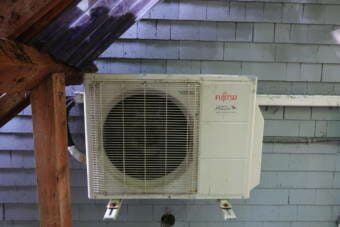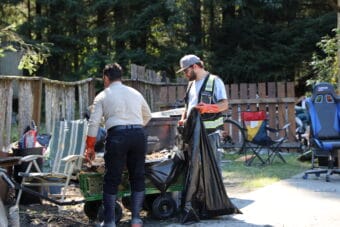
An air-to-air heat pump can provide a more efficient alternative for heating a home, particularly in regions of Alaska with less dramatic temperature swings like Southeast. Because they run off of electricity, they can also reduce greenhouse gas emissions in communities that use renewable alternatives like hydropower or solar. (Erin McKinstry/KCAW)
Southeast Conference and the Juneau-based nonprofit Alaska Heat Smart have received a $38.6 million federal grant to help homeowners in Southeast and Southcentral coastal Alaska buy electric heat pumps to replace traditional fossil-fuel based heating systems.
AK Heat Smart has already helped to get heat pumps in 1,000 households across the region. This new infusion of money, which came in an announcement from the Environmental Protection Agency last week, will “supercharge” those efforts.
“It was, you know, definitely a feeling of shock,” said Andy Romanoff, Alaska Heat Smart’s executive director. “Then a little little bit of terror at the same time, which soon translated into excitement.”
Romanoff says the region is poised for more heat pump installations.
“We like to say coastal Alaska, from Ketchikan to Kodiak, is sort of the Goldilocks zone for heat pumps,” he said.
On Alaska’s southern coast, winters are not too cold and summers aren’t too hot, so heat pumps can easily maintain comfortable temperatures. And communities like Juneau, Sitka and Ketchikan have clean, renewable electricity in the form of hydropower, while Kodiak combines hydropower with wind energy. When heat pumps tap into those grids, they’re essentially emissions-free.
But even when they run on diesel-generated electricity, heat pumps can save homeowners up between 25% to 50% on heating bills when compared to traditional oil-based heating systems.
“That’s a really big lift, especially in our rural communities,” said Robert Venables, executive director of Southeast Conference. “And that is one of the primary focuses of this project, where over half the funds are really intended to those small rural villages that struggle with heating costs.”
The new funding will establish the Accelerating Clean Energy Savings in Alaska’s Coastal Communities Program, administered by Southeast Conference and AK Heat Smart, with help from Alaska Municipal League. The program will dole out financial incentives for heat pumps in communities from Ketchikan to Kodiak. Homeowners will be eligible for between $4,000 up to $8,500, depending on household income, to put towards a heat pump.
The program proposal was selected from more than 300 applicants nationwide who submitted bids under the EPA’s Climate Pollution Reduction Grant program, which ultimately divvied up $4.3 billion dollars total to states, local governments and a tribe for 25 projects that will cut down on the nation’s greenhouse gas emissions.
The biggest potential hurdle to this program’s success, Romanoff says, may be the workforce. There’s money for heat pumps, but there’s not really enough people to install them. He hopes more HVAC professionals, plumbers, electricians and even companies that have traditionally serviced oil boilers will go all-in on heat pumps, following this funding announcement.
“This is a chance to either grow a business, start a business, move into the space and recognize that this is where things are going, especially with this kind of infusion of money,” he said. “Now is a great time to get on the train and go for the ride with us, because we’re leaving the station.”
The program is expected to be officially up and running sometime next spring.
Correction: A previous version of this story characterized the new program as a rebate program, which would give refunds for heat pumps after purchase. Instead, homeowners will receive direct financial incentives ahead of purchase.
Palm Springs, Calif., is one of many U.S. cities seeing temperature records falling in recent days and weeks. (Mario Tama | Getty Images North America)
When Joe Pascale moved to the desert city of Palm Springs, Calif., about 17 years ago it was hot, but in the mornings and evenings there was a break from the heat.
“You could get up in the morning and it would be relatively cool and you could enjoy outside, even in the dead of summer,” he says. “The mornings would be just brilliant.”
“That doesn’t exist for us anymore, and it’s a huge loss,” he says.
Last Friday, the city broke its all-time high temperature record when it hit 124 degrees. Even in the early mornings this week, the temperature has still been in the low 90s or high 80s.
Pascale recognizes the connection between his increasingly hot city and climate change, caused largely by humans burning fossil fuels.
“Sometimes we feel like we’re screaming into the void,” Pascale says. “There’s a problem that we need to be addressing.”
Last year was the hottest year on record for the world. The U.S. is warming up at a faster rate than the global average, which means the effects of global warming will be more pronounced.
Arizona, California, Oregon and Nevada have all seen record-breaking heat in recent weeks. And while the heat wave is mostly in the West, states across the country like North Carolina and Maryland have also seen temperature records fall this summer.
“We’re going to continue [breaking temperature records] as long as we keep increasing the amount of greenhouse gases in our atmosphere,” Russell says.
In 2015, at a U.N. conference in Paris, most countries of the world agreed to try to limit warming to 1.5 degrees Celsius (2.7 degrees Fahrenheit) above preindustrial levels by the end of the century. 1.5 degrees is a threshold that scientists say could unleash more severe climate change impacts.
Given that global fossil fuel use is still increasing, it’s unlikely — but not impossible — that the world will stay below that 1.5 degrees threshold, according to many international scientists.
“But a 1.5 degree target is not a magic number,” says Katharine Hayhoe, climate scientist and chief scientist for The Nature Conservancy, a nonprofit.
Even if the world can limit warming to 1.5 degrees, more temperature records will continue to fall, Hayhoe says.
“We scientists have known for a long time — for decades — that as the world gets warmer, we’re going to see our temperature extremes [increasing],” she says. “Climate change is already affecting the people we love, the places we love, and the things we love.”
The good news is that the world has proven and scalable climate solutions, Russell says.
Xin Li, a research and development associate, works at Ascend Elements in Westborough, Mass., on June 13. The company is one of several that are scrambling to build recycling plants that can recover minerals from electric vehicle batteries without using dirty techniques like burning them — or wasting energy by shipping them overseas. (Amanda Andrade-Rhoades for NPR)
WESTBOROUGH, Mass. — Plastic bags of dark powder sit on a metal shelf. The powder contains minerals that came from lithium-ion batteries and are destined to be made into batteries again. That, in itself, is not revolutionary.
But where this shelf is located — in an unassuming industrial park an hour west of Boston — symbolizes how the battery-recycling industry is on the cusp of change.
Today, key steps in the battery-recycling process mostly happen overseas, particularly in Asia. Companies there have spent years building up a battery supply chain in which recycling and building batteries are closely connected.
But more and more batteries spend their lives powering electric vehicles in the United States. Shipping minerals halfway around the world costs money, creates carbon emissions, adds supply chain risks and, from the U.S. perspective, pushes some jobs and profits overseas.
That’s why the U.S. government is pouring money into an effort to bring the whole battery-recycling ecosystem to the United States. Meanwhile, automakers and battery companies, as they build new battery and EV plants across North America, want recycling close by; they’ll have a lot of batteries to scrap in the years ahead as electric vehicle sales rise.
These minerals in their 25-pound plastic bags, recycled by a company called Ascend Elements, epitomize the new geography of battery recycling. They were ground up in Georgia, processed in Massachusetts and headed to Michigan for manufacturing — every step happening in the United States.
Keeping battery minerals closer to home
Lithium-ion batteries are hazardous waste if they’re discarded, but they’re a valuable resource if they’re recycled.
Because they’re hazardous, some states legally require battery recycling. And because they’re valuable, EV batteries are often recycled even where it’s not mandated: Vehicle dismantlers can sell the batteries for money.
But how does it work? Step 1 is safely collecting batteries, discharging them and then disassembling and shredding them. The result is a black powder that’s called “black mass” in the battery-recycling industry. This happens at locations scattered across the U.S., including at an Ascend Elements facility in Georgia.
Chemical operator Pedro Servones works on a tank at Ascend Elements on June 13. (Amanda Andrade-Rhoades for NPR)Brian Gaulin picks up a scoop of “black mass,” the material left after batteries are shredded and sifted, at Ascend Elements on June 13. (Amanda Andrade-Rhoades for NPR)
Then that powder of jumbled-up minerals is frequently shipped overseas to get turned back into something useful. In Westborough, Mass., Ascend Elements is doing those steps closer to home. The powder gets combined with sulfuric acid, where some minerals dissolve and others don’t, making it easier to sort them apart.
Ascend takes out (and in some cases, sells off separately) everything except the nickel, cobalt and other costly minerals that go into a battery’s cathode. The levels of each mineral get fine-tuned, and the mixture is dried back into a powder again.
Last month, the company began shipping the powder coming off the line — precursor cathode active material (pCAM), to use its technical term — to a buyer that will put the material into batteries for heavy-duty vehicles. Ascend believes this is likely the first time that pCAM made wholly in the U.S. from recycled materials is being used in commercial manufacturing.
Newer, cleaner processes for recycling batteries
In some cases, recycling processes, not just locations, are also changing. An older method relied on burning battery materials, which wasted many of the minerals and created pollution.
A newer method involves dissolving the minerals in acid instead, recovering more minerals with less waste (or potentially no waste, if companies reuse water and find uses for all their chemical byproducts). “Recyclers all across the world are adopting this technology,” says battery expert Beatrice Browning.
Meanwhile, Ascend is skipping several steps by not isolating all the minerals separately, like most acid-based processes do. “That’s extracting 98% of the material because you’re worried about the 2% of impurities,” co-founder and Chief Technology Officer Eric Gratz explains. “So we flip the problem around, and we’re extracting the 2% of impurities and keeping the nickel, manganese and cobalt together.”
Eric Gratz, co-founder of Ascend Elements, poses for a portrait at the company’s battery-recycling facility in Westborough, Mass., on June 13. (Amanda Andrade-Rhoades for NPR)
Imagine you have a large Lego creation and you want to make a different Lego creation. Melting the whole thing down would be a brute-force waste of energy. Taking it apart and sorting all the bricks is more finicky but much more effective — like extracting out each mineral one by one. What Ascend is doing is more like breaking it down but not sorting all the bricks, just keeping them together in a big pile.
Meanwhile, some companies are working on a form of recycling called “direct recycling” that would take the battery apart without shredding it at all. It’s like keeping big chunks of Lego bricks together and reusing them as a single unit. And still other companies are exploring new ways to use electricity or other technologies to refine how metals are, well, refined.
A dual purpose: cutting emissions, boosting profits
Ascend’s production line is built right behind the company’s research and development lab, where Matthew Valdiviezo is watching a vivid teal liquid spin in a beaker as he explains that chemistry is all about rules. And his work is all about manipulating those rules — “to make us money in the long run,” he says, “and help the planet, of course.”
For many environmentally conscious drivers, battery disposal is a major concern. And it’s true that if batteries wind up in landfills, they would be a serious problem. But environmental advocates see a huge opportunity in recycling.
“Battery recycling can play, in the long run, a really big role in making electric vehicles more sustainable,” says Dale Hall of the International Council on Clean Transportation. “Decades from now, we’ll need very little new virgin raw materials to build new EVs. And that’s very different from what you have now with combustion engine vehicles, where you’re going to always have to be producing new virgin oil and feeding tons and tons of that into the vehicles over their lifetime.”
Meanwhile, Valdiviezo’s other motivation — the bottom line? That’s real too, and lots of other companies are chasing it.
Redwood Materials, started by a Tesla co-founder, is building multibillion-dollar plants in Nevada and South Carolina. “There is an incredible opportunity to create this closed-loop supply chain here domestically for the first time,” the company’s vice president of government relations and communications, Alexis Georgeson, told NPR in an interview earlier this year.
And, she noted, battery recycling is profitable today.
Cirba Solutions, another big player, is working on plants in Ohio and South Carolina. “We’re building as fast as we humanly possibly can build,” says CEO David Klanecky. “And I think we’re going way too slow, to be honest with you.”
A scientist measures precursor cathode active material (pCAM) at Ascend Elements on June 13. (Amanda Andrade-Rhoades for NPR)Battery materials engineer Alfred Nkhama works at Ascend Elements on June 13. (Amanda Andrade-Rhoades for NPR)
“It’s not fast enough”
The pressure for speed might seem counterintuitive. EV batteries can last more than a dozen years (maybe much longer — the first mass-market EVs aren’t old enough to have much data beyond that). Some outlive their vehicles and could have a second life, like storing backup power for a building. And there aren’t that many EVs on the roads — yet.
But EVs from the first generation are starting to reach the end of their lives. Recalled batteries or those damaged in vehicular accidents also need to be recycled, as does scrap material coming from the production lines of plants manufacturing new batteries. Meanwhile, the nascent battery-manufacturing industry in the U.S. is hungry for materials, especially ones that meet made-in-America requirements for federal incentives.
That’s pushing companies to move fast. “Two years ago, there was nothing in here,” says Ascend senior process engineer Zain Nasir at the plant in Westborough. “The amount of hours everybody’s put in trying to get this place to where it is is just incredible.”
In the lab where she was testing products to confirm their quality, Rebecca Neslusan laughed when I asked her about the timeline. “The pressure is on,” she said. “As fast as we can do it, it’s not fast enough.”
In fact, the milestone that Ascend hit in June — that first commercial shipment out of this manufacturing line — is itself proof of the sense of urgency. For a chemical plant, the production line here in Massachusetts is tiny. It was originally meant to be a pilot, a proof of concept. But the demand is too high.
“We’re shipping here because the customer wants and needs the material as soon as possible, you know, basically faster than we can build our facilities,” says Gratz, the company’s co-founder and CTO.
His billion-dollar plant in Kentucky is due to open early next year.
Transcript:
JUANA SUMMERS, HOST:
There’s a race underway in the world of electric vehicles, but it is not about sprint times. This race is about who’s going to recycle EV batteries here in the U.S. Right now, much of it happens in Asia, and shipping valuable minerals halfway around the world has costs in terms of money, carbon emissions, U.S. jobs. NPR’s Camila Domonoske takes us to one of the companies trying to remake the geography of battery recycling.
CAMILA DOMONOSKE, BYLINE: Past a lab with liquids spinning and dripping in giant beakers – quick pause for safety gear.
ERIC GRATZ: So let’s grab some goggles.
(SOUNDBITE OF PLASTIC RUSTLING)
DOMONOSKE: Through a nondescript door…
(SOUNDBITE OF DOOR SQUEAKING)
DOMONOSKE: …There’s a miniature chemical plant tacked onto the back of Ascend Elements’ R&D facility in Massachusetts. Now, miniature is relative.
GRATZ: I mean, we have tanks that are up to 18 feet tall.
DOMONOSKE: Eric Gratz is Ascend’s co-founder and chief technical officer.
GRATZ: And then this one here, which is taller than me, is one of our smallest tanks.
DOMONOSKE: But this is a fraction of the size of the factory Ascend is building in Kentucky. This month, this little plant sent its first commercial shipment of battery materials fully recycled in the U.S. The company thinks that’s a first for their kind of product. They’ll go back into batteries for things like electric construction vehicles. If you don’t recycle batteries, they’re hazardous waste, but if you do, they’re a valuable resource. The more you recycle, the less you need to mine. Step one is collecting and pulverizing batteries. Employee Brian Garland scoops some black powder for me.
BRIAN GARLAND: Hang on, let me just give you a little so you can see it. And that’s what we get from shredding the batteries.
DOMONOSKE: Literally shredding them – this step has been happening in the U.S. for a while. But today, that powder of jumbled up minerals mostly gets shipped to Asia, where companies had a big head start on building battery supply chains for the next steps. These molecules are going on a short journey here in the states. Gratz leads the tour.
GRATZ: Then you get pumped down to that leaching tank there where you’ll be dissolved in sulfuric acid.
DOMONOSKE: Some of the minerals, like nickel and cobalt, dissolve. The graphite in the mix doesn’t. That helps sort them apart.
GRATZ: Then you’re going to go over to our impurity removal station.
DOMONOSKE: The exact combination of minerals gets fine-tuned, and finally, it’s dried back into a powder, currently sitting on a shelf in 25-pound bags.
GRATZ: So it comes in as a powder, and it’s leaving as a powder. It’s just coming in, you know, very impure and – but leaving very pure.
DOMONOSKE: Doing this whole process in the states is a priority for the Biden administration. The idea is to promote jobs and secure supply chains as well as fight climate change. The federal government is pouring money into this industry. But it’s not just where this is happening that’s different. Companies are trying to make the process more efficient and cleaner. At Ascend’s R&D lab right next to that production line, Matthew Valdiviezo, standing before a beaker of swirling bright teal liquid, says chemistry is all about rules.
MATTHEW VALDIVIEZO: So we’re trying to manipulate the rules here to make us money in the long run, you know, and help the planet, of course.
DOMONOSKE: Environmental groups do think battery recycling can help the planet if it’s done right. To explain how these processes are improving – imagine you have a big LEGO creation, and you want to make a different LEGO creation. Melting it down to make new Lego bricks would obviously be a huge waste of energy. Taking it apart and sorting all the bricks – that’s more finicky, but cleaner. Now, Ascend figured out you don’t even have to sort all the bricks.
GRATZ: We’re just removing the 2% that we don’t want and keeping the 98% that we want together.
DOMONOSKE: Lots of companies with different approaches are scaling up battery recycling in the states and trying to do it quickly. At Ascend, Rebecca Neslusan is testing samples and feeling a sense of urgency.
REBECCA NESLUSAN: The pressure is on to, you know, make this product. And as fast as we can do it, it’s not fast enough even then.
DOMONOSKE: In fact, the very existence of this mini chemical plant is a testament to this pressure. This is a research lab. There was never meant to be a commercial line here, but the EV industry is demanding recycled minerals now. And Ascend’s billion-dollar plant in Kentucky – it’s due to open next year.
Camila Domonoske, NPR News, Westboro, Mass.
(SOUNDBITE OF DANILO PLESSOW AND THE MOTOR CITY DRUM ENSEMBLE’S “THE STRANGER”)
A Juneau Icefield Research Program expedition in 2018. (Photo courtesy of JIRP)
The Mendenhall Glacier is a beautiful sight. To Bethan Davies, a glaciologist at Newcastle University in the United Kingdom, it’s also a reminder.
“It’s the most visible, iconic evidence of climate change,” she said.
It’s no secret that Alaska’s glaciers are shrinking as the burning of fossil fuels warms the planet. But in the Juneau Icefield, home to the Mendenhall and more than a thousand other glaciers, ice has melted especially fast over the last decade — twice as quickly as it did before 2010.
Davies worries that glaciers in the Juneau Icefield and elsewhere are approaching an irreversible tipping point.
“That means that we would continue to lose ice from Juneau Icefield, even if climate change stops. Even if temperatures stop rising,” she said. “At the moment, we can retain our icefields, but if we cross that tipping point it’s too late.”
The icefield stretches across 1,5000 square miles of mountain terrain between Juneau and British Columbia. It reached its peak volume back in the late 18th century, during a period of cooler temperatures known as the Little Ice Age.
Since then, almost a quarter of it’s ice volume has melted away. Davies and her colleagues from universities in the United Kingdom, United State and Europe used satellite imagery, historical photos and decades of glacial measurements to track that decline in a study published in the journal Nature Communications.
They found that glacier volume decreased at a pretty steady pace between 1770 and 1979. Through the tail of the 20th century and the early 2000s, things started to melt a little bit faster. Then, between 2010 and 2020, ice loss accelerated sharply.
And across the icefield, glaciers shrank five times faster from 2015 to 2019 as compared to the mid-20th century.
Every single glacier in the Juneau Icefield is smaller than it was 250 years ago. At least 108 of them have disappeared completely. Those that remain are thinning, receding and breaking into smaller and smaller fragments.
The consequence of all that melting, is more melting. Because the Juneau Icefield is a broad, top-heavy plateau, with ice stretching skyward. When it start to melt, the surface of the icefield slumps down to a lower elevation, where air temperatures are higher.
“And because it’s warmer, it melts more,” Davies said.
The icefield also is at risk of dipping below the snow elevation line. It’s the boundary between seasonal snow and snow that persists year-round, like the white caps on some of Juneau peaks. And it’s moving higher and higher.
“That means you’re suddenly losing snow, losing nourishment over a really big area of the icefield,” Davies said. “That’s not a healthy thing for a glacier.”
As snowfall decreases and ice breaks apart, the icefield loses some of the reflective, bright white quality that protects it too.
“You’re left with rock that dark, you’re left with glacier ice that’s maybe a bit gray and a bit dusty,” Davies said. “That absorbs more of the sun’s energy,”
These melt-accelerating processes could be happening to other plateau icefields in Norway, Canada and other parts of the Arctic. The fate of all that ice matters for the whole world.
Glaciers only cover about 1% of the planet.
“But they are currently responsible for about a quarter of sea level rise,” Davies said. “So all the world’s glaciers together are contributing more to sea level rise than the Greenland ice sheet, and more to sea level rise than the Antarctic ice sheet. And the area that’s contributing most from glaciers is Alaska.”
The only way to prevent that sea level rise is to keep water locked in glacial ice. And the only way to do that is to slow the rate of global climate change.
“Every 10th of a degree matters,” Davies said. “If we stick to 1.5 degrees of warming —which is now very close— we’ll retain most of the world’s ice.”
Meghan Tabacek, the executive director of Trail Mix Inc., stands over a “gabion basket” that was installed to prevent erosion under a bridge on Juneau’s Black Bear Trail. (Photo by Anna Canny/KTOO)
Meghan Tabacek stepped off the narrow path of the Black Bear Trail in Juneau and pointed to a U-shaped bend in Montana Creek where loose dirt and tree roots jut out over the water.
“If this all were to erode out and cut under the bank, then our whole trail could collapse,” she said. “At first glance, this looks pretty subtle and pretty far away from the trail. But give it like, three or four big storm cycles, and that could really get eaten away.”
Tabacek is the executive director of Trail Mix, Inc., a local non-profit that spends each summer clearing brush, downed trees and — occasionally — landslide debris, on trails managed by the City and Borough of Juneau, the state and the Forest Service.
But mostly, her crews work to strengthen trails against the rain that pummels Southeast Alaska.
“We’re used to mud,” Tabacek said. “Mud is our bread and butter.”
What they’re not used to is the intensity of the mud, the erosion and the wash-outs that are wreaking havoc on trails as human-caused climate change makes rainstorms more extreme. Typically, Tabacek says, trails have a lifespan of 10 to 20 years before they need major maintenance. But that’s changing now.
“The time from when we build a trail or do a refurbishment of a trail to the time it needs touch-ups and fixings is shortening,” Tabacek said. “We’re having to do a lot of maintenance that isn’t technically planned.”
Erosion is eating away at the bank of lower Montana Creek, which borders the Black Bear Trail. Rapid stream erosion is one of the most common threats to Juneau’s trails. (Photo by Anna Canny/KTOO)
Warmer air holds more moisture. So as greenhouse gas pollution drives up global temperatures, rainy Southeast Alaska is becoming even rainier. According to Juneau’s Climate Change report, Juneau’s average annual precipitation has increased 20 inches in the last century. And a lot of that rain is coming down in atmospheric rivers — periods of heavy, prolonged rainfall that are often accompanied by high winds.
An atmospheric river in December 2020 brought record-breaking rain that caused flooding and mudslides across Juneau. It also washed out local trails like the Blackerby Ridge Trail, which took weeks to clear and repair.
Then another storm in 2021 blew down enormous trees that made some trails impassable, like the Herbert Glacier Trail. Tabacek recalls chainsawing and hauling out hundreds of downed trees.
“Those trees would have dropped at some point anyway. But when we have these big storms and big wind events, then they’ll drop at once,” Tabacek said. “So we’ve been seeing some of these things that we have to react to more frequently.”
Tools used for trail maintenance and restoration. (Photo by Anna Canny/KTOO)
Storms may become more frequent over time, but Southeast Alaska’s trail system has always taken a beating. James King, who was the executive director when Trail Mix got started back in the 90s, says he remembers cleaning up frequent landslides on the city-owned Perseverance Trail.
That trail was closed just this spring because of landslides.
Like a lot of trails in Alaska, Perseverance was created from an old mining road. Those routes were built to get to resources as fast as possible — not for longevity or climate resilience.
“They go up narrow canyons. They’re going along creeks,” said King, referring to routes which make trails vulnerable to threats like landslides and erosion. “Some of these trails just aren’t in the right spot.”
Now King is the director of Recreations, Lands and Minerals for the Tongass and Chucagh National Forests. In the Tongass, the Forest Service manages nearly 1,000 miles of trails for nearly 3 million annual visitors.
Even without climate change, upkeep on some of these trails has been disrupted as federal funding fluctuated over the years. But right now the agency is relatively flush. And as they work on a new iteration of the Tongass forest plan, climate change and tourism are some of the most pressing priorities.
Trail Mix crew remember Jessie Harlan prepares the bank for a new bridge abutment, which will support a crossing that collapses because of erosion. (Photo by Anna Canny/KTOO)
“So rerouting, rethinking how we get people through these places and how we build infrastructure that’s more resilient, that reduces that long term maintenance? That’s a big goal of ours,” King said.
Building trails with climate resilience in mind might mean putting in larger bridges that can handle larger floods. It might also mean laying down gravel paths to weigh down the soil and stop water from pooling or rerouting trails so they’re less vulnerable to erosion.
Those improvements tend to make trails more accessible for hikers of all abilities too.
Just down the Black Bear Trail, crews are building up a new fortified abutment for a lopsided wooden bridge. The bridge itself is in good condition, but it falls short of one bank and slumps into the mud. Erosion caused it to collapse.
One of the bridges on Black Bear Trail falls short of the stream bank. Tabacek said damage like this drives up the cost of trail maintenance. (Photo by Anna Canny/KTOO)
“You see trail damage like this, and it’s just like a line of dollar signs floating down the water,” Tabacek said.
On a sunny spring day, the creek below the bridge is running low and the forest undergrowth is full of fresh fans of Skunk Cabbage and Fiddlehead Ferns.
“We get a couple weeks of rain and then it gets sunny for two days and everything goes ‘poof,’ she said.
Frankie Dillon displays a chum salmon caught in the Big Fish River, near Aklavik, Northwest Territories, in 2023. (Photo by Colin Gallagher, DFO)
Johnnie Storr grew up fishing with his dad in the hamlet of Aklavik, a small town on the Mackenzie River Delta in Canada’s Northwest Territories. Depending on the season, they looked for Arctic char, Dolly Varden or whitefish.
“We fished for char in the fall time,” Storr said. “Soon as there was enough ice, we walked out and set nets for whitefish.”
Storr is Inuvialuit and Gwich’in, and heads the local Hunters and Trappers Committee, which helps manage Indigenous hunting rights in the region. He said elders say chum salmon have always lived in small numbers in the Mackenzie River, but in the last decade there has been a clear uptick.
“I think it was 2019 where we have seen a big jump,” he said. “I think we had at least 300 salmon brought into the Hunters and Trappers Committee.”
In recent years, all five salmon species have shown up in rivers from northeast Alaska to Nunavut, in Canada’s eastern Arctic. Chum salmon, one of the most cold-tolerant salmon species, are the most commonly found.
Storr said some people eat them, but personally he doesn’t prefer salmon.
“We were releasing them just because we really prefer char around here,” he said.
A research collaboration between local Indigenous fishers, Fisheries and Oceans Canada and the University of Alaska Fairbanks is investigating this jump in salmon in the Canadian Arctic. A study published last week found climate change-driven ocean warming is at the center of the shift.
For salmon to make it all the way from the Bering Sea to the Canadian Arctic, ocean conditions need to be just right, said Joe Langan, a postdoctoral fellow at UAF who co-authored the study.
“We call it a two-part mechanism. You need warm conditions in the late spring Chukchi Sea … we think that salmon are following that north,” Langan said. “And then if the Beaufort [Sea] clears of ice and warms up as well, it kind of opens the door for them.
Graphs show a correlation between the number of salmon caught in the western Canadian Arctic (top) and relatively warm ocean conditions in the Chukchi and Beaufort seas (bottom). (Figures by Joe Langan)
Langan said the longer this Arctic ocean corridor remains warm and ice free, the more salmon make it to western Canadian Arctic rivers.
Human-caused climate warming is rapidly transforming the Arctic — sea ice is declining, water temperatures are higher and summers are longer, said Karen Dunmall, a research scientist with Fisheries and Oceans Canada.
“The salmon are really one of the tangible examples of this change,” she said. “They are showing up because the environment is changing.”
An infographic shows the ocean conditions north of Alaska that allow salmon to migrate to the western Canadian Arctic. (Infographic courtesy Fisheries and Oceans Canada)
Dunmall has worked with Arctic communities to study the impacts of climate change on fisheries for more than two decades. Local fishers offer samples from salmon they catch and their questions drive her research: Where are these new salmon coming from? And will they disrupt the local ecology?
Salmon are born in rivers, spend their adult lives in the ocean, and generally are known to return to their home rivers to spawn and die. Dunmall said the increasing abundance of salmon in the Arctic means that some of these newcomer fish probably originated somewhere else.
“The fact that they’re showing up in the Canadian Arctic in rivers suggests that they may not be able to go back to their natal streams if they get so far north,” she said. “They just follow the urge to spawn and try to find something that might be suitable.”
In recent decades, Western Alaska has seen record low chum runs. Scientists say the decline is at least in part due to marine heat waves and warming rivers.
Could Alaska chums be heading north?
“It’s likely in part some of the same fish,” said Curry Cunningham, a UAF fisheries ecologist who contributed to the study. He said it’s possible that some of these salmon are finding more suitable habitat further north.
“As we see warmer temperatures in the Arctic, there’s at least access for these chum to be moving further north and the potential that some of the freshwater habitats may be becoming more conducive,” Cunningham said.
Dunmall said her team is working on genetic studies of the fish to try to nail down whether they’re the same ones missing from Alaska.
But the new Arctic salmon aren’t exactly a welcome addition in Canada. Storr, in Aklavik, said there’s concern they could be encroaching on the spawning habitats of char and Dolly Varden. And he worries the local fish could be susceptible to unfamiliar salmon parasites.
Storr knows that 300 miles south, families along the Yukon River have been hurting, going many years without a normal salmon harvest.
“If there was a way we could send them back, we would send them back,” Storr said.
Close
Update notification options
Subscribe to notifications
Subscribe
Get notifications about news related to the topics you care about. You can unsubscribe anytime.