A walrus is seen in Alaska’s Chukchi Sea in June of 2010. Research by a University of Alaska Fairbanks student found microplastics, mostly tiny fibers, were lodged in muscle tissue, blubber and livers of walruses harvested by hunters from St. Lawrence Island and Wainwright. (Sarah Sonsthagen/U.S. Geological Survey)
Vi Waghiyi grew up in the village of Savoonga on St. Lawrence Island, where meat from walrus, seal and bowhead whale sustained her family through long winters.
“My people continue to live off the land and ocean like we have for millenia,” Waghiyi said. “Our elders call the Bering Sea our farm.”
Today, as an elder herself, Waghiyi wants her grandson to have access to the same traditional foods. But food security in the Arctic is increasingly threatened.
The burning of fossil fuels is heating the region four times faster than anywhere else on the planet. Warming waters are disrupting the food chain, and melting sea ice is erasing animal habitat and making hunting more dangerous.
“And we are some of the most highly contaminated people on the planet because of our reliance on our subsistence foods,” Waghiyi said.
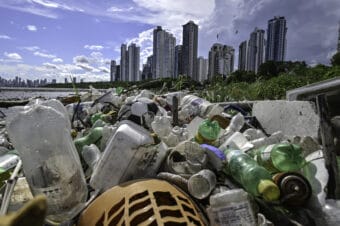
Because plastic waste piling up across the planet is making its way up to the Arctic. Plastics contain toxins that have been linked to long-term health problems like cancer, hormone disruption and damage to the heart, liver and kidney, which threaten Alaska Native communities. That’s according to a new report from Alaska Community Action on Toxics and the International Pollutants Elimination Network.
Waghiyi, who is the director of environmental health and justice for Alaska Community Action on Toxics, is a co-author on the report, along with other scientists and Alaska Native leaders who are calling for an end to new plastic production worldwide. They’ll represent Alaska’s Arctic communities at a meeting of the United Nations later this month.
Pamela Miller, a long-time Alaska scientist who works with both organization, is also a co-author. She said strong currents in the ocean and the atmosphere naturally move from lower latitudes to the poles, carrying plastic and other pollutants along with them.
“We now know that there are microplastics in fish, in walrus, in ring seal, bearded seal, spotted seal, and many different whale species,” Miller said. “These are the animals that have been relied on for centuries for sustenance.”
The accumulation of plastics in the Arctic is made worse by climate change.
“We also know that with climate warming happening so rapidly that the highest concentrations of microplastics are found in those areas where there’s the most rapid melting of sea ice,” Miller said.
The melting of sea ice, permafrost and glaciers also release plastics and chemicals that have long been bound in ice.
In 2022, the United Nations set out to write a treaty on how to deal with growing plastic waste. They’ve held several meetings to hash out the terms, including one happening later this month in Ottawa, Canada. There, the authors of the new report will join representatives from more than 170 other countries.
Miller says there’s only one real solution to the plastics problem.
“The first thing is to curb the production of chemicals and plastics,” she said. “Since they’re reliant on fossil fuel production, that also means curbing fossil fuel production.”
But not everyone agrees with her.
Most plastic is created with chemicals derived from fossil fuels. And as demand for oil and gas in transportation or home heating drops with the switch to cleaner energy, many in the fossil fuel industry see plastics as a way to support their future business.
Waghiyi says she hopes that Arctic Indigenous communities are able to push back against those industry interests.
“Our people have done all we could to make sure our land, airs and waters are protected,” Waghiyi said. “These multinational corporations do not take human health into account.”
She says she’s headed to Ottawa to fight to protect the health and food of her grandson.
Scientists Carly Biedul, Bonnie Baxter and Heidi Hoven look for migratory birds on the eerily dry south shore of the Great Salt Lake in Utah. (Lindsay D’Addato for NPR)
SALT LAKE CITY, Utah — Drive west of this sprawling high desert city, past its newly built international airport, through a series of locked gates into the Audubon’s Gillmor Sanctuary and it’s like entering another world.
Or maybe better put, an other worldly landscape: the vast, and drying wetlands along the Great Salt Lake, the largest saline lake left in the western hemisphere, some fifty miles long and thirty wide.
“It’s quite an adventure to get out here,” says Carly Biedul, a wildlife biologist at nearby Westminster University. She’s part of a team of scientists who have been tracking the lake’s decline amid the West’s record megadrought made worse by climate change. They’ve been conducting weekly trips to various sampling and study sites for the last several years at the remote lake that only recently started making international headlines due to its sharp decline.
Even since its water levels peaked in the 1980s, the Great Salt Lake has always had this mysterious vibe. It’s shallow and boggy. It can stink, especially in the heat of summer.
But zero in right here at this private sanctuary – where steady water still flows in due to a complex web of agreements – and it soon becomes clear how alive this ecosystem can be and how hugely important of a stopover it is for migratory birds.
Wetlands ecologist Heidi Hoven looks for shorebirds at the Gillmor Sanctuary, which she helps manage. (Lindsay D’Addato for NPR)Water diversions by farmers and Utah’s booming population are seen as some of the biggest culprits behind the Great Salt Lake’s decline. (Lindsay D’Addato for NPR)
Despite recent moisture, the lake is still shrinking
2023 brought record snow to Utah, and a healthy spillover of runoff into the imperiled lake. Scientists warn the lake has already shrunk nearly in half from its historical average.
“It’s because of so many years of drought and climate change and water diversions, and we can’t keep going like that,” says Bonnie Baxter, director of the Great Salt Lake Institute.
But she says there’s still time to reverse its decline. The last two years has bought the state some time. Researchers here are already detecting sharp declines in shorebird populations such as burrowing owls and snowy plovers. As the lake and its wetlands dry, the brine shrimp the birds feed on are dying out.
“For these birds that queue into these saline habitats, there are fewer places for them to go,” says Heidi Hoven, a wetlands ecologist who helps manage the Gillmor. “All the saline lakes here in the West, and many in the world, are experiencing this loss of water and in essence that relates to a loss in habitat.”
There are plenty of culprits behind the lake drying up
Scientists say the West is believed to be as dry as it’s been in 1200 years. The megadrought made worse by climate change has been contributing to the Great Salt Lake’s decline. But agriculture usually bears the bulk of the blame. Upstream water diversions for expanding alfalfa farms and dairies has meant less and less flows into the lake. Utah’s population is also booming. Hoven says development is now running right up to the sanctuary.
“You can actually see it over your shoulder,” she gestures. “It’s this advancement of large, distribution warehouses that are within a mile from the sanctuary now where it used to be open land.”
A short, bumpy ride later along a rutted out dirt track, Hoven pulls to a stop at a favorite vista. The setting sun is casting an eerie orange glow over the distant mountains that ring the dry lake bed. It stretches for miles with just a few pools of water here or there.
Scientists Heidi Hoven, Senior Manager at the Gillmor Sanctuary and Audubon Rockies and Bonnie Baxter, Director at The Great Salt Lake Institute, look for small flies at a bird sanctuary where many species of birds are affected by the recession of The Great Salt Lake. (Lindsay D’Addato for NPR)Wetlands ecologist Heidi Hoven looks for small flies at a bird sanctuary where many species are in decline due to the alarming drying of the Great Salt Lake. (Lindsay D’Addato for NPR)
It’s beautiful but also eerie, even for the trained eye of wildlife biologists like Biedul, who make weekly research trips to the lake.
“Otherworldly is a great word,” she says. “It’s crazy. We’re at Great Salt Lake right now but there’s no water. The other places where I go and sample there’s water there at least. But here we’re still at the lake and it’s dry.”
Hoven chimes in, solemnly.
“It’s just so shocking, and you know, it’s a shock to me every time I see it,” she says. “But to see someone view it for the first time. You can really see them taking it in. You never thought you could see this dryness.”
The state is being galvanized into action
But all this shock and alarm, the scientists say, may be good. It’s pressuring state leaders into action. Utah Governor Spencer Cox has pledged the lake won’t dry up on his watch. The state legislature has put upwards of a billion dollars lately into water conservation programs, most geared to farmers.
“For generations the lake was seen as kind of this dead thing that just happens to be there and will always be there,” Cox told NPR recently. “And now that people are realizing there’s a potential that it might not always be here, that’s gotten people’s attention in a positive way.”
Wildlife biologist Carly Biedul of the Great Salt Lake Institute closes the last of many gates to the protected Gillmor Sanctuary along the south shores of the Great Salt Lake. (Lindsay D’Addato for NPR)
Everything from lake effect snow for the lucrative ski industry, to mining, to air quality depends on the lake’s survival. Recent publicity around the crisis has raised public awareness but also started to bring more money which could lead to more comprehensive research that could inform everything from strategic action plans to save the lake to just understanding how the remaining migratory birds are coping.
Heidi Hoven, the wetlands ecologist, sees the shorebirds as a key indicator species.
“We have so much more to understand about what their needs are,” she says. “In these changing times, it’s really highlighting the need to understand these things quickly.”
The scientists say the last two winters may have bought Utah a little time, but no one in the West is counting on another good snow year next year.
Copyright 2024 NPR. To see more, visit https://www.npr.org.
Transcript :
SCOTT SIMON, HOST:
Trip now out to Utah’s Great Salt Lake, where water levels are up 3 feet after a couple of especially wet winters. That’s actually good news because the lake has been drying up fast. It is now about half of its historical size. NPR’s Kirk Siegler recently took a trip to a private wildlife sanctuary there, with scientists who’ve been warning about a looming ecological disaster.
KIRK SIEGLER, BYLINE: Just west of Salt Lake City and its newly built international airport, we drive through a series of locked gates, heading for the Audubon’s Gillmor Sanctuary.
(SOUNDBITE OF GATE LOCK OPENING)
SIEGLER: It’s like entering into another world – or maybe otherworldly – landscape, the vast wetlands along the Great Salt Lake, 50 miles long and 30 wide.
CARLY BIEDUL: Yeah, it’s quite an adventure to get out here.
SIEGLER: It’s always had this mysterious vibe. It’s shallow. It’s boggy. It stinks. But zero in right here, and you realize how alive it can be, how hugely important of a stopover it is for migratory birds.
(SOUNDBITE OF BIRDS SINGING)
SIEGLER: Sadly, sounds like these, archived by the University of Utah back in 2011, are becoming more and more rare out here. As the lake and its wetlands dry, the brine shrimp the birds feed on are dying. Heidi Hoven, a wetlands ecologist who helps manage the sanctuary, is leading our expedition.
HEIDI HOVEN: There’s less and less places for these birds that do queue in to these saline habitats. There’s fewer places for them to go.
SIEGLER: Hoven and her team are tracking a sharp decline, particularly in burrowing owls and snowy plovers, white-breasted with their tiny black beaks.
(SOUNDBITE OF BIRD SINGING)
SIEGLER: There are plenty of culprits behind the lake drying up. Farmers are diverting a lot of water upstream from here that used to flow into it. Utah’s population is also booming, and that development is running right up to us.
HOVEN: You can actually see it over your shoulder. We have – it’s this advancement of large distribution warehouses that are within a mile from the sanctuary now, when it used to be just open land.
SIEGLER: Back in her pickup, Hoven steers expertly through a series of huge, muddy puddles that look like they could swallow us.
(SOUNDBITE OF TRUCK DRIVING THROUGH MUD)
HOVEN: So there’s a little bit of road base left under all that.
SIEGLER: For the scientists, the mud is an encouraging sign. Utah is coming off two snowy winters.
HOVEN: So we can park here. This is a good get-out place.
SIEGLER: We stopped for a beat to take it all in, just shy of the lake bed. Bonnie Baxter, who runs the Great Salt Lake Institute at nearby Westminster University, chimes in.
BONNIE BAXTER: You know, I think we’ve bought ourselves a couple of years, and that’s great. But you look at this dry lake bed in front of you, and you can see, even after all of that snow from last year and a decent year this year, we’re still struggling.
SIEGLER: A short, bumpy ride later, we reached the actual shore, if you could call it that. The setting sun is casting an eerie orange glow over the distant mountains surrounding us on all sides. We feel tiny.
(SOUNDBITE OF TRUCK DOOR CLOSING)
SIEGLER: The dried lake bed stretches out for miles. It’s beautiful, but it’s eerie, even for the trained eye of wildlife biologist Carly Biedul.
BIEDUL: Otherworldly is a great word. It is – well, it’s crazy. We’re at Great Salt Lake right now, but there’s no water.
BAXTER: Yeah.
BIEDUL: Like, I feel like the other places – at least where I go and sample – there’s water there. At least you can see it. But here we’re still at the lake, and it’s dry.
SIEGLER: Heidi Hoven says she’s never not shocked looking out across the dry sand and dust.
HOVEN: It never ends to really strike people with awe in a way that – something that you never thought you could see, this dryness.
SIEGLER: But all this alarm, they say, is maybe good. It’s pressuring the state into action. Utah’s governor, Spencer Cox, is pledging the lake won’t dry up on his watch. The state has put a billion dollars so far toward conservation, mainly for farmers.
SPENCER COX: For generations, the lake was seen as just kind of this dead thing that just happens to be there and will always be there. And now that people are realizing there’s a potential that it might not always be here, that’s gotten people’s attention in a positive way.
SIEGLER: Everything from lake effect snow for the ski industry to mining to air quality depends on the lake’s survival.
BIEDUL: Is that coyote scat?
SIEGLER: But Cox has also called predictions by local scientists that the lake could dry up in five years alarmist. Bonnie Baxter from the institute helped write that 2022 study.
BAXTER: You know, scientists aren’t really known for being dramatic (laughter).
SIEGLER: What will be more dramatic, these scientists say, is if we let the lake dry up. Heidi Hoven sees the shorebirds as one of the indicator species.
HOVEN: And we have probably so much more to understand about what their needs are. And in these changing times, it’s really highlighting the need to understand these things quickly.
SIEGLER: Because no one in the West is counting on another good snow year next year.
Kirk Siegler, NPR News, Salt Lake City. Transcript provided by NPR, Copyright NPR.
If you’re thinking about getting an electric vehicle, you’re not alone.
People in the U.S. buy more than a million new cars every month, and as of March, less than 10% of those are electric vehicles. But more than half of car shoppers are at least considering battery-powered cars and SUVs, according to multiple studies.
And shoppers have lots of questions. In January, The Sunday Story, an NPR podcast, asked listeners for their EV questions. More than 60 listeners sent in queries, and The Sunday Story and Life Kit teamed up to answer them. The listener questions have been edited for length and clarity.
Are EVs truly better for the planet, even with mining for batteries and fossil-fuel-based electricity to charge them? (This was the No. 1 question asked by our listeners.)
The answer is yes. Many researchers have confirmed it, and online tools let you compare the impacts for yourself. One of the most recent analyses comes from Corey Cantor with the energy research company BloombergNEF, who headlined his report last month: “No Doubt About It: EVs Really Are Cleaner Than Gas Cars.”
“Big picture, moving away from spewing more CO2 into the atmosphere is a good thing for the climate,” he says. And the environmental benefits of EVs are getting bigger over time as grids get cleaner.
Is it better from an environmental standpoint to buy an electric vehicle now, or keep driving the gas car you have until you need a new car? –Ali Mercural, Portland, Ore.
For the climate, there’s a strong case for switching now.
Yes, creating that new EV — getting the materials to build it from scratch — is resource-intensive. But the climate impact of a gas-powered car increases every single day you drive it.
To be precise, more than 85% of a gas-powered vehicle’s lifetime emissions come from using the car, not from building the car. That’s according to researchers at Argonne National Laboratory. And that means the new EV, despite its manufacturing costs, will be cleaner over time.
Jessika Trancik, a professor at the Institute for Data, Systems and Society at Massachusetts Institute of Technology, suggests taking the long view on decisions like these. Think not just about emissions right now but over the entire time you’ll own a vehicle.
“Generally speaking, switching to that electric vehicle is going to provide a benefit over the lifetime of the car,” she says.
I’m not proud, but I’ve run out of gas twice in my life. Luckily, I had friends nearby to bring me a gallon of gas. What would happen if I ran out of charge in an EV? Would a tow truck come to charge me up? How long would that take? And how embarrassing would that be?–Robin Rzechula, Chicago
We can’t promise it won’t be embarrassing, but a tow truck could tow you to a charger. In some cities, AAA will bring a mobile charger to you.
Overall, charging is a different experience than fueling up. With a combustion engine, you have to regularly make a stop at a gas station to fill up. With an EV, for daily driving, most people charge at home overnight – which drivers frequently cite as a major perk of EV ownership. (This does require the ability to charge at home).
For road trips, on the other hand, many parts of the country still have limited availability of fast chargers, which are high-speed chargers designed for use in the middle of a trip. Charger speeds and reliability at public charging stations vary, and charging takes much longer than filling up at a gas station.
So charging takes less work day-to-day, but more planning on long trips. Map out chargers on your route so you won’t find yourself calling AAA.
Does leasing an electric car come with the same perks (like tax rebates) as buying an electric car? –Hallie Andrews, Washington, D.C.
The same or better.
There’s a federal $7,500 tax credit for purchasing an EV, now available as an up-front credit toward the cost of the car. But the list of vehicles that qualify is short because of requirements meant to support U.S. jobs and supply chains. Buyers also have to be under an income cap.
Leased electric vehicles all qualify for a $7,500 credit – no matter where they’re built, with no income cap. Check your lease paperwork to confirm that the credit is being fully passed along to you.
Wouldn’t it be better to design cities around mass transit and use mass transit than get everyone to convert to electric vehicles? –Thomas Guffey, Los Angeles
Switching to EVs is an important part of fighting climate change, but far from the only change that needs to happen.
The digital story was edited by Malaka Gharib. The visual editor is Beck Harlan. We’d love to hear from you. Leave us a voicemail at 202-216-9823, or email us at LifeKit@npr.org.
The Pretty Rocks landslide viewed from the east in May 2023. (Dan Bross/KUAC)
Work is scheduled to resume this month on a bridge that will cross a slumping stretch of the road into Denali National Park. The $100 million bridge will span 475 feet across a landslide at Mile 45, in an area known as Pretty Rocks, where accelerated melting of a rock glacier has closed the road since August 2021.
During the summer of 2023, bridge project contractor Granite Construction built a work camp and staging areas, transported materials and equipment, and began site preparation that included blasting, excavation, slope stabilization and pioneering a temporary heavy equipment access route across the Pretty Rocks landslide.
Denali National Park engineer Steve Mandt called 2023 “a huge year for the project” at a recent virtual town hall event, during which he reviewed last season’s progress and previewed what’s to come.
Mandt said this spring’s work will complete excavation on the west side of the slide, followed by construction of bridge abutments, or foundations.
“These foundations are composed of these large precast concrete blocks,” Mandt said. “So each of those blocks is 15 feet long, 4 feet wide, 4 and a half feet thick. There’s 13 of those per abutment. Each one of those is about 40,000 pounds of concrete. So, this entire abutment is 52 feet long, 15 feet long and four-and-a-half feet thick, so it’s just a massive foundation that’s going to be supporting each end of the bridge.”
Mandt said the abutments will be secured into solid underlying rock on either side of the slide.
“Basically, it’s a hole drilled into rock into which a steel bar is inserted and then that’s grouted in place,” he said.
Mandt said the contractor will also begin installation this summer of thermosiphons, commonly used along the Trans-Alaska pipeline and some Alaska roads, to keep ice underlying rock and soil on the east side of the bridge from thawing.
“We all know that climate is changing and even recent trends in the park are showing just progressively warmer temperatures over time, so we want to make sure that the ice that is ultimately helping support the bridge…that ice remains frozen,” Mandt said. “So, the thermosiphon is the tool that’s going to be used to do that.”
This season’s work will also see construction of a platform on the east side abutment, and the first third of the actual bridge.
“So, on that launch platform this year the contractor is going to be erecting the first three bays of the bridge,” Mandt said. “So, the first three sort of triangles of the truss will be assembled and sitting on that launch platform at the end of this construction season.”
Mandt said the rest of the bridge bays will be constructed on site in 2025 and then the entire structure will be pushed from the east side out over the slide to a receiving structure extended from the west abutment.
“Progressively moved over to the west side and then once that’s done that launch nose, the temporary truss will be removed,” he said. “The truss will be lowered onto the foundation.”
Bridge deck and guard rail installation are slated for summer of 2026, after which the bridge will open for park service and private in-holder use. Park visitor buses are scheduled to begin driving across the Pretty Rocks Bridge in the spring of 2027.
Passengers from the Natural Bliss Norwegian Cruise board a tour bus in April 2022. (Photo by Paige Sparks/KTOO)
Juneau may soon establish a new fund to help the city’s tourism businesses swap out polluting fossil fuel for cleaner forms of energy in their planes, buses and boats.
The proposal would set aside $1 million collected via marine passenger fees to fund a new clean energy loan and incentive program. It’s a small fraction of the $21.5 million in revenue expected from 1.6 million cruise ship visitors this summer.
According to city tourism manager Alix Pierce, the visitor industry generates a lot of Juneau’s greenhouse gas emissions, which contribute to human-caused climate change. She’s heard from residents and business owners who want to cut down on pollution, but she says they still need incentives to speed the transition to cleaner power.
“What I keep hearing consistently is that operators are interested, and that it’s just cost prohibitive,” Pierce said.
Public businesses or governments are often eligible for money that helps them to cut down on fossil fuels. Juneau, for instance, received funding from the Federal Transit Administration to buy electric buses.
But private tourism businesses are usually excluded from those grant programs. Bob Janes, owner of the whale watching and hiking company Gastineau Guiding, has about 30 diesel buses he’d like to replace. But he says it’s hard for small tourism companies to scale up.
“We can dabble here and there in the market, but until we really go into it full speed ahead, the impact is not much,” Janes said. “Well, full speed ahead is a lot of money. But this grant program would hopefully make that possible for us.”
Pierce says there’s a precedent for a loan and incentive program like this. In the early 2000s, the city established a fund that helped companies buy quieter engines for their float planes. The new clean energy program uses that as a model.
At this stage, what qualifies as clean energy is unclear. But Pierce says the bottom line is, it’s something that would cut down on greenhouse gas emissions. She says that could extend to hybrid power or even things like biodiesel.
Holland America and Princess Cruises in Juneau have used biodiesel developed from cooking oil to supplement the fossil fuel that powers some of their tour buses. They claim that it can cut emissions by 10%.
Even energy efficiency projects may qualify under the definitions of clean energy.
“I don’t want to unnecessarily limit operators,” Pierce said. “Maybe a smaller operator that wants to replace a dirty old school bus with just a brand new clean diesel bus — that’s a really big move in terms of emissions reduction.”
But Janes hopes the program will eventually push the local tourism industry toward net-zero emissions through electrification, which would tap into the city’s renewable hydropower supply.
“If I live long enough to see our fleet converted to electric, both on our boats, and with our buses, I will be the happiest person in the world,” he said.
The city is also considering using $5 million dollars of marine passenger fees for electrification of cruise ship docks. Renewable shore power is already available at the South Franklin Dock, which is privately owned by Princess Cruises. But Juneau has long-considered the installation of similar technology at two city-owned docks.
Though both funding proposals are in their preliminary stages, they’ll be up for debate as city budget discussions begin this weekend.
A sign points out a tsunami evacuation route in Pelican, Alaska, in July, 2023. (Clarise Larson/KTOO)
Alaska is home to breathtaking fjords, massive glaciers and a lot of mountainous nooks and crannies where nobody lives.
According to Mike West, director of the Alaska Earthquake Center, that rugged terrain is moving all the time in ways people might never see.
“Alaska is one of the few places where you can have a really massive landslide and nobody knows about it,” he said.
That happened 2015, when one of those remote landslides sent 180 million tons of rock tumbling into the Taan Fjord in Icy Bay. The force created a wave that crashed more than 620 feet up the shoreline.
And back in 1958, a massive earthquake triggered the tallest tsunami in recorded history in Lituya Bay. The wave killed five people, and stripped land, rocks and trees up to an elevation of 1,720 feet. At first, researchers couldn’t figure out how it reached that high, until they discovered that a landslide from the head of the bay created a wave of massive proportions.
Research seismologist Ezgi Karasözen with the University of Alaska Fairbanks said megatsunamis like that have the potential to be devastating for Alaska’s coastal communities.
“But we haven’t been monitoring these landslides routinely,” Karasözen said.
Until now. West and Karasözen have teamed up to develop a prototype method that can detect wave-generating landslides within minutes. They explain the new method in an article published in the journal The Seismic Record last month.
Seismic records from a landslide at Barry Arm. The left depicts both short-period and long period waves. On the right, long-period waves only. (Image courtesy of West and Karasözen)
Luckily, they didn’t have to start from scratch. Since the Good Friday Earthquake wreaked havoc 60 years ago this week, the state and other agencies have installed hundreds of seismometers that detect earthquakes and all kinds of geologic movement. The prototype taps into that existing network.
“So we have the infrastructure in place already,” West said. “It’s the same dang data – just analyzed in a different way.”
But the analysis is where things get tricky — because earthquakes, calving glaciers and all kinds of human noise create their own vibrations that can muddle the seismic records.
“When you only search for the landslide signal, the other signals become like noise to you, and you want to get rid of them,” Karasözen said.
Seismic signals can be read on a graph of vibrations over time. Most earthquakes happen briefly, just a few seconds. That motion creates what’s known as a short-period wave.
A lot of things create short-period waves, so the seismic record gets really busy. But landslides routinely last a minute or more, which means they create more distinct long-period waves, too.
The new detection method routinely scans the seismic record for those distinct, long-period landslide signals. Once it finds one, it runs that reading through an algorithm that calculates the rough size and location of the slide.
Karasözen says a detection system like this is more important now than ever because the risk of megatsunamis is growing as human-caused climate change melts glaciers.
“Once they retreat, these steep fjords we have all over coastal Alaska are losing their support,” Karasözen said. “If they were to fail — these slopes — they would fall into the water body and could trigger a tsunami that we wouldn’t know about.”
The Barry Arm fjord in May 2021. (Photo courtesy of the Alaska Division of Geological and Geophysical Surveys)
Barry’s Arm in Prince William Sound is probably the most well known example of this phenomenon. The steep face of the fjord, which was once buttressed by the retreating Barry Glacier, slumped hundreds of meters over the past few decades.
Scientists say a large tsunami there could hit nearby communities like Whittier within 20 minutes. Obviously that hasn’t happened yet. But West said that doesn’t mean it won’t happen in the future. He used the analogy of a dart board.
“I’m a really lousy darts player,” West said. “If I’m shooting for bullseyes, the vast majority of my darts are going all over the place, they’re missing,” West said.
Like in Barry’s Arm, where there have been at least three landslides in the last five years, but no big tsunami.
“But every once in a while, that dart, by coincidence, happens to line up with a bullseye,” West said. “And kind of the same thing is true for these landslides, which are happening all over the place, but most of the time don’t intersect with population centers.”
West and Karasözen say it’s their job to prepare before the day a landslide-triggered tsunami hits the bullseye. Their detection prototype has been collecting slide data in Barry’s Arm since last summer.
Every landslide they detect helps train the technology to get more precise. At the same time, they need more scientists who know how to interpret the data. That means it could be a long time before the method can be used as a practical warning system.
While monitoring of traditional earthquake-triggered tsunamis in the state has been honed over the last 60 years since the Good Friday earthquake, West points out that the science for detecting landslide-triggered tsunamis is still very young — but the new method is still a major step for tsunami preparedness.
“I’ve been humbled enough times on the earthquake side of things to appreciate that we still have a ways to go,” he said. “But this is research that has the potential to protect people.”
Close
Update notification options
Subscribe to notifications
Subscribe
Get notifications about news related to the topics you care about. You can unsubscribe anytime.