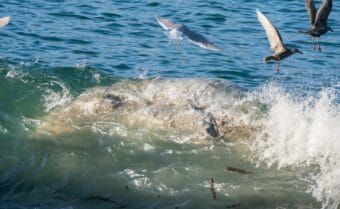
Wind blows the water in the Gastineau Channel on Wednesday, Sept. 17, 2025. (Photo by Clarise Larson/KTOO)
This story has been updated.
A storm moving through Southeast Alaska is causing high winds that will continue into Wednesday evening in Juneau. It’s resulting in power outages and fallen trees. Multiple cruise ships have canceled port calls.
The National Weather Service issued a high wind warning early Wednesday morning, which is in effect until 7 p.m. Brian Bezenek, the lead meteorologist at the Juneau NWS office, said sensors have reported gusts reaching up to 60 miles per hour downtown.
“We’ve got some very gusty and strong winds moving through the area that have been knocking down a few trees here and there, as well as some other minor damage around town,” he said.
Three cruise ships that were scheduled to arrive in Juneau canceled their stops ahead of the storm Tuesday night. One ship, the Caribbean Princess, chose to stay in Juneau overnight and remains in port this afternoon. The Viking Orion cruise ship was scheduled to arrive in Sitka today, but instead diverted course to Juneau due to the winds.
Matt Creswell, the city’s harbormaster, said local tugboats helped the ship moor this afternoon.
“All cruise ships visiting Juneau are able to have tugs on standby at any time they want,” he said. “That’s a common thing that if you need a tug, it’s always manned and ready to go if the ships need it.”
Alaska Electric Light & Power reported an areawide outage due to downed trees across town. The City of Hoonah also reported outages.
Bezenek said the heavy winds are expected to head north and through Juneau later this evening.
“It’s drifting north, and it should be jumping inland across the mountain range through today,” he said. “We’ll probably have the gusty winds in the Juneau area continue for another couple hours, and then we’ll see this wind band probably pushed north through the Lynn canal area.”
The Juneau School District reported at noon that all schools have been impacted by the power outage, but classes are continuing as regularly scheduled.
This is a developing story. Check back for updates.
Alaskans and, really, the rest of the world can expect a La Niña climate pattern this winter.
That could mean a potentially cooler-than-average winter.
According to the National Weather Service Climate Prediction Center, there’s a 71 percent chance of a La Niña setting in by October. The center updated its forecast Friday from essentially a coin flip chance to now saying a La Niña is more likely than not.
What that means for Alaska is still unclear, National Weather Service climate researcher Brian Brettschneider said.
“It, historically, would generally mean cooler falls in Alaska and cooler winters. That hasn’t worked out the last couple of times,” Brettschneider said. “And so I like to say that it puts the thumb on the scale, but sometimes that thumb slips off the scale and it just doesn’t work out.”
That’s not just because the Earth’s climate is warmer now than it used to be. A La Niña only accounts for some of the variability across an entire winter. Other things – like increased tropical cyclone activity, sea ice distribution or a polar vortex – can overwhelm that, Brettschneider said.
And even though La Niña winters tend to favor drier conditions, they sometimes produce more snow in Alaska.
“If you have the same amount of precipitation, but it’s colder, then you get more snow,” Brettschneider said. “You’re converting more of the would-be rain into snow. And then also, generally, when it’s colder, to a point, you get more efficient snow crystal production, and so you get fluffier snow.”
In Anchorage, one of the top three snowiest winters on record was a La Niña, while another was its counterpart El Niño, which tends to produce warmer, wetter winters.
And, Brettschneider said, the warmest winter on record in Alaska was during a La Niña. So the climate prediction can’t say what will happen, only what is likely to happen, he said.
On this episode of Garden Talk, host Bostin Christopher talks with Darren Snyder about maximizing your precious harvest and preparing for successful storage.
Photo courtesy of UAF Cooperative Extension
This episode of Garden Talk with Bostin Christopher features UAF Cooperative Extension Service agent and Associate Professor Darren Snyder, who discusses making the most of your precious harvest.
As the growing season comes to a close, many gardeners wonder what to do with their bounty. Darren shares insights into proper preparation for successful storage, emphasizing that a bit of planning now can make all the difference.
Discover how to preserve your harvest into fresh, crisp and nutritious food that lasts for weeks or even months by replicating a refrigerator’s environment. Learn about the three main concepts for successful cool storage: managing temperature (ideally just above freezing, 32-40°F for many root crops), controlling humidity (often over 90% for most vegetables), and ensuring adequate airflow.
Darren also discusses starting with the best quality produce, strategies like “skinning up” potatoes, and various root cellar options—from modifying a dry crawl space in your home to separate structures or even buried barrels.
Jared Nelson, left, and Adam Olson, right, show off their haul of albacore tuna caught off the Sitka coast on Sept. 7. Waters near Sitka were warm enough to draw tuna from the south, and residents took advantage of the rare opportunity to hook a type of fish not normally seen in Alaska. (Photo by Rebecca Olson/Used By Permission)
In Alaska, a state famous for abundant salmon and huge, cold-water-loving crab, another type of fish is making a splash: tuna.
Incursion of warm waters into Southeast Alaska coastal areas off Sitka and Baranof Island created a brief tuna jackpot earlier this month for sport fishers.
One of the first of those anglers was Troy Tydingco, who happens to be the Sitka sportfish area management biologist for the Alaska Department of Fish and Game.
He took a day off from work when conditions were just right to search for tuna, a type of fish suited to more southern latitudes: beautiful weather, with calm waters and water temperatures that reach 60 degrees.
About 30 miles offshore, the search was successful. Tydingco and his six companions caught 44 albacore tuna in all. Other fishers followed.
“I think this is probably the first time sport anglers have really successfully targeted them and harvested them out of Sitka,” he said.
Another successful Sitka tuna angler was Adam Olson, operations manager at the Northern Southeast Regional Aquaculture Association.
What makes it fun, he said, is that it is “incredibly unique and unusual.” It is a big change for Sitka, he said. “We’re very salmon-centric here in Southeast Alaska,” he said.
Steve Ramp, Troy Tydingco, Isabel Platten, and Alex McCarre pose on Sept. 4, 2025, with some of the albacore tuna they caught that day about 30 miles offshore from Sitka. (Photo provided by Troy Tydingco)
Olson enjoyed eating the tuna as well as catching it, grilling it with a little salt and pepper. “It was phenomenal,” he said.
Tydingco said there is no precise count for the tuna haul. Based on anecdotal reports, social media posts and general talk around town, he estimates that there were 200 caught out of Sitka.
Anyone with a sportfishing license is allowed to harvest tuna in Alaska, as long as they use legal means. Most anglers use rod-and-reel gear that would typically be used to catch salmon. It is also legal to use a spear gun, which one man employed successfully to get a skipjack tuna in the Sitka harbor.
Commercial opportunity?
The Sitka tuna flurry generated enough interest to prompt the Department of Fish and Game to issue an advisory on Friday laying out the rules for a commercial harvest.
There is no federal fishery for tuna in Alaska, so it is up to the state to regulate catches if they occur, said Rhea Ehresmann, a Sitka-based groundfish project leader for the Department of Fish and Game.
Though no one may have tried it yet, commercial tuna fishing is legal in Alaska. There are requirements for permits, gear types and record-keeping. Trolling and jigging gear, which uses hooks to catch fish, is allowable for tuna, but nets are not.
So far, the department has issued a couple of permits to interested fishers, Ehresmann said.
Any commercial catch of tuna – whether deliberate or accidental bycatch during a harvest targeting another species — is required to be reported to the state. There had been no such reports as of Monday, said Grant Hagerman, a Sitka-based troll management biologist for the Department of Fish and Game.
The Sitka tuna bounty may be new. But the occasional presence of tuna in Alaska waters is not.
Sea surface temperature departures from normal across the oceans as of Sept.14, 2025. (Map provided by the National Oceanic and Atmospheric Administration)
Up to now, Prince of Wales Island, at the far southern tip of Southeast Alaska, has been the site of most of the state’s tuna fishing, Tydingco said.
There are also isolated cases of tuna catches farther north, such as a skipjack tuna fished off Yakutat in 2015.
History indicates that the presence of tuna in Alaska waters is ephemeral. They might linger for a few weeks if waters are warm enough, then swim south.
Excitement over tuna in Alaska and rumors of their appearances date back to the 1920s, according to a 1949 report by the U.S. Fish and Wildlife Service. There was a Ketchikan-based commercial harvest in 1948, though that tuna appears to have been caught off British Columbia’s Queen Charlotte Island, according to the report.
Whether tuna fishing will become a trend in Alaska is yet to be determined.
Tydingco said this year’s successes are likely to encourage more fishers to look for tuna, but that people should not count on having tuna-friendly conditions every year.
“That warm water temperature doesn’t even always make it up this far,” he said.
There are signs that Alaska will be more hospitable to tuna in the future, due to warming waters caused by climate change and other factors.
While sea surface temperatures have increased in almost all of the world’s marine areas, temperatures in the North Pacific Ocean are rising faster, according to National Oceanic and Atmospheric Administration scientists. That includes the Gulf of Alaska, which has had recent marine heat waves.
An albacore tuna is hooked on a bait pole on Oct. 9, 2012, in waters off Oregon. Tuna are normally found along the U.S. West Coast but occasionally stray into Alaska waters if tempertures are high enough. Sport anglers catch them with gear similar to that used to hook salmon. (Photo provided by the National Oceanic and Atmospheric Administration/West Coast Fisheries Management and Marine Life Protection) Offshore in Oregon
Killer whales, including calves and juveniles, travel in their family group in the Gulf of Alaska in June 2025. (New England Aquarium in collaboration with North Gulf Oceanic Society under NMFS Research Permit 26614)
It’s well documented by now that the marine heatwave that hit the Pacific Ocean in 2014 had devastating effects on Alaska’s marine ecosystem and commercial fisheries.
Now, scientists are uncovering long-term impacts on Alaskan killer whales specifically – a harbinger as marine heat waves become more frequent and severe with climate change.
“We’ve learned that females that were growing during those heat wave years grew to smaller sizes,” said John Durban, a senior scientist with the New England Aquarium in Boston who has been studying killer whales in the Gulf of Alaska for two decades.
“If you’re smaller as a whale, it means you don’t have as much fasting endurance, you can’t store as much blubber,” Durban added. “So if you go through lean times, you’re less likely to bring a successful pregnancy to term.”
Durban has been partnering with the Alaska-based nonprofit North Gulf Oceanic Society to monitor several hundred resident, salmon-eating killer whales in the Gulf of Alaska. He flies drones over the water, which capture images of the whales from more than 100 feet in the air.
Those images allow researchers to measure how individual whales are developing over time.
The North Gulf Oceanic Society has been monitoring killer whales in the Gulf for more than four decades. Durban said that work became particularly important in the aftermath of the Exxon Valdez oil spill, which correlated with an “unprecedented” number of whale deaths among two pods that were exposed to the spill, according to NOAA.
The resident killer whales gradually recovered over the years. Or at least they were recovering, before the 2014 heatwave known by many as “The Blob” hit the area, according to Durban’s research.
“We started seeing that this recovery that had happened over the previous three decades basically getting wiped out in the course of a couple of years,” Durban said.
The technology has delivered some good news. This summer, researchers observed three new calves, plus some slightly older ones that appeared to be healthy and growing as expected.
That could mean the population is on a path to recovery. But it doesn’t mean the Gulf’s resident killer whales are in the clear. The females impacted by the heat wave may be less resilient in the face of future events, such as heat waves or dips in the salmon population.
“We’re cautiously optimistic, but I think it does mean that there’s some vulnerable whales out there,” Durban said.
His latest scientific findings haven’t yet been published. But he said he’s working on several scientific papers that lay out evidence that the so-called blob is still impeding Alaskan killer whales’ growth and reproductive success today, a full decade later.
As he sees it, the findings underscore the importance of studying apex predators. They rely on species down the food chain, which means they can serve as early indicators of trouble in the broader ecosystem.
Durban emphasized that the findings also highlight something else: the threat of climate change.
“These marine heat waves that we’re starting to see in increasing duration and intensity around the world are having really important effects on marine food webs.”
People celebrate Eaglecrest Ski Area’s 50th year of operation on Saturday, Sept. 13, 2025. (Photo by Clarise Larson/KTOO)
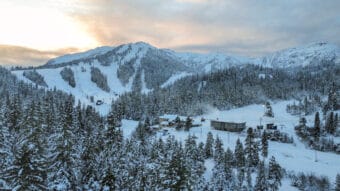
Eaglecrest Ski Area celebrated 50 years of downhill skiing and outdoor adventures in Alaska’s capital city on Saturday. But, the celebration comes amid questions about the financial viability of the city-owned ski area in the years ahead.
A live band played under the sun outside the lodge. Athena Morris was in the crowd with her family. She has been skiing most of her young life. She and her friend said their favorite thing about the local ski area isn’t the skiing.
“It’s the chairlift,” she said. “You get to sit on it and you get to go really high.”
Her dad, Ammon Morris, said his favorite part is the easy access to the sport and being able to share it with his daughter.
“I just love it,” he said. “I feel so privileged that we have this thing — and right in town. It’s just like, 20 minutes from my house. I get here every weekend, and we’re totally doing that this year.”
The Morrises were among the hundreds of residents who flocked to the ski area on Douglas Island on Saturday to celebrate its 50th year of operation. There was live music, food and auctions.
For five decades, Eaglecrest has drawn generations of local outdoor enthusiasts and travelers seeking Alaska snow adventures. It’s the only ski area in town.
Jim Calvin is the board chair for the Eaglecrest Foundation, a nonprofit dedicated to generating community support for the ski area.
“I think it’s hard to understate the value of Eaglecrest,” he said. “It’s hard to measure the value of Eaglecrest to the community, but it really is one of the things that makes Juneau a special place to live.”
Over the years, Eaglecrest has faced criticism for its growing reliance on city funding to build and maintain infrastructure and pay its staff. Now, management is looking to the future. The ski area is attempting to expand its services to operate year-round and become financially self-sustaining.
Calvin said Eaglecrest is at a turning point in its history.
“I think many of us see that summer development opportunities are part of the equation, part of the solution as we move to the next generation of Eaglecrest and we’re working hard to make that happen,” he said.
In the coming years, the ski area is slated to run into a multimillion-dollar deficit. It’s a part of a plan to repair some broken and aging infrastructure while boosting pay to employees and preparing to operate year-round.
Its expansion into summer operations relies heavily on the success of a gondola that the city bought for about $2 million three years ago. Its parts haven’t left the ground since arriving in Juneau, and it’s unclear how much it will cost to get it up and running. But once it’s operating, leaders say it will allow the ski area to stay open year-round and eventually make enough money for Eaglecrest to be self-sustaining.
Hannah Shively, Eaglecrest’s new board chair, said that’s critical to the next 50 years of operation. Eaglecrest’s former longtime board chair Mike Satre resigned earlier this month, saying he didn’t have enough time to dedicate to the position.
Shively said, despite the uncertainty, she thinks Eaglecrest’s future is bright.
“There’s a lot of opportunity to becoming more self-sustainable and maybe even subsidize winter recreation in the future,” she said. “I think it’s all potential, and it’s whether or not we can grab onto it.”
The ski area plans to host another anniversary celebration in January, which is when Eaglecrest officially opened in 1976.
Close
Update notification options
Subscribe to notifications
Subscribe
Get notifications about news related to the topics you care about. You can unsubscribe anytime.