Politics

House Speaker John Boehner Will Step Down From Congress In October

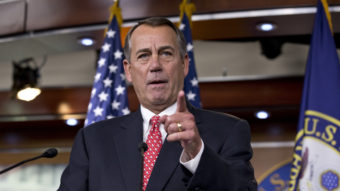
Speaker of the House John Boehner responds to reporters about the impasse over passing the Homeland Security budget on Friday. (Photo by J. Scott Applewhite/AP)

House Speaker John Boehner will give up his seat in Congress at the end of October.

Boehner became the 53rd speaker of the House in 2011. The Ohio Republican’s tenure has been marked by fierce confrontations with Democrats and sometimes with his own party. One of those fights led to a 16-day partial government shutdown in 2013.

Amid renewed conflict with more conservative members of his party, Boehner is once again facing the prospect of a government shutdown.

A Republican aide says that Boehner believes “the first job of any speaker is to protect this institution.”

The aide said Boehner expected to serve through the end of the year but that he changed his mind after seven-term Rep. Eric Cantor, the former House majority leader, lost his seat to a Tea Party candidate in 2014.

“The speaker believes putting members through prolonged leadership turmoil would do irreparable damage to the institution,” the aide said.

Boehner, who has 11 brothers and sisters, grew up working at his family’s tavern. He has represented Ohio’s 8th Congressional District since 1990.

His speakership was almost immediately challenged in 2011 as the Tea Party wing of the Republican Party refused to vote for a plan to raise the debt ceiling.

In 2013, that fight came to head, ending in a partial government shutdown. At the time, both Democrats and Republicans criticized the speaker of being too accommodating to the conservative wing of his party.

Boehner is in the same position now, NPR’s Brian Naylor tells our Newscast unit, except this time the fight is over the funding of Planned Parenthood. The conservative wing of his party wants to defund Planned Parenthood as part of a bill to keep the government open.

“There has been a movement by renegade Republicans to oust him from the speakership,” Brian says.

Boehner was expected to speak but it’s unclear whether he will. We’ll update this post if he does.

Update at 10:58 a.m. ET. Boehner Walks Past Reporters:

Boehner was supposed to speak to reporters, after he met with the GOP conference. Microphones had been set up at the Capitol, but minutes ago Boehner walked past reporters without saying anything.

The meeting is over, and he is back in his office. He may choose to speak later today, but that’s still an unknown.

Update at 10:16 a.m. ET: An Encounter About A Looming Shutdown

NPR’s Scott Detrow saw Boehner leaving a restaurant last night in Washington, D.C. He sends us this missive:

“Boehner looked relaxed and content last night, when he emerged from his favorite Washington Italian restaurant, Trattoria Alberto, around 9:30.

“A man who appeared to be the owner saw Boehner and his family out. And as the speaker walked to his SUV, a man at a neighboring restaurant approached the speaker for a handshake, and then asked him to please not shut the federal government down.

“Boehner embraced the man, grabbing both his shoulders, and said, ‘That’s not going to happen.’

“‘Look at me,’he said, pointing to both men’s eyes with two fingers. ‘From me to you, that’s not going to happen.'”

Update at 10:05 a.m. ET: Applause At Values Voter Summit

NPR’s Jessica Taylor sends this report from the Values Voter Summit, where GOP presidential hopeful Sen. Marco Rubio broke the news to the crowd:

“When Rubio announced at Values Voter Summit that Boehner had announced he was resigning, there was huge applause and a standing ovation.

“He deviated some from his prepared remarks. While he said he respected Boehner, ‘the time has come to turn the page for a new generation of leadership, and that extends to the White House.’ “

Copyright 2015 NPR. To see more, visit http://www.npr.org/.
Read Original Article – Published SEPTEMBER 25, 2015 9:39 AM ET

Senate Vote To Keep Government Funded Fails As Shutdown Nears

Senate Majority Leader Mitch McConnell brought a measure up for a vote Thursday that funded the government but defunded Planned Parenthood. Democrats banded together to block it. Evan Vucci/AP
Senate Majority Leader Mitch McConnell brought a measure up for a vote Thursday that funded the government but defunded Planned Parenthood. Democrats banded together to block it.
Evan Vucci/AP

Senate Democrats today blocked a Republican plan to keep the federal government open beyond next week. Their objection was that it also denied federal funds to Planned Parenthood.

With only days left before an Oct. 1 shutdown, the short-term measure that would fund the government through mid-December fell well short of the 60 votes needed advance, 47 to 52.

The vote took place just hours after Pope Francis’ speech to a joint meeting of Congress in which he urged lawmakers to come together to solve America’s problems.

This outcome was not unexpected.

Democrats had vowed to vote down any measure containing anti-Planned Parenthood language, and President Obama had threatened to veto any such bill.

Conservatives in Congress, notably Texas Sen. Ted Cruz, want to block federal dollars from going to the Planned Parenthood. The organization has been the subject of ongoing controversy since a sting video was released that alleges it profits from the sale of fetal tissue.

So the scramble continues to keep the government funded.

As the Two-Way reported last week, leaders of both parties are not itching for a shutdown. Republicans fear should a shutdown take place, a majority of Americans would saddle them with the blame, as in 2013.

Since Thursday’s procedural vote failed, Senate Majority Leader Mitch McConnell is expected to move to a vote on a “clean” continuing resolution, or CR, that leaves federal funding for Planned Parenthood intact.

As Politico reports:

“McConnell can also box out Sen. Ted Cruz (R-Texas) from attempting a filibuster if the GOP leader acts quickly after the failed vote; otherwise Cruz could try to delay McConnell’s plans to jam House Speaker John Boehner (R-Ohio) with a do-or-die vote on a clean stopgap spending bill, or continuing resolution. But Senate GOP leadership is confident they can rebuff any Cruz maneuvering.”

If the clean CR passes, as is expected, it will then go to the House, where its fate is less certain.

As The Hill reports, House conservatives could once again rally behind Cruz AS they did for the 2013 shutdown.

“Cruz’s power on Capitol Hill rests largely with House conservatives, as it did two years ago, because few Senate colleagues are willing to join him in challenging McConnell.

“If enough Republicans in the lower chamber side with Cruz, it could pressure [House Speaker] Boehner not to schedule a vote on a clean Senate-passed stopgap out of fear that it may cost him his gavel.”

Copyright 2015 NPR. To see more, visit http://www.npr.org/.
Read Original Article – Published SEPTEMBER 24, 2015 4:16 PM ET

Update: Gov. Walker calls special session on new gas tax, pipeline buyout

Update | 7:46 p.m. 

House Speaker Mike Chenault says he’s shocked by the governor’s inclusion of a new natural gas tax on the docket for the October special session.

In a press release, Chenault, a Nikiski Republican said he met with the governor on Monday and the tax wasn’t mentioned. He called the natural gas reserves tax “unusual and confrontational,” likening it to taking “a shot at our partners.”

At a nearly 2-1 ratio, state voters shot down a tax of this kind in 2006. The ballot measure proposed levying a tax on state leaseholders of 3 cents a year per 1,000 cubic feet of natural gas in the ground. The tax would be repealed on completion of a natural gas pipeline.

Original post | 4:37 p.m.

Bill Walker, State of the Budget
Gov. Bill Walker speaks to a joint session of the Alaska Legislature in January. (Photo by Skip Gray/360 North)


Gov. Bill Walker on Thursday formally called the Alaska Legislature back to Juneau for a third special session this year.

His proclamation calls for consideration of two topics: a tax targeting undeveloped natural gas still in the ground, and buying out Canadian pipeline builder TransCanada’s ownership stake in a proposed natural gas pipeline.

In a press release, Walker likened the state’s natural gas reserves to milk with no expiration date. He says taxing it serves as an insurance policy against the “significant risk of never monetizing” the gas.

The TransCanada pipeline ownership buyout is an option the state must exercise by the end of the year, if at all. The buyout would give the state more negotiating power with the other pipeline partners, ExxonMobil, ConocoPhillips and BP.

In a press release, the governor said the gasline project has gone from “a wish list item to a must-have” because of the state’s $3.5. billion budget deficit.

Sen. Dennis Egan, a Juneau Democrat, said he’s pleased the governor wants the session in Juneau.

“You know, the Capitol is ready for business,” Egan said. “And we just learned … the House chambers will be available as well. So Senate and House chambers will be available. There’ll be a few offices not ready yet, until mid-November, but we can accommodate everyone. And more than enough to accommodate a heckuva lot more than were accommodated in Anchorage.”

The governor is holding a press conference Friday morning in Anchorage on the special session.

FBI Investigators Recover Clinton Emails Thought To Have Been Lost

Democratic presidential candidate Hillary Clinton speaks during a community forum Tuesday at Moulton Elementary School in Des Moines, Iowa. Charlie Neibergall/AP
Democratic presidential candidate Hillary Clinton speaks during a community forum Tuesday at Moulton Elementary School in Des Moines, Iowa.
Charlie Neibergall/AP

Investigators with the FBI have recovered a trove of personal and work-related Hillary Clinton emails that had been thought to have been deleted and lost from a private computer server, one source familiar with the investigation tells NPR’s Carrie Johnson.

The recovery might mean that those emails may one day become public.

Bloomberg, which first broke the news, reports that the FBI is in the midst of an investigation looking at how and why classified information moved on Clinton’s private server.

Bloomberg reports:

“A review by Clinton and her aides determined that about half of the 60,000 e-mails she exchanged during her four-year tenure as secretary of state were of a personal nature, the presidential candidate has said.

“Those e-mails, she said, mostly dealt with planning for Chelsea’s wedding, yoga routines and condolence messages.

“Clinton said the personal e-mails were deleted from the server and her staff turned over paper copies of the remaining work-related e-mails in December to the State Department for processing and archiving. The FBI obtained Clinton’s server from the Colorado-based company managing it.”

As NPR’s Aarthi Shahani reported earlier this month, it was never clear whether the emails were simply deleted or had been “wiped” from the Clinton email server.

When Clinton was asked whether the server was wiped, she answered, “What, like with a cloth or something? I don’t know how it works digitally at all.”

As The New York Times reports, Clinton and her lawyer had said the personal emails were deleted and work-related emails were handed over to the State Department. In March, a House committee demanded that Clinton hand over the private server to a third party so they could make sure that all work-related emails had been turned over. The Times adds:

“Mrs. Clinton’s lawyer, David E. Kendall, said in response to the request that there was no reason to hand over the server because there was nothing on it. He said that after Mrs. Clinton’s aides had reviewed the emails, a setting on the server was changed so that only emails sent in the previous 60 days would be retained.

“But in August, Mrs. Clinton authorized her aides to hand the server to investigators. Computer forensic experts have said that if the change in the server setting was the only measure taken, it would be fairly easy for F.B.I. agents who specialize in recovering deleted information from computers to retrieve the messages.”

Clinton has asked the State Department to release all of her work-related emails. They are doing so in tranches, after reviewing whether they contain any sensitive information.

Copyright 2015 NPR. To see more, visit http://www.npr.org/.
Read Original Article – Published SEPTEMBER 23, 2015 9:19 AM ET

Obama To Nominate First Openly Gay Military Service Secretary

Eric Fanning, then the acting secretary of the U.S. Air Force, delivers remarks during a 2013 ceremony at the Pentagon. Fanning has held numerous military posts in the Obama administration. Paul J. Richards/AFP/Getty Images
Eric Fanning, then the acting secretary of the U.S. Air Force, delivers remarks during a 2013 ceremony at the Pentagon. Fanning has held numerous military posts in the Obama administration.
Paul J. Richards/AFP/Getty Images

President Obama has nominated Eric Fanning as secretary of the Army, which could make him the first openly gay leader of one of the U.S. military branches.

“Eric brings many years of proven experience and exceptional leadership to this new role,” Obama said in a statement. “I am grateful for his commitment to our men and women in uniform, and I am confident he will help lead America’s Soldiers with distinction. I look forward to working with Eric to keep our Army the very best in the world.”

Fanning has held numerous military posts in the Obama administration including special assistant to Secretary of Defense Ash Carter, acting secretary of the Air Force, and deputy undersecretary of the Navy. Before that, he was deputy director of the Commission on the Prevention of Weapons of Mass Destruction Proliferation and Terrorism, according to the White House.

In a Defense Department statement in July, Fanning said he came out as gay in 1993 and talked about how attitudes at the DOD have changed in recent decades.

“There is a much larger community out there that is looking for opportunities to show its support of us — that’s certainly been my experience as I’ve come out in my professional network, and it’s picking up steam,” Fanning said. “It’s gone from tolerance to acceptance to embrace.”

The nomination is the latest in a series of policy changes and appointments the Obama administration has made that advance the rights of LGBT people in the government. In addition to extending federal benefits to same-sex couples and repealing “don’t ask, don’t tell,” which allowed gays to serve openly in the military, last month, Obama announced the hiring of the first openly transgender White House staffer.

Fanning, who has served as acting undersecretary of the Army since June, still must be confirmed by the Senate.

Copyright 2015 NPR. To see more, visit http://www.npr.org/.
Read Original Article – Published SEPTEMBER 18, 2015 4:21 PM ET

Sen. Murkowski challenges Mendenhall Glacier Visitor Center fee bump

Mendenhall Visitor Center (Photo by Reywas92/Wikimedia Commons)

Sen. Lisa Murkowski on Thursday challenged National Park and Forest Service officials about the fees they collect from visitors.

At a Senate hearing, Murkowski said she “generally” supports the law allowing the agencies to collect fees.  The 10-year-old law requires that most of the revenue is spent on things like visitor services, maintenance and public safety. But then Murkowski homed in on the Mendenhall Glacier Visitor Center.

The Forest Service is raising the entrance fee at the visitor center from $3 to $5 starting in May. Murkowski said the increase is reasonable, but was leery of plans to expand the fee area beyond the visitor center.

“If you want to bypass the visitors center, you don’t want to go to the restroom, you don’t even want to park your car, if you just want to go to – and I’m just reading the article from the Juneau Empire here – if you just want to go to the Photo Point Trail, we’re going to charge the $5,” she said.

The senator says she worries the agencies are making public lands “uninviting.”

“I don’t want to go to my Mendenhall visitors center and go hiking on the great trails that we have out there and feel like I’m going to have somebody from Forest Service who’s going to chase me down the trail to pull up my multiple rain jackets to see if I’ve got a wristband on,” she said.

“Um, yeah, not only are we not going to chase them down trails but our real focus is going to be on trying to get our community to support us more in the future, by delivering things for this fee that they’ll support,” said John Neary, director of the visitor center.

Neary wasn’t at the hearing, but he says he’s concerned about preserving the visitor experience, too. He says 90 percent of the 500,000 visitors the park expects next year will have already paid their fee through a commercial tour operator. For those who arrive on their own, enforcement will be sporadic and Neary doesn’t envision asking hikers to roll up their sleeves.

“In the past we’ve used wristbands. We’d like to get away from that, for a variety of reasons … and I think a lot of people find them annoying,” Neary said.

Neary says visitors won’t be charged to use most trails, only those the Forest Service has invested money in, like Photo Point Trail, which is paved. User fees help maintain those improvements, and the center director says it needs more amenities.

“Right now, women that come out on a cruise and take a bus out here on a Monday afternoon typically have to wait 15 or 20 minutes on line to use the restroom block. And that’s unacceptable.”

Neary says the visitor fees will help pay for new bathrooms, since they can’t rely solely on funds from Congress.

Site notifications
Update notification options
Subscribe to notifications