Politics

Public testimony closes on Anchorage anti-discrimination ordinance

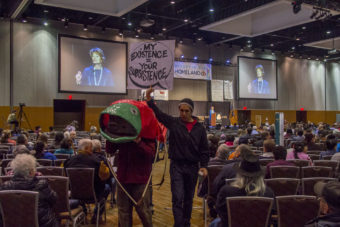
Members of the public line up to testify before the Anchorage Assembly on an anti-discrimination ordinance. Public testimony will continue Wednesday night, Sept. 16. (Photo by Zachariah Hughes/KSKA)

Public testimony is closed on a controversial Anchorage ordinance that could extend legal protections to residents on the basis of sexual orientation and gender identity. But the measure’s final form isn’t yet clear.

After extending the public commenting period to accommodate overflow, final action on the measure was postponed until the Assembly’s Sept. 29 meeting. That was in part because Assembly Chair Dick Traini wanted to make sure all members of the body were present for voting, and Vice Chair Elvi Gray-Jackson is currently out of state for a White House event.

When the Assembly resumes discussion it’ll be over proposed amendments. Some will be minor tweaks to language, particularly on the wording around ministerial exemptions that give hiring latitude to religious organizations. But conservative Assembly Member Amy Demoboski says she plans to introduce multiple amendments that are aimed at better protecting religious freedoms.

Most of those watching the measure expect it will pass. If so, Anchorage would become the first city in Alaska to extend full legal protection against discrimination on the basis of gender expression and sexual orientation.

Report: America’s Aging Voting Machines Could Present Election Problems

A voter fills out her ballot in Las Vegas in 2004. A new report finds several states, including Nevada, have voting machines more than 10 years old, which are more likely to fail. David McNew/Getty Images
A voter fills out her ballot in Las Vegas in 2004. A new report finds several states, including Nevada, have voting machines more than 10 years old, which are more likely to fail.
David McNew/Getty Images

Voting machines around the United States are coming to the end of their useful lives. Breakdowns are increasingly common. Spare parts are difficult, if not impossible, to find. That could be a serious problem for next year’s presidential elections.

Allen County, Ohio, election director Ken Terry knows how bad things can get. In the last presidential election, he had to replace the Zip disks — a 1990s technology — in the main machine his county uses to count votes. The disks are no longer made. And when he finally got some from the voting machine manufacturer:

“They actually had a coupon in them. They were sealed and everything. And the coupon had expired in … 1999,” he said.

And, to make matters worse, Terry said his voting machines use memory cards that hold only 250 megabytes of data — a tiny fraction of what you can store today on a $6 thumb drive. “You know, by today’s standards that’s just absurd,” he said.

Allen County is by no means alone in dealing with antiquated voting equipment. In Michigan, optical scan machines purchased in 2005 are breaking down at an increasing rate. That can be frustrating for voters and election workers, Oakland County election director Joe Rozell said.

“We’ve all become experts with cans of compressed air, trying to clear any debris or any pieces of paper that may have jammed the ballot path,” he said.

Michigan is trying to get new machines for next year’s elections. But that’s not the case in Ohio or most other states with aging equipment. According to a new report by the Brennan Center for Justice at New York University, 43 states will use some voting equipment next year that’s at least 10 years old.

“We’re not saying that all the systems are going to fail on Election Day — most systems will work. But the closer you get to this end of projected lifespan, the more likely you’re going to see problems,” said Larry Norden, one of the report’s authors.

Problems such as vote flipping — that’s when a voter presses one candidate’s name only to have the opponent’s name light up. It happens when the glue on touch-screen machines gets old and erodes. Norden said everything’s coming to a head at once because almost every state bought new computerized voting equipment right after the disputed 2000 election, using $2 billion in federal aid. But he says now there’s neither the money nor the same sense of urgency.

“More than one official has said to me [that] legislators [and] county funders are waiting for a disaster, which I think is crazy,” he said.

Disaster does seem increasingly possible. Earlier this year, the state of Virginia realized that machines used in 20 percent of the state were vulnerable to hackers and immediately ordered them replaced.

“It’s not a cheap endeavor. You know, we’re talking probably $10[,000] to $12,000 a precinct,” said state election commissioner Edgardo Cortes. That means hundreds of thousands of dollars for some counties, he said.

He worries that while rich counties will be OK, poorer ones will struggle — especially after the Legislature rejected the governor’s request for $28 million to buy new voting equipment statewide.

Some local governments, he said, just “can’t afford at this point to put out that kind of money.”

And the Brennan Center found a similar pattern in other states, where wealthier counties are getting new equipment, while poorer ones are not.

Cortes and other election officials said they’re not really worried about losing votes — most systems have paper ballot backups — but they do worry about maintaining voter confidence if broken machines mean longer lines and confusion at the polls.

Cortes said voters need to be confident “that the democratic process is working and that elections are as easy as possible to participate in for all our eligible citizens.”

That’s a challenge, given that many voters already say they’ve lost faith in the political process.

Copyright 2015 NPR. To see more, visit http://www.npr.org/.
Read Original Article – Published SEPTEMBER 15, 2015 1:03 AM ET


LGBT rights in Alaska

P R I D E

LGBT Rights in Alaska: Past, Present, Future

Layout and Design: Lakeidra Chavis
Content: Lakeidra Chavis
Editing: Jennifer Canfield and Jeremy Hsieh

A lifetime of fighting: A history of Alaska LGBT rights

Alaskans voted in 1998 to define marriage in the state constitution as only between a man and a woman. Now that the U.S. Supreme Court has invalidated that definition, Alaska and the entire country has marriage equality.

To some it may seem like things are changing fast, but Alaska’s fight for gay rights began half a lifetime ago.


Gov. Bill Walker on April 18. 2015. (Photo by Jeremy Hsieh/KTOO)

Q&A: Gov. Walker discusses LGBT rights

Walker has not given a direct answer when questioned about his position on LGBT rights. He’s only stated that he believes marriage is between a man and a woman. When questioned further in this interview about his stance on LGBT rights, he still did not provide a direct answer.

Rachel Pettijohn says she was discriminated against by two Juneau employers. The State of Alaska has no law protecting discrimination based on sexual identity or gender orientation. (Photo by Lakeidra Chavis/KTOO)

Despite marriage equality ruling, LGBTQ Alaskans can still be discriminated against

“They didn’t fire me,” says Rachel Pettijohn, “they just cut down my hours to where I wasn’t getting any hours.” 

Rainbow flags fly in front of San Francisco City Hall in 2013 after the U.S. Supreme Court cleared the way for same-sex marriage in California. Noah Berger/AP

LGBT discrimination claims still not valid in Alaska

“Just imagine if you couldn’t call the fire department because you were LGBT. If you are LGBT you should be able to call any state agency and get the same service,” says attorney Caitlin Shortell. She represented the same-sex couples that sued the state for the right to marry. “This is an injustice that needs to be corrected.”


Politicians and activists weigh in

Jesse Kiehl, aide to Sen. Dennis Egan, interacts with a visitor to the senator's office, Feb, 10, 2014. (Photo by Skip Gray/Gavel Alaska)

Juneau Assemblyman Jesse Kiehl on LGBT protections in Juneau.

Gov. Bill Walker discusses a tax credit veto with the press, July 1, 2015. (Photo by Jeremy Hsieh/KTOO)

Gov. Walker on handling LGBT rights during his tenure.

Activist and researcher Melissa Green. (Photo courtesy of Melissa Green)

Activist and Researcher Melissa Green.


Documents

This list includes the official files from bills that have included sexual orientation or gender identity in drafts of legislation dating back to 1975. The grid also includes links to significant court cases and video focusing on LGBT rights.

Michigan Lawmaker Quits, Another Is Expelled Over Bizarre Sex Scandal

State Rep. Todd Courser (second from right), R-Lapeer, testifies before a House committee Wednesday in Lansing, Mich. Courser resigned amid a vote to expel him for an elaborate scheme to cover up an extramarital affair with a fellow lawmaker. David Eggert/AP
State Rep. Todd Courser (second from right), R-Lapeer, testifies before a House committee Wednesday in Lansing, Mich. Courser resigned amid a vote to expel him for an elaborate scheme to cover up an extramarital affair with a fellow lawmaker.
David Eggert/AP

Two Tea Party Republican lawmakers in Michigan are gone today — one resigned, another expelled — after their alleged extramarital affair and a botched cover-up became national news last month.

Michigan state Rep. Todd Courser announced his resignation at 3:12 a.m. today after hours of debate in the state Legislature over whether to force him out of the body.

“I felt it was the appropriate thing to do,” Courser said. “I put everybody through a whole bunch, my family, constituents and the people in this room,” he said.

https://twitter.com/Todd_Courser/status/641961243566211072

Rep. Cindy Gamrat, with whom Courser allegedly had the affair, was expelled from the Legislature by a 91-12 vote.

“I firmly believe in restoration and redemption,” she said after the vote. “I have done everything I can to redeem this situation, and I’m sincerely sorry for what this has caused. I still believe my actions warrant censure, but not expulsion.”

Michigan Rep. Cindy Gamrat, R-Plainwell, sits at her desk on the House floor last month. She was expelled from the chamber early Friday. David Eggert/AP
Michigan Rep. Cindy Gamrat, R-Plainwell, sits at her desk on the House floor last month. She was expelled from the chamber early Friday.
David Eggert/AP

Michigan Public Radio’s Rick Pluta writes: “Many hours of floor debate, cajoling, and, finally, a standoff that lasted through the night ended with Courser walking to the front of the House chamber to hand the clerk a brief letter of resignation. Courser then walked back to his desk, collected his things and was escorted out of the chamber by three red-coated sergeant-at-arms, who confiscated his key cards that got him into the parking lot, the House Office Building, and the state Capitol.”

The Associated Press says Gamrat “declined comment as she left the Capitol with her teen son, her sister and her attorney at the end of a drama-filled, marathon 16-hour session.”

As we reported last month, Courser — who, like Gamrat, has close ties to the Tea Party movement — was caught on tape planning to circulate an anonymous email containing a rumor about himself that he’d engaged in sex with a male prostitute. The plan, according to the recording between Courser and an aide who was subsequently fired, was that the email wouldn’t be believed because of his conservative credentials and because Courser was married and had a family. The false rumor would help “inoculate” Courser from the charges of an affair with Gamrat, according to the tape.

The AP says: “The self-smear email called Courser a ‘bi-sexual porn addicted sex deviant’ and ‘gun toting Bible thumping … freak’ and Gamrat a ‘tramp.’ ”

In a May 19 conversation with aide Ben Graham, Courser, who has acknowledged the authenticity of the recording, is heard to say: “In a controlled burn, you do a little bit of truth mixed in with a lot of lies.”

According to the AP:

“Gamrat, from Plainwell in the southwestern part of the state, said she discussed the plot with Courser but did not know the email’s graphic content before it was sent.

“On Thursday, a special House committee recommended the expulsion of both freshmen tea party legislators, who had based legislation on their Christian beliefs and clashed with GOP leadership even before the controversy broke. But the full chamber then deadlocked for hours, as more than two dozen Democrats in the minority refused to vote.”

Gov. Rick Snyder has said he supports a criminal investigation against Courser and Gamrat to “bring closure to the issue for all involved.”

Copyright 2015 NPR. To see more, visit http://www.npr.org/.
Read Original Article – Published SEPTEMBER 11, 2015 9:17 AM ET

Trump, Cruz Headline Tea Party Rally Against Iran Nuclear Deal

Republican presidential candidates Sen. Ted Cruz of Texas and businessman Donald Trump
Republican presidential candidates Sen. Ted Cruz of Texas and businessman Donald Trump greet each on stage at a rally on Capitol Hill to oppose the Iran nuclear agreement. (Photo by Carolyn Kaster/AP)

Republican presidential candidates Donald Trump and Sen. Ted Cruz of Texas were among the speakers at a Tea Party rally Wednesday to denounce the Iran nuclear deal.

Trump, who leads the Republican presidential field in virtually all national polls, had his trademark bluntness on full display. He told the crowd of hundreds on the West Lawn of the U.S. Capitol that he has experience with negotiating, and that the United States got a bad deal with Iran.

“I’ve been doing deals for a long time; I’ve been making lots of wonderful deals, great deals. That’s what I do,” Trump said. “Never, ever, ever in my life have I seen any transaction so incompetently negotiated as our deal with Iran.”

And just in case it wasn’t clear where Trump stood, he took it one step further:

“We are led by very, very stupid people. We cannot let it continue. We are a country that owes $19 trillion. We lose everywhere, we lose militarily, we can’t beat ISIS, give me a break. We can’t beat anybody.”

Sen. Cruz, who is thought to be trying to court Trump supporters, got in on the bash-fest against the deal with Iran.

“It is the single greatest national security threat facing America,” Cruz said.

He told the crowd that if the deal goes through, the Obama administration will become the “world’s leading financier of radical Islamic terrorism” and that jihadists will use those funds to murder Americans, Israelis and Europeans.

Cruz, who is middle of the pack in many GOP polls, invited Trump to the rally to give it some additional media exposure, according to The Wall Street Journal:

“The rally, originally called to pressure Congress to pass legislation blocking the Iran deal, came to be seen as a largely symbolic protest because President Barack Obama has secured enough support for the deal to sustain his expected veto of legislation. But that did not deter Senate GOP leaders from opening debate on the legislation this week, nor Mr. Cruz and his allies from proceeding with the rally.”

Former vice presidential Republican candidate Sarah Palin speaks during a Tea Party rally against the Iran deal on the West Lawn of the Capitol in Washington
Former vice presidential Republican candidate Sarah Palin speaks during a Tea Party rally against the Iran deal on the West Lawn of the Capitol in Washington. (Jacquelyn Martin/AP)

For his part, Cruz seemed willing to place blame for the outcome of the Iran deal equally on Senate Democrats and the two top Republicans in Congress.

“If Senate Democrats decide that party loyalty matters more than national security, and if Republican leadership decides that a show vote is more important than stopping this deal, then the single most important issue in 2016 will be stopping Iran from acquiring a nuclear weapon,” Cruz said.

He added later that the next president should be ready to nullify the deal.

“Any commander-in-chief worthy of defending this nation should be prepared to stand up on Jan. 20, 2017, and rip to shreds this catastrophic deal,” Cruz said.

As the crowd outside the Capitol listened to more than 50 conservative speakers, including former GOP vice presidential candidate Sarah Palin and conservative radio host Mark Levin, a different issue was bubbling up inside the building.

Several media outlets report some conservative House Republicans rebelled against party leadership, causing a delay in what were supposed to be the first votes on the Iran accord since Congress returned from the summer recess.

Politico reports the procedural vote was put off after some in the Republican caucus say the Obama administration did not disclose “what they call ‘side deals’ between Iran and the International Atomic Energy Agency.”

“They are moving toward voting on a measure asserting Obama did not submit all elements of the agreement with Iran, a concept first raised by Reps. Mike Pompeo (R-Kan.) and Peter Roskam (R-Ill.), a former member of GOP leadership. Second, Republicans are working on a bill to try to prevent Obama from lifting sanctions against Iran. Third, the House would vote on a resolution to approve of the Iran pact. The original plan was to vote on a disapproval resolution.”

Copyright 2015 NPR. To see more, visit http://www.npr.org/.
Read Original Article – Published SEPTEMBER 09, 2015 5:37 PM ET
Trump, Cruz Headline Tea Party Rally Against Iran Nuclear Deal

Reality Check On Campaign Finance Reform: It Would Be Difficult And Slow

The U.S. Supreme Court in Washington, D.C., April 2, 2014. (Creative Commons photo by Stephen Melkisethian)

Candidates are championing campaign finance reform this year at a heightened pitch even as they’re still forced to cope with the realities of the uneven playing field if they want to survive politically.

Democrat Hillary Clinton was the latest to weigh in with her plan on Tuesday, outlining how she would curb the growing influence of money in politics. Her chief rival, Vermont Independent Sen. Bernie Sanders, has long made the issue a cornerstone of the insurgent movement he’s inspired. And the latest candidate to jump into the Democratic fray, Harvard Law professor Lawrence Lessig, is running solely on the issue.

While the furor against these campaign-finance vehicles comes mostly from the Democratic side, and is a big issue with Democratic voters, some Republicans have begun to acknowledge the problem and offer solutions, too.

The greatest indicator yet that it is becoming an issue among GOP voters is the rise of Donald Trump. The billionaire businessman is self-funding his campaign and won’t accept any corporate money or donations and says he’s beholden to no one — a large part of his appeal to primary voters.

But each of their plans and calls for reform can’t be enacted swiftly — or probably at all — in this political climate. Meanwhile, most of them have superPACs and have raised money for them to boost their own bids. That has forced them to play by the realities of the current rules even as some decry the rules as they are.

What Clinton’s plan says?

Clinton is pledging to:

  • overturn the Citizens United decision that opened the money floodgates and made way for superPACs five years ago.

To do that she promises to:

  • appoint Supreme Court justices who would oppose that ruling, along with
  • backing a constitutional amendment to limit the outsize influence of wealthy donors and special interests.

Clinton is also calling for more public disclosure of funding sources with:

  • an SEC rule to require publicly traded companies to disclose their political spending to shareholders and
  • requiring all federal government contractors to disclose all political spending.

She’s also proposing:

  • a public small-donor matching system for presidential and congressional candidates.

Is it realistic?

Yes and no. If she were president, Clinton may be able to nominate justices who would overturn Citizens United, but they could face a difficult confirmation. And even if they did get through, there’s no guarantee they could change the court’s makeup enough to change the outcome.

As for her proposal for a constitutional amendment on the issue, that’s a long and tedious process and one that would likely be dead on arrival in a GOP-controlled Congress or a divided one. It’s been over a decade since the McCain-Feingold Bipartisan Campaign Reform Act, otherwise known on Capitol Hill as BCRA, went through Congress. And the institution is far more polarized now.

Some of her other plans, like increasing disclosures for companies and government contractors, could feasibly be done, but would still likely meet Republican resistance. Clinton, though, indicated that some of her proposals she might try through executive order.

What have other Democratic candidates said?

Sanders, Clinton’s chief rival, has long championed campaign finance reform, and his insurgent campaign has been fueled, in large part, by a disgust with the growing influence of money in politics.

Sanders has already:

  • sponsored a constitutional amendment to undo Citizens United and
  • co-sponsored legislation to increase transparency.

He also says he would:

  • appoint justices committed to overturning the decision, and
  • supports public funding of elections.

“The Koch brothers, the second wealthiest family in America, plan to spend some $900 million in the coming 2016 election — more money than either of our major parties spent in the last election,” Sanders says on his website. “That is not democracy. That is oligarchy.”

The appetite for the issue even spurred Lessig, a relative political unknown, to officially get in the race for president this weekend after raising $1 million via a Kickstarter campaign.

His sole campaign platform is behind his:

  • Citizens Equality Act of 2017 — to reform campaign finance and voting rights.

He says he’ll serve only as long as it takes to enact the law, and then would step down and let his vice president take over.

Do they still have superPACs?

Clinton does in Priorities USA Action, along with other smaller groups. She’s raised money for the group and has embraced it — albeit reluctantly. That’s much like President Obama did in 2012, recognizing that superPACs were, as they saw it, a necessary evil in order to combat Republicans, who successfully used superPACs and other groups to win in a landslide in the 2010 midterms shortly after Citizens United was decided.

Sanders says he won’t accept any superPAC help but has only obliquely criticized Clinton for accepting support from one.

“We will be outspent,” Sanders told CNN Friday. “Let me just say this. I know we will be outspent by our opponents. We don’t have a superPAC. We’re dependent upon small, individual contributors, but I think that grassroots movement that you saw out there, that’s what’s going to win it for us.”

But it’s not contradictory to both want to do away with superPACs but also utilize their help, contends Viveca Novak of the Center for Responsive Politics.

“I think they recognize that you can’t hope to change things unless you’re in office,” she said. “How do you get there? You have to play the same rules as the Republicans are playing. Whether they like it or not, those are the rules of the game right now. If you don’t use them, it’s not going to turn out well.”

Are any Republican candidates for campaign-finance reform?

Republicans have largely been the beneficiary of these types of secret-money groups, and they have certainly used them to their advantage.

Trump: But even among the GOP electorate, there does seem to be a growing anger about money in politics — personified in the rise of Trump. While the current GOP front-runner hasn’t laid out a specific plan to reform the system, he has called the current system a “disgrace” and hit his other rivals for accepting the money, saying he “loves” the idea of campaign finance reform.

Graham: South Carolina Sen. Lindsey Graham, a close ally of BCRA co-author Arizona Sen. John McCain, has also said he supported the repeal of Citizens United.

Christie: New Jersey Gov. Chris Christie supports an unlimited contribution system with immediate disclosure.

“There has to be an absolute rule that 24 hours later you will reveal those contributions on the Internet, publicly available, so members of the public can scroll down on their computer,” he said at a New Hampshire town hall.

Fiorina: Former Hewlett-Packard CEO Carly Fiorina has said the system is obviously broken, but that the current reforms would favor Democrats.

“I’m OK with any set of rules as long as it’s the same for everybody, it’s completely transparent and we understand who’s giving the money to what,” she said last month in Iowa.

What’s the bottom line?

The current web of campaign finance is here to stay in 2016, and this cycle will be the most expensive ever. And if a pro-reform candidate does win, they’ll still face plenty of hurdles at undoing the current system — a Pandora’s box which Citizens United opened.

Copyright 2015 NPR. To see more, visit http://www.npr.org/.
Read Original Article – Published SEPTEMBER 09, 2015 10:40 AM ET
Site notifications
Update notification options
Subscribe to notifications