Politics

Judge denies injunction; Medicaid expansion will happen next week

An Anchorage Superior Court judge ruled Friday afternoon that Medicaid expansion can go forward in Alaska as planned next week. Judge Frank Pfiffner denied the Legislative Council’s request for a temporary restraining order to stop the program.

Pfiffner spoke for more than 45 minutes in court, unpacking the complicated legal arguments each side presented to make its case. To win a restraining order to stop Medicaid expansion, the Legislative Council had to prove the legislature would face “irreparable harm” if the program went ahead on Sept. 1. In denying the council’s argument, Pfiffner made several points, including the fact that the state won’t spend any money expanding Medicaid.

“For this fiscal year, with acceptance of Medicaid expansion, nobody disputes that the federal government is picking up 100 percent of the tab,” Pfiffner said. “It doesn’t cost the state one single dime.”

In his preliminary decision, Pfiffner also concluded the Legislative Council failed to prove it was likely to win on the merits of the case if it were to move forward. The case centered on whether the Medicaid expansion population is mandatory or optional. If the expansion group is optional, that would require legislative approval.

Health Commissioner Valerie Davidson smiled with relief when the judge wrapped up his decision. She said many Alaskans have waited a long time for Medicaid expansion and she’s glad they don’t have to wait any longer:

“You know, it isn’t about us; it’s about Alaska and Alaskans who are going to get what they need,” Davidson said. “They deserve good health care coverage. We all do.”

A spokesperson for the Legislative Council said no lawmakers were available to respond to the ruling. The council hasn’t said yet whether it will appeal the decision to the Alaska Supreme Court.

The state will begin enrolling newly eligible Alaskans in the Medicaid program Tuesday.

Sen. Menendez Bribery Case Heats Up With New Justice Filing

The Justice Department indicted Sen. Bob Menedez on bribery and conspiracy charges earlier this year, and the lawyers in the case have been getting under each other's skin. Andrew Burton/Getty Images
The Justice Department indicted Sen. Bob Menedez on bribery and conspiracy charges earlier this year, and the lawyers in the case have been getting under each other’s skin.
Andrew Burton/Getty Images

The Justice Department forcefully defended its prosecutors Monday against allegations of misconduct and perjury lodged by lawyers for Sen. Robert Menendez, D-N.J., and an eye doctor who served as one of his longtime donors.

Prosecutors said their “exhaustive, focused and disciplined investigation” ferreted out “a stream of bribes” the senator solicited and accepted from Salomon Melgen, including lavish trips to Paris and the Dominican Republic. In return, the government said, Menendez exerted his influence to advance the interests of his longtime donor in meetings with officials at the Department of Health and Human Services and elsewhere.

“No ordinary constituent from New Jersey received the same treatment and the quid pro quo outlined in the indictment is clear and unmistakable,” the new Justice Department filing said. Prosecutors also accused the defendants and their legal teams of substituting “vituperation for substance,” misusing ellipses to leave a misleading impression and deploying “false factual premises and specious legal reasoning.”

The remarks represent the latest in a series of incendiary legal filings in the high-profile case. Just last month, defense attorneys alleged that prosecutors and FBI agents had misled the grand jury in order to secure an indictment in New Jersey. The defense teams accused the government of such “outrageous misconduct” that they said all charges should be dismissed.

And they cited an embarrassing precedent — an earlier case against former Sen. Ted Stevens, R-Alaska — which the Justice Department ultimately abandoned over lapses in sharing evidence with the defense.

Unlike in the Stevens case, however, the Justice Department’s public integrity unit is giving little ground. Instead, they are fighting back, arguing that “what the defendants characterize as perjury is merely evidence that conflicts with their public protestations of innocence.”

And unlike in many federal public corruption cases, this prosecution revolves, in part, around testimony by ex-girlfriends of Menendez and his donor, the eye doctor Melgen. The Justice Department says at least six of those girlfriends are “direct witnesses to the corrupt relationship between the defendants.” Prosecutors added that they didn’t call all of the men’s former paramours, only those who benefited from the alleged corruption.

Lawyers for the senator and the doctor say FBI agents and prosecutors are wrongly focused on salacious allegations and attempts to dig up “dirt.”

Prosecutors also offered new details about one of the most contested pieces of evidence: a black-bound notebook seized from Melgen’s office that the FBI had described as a prostitution ledger.

Lawyers for Melgen are trying to get that evidence thrown out as an illegal seizure, because it runs far afield of the doctor’s health-care billings and relationship with Menendez.

But the Justice Department contends the notebook is in bounds. And prosecutors alleged in their court filing that they and the FBI found “substantial evidence” to establish probable cause that the doctor was “involved in prostitution.” The government also said Menendez took trips to the Dominican Republic “during time frames in which one unidentified alleged minor victim specifically claimed to have had sex with him.”

One key factual dispute between the government and the defense revolves around how former HHS Secretary Kathleen Sebelius and other top officials described a 2012 meeting they had with the lawmaker. The Justice Department and the FBI said that session was designed to benefit Melgen, while defense lawyers argued the purpose was far less clear.

Kirk Ogrosky, a lawyer for Melgen, and Abbe D. Lowell, a lawyer for Menendez, said they would respond to the Justice Department’s arguments September 14. “We stand behind the motions and remain confident that both defendants will be vindicated,” they said in a joint statement.

Menendez and Melgen had been friends for years before the indictment on bribery, conspiracy and other charges — and they say what DOJ describes as corrupt favors are actually a natural exchange of hospitality.

Copyright 2015 NPR. To see more, visit http://www.npr.org/.
Read Original Article – Published AUGUST 24, 2015 7:21 PM ET

Despite Same-Sex Marriage Ruling, Gay Adoption Rights Uncertain in Some States

Casanova and Daniel Nurse stand with children Ava Rose, 2, and Neijal and Cameron, both 4, whom they adopted from Florida’s foster care system. Some states still have barriers for married gay couples looking to adopt from foster care. (Photo courtesy of Pew Charitable Trusts)

As soon as Daniel Nurse met baby Cameron in 2011, he knew he wanted to adopt him.

“It was just like instant love. He was so sweet and loving, and seeing him smile—it was just an instant connection,” Nurse, of Tallahassee, Florida, said of the baby, then 11 months old.

But going about adopting Cameron proved challenging for Nurse and his husband, Casanova. Florida’s 1977 ban on gay adoption had only recently been overturned when the Nurses began looking to take in foster children in 2011 with the hope of ultimately adopting them.

While same-sex couples have long been able to adopt from private, gay-friendly adoption agencies, adopting children from the foster care system has proved more difficult in some states.

The U.S. Supreme Court decision in June that made same-sex marriage legal nationwide is changing that, but not everywhere—particularly in states with laws that limit joint adoption to a husband and wife.

“Marriage doesn’t create this completely certain playing field,” said Ellen Kahn, director of the children, youth and families program at the Human Rights Campaign, which advocates for gay rights.

And some states have taken up legislation that would allow taxpayer-funded contractors that oversee state adoptions to refuse to let gay or lesbian individuals adopt children if it conflicts with the organization’s religious beliefs. Michigan passed such a law right before the court decision.

The Nurses became familiar with all these roadblocks when adopting Cameron and their two other children.

The couple found they were limited in which contractors they could work with because some wouldn’t allow gay and lesbian couples to adopt. And though Florida’s ban on gay adoption was overturned in 2010, the Nurses were unable to marry in the state until this year. Thus, they couldn’t file adoption paperwork together. The adoptions had to be filed under Daniel’s name only, and the couple faced the added time and expense of adding Casanova’s name later.

Change Comes State by State

Thirteen states—Arkansas, Georgia, Kentucky, Louisiana, Michigan, Mississippi, Missouri, Nebraska, North Dakota, Ohio, South Dakota, Tennessee and Texas—prohibited same-sex marriage before the Supreme Court decision.

All but Arkansas and Tennessee also had policies that did not allow gay and lesbian couples to adopt foster children jointly, according to the Human Rights Campaign. In Alabama, where a federal court overruled the state’s ban on gay marriage, gay couples were also not allowed to adopt jointly.

But many of those states are changing their policies in the aftermath of the Supreme Court decision. That’s the case in North Dakota, where the law allows single people to adopt but specifies that adopting couples must be “husband and wife.”

“It’s simple,” said Julie Hoffman, adoptions administrator for the state Department of Human Services. “Now that gay couples are allowed to marry, they’ll be treated like any other married couple who’s adopting.”

Georgia, Kentucky, Louisiana, Missouri, Ohio and South Dakota also are changing their practices to allow married gay couples to go through the adoption process together. Some of them said they’re starting to update their forms to make them gender neutral.

In Alabama, married gay couples will be allowed to adopt a foster child, but they’ll have to wait longer than most—the state requires married couples interested in adopting to have been married for a year before beginning the adoption process.

Mississippi is the only state that has a law that specifically bars gay couples from adopting foster children, and Julia Bryan, spokeswoman for the state Department of Human Services, said the law will be followed unless the legislature makes any changes when it reconvenes in January. However, the ban is being challenged in the courts.

The Texas Department of Family and Protective Services also will wait on the legislature before changing how it operates, according to spokeswoman Julie Moody. Gay couples in the state will have to continue to have one member of the couple formally adopt the child, she said, and then the other member has to come back later to do a second parent adoption—a similar process to a step parent adopting a stepchild.

Nebraska policy prevented unmarried couples, gay or straight, from fostering or adopting state wards until 2012, when the state started allowing gay couples to become foster parents, ultimately placing foster children with 15 same-sex couples, according to the Omaha World Herald.

A county judge recently struck down the unmarried couple ban. But the state is planning to challenge that, saying that the broad scope of the order would require its Department of Health and Human Services to treat “unrelated, unmarried adults residing together” the same as it treats individuals and married couples. A statement from the Attorney General’s Office said that would make it more difficult to make placements in the best interest of the child.

Religious Interests

Although the court decision is leading to changes in some states, others are creating new roadblocks to gay adoption.

Michigan is one of the first states to enact a law that allows groups that contract with the state to oversee adoptions to decline service to any person or couple that conflicts with their “sincerely held religious beliefs.” Similar bills were considered in Alabama, Florida and Texas.

Republican state Rep. Thomas Hooker, who worked on the Michigan bill, said he was worried that if the state didn’t pass the law, it might have lost the roughly 30 percent of adoption agencies the state contracts with that are religiously affiliated.

That has happened in other states. Some Catholic organizations in Illinois andMassachusetts shut down rather than violate their conscience by serving gay couples.

But opponents of the Michigan law say its language is too broad, giving religious organizations leeway to discriminate against not just gay couples, but single people, interracial couples, people of other faiths or anybody who they say conflicts with their faith.

“Discrimination shouldn’t be happening at all, and it shouldn’t be done using taxpayer dollars,” said Lonnie Scott, executive director of Progress Michigan, an advocacy group that lobbied against the law.

Hooker said the law doesn’t pose a disadvantage to gay couples because the organizations will have to refer anyone they turn down to an organization that is willing to serve them.

While religious groups often argue that same-sex parents could be damaging to children, nearly all research has found the opposite. A 2015 project at Columbia University assembled scholarly, peer-reviewed studies on the well-being of children with gay parents. Of 77 studies, just four found that having gay parents negatively impacts a child.

Even in states that require agencies to work with gay couples, there are no guarantees against discrimination in deciding whether to allow them to adopt.

“It’s easy to find a way to say no to a couple. It’s easy to prioritize some couples over others,” said April Dinwoodie, chief executive of the Donaldson Adoption Institute, which researches adoption policy. She said if case workers have a bias, “they can find something within a home study that doesn’t suit them or find a reason a child wouldn’t be a good fit for a home.”

‘Love Is Love’

Daniel Nurse went to Florida’s Capitol earlier this year to testify against a bill that would have protected state contractors’ ability to turn him away. He put up pictures of his family. In addition to Cameron, now 4, the couple has adopted Neijal, also 4, and Ava Rose, 2.

Nurse questioned how someone could look at faces like those and argue they didn’t deserve the home that they now have.

“Love is unconditional. Love is love, and it’s what these children deserve,” Nurse said. “A person’s lifestyle shouldn’t matter if they can provide love and compassion.”

The bill passed in the House, but later died in the Senate. It was a big year for gay rights in Florida. The legislature also passed a bill that formally removed the 1977 ban on gay adoption from law. This wasn’t just a symbolic move—it was an appellate court that overturned the ban, but the matter never came before the state’s Supreme Court.

Read Original Article – Published August 19, 2015
Despite Same-Sex Marriage Ruling, Gay Adoption Rights Uncertain in Some States

Petersburg voters to consider exempting elected officials from financial disclosure

Petersburg voters have only one ballot question to decide this fall and it’s a question voted down by a narrow margin a year ago.

The borough assembly Thursday voted to put an exemption to state financial disclosure requirements on the ballot for the second year in a row. People who run for mayor, borough assembly, school board and planning commission, along with the borough manager are currently required to disclose their income sources to the Alaska Public Offices Commission.

State law on financial disclosure says the requirement is to discourage a public official from acting on a private business interest while serving the public. It’s meant to shine a light on a potential conflict of interest by a local office holder.

Mayor Mark Jensen thinks the requirement should be removed.

“I think it might help people participate in the elections if they didn’t have to file these disclosures. For a municipality our size, I don’t think it’s necessary, that’s my two cents on it,” Jensen said.

Along with Petersburg, several other Southeast communities like Juneau, Wrangell, the Ketchikan Borough, Haines and Skagway, along with the recently incorporated city of Edna Bay, still observe the filing requirement.

The Alaska Public Offices Commission website has a searchable database for these Public Official Financial Disclosure reports, as they’re called. Those reports show an office holder’s address and contact information, along with chief sources of income and amount of money an office holder makes within a range. It also shows income for other close family members.

Office holders with the old city of Petersburg were exempt from the reporting requirement, but that exemption went away with the creation of the new Petersburg borough, an unintended consequence of borough formation. Wrangell is also voting this year to remove the requirement.

Assembly member Nancy Strand just filed her paperwork to run for re-election to her seat, along with the APOC financial information.

“I am still kinda torn about it, but yes it’s a pain and there’s really no need for it here. I think that if somebody was doing shady things with money here everybody would already know about it,” Strand says.

Last year the exemption was on the ballot with some other controversial tax changes. It failed to pass with 518 people voting no, only 29 votes more than those who voted yes. This year it’s the only question on Petersburg’s ballot. The assembly Thursday approved the third and final reading of the ordinance sending the issue back to voters by a 5-0 vote. Assembly members Bob Lynn and Jeigh Stanton Gregor were not at the meeting.

2016 Campaigns Will Spend $4.4 Billion On TV Ads, But Why?

Thomas Checkler, owner of The Old Village Barber in Worthington, Ohio, discusses the impact that the barrage of political ads have on him and his customers during the 2012 presidential election campaign. Mike Munden/AP
Thomas Checkler, owner of The Old Village Barber in Worthington, Ohio, discusses the impact that the barrage of political ads have on him and his customers during the 2012 presidential election campaign.
Mike Munden/AP

The 2016 election is already providing a lot of eye-popping statistics about the ballooning spending candidates will be doing. Among them:

  • Former Florida Gov. Jeb Bush’s superPAC has already raised more — in the first half of a non-election year — than Obama’s main superPAC did in all of the 2012 cycle.
  • The latest big TV ad buy in the 2016 presidential election — on Ohio Gov. John Kasich’s behalf, totaling $375,000 — is worth more than seven times the annual median U.S. household income.
  • There have already been seven times more political ads in the 2016 election than at this point in the 2012 election, according to Elizabeth Wilner, senior vice president at Kantar’s Campaign Media and Analysis Group.

Or just try to digest the aggregate numbers. For instance, political TV ad spending will top $4.4 billion for federal races this year, up from $3.8 billion in 2012, Wilner estimated.

Yet TV ads seem to have only small effects on how Americans vote. So why do campaigns spend such huge chunks of their budgets on television spots? It’s the need for name recognition, at first. Later on, fear, habit and the hunger for the small sliver of votes at play also drive the huge spending.

Do TV Ads Work?

TV ads (and complaining about them) are a time-honored tradition of elections, and for good reason. Let’s start with what TV ads do well. One is that they reach a lot of people — 87 percent of people over 18, as Derek Willis wrote for the New York Times earlier this year. No other single medium comes close.

And for candidates who need to get the message out that they’re even running, that’s important. Because TV ads reach a lot of people, they also are super effective, dollar for dollar, in boosting lesser-known candidates. For this reason, challengers in House races benefit more from ads than incumbents because those ads give a candidate the big lift of simply making their names known, political scientist John Sides wrote in 2011. So in the crowded 2016 Republican primary, that will drive a lot of spending, as candidates struggle for oxygen.

But incumbents still spend big on ads. President Obama and his supporters in 2012 spent more than $450 million on advertising altogether, by one estimate. Hillary Clinton, one of the best-known politicians in the U.S., has already amassed a $45 million campaign war chest, a large part of which will likely also go to TV spending.

Once the general election rolls around and the candidates already have voters’ attention, the evidence is sketchier (and lots of journalists before me have tried to dissect this question) … but it appears that campaigns are spending a lot of money on a short-term effect on a small group of voters.

When studying the outcomes of the 2012 presidential election, Sides and UCLA political science professor Lynn Vavreck found that while ads had a measurable effect on voter attitudes, that effect was small and remarkably short-lived — it disappeared within a week.

In another often-cited 2010 study, Bowdoin’s Michael Franz and Washington State University’s Travis Ridout found that advertising had meaningful effects on voting in the 2008 election, but they also found that you need a lot of ads (and a lot more than your opponent) for a little gain.

“Having a 1,000-ad advantage across the entire campaign, for instance, resulted in about a 0.5 percentage point improvement in a candidate’s share of the vote in 2008,” they wrote.

And as campaigns go increasingly negative in their advertising, there’s evidence that those negative ads don’t really change voters’ minds, as researchers from Rutgers and George Washington Universities found in 2007.

And even if your ads are effective, they’re chasing a small group of people. In the big races like the presidency, campaign advertisements work only at the margins — they might affect the (very) small share of people in the middle, but lots of Americans will fall in line with their parties.

Indeed, there’s evidence that the number of persuadable voters is shrinking, as the number of moderates slowly but steadily declines and voters grow more polarized. So this could mean more advertising dollars chasing fewer voters in general elections.

There’s another growing problem with TV advertising, says one expert: It doesn’t keep people’s attention the way it used to.

“TV ads are not as effective as they once were,” said Donald Green, professor of political science at Columbia University.

Once upon a time, people had to get up to change channels or turn down the volume to avoid ads, he said. “In the early days of TV, when people watched more attentively … you could show your ads to people who would sit right through them.”

And the ways to avoid political TV ads have proliferated well beyond remote controls and mute buttons. Today, lots of people might fast forward past ads on their DVR or on-demand services, Green said, or they might simply fiddle with their phones during commercial breaks.

That means that at some point, campaigns may have to start thinking differently about how to win voters over.

“There is some evidence that more and more people are sort of turning off those [TV] ads,” said Gregg Phillips, who ran Newt Gingrich’s superPAC, Winning Our Future, in 2012. “The younger generation is going to be moved by a different type of ad. They’re going to be moved by some enterprising group on Reddit that has found a way to deliver a message rather than on a traditional format.”

So Why Buy Ads?

You could argue that part of the reason ads are so expensive is because campaigns don’t know how effective they’ll be.

“In a highly competitive race where candidates are well-known, ads aren’t going to make more than a 2-3 percentage point difference, but obviously, some races are decided by 2-3 percentage points, and so you just don’t want to give up on that,” writes Ridout in an email.

Campaigns don’t know what the return on investment on any given ad will be, but then, they only care about one return: winning or losing. The one vote that pushes a candidate over the finish line is the vote that matters, so it’s priceless.

There’s also a business reason that campaigns spend so much on ads: campaign consultants have an incentive to push ads, according to Green, because they’re in the media business — they not only believe in ads, but they sometimes get a cut of the media spending.

One other reason spending is growing: It’s an arms race.

“We found ourselves trying to match each other in the buying,” said Phillips of the 2012 campaign. After winning South Carolina, the campaign soon found itself outmatched in Florida, where Mitt Romney’s campaign inundated voters with anti-Gingrich ads. He even compared the spending ramp-up to a military attack.

“What [the Gingrich] campaign faced when they left South Carolina and went down to Florida was nothing short of a blitzkrieg. It was a bombing of sorts, a carpet bombing of Gingrich folks, that we have never seen before,” said Phillips.

And if ads really do have that short-term effect that studies have found, campaigns want to keep the blitzkriegs going, unstopped, to keep those effects going (and to avoid losing ground to opponents, who are launching their own blitzkriegs).

But if the general election is an arms race of spending on ineffective ads that only affect a few people, what does that mean? Could campaigns radically pull back their spending with little effect? Could they reinvest elsewhere?

They could, says one expert — if they were willing to take the risk of being guinea pigs. And no one is willing to do that.

“Elections are one-time things, and [campaigns] don’t want to risk not doing everything everywhere,” said Diana Mutz, political science professor at the University of Pennsylvania.

Because of that, change in how campaigns spend on ads is slow. But there is one clear shift underway in national races: a move away from traditional broadcast ads and toward more targeted digital advertising — the equivalent of switching from a hacksaw to a scalpel.

“[TV] reaches a huge audience. But is it reaching the right people?” asked Mutz. Some types of TV advertising, like uber-targeted cable advertising, are in their infancy but promise to target voters not just by neighborhoods (places where young people, Hispanics, or low-income voters live) but on an individual level (certain low-income Hispanic young voters).

Online advertising likewise holds that promise and is growing rapidly — far more so than TV, in fact. Digital spending in 2016 could top $1 billion, according to market research firm Borrell and Associates, growth of 576 percent over 2012. Cable spending, in comparison, will grow by only 28 percent, and broadcast TV by 7 percent. And sooner or later, that TV spending could flatten or even fall off.

“Spending on TV will deteriorate,” predicted Kip Cassino, vice president of research at Borrell. “By 2020 you’re going to see this kind of spending approach what used to be spent on TV. It’ll be within a billion of TV by the 2020 election.”

And that’s maybe the best indication of how massive campaign ad spending has gotten. Despite all the uncertainty about what TV ads even do, getting “within a billion” of it is, in fact, pretty close.

Copyright 2015 NPR. To see more, visit http://www.npr.org/.
Read Original Article – Published AUGUST 19, 2015 9:57 AM ET

Legislative panel votes to spend $450K to stop Medicaid expansion in court

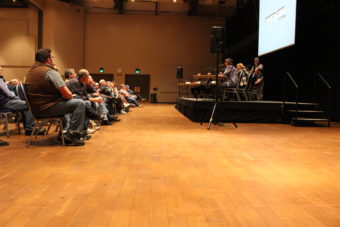
At a meeting in Anchorage on Tuesday morning, the Legislative Council voted to spend up to $450,000 on legal assistance to fight Medicaid expansion in court. (Annie Feidt/APRN)

A legislative panel has voted to sue Gov. Bill Walker to stop Medicaid expansion. The Legislative Council made the announcement after a closed door meeting in Anchorage Tuesday morning.

The council voted to spend up to $450,000 on legal assistance to fight Medicaid expansion in court. Before the vote, Sen. Charlie Huggins (R-Wasilla) made the case for the lawsuit:

“This is not the time for the Alaska State Legislature to be timid and it’s not about the issue, it’s about the separation of powers. So I firmly, firmly urge members of this body to support the motion.”

Last month, Gov. Walker announced he would expand Medicaid starting Sept. 1. The Legislature failed to vote on his Medicaid expansion bill during this year’s regular or special session.

Only one lawmaker voted against the lawsuit, Rep. Sam Kito (D-Juneau). He noted that several legal opinions supported Governor Walker’s decision to expand Medicaid on his own:

“And I am concerned about spending money in our current budget times to actually perform an action that could cost the state money.”

Medicaid expansion would offer federal health care to low income, childless adults. The federal government will pay 100 percent of the cost until 2017. After that, the state’s share of the cost of the program will gradually increase, but never amount to more than 10 percent.

At a news conference following the legislative council vote, Walker said he was disappointed in the legislature’s action:

“I stand firm on my decision. It was the right thing to do. I’m not wavering for a minute. Alaskans deserve nothing less. This has not pushed me in a different direction whatsoever.”

The legislative council is bringing in a Washington, D.C., law firm to challenge Medicaid expansion. Lawyers with Bancroft PLLC have argued against the Affordable Care Act in cases before the U.S. Supreme Court.

Senator John Coghill, a Republican from Fairbanks voted for the lawsuit. He says the lawyers will focus on getting a judge to issue an injunction stopping Medicaid expansion from going forward on Sept. 1. He says if an injunction isn’t granted, the lawsuit is unlikely to be effective:

“I think that we’ll push it, but by the time the process works we’ll probably be in a regular session, so at that point, the damage will probably already be done and then how to unravel it? Probably is not going to happen in the court system.”

About 40,000 Alaskans would qualify for Medicaid expansion. The Walker administration estimates about half that number would sign up in the first year.


Site notifications
Update notification options
Subscribe to notifications