State Government

Primary ballot measure results certified

Turnout in last month’s Alaska statewide primary appears to be the lowest in a decade at 25.34 percent.

That’s the lowest primary turnout since 2002.

This year’s primary didn’t have a high-profile race. Past years, such as 2008 when 40.6 percent turned out, included a hotly contested Republican U.S. House race. In the 2010 primary for U.S. Senate and House and the governor’s office, turnout was 33.7 percent.

Lt. Gov. Mead Treadwell certified the Aug. 28 statewide primary election on Monday.

Ballot Measure 2, which would have re-established a coastal management program in the state, was soundly defeated, but official election results show Ballot Measure 1 won by a slight edge.

The measure would make it legal for local governments to exempt the first $50,000 worth of a homeowner’s property from taxes. Currently, local governments can exempt up to $20,000 of the value of owner-occupied housing from property taxes, with voter approval.

Results show 61,804 votes in favor of Ballot Measure 1 and 61,495 against. Recount request must be received by the end of the week.

Assembly says slow down in Auke Bay corridor

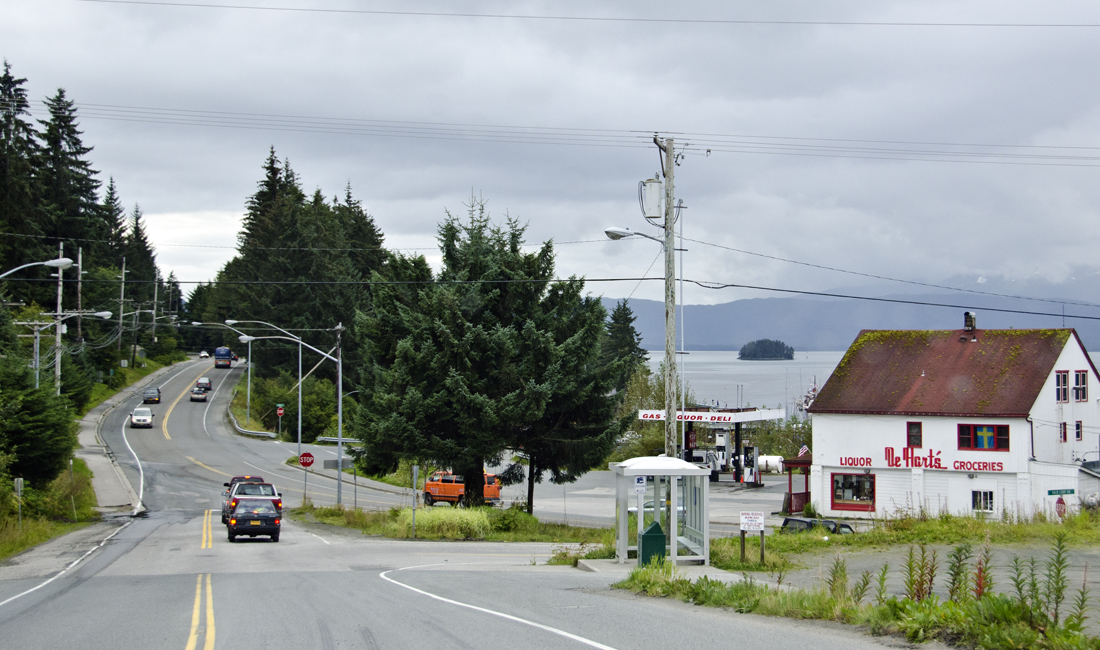
The intersection of Glacier Highway and Back Loop Road in front of De Hart's.
The intersection of Glacier Highway and Back Loop Road in front of De Hart’s. (Photo by Heather Bryant/KTOO)

The Juneau Assembly wants a say on the speed limit in the Auke Bay corridor. The panel last night (Monday) told state Transportation Department planners that the proposed speed limit – not a new roundabout – is a problem.

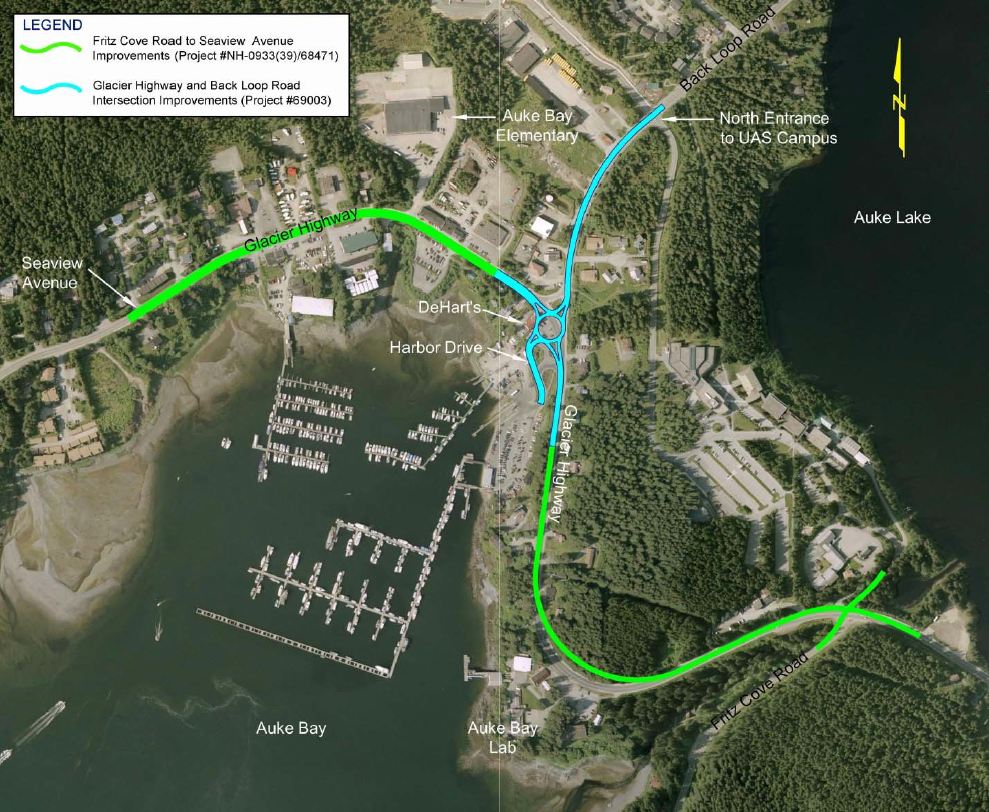
DOT proposes to build a circular intersection at Glacier Highway and the Back Loop Road. The project has gone through several iterations since DOT once proposed a controversial roundabout that would have eliminated DeHart’s store.

With the historic site – on Alaska standards – saved, the public is focusing on speed through the area.

The corridor is defined as an Urban Principal Arterial and it includes a U.S. Post Office, a city fire station, small businesses, Auke Bay Elementary School, and homes as well as major harbors.

Project consultant Nathan Leigh said the roundabout will be safer for pedestrians.

“As the roundabout goes around, it slows traffic down at that intersection,” Leigh said, “and there’s crosswalks at each leg of that, so as you’re crossing the roundabout you only have to look at one direction of traffic.”

The project includes other safety improvements, such as sidewalks on both sides of the road and improved access to the Auke Bay school and a school crossing.

DOT Manager Greg Lockwood said the speed limit will stay the same.

“We’re not changing the speed limit essentially; we’re designing to the current speed order. The 35-miles an hour that’s posted from Auke Lake to Harbor Drive doesn’t meet the current speed order. So what we’re doing on this project, we’re not changing any speed order we’re just designing the road to be safe at the speed order speed,” Lockwood said.

But much of the public that has already weighed in on the project – and most of those asking the Juneau Assembly to take a stand – believe that’s too fast.

Assembly member Carlton Smith – who used to live near the Auke Bay fire station – says a higher speed limit is not logical.

Map of the Glacier Highway Improvement projects.
Map of the Glacier Highway Improvement projects.          (Map courtesy of CBJ)

“The ferry workers that are going out, the ferry workers that are coming back, the mine workers changing shifts, plus the tour buses, I just don’t see the logic of doing anything more than 20 miles a hour through that entire area,” smith said. “But my perspective is having lived there.”

The highway engineers say it’s a balancing act to satisfy people driving out the road, pedestrians, bicyclists, and local businesses and residents.

State law requires the Department of Transportation consult with municipalities in determining safe speed limits and speed zones, and the Assembly has been lobbied heavily in recent months by people asking them to force the issue.

The Assembly last night directed city staff to draw up a formal resolution requesting a speed study in the Auke Bay corridor.

The project schedule calls for going out for bid on the Auke Bay Corridor improvements, with construction to start in the spring.

Parnell administration defends practice of not keeping text messages

Governor Sean Parnell’s administration is standing by its practice not to preserve or make public any information sent or received as cell phone text messages.

A former Parnell staffer told the Anchorage Daily News more than a month ago that the administration routinely uses text messages to avoid public disclosure rules.

Senate Judiciary Committee Chairman Hollis French on Thursday released a legal opinion by a legislative lawyer that seems to call the practice into question.

Attorney Dan Wayne’s memo says state law defines public records as “books, papers, files, accounts, [and] writings … regardless of format or physical characteristics.”

French says technology doesn’t matter in the view of the law.

“The public expects that written records, in whatever form they take place – whether it’s a Facebook message, email, a text message – should be saved so they can reveal the work of their government. That’s the idea, and as technology changes, we just have to make sure that the law stays abreast of those changes,” French says.

Parnell Spokeswoman Sharon Leighow disputed via email the claim that text messages need to be preserved as public records.

“Text messages are transitory and are not saved,” Leighow wrote. “The administration does not consider text messages public records.”

French says that’s an unfortunate interpretation of an increasingly common means of communications.

“More and more people are going to text messaging. It’s functionally identical to an e-mail. So, I think the governor and his staff should rethink their position,” he says.

The Alaska Supreme Court is expected to weigh in – indirectly – on the dispute when it issues a decision on whether state business transacted on private email accounts is subject to the state’s Public Records Act.

Ferry system gets anniversary logo

The new Alaska Marine Highway logo, created by Bradley Reid of Anchorage. It celebrates the system’s 50th anniversary. Image courtesy AMHS.

The Alaska Marine Highway has a new logo.

The blue-and-white “retro” image includes a ferry surrounded by a circle with the system’s name, plus an orange anniversary banner.

Officials say the shape is inspired by portholes of oceangoing vessels. The colors represent the ocean and waves ferries sail through.

Department of Transportation spokesman Jeremy Woodrow says it’s part of the upcoming celebration of the system’s 50th year.

“January 2013 will probably be when it starts. We’re going to be announcing the roll-out of the celebration coming up pretty soon here, within the next week or two,” he says.

Anchorage’s Bradley Reid and Associates created the new logo.

It replaces a more standard-looking, rectangular image that also shows a ferry and the system name.

Coastal management issue likely to come up next session

Despite the failure of Ballot Measure Two, Alaska could still reestablish its Coastal Management Program. Lawmakers on both sides of the vote expect to work on the issue again next legislative session.

Ketchikan Representative Kyle Johansen, who is facing a re-election challenge this fall, was glad voters turned-down the initiative. Johansen and other opponents have said they are in favor of having some sort of coastal management program…but not the one proposed in the initiative.

The measures opponents said, among other things, that it was too far reaching. With support from oil producers and other pro-development interests, the vote-no-on-two campaign was able to vastly outspend initiative backers who received most of their support from coastal towns and residents.

Juneau representative Beth Kertula was an outspoken advocate for the initiative, so she was disappointed by the result. But she’s hopeful that next session, lawmakers can agree on a bill that could still bring back the program, which sets up state standards to review development projects in coastal areas.

Nearly 62 percent of Alaska Voters said no to the Coastal Management initiative and just under 40 percent supported it.

Parnell plans state food stockpiles, just in case

Alaska is known for pioneering, self-reliant residents who are accustomed to remote locations and harsh weather. Despite that, Gov. Sean Parnell worries a major earthquake or volcanic eruption could leave the state’s 720,000 residents stranded and cut off from food and supply lines. His answer: Fill giant warehouses full of emergency food and supplies, just in case.

For some in the lower 48, it may seem like an extreme step. But Parnell says this is just Alaska.

In many ways, the state is no different than the rest of America. Most people buy their groceries at stores, and rely on a central grid for power and heat. But, unlike the rest of the lower 48, help isn’t a few miles away. When a fall storm cut off Nome from its final fuel supply last winter, a Russian tanker spent weeks breaking through thick ice to reach the remote town.

Weather isn’t the only thing that can wreak havoc in Alaska, where small planes are a preferred mode of transportation and the drive from Seattle to Juneau requires a ferry ride and 38 hours in a car. The state’s worst natural disaster was in 1964, when a magnitude-9.2 earthquake and resulting tsunami killed 131 people and disrupted electrical systems, water mains and communication lines in Anchorage and other cities.

“We have a different motivation to do this, because help is a long ways away,” said John Madden, Alaska’s emergency management director.

The state plans two food stockpiles in or near Fairbanks and Anchorage, two cities that also have military bases. Construction on the two storage facilities will begin this fall, and the first food deliveries are targeted for December. The goal is to have enough food to feed 40,000 people for up to a week, including three days of ready-to-eat meals and four days of bulk food that can be prepared and cooked for large groups. To put that number into perspective, Alaska’s largest city, Anchorage, has about 295,000 people, according to the U.S. Census Bureau, and Juneau, its third largest, about 31,000.

It’s not unusual for states that routinely experience hurricanes or other large-scale disasters to have supplies like water, ready-to-eat meals, cots and blankets. But Alaska is interested in stocking food with at least a five-year shelf life that meets the nutrition, health and cultural requirements of the state’s unique demographics. That means, as part of the effort, trying to incorporate cultural foods like salmon for Alaska Natives as well as foods that would be more common in urban areas, state emergency management spokesman Jeremy Zidek said.

An estimated 90 percent of commodities entering Alaska are delivered through the Port of Anchorage. Air service is also a critical link to the outside world and generally the only way to reach many rural communities. A volcanic blast emitting a large amount of smoke and ash could disrupt supply lines by air and water for an extended period, Madden said, and an earthquake could knock out airport runways or ports. Those are just some of the disasters that might require emergency supplies.

Parnell has made disaster readiness a priority of his administration. His spokeswoman said he has experienced firsthand the devastation of natural disasters, including heavy flooding that knocked some buildings off foundations in Eagle in 2009, when he was lieutenant governor, and the Joplin, Mo., tornado last year. Parnell and his wife visited Joplin with members of the relief organization Samaritan’s Purse.

Madden said Alaska’s readiness is better than it once was and it continues to improve.

State officials have been working to encourage individual responsibility, with talks at schools and public gatherings. Emergency management officials plan to have a booth at the Alaska State Fair. A statewide disaster drill is planned for October.

Over the past year, the state has acquired or purchased water purification units and generators designed to work in cold climates, including units that could power facilities like hospitals, Madden said. Officials also are determining what the state needs in terms of emergency medical supplies and shelter, he said.

Delivery of the food stockpiles would be staggered over three years. It would be replaced after it’s used or expired, and it’s entirely possible that much of the food will never be needed. It is not clear what the state will do with the expired, unused food.

The project has a budget of around $4 million and hasn’t generated any real controversy.

Allen Geiger, enjoying hot dogs from a street vendor Tuesday in Anchorage’s Town Square Park, said he had no objections to the plan.

“It seems like an OK idea,” Geiger said. “The scale of it is not too huge.”

Correction: The original story stated that the state of Alaska planned to build two warehouses to store food in case of a natural disaster. The state has asked for proposals from contractors, who may build new warehouses or opt to use existing facilities instead. The story has been updated to reflect that change.

Site notifications
Update notification options
Subscribe to notifications