KTOO News is hosting a live, one-hour special on Friday, March 11, from 10-11 a.m. to talk about hospital management and operations with the people tasked with overseeing it.
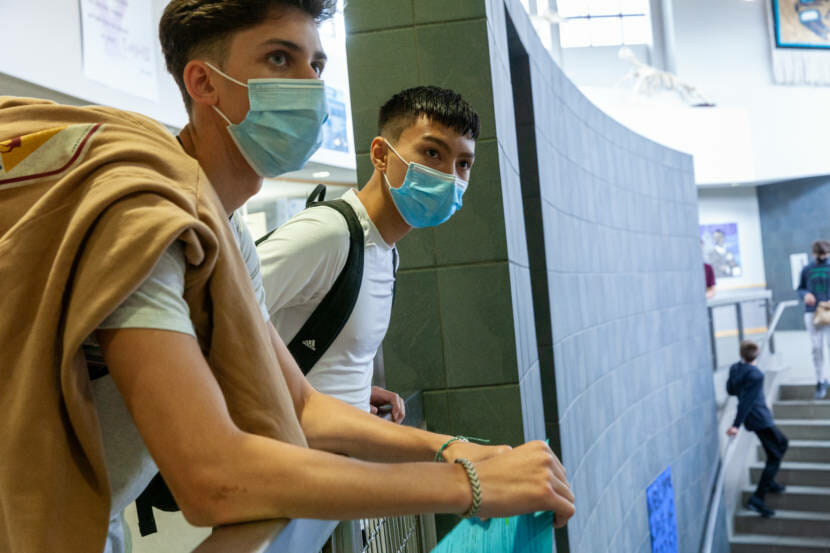
Thunder Mountain High School seniors Kafoa Maka and Ammon Kawakami watch students head to lunch on the first day of school on Monday, August 16, 2021, in Juneau, Alaska. (Photo by Rashah McChesney/KTOO)
Masks will be optional in Juneau School District buildings and on schools grounds starting on April 4.
Juneau School District Superintendent Bridget Weiss went over the results at a Board of Education meeting on March 8.
Weiss said that according to the survey, students at both high schools were about half for and half against requiring masks. But student representatives at the meeting said that most students they talked to want to keep masks, especially students in their third and fourth years.
Jowielle Corpuz is a student representative for Juneau-Douglas High School: Yadaa.at Kalé.
“It’s just that we are all excited for prom and we’re all excited for graduation. So if we had a sudden rise in cases, and prom has to be canceled because the masks being abolished, that’s not what we want,” Corpuz said. “We want prom, we want graduation, we want all the celebrations that we can have since we are in our final years of high school.”
Weiss said the survey indicated that 48% of school staff said yes, 22% said maybe and 30% said no to making masks optional. For families, 65% said yes, 10% said maybe and 25% said no.
The board held a second meeting on March 10 to make the final decision.
Most people who testified to the board meetings on March 8 and 10 wanted to end the mask mandate.
Those people argued that most masks don’t protect people from getting the virus, that not seeing people’s faces is preventing small children from learning. They said that masking should be a choice.
Maureen Hall is a school nurse at Harborview Elementary. She said she supports removing masks because the omicron variant is less severe than the delta variant. She also said people should consider how to protect children who can’t get the vaccine and high-risk children.
Christopher Coutu said too much voice is given to the minority of the population who want to keep masks.
“You’ve got super majorities of parents as well as staff that want to change the current mask policies,” Coutu said. “And with those who are still fearful in that percentage, there are masks that protect, that can protect them. And that’s the N95 masks.”
A few people called in asking the board to keep masks.
Some said it was too early to remove masks and that the board should make their decision based on public health guidance – not on parent and staff opinions.
Another supporter of masks, Anne Stepetin, said that mask-wearing shouldn’t only be about protecting yourself.
“I understand where other parents are coming from saying making an optional would still allow students to use their masks as they please. I come from a culture where we take care of each other and our masks, our mask wearing is about protecting others,” Stepetin said.
The board unanimously voted to end the mask mandate in schools. The new policy is linked to Juneau’s community level and to CDC guidelines. Masks will remain optional in schools if Juneau is at a medium or low risk level.
Providence Alaska Medical Center in Anchorage. (Photo by Jeff Chen/Alaska Public Media)
After a large spike in COVID-19 cases earlier this year that strained hospital resources, Anchorage hospital officials are cautiously hopeful that a return to more normal conditions is near.
In late January, Alaska saw more than 14,000 cases of COVID-19 in one week, a record driven by the omicron variant. Its high transmission rate was hitting hospital staff hard.
“Throughout January and most of February, their facilities were dealing with a lot of staff out,” said Jeannie Monk, senior vice president of the Alaska State Hospitals and Nursing Home Association.
While omicron sent a lot of people to the hospital, fewer of them needed intensive care and ventilation than during the delta spike, Monk said.
“But at the same time, hospitals have been very busy because throughout delta and this whole pandemic, many people have postponed care, and now are at the point where they need it,” Monk said. “The care that they had postponed was becoming more and more urgent.”
Case counts across the state have plunged since the winter omicron spike. COVID-19 hospitalizations have dropped by more than half since the end of January. They’re less than a quarter of what they were at last year’s peak.
Providence Alaska Chief Medical Officer Dr. Michael Bernstein said omicron’s impact on hospitals was not nearly as bad as delta’s, for a couple reasons. One is that more people are vaccinated, so their infections are less severe. And omicron itself is helping to lessen the strain on hospitals, due — ironically — to its prolific spread and how it’s transmitted.
“Omicron just happens to be better at the mechanism that’s more efficient in the nose and much less efficient at affecting the one in the lungs,” Bernstein said. “So that combination really was kind of a gift to us because it meant it spread through huge amounts of the population, increasing the amount of people that are immune. But it didn’t overwhelm us more than delta.”
Bernstein clarified that vaccination provides much more immunity than omicron infection does.
Dr. Robert Onders, administrator of the Alaska Native Medical Center, noted that most of the patients that the hospital saw during the Omicron surge were not vaccinated.
“We still have a fairly large segment of the population that is unvaccinated, particularly in the urban areas,” Onders said.
While case counts and hospitalizations are lower, Monk, with the hospital association, says data may not tell the whole story.
“We’re not doing the level of testing that we were, and people are relying on home tests,” Monk said. “And so we can’t rely on case counts anymore to tell us what’s going on.”
All three health care officials say a new variant of COVID-19 could renew the need to exercise more caution. For now, they recommend people stay up to date on vaccinations and wear masks in indoor public places, but they’re hopeful that COVID-19 not overwhelm hospital capacity in the future.
The sun rises over downtown and the cruise ship docks on Dec. 22, 2021, in Juneau, Alaska. (Photo by Rashah McChesney/KTOO)
Juneau lowered its pandemic alert level to “minimal” on Monday. The update means masks are no longer required in Juneau. The city still recommends masks indoors, especially for immunocompromised people or people at risk for severe illness. Large indoor gatherings are also permitted with social distancing of six feet.
The change comes as COVID-19 risk levels drop. Case levels have decreased and hospital capacity is stable, according to a city press release. The community is highly vaccinated and protective masks, at-home COVID tests, and therapeutics to treat the virus are available.
Face masks are still required in city buildings, but officials say an update to that policy will likely come later this week.
Juneau’s risk level is “medium” according to the Centers for Disease Control and Prevention. At that level, the federal guidance for the community is roughly the same. CDC recommends talking to a healthcare provider about masking if you are at high risk for severe illness, staying up to date on vaccines and testing if you have symptoms.
People, masked and unmasked, in downtown on Saturday, September 5, 2020, in Juneau. (Photo by Rashah McChesney/KTOO)
Friday’s change in masking guidance from the Centers for Disease Control and Prevention comes as many states and cities across the U.S. are starting to — or already have — ease up on mask mandates.
According to the new CDC metrics, about 70% of the U.S. population lives in a place where they no longer need to wear a mask to protect themselves and others. Their calculation is based on three variables: rates of new cases, new hospital admissions and hospital capacity.
But infectious disease specialists surveyed by NPR say they’re not ditching their masks just yet. Many still plan to wear them because they live in a part of the country where the coronavirus is still spreading widely — at least for the time being.
When would they feel comfortable dining in, teaching and grocery shopping sans masks? They shared their personal risk calculations with NPR.
Look for low community transmission — but how low?
The CDC’s new emphasis on hospitalization rates is warranted, but that metric isn’t necessarily the best guide when considering your individual risk, says Dr. David Dowdy, an epidemiologist at Johns Hopkins University. He and other experts still look at local infection rates when they weigh their personal precautions.
Dowdy says he’s vaccinated and boosted and feels well-protected from hospitalization, but he’s still trying to avoid catching COVID.
“I just don’t want to be out of work. I don’t want to be spreading it to my family and making them have to miss work and school,” he says. “And so from that perspective, cases actually matter more than hospitalizations”
Dr. Robert Wachter says he’s waiting for daily case rates in his community to drop to 10 cases per 100,000 people per day.
“There’s nothing magic about the number 10,” says Wachter, chair of the department of medicine at University of California, San Francisco. “If someone else prefers 15 or 20, that’s fine.” He’s looking for a number that “implies a lower amount of virus in the community.”
In California, where Wachter lives, the rates are currently around 24 per 100,000 people per day and falling. And he is starting to make exceptions to masking up when there is a big enough benefit, which, for him, includes eating at a restaurant indoors.
The number of new cases per capita is also guiding Dr. Ali Khan, dean of the school of public health at the University of Nebraska, in deciding to mask or not.
Khan would like to see about 5 to 10 cases per 100,000 people per day before going mask-free. “My desire was never to have individuals wearing masks forever – it was really to get levels of transmission in the community low enough so that we could be safe,” he says. “I don’t have a high-risk condition, so I’ll be taking off my mask in about two to three weeks when cases get down in my community.”
Dr. Lisa Maragakis, senior director of infection prevention at the Johns Hopkins Health System, agrees that she would like to see the case rate “in single digits” before she’s comfortable without a mask. She’s watching for a daily case rate of 1 to 5 per 100,000 in the rolling 7- to 14-day average.
Daily COVID-19 case rates are not a perfect guideline for taking (or giving up) precautions, Wachter acknowledges, especially as more people use home tests that don’t get reported in the national numbers. Still, he says, decreased levels of community transmission are a good signal that “that the system is not being super-stressed; that hospitals are not overwhelmed; that I’ll have access to a test and that I might have access to therapies [if needed].”
A trend sustained over time
It’s not just about how many cases are being reported, though.
Dr. Abraar Karan, an infectious disease physician at Stanford University, looks at how many tests are coming back positive, what’s known as the test positivity rate.
If there is a sustained test positivity rate below 1% — without an uptick — Karan says, “the chance of resurgence or community outbreaks is much, much lower.” Test positivity can be found for many counties in the government’s Community Profile dataset or on a state health department’s COVID-19 dashboard.
“With high community incidence right now, I would not be removing my mask in indoor settings,” says Karan of his community.
Cases are falling where Karan lives in California, as they are in much of the U.S. If people start taking off their masks in response and case counts stay low, he says that’s an encouraging sign. “We may very well buy ourselves a good spring.”
Other health mavens don’t have a strict number in mind. “There will come a time where the transmission rate [reaches a plateau] and it’s not budging. At that point, I’ll just make a decision,” says Dr. José Romero, health secretary for the state of Arkansas. Factors he’ll consider at that point include how well the vaccines are holding up and whether COVID-19 treatments are widely available.
A permanent accessory — as part of a layered risk strategy
Masking doesn’t have to be an all-or-nothing choice.
Even when Romero of Arkansas feels comfortable grocery shopping without a mask, “I’m not sure I’m going to abandon it completely,” he says. Like the bottle of hand sanitizer in his backpack, he considers masks just another measure to protect himself, especially during times when the risks are higher.
Sianna Lia Ripley Mearig, 8, gets a COVID-19 vaccine during a pediatric clinic on Nov. 11, 2021, at Riverbend Elementary in Juneau. (Photo by Rashah McChesney/KTOO)
Masks have become a permanent accessory for Seema Lakdawala, a virologist at the University of Pittsburgh. “It’s a really nice complement to the vaccines,” she reasons. “If I’m wearing a mask and somebody else in my environment is infected, I’m going to breathe in less virus. Even if I do become infected, the infectious dose would perhaps be low enough that my immunity from vaccination can provide a strong enough barrier and help me recover.”
Practically speaking, “If cases are low, maybe I’ll go and pop into a store without a mask on,” she says, “But I’ll keep a mask in my car or in my jacket pocket. And if I want to, I’ll just pull it out and put it on.”
Consideration for high-risk people and their households
Of course, decisions about masking are personal. They will differ for certain groups, including those at high risk of severe COVID-19, unable to be vaccinated or living with someone who falls into either of those two previous categories.
Though her youngest child is now 6 and vaccinated, Lakdawala says it makes sense for families with young kids to continue to be more conservative about COVID-19 risks. “I do think if I had kids under 5, I would still be very concerned about some of the environments that we would go [to],” says Lakdawala.
For those who are similarly cautious during this transitional period, a high-quality, properly fitted N95 or KN95 mask can provide a substantial amount of protection to the wearer, even if others in a public setting are not wearing a mask. Still, there are places where Maragakis thinks mask requirements for everyone should remain in place.
“We need to understand and take care of the people who are most vulnerable among us by not forcing everyone into situations where they must be in close contact with maskless people.”
Maragakis says requiring masks for a while longer would make sense in some settings, including on public transit.
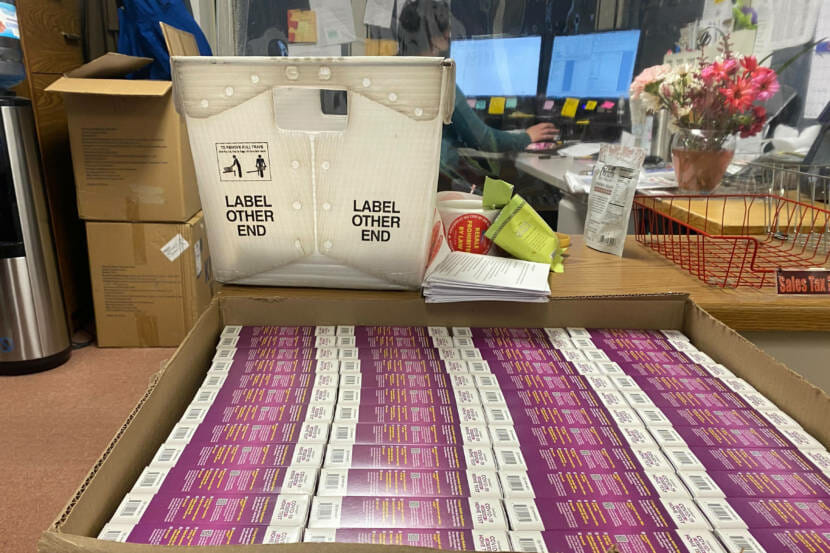
At-home test kits available to the public at City Hall in Juneau. February 24, 2022. (Photo by Claire Stremple/KTOO)
Among Alaska’s major cities, Juneau has kept up some of the most restrictive protective measures throughout the pandemic. Now it’s relaxing the rules while it increases access to public health tools for residents.
The Juneau Public Health Center is kind of a one-stop shop for all the proven defenses against COVID-19. You can grab masks and test kits or walk in to vaccine appointments. It’s all free.
If a public health initiative is measured by how much the community uses it, this is doing well. The first day Juneau offered masks, about 300 people showed up and cleaned out the stock.
Even on this average day, lots of people drop by for supplies. Gabriel Quinones and Jamie Campbell came by for masks because they got too pricey on the internet.
They say they’re still masking, but have loosened up on other things.
“We kind of go out a little bit more,” Quinones said. “But we’re still practicing most of the social distancing and precautions that we have taken since the COVID pandemic started.”
Marlin Bowles also came in for a pack of KN95 masks. He says he hasn’t expanded his bubble, and he still doesn’t go out to eat, but he and his wife do shop and use the pool.
“I don’t think that I’m going to be in public places without a mask anytime soon. I just want to see what’s happening. I fear that states like Alaska may unmask too soon,” he said.
Juneau has hewn closely to CDC pandemic guidelines. But this month, the state’s pandemic poster child dropped mask mandates for vaccinated folks, and city officials say they’re envisioning a day when they relax regulations even further.
Test kits and masks are available at locations all over town, not just the public health center — libraries, the police station, City Hall. Another shipment of 24,000 KN-95s is arrived this week.
“I think adhering to these risk mitigation factors has really benefited our community,” said Alison Gottschlich, the nurse manager for the Juneau Public Health Center.
“I think, overall, throughout this pandemic, we have been really fortunate to have typically lower case rates, lower hospitalizations, higher testing rates, and we have a really nice high vaccine rate locally as well.”
So restrictions are easing, but that’s after some of the more aggressive masking requirements in the state. Juneau schools have masked since in person classes resumed last year. There’s a nearly 80% vaccination rate.
“We still see people getting my first doses. Yeah. Which is a wonderful.”
Gottschlich estimates about 60 people a week come into the public health center for the jab—whether it’s the first, second, or a booster.
If states that drop restrictions are letting the public fight the virus on its own, Juneau’s approach is to heavily arm the public and then let them fight the virus. It’s been working.
Juneau Deputy City Manager Robert Barr in his office. February 22, 2022. (Photo by Claire Stremple/KTOO)
“I think that’s just a case study, and how much how much can change and how the nature of the virus can change,” said Robert Barr, the city’s deputy city manager. He runs Juneau’s emergency operations center.
Barr says omicron is simply a different variant than we’ve seen before. And at this point in the pandemic, a city with a very high case rate can still be only at moderate risk for COVID-19. He wouldn’t have expected that six months ago.
“I would have been shocked, right, I would have been like… There’s no way. We can’t deal with numbers that are that high.”
Some cities and states in the Lower-48 have dropped restrictions. Barr said he thinks Juneau is moving at a reasonable pace. But like Marlin Bowles at the Public Health Center, he’s thinking about the consequences of dropping restrictions too soon.
“I don’t think we are, but COVID has surprised us before,” he said.
It’s been three weeks since the city dropped mask requirements for vaccinated people. Local hospital operations are normal. Case counts continue to drop.
Close
Update notification options
Subscribe to notifications
Subscribe
Get notifications about news related to the topics you care about. You can unsubscribe anytime.