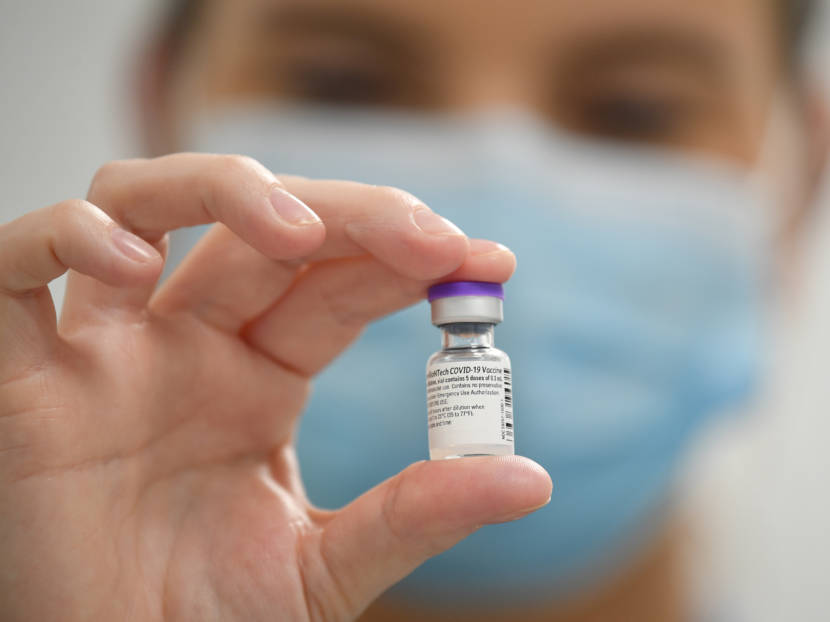
A staff member poses with a vial of Pfizer-BioNTech COVID-19 vaccine at a vaccination health center. (Pool photo/Getty Images)
Pfizer and BioNTech are planning to ask the Food and Drug Administration to authorize a second COVID-19 booster shot for people 65 and older.
The companies plan to seek emergency authorization for this additional booster for older adults to strengthen protections against the omicron variant, according to two people familiar with the situation.
Pfizer didn’t immediately respond to a request for comment. If authorized, the second booster would bring the vaccination schedule for the Pfizer vaccine to four shots in this age group.
Evidence has been mounting that the protection from three shots has faded with time, especially against the omicron variant which is better at evading the immune system than previous versions of the coronavirus.
The vaccines do still provide protection for most people against getting so sick that they end up in the hospital or die.
Some experts remain skeptical that another booster is needed yet and question how effective another shot may be. Others say boosting the most vulnerable is important.
This development was first reported by The Washington Post.
Copyright 2022 NPR. To see more, visit https://www.npr.org.
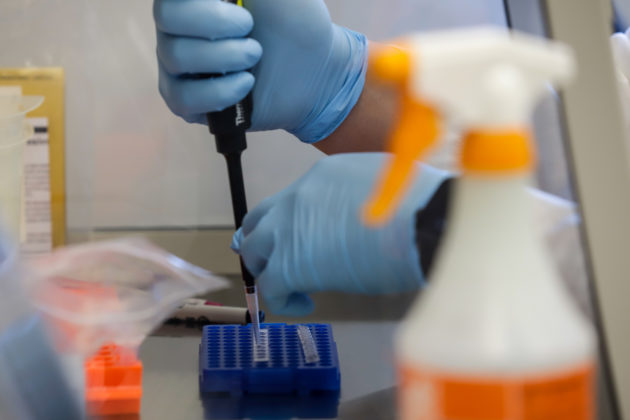
A researcher at a University of Alaska Anchorage lab prepares samples for sequencing — the process that scientists use to detect specific strains of the virus that causes COVID-19. (Jeff Chen/Alaska Public Media)
A subvariant of omicron has gradually become more widespread in Alaska in recent weeks.
Speaking on Talk of Alaska Tuesday morning, Alaska chief epidemiologist Dr. Joe McLaughlin said the BA.2 variant is gaining ground across the country, including Alaska.
“Probably about a quarter of the cases are BA.2 now in the U.S.,” McLaughlin said. “It’s a little bit higher in Alaska.”
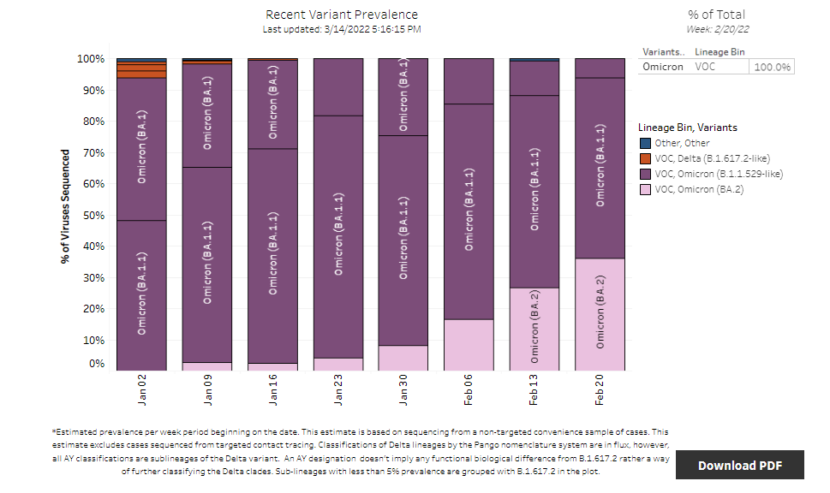
The first Alaska case of BA.2 was detected in early January, according to state data. By mid-February, more than a third of Alaska cases were the BA.2 subvariant. McLaughlin said while the BA. 2 mutation can be spread more easily, it doesn’t appear to lead to more severe symptoms.
“This strain is about 30 percent more transmissible than the BA.1 strain, but it’s not more virulent,” McLaughlin said. “And it doesn’t appear to be more capable of evading prior immunity through vaccination or prior infection.”
This chart tracks the prevalence of various COVID-19 variants. (Alaska Department of Health)
McLaughlin said people who have already contracted the BA.1 subvariant of omicron have more immunity to BA.2.
Dr. Lisa Rabinowitz, a Providence Medical Center physician who works for the state health department, said while the BA.2 subvariant is continuing to spread, vaccine manufacturers are taking note.
“Currently, delta, omicron and even BA.2 are being worked at in a combo vaccine, looking towards the fall if needed,” Rabinowitz said. “So lots of exciting things happening in the vaccine world.”
While the omicron variant led to a record number of COVID-19 cases in Alaska this winter, case counts and hospitalizations have been on a downward trend, currently sitting at about a tenth of the peak case count in January.
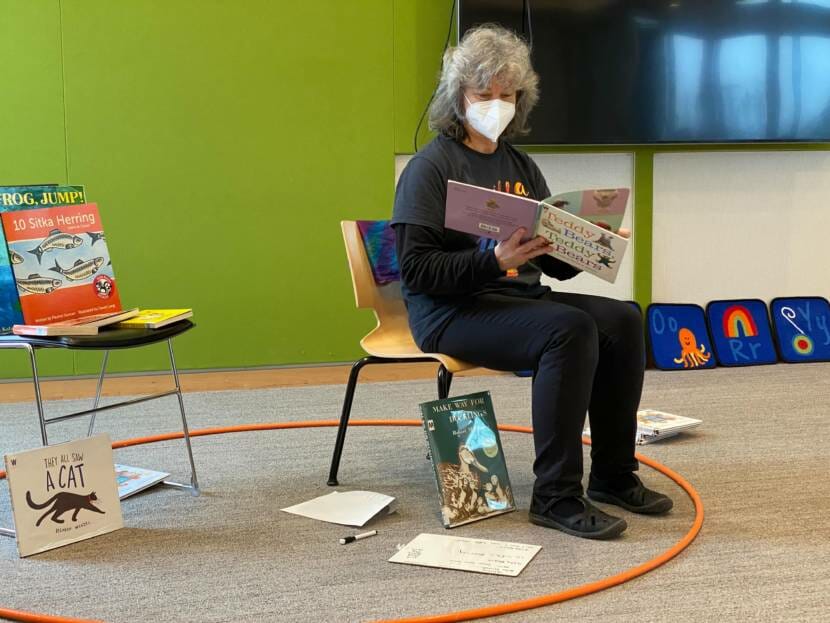
MJ Grande reads to Juneau youth at Mendenhall Valley Library’s first storytime in two years. March 15, 2022. (Photo by Claire Stremple/KTOO)
Juneau officials dropped the city’s pandemic alert level to “minimal” two weeks ago. One of the activities to return to the community’s calendar is storytime at Mendenhall Valley Public Library.
“My heart’s beating really, really fast,” said MJ Grande as she waited for families to arrive.
Grande is the Youth Services Librarian for Juneau Public Libraries. She’s preparing for the first storytime in two years. And she’s anxious because storytime is for kids young enough that they can’t get vaccines yet, but she’s trusting public health guidance.
“This is an essential part of services to children. The schools get them at five. But to link that early literacy in the family setting — and with the smallest people — has been the public library’s responsibility,” she said.
Juneau libraries have also been hubs for information and free pandemic supplies over the last two years. They’ve remained open, except for a couple of weeks in March of 2020.
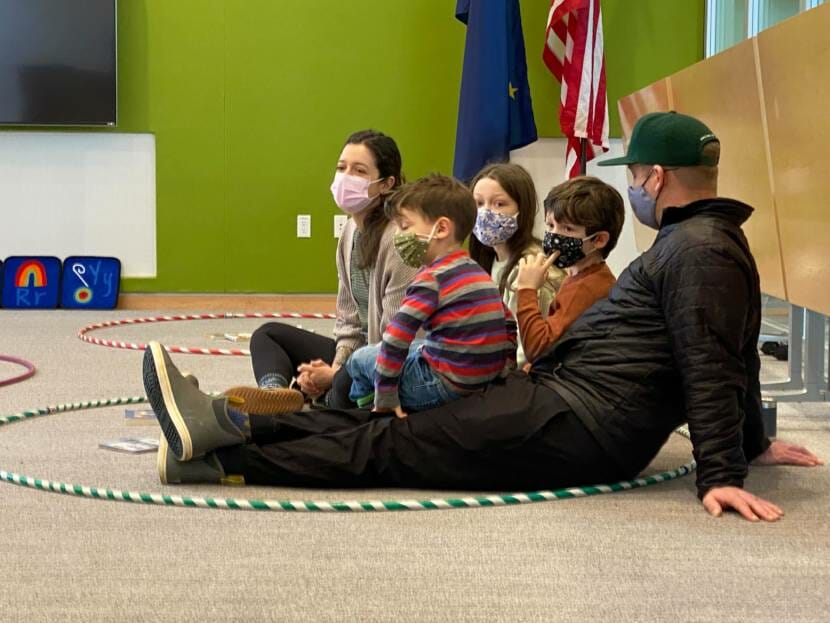
Families stay spread out in bubbles that are marked by large hoops on the floor.
The McCarthy family settles into one. They moved to Juneau mid-pandemic. They’ve been coming to the library a lot, and today they’re looking for some books about raising ducks. Their youngest, Reed, just turned four, and he’s pretty excited about it.
The McCarthy family moved to Juneau in 2020. This is their first storytime at Mendenhall Valley Library. March 15, 2021. (Photo by Claire Stremple/KTOO)
A few more people come in and find space on the floor.
There are some changes to storytime. Sign-ups are required now — although there were a few no shows, so the library accepted a couple drop-ins. Masking is encouraged. Instead of meeting in the kid’s section, storytime is in a large room with more floor space and better ventilation. At the door, there are at-home test kits, backup masks and hand sanitizer — so the room smells faintly of rubbing alcohol.
Grande starts with some songs, then gets down to business. There’s a book about herring, for the herring season that’s about to open, and a book about a duck family for Reed McCarthy.
Storytime is designed for the average 3-year-old’s attention span, so actual reading is punctuated by songs, and it’s all over in about a half an hour.
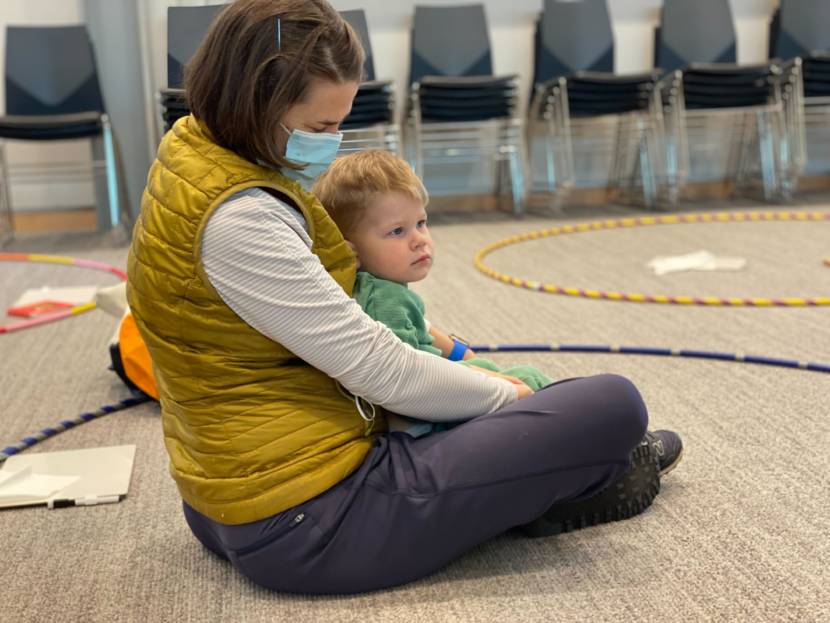
Christina Shanley says she and her son Hollis will likely return to storytime at the Mendenhall Valley Public Library. March 15, 2022. (Photo by Claire Stremple/KTOO)
For Christina Shanley and her son Hollis, this is the first storytime. That’s true for most people here because a lot of the kids are barely as old as the pandemic. She says they’ll probably come again.
“This felt nice and safe. There’s things that are opening up in town that’s giving us opportunities, those of us with toddlers to get our toddlers out in the community, which we haven’t been so far,” she said.
MJ Grande says it’s good to be back.
“If a person can have an essential self, this is mine,” she said.
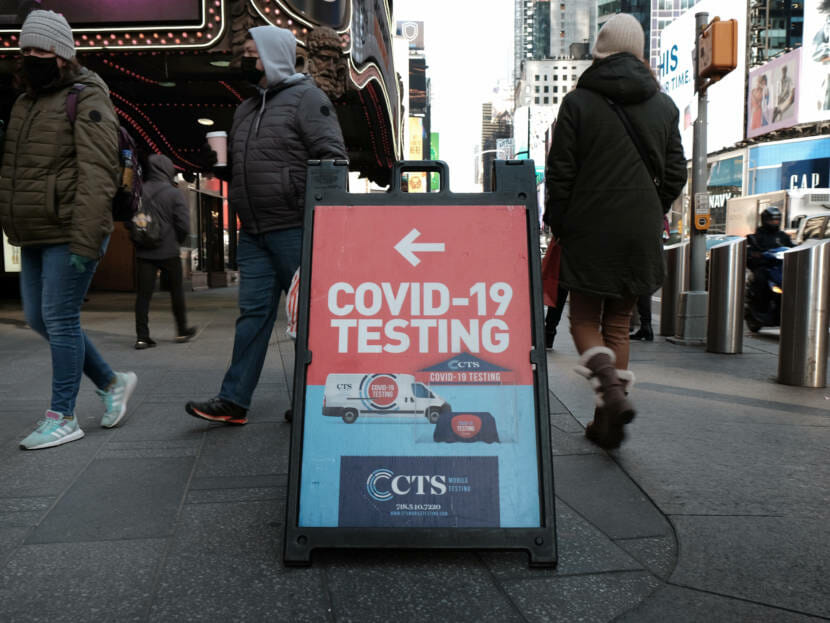
People pass a COVID-19 testing site on a Manhattan street on Jan. 21. The White House says it is running out of money to pay for coronavirus tests for people who don’t have insurance. (Photo by Spencer Platt/Getty Images)
Next week, the White House says it will start to wind down a COVID-19 program that pays to test, treat and vaccinate people who don’t have health insurance.
It’s one of several immediate impacts after Congress declined to add $22.5 billion in funding to a broad government spending bill passed last week. President Biden is expected to sign it into law later on Tuesday.
The COVID funding request met with political pushback from Republicans and concern among some lawmakers that the White House has not fully explained how trillions in COVID money has been spent so far and what funding remains. Republicans in particular have been unwilling to agree to new spending.
The White House has since raised alarms about the spending, warning House Speaker Nancy Pelosi in a letter on Tuesday that the country risks being “blindsided” by future coronavirus variants.
“With cases rising abroad, scientific and medical experts have been clear that in the next couple of months we could see rising cases of COVID-19 here in the United States as well. Waiting to provide funding until we’re in a surge will be too late,” said Shalanda Young, the acting head of the Office of Management and Budget, and Jeff Zients, the COVID-19 response coordinator.
Democrats are expected to proceed with a standalone COVID funding bill, which is expected to pass the House but is unlikely to clear the Senate.
The White House will cancel a new order for monoclonal antibodies
Another impact: shipments of monoclonal antibody treatments to states will be cut by 30% next week, an official told reporters. Even after cutting back shipments, the White House expects the nation’s supply of those treatments could run out as soon as May.
The Biden administration is canceling plans to buy more of the treatment next week because of the lack of funding, the official told reporters.
Without more funding, the government cannot buy more oral antiviral treatments like Paxlovid beyond the 20 million treatments already secured and needs to scale back planned purchases of preventive treatments for immunocompromised people, the White House said.
And while officials say they do have enough vaccine doses available for immunocompromised people to get a fourth dose, if the rest of the population ends up needing an additional dose, they may not have the funds needed to meet the nation’s needs. The gap in funding would be particularly severe if a vaccine-evading variant comes along and a new formulation is needed.
There were plans to support makers of at-home tests, but those are off
The White House also said it will not be able to provide help to domestic manufacturers of at-home coronavirus tests beyond June, which it said will lead to diminished testing capacity.
“After spending the last year building up our testing capacity, Congress now risks squandering that capacity heading into the second half of this year,” a second official told reporters. “Because it takes months of ramp-up to rebuild capacity, failure to invest now will leave us less prepared for any potential future surges.”
Research into next-generation COVID-19 vaccines will be curbed, and some surveillance for new variants will also be stopped, the White House said. The administration also will need to limit its push to help poorer countries vaccinate people.
Copyright 2022 NPR. To see more, visit https://www.npr.org.
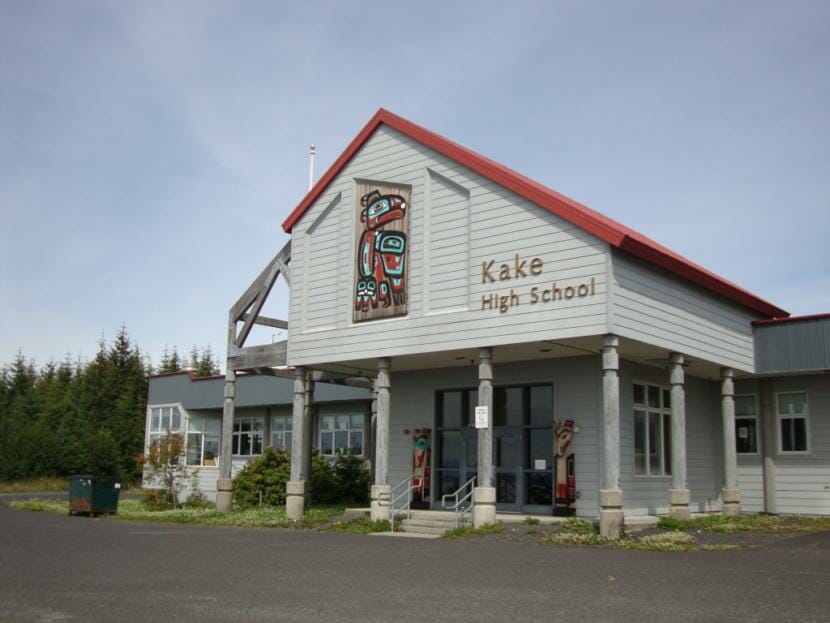
Kake’s high school photographed in 2010 (Division of Community and Regional Affairs’ community photo library.)
Kake is now experiencing one of its biggest outbreaks of COVID-19 since the beginning of the pandemic, with 32 active cases reported as of March 11.
Kake city schools have moved to remote learning through at least the end of this week.
The outbreak started after Kake High School basketball teams traveled with family and fans to Juneau for the small schools regional basketball tournament on March 2-5 at Thunder Mountain High School, where community members are suspected of catching the virus.
Thunder Mountain’s activities director, Luke Adams, told KCAW that masks were mandatory for spectators and non-playing team members but optional for players on the court.
In a call with KCAW, Kake superintendent, Rich Catahay said the teams — as well as accompanying fans and family members — followed masking protocol and were diligent about testing before and after the tournament. Catahay says the city made sure to report the positive cases to the Alaska School Activities Association.
The city is offering antigen tests to those who believe they’ve been exposed or are experiencing symptoms, as well as preventive measures for the elderly and immunocompromised.
The next booster and children’s vaccine clinic will take place April 1.
Alaska School Activities Association basketball director Isaiah Vreeman said in an email that the association was unaware of the outbreak, but that since the state 1A tournament was more than 10 days away, “this might not be an issue.”
The state 1A/2A tournament will be held March 16-19 in Anchorage at the Alaska Airlines Center and the UAA Seawolf Sports complex.
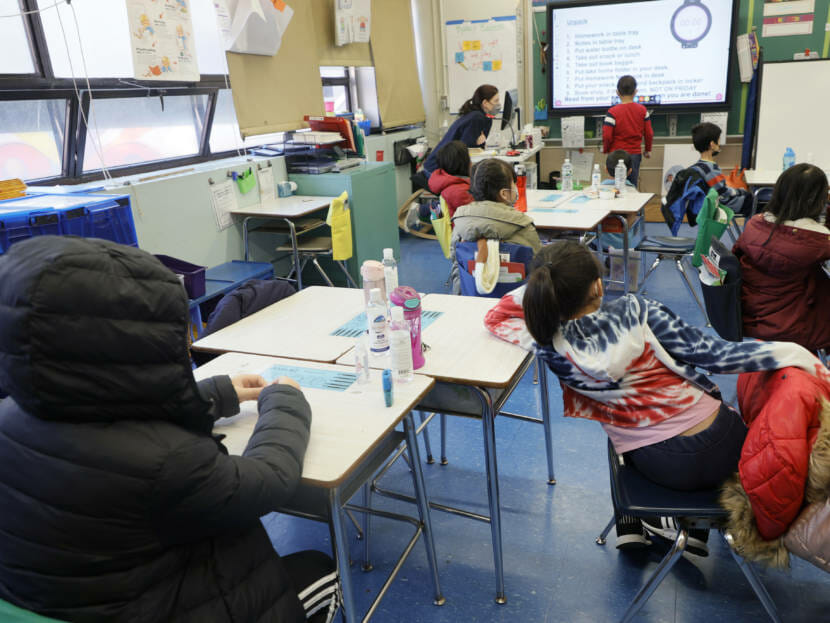
Open windows and portable air cleaners can help improve ventilation, but many schools in the U.S. are more than 45 years old and need a complete overhaul of their HVAC systems. (Photo by Michael Loccisano/Getty Images)
Not many people can say the pandemic has made their jobs easier. But in some ways, Tracy Enger can.
“You know, it is such a hallelujah moment, absolutely,” says Enger, who works at the Environmental Protection Agency’s Indoor Environments Division. For more than 25 years, she’s been fighting to improve the air quality inside of America’s schools.
But there are lots of competing demands for limited school budgets. And in the past, getting school districts to prioritize indoor air quality hasn’t been easy. Often, she says, it took some kind of crisis to get schools to focus on the issue — “when they found the mold problem, when their asthma rates were kind of going through the roof.”
Then came the COVID-19 pandemic — spread by virus particles that can build up in indoor air and linger, sometimes for hours. Key to clearing out those infectious particles: good ventilation and filtration. For example, one study of Georgia schools linked improved ventilation strategies, combined with HEPA filtration, to a 48% lower rate of COVID.
“It matters more to people right now,” says Heming. “COVID is this immediate threat that has made air quality immediately relevant.”
That’s why she and other indoor air-quality experts say the Biden administration’s new National COVID-19 Preparedness Plan is a step in the right direction: It specifically highlights the need to help schools upgrade their ventilation systems for the long term, using funding from the American Rescue Plan Act.
Heming says in the past, it’s been hard to make a health case for improving air quality in schools, because the health impacts tend to be longer term. But a whole body of research shows the health and academic benefits are substantial — and go beyond COVID. When a room is better ventilated, influenza rates, asthma attacks and absenteeism go down, reading and math test scores go up. Less carbon dioxide builds up in a room, which helps students think more clearly.
“It’s well documented across all different countries and all different ages,” says Joseph Allen, director of the Healthy Buildings program at Harvard University. “We see benefits in kindergarteners, we see benefits in high school, we see benefits in college students and middle schoolers – every age group.”
Allen says understanding these long-term benefits of upgrading ventilation is vital, “because an investment right now is not just a short-term investment for COVID. If a school does this right, they can expect not only years, but decades of benefits to health beyond reductions in infectious disease transmission.”
And experts say those investments are desperately needed, because most U.S. schools are poorly ventilated to begin with. The average American school is over 45 years old, and many have HVAC systems that are outdated or need repairs, according to a 2020 report from the Government Accountability Office. Some schools are so old, they don’t even have mechanical ventilation systems.
“I don’t think a lot of people recognize that the design standards [that govern ventilation rates in schools and other buildings] are bare minimums. They were never actually set for health,” says Allen.
Carl Thurnau knows all too well just how bad deferred school maintenance can get. Several years ago, a classroom ceiling actually collapsed at a school in the City School District of New Rochelle, New York. That’s when the district recruited Thurnau, an engineer, to become its director of facilities to oversee a $106 million overhaul of buildings – a process that was already funded and in motion when COVID struck. That money meant the school district could quickly pivot to implement ventilation upgrades in response to COVID.
Having funding in place “is why we were able to get ahead of this – and in my opinion, stay ahead,” Thurnau says. But “there’s no doubt that districts with less financial resources are struggling to find the money to solve some of these problems.”
Ventilation and green building experts have been offering schools guidance on how to improve their air quality to reduce COVID risk since the early days of the pandemic, even before the Centers for Disease Control and Prevention acknowledged the virus could spread through the air. Broadly speaking, Allen says, the advice boils down to three major things: increasing the amount of outdoor air in a classroom; using higher-efficiency MERV filters in HVAC systems; and supplementing these measures with portable air cleaners with HEPA filters.
But two years in, it’s unclear how many schools have actually made these changes. That information isn’t tracked at the federal level, though some reports hint at the challenges schools have faced. What’s clear, says Allen, is that while a lot of schools have taken steps to improve ventilation, many others haven’t. “Some haven’t done the basic measures, the stopgap measures,” Allen says.
Heming says schools have been able to tap federal funds for ventilation upgrades since late December 2020, and the American Rescue Plan Act, passed in March 2021, made a lot more money – $122 billion – available to schools for this and other pandemic-related purposes.
So why have many schools been slow to act when it comes to indoor air quality? Last year, the Center for Green Schools published a survey of more than 47 school districts representing 2.5 million students in 24 states. The vast majority of them said they prefer to invest in long-term solutions rooted in revamping or replacing their HVAC systems.
But with so many old and outdated school buildings, Heming says “these strategies that schools need to use require that they do pretty major renovations.”
That kind of work takes many months to plan and contract. In many cases, she says, those plans are only being firmed up now. And a recent survey found many school districts are worried that they won’t be able to complete the work by a September 2024 deadline under the law, especially because of supply chain issues and labor and material shortages.
Stopgap measures like opening windows or using portable air cleaners really do work to improve indoor air quality, Heming says, but they can only take schools so far. For example, open windows aren’t realistic when outdoor temperatures are freezing, she says, and in humid regions, they can pull in more humidity, promoting the growth of mold.
And while many school districts have invested in stand-alone portable air cleaners, they come with their own headaches, says Heming: The units can be disruptively noisy and they need to be stored and maintained over time.
In general, she says, the school districts that were able to move quickest to improve their air ventilation and filtration in response to the pandemic were those that already had money available to upgrade their facilities, and in many cases, they’d already assessed their buildings and knew which ones needed work.
But there are some encouraging signs that more schools may be catching up soon. An analysis released in February found that school districts already had plans in place to spend about $4.4 billion on HVAC updates, and if trends continue, that could reach nearly $10 billion. Another analysis found that high-poverty districts are more likely to plan to use federal funds to upgrade aging ventilation systems.
The EPA’s Tracy Enger says interest in the agency’s guidance on indoor air quality for school has skyrocketed over the last year. “What we are seeing is this moment turning into a movement for improving indoor air quality in schools and creating healthier learning spaces,” she says.
Heming says she’s also optimistic, but her enthusiasm is tempered. She notes that the $122 billion of American Rescue Plan funds designated for schools has to pay for a host of pandemic-related needs – from hiring more staff to summer school programs – not just ventilation upgrades.
Even if every last dime of the American Rescue Plan funds for schools were spent on facilities, “it’s still a big gap between that and what’s actually needed,” Heming says. A 2021 report found that each year, districts spend $85 billion less than what’s needed to get schools into good condition.
Copyright 2022 NPR. To see more, visit https://www.npr.org.
Close
Update notification options
Subscribe to notifications
Subscribe
Get notifications about news related to the topics you care about. You can unsubscribe anytime.

9(MDEwMjQ0ODM1MDEzNDk4MTEzNjU3NTRhYg004))
9(MDEwMjQ0ODM1MDEzNDk4MTEzNjU3NTRhYg004))
9(MDEwMjQ0ODM1MDEzNDk4MTEzNjU3NTRhYg004))