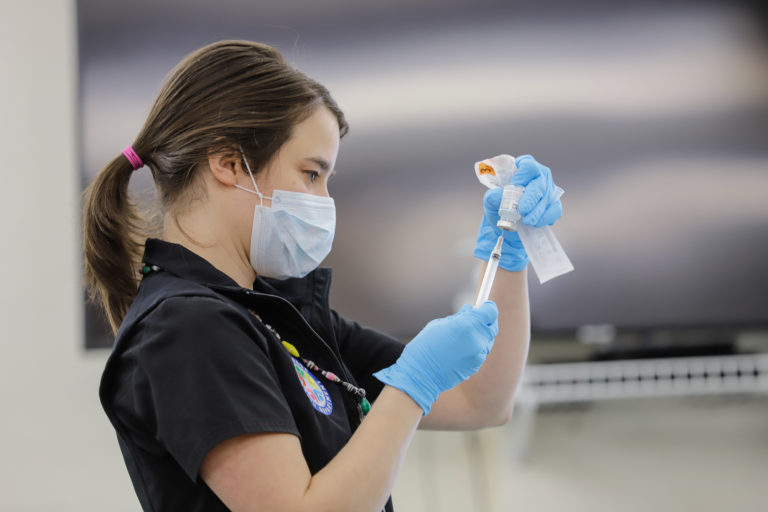
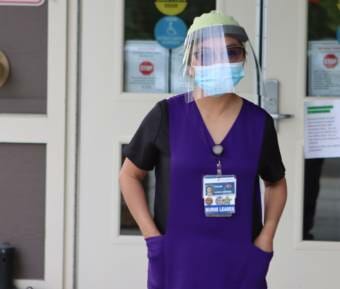
Anchorage Health Department public health nurse Marguerite Leeds prepares to administer the Covid-19 vaccine during the community vaccine clinic held at Manai Fou Assembly of God Church in Airport Heights on Feb. 23, 2021. (Jeff Chen/Alaska Public Media)
COVID-19 case numbers continue to decrease in Alaska.
The state health department on Wednesday reported 2,874 cases over the last seven days. That’s a 36% drop compared to the previous week, which had 4,512 reported cases.
Those numbers do not include positive at-home tests.
Nationally, Alaska ranked Wednesday as the U.S. state with the sixth-highest case rate over the past seven days, according to the Centers for Disease Control and Prevention. It previously ranked at the top of the list.
As infections continue to decline, state health officials are shifting from looking at case counts to broader trends, said state epidemiologist Dr. Louisa Castrodale.
“Going forward, there will be less exact numbers for the case counts, but we’re going to be looking for activity such as cases in schools and outbreaks, and talking to our hospital partners to see what they’re seeing,” she said.
Hospitalizations also continue to decrease, though more slowly than case numbers. The number of patients hospitalized with COVID-19 has remained around 100 over the last two weeks, according to the state’s hospital dashboard. There are currently 23 adult ICU beds available in the state, just one of which is in Anchorage.
The department also announced 22 COVID-19 deaths Wednesday, none of which occurred in the previous week.
Officials shared additional information about vaccines at a public health presentation Wednesday. They shared recent data that shows infants are 60% less likely to be hospitalized with COVID-19 if their mothers get vaccinated during pregnancy.
They also addressed some concerns about myocarditis and other heart problems following COVID-19 vaccinations, especially in adolescent boys. State epidemiologist Dr. Joe McLaughlin shared data that shows that COVID-19 infections carry much greater risk for myocarditis, heart attacks, pulmonary embolism and other issues than vaccinations.
Pediatrician Dr. Mishelle Nace said it’s important for parents to understand the data behind those risks. She said for 12 to 17-year-olds, the state has seen six or seven cases of myocarditis per 100,000 patients after being vaccinated. They’ve seen 45 cases per 100,000 following a COVID-19 infection.
“If the thing you are concerned about is the heart, and if you’re worried about your child and what myocarditis might do, then the best protection would be to be vaccinated against getting COVID-19,” she said.
As of Wednesday, 36% of Alaskan adults were up-to-date on their COVID-19 vaccines, meaning they received their initial doses as well as any boosters they’re eligible for. More than 40% of vaccinated adults are overdue for a booster. More than 57% of kids age 12 to 18 in Alaska have received at least one dose, and 26% of kids age 5 to 11 have.
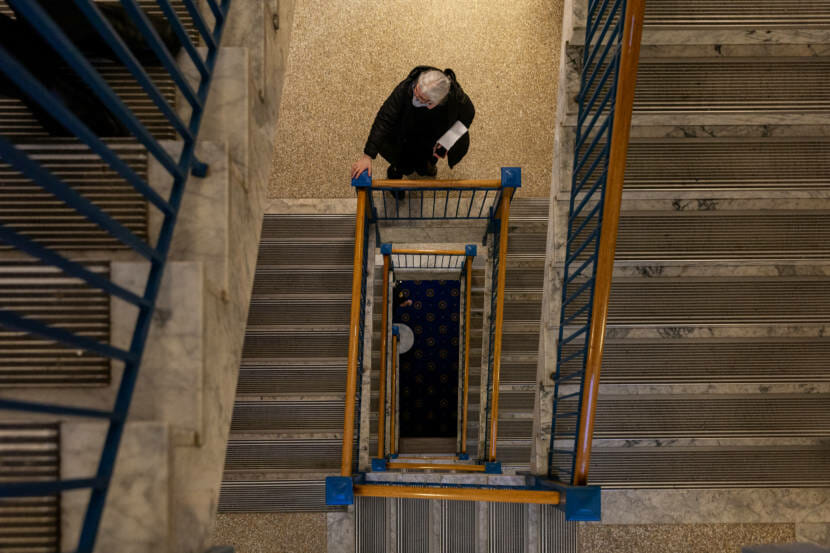
A masked woman waits in the stairwell of the Capitol in January 2021. On Wednesday, the Legislative Council voted to make masks and COVID-19 optional for lawmakers and others who work in the building. (Photo by Rashah McChesney/KTOO)
Legislators and others who work in the Alaska State Capitol are no longer required to wear masks and be tested for COVID-19. The Alaska Legislative Council voted to eliminate the mandates on Wednesday.
The council required masks throughout the regular session last year but made masks optional during the four special sessions. It reinstated the mandate at the start of the session this year.
The Capitol was closed to the public from March 13, 2020 until June 16, 2021. But it has remained open since then.
Cases in Juneau and throughout Alaska have fallen steeply since the session started.
The rules will continue to require those who test positive for the virus to isolate. Individual legislators may continue to require masks in their offices.
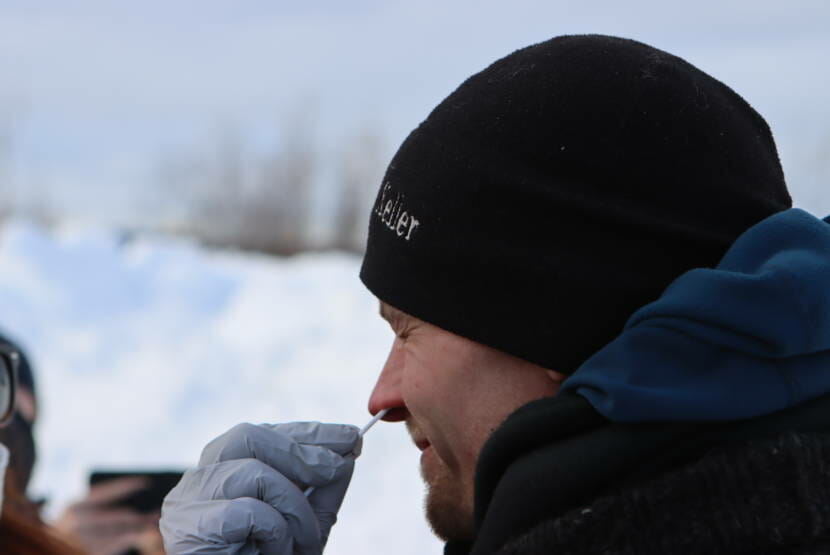
Dallas Seavey receives a mandatory COVID-19 nasal swab upon arriving at the McGrath checkpoint during the 2021 Iditarod Sled Dog Race. (Photo by Zachariah Hughes)
Volunteers and race officials at the 2022 Iditarod Sled Dog Race will be tested daily for COVID-19 and must prove they are fully vaccinated to be in the Iditarod bubble.
Those rules and others were announced as part of the latest COVID prevention plan for the 1,000-mile sled dog race that starts in just under two weeks.
Mushers will also have to prove they are fully vaccinated and will have to test negative for COVID three times before the start of the race, plus another time at the checkpoint in McGrath — about a third of the way into the competition.
Race marshal Mark Nordman said he’s confident the plan will help keep mushers and communities along the route safe.
“I don’t think you could find a better plan,” he said in an interview last week.
Race officials and volunteers will wear armbands and ID badges to show that they are part of the Iditarod bubble at checkpoints along the trail, according to the race’s 25-page COVID prevention plan.
Those inside the bubble are required to wear face masks when interacting with people outside of the bubble. Mushers should wear masks too, according to the COVID-19 plan.
Nordman said the Iditarod developed the plan with Dr. Jodie Guest, an infectious diseases epidemiologist and professor at Emory University. Guest is also a longtime Iditarod volunteer who helped craft last year’s protocols too.
Some communities along the race trail have taken additional measures to prevent COVID from spreading.
The community of Takotna, famous for its spread of pies for mushers, decided to not be a checkpoint this year. Instead teams will run 41 miles from McGrath straight to Ophir.
White Mountain’s checkpoint will also look different. This year, the checkpoint will be in a heated tent on the river, instead of closer to town. Teams still must take an eight-hour rest there before their final 77-mile sprint to Nome.
Nordman said on Friday that trail breakers on snowmachines reported good conditions during their run through the Alaska Range.
“They were very pleased: Not a lot of bridges to build, good snow in Rohn,” he said “We were really light on snow a week ago around Nikolai — they’ve got over close to 2 feet now. So it looks like we got a great trail all the way to Nome.”
The 50th running of the Iditarod starts with the ceremonial start on Saturday, March 5, in downtown Anchorage. Race officials say fans can attend in person but are asked to wear masks. There are 49 teams currently signed up to race, including last year’s top three finishers.
Pediatricians in Anchorage say misinformation is a big problem as they work to help parents understand the vaccines are safe.
Dr. Killian Schafer, a pediatrician at the Children’s Clinic, said he’s still getting a lot of the same questions from parents as he did in November, when the CDC authorized the vaccine for children from 5 to 11 years old. He said he tries to address parents’ concerns by explaining how getting kids vaccinated can help other family members.
“A lot of times, being able to travel, having family visit, being able to visit family — especially family that may have health problems — encourages parents to get their kids vaccinated,” he said.
He said some parents were quick to bring their kids to his office’s drive-through vaccination clinic back in November. But most parents are still hesitant, even if they’re vaccinated and boosted themselves.
“A lot of people like to consult Dr. Google,” he said. “That can cause a lot of problems because there’s a lot of misinformation.”
Much of that misinformation revolves around this being a new type of vaccine. It contains mRNA rather than a live virus, like the chickenpox vaccine does, or a dead virus, like flu shots do.
“They’re more than willing to get their kids vaccinated for all the prior childhood vaccines that have been available, but some are wanting to wait to see as far as this new vaccine is concerned,” Schafer said.
Dr. Jeff Brand is a pediatrician with Providence Alaska Medical Center in Anchorage and Eagle River. Because parents are already confused about mRNA vaccines, he said, misinformation is that much more effective.
Dr. Jeff Brand works in his office at the Providence Alaska Medical Center in Eagle River. (Photo by Matt Faubion/Alaska Public Media)
“I’ve had several parents, like, ‘I don’t want to give it to my daughter and have to tell her 20 years from now when she can’t have a baby it was from the vaccine,’” he said. “It doesn’t get into the ovaries, it doesn’t change your DNA.”
Brand often compares the COVID-19 vaccine to other vaccines, like for polio or measles. He said any negative side effects from a vaccine usually appear in a population within the first year.
“When the measles vaccine came out in the ‘60s, nobody knew what was going to happen one or two years later, and they didn’t wait until they were 35 to figure it out. No one said, ‘I think I’ll wait ‘til my kid’s 20 to find out if he really is going to get meningitis or if the Hib’s going to protect him. That’s what’s going on now, and I guess I don’t understand that,” he said. “I’ve been doing this since 1982. I’ve never seen a long-term side effect from a vaccine.”
Omicron has brought up new questions, said Brand. He said some people are wondering why they should bother getting vaccinated at all, if they might get COVID-19 anyway because omicron is so contagious. He said it’s important to recognize that while the vaccine isn’t 100% effective — and no vaccine is — it’s still protecting most people from getting hospitalized.
“Very early on, it was like, if we can get a vaccine that’s as effective as the flu vaccine, we’ll be happy,” he said. “But then we had two vaccines come out that are 90% effective at preventing death, at preventing hospitalizations. And people kind of got spoiled in the sense that, originally we were talking about, we want one as good as the flu, which is 40% effective.”
The FDA recently postponed its meeting with Pfizer on vaccines for kids under 5. In the meantime, Brand reminds parents to read trustworthy sources, avoid scientific studies that aren’t peer reviewed and ask pediatricians about any concerns.
Yuut Elitnaurviat has housed the Kuskokwim Learning Academy on the second floor of its building in Bethel since a 2015 fire. (Dean Swope/KYUK)
Seven years ago, a fire displaced the Kuskokwim Learning Academy, a boarding high school in Bethel. Without classrooms or housing, students moved into the dorms at Yuut Elitnaurviat, an adult learning center, where they soon resumed classes on the second floor of the campus’ administration building.
“We had over 100 high school students up there and we realized that we were crammed for space,” said Mike Hoffman, the current executive director at Yuut. He said with the limited space, the school could only house about 45 students.
Working with the Lower Kuskokwim School District, Yuut decided to move ahead with plans to expand the administration building and add another dorm to the campus. Designs were finalized. Funding was tricky, but they were able to square that away too with a bank loan, said Hoffman.
“But then COVID came a couple years ago,” he said. “And we heard and knew that prices were going to escalate. We didn’t expect them to escalate by 20% — they did.”
Prices never really came back down. Hoffman said finally, a few months ago, Yuut and the school district decided — with the pressing need for more classroom and living space — they would have to bite the bullet and absorb the extra costs.
But then, suppliers facing huge backlogs told Hoffman they wouldn’t be able to get materials to Bethel in time for the short summer building season.
These delays and price surges are indications that COVID-19 is still playing a huge role in the global economy. Every step of the supply chain — from manufacturing to shipping to distribution — has lost any sense of a normal rhythm, said Darren Prokop, a professor of logistics at the University of Alaska Anchorage.
“If any one of those things gets jammed up due to COVID, due to a blockage at a port of entry, something like that, then you end up with bottlenecks,” Prokop said. “So you end up with too much stuff in one place and not enough in another.”
Prokop said the supply chain holdups, plus now inflation, inevitably lead to higher prices.
Supply chain difficulties add an additional layer to the already complex challenge of building in rural Alaska. Barge season in Western Alaska only runs May through October. It’s a narrow window to bring in the large shipments of lumber and other building materials that construction projects require.
That tight timeframe compounds the problem for builders trying to navigate supply blockages and the resulting price hikes.
CEO of the Alaska Village Electrical Cooperative Bill Stamm has one word for it: “grueling.”
The utility maintains power generators for 58 rural communities stretching from Old Harbor to Kivalina. Maintaining dozens of diesel power plants, wind turbines and solar arrays, plus 500 miles of distribution line, is a complicated, year-round effort — in a good year.
During the pandemic, prices and lead times for big items like power poles and cables have effectively doubled. Stamm said the delivery estimate he was quoted on a new transformer is 40 weeks.
“That’s most of the year,” he said. “We like to have a backup plan for just about everything, but the margins get thinner and thinner.”
Stamm said delays have meant communities have to rely more on smaller backup generators while they wait for materials.
“It’s a bit nip and tuck at times to make sure the lights stay on all the time,” he said. “And it doesn’t look like it’s going to improve much through this summer.”
It’s not just big projects being affected by increased prices and supply chain hang ups.
Shelby Clem is a field supervisor for RurAL CAP, a nonprofit that, among other things, helps maintain safe and affordable housing statewide. He’s in the middle of surveying homes in Bethel for weatherization improvements. The idea is to make upgrades that will ultimately help residents save on heating and maintenance costs.
Surveying happens now so that they can place all their material orders on April 1 when RurAL CAP receives its annual funding from the Alaska Housing Finance Corp. Clem said it’s difficult to make his recommendations while delivery schedules are so backed up and prices are through the roof.
“Three years ago, a piece of plywood was $17. And now, last time I checked, it was close to $58. That’s really coming into play a lot because everything we do has to have a savings investment ratio on it. And it’s really tough to get a payback when you’re paying triple times the price of plywood,” Clem said.
In Bethel, after already waiting more than five years to add on to the Yuut Elitnaurviat campus, Hoffman recently had to accept that rebuilding won’t start until the 2023 season. He said the materials weren’t going to make it in time to start this summer.
“So we have to wait. We’re ready to go. We are ordering all of our materials, but talking to our vendors, we will not have them until next year,” he said. “Not this spring but the spring after and we’ll have a lot of that coming in on that first barge in 2023.”
Pre-construction work will be done in the next few months, Hoffman said. Then the site will stay vacant and ready until 2023.
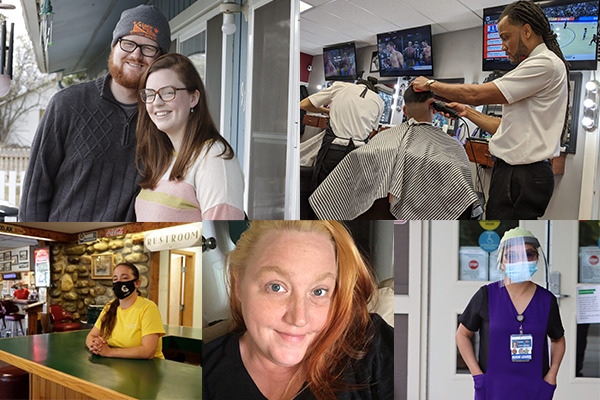
Five Anchorage residents reflect on how the COVID-19 pandemic has shaped their lives, two years in. (Alaska Public Media)
Over the course of the COVID-19 pandemic, Alaska Public Media reporters have reached out to dozens of Alaskans to see how the pandemic has changed their everyday lives. We’ve talked with business owners who had just opened their doors when the pandemic started and health care workers treating the state’s sickest residents and people in assisted-living homes reuniting with their families after some restrictions eased.
As the pandemic approaches the start of its third year, we wanted to check in with some of the Alaskans from those earlier stories. We asked about how the past two years have shaped them, how they’re adapting and their hopes for the future.
They spoke of illness, loss and isolation. But they also spoke about growth — a new baby, a new house — plus reuniting with friends in different ways and optimism that the worst is over.
Hear from five Anchorage residents, in their own words:
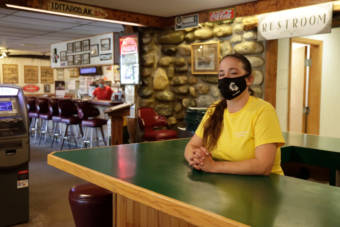
Melissa Hutchinson, a waitress at Gwennie’s Old Alaska Restaurant
Melissa Hutchinson. (Matthew Faubion/Alaska Public Media)
“Early on in the pandemic, I was very concerned with the closures of the restaurants, concerned about all of the people who were going to be out of work, you know, myself and my coworkers included. The struggle of being able to pay bills and everything was very real. Luckily, in the short term anyway, the added unemployment did seem to help everybody through that.
As things progressed, when we re-opened, there were constantly changing protocols. We were continuously trying to keep everybody safe but keep everybody working. Then trying to get people back to work was really difficult — so lots of hours actually, putting in a lot of work trying to make things work with less staff than we had anticipated coming in the next year.
In an effort not to work people into utter exhaustion, we eventually had to take our night crew, bring as many of them as we could to days, so we could open a second kitchen for the summer. And yeah, so we’re strictly breakfast now. We close at 3 p.m.
We’re definitely, I think, past our major fear of the pandemic now. Pretty much everybody I know has gotten COVID. We’ve moved past it. I know several people who’ve lost someone that they loved, usually an older person, usually people with some very serious underlying conditions. So I think we’re kind of moving past the absolute terror phase of all of that, which is a good thing. It’s still a bit of a challenge, for sure, trying to keep everybody safe but still trying to get back to normal.”
Connie Mast, director of nursing at the Providence Transitional Care Center
Connie Mast. (Photo by Tegan Hanlon/Alaska Public Media)
“From the beginning, I had to eat separately from them. I had to sleep separately from them. And when I go into the house when I get home from work, I have to tell my kids, ‘Don’t go near.’ I have to take a shower right away before I can even go out with them. I had some fear because I work in a health care facility. I even told them, ‘We don’t go out. No friends allowed in the home.’ They can’t go out with friends. We just have to stay more of the time.
But now, I don’t know, the key is really the vaccination. My kids are vaccinated, my husband, all in the family are vaccinated. So now, compared to before, we’re more open. There’s still caution when they go out. For me, there’s fear, but I want them to move on with their life as well. Two weeks ago, they wanted to go out to a movie. I had hesitation, but I let them go out. I said, ‘Go out with your friends, but always wear a mask. Do not eat or drink inside the movie theater.’ But we have to enjoy, we have to explore things. We have to go out for mental health and emotional support as well.
There’s a light at the end of the tunnel. This will be it. We’re moving forward toward a new 2023 without having this. It’s like normal, it’s like the flu, that we just have to be vaccinated every year to be protected, so that there will be no host that they can do another variant again. So I’m very optimistic that this will be the last thing, then we’re going to go to normal.”
Chuck Seaca, planned a wedding for July 2020, until the pandemic forced his plans to change
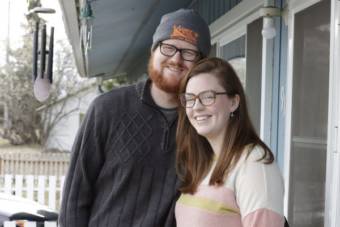
Chuck and Maggie Seaca. (Photo by Matthew Faubion/Alaska Public Media)
“My at-the-time girlfriend, now wife, and I had just moved back to Alaska, planning a huge wedding that summer. I think we were planning to have over 300 people up in Talkeetna. We originally decided to postpone the celebration, but to have a small ceremony on the glacier in Wrangell-St. Elias, where we had gotten engaged, and then we were planning in the summer of 2021 to have the big wedding reception.
At Wrangell-St. Elias, it was a wonderful wedding. I think there were 11 people there just out on the glacier. Super meaningful and super small. It was disappointing to not have family there. We figured they’d all be at the celebration next summer, and then we decided to cancel that celebration once COVID didn’t calm down.
Before the pandemic I was not married, didn’t have kids, didn’t own a house, and now all of those things are true. We bought our house last year and then had a little baby girl that just is about to turn 6 months old this month. She’s healthy and just started sitting up and she can giggle now. Of places to be during a pandemic, taking care of an infant and getting to work from home while that infant is around has been quite the opportunity. I think we’ve brought her outside of the house only a couple times throughout her entire life, so definitely excited to be able to bring her to other people’s weddings and see all the family that’s there.”
Shawn Idom, owner of Hair Science barbershop
Shawn Idom. (Photo by Mayowa Aina/Alaska Public Media)
“The pandemic for us, it was kind of a rough point in the beginning. It was the first time that we had ever been shut down, or had a mandatory shutdown. I’ve been in business for 15 years and that was the first time that had happened. So that was the biggest adjustment, being considered a nonessential worker, and I think we were out for 6 or 7 weeks. So that was a big adjustment.
And then just getting everybody back. We were always… being a barber you have to kind of stay up on the sanitation, disinfection and things like that. But we really wanted not only to make sure that our customers were safe, but to make sure that our staff felt safe. A lot of our customers were appreciative of a lot of the health things that we were doing to just make them feel comfortable. Because in the beginning there was so much uncertainty, like: ‘Do you get this if somebody just rubs elbows with you?’ There’s a lot of different things that we just didn’t know. So we just tried to do our part as a business owner, but also as Alaskans just trying to do the right thing, which is making sure we weren’t compromising anybody’s health.
I’m just grateful the doors are still open. There was some economic repercussions, even still, that people are going through. During the summertime, for example, tourism hasn’t been as busy as it usually is, so that’s something that all businesses are affected by. Because those are the extra population, extra people that come in every summer, that we just haven’t had in the last few years. But, the base of our clientele — the community that we’ve been able to rely on for years and years — they showed up. And I’ve got to contribute most of our success in being able to weather this to them.”
Tisha Pike, an Eagle River mother who started to homeschool her son after the pandemic closed classrooms
Tisha Pike is an Eagle River mother who moved her son to homeschooling after the pandemic impacted the Anchorage School District. (Photo courtesy of Tisha Pike)
“When the pandemic started, honestly, I had just had my knee replaced. I was one of the last surgeries before they shut everything down. So I was on lockdown a lot harder than a lot of people.
Our biggest challenge was schooling. The Anchorage School District was going to school, and then they shut everything down and they went to ASD virtual learning or whatever. And some kids just can’t hack that, my kids was one of those kids that couldn’t hack that, and we struggled for a while. If parents have time to sit their kids down and do homeschool, it’s fine. Most homeschool programs are set up so that it’s learn at your own pace. So if we can only do school one day a week, then we do school one day a week. If we can do it five days a week, we do it five days a week. There’s so much room and flexibility in there.
My big concern is him getting socialization. I mean, education or whatever, we can cover that with books and learning apps and all that kind of stuff. We can cover that part, but it’s the socialization that you can’t make up for.
We have certain parameters where we can’t go out and hang out with everybody because of the pandemic. I have health issues and I can’t catch COVID, I can’t get sick. So we’ve been hunkered down a lot more than other people, but what we have done is we’ve made sure everyone in our circle is vaccinated. He gets to play with his cousins or our friends’ kids, and we do that at least two or three times a week, so he is getting some socialization. But through elementary school, that’s when they learn how to behave and it molds them to be a better person and how they’re going to do at work and if they’re going to be an introvert or extrovert. So it’s been a struggle to make sure that he’s getting everything. I think we could do homeschool until fifth or sixth grade, but at some point he’s going to have to go back to public school.”
Note: The interviews were lightly edited for length and/or clarity.
Close
Update notification options
Subscribe to notifications
Subscribe
Get notifications about news related to the topics you care about. You can unsubscribe anytime.