COVID-19 cases in the Yukon-Kuskowkim Delta region are the highest they’ve ever been. The Yukon-Kuskokwim Health Corporation reported 817 new cases last week, almost 100 more cases than the week before. YKHC also reported one death and four hospitalizations over the same period of time.
The region’s case has spiked as state and national infection rates have been falling.
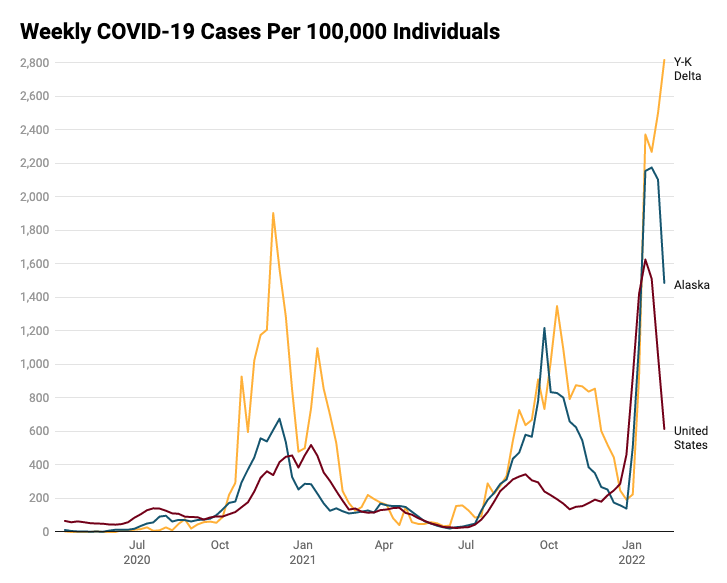
The Y-K Delta’s COVID-19 case rate is currently two times higher than the state’s. Despite having one of the highest case rates in the country, the Bethel City Council voted not to renew the city’s mask mandate this week. That mandate will expire Feb. 18.
Last week, the Alaska Department of Health and Social Services announced 8,950 new COVID-19 cases across Alaska, a 35% drop from the week prior. During that time, the Yukon-Kuskokwim Delta made up 9% of the state’s new cases.
According to state data, over 75% of adult hospital beds are still occupied, and 13% of those occupying hospital beds are COVID-19-positive.
Datawrappper chart showing weekly COVID-19 cases per 100,000 since April 6, 2020, when YKHC announced the first COVID-19 case in the Y-K Delta. (Chart: Elyssa Loughlin Source: YKHC, Alaska DHSS and CDC)
Local health officials continue to urge wearing masks and getting vaccinated and boosted against the virus to protect your health, and to prevent the health care system from being overwhelmed by new cases. Anyone with questions about the virus is encouraged to visit the YKHC COVID-19 Dashboard or call the COVID-19 hotline at 543-6949.
The Yukon-Kuskokwim Delta case rate remains higher than both that of the state and the nation. Per 100,000 people over seven days, about 2,800 developed COVID-19 in-region. That’s compared to the national case rate of 615 cases per 100,000 and the state case rate of 1,487 per 100,000 over the same period of time.
YKHC reports that 65.9% of the eligible population is completely vaccinated against COVID-19, a 0.2% increase from last week. DHSS reports that 61.8% of all eligible Alaskans have completed a vaccine series. Nationwide, 67.9% of the population that is five or older is fully vaccinated, according to the Centers for Disease Control and Prevention (CDC).
A vial of monoclonal antibody treatment at the Alaska Native Tribal Health Consortium warehouse on Oct. 5, 2021 (Photo by Lex Treinen/Alaska Public Media)
COVID-19 cases in Alaska are decreasing as the omicron wave tapers off throughout the country.
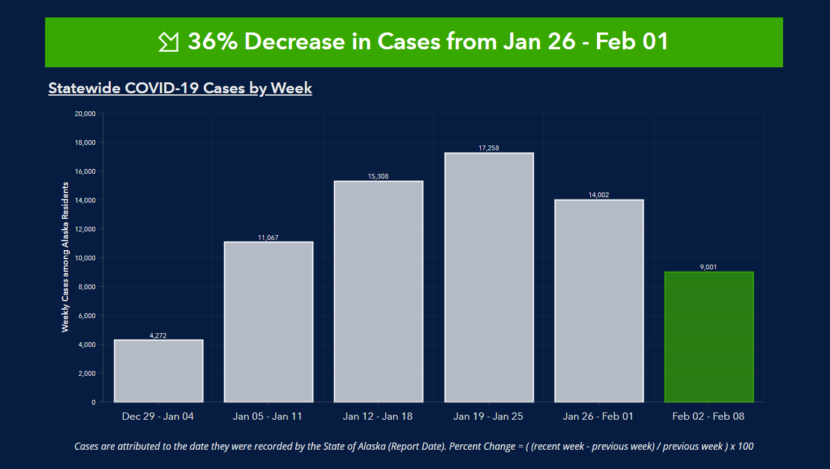
Alaska tallied 9,001 COVID-19 cases over the past week, down from 14,002 the week prior. That’s a 36% decrease in reported cases.
Alaska’s chief medical officer, Dr. Anne Zink, noted that even though case numbers are declining, Alaska still has one of the highest case counts in the country. While that means more people have some immunity, she said, people who haven’t received a booster shot are three times more likely to have symptoms if they test positive.
“More of the population has some degree of protection, either being vaccinated and ideally boosted, or having previously had COVID-19,” she said during a public health presentation Wednesday. “By far your best protection is if you are boosted, if you are eligible, against the disease.”
The state health department reported 859 COVID-19 cases on Monday and 1,379 on Tuesday. Those numbers don’t include at-home tests.
The department on Wednesday also reported 21 COVID deaths, two of which are from the last week. The rest occurred earlier in the pandemic. They include an Anchorage resident in his 30s, a Fairbanks resident in his 80s and a Nome resident in her 70s.
Zink said the decline in cases also means COVID treatments are more widely available. Previously, certain oral antiviral and monoclonal antibody treatments were only recommended for those who were immunocompromised, pregnant, or 65 and older with risk factors.
Now, there’s enough for other patients who are likely to be hospitalized if they test positive, said Zink. She described that group as “really anyone 50 and older with underlying risk factors, anyone 75 and older regardless of risk factors, as well as those who are pregnant and those who are immunocompromised and unlikely to mount a good response to a vaccine.”
The decline in cases and increase in available treatments prompted Juneau officials on Wednesday to lower the city’s risk level. That means the city will no longer require masking for vaccinated people at indoor spaces and crowded outdoor events. Indoor gatherings are still limited to 50% capacity or 50 people, and masks are required for those who are unvaccinated.
Statewide, 29 adult ICU beds were available Wednesday. Eight of them were in Anchorage and seven were in Southeast.
(Screenshot of the Department of Health and Social Services cases dashboard on Wednesday, Feb. 9, 2022.)
The sun rises over downtown and the cruise ship docks on Dec. 22, 2021, in Juneau, Alaska. (Photo by Rashah McChesney/KTOO)
Juneau’s emergency managers have decided to lower the city’s COVID-19 risk level. That’s in part because of a decline in new cases and in part because there are more treatments available for people who are at a higher risk of having severe cases of the virus.
The city has been at a modified high level since early January. Now it’s down to moderate.
What that means in practice is that the city’s current mask mandate is still in place for people who are not fully vaccinated. But for people who are, it’s just recommended. Businesses and organizations can choose whether to require masking. It’s still required in city facilities.
Indoor gatherings are still limited to 50% of the indoor capacity of a building — or 50 people — whichever is greater. But there are no size limits if everyone is fully vaccinated. Bars and gyms are still limited to 50 percent capacity too.
The state reported another 66 new cases for Juneau on Wednesday. Those are new cases from the past two days, but that number doesn’t include results from home rapid tests.
The city’s emergency operations center reports that it still has a good supply of those take-home tests which can be picked up at all of the libraries, the police station and city hall.
Three patients are currently being treated for COVID-19 and 11 staff members are out due to exposure to the virus.
The Juneau school district reported 17 new cases in schools since Monday.
Statewide, another 2,264 Alaskans and visitors to the state have tested positive for the virus over the last two days.
The state is reporting that another 4 people have died. So far, at least 1,114 Alaskans and visitors have died after contracting COVID-19.
A welcome sign at the Office of Children’s Services Child Welfare Academy. (Photo by Jeff Chen/Alaska Public Media)
For many of the roughly 3,000 foster children in Alaska, finding a stable home has never been harder.
“Children are sleeping in offices, in OCS offices, because they test positive for COVID, and there’s no one available to take them,” said Amanda Metivier, interim director of the Child Welfare Academy, a University of Alaska Anchorage organization that provides training for people working with foster youth.
Alaska has long struggled to have enough foster homes for the children and teenagers who need them, but the pandemic has made the problem even worse. Fewer families are volunteering to foster for a variety of reasons, from fear of COVID-19 spread to pandemic-driven financial challenges, said Metivier.
On top of that, the state Office of Children’s Services — which places kids in foster homes — has long had trouble filling open jobs and has a high rate of staff turnover. It’s all resulting in more Alaska children staying in shelters during a pandemic instead of with families in foster homes.
“They’re sleeping in hotels, and staff are doing shifts for 40-50 hours to stay with children in a hotel until they can find a family setting for them to stay in,” Metivier said. “More than ever, young people are staying in shelters.”
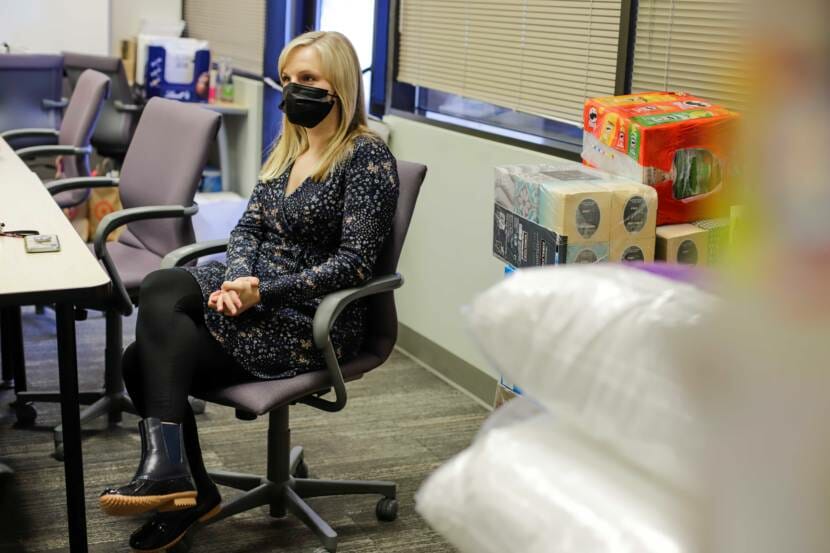
Amanda Metivier speaks with a reporter at the Office of Children’s Services in Anchorage on Feb. 1, 2022. (Photo by Jeff Chen/Alaska Public Media)
From 1,100 licensed foster homes to 650
One of those young people was 17-year-old Jesse Herrera. She stayed at the Covenant House youth shelter in Anchorage for a month last year, until she found a foster home.
And before that, it also wasn’t easy.
Since the age of four, Herrera has bounced around the foster care system between California and Alaska, experiencing failed adoptions, group homes and treatment facilities. She said typically teenagers in foster care have behavioral issues and trauma from their experiences and are less likely to find homes than younger kids.
“The biggest thing for me is I’m also trans, and a teenager,” Herrera said. “So a lot of people don’t want teenagers, but also a trans youth, so there were no homes that would take me so they had to place me at Covenant House.”
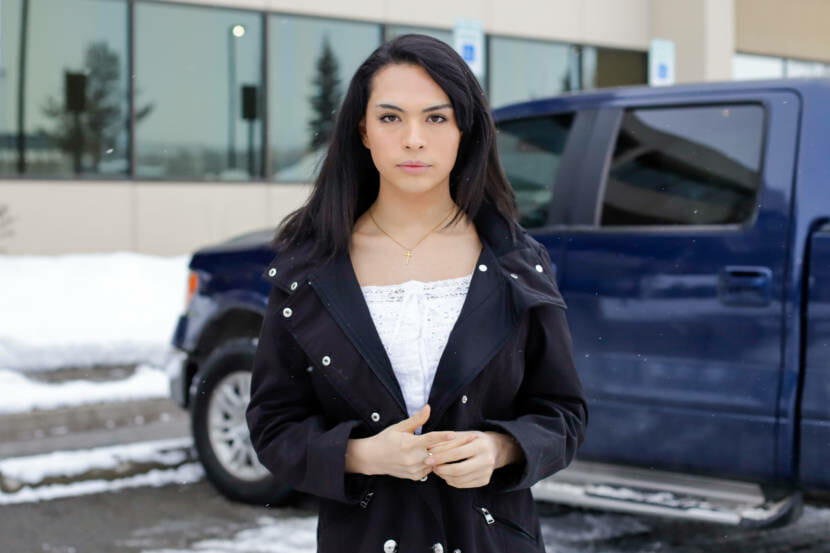
Jesse Herrera poses for a photo outside the Office of Children’s Services in Anchorage on Feb. 1, 2022. (Photo by Jeff Chen/Alaska Public Media)
Herrera eventually found her own way to a foster family in Anchorage after visiting the home of a friend’s foster mother.
“I went there for a weekend to spend time with my best friend and hang out, and returned back to the facility at Covenant House, and they said I had to leave because I was gone for too long,” Herrera said. “She said, ‘Get in the truck. Let’s go. You’re staying with me now.’ The caregiver that she is, she took me in out of her own heart.”
While Herrera said she got lucky in finding her foster mother, thousands of other Alaska kids remain stuck without a stable home. Metivier said the number of children in the foster care system has been pretty stable during the pandemic, but the number of foster homes has declined dramatically.
There are roughly 3,000 children in the foster care system.
But by the end of last year, there were just over 650 licensed homes that could take any child — down from more than 1,100 the year before, according to the Office of Children’s Services. That drop doesn’t take into account the licensed homes that aren’t taking in new kids because of things like stress and worries over COVID-19 spread.
‘A systematic failure’
According to some foster care advocates, the problems at OCS go beyond a lack of families and started well before the pandemic. And for one foster parent, those problems prompted him to leave the system.
“I think there’s a lack of training. I think it’s a lack of a qualified workforce. It’s a systematic failure,” said Jason England.
England moved to the Lingít community of Klawock on Prince of Wales Island in 2014. He met his wife, who’s Lingít and the two became licensed foster parents in 2018. He said the demand was immediate.
“We get the phone call, ‘You’re licensed. Here you go, everything’s good.’ It was literally a couple days later, we had three kids in foster care,” England said.
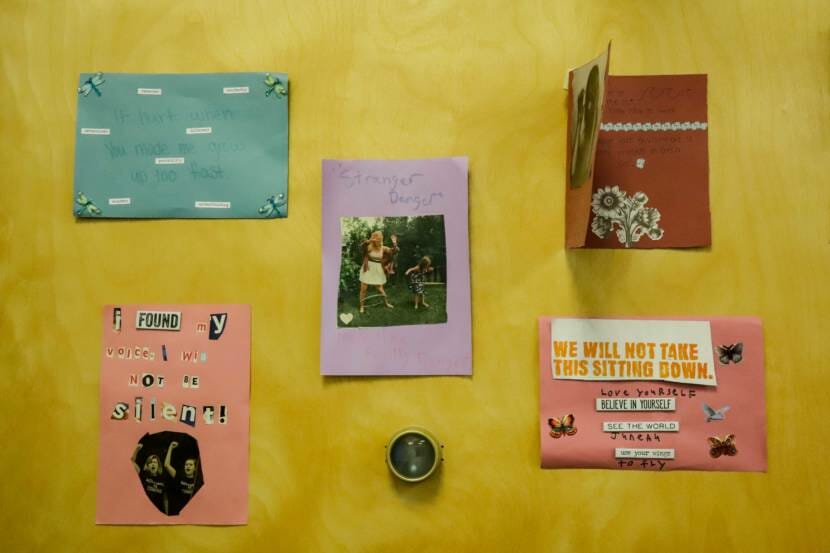
Art made for the Foster Care Alumni of America Post Secret project is taped to a door at the Office of Children’s Services in Anchorage. (Photo by Jeff Chen/Alaska Public Media)
England had done work at the local school and was familiar with the three kids — they were siblings and related to his wife. But the transition was difficult, he said. The only OCS case worker on Prince of Wales at the time told England he had an emergency in Hydaburg, so England would have to pick up the kids.
“It was definitely awkward,” England said. “Going into their house, getting their stuff, the mom sitting there, them crying. And that was the beginning of this journey.”
England said having to pick up the foster children highlights another problem with OCS: There aren’t enough workers. England has had eight different OCS case workers in his roughly three years as a foster parent. There’s rarely more than one to cover Prince of Wales cases, he said
“Prince of Wales is the size of Rhode Island,” he said. “And you’re expecting one person to cover that?”
England said none of his OCS concerns had to do with the kids he was watching. Though he is done being a foster parent, England was able to get the children who were in his care back home to their mother. He said not having to deal with OCS anymore has reduced his stress.
“The last child that we had went home Jan. 21,” England said. “I’ve seen him, he still comes over and watches football with me. And I had my blood pressure checked a couple days ago, and I’m down 20 points.”
Pandemic makes staffing problems worse
State OCS director Kim Guay said the number of foster families in the state has been declining for the past five years, stretching back to before COVID-19 hit. She said staff turnover is normally around 30%, but the pandemic has made it worse. Now it sits at roughly 60%.
As a result, the department sometimes has to ask more of their foster parents, said Guay.
“That’s kind of the nature of our job, is constantly trying to reprioritize what’s needed,” she said. “What’s an emergency, what can be moved.”
Guay said not everyone who’s being hired as an OCS case worker has a background in social work or a similar field because of a small pool of qualified applicants. That has led to OCS shifting focus to more on-the-job training.
The department is also trying to provide foster parents with more support, said Guay. It’s working to create forums for them to discuss issues, as well as a new hotline to get foster parents directly in contact with OCS instead of waiting for their case workers to be available.
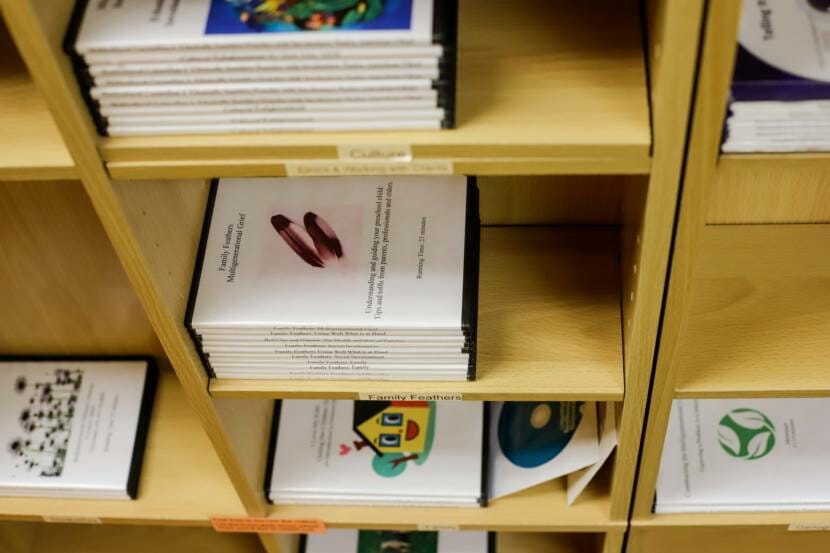
Training DVDs for foster parents sit on a shelf at an Office of Children’s Services office in Anchorage. (Photo by Jeff Chen/Alaska Public Media)
Gov. Mike Dunleavy also announced a program in December called the People First Initiative, which would provide millions of dollars in funding to areas including public safety and foster care.
“He did make this announcement to really invest in child welfare,” said Metivier with the UAA organization. “I don’t know that that’s reflected in the current state operating budget and what he’s proposed. So I’m interested to see what’s to come.”
Guay said more information on the funding should be available in the coming weeks. She said recruiting new foster families and OCS workers is a priority, as is keeping the foster families who are already licensed.
She says her message to foster parents is: “Please hang in there.”
“We need you, and this work can’t be done without you,” she said. “And it’s not that OCS needs you. The kids in this state need our foster parents, and we need them to be strong and healthy.”
Already, withgrant funding from the Anchorage Assembly, Metivier and UAA’s Child Welfare Academy have produced ads to try to recruit new foster families.
“Through social media, putting it out at public gatherings, doing things like coffee sleeves, pizza inserts, you name it,” Metivier said. “There’s a huge call to the community to sign up to be a foster parent.”
As for Herrera in Anchorage, who is in one of those ads, she’s thriving in her new foster home since moving in last May.
“It made me feel like I was loved and cared for,” Herrera said. “My depression was rough, and if I wasn’t in this home, I don’t think I’d be here today.”
Herrera turns 18 in March and will age out of the system. Her goals include getting an MBA or J.D. degree, so she can help advocate for the thousands of children that live the same struggles she did.
Correction: An earlier version of this story said Amanda Metivier was assistant director of the Child Welfare Academy. She is the interim director.
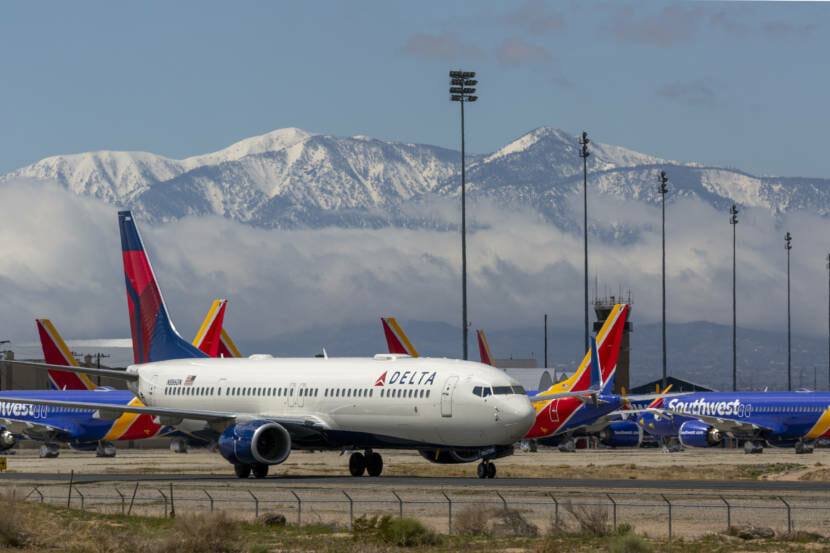
A Delta Air Lines jet seen parking at Southern California Logistics Airport (SCLA) in March 2020, in Victorville, Calif. (Photo by David McNew/Getty Images)
The number of disorderly passengers on commercial airplanes has skyrocketed during the pandemic. Now, one airline executive is renewing his call for a national unruly passenger no-fly list.
Edward Bastian, CEO of Delta Air Lines, sent a letter to U.S. Attorney General Merrick Garland last week asking for the federal government’s help in setting up a nationwide no-fly list for people who misbehave — sometimes violently — on planes.
“In addition to the welcome increase in enforcement and prosecutions, we are requesting you support our efforts with respect to the much-needed step of putting any person convicted of an on-board disruption on a national, comprehensive, unruly passenger “no-fly” list that would bar that person from traveling on any commercial air carrier,” Bastian said in the letter shared with NPR.
“Generally, we think it’s a bad idea,” Jay Stanley, a senior policy analyst for the American Civil Liberties Union, told NPR. “Our experience with government watch lists and ban lists has not been a good one.”
Another no-fly list raises civil liberties concerns
The ACLU has sued the U.S. government on behalf of people who were put on the TSA’s terrorist no-fly list without being told why they were included or how to be removed.
Stanley said the government has “fought tooth and nail against basic fairness and due process protections” in such litigation, which makes him skeptical of another proposed no-fly list.
Also, he said he worries about the disparate effects the same punishment — being prohibited from flying — could have on a slew of different alleged offenders.
“If somebody is a casual flier who only flies once or twice a year for a family vacation, then this punishment of not being able to fly would not amount to much,” he said. “On the other hand, if you’re in sales or some other position where your job depends on being able to fly every week, it could be an enormously significant punishment.”
Still, airlines do have some legal authority to create their own no-fly lists that are separate from the databases the federal government maintains for suspected terrorists and others, according to Charles Stotler, co-director of the Center for Air and Space Law at the University of Mississippi School of Law.
“As long as the airline’s not acting in an arbitrary and capricious manner, and they’re taking actions in order to curb activities that might be inimicable to safety, then the airline no-fly list is legitimate,” Stotler told NPR.
“There has to be some link with safety. Obviously unruly passengers fall into that,” he said.
Delta said it has already put 1,900 people on it’s own no-fly list for refusing to comply with masking requirements.
Unruly passenger incidents have increased during the pandemic
The U.S. has seen a spike in unruly passenger incidents since 2020, largely attributed to the stresses brought on by COVID-19 and new masking rules in airports and on planes.
“This also predated coronavirus. We were already seeing an increase in the number of unruly passengers,” Clint Henderson, senior news editor at the travel news website The Points Guy, told NPR.
Henderson said the increase before spring 2020 could have been caused by planes and airports being more crowded and the fact that people have become less willing to put up with bad behavior, including unwanted sexual advances. Then, the pandemic added a whole new set of difficulties that caused the number of unruly passenger incidents to spike.
“COVID has poured gasoline on the fire, as it were,” Henderson said.
Delta previously called for a national unruly passenger no-fly list in the fall but it was never adopted.
Still, the federal government has vowed to crack down on in-flight misconduct. The TSA has threatened to revoke PreCheck privileges for people who act out on planes and doubled its fines for those who refuse to wear masks on board. The Justice Department also said in November that it would prioritize prosecuting federal crimes on airplanes that put the safety of those on board at risk.
But the ACLU’s Jay Stanley worries that if the surge in unruly passenger incidents is largely driven by COVID and eventually comes down, then a no-fly list could continue to cause negative consequences for people long after the pandemic has subsided.
“[Unruly passenger incidents] may go back to normal levels when this is over,” he said. “And yet we’ll have this infrastructure for creating this punishment that will long outlast the current circumstances and that has the potential to create real unfairnesses for people if it’s not done just right.”
Copyright 2022 NPR. To see more, visit https://www.npr.org.
Strike signs hang in the Kenai Peninsula Education Association teachers union office as a reminder of the 2019 negotiation process. (Photo courtesy Nathan Erfurth)
Alaska’s schools have long struggled to attract and retain teachers and support staff. That was the case even before COVID-19 hit and upended education worldwide.
The pandemic has only made things more challenging, say education officials, as the strains from burnout and absenteeism pile stress on a system that was already buckling under the pressure.
The Kenai Peninsula Borough School District is among the many districts in Alaska having trouble filling open jobs and keeping current staff.
For the head of the local teachers union, teacher retention is the number one priority.
“As far as this particular issue is concerned, this has always been an elephant in the room,” said Nathan Erfurth, president of the Kenai Peninsula Education Association. “But the lights were off. We were not looking around in the corners of the room. COVID flipped on the fluorescents and we can see everything right now.”
Burnout is one factor contributing to a nationwide teacher exodus. Erfurth said about 18 teachers are planning on leaving the Kenai school district this year, and he’s expecting a big spike in the spring when contracts come out. In general, he said, he’s heard a lot more discussion this year from teachers who are thinking about resigning as they contend with the ongoing stress of the pandemic and national battles about school curriculum.
At the same time, it’s becoming harder for teachers to support themselves. The pandemic has put more strain on already sparse daycare services and affordable housing. Erfurth said there’s at least one new administrator in Seward who hasn’t been able to find housing for his family since he moved to the district in the fall.
“At the beginning of the year, I was talking to one of our local landlords and he was telling me that he had zero available units,” said Erfurth. “And we were trying to hire, at that time, 25 different teaching positions across the school district.”
At a recent school board meeting, Kenai Superintendent Clayton Holland said he’s working with administrators in Seward to find more housing for teachers and their families.
The problem is hardly unique to the Kenai Peninsula.
Gov. Mike Dunleavy convened a task force in 2020 to find out why schools were having trouble recruiting and retaining employees.
The state is part of the problem, said Tom Klaameyer, president of Alaska’s branch of the National Education Association teachers union. He said low funding from the state has impacted teachers everywhere, who now have to do more with less.
“We used to be sort of the model in the country for teacher recruitment and retention and compensation,” he said. “And we’ve lost a lot of ground there with flat funding, for the last decade, approximately.”
Retirement benefits for teachers in Alaska have also gotten worse, he said. Over 15 years ago, the state gutted its pension system. Without good retirement, there’s an “educational tourists” problem, he said. Teachers stay in their districts for four to five years and then leave. Research shows that higher turnover is associated with lower outcomes for students and higher costs for districts.
There is a bill working its way through the Alaska Legislature now that would improve retirement benefits for public sector employees, including teachers.
The problems hit even harder in more remote areas. Klaameyer said the rate of turnover for Alaska’s rural districts is above the statewide average
“And in Alaska, just like in all other career fields, it’s a special person that wants to come to Alaska and live here, especially the further you get from the road system,” he said. “That’s always been a challenge, and it’s an even greater one now.”
School districts are also struggling to hire support staff — the critical behind-the-scenes positions that keep schools running.
There are almost 25 open support staff positions in the Kenai district. The district has had to up its recruitment game in the last year, raising pay for nurses and changing hiring requirements for substitute teachers to make employment more attractive.
Susanna Litwiniak, who represents support staff with the Kenai Peninsula Educational Support Association, said the unfilled jobs become unbearable when COVID-19 exposures are also keeping staff out of school.
“What it looks like is the custodian greeting the kids in the morning and making sure that they’re keeping a 6-foot distance because there aren’t enough teachers to do that. And then the custodian helping in the lunch room because the lunch room is short staffed,” she said.
Retaining school staff is just part of the equation. National studies say the pandemic is turning many teachers-to-be away from the profession in the first place.
Erfurth said he understands why.
“Because they’re seeing what we’re going through. and it’s not attractive,” he said.
Despite the challenges, he said people stick around because they love what they do. It’s just important to them that their schools love them back.
Close
Update notification options
Subscribe to notifications
Subscribe
Get notifications about news related to the topics you care about. You can unsubscribe anytime.





9(MDEwMjQ0ODM1MDEzNDk4MTEzNjU3NTRhYg004))