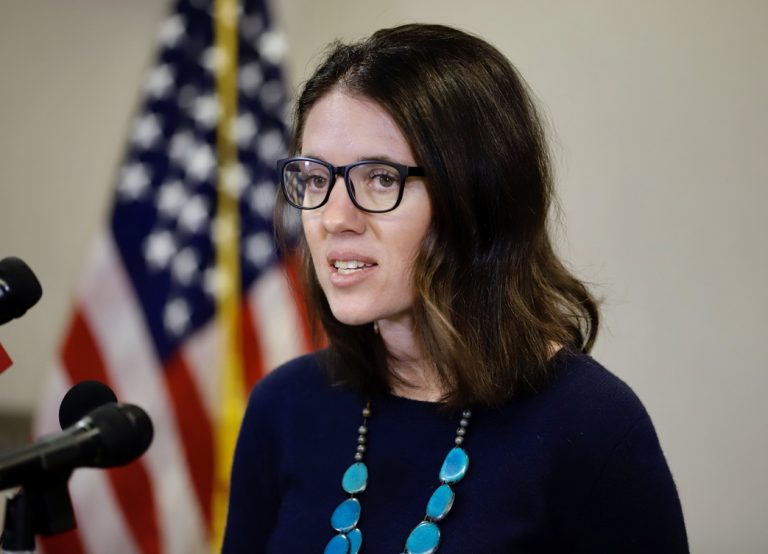
Alaska Chief Medical Officer Anne Zink talks to reporters at a press conference about the coronavirus on Monday, March 9, 2020. (Photo by Joey Mendolia/Alaska Public Media)
The latest COVID-19 case numbers suggest that the omicron wave may have reached its peak in Alaska, though chief state medical officer Dr. Anne Zink said it’s too soon to say for sure.
“Here in Alaska you can start to see that we’re starting to maybe plateau-ish,” she said in a Zoom call with reporters Thursday. “We’ll have to kind of see what this next week, week-and-a-half looks like moving forward. But nice to not see quite the same upward trajectory.”
Still, Alaska has the highest COVID-19 case rate of any state in the country. The number of new daily cases is several times higher now than at the peak of the delta variant.
“Case rates declining does not mean that case rates are low,” said Anchorage economics consultant Jonathan King, who puts the numbers in perspective for a weekly COVID-19 newsletter he produces.
He noted that the state recorded 55,000 cases in January.
“It’s just a staggering number for one month, for a 30-day period,” he said. “What it means is, officially, one in every 13 Alaskans … tested positive for COVID in January.”
Even without data from home tests, or an estimate of how many people became infected and never get tested, it’s obvious the omicron wave towers over delta and previous variants, said King.
“Twenty-six percent of all COVID cases, for the entire pandemic, occurred in Alaska in January,” he said.
Though illness from omicron is usually more mild than illness from the delta variant, it’s still straining Alaska hospitals, especially because many health care workers are out sick or in quarantine. But state officials say, compared to the delta wave, COVID patients now are less likely to need intensive care, and their hospital stays are shorter.
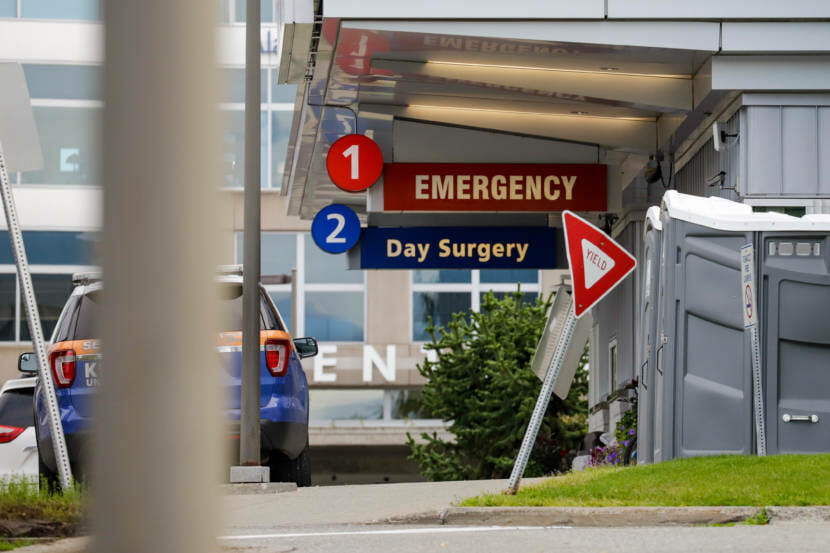
The Emergency Department and Day Surgery entrance at Providence Alaska Medical Center in Anchorage. (Jeff Chen/Alaska Public Media)
Alaska health officials on Wednesday reported the state’s first COVID-19 pediatric deaths. Both Alaskans were infants from the Anchorage/Matanuska-Susitna Borough areas, according to the state Department of Health and Social Services.
They’re the first COVID-19 deaths of any Alaskan under the age of 20 since the pandemic began, according to health officials.
“They were both less than 12 months old in the Southcentral region,” said the state’s chief medical officer, Dr. Anne Zink, during a public presentation on Wednesday afternoon. “They were from a while ago but the death certificate process caught up and is now out.”
The two infant deaths occurred in 2021, according to the health department.
While hospitalizations among children have increased during the surge of the highly contagious omicron variant, it’s still very unlikely for children to die from the illness. That has been the case for other variants too, including delta.
Nationally, 1,225 people under age 18 have died of COVID-19 throughout the pandemic’s two years, according to the CDC. That’s less than 0.2% of the total number of American deaths. The two infant deaths in Alaska are out of more than 1,000 Alaskan COVID-19 deaths.
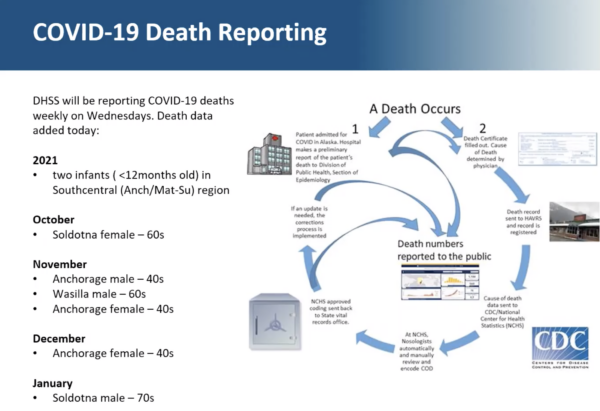
The state health department also reported six adult COVID-19 deaths on Wednesday. They occurred earlier in the pandemic but were added to the Alaska data after the state reviewed death certificates.
Health officials say reviewing death certificates is a lengthy process. (Screenshot from Department of Health and Social Services ECHO presentation on Wednesday, Feb. 2, 2022.)
Zink said the state has received many questions about the death certificate review process. In the presentation on Wednesday, she showed an example death certificate that listed acute respiratory distress syndrome as the immediate cause of death, and pneumonia and COVID-19 as underlying causes. That means the person first had COVID-19, then pneumonia, then acute respiratory distress, said Zink. That person’s death would be counted as a COVID-19 death in state data.
“If it says COVID-19 anywhere on here, we share it in these numbers that we share,” she said. “However, when we look at our big yearly reports, we’re really looking at that underlying cause of death. So if someone, say, has metastatic cancer and they get COVID, their underlying cause of death would be that metastatic cancer.”
This week, Pfizer requested authorization for its vaccine for children 6 months to 5 years old. Zink said while the FDA is still reviewing the data, parents can talk to their children’s doctors about the benefits and risks of vaccination.
“If you have questions about this age group, my recommendation to you is to make an appointment with your pediatrician,” she said.
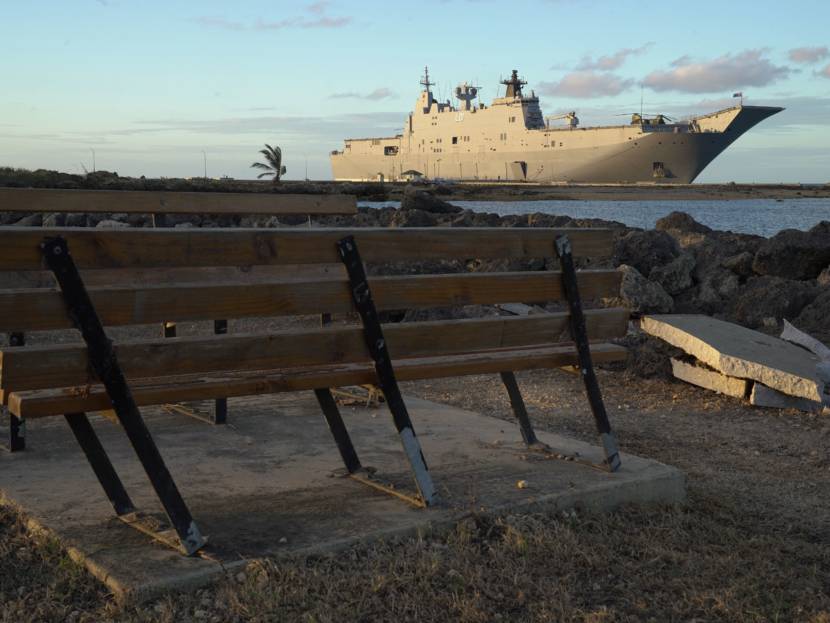
This photo shows the Australian Navy’s HMAS Adelaide docked at Vuna Wharf in Tonga’s capital Nukualofa on Jan. 26 to deliver aid following the Jan. 15 eruption of the nearby Hunga Tonga-Hunga Haapai underwater volcano. Tonga’s deputy chief of mission in Australia Curtis Tu’ihalangingie told Reuters that the infected dock workers were not at the same wharf the HMAS Adelaide docked at. (Photo by Mary Lyn Fonua /Matangi Tonga/AFP via Getty Images)
Prime Minister Siaosi Sovaleni announced a lockdown for his nation of 106,000 people after it recorded its first cases of community transmission of COVID-19. Tonga’s High Commission in London confirmed the announcement and said it would be reviewed every 48 hours.
Two workers tested positive Tuesday, local media reported, after the Ministry of Health increased testing at the wharf they worked at amid a flow of international aid following last month’s volcanic eruption and tsunami.
Mr. Sovaleni said Wednesday that three more people tested positive for the virus. The lockdown will require people to remain at home, though aid personnel will be exempt.
These newly recorded cases bring Tonga’s overall total for the pandemic to six. The South Pacific archipelago nation recorded its first COVID-19 case last October. Following the volcanic eruption, there had been worries that the influx of foreign development workers would bring coronavirus to Tonga. An Australian Navy ship had 23 COVID cases on board when it docked last week to deliver pallets of supplies.
Reuters reports that the Australian Defence Force’s Chief of Joint Operations Greg Bilton said in an interview that ship is unlikely the source of the first two infections. Tonga’s deputy chief of mission in Australia Curtis Tu’ihalangingie told Reuters that the infected dock workers were not at the same wharf the Australian ship docked at.
The prime minister said at his press conference that authorities were trying to identify which ship the dock workers were unloading.
“We have the record of ships that had been here, at time that could have spread this virus,” Mr. Sovaleni said. He said the lockdown would help slow the spread, and “no boat will be allowed to go from one island to another. No more aeroplane flights to Ha’apai, Vava’u, or for them to come here to Tongatapu.”
Jack Lewis operates Firetap Alehouse, along with several other restaurants in Anchorage. (Photo by Matt Faubion/Alaska Public Media)
Restaurants are going on two years of income uncertainty and staffing challenges due to COVID-19. Jack Lewis works as an operating partner for several restaurants and chains in Anchorage including Firetap Alehouse and a Krispy Kreme.
He told Alaska Public Media’s Kavitha George that the pandemic is still causing daily headaches in his industry.
Listen here:
This transcript was lightly edited for clarity.
Jack Lewis: People think it’s over, but yeah, it’s not with omicron. You think because of the vaccinations we would be on the downhill run here. But in actuality, the restaurants are getting hit hard again.
There’s a lot of confusion out there. Is it safe to go out? Is it not safe? Even if people have been vaccinated, they’re hesitant about going out. They’re not concerned about being hospitalized, but now they just don’t need to. So here we go, again, where the restaurants get hit hard again. So we are definitely not out of the woods yet by any means. And the workforce continues to be tight as we look for people.
Kavitha George: What does hit hard look like? Is it lowered sales, staff out sick?
Jack Lewis: It’s every area, it’s up and down. Sometimes you think you’re out of the woods, you have a big weekend, and then the following weekend, your sales are way off. You can have a big Tuesday, and then just sit there with an empty dining room on a Wednesday. So it’s all over the place.
The labor market, we are extremely short. My peers in the industry are extremely short. And it’s every area — it’s management, it’s food servers, line cooks, kitchen managers, every area has been affected.
Kavitha George: Have you opted to raise wages to attract workers?
Jack Lewis: I mean, wages are way up there. Probably well over 10% more than we were paying [pre-pandemic]. Close to 20% in some areas. Some you pass on to the consumer and you hope you don’t get pushback because we are paying people better. Minimum wage, I think, is pretty much non-existent in my operation and probably most of my peers up here. We’re paying the highest wages we’ve ever paid in the industry to keep people working, and paying overtime all over the place with the [worker] shortages.
Kavitha George: With the staff that you do have, have you had issues with one person testing positive, then everybody has to test and you have to shut down while you’re waiting?
Jack Lewis: Right. You know, we’re still in a very challenging period here. Because if someone calls in, says “I’ve been exposed to somebody that tested positive,” now we have to wait and see whether they tested positive. And then if they do, we have to notify everyone that we’ve had a positive case. We usually don’t even open until we’ve been assured that everyone has tested negative or has zero symptoms.
And the public gets mixed messages. If you’re closed for a day, even though it could be 100% safe, the public wonders “Wow, well they shut down for that day.” So I think the public is still very confused, should they go out to restaurants or should they not? And we need them in the dining rooms. Because we’re certainly not going to make a living off of takeout and third party carriers, that’s for sure.
Kavitha George: How many times have you had to shut down for a day or even just cut back hours?
Jack Lewis: During the heat of COVID, I shut down several operations for over a week. I shut down Burger Fi for a week, Peanut Farm was shut down for over a week, Firetap Ale House shut down for over a week, Krispy Kreme shut down many days. And you know, your overhead carries on. And it’s an even worse effect because your people aren’t working … for those that couldn’t come into work because we weren’t open, they lost their income. So it was a real domino effect when we had to shut down.
Now we’re in omicron, I would say we’re shut down for like days at a time, or maybe we don’t do lunch hour, or maybe skip a day on a Monday just to play it safe. So we’re sort of going day by day. I wake up in the morning, as head of operations, and I’m fearful to look at my phone.
These are very difficult decisions, because I’m trying to do everything right. And my peers are trying to do everything right. And yet, people need to make a living and they’re trying to get to work.
Kavitha George: What would help you at this point? More relief money, more access to testing?
Jack Lewis: Well, we certainly need some more relief money. There’s no doubt about it. We’re not out of the woods yet. A lot of us don’t have the holding power, should we get hit again.
And then, information to the public, clear information. What are the odds of getting sick in a restaurant? I think they’re slim now, if you’ve been vaccinated. I think the more information out to the public, the better the restaurants will do. I still think there’s a lot of confusion by the general public, which I think is keeping them out of the dining rooms.
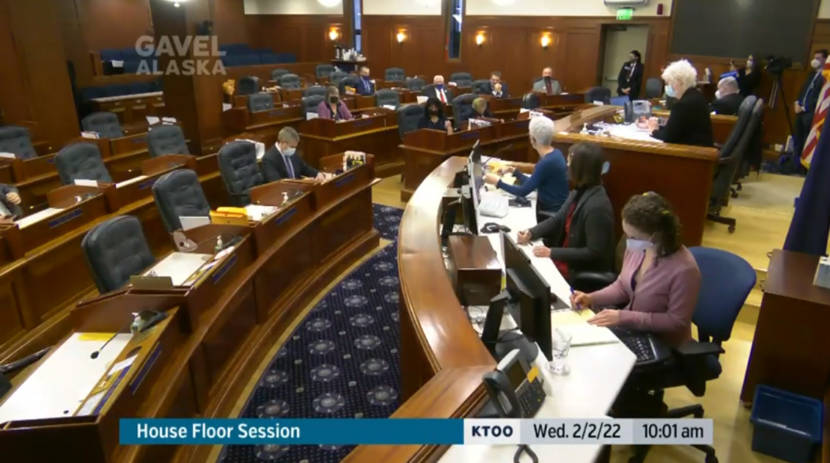
The Alaska House of Representatives is largely empty during a technical session on Feb. 2, 2022 due to many of its members being exposed to someone who tested positive for COVID-19 on Wednesday in the Capitol. (Screen capture of Gavel Alaska)
Leaders of the Alaska House of Representatives canceled the regular floor session on Wednesday, due to a large portion of representatives being exposed to COVID-19 over the last day.
Instead, the House held a technical session without normal legislative business.
House Speaker Louise Stutes, a Kodiak Republican, said in a statement that contact tracing was ongoing. She said the decision was made “in an abundance of caution.”
A spokesperson for the House majority caucus said that roughly half of the House members were close contacts of a positive case.
As of Wednesday morning, the Legislature’s testing contractor was still determining who had to quarantine, based on their vaccination status, according to the spokesperson.
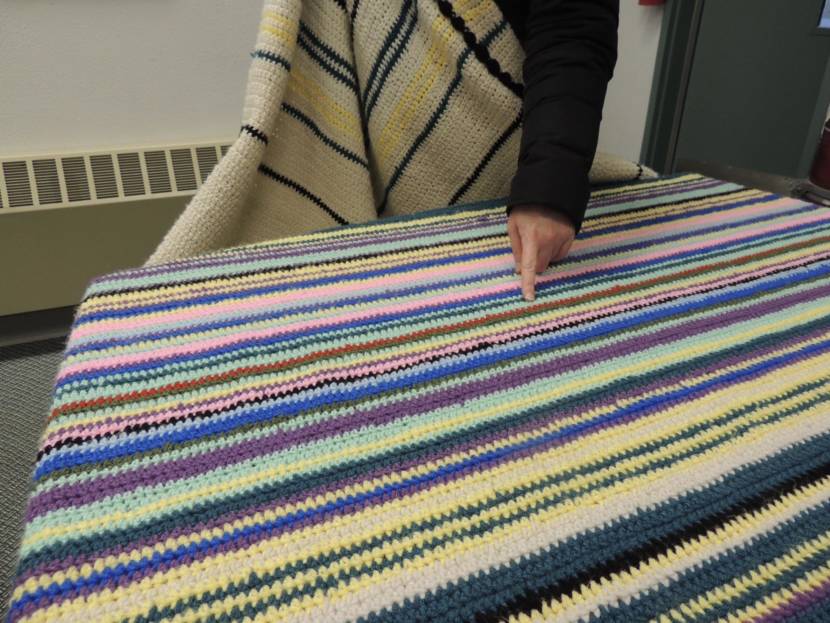
Rebecca Bezdecny points to a line of red yarn in her blanket, symbolizing a day of 90-100 new COVID-19 cases on the central Kenai Peninsula. (Photo by Sabine Poux/KDLL)
When the pandemic grounded people at home, many new crafters picked up painting, sewing or bread-baking for the first time. For those already making crafts, the extra days at home were chances to get even craftier.
For Rebecca Bezdecny, the pandemic wasn’t just an excuse to craft, it was also a muse. The Kenai resident crocheted what she’s calling her COVID blanket — a striking visual picture of one pandemic year on the central Kenai Peninsula.
“It gave me a way to kind of bring order to an unorganized thing that was going on outside of my control,” she said. “It’s almost literally like a safety blanket.”
Bezdecny’s blanket is modeled after what’s called a temperature blanket in the fiber arts world. Each row on a temperature blanket represents one day, using a different color of yarn to show how hot or cold it was on a given day.
Each row on Bezdecny‘s blanket represents a day of COVID-19. And each color is a different range in case numbers.
A row of white means the central peninsula had between zero and five new cases that day. There’s a lot of white on the blanket at the beginning, representing July 2020.
“It starts off really mild,” Bezdecny said.
But as summer 2020 faded into fall, Alaska saw its first COVID spike. That’s where the blanket becomes really colorful. Pink stripes are days with 51 to 60 reported cases and light blue stripes are days with 61 to 70 reported cases. Noticeably missing is any white.
There is one ominous strip of red, representing 91 to 100 cases.
“It’s stuck in my mind,” she said. “Ninety-two cases that day. Now I look back and go, ‘Yeah, that wouldn’t be a bad day today.’ But back then, about a year ago, that was a really bad day.”
Bezdecny stopped before the omicron era. Her last row represents June 30, 2021.
The finished blanket is nearly 11.5 feet long by 5 feet wide and weighs 10 pounds. It represents more than a year of crocheting in front of the TV, watching cases spike and fall like a roller coaster.
That deeper meaning, hidden behind cheerful pastels and a black scalloped border, is eerie. But Bezdecny wonders what the blanket would look like to someone who doesn’t know the story. At first glance, there seems to be little rhyme or reason why there’s one row of dark blue here and two rows of pink and yellow there.
“I try to imagine, if I hand this down to my grandkids, are they going to understand what this means? Are they going to know that Grandma did this in the middle of the pandemic?” she said.
There’s also an ode to Bezdecny’s own COVID-19 experience. A red pin near the piece’s chronological end represents the point in the process when COVID-19 came into her home for the first time.
The pandemic, of course, is not over. And if Bezdecny was still crocheting, she might have to create a whole new color category to account for the high case numbers reported some days on the central peninsula.
But she has hung up her crochet hook for now. That also means relief from meticulously monitoring the state’s case counts.
“There were some days where you add ’em up, you had to add up the four towns I was keeping track of, your stomach just sinks,” she said. “You’re like, ‘Oh, gosh.’ Even now, it’s a hard habit to break. You get those texts from the state with the every-other-day case counts, it’s like, ‘Oh, OK. I don’t need to keep track of this anymore.’”
Finally, she can enjoy the blanket for what it is, using it to keep warm during her third pandemic winter.
Close
Update notification options
Subscribe to notifications
Subscribe
Get notifications about news related to the topics you care about. You can unsubscribe anytime.

9(MDEwMjQ0ODM1MDEzNDk4MTEzNjU3NTRhYg004))