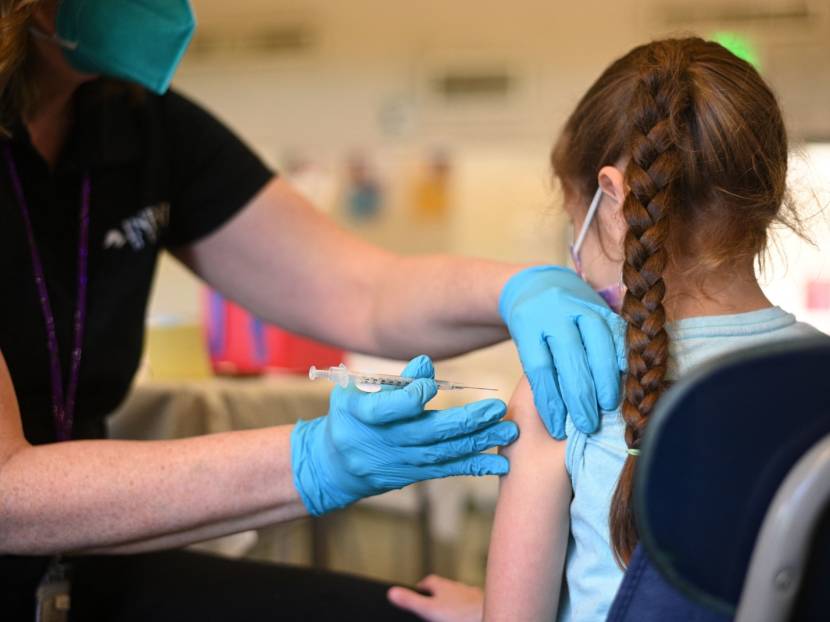
A nurse administers a pediatric dose of the Covid-19 vaccine to a girl at a L.A. Care Health Plan vaccination clinic at Los Angeles Mission College in the Sylmar neighborhood in Los Angeles, Ca., January 19, 2022. (Photo by Robyn Back/AFP via Getty Images)
The last age group of the population unable to get a COVID-19 vaccine may soon be able to do so — and much earlier than anticipated.
Pfizer-BioNTech is expected to file a submission for emergency use to the Food and Drug Administration for a vaccine regimen designed for use in children aged six months to five years, according to a person familiar with the plan. The companies could file for the authorization as early as Tuesday.
Clinical trials last fall showed that the low doses of the vaccine generated protection in children up to 2 years old but failed to do so in kids aged 2-5. The companies announced in December they’d add a third dose to its trials, which would delay the submission to the FDA.
Emergency use authorization could allow children to begin a two-dose regimen, which would prepare children between 2-5 years old to receive a third shot when the data demonstrates its effective.
“By now they probably have more information on whether the two shots provided any protection at all,” Dr. Bob Wachter, chair of the University of California San Francisco Department of Medicine, said .
“It seems likely the third shot will be necessary … but you can’t get shot #3 until you’ve [had] shots 1 and 2,” he wrote in an email Monday night.
A spokesperson for Pfizer emailed a written statement that says “At this time, we have not filed a submission, and we’re continuing to collect and analyze data from both two and three doses in our younger age cohort.”
The FDA authorized the companies’ vaccine for children aged 5 through 11 years old last October, but use among children remains significantly lower than the overall population. According to data from the Centers for Disease Control and Prevention, only 21.6% of children 5-11 are fully vaccinated.
“The key question is whether the parents of younger children will get their kids vaccinated,” Dr. Celine Gounder, a clinical assistant professor at NYU Langone Health, said . “Parents are relatively more hesitant to get their young children vaccinated than themselves.”
Gounder predicted vaccination rates for the younger group of children would mirror that of the group already authorized for the doses.
Copyright 2022 NPR. To see more, visit https://www.npr.org.
The sun rises over downtown on Dec. 22, 2021, in Juneau. (Photo by Rashah McChesney/KTOO)
An elderly Juneau man died of COVID-19 at Bartlett Regional Hospital over the weekend.
Juneau Emergency Manager Robert Barr said the man was in his 80s. So far, at least 20 Juneau residents have died during the pandemic.
According to state data, there were 163 new COVID-19 cases reported among Juneau residents and visitors from Friday through Sunday. That’s down about a third from this time last week.
Three people with active COVID-19 infections are being treated at the hospital.
Within Juneau schools, at least 11 cases were reported among people who were infectious while in a school or during school activities on Monday. That includes six cases at Juneau-Douglas High School: Yadaa.at Kalé, three cases at Sít’ Eetí Shaanáx Glacier Valley School, one at Yakooske Daakahidi High School and one at Mendenhall River Community School.
Statewide from Friday through Sunday, 4,447 new cases were reported among state residents and visitors. That’s down about 23% from this time last week. Hospital data shows 154 people who are positive for COVID-19 are hospitalized, including 8 people on ventilators.
State data show two new deaths were preliminarily reported among Alaska residents for the week ending Jan. 30.
A school bus drives down Front Street on Monday morning, March 13, 2017, in downtown Juneau. (Photo courtesy Tripp J Crouse)
ELKO, Nev. — After years leading school districts on the East Coast, Michele Robinson wanted to come home.
In May of 2020, the Las Vegas native accepted an offer to become superintendent of the Elko County School District, which serves roughly 10,000 students in northeastern Nevada. Her tenure began just a few months into the pandemic when coronavirus cases were surging across the nation and education officials were grappling with whether and how to reopen schools.
As hard as those first months were, the gradual return to in-person learning in fall 2020 was harder. Parents and community members — angry about mask requirements and bristling at potential Covid vaccine mandates — pressured Elko County School Board members and district officials to flout state directives and exert local control over those decisions. At some point last school year, board meetings devolved into people shouting at district leaders to watch their backs. Security at meetings was increased.
Robinson concluded they weren’t and resigned in June 2021.
Nationally, about 25 percent of superintendents have made a similar decision in the past year, compared to a typical turnover rate of 14 to 16 percent, according to the American Association of School Administrators.
Superintendents’ reasons for leaving vary. As many as 1,500 to 2,000 superintendents have stepped away after delaying their retirement during the first year of the pandemic, estimated Michael Collins, president of Ray and Associates, a national search firm that consults with school boards tofind new leaders.
“Superintendents stood by their districts when they thought this would be a couple of months,” said Molly Schwarzhoff, executive vice president and a lead recruiter for Ray and Associates. “It’s a whole different ball game now. Once we saw what we were up against … a lot of people just said, ‘I don’t want to play anymore.’ ”
This story was produced by The Hechinger Report, a nonprofit, independent news organization focused on inequality and innovation in education.
A child carries breakfast and lunch from the school bus in Glencaren Court in East Anchorage on Friday, March, 20, 2020. (Photo by Tegan Hanlon/Alaska Public Media)
Tisha Pike lives in Eagle River with her son, who’s in second grade. Before the pandemic, he got free lunches at his school, Birchwood ABC Elementary. Then, schools went online, and she had to spend more on groceries.
She got reimbursed for those groceries through a federal program called the Pandemic-Electronic Benefits Transfer Program, or P-EBT.
“That stability, and being able to know that I have money coming to make sure that my child has food, it means the world,” she said. “Because I know that’s something that he doesn’t have to stress out about.”
Students were eligible for P-EBT if they were enrolled in their school’s free or reduced-price meal program and if the school closed due to COVID-19. In the Anchorage School District, nearly 14,000 students — about a third of students in the district — meet the requirements for free and reduced meals.
Anthony Reinert, the SNAP outreach manager for the Food Bank of Alaska, said it’s meant to make up for those lost meals.
“This is not a benefit in the traditional sense — this is a reimbursement,” he said. “Those children who couldn’t attend school because of the pandemic missed meals that would have been provided through free and reduced meal programs. Those meals then had to be paid for by parents while they ate at home.”
Families can check the Food Bank’s online eligibility calculator to see if they were automatically enrolled for the 2020-2021 school year. Reinert said some families could receive up to $1,800 per child.
Jo Dawson, the state administrator for the department of education’s child nutrition program, said reimbursing families for spring 2020 was an easier process. That’s because closures were fairly consistent across schools.
“Essentially two weeks in March, four weeks in April, and three weeks in May,” she said. “School year 2021 was all over the map.”
Last year, schools were closing and reopening at different times. Some students switched schools or left their districts. That made the data much more complicated.
Shawnda O’Brien directs the state’s Division of Public Assistance. She said dispersing funds is taking so long because state workers are combing through school district data manually. Automating the process requires using an outdated computer programming language.
“Most of the individuals who have that experience are retired or retiring,” she said. “It’s not something that someone in college would be learning to do.”
Starting from scratch in a more modern programming language would take years. They’ve started that process, but in the meantime, the department is looking nationally for people who can work with the existing system.
“Asking folks to be patient is difficult, especially when it comes to money,” O’Brien said. “The biggest thing we can do is let them know that we’re working on it, and we understand the hardship that it’s placing on families and that we’re working as hard as we can to find a solution.”
Some states have applied for P-EBT again for this school year. But like many states’, Alaska’s application is still pending. For now, families waiting on last year’s funds can check the Food Bank of Alaska’s website for updates or sign up for their emails.
Until their cards arrive in the mail, parents like Pike will have to keep waiting.
“Most people have written it off,” Pike said. “I’m never going to get that money. At this point, it’s like beating a dead horse.”
O’Brien said the Division of Public Assistance aims to have a clearer disbursement timeline within the month.
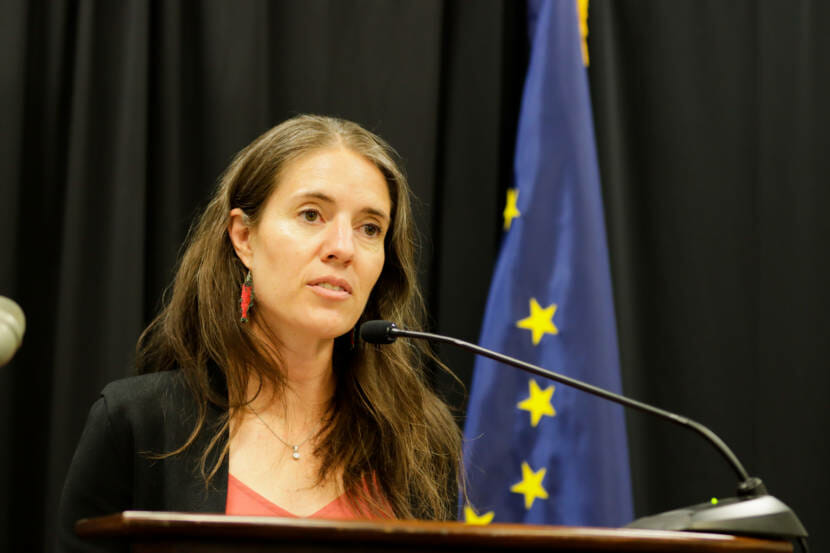
Alaska Chief Medical Officer Dr. Anne Zink discusses the state of the coronavirus pandemic during a news conference at the Atwood Building in Anchorage on Thursday, Aug. 26, 2021. (Matthew Faubion / Alaska Public Media)
The COVID-19 omicron variant is still gaining steam in Alaska.
“Alaska continues to be on an upward trend,” the state’s chief medical officer, Dr. Anne Zink, said in a Zoom session Wednesday, presenting the latest data.
“You can see our high case rates here,” she said. “Fortunately, with omicron, we’re seeing less severe disease and so not quite the same uptake in hospitalizations.”
For the previous seven days, case counts rose 13% compared to a week prior. The figures do not include results from at-home tests.
Zink also highlighted findings from the annual vital statistics report that was just released, covering 2020, the first year of the pandemic. It found 231 COVID deaths in Alaska, plus another 34 deaths where COVID was a contributing factor.
“Again, this is 2020 data. I takes a long time for all these death certificates to come in to review it,” Zink said.
The report found COVID was the fourth leading cause of death, after cancer, diseases of the heart and fatal accidents.
More than 93% of Alaska’s cases are now attributed to the omicron variant. Zink and other state health professionals said vaccines, particularly when fully boosted, continue to provide excellent protection against serious illness and hospitalization for COVID-19.
Jared Kosin, president of the Alaska State Hospital and Nursing Home Association, said hospital staff absences due to COVID exposure or infection remain a huge challenge, but he said facilities are not as full as they were at the height of the delta variant wave.
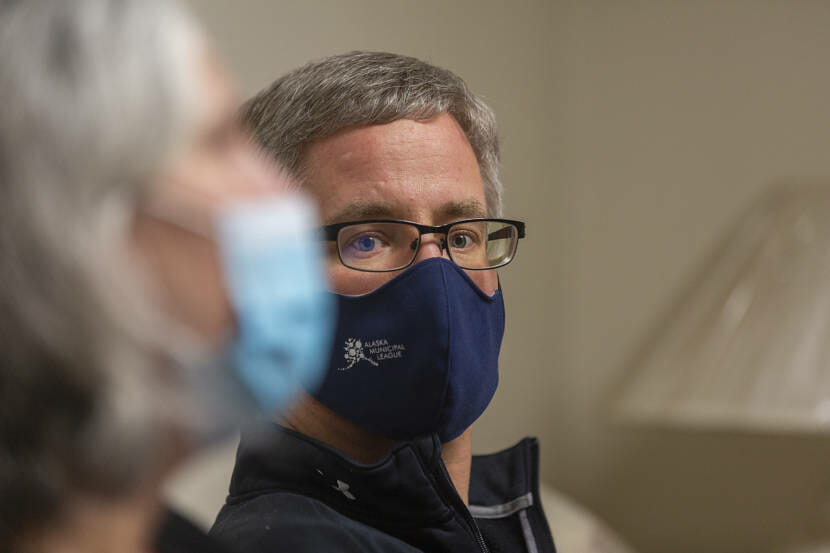
Mayor Doug Olerud looks at interim Borough Manager Alleka Fullerton during a press briefing on Sunday, Dec. 6, 2020, in Haines, Alaska. (Photo by Rashah McChesney/KTOO)
Haines mayor Douglas Olerud has tested positive for COVID-19. He says he was asymptomatic at first but experienced light symptoms when he went into quarantine over the weekend.
Olerud said he tested positive on Friday after taking a routine rapid test before visiting the Haines SEARHC clinic.
“I was asymptomatic at the time, and so I had no way of knowing,” he said. “So I was glad that they made me test before going inside, so I was able to find out.”
Olerud confirmed that he’s not vaccinated but declined to explain his reasons. He says when he got the positive result, he was worried about getting sick.
“There’s two parts. Part of it is like, OK, I’m gonna have a few days to rest and recover from this,” he said. “Also, there’s a little bit of anxiety. Anytime you get a diagnosis of anything, you’re hoping you’re in the mild symptoms, rather than one of those that needs to be medevacced out of town and into the hospital. So far, luckily enough, I happen to have those lighter symptoms, which I’m very thankful for.”
He said he was isolating for the required five days and experiencing some symptoms.
“I’ve been feeling really good. Friday night, I had a headache and sore throat, and that went through Saturday. But since I woke up on Sunday morning, I’ve been feeling about 90%. So, feeling pretty good and very, very fortunate,” he said.
Haines is in the midst of a COVID-19 surge, with state public health reporting at least 55 new positive cases over the last two weeks, from Jan. 10-24.
Since March 2020, Haines has had 364 reported cases, three hospitalizations and one death. Haines does have a higher than average vaccination rate, with 66% of the eligible population ages five and above having received the first vaccine series. That’s 9% higher than the statewide average. Just over a third of eligible Haines residents had received their boosters as of Jan. 24.
“I think the odds were that I was gonna get it at some point,” Olerud said.
He says he believes this is his second round of COVID, after experiencing some symptoms during the last large COVID-19 outbreak in Haines last August. He said he felt sick at the time but never tested positive.
“But ever since then, I just really haven’t had the level of energy that I’ve normally had,” he said. “And so there’s a possibility that I could have already been having some of those long COVID symptoms, but they didn’t really have a way to test to find out if that was something there or not.”
He says the lingering loss of energy hasn’t prevented him from any daily activities, so he’s not too concerned, but it’s something he’s monitoring.
In addition to mayoral duties, Olerud is co-owner of Olerud’s Market and active in the retail operations there. He said he alerted close contacts immediately.
Olerud said he is able to conduct borough business from home via Zoom, as have other borough employees who have tested positive. That’s excluding the 911 dispatch team who tested positive earlier this month but elected to continue working.
Olerud said he does not have an estimate of the number of borough staff impacted by COVID-19, but so far he says it hasn’t affected borough operations.
“The ones that have gotten it have been able to work off site,” Olerud said. “There were some issues with dispatch, and none of them were sick enough that they weren’t able to come in — and very thankful that they were willing to work through being sick and take extra precautions, locking down the dispatch room and things like that. So they would be able to continue providing that service.”
He says contracting COVID-19 has not significantly changed his thinking or approach about the virus or current community outbreak.
“Each of us has a responsibility to do the best we can, talking to our doctors figuring out what our individual risk is for COVID, and making sure we’re healthy,” Olerud said. “And then on top of that, also remembering that there are a lot of people in our community that might have different health risks than we do personally. And so when we’re making our choices, you obviously look at yourself first, but then we have to look at the community as a whole. And how are our actions impacting those around us and trying to make the best choices to protect the vulnerable people in our community as well.”
Olerud says he plans to isolate until Thursday, and take a rapid COVID-19 test before leaving quarantine.
The Haines Borough Assembly meeting has been moved to Zoom only this week, it’s scheduled for 6:30 p.m. Tuesday.
Close
Update notification options
Subscribe to notifications
Subscribe
Get notifications about news related to the topics you care about. You can unsubscribe anytime.


9(MDEwMjQ0ODM1MDEzNDk4MTEzNjU3NTRhYg004))