Family

To Help Newborns Dependent On Opioids, Hospitals Rethink Mom’s Role

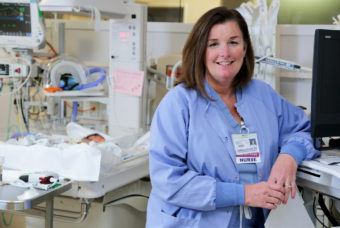
Carolyn Rossi, a registered nurse at the Hospital of Central Connecticut, says the opioid epidemic has required nurses who used to specialize in care for infants gain insights into caring for addicted mothers, as well. Rusty Kimball/Courtesy of Hartford HealthCare
Carolyn Rossi, a registered nurse at the Hospital of Central Connecticut, says the opioid epidemic has required nurses who used to specialize in care for infants gain insights into caring for addicted mothers, as well.
Rusty Kimball/Courtesy of Hartford HealthCare

Carolyn Rossi has been a registered nurse for 27 years, and she’s been fiercely protective of infants in her intensive care unit — babies born too soon, babies born with physical and cognitive abnormalities and, increasingly, babies born dependent on opioids.

As clinical manager of the nurseries at the Hospital of Central Connecticut, Rossi works in the neonatal intensive care unit. Like many hospitals across the country, the facility near Hartford has seen a dramatic rise in recent years in the number of babies born with neonatal abstinence syndrome. The National Institute of Drug Abuse reports that more than 21,000 infants born in the U.S. in 2012 (the most recent year for which data are available) experienced symptoms of opioid withdrawal. The hospital says each such baby in its care costs roughly $50,000 to treat.

These fragile and fitful newborns present new challenges for hospitals. Some research suggests the children do best when they can be held for hours at a time, preferably by their mothers, in quiet, private rooms, as they go through the process of being weaned off the drugs.

But delivering care that way requires changing the attitudes of many doctors and nurses about addiction.

Rossi, for example, says her initial training in the best ways to care for newborns in withdrawal was very different from what the research now suggests.

“You know, we looked at it like, ‘They are drug addicts and the baby is born a drug addict and we’re trying to protect the baby from the mother,’ ” Rossi says. “Like we were going to cure the baby, but not cure the mother and the family. So it was a lot about taking babies away from moms.”

That turns out not to be a useful strategy if you’re hoping to engage the help and support of a mother who already feels stigmatized by her drug habit, says Kate Sims, who directs women’s and children’s services at the hospital.

“She’s feeling guilt herself,” Sims says. “And then [she] comes in here and, unfortunately, as best as we are as providers and nurses, we’re also judgmental. And so it’s felt.”

A lack of trust between mother and a nurse makes treating the baby even harder, Sims says.

So the hospital is now trying to make sure everyone in patient care sees the addicted mother first as a mom. In some cases that means getting care providers to understand that addiction isn’t a moral failure, and that many people who are addicted come from a lifetime of trauma. Rossi says it’s been hard for nurses who have been trained to be baby specialists to become mom specialists, too.

“It’s a big culture change for me personally, and I know for the NICU nurses that are in here,” she says. “You really do believe you’re doing the right thing until something like this comes along.”

The hospital’s approach to caring for these infants is changing, in other ways, too. Dr. Annmarie Golioto, chief of pediatrics and the head of the hospital’s nursery, says a bright, loud and bustling intensive care unit is a hard environment for a baby going through withdrawal. So she’s gotten approval to use a few rooms just outside the intensive care unit as a quiet, monitored space for a baby and mother to stay for as long as the baby needs it.

“We’ve had to figure out: ‘How can we use our rooms differently?’ ” says Golioto. “How can we use our space differently? And how we can partner with mom differently to have that relationship with her, to say, ‘We expect you to stay here with your baby and take care of the baby after you’ve been discharged.’ ”

Golioto hopes the new setting will shorten recovery times for the children and decrease the amount of morphine a baby needs to ease withdrawal. She’s also hopeful these moves will inspire some mothers to think differently about their newborns.

“The thinking was, ‘My baby is being taken care of. There are nurses there. There are doctors there. I don’t need to be here. They’re getting everything they need,’ ” says Golioto. “We’re trying to change the thinking — ‘no, they’re not getting everything they need if you’re not here. Because they need you.’ ”

Rossi says she recognized the value in this new nursing approach the very first time she saw it in action. It was last December, she recalls. Rossi gave a mother a hospital room to stay in for more than a month while her baby went through withdrawal.

“She was just thrilled,” Rossi says. Though the mother couldn’t be at the hospital 24/7, “she was here as much as she could be,” the nurse says, “and just knowing that she had the flexibility helped me understand that she is a mom. She is a great mom. She wants to be a better mom.”

Nearly every aspect of the opioid epidemic worsened in 2014, according to the federal government’s latest figures. And even though the Hospital of Central Connecticut’s programs are just a few months old, health care workers there hope the changes they’ve made in their culture of care will, at the very least, give vulnerable moms and babies a better start.

This story is second in our four-part series Treating the Tiniest Opioid Patients, a collaboration produced by NPR’s National & Science Desks, local member stations and Kaiser Health News.

Parent Support May Help Transgender Children’s Mental Health

Sophie plays in her backyard in Bellingham, Wash. Her mother says she started objecting to being identified as a boy around age 2. Ian C. Bates for NPR
Sophie plays in her backyard in Bellingham, Wash. Her mother says she started objecting to being identified as a boy around age 2.
Ian C. Bates for NPR

Six-year-old Sophie says she has always known she’s a girl. “I used to be Yoshi,” she says. “But I didn’t like being called Yoshi.” And she didn’t like being called a boy.

Sophie lives with her family in Bellingham, Wash. Her mother, Jena Lopez, says she started seeing the signs before Sophie turned 2.

“She’d say things like, ‘I’m a she, not a he,’ ” Lopez says. “She would cry if we misgendered her. She’d become angry.”

Sophie’s parents didn’t know what to do. They didn’t know if this was just a phase, and they knew the statistics for transgender people are grim. Nearly all the research into transgender mental health shows poorer outcomes. Attempted suicide rates are nine times higher than for people overall, and rates of depression and anxiety are higher, too. But Sophie convinced them. “I proved it,” she says.

There’s very little data on children who have fully socially transitioned, says Kristina Olson, an associate professor of psychology at the University of Washington. Olson got interested in the subject when a friend’s 10-year-old was transitioning from male to female. Olson knew attitudes about transgender people were changing, both in society and in science.

“Forty years ago everyone considered this to be a pathology,” Olson says. It was considered a “gender identity disorder” until 2013, when it was changed to “gender dysphoria” in the fifth edition of the DSM, the diagnostic manual for mental health.

Olson says a lot of research still works under this assumption and is based on children in clinical settings where they’ve often been brought to be treated.

Sophie says she likes being a kid and "that I get to be Sophie." Ian C. Bates for NPR
Sophie says she likes being a kid and “that I get to be Sophie.”
Ian C. Bates for NPR

“So I had no idea, based on the literature, what impact my friend’s decision would have on her child’s life,” Olson says.

That’s especially important, since what research there is paints such a bleak picture. But it’s not clear what’s the cause of mental distress for transgender people. It could be due to internal factors, such as gender dysphoria, the tension resulting from having a gender identity that differs from the one assigned at birth. Or it could be due to external factors, such as discrimination and lack of support. As Tara Haelle reported last month in Shots, researchers are just starting to try to figure that out.

So Olson decided to do her own study looking at families who are supporting their child’s decision to live as a gender different from their biological sex. The study, published in the March issue of Pediatrics, looked at the mental health of 73 transgender children between ages 3 and 12. What it found was strikingly different from other research.

“They had exactly the national average for depression,” says Olson. “They are no more or less depressed. They show a marginal, like, a tiny bit of an increase in anxiety, but nowhere near the rates that previous work has found.”

The study can’t make a direct connection between the healthier outcomes and parental support, but Olson says it shows that the struggles that have been reported by people who transition aren’t inevitable. Olson plans to follow the children to see what happens as they grow older. Adolescence is a time when many mental health problems emerge, and no one knows what will happen with these children over time.

There is a desperate need for research in this field, according to Dr. Aron Janssen, clinical assistant professor, Department of Child and Adolescent Psychiatry at NYU Langone’s Child Study Center. “It’s incredibly refreshing to have this little bit of good news, because I’ve seen in my work a lot of these kids with really positive outcomes. And their stories aren’t often the stories that are told,” Janssen says.

Jena Lopez with her daughters Sophie, left, and Nora. Research suggests that parental support is the key to good mental health in children who transition. Ian C. Bates for NPR
Jena Lopez with her daughters Sophie, left, and Nora. Research suggests that parental support is the key to good mental health in children who transition.
Ian C. Bates for NPR

The more common stories are of transgender people who are not supported and face discrimination that can lead to problems at school and at work, as well as poverty and increased risk of substance abuse

The hope is that if Sophie’s gender identity is validated early on, she will be less vulnerable to mental health issues. Her mother says that rings true for her family. “She’s blossomed,” Lopez says.

Sophie says: “I like being a kid.” And she likes “that I get to be Sophie.”

Copyright 2016 KPLU-FM. To see more, visit KPLU-FM.

Paid Family Leave Advocates Celebrate A Big Week, But The Battle’s Not Over

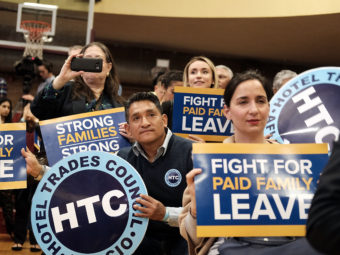
Supporters watch as New York Gov. Andrew Cuomo speaks to promote his paid family leave initiative at a rally in Manhattan on March 10. Spencer Platt/Getty Images
Supporters watch as New York Gov. Andrew Cuomo speaks to promote his paid family leave initiative at a rally in Manhattan on March 10.
Spencer Platt/Getty Images

It’s been a big week for supporters of paid family leave.

The city of San Francisco and the state of New York took groundbreaking steps toward new and more generous leave policies. Advocates hope the moves will create momentum in other places that are considering similar measures.

“I do believe this will pave the way for other states,” says Dina Bakst, the co-founder of A Better Balance, a nonprofit in New York that advocates for family-friendly policies in the workplace.

“What we’ve seen in other fights, like paid sick days and our fights for pregnancy accommodations — it starts local and then it sweeps the nation,” Bakst says. “I think we’re on the paid family leave wave.”

Starting in a few years, workers in New York state will be able to take 12 weeks of partially paid family leave to care for a new child or an ailing parent. That gives New York the most generous family leave benefits of any state in the country.

“We are restoring respect and pride and dignity to the worker with paid family leave,” Gov. Andrew Cuomo said at a rally Monday, “which says no one should choose between seeing their child born and earning a paycheck.”

The following day, San Francisco’s board of supervisors approved a bill guaranteeing most workers six weeks of paid leave at their full salaries.

Both measures go far beyond what federal law requires. The Family and Medical Leave Act mandates that employers offer their workers 12 weeks of leave. But it’s unpaid. And even that doesn’t apply to many part-time workers.

A few states are more generous and will pay employees roughly half of their salaries for up to six weeks. That idea is now being debated in several other places, including Massachusetts, Connecticut and Washington, D.C.

Paid family leave would have been a big help for Rob and Mandy Keithan. Their daughter, Eleanor, was born prematurely last year, seven weeks before her due date. Neither parent had a job that offers paid family leave to care for her.

Mandy and Rob Keithan had to take turns to take care of their baby Eleanor when she was born. Neither of them had a job that offers paid family leave. Marisa Penaloza/NPR
Mandy and Rob Keithan had to take turns to take care of their baby Eleanor when she was born. Neither of them had a job that offers paid family leave.
Marisa Penaloza/NPR

“So that’s seven additional weeks that we have to deal with,” says Rob Keithan. “And just make the constant evaluation of, what’s the cost of spending time with our baby?”

The Keithans had to take turns staying home from their jobs to visit Eleanor in the intensive care unit and then care for her when she came home.

“We had to calculate every day, every week, every month: Is this something that we could afford to do?” says Mandy Keithan. “When it felt like on the deepest level, being with her was where we needed to be. And it’s a terrible thing to have to put a price tag on.”

Still, some business leaders worry about how much paid family leave will cost them.
“For small businesses, this really is a hardship,” says Zack Hutchins, director of communications at The Business Council of New York State. He points out that New York just adopted a paid leave period that’s twice as long as that of any other state. The money to pay for it will come mostly from a tax on employees, not employers. Still, Hutchins says there may be hidden costs when the new law takes effect, starting in 2018.

“There’s the very real cost of trying to obtain replacement employees [and] train those employees,” he says. “And that’s going to fall heaviest on small employers and small businesses.”

Many employers are already flexible about giving their workers time off when they need it, Hutchins argues.

But family leave advocates say that’s rarely the case for low-income workers who need paid leave the most. They say there’s no other developed country in the world that handles family leave like the U.S. does.

“It is an embarrassment for the United States,” says Ellen Bravo, director of the nonprofit Family Values @ Work. “Our minimums are in fact minimal, compared to what people need, and what the rest of the world does.”

Bravo says the recent victories for paid family leave are encouraging. But she says there’s still a long way to go.

Copyright 2016 NPR. To see more, visit http://www.npr.org/.

Juneau rallies for hope amid heroin crisis

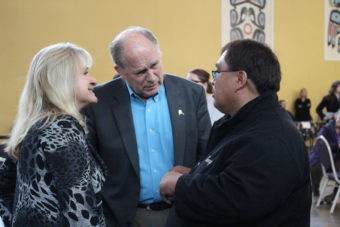
The governor and first lady Donna Walker talk to people at Hope, Not Heroin. (Photo by Elizabeth Jenkins/KTOO)
First lady Donna Walker and Gov. Bill Walker talk to a man at Saturday’s Hope, Not Heroin event. (Photo by Elizabeth Jenkins/KTOO)

The Juneau Police Department recently held an event to bring people and service providers together called Hope, Not Heroin. Alaska lawmakers were there, as well as Gov. Bill Walker. And for some in the crowd, the event signified how communities are changing the conversation when it comes to talking about addiction.

Hope, Not Heroin started off with a Juneau firefighter describing how he uses Naloxone, also known as Narcan, in the field.

“Giving Narcan, we want to make sure that they are actually overdosing on an opiate,” he told the crowd. 

It’s an emergency drug that can save a person dying of an overdose. And it won’t be just emergency responders administering it anymore. Since the legislature passed Senate Bill 23, some Alaska pharmacies could start carrying it as early as the summer. Family members or friends could have access to the drug.

That’s one of the reasons why 19 year-old Nichelle Williams said she wanted to be here: Naloxone saved her life.

“I just came out of treatment from a heroin overdose. And so I came here to help support the bill and everything that’s going on with the heroin stuff,” Williams said.

Williams is exactly who this event is for. Around the room, there are about 31 booths with information about addiction, recovery, even proper syringe disposal. But for such a heavy topic, the atmosphere is light. There’s folky music and a food truck selling pizza.

Rick Hanby is sitting around a table with his wife and kids. He said they decided to come because they’ve known someone who’s struggled with opiate use.

“I think sooner or later, or one way or another, it affects somebody, everybody here. It affects our community. So this is a really good start to get everyone to start thinking and start talking about it,” Hanby said.

Lt. Kris Sell said it’s not common for police departments to organize an event like this. But over the past six months, they’ve tried to use other tactics to reduce heroin use. For decades, she said police across the country focused on the narcotics supply in the War on Drugs.

“And so now we’re acknowledging that it’s the demand that fuels this problem,” Sell said.

Event goers watch the governor's speech at Hope, Not Heroin. (Photo by Elizabeth Jenkins/KTOO)
Event goers watch the governor’s speech at Hope, Not Heroin. Sen. Johnny Ellis, who helped craft SB 23, also attended. (Photo by Elizabeth Jenkins/KTOO)

Seven people died in heroin-related deaths in 2015. This year, there’s been one. And Sell thinks, overall, 200 people in Juneau use heroin on a daily basis.

“Doubling to about 400 during the summer when we get in highly paid seasonal workers, like in the fishing industry. Some of the tourist industry,” Sell said.

So, for those struggling with addiction who want to get help, she said it can be difficult to navigate what treatment options are available. Unfortunately, in Juneau, the answer is not a lot.

Mitzi Privett, the interim director at Rainforest Recovery Center, said typically, they have some beds available for in-patient detox.

“Recently, we’ve been very full,” Privett said. “And so if someone came in that needed help right away, it would be much harder to serve them. If we had more options, we could say, ‘We’re not available to help but let us refer you to somebody who is.’”

Nichelle Williams was one of the people who was able to get in after her heroin overdose. But she thinks Juneau should have more options. Recently, her friend overdosed and died before she could get help.

“And it was really hard, and she didn’t have the option of treatment because when she went into the hospital, they were like, ‘We can’t help you,'” Williams said. “That’s how most people die in Juneau, if they want help and they try to get help, the hospital can’t help them detox.”

With her recovery, Williams said seeing support — like Saturday’s event — has been huge. But there’s still room for growth when it comes to educating people about addiction.

“When people call me a junkie or something, it makes me feel degraded,” Williams said. “I’m a normal human being. I just have an issue. Just the labeling, it really gets people down. It really does.”

While Juneau waits for more addiction treatment, Williams said there’s something else the community can do to help: be positive and keep the conversation going.

House passes foster care improvement bill

The Alaska House passed a foster care improvement bill Friday afternoon. Under the new legislation, the state would put a stronger focus on finding foster children permanent homes and prioritize placing them with relatives when possible.

One provision of the bill requires the court system to that Office of Children’s Services workers do their best to find long-term homes for children. The goal is to get the children a permanent placement within one to two years of entering foster care. At the moment, more than 700 children in Alaska are looking for permanent homes — a much higher number than in other states.

Rep. Les Gara, D-Anchorage
Rep. Les Gara, D-Anchorage.(Photo by Skip Gray/360 North)

“This bill aims to give people a better chance to succeed through our foster care system, without damage, without being bounced between 10, 20, 30, 40 or 50 homes,” said bill sponsor Anchorage Rep. Les Gara during the discussion. “That in itself is neglect and abuse. The same neglect and abuse we’re trying to prevent, just in a different form and an institutional one.”

OCS will also continue to seek relatives of the children past the currently mandated first 30 days of out of home care. Research shows that children are more successful when placed with family or close friends. The bill also encourages more collaboration between OCS and Alaska Native groups.

Other parts of the bill provide that children will stay in the same school even if they move to a different placement, so long as the school is in the same municipality and it’s in the best interest of the child. Switching schools midterm has shown to set students back multiple months.

Though the bill passed unanimously, some representatives had reservations. Anchorage Rep.Lance Pruitt shared a story about trying to help a young boy in foster care and seeing all of the problems the child faced. He said the bill didn’t do enough.

“There really is a broken system. An OCS system that’s broken. And the management of it is not being done appropriately.”

Others mentioned that foster care is reactive, and the government should instead be focused on prevention and treating societal problems, like substance abuse.

Gara says the bill creates tools to address some of the current problems but more needs to be done.

The bill now goes to the Senate.

Demand Surges for Addiction Treatment During Pregnancy

Makenzee Kennedy is groomed by nurse Megan Kelly in a special unit for weaning newborns off heroin and other opioids at North Baltimore’s Mount Washington Pediatric Hospital. The number of newborns suffering from opioid withdrawal symptoms has skyrocketed in the last five years. Getty Images

BOSTON — As soon as the home pregnancy test strip turned blue, Susan Bellone packed a few things and headed straight for Boston Medical Center’s emergency room. She’d been using heroin and knew she needed medical help to protect her baby.

“I felt so guilty. I still do,” said Bellone, a petite, energetic woman. At 32, and six years into her heroin addiction, having a baby was the last thing on her mind. “I was not in the right place to start a family,” she said. “But once it was happening, it was happening, so I couldn’t turn back.”

Nationwide, the number of pregnant women using heroin, prescription opioids or medications used to treat opioid addiction has increased more than five-fold and it’s expected to keep rising. With increased opioid and heroin use, the number of babies born with severe opioid withdrawal symptoms has also spiraled, leaving hospitals scrambling to find better ways to care for the burgeoning population of mothers and newborns.

Among the most important principles is that expectant mothers who are addicts should not try to quit cold turkey because doing so could cause a miscarriage. Trying to quit opioids without the help of medications also presents a high risk of relapse and fatal overdose.

Until the opioid epidemic took hold about eight years ago, most hospitals saw only one or two cases a year of what is known as neonatal abstinence syndrome. Now, a baby is born suffering from opioid withdrawal every 25 minutes in the U.S., according to the National Institute on Drug Abuse.

When a pregnant woman uses drugs or alcohol during pregnancy, some of the substances travel through the placenta to the baby. In many, but not all, cases, exposure to opioids during pregnancy can cause the fetus to develop physical drug dependence. When the umbilical cord is cut at birth, the newborn is abruptly disconnected from its supply of opioids and can suffer withdrawal symptoms.

When Bellone rushed to the emergency room six years ago, she didn’t know she’d gone to one of the best places in the country to receive addiction treatment during pregnancy.

At Boston Medical Center in the city’s South End, heroin addiction during pregnancy is not new. A specialized team of obstetricians, addiction medicine providers and counselors known as Project RESPECT has been treating pregnant drug users here for more than 30 years.

Now, dozens of hospitals and health clinics are gearing up to provide the same kind of specialized treatment for a rapidly rising number of pregnant drug users and their newborns

Demand Surges for Addiction Treatment During PregnancyAlthough painful, newborn withdrawal symptoms, which include muscle cramps, tremors, diarrhea, vomiting, sleep problems and sometimes seizures, are not life threatening and have not been shown to cause health problems or developmental deficiencies later in life. The condition can be treated with small doses of morphine and subsides within a one to three weeks.

Methadone and Buprenorphine

As an epidemic of opioid and heroin addiction continues to ravage the nation, affecting at least 2.5 million people, hospitals and obstetrical practices nationwide have begun collaborating with addiction specialists to find the best way to treat women for their addiction while providing the safest care for their babies.

“Addiction specialists are terrified of treating anyone with a baby inside, and obstetricians are terrified of getting into addiction medicine,” said Dr. Ronald Iverson, of the Massachusetts Perinatal Quality Collaborative. But as demand for prenatal care for opioid-dependent women skyrockets, hospitals and private practices are increasingly offering combined addiction treatment and obstetrical services, so that pregnant women can see both specialists in one appointment.

Last year, a federal law was enacted — the Protecting Our Infants Act — authorizing the U.S. Centers for Disease Control and Prevention (CDC) to work with states to collect data on the prevalence of babies born with opioids in their bloodstream. It also calls on the U.S. Department of Health and Human Services to develop recommendations for the best way to prevent and treat drug use during pregnancy.

For now, here’s what major medical organizations — including the American College of Obstetricians and Gynecologists, the American Society of Addiction Medicine and theAmerican Academy of Pediatrics — agree on:

The standard of care for pregnant women using prescription painkillers or heroin is maintenance treatment with opioid addiction medications methadone or buprenorphine. Abstaining from drugs without medication is not recommended because of the high risk to the mother of relapse and overdose.

Although methadone and buprenorphine expose the fetus to low doses of opioids, the risk to the newborn of withdrawal symptoms is far outweighed by the risk of a fatal overdose when pregnant women receive no treatment or attempt to abstain from drugs without medication.

Abruptly quitting opioids in the first and third trimesters of pregnancy can cause harm to the fetus, including miscarriage and stillbirth, and is not recommended. Even in the second trimester, specialists agree that the risk of relapse outweighs any potential benefit to the fetus of lowering the dose of addiction maintenance medications or discontinuing their use.

Advocates for newborns, including the March of Dimes, agree with major medical organizations on the use of opioid treatment medication. But they argue more data and better research are needed to determine the best approach to treating opioid addiction during pregnancy.

“With pregnant moms, we’re weighing the high risk of death from overdose against the risk to the newborn of treating pregnant women with low dose opioid maintenance,” said Dr. Siobhan Dolan, medical adviser to the March of Dimes. With more research, she said, “we would be in a better position to consider abstinence and behavioral health counseling for some women.” And that could result in healthier babies.

According to the most recent data from the CDC, the number of opioid and heroin overdose deaths shot up by 14 percent between 2013 and 2014, killing more than 28,000 people, more than 10,000 of whom were women.

Demand Surges for Addiction Treatment During Pregnancy

Fear and Misinformation

Most women who come into Boston Medical Center for drug treatment and prenatal care do so early in their pregnancy, said Dr. Kelley Saia, who heads Project RESPECT’s team that now treats about 250 patients at any given time, triple the number it did 10 years ago.

“They are so smart and so tuned into what they’re going through,” Saia said. “But they feel incredible guilt about taking medication during pregnancy and they worry about what their babies will go through.”

When Bellone arrived at Boston Medical she was ready to quit heroin. She’d done it before. “I wanted to stop everything. I didn’t even want to be on Subutex [a form of buprenorphine], but they said I might miscarry.”

On top of the normal worries about going through a pregnancy and becoming a parent, women with a drug habit worry about getting reported to child protective services. Massachusetts requires hospitals to report all babies born with opioids in their bloodstream to the state’s child welfare agency.

In many other states, doctors are required to report their patients to child welfare agencies before their babies are born, said Farah Diaz-Tello, an attorney with National Advocates for Pregnant Women, which advocates for the civil rights of drug-using women. In three states — Alabama, South Carolina and Tennessee — women can be prosecuted for child endangerment if they are reported using drugs during pregnancy. (The Tennessee law will not be in effect after July 1.)

Diaz-Tello and others say this threatens the health of women and their babies. Women need to feel safe so they don’t have to hide their drug use when seeking prenatal care or not seek care at all, she said.

Bellone said she wasn’t concerned about getting reported to child protective services because she knew she was doing the right thing. “If I wasn’t ready to quit I would have been worried,” she said. “But I knew five years before I got pregnant that I didn’t want to lead that life. I needed help and didn’t know where to go.

“It was almost like it took me getting pregnant to find help. It was hard to get into any place. There were no beds. But once you got pregnant it was instant, people were willing to help.”

Bellone’s pregnancy and her addiction treatment went smoothly. She delivered twin girls, Gemma and Mischa, on Aug. 3, 2010. They had to stay in the hospital for three weeks, but they’ve been healthy since they came home.

Perched on her chair sipping a huge to-go cup of iced tea in one of the hospital’s private consultation rooms, Bellone passed around photos of the twins jumping on their bed. Gemma, the oldest by seven minutes, just lost a tooth. “She pulled it out herself. She was very brave,” Bellone said.

Nearly six years after their birth, Bellone is still in recovery. She’s taking buprenorphine, making monthly visits to her addiction doctor and attending group meetings two times a week. She’s also working full time as a cook at a nursing home. “I’m tired a lot, like anyone with twins would be,” Bellone said. “People think I’m lying, but I never think about using.”

Read original article – March 25, 2016
Demand Surges for Addiction Treatment During Pregnancy

Site notifications
Update notification options
Subscribe to notifications