Family

Babies Who Eat Rice Cereal Have Higher Arsenic Levels, Study Finds

A new study finds that babies fed rice cereals and other rice-based snacks have higher concentrations of arsenic in their urine. iStockphoto
A new study finds that babies fed rice cereals and other rice-based snacks have higher concentrations of arsenic in their urine.
iStockphoto

When it comes to introducing babies to solid foods, rice cereal is often first. And rice is a staple in many baby and toddler foods.

But, as we’ve reported, multiple studies have found that rice-based foods contain traces of arsenic, and sometimes levels are surprisingly high.

Now comes a new study published in JAMA Pediatrics that finds babies who are fed rice cereals — and other rice-based snacks — have higher concentrations of arsenic in their urine compared with infants who are not fed rice.

“The highest arsenic concentrations were among those who consumed infant rice cereal,” says researcher Margaret Karagas, an epidemiologist at Dartmouth’s Geisel School of Medicine. “Among those [babies] who ate rice snacks, levels were about double [that of] non-rice eaters.”

The study was based on data from the New Hampshire Birth Cohort Study. The researchers analyzed the eating habits of about 750 infants of mothers enrolled in the study.

“We knew rice cereal was a common first food, but we didn’t really know how common it was or what age it was introduced,” Karagas says. The study found that, by age 1, about 80 percent of babies had been introduced to rice cereal, usually starting at 4 to 6 months. “We were surprised by the number of infants consuming rice products,” Karagas says.

The potential health effects of regularly consuming infant rice cereal — and other rice-based products —containing traces of arsenic are unclear. But the authors write in their paper that “emerging epidemiologic evidence suggests that [arsenic] exposure in utero and during early life may be associated with adverse health effects” on immune system and brain development.

Earlier this month, the Food and Drug Administration proposed a limit of 100 parts per billion for inorganic arsenic in infant rice cereal. Inorganic arsenic is the type that public health officials worry about the most.

“Our actions are driven by our duty to protect the public health and our careful analysis of the data and the emerging science,” Susan Mayne, director of the FDA’s Center for Food Safety and Applied Nutrition, said in a statement on the proposed limit.

The FDA’s statement points to research that links exposure to inorganic arsenic early in life to decreased performance on certain developmental tests.

The FDA tested 76 samples of infant rice cereals from retail stores for concentrations of inorganic arsenic. The agency found that about half of the samples contained levels of inorganic arsenic that were higher than 100 ppb, but most exceeded the proposed limit only slightly.

So, what advice does the agency have for parents? Rice doesn’t need to be the only — or first — source of grain in your baby’s diet, the FDA says. Other sources include oats, wheat and barley.

“For toddlers, provide a well-balanced diet, which includes a variety of grains,” the agency says.

This advice is seconded by the American Academy of Pediatricians. A wide variety of foods “will decrease [a] child’s exposure to arsenic from rice,” concludes the AAP’s advice to parents. And as the AAP notes, other foods — like finely chopped meats or vegetable purees — “are equally acceptable as a first food.”

Copyright 2016 NPR. To see more, visit http://www.npr.org/.

Reuniting families with community support

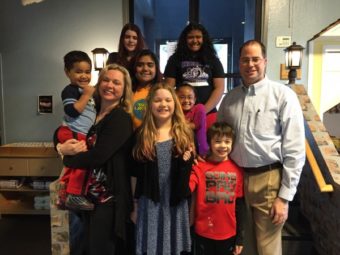
Princess Taala (center, orange shirt), Crystal Stone (front left) and their family. (Photo by Hillman/KSKA)

For most children who enter foster care, the ultimate goal is to reunite them with their families. But getting to that point takes a lot of work. Parents have to follow case plans set up by the Office of Children’s Services and meet requirements like getting substance abuse treatment.

Parents also need to maintain relationships with their children and sometimes that requires a little community support.

Princess Taala entered the foster care system two and a half years ago. The 14-year-old says she was upset about it, but she understands why it happened.

“There was some neglecting issues and physical abuse and emotional and verbal abuse. And I understood it wasn’t healthy for anyone to be in those kind of situations,” she recalls. “When I was little my dad abused my mom, so it was kind of a chain reaction.”

Princess lounges on the couch of a large playroom filled with a mock stage, toys, books, food — anything that helps families interact. It’s a space run by a local Christian nonprofit Beacon Hill to give foster children a place to visit with their parents. Six other children zip around Princess, asking her questions and some jumping on her lap. She keeps talking about a pretty rough topic, completely unfazed. No one in her first four foster homes would probably guess she could be so forthright.

“In my other foster homes, I would never utter a word other than ‘yes,’ ‘no,’ or ‘thank you.’ Just those simple answers.”

Now she chats with her mom and her siblings and her new extended family, the Stones.

“I would say there was an instant connection between the children. It was really fun,” says Crystal Stone. She first met Princess when she started volunteering with Beacon Hill.

Here’s the idea behind the organization: many families that get involved with OCS don’t have healthy support networks. No one intervenes when there is a crisis, and so the situation becomes unsafe for the children. At Beacon Hill, they want to help parents build those networks so when they are reunited with their children, they’re more likely to stay together. The Stones decided to volunteer with Beacon Hill just to befriend Princess and her family, but the relationship grew quickly because they had so much in common.

“Music, our faith,” she lists. “Birthdays. Ages of the children. Interests that the children enjoy. Dance. I mean, a lot of it.”

After about a year, Princess’s two youngest siblings were also taken away from their mom. Instead of them going to an unfamiliar foster family, they went to live with the Stones.

Madison, the Stone’s oldest daughter, says the transition wasn’t always easy. “You don’t get a lot of attention. That’s for sure. Sometimes you like it because they’re not always on you. But other times when you want help with things or you want to talk, you kinda have to wait your turn.”

But Crystal says they make it work by showing all of the children love and making them feel like a giant family. But they also ensure that Princess’s siblings remember their mom. They put up photos of her and the older siblings. They sing songs about weekly visiting days.

“You don’t want to talk bad about the other parent because that doesn’t help that child,” Crystal says. “That doesn’t build them up or help them feel secure. You want to be as fair as possible.”

She’s interrupted by her son, Prince, Princess’s little brother. The 5-year-old grabs onto Crystal for a kiss before running off to see his biological mom and plays with his two sets of siblings.

The families are going through a transition. Princess and her 10-year-old sister are back with their mom, and Princess says she’s thrilled to be home.

“It was fun,” she says of her first night back. “The first thing I did was grab all my stuff and put it in her room and spend the night with her because I haven’t cuddled with her in a long time.”

The younger two, who live with the Stones, may have overnight visits with their mom and siblings soon. Crystal says she’s happy they’ll be reunited, but after more than a year together, it’s an emotional change for all of them.

“So we just talk about it. ‘This is hard. This is good. These are the pros and the cons and this is how we’re going to get through this.’”

Both families say this will not be the end of their relationship because, as Princess says, they rely on each other.

The Stones “help us in a lot of ways. They give my mom advice and they talk to her when she has no one to talk to. They’re like our second family.”

Princess says during her time in foster care, she needed a strong, solid connection with her mother. But through her bond with the Stones and other caring adults, now she realizes that family extends beyond blood. It includes those who support and encourage you when you feel like no one else will.

How Talking Openly Against Stigma Helped A Mother And Son Cope With Bipolar Disorder

LA Johnson/NPR
LA Johnson/NPR

It was December 2012 when the country learned about the massacre at Sandy Hook Elementary School, that left 20 children dead at the hands of 20-year-old shooter Adam Lanza.

After the shock and the initial grief came questions about how it could have happened and why. Reports that Adam Lanza may have had some form of undiagnosed mental illness surfaced.

The tragedy drove Liza Long to write a blog post on that same day, titled “I Am Adam Lanza’s Mother.” She wasn’t Lanza’s mom, but she was raising a child with a mental disorder.

Her 13-year-old son had violent rages on a regular basis. He was in and out of juvenile detention. He had threatened to kill her. She detailed all this in her essay that took off online.

Now, four years later, her son is speaking out too.

This week on For The Record: a mother, a son and life on the edge of bipolar disorder.

Eric Walton, Liza Long’s son, is now a 16-year-old high school sophomore in Boise, Idaho. After a series of misdiagnoses, he’s been diagnosed with bipolar disorder.

But four years ago, he didn’t know much about his condition.

“I knew that there were times when I would have rages, didn’t like them. I knew that I wanted them to stop,” Walton says.

Except he felt a loss of control in those moments. He describes the onset of these rages as a “blackout” of sorts.

“I would start getting angry,” he says. “Then it’s like being trapped inside a box inside your own head. It was like a television on the wall that shows you what you’re seeing. You can feel everything, but you no longer have the video game controller to control your own body.”

Walton’s mom says when Eric would get into those states, “he would express a lot of suicidal thoughts, and hearing him just say, ‘I want to die, I just want to end it.'”

Then, two days before the Newtown shooting, Eric Walton had another episode.

“It was a pretty eventful day, even for my rages,” Walton recalls. “I’d woken up and I’d slipped on a pair of navy blue sweats. But my school has this policy that you have to be wearing black pants. So my mom and I got into an argument over whether navy blue was actually black.”

The fight got bad and it escalated as it often did. Eric threatened to kill himself, and he threatened to kill his mom.

“At that point, we were almost to my school, but mom decided to take me to Intermountain [Hospital] instead,” he says, referring to the mental health facility in Boise.

“It took I think three or four of the nurses to hold me down,” he says. “They shoved a needle into my arm full of some kind of tranquilizer. And I woke up the next day in Intermountain.”

That day left Liza Long feeling “completely hopeless.”

“I really felt like a failure on that day,” she says. “Here I had this child, he had seen multiple doctors, multiple specialists, numerous medications. Nothing had helped my child, he had been in juvenile detention four times at that point, every time for a behavioral symptom of a brain disease,” she says.

Two days later, the news broke out of Newtown.

“I just put my head on my desk and started to cry,” Long recalls. “I just had this overwhelming sense of empathy for Nancy Lanza. I know at that point people were already blaming her, but instead I could just see in my mind this little boy who probably had needed help.”

She started writing about how tough it was to be the single mother of four kids, one of them a middle-schooler struggling with mental illness, a kid who could violently rage one hour, and turn back into a calm, sweet boy the next.

Days after she posted the essay on her anonymous blog and millions of shares later, the Huffington Post picked it up — and then it was everywhere.

Three days after she wrote the piece, she visited her son in the hospital and read it to him off her phone.

“It was very powerful piece,” he says. “I had seen it as only from my point of view, but until that day, I hadn’t considered what it was like for someone outside, looking in.”

She got messages of support, but she also got criticism. People laid into her for comparing her son to a mass murderer, violating his privacy, and some suggested that she was somehow responsible for her son’s condition. It stung, but for the most part she pushed it away.

“Mother-blaming is as old as Eve though, right, it’s really easy for us to blame mothers, and that was exactly the point I was trying to make,” Long says. “Families are suffering in shame and silence; I was suffering in shame and silence. So is my child. But when we don’t share our stories, there’s no chance that we’re going to make change.”

That could have been the end of the story, but that blog post ended up changing everything for Long and Walton.

Long was inundated with emails, as readers continued to reach out to her.

“One person was very persistent, and she kept saying ‘I know someone who can help,’ ” Long says.

That person was a research assistant who worked for Dr. Demitri Papolos, director of research for the Juvenile Bipolar Research Foundation.

After meeting and talking with Walton and his mother, Dr. Papolos understood Walton’s symptoms. It looked like a particular strain of bipolar disorder.

“The symptoms that occur within the manic domain are hyperactivity, agitation, racing thoughts, pressured speech,” Dr. Papolos says. “In the bipolar form, you see psycho-motor retardation, lethargy, fatigue, oversleeping, depressed mood.”

“Mania feels really, really good,” says Eric Walton. “But it’s also not that good because when you start moving at that speed, no one can keep up with you.”

On the flip side of the disorder, “I go through 3-4 days of almost complete inactivity,” he says. “I’m kind of depressed and lethargic, and I don’t even want to get out of bed.”

“They are overwhelmed with fear and they misperceive things as threatening when they’re not,” says Dr. Papolos.

Those symptoms check out with Walton. “Any time I felt attacked. It was like a defense mechanism type thing.”

After Dr. Papolos diagnosed Walton with childhood bipolar disorder, everything got better.

“I got the correct diagnosis. I got put on the right medication. And I haven’t had a rage, I think, since that day,” Walton says. “It’s funny, I don’t even keep track anymore.”

But the road to pinning down the diagnosis is often the hardest part, especially for parents, who often have to become psychiatric advocates for their children.

“The problem is that we are still relatively in infancy in terms of understanding the nature of psychiatric diagnosis, particularly in children,” Dr. Papolos says. “I think [parents] have to do a lot of homework on their own. I wish I had another answer, but it’s the way things are currently.”

Today, Eric owns his diagnosis. “I choose to think of it as my superpower.”

“I’m really, really creative. I’m very empathetic. I have a lot of skills that teenagers don’t normally have: conflict resolution, mindfulness — just things I’ve had to pick up over the years because it kind of helped control myself before the right diagnosis.”

His TED Talk in Boise early this month was the first time he outed himself publicly as the boy in that essay. And he used it to deliver a broader message:

“Mental illness should be treated with respect and kindness, not fear and stigma. People with mental illness are all human beings. And they deserve the same respect as anyone else.”

And it was his mother’s willingness to talk openly against mental stigma, a few years ago that helped him carry that message in the first place

“When I wrote that blog post, I was really concerned that my son’s fate was prison or worse, and now we are talking every day about college, about what he’d like to major in,” Liza Long says. “I don’t think there are any right or wrong answers for Eric. There just a lot of great opportunities for Eric.”

And her inbox is still overflowing.

I have a tremendous sense of gratitude honestly mostly for all the — I still hear from families every day, some who just found that blog post for the first time. And to be able to connect people with resources, to be able to say ‘look there is hope for you, don’t give up on your kid,’ that’s been really powerful for me.”

Copyright 2016 NPR. To see more, visit http://www.npr.org/.

Number of foster kids at record high, caseworkers overloaded

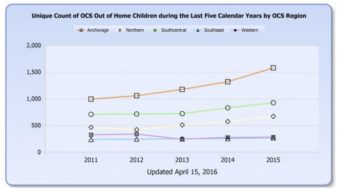
Number of foster kids at record high, caseworkers overloadedNearly 3,000 children are in out of home care in Alaska – an all-time high – and as a result, caseworkers are overburdened and can’t give foster kids or foster families the attention they need.

“If you give a worker twice as many cases as is reasonably able to be done, the entire system is going to suffer,” said Travis Erickson, the operations manager for the state’s Office of Children’s Services.

Erickson has been with the agency for 17 years and says the problem isn’t new. “I could have given the same speech five years ago, ten years ago, and 15 years ago. The only thing that’s different, really, is that we’re doing a better job at keeping children safe, and the system is being taxed harder than it has been probably ever.”

Erickson said multiple factors are driving up the numbers statewide. One is OCS is screening more reports of abuse to see if the government needs to intervene sooner. They are trying to reduce rates of repeat maltreatment, and keep children safer.

Substance abuse is the number one reason kids end up in foster care, “but it’s really not clear how much the heroin growth and these designer drugs are really affecting the numbers,” he said. “But we’re concerned about it.”

He said heroin could be adding to the numbers or could just be taking the place of other drugs. They’ll have new data analysis tools available in a few months to make that determination.

The end result is the court system is determining that more kids should be placed in out of home care. And with incoming case numbers increasing, it’s harder for caseworkers to look after the kids who are already in foster care and see if they can safely be reunited with their parents or sent to another long-term family. Caseworkers just don’t have the time, so the kids just stay in the system longer.

“If you were to go and interview anyone of our workers and say, ‘Hey are you keeping up on your workload?’ You’d probably get some gasping, some bewildered looks, and then something along the lines of ‘No, I’m not keeping up. I’m trying my best but no, I’m not keeping up.”

The agency is seeing similar problems in both rural and urban Alaska, according to Director Christy Lawton. In rural areas, especially western Alaska, it’s exacerbated by smaller offices and an inability to recruit local people in small communities to work with an agency that’s often mistrusted.

Lawton said they end up hiring people from outside of Alaska who don’t stay long enough to really build trust with the communities. “And that, then, really decreases our ability to have the most successful interventions and to work with the community in a way that’s going to produce better results all around. So it’s, unfortunately, a really vicious cycle, and we’ve been stuck with trying to find real solutions that work.”

For Erickson, the solution is ultimately preventing child neglect and abuse instead of just reacting to it. In his view, that’s not solely the job of government, it’s up to the whole community.

“I would really like us to wake up as a state and say we’ve gotta do something different, and that’s going to take some radical thinking.”

On Obama’s Immigration Actions, Supreme Court Seems Sharply Divided

Immigrant activists, including Jose Antonio Vargas and Sophie Cruz, speak to reporters after oral arguments at the Supreme Court. Kara Frame/NPR
Immigrant activists, including Jose Antonio Vargas and Sophie Cruz, speak to reporters after oral arguments at the Supreme Court.
Kara Frame/NPR

President Obama’s controversial executive actions on immigration were challenged in the Supreme Court on Monday.

While it’s impossible to glean how the court will ultimately decide the case, the eight justices seemed evenly split along ideological lines during oral arguments, leaving a real possibility of a 4-4 tie.

If that comes to pass, a lower court decision that stopped the actions from going into effect will stand, Obama’s term will come to an end and his executive actions, which were intended to shield some 4 million people from deportation, will never go into effect.

Two things were important to look at during arguments: the question of standing — whether Texas should be allowed to bring a suit on this matter against the government in the first place — and where Justice Anthony Kennedy, a swing vote even on an eight-justice court, landed on the issue.

The issue of standing took up a lot of time during arguments. Chief Justice John Roberts, who famously sidestepped a broader opinion on same-sex marriage in 2013 based on the issue of standing, is a critical voice to that end. He seemed to side with Texas, which argued the state had standing because it would be harmed by the actions as it would cost more money to issue driver’s licenses to people in the country illegally.

Kennedy, who has in the past has written opinions in favor of giving the executive broad powers on enforcement, seemed dubious in this case. He said 4 million people is a lot of people and it seems that to give them quasi-legal status should be a legislative decision, not an executive decision.

In other words, the court seemed evenly split.

Outside the court, hundreds of protesters gathered to show their support for the president.

Marcy Suarez, a 20-year-old who was shielded from deportation by a previous executive action that is not in dispute now, said she hopes the court takes into account what she calls the humanitarian dimension of the issue.

“We are here to work hard, contribute to the country,” Suarez said. “This is our home; that’s why we don’t want to leave.”

Copyright 2016 NPR. To see more, visit http://www.npr.org/.

Bill seeks to rein in state employees’ wages until oil prices rise

State workers wouldn’t see pay hikes based on experience until oil prices rise sharply, under a bill introduced in the House on Monday.

House Bill 379 says that the Legislature plans to approve contracts with public employee unions that suspend step increases until after oil prices average $90 per barrel for a year.

While Gov. Bill Walker’s negotiates contracts with workers, the bill seeks to limit these contracts. Currently, workers receive step increases each of their first five or six years, then periodically after that.

Legislative leaders have been looking for ways to reduce the state budget as they weigh cuts to Permanent Fund dividends and oil and gas tax credits.

It was the only bill introduced Monday, the first day after the scheduled end of the legislative session.

Site notifications
Update notification options
Subscribe to notifications