Family

Tribal council takes over foster care for region’s Native children

State Health and Social Services Commissioner Valarie Davidson and Tlingit-Haida Central Council President Richard Peterson embrace after signing an agreement transfering foster care and other programs for Southeast native Children to the council. (Photo by Ed Schoenfeld/CoastAlaska News)
State Health and Social Services Commissioner Valerie Davidson and Tlingit-Haida Central Council President Richard Peterson embrace after signing an agreement transferring foster care and other programs for Southeast Native children to the council. (Photo by Ed Schoenfeld/CoastAlaska News)

The largest tribal government in Southeast Alaska now has authority over foster care and other services for Native children facing abuse or neglect in the region. An agreement signed Wednesday transfers state management, as well as funding, to the Central Council of Tlingit and Haida Indian Tribes of Alaska.

The central council, which is headquartered in Juneau, lists more than 30,000 tribal members in and outside of the state. Despite that, tribal children removed from their parents due to abuse or neglect are often placed in non-Native homes.

Council President Richard Peterson said Native children have a better chance in life if they know their heritage. He says those separated from their extended families and cultures have a harder time.

“A lot of us don’t know who we are. We don’t know how we fit into this modern society that has grown up around us,” he said.

“I am ever so grateful that we’re taking steps forward, steps that are going to heal those wounds, that are going to put our families back together.”

The council said about two-thirds of all Southeast children in state custody are Alaska Native or American Indian. Peterson said his tribal organization’s cultural understanding will make it easier to work with parents and increase the number of Native foster homes.

Central Council Director of Tribal Family and Youth Services speaks at a Wednesday signing ceremony as Health and Social Services Tribal Affairs Advisor Kristie Swanson listens. Both were key to reaching the agreement. (Photo by Ed Schoenfeld/CoastAlaska News)
Central Council Director of Tribal Family and Youth Services Francine Eddy Jones speaks at a Wednesday signing ceremony as state Health and Social Services Tribal Affairs Adviser Kristie Swanson listens. Both were key to reaching the agreement. (Photo by Ed Schoenfeld/CoastAlaska News)

The agreement puts the central council in charge of temporary foster care placement until children can safely return home. If that can’t happen, it will find permanent homes with relatives or through adoption.

The tribe is also taking over regional state programs addressing underlying causes of abuse and neglect, and it will support children placed with relatives who become guardians or adoptive families.

The council has had control and funding for some other state social service programs in Southeast for more than a decade. Alaska Health and Social Services Commissioner Valerie Davidson said the transfer is long overdue.

“This agreement really takes it to a whole new level by extending child welfare and tribal court services, including extensive case management, foster home licensing, financial support for tribal foster homes and a whole host of other services,” she said.

The agreement is modeled after a 2013 compact with Interior Alaska’s Tanana Chiefs Conference.

Artwork from the cover of the agreement between the state and the Tlingit-Haida Central Council. (Photo by Ed Schoenfeld/CoastAlaska News)
Artwork from the cover of the agreement between the state and the Tlingit-Haida Central Council.

The Tlingit-Haida Central Council and some other tribal governments have sought such authority for years. But they’ve met opposition from some state officials, among others.

Davidson said it’s time to return control.

“This truly is a government-to-government agreement that recognizes that tribes are uniquely and supremely and ultimately qualified to meet the needs of tribal families,” she said.

The council’s Peterson said it’s also time for tribal organizations to provide more services to people they best understand.

“I’m a major proponent of our tribal sovereignty. Building upon our tribal courts and our programs — this is us being sovereign. Putting put our families back together is being sovereign.”

The agreement was signed during a March 2 ceremony at the Elizabeth Peratrovich Hall in downtown Juneau.

Some States Help College Students Avoid Unplanned Pregnancies

Donyell Hollins, 18, holds a picture of her daughter. Mississippi’s teen birth rate is highest among 18- and 19-year-olds, and the state wants colleges to address it. AP

At 10 a.m. on Wednesday, the 11 students in Carol Jussely’s “Essential College Skills” class were talking about sex.

Crammed into school chairs and clustered in groups of three or four, they leaned together to confer and then shouted out answers to trivia questions like, “Fact or fiction: You can’t get pregnant from having sex in a hot tub.”

Mississippi has among the highest teen-pregnancy rates in the country, and the teens most likely to get pregnant are college-age. So in 2014, the state passed a law that requires public colleges like Hinds Community College here to teach students how to avoid unplanned pregnancies. Arkansas passed a similar law last year.

Lawmakers in both conservative, Bible Belt states have fought for years over whether and how high schools should teach students about sex. Yet the new laws, which affect legal adults, were surprisingly uncontroversial.

And amid a national push to increase the share of Americans who have a postsecondary certificate or degree, other states and college systems are paying attention. Seven percent of community college dropouts leave because of an unplanned pregnancy, according to the American Association of Community Colleges.

Like most community colleges, Hinds doesn’t collect data on why students stop showing up for class, and it’s not clear if unplanned pregnancies are widespread or a major risk factor for dropping out.

But young mothers can be found all over Hinds’ six campuses. As students settled into their seats in Jussely’s classroom, a pony-tailed 21-year-old stood up and grimaced. “He’s kicking,” she said apologetically, putting her hand on her belly.

A Different Conversation

Mississippi state Sen. Sally Doty said she couldn’t believe it when Gov. Phil Bryant — “our Republican, tea party governor” — said in his 2012 inaugural address that he wanted to reduce teen pregnancies.

Doty, also a Republican, joined Bryant’s teen pregnancy task force and started doing research. “I realized that 70 percent of our [teen] pregnancies were 18- and 19-year-olds,” she said. “They may not even think of themselves as teenagers.”

There were 5,644 teen pregnancies in Mississippi in 2012, according to state records, and 3,913 were among older teens. Although the state’s teen pregnancy and birth rates have fallen steeply over the past 20 years, Mississippi’s rates were among the highest in the nation in 2014, according to the nonprofit National Campaign to Prevent Teen and Unplanned Pregnancy.

When teenagers have kids, they and their children often struggle. Teen mothers are less likely to pursue further education and get good jobs, and the children of teenage mothers are more likely to drop out of high school, experience health problems, go to jail and face unemployment as adults, according to the Centers for Disease Control and Prevention.

Yet Mississippi lawmakers have been reluctant to require public schools to teach comprehensive sex education.

“Any time that you talk about sex ed, it seems to be a volatile issue,” Doty said. Mississippi only started requiring high schools to teach such classes in 2011, with a focus on abstinence.

With advice from the National Campaign and the Women’s Foundation of Mississippi, Doty wrote a bill to require colleges to come up with a plan for addressing “the prevention of unintended and unmarried pregnancies among older teens.”

The measure, which Bryant signed into law in March 2014, describes steps colleges could take, from giving students unplanned pregnancy prevention information to working with community health centers. And it suggests that colleges identify barriers single parents face, such as lack of access to child care.

Although Mississippi’s law doesn’t limit the discussion to abstinence, it didn’t ruffle many feathers.

Arkansas — which also has a high pregnancy rate among older teens — passed asimilar law in 2015, and it didn’t stir much controversy there, either.

Doty noted that a lot of college students, particularly at community colleges, can be in their late 20s or 30s.

And many lawmakers consider unplanned pregnancy, at the college level, to be a workforce issue. “This is all about college retention,” said Republican state Rep. Robin Lundstrum, a co-sponsor of the Arkansas bill.

Most governors, including Arkansas Gov. Asa Hutchinson, a Republican, want more residents to earn postsecondary credentials that will prepare them for high-skilled jobs.

“We’ve got to get students to stay in school and finish their degree or certificate or whatever program they’re in, because we want them to be contributing members of society, we want them to be successful, we want the incomes in Arkansas to go up,” said Angela Lasiter of the Arkansas Department of Higher Education.

Delen Lee Jr., a 28-year-old who attends Hinds’ Jackson campus, knows how hard it is to stay in school when you have a new baby at home. “I want to be there for the mother of my child,” Lee said. For a while that meant nights spent filling bottles for his son, on top of working as a dishwasher and going to class. Overwhelmed, he took last semester off.

Getting Students Talking

In a way, the Mississippi and Arkansas laws extend services public colleges and universities already provide, like teaching students about sexual harassment.

Community colleges have historically paid less attention to students’ health than residential four-year colleges. At the University of Mississippi, for example, students can head to the campus health center to be tested for sexually transmitted diseases and get birth control prescriptions. Hinds can’t afford that kind of on-campus amenity.

Yet CDC statistics show that groups more likely to attend community college — low-income, African-American, Hispanic and Native American youth — are also more likely to experience a teen pregnancy.

Hinds began working on its pregnancy prevention and sexual health initiative before Mississippi passed its law, thanks to a small grant from the National Campaign. The initiative, branded “Back Off Baby, I’m in School,” uses materials and strategies developed by the nonprofit.

Mississippi lawmakers appropriated $250,000 for college unplanned pregnancy prevention efforts in 2015. Hinds has mostly spent its portion of the state funds on promotional materials and faculty stipends, according to Mary Lee McDaniel, the head of counseling and testing.

McDaniel arrived in Jussely’s cinderblock-walled classroom last week with a PowerPoint presentation full of trivia questions and a basket of chocolate chip cookies decorated with Back Off Baby tags. The trivia contest’s winning team got pens emblazoned with the Back Off Baby logo.

Teachers like Jussely have received $250 stipends to come up with lessons that incorporate family planning. The ideas range from the obvious — using teen pregnancy statistics in a statistics class — to the creative, such as teaching the scientific method by asking students to test the strength of different brands of condoms.

Hinds also requires students to take online lessons on unplanned pregnancy prevention during orientation; includes Back off Baby information at campus health fairs; and invites officials from the Health Department to campus to talk about safe use of contraceptives. Hinds’ rural Utica, Mississippi, campus is planning seminars this month on healthy relationships and communicating with someone you’re dating.

Daphine Ndishabandi, an 18-year-old freshman at the Utica campus, said she’s learned pretty much everything she knows about sex and its dangers from the Bible and Back off Baby.

“I think it’s really cool,” she said of the initiative. “Because being away from home, you don’t really have that mother to give you advice.” (Unlike most community colleges, Utica is a residential campus; about 80 percent of its students live in dorms, according to McDaniel.)

What Do Students Need?

Although Hinds has partnered with the state Health Department, access to health care remains a challenge. To buy condoms, students on the Utica campus would have to drive to the Dollar General store, 3 miles away.

Mississippi didn’t expand Medicaid under the Affordable Care Act, so many community college students across the state lack health insurance. Mississippi does offer family planning services to low-income residents, but many people don’t know that, said Jamie Bardwell, deputy director of the Women’s Foundation of Mississippi.

And while a focus on colleges helps further state workforce goals, colleges may not be the best place to reach 18- and 19-year-olds at risk of an accidental pregnancy. “For sure, the most high-risk population, most likely in the deepest poverty, are not going to be in college,” Bardwell said.

That said, community colleges like Hinds serve a range of students, including high school students earning college credits and young adults studying for their GED. And the Mississippi and Arkansas laws encourage colleges and student groups to reach out to local K-12 schools.

Jussely said that in her remedial class, it’s not unusual for her to teach students who dropped out of high school because of a pregnancy.

After the trivia contest, McDaniel and a visiting Stateline reporter got the students talking. Of the 11 students — all African-American — two were pregnant. One had a baby at home. (The mother and soon-to-be mothers were all on the winning trivia team.)

An older student said some women get pregnant to prevent their partners from leaving. A pregnant 22-year-old said most people in exclusive relationships don’t use condoms because they trust each other.

Everyone seemed to know someone who had dropped out of high school or college because of a baby. The 22-year-old said she planned to stay enrolled once she’d had her child. After her first baby was born prematurely and died, she and her husband spent a year trying to conceive again, she said.

About 10 percent of female community college students in Mississippi plan to have a child while they’re in college, according to a 2014 survey of about 550 women commissioned by the Women’s Foundation. Forty-six percent don’t use birth control or contraception.

After the students took their cookies and trooped out, Jussely and McDaniel talked about the Back off Baby exercise. Jussely said, emphatically: “You need the program in the high school.”

Read original article
Some States Help College Students Avoid Unplanned Pregnancies

Public assistance to drop for 5,348 low-income seniors

Thousands of low-income seniors will see a drop in their state benefits starting March 1. Officials say they have tried to mitigate the negative impacts on beneficiaries, which stem from last year’s budget cuts.
Thousands of low-income seniors will see a drop in their state benefits starting March 1. Officials say they have tried to mitigate the negative impacts on beneficiaries, which stem from last year’s budget cuts.

In a letter sent out Feb. 18 by the Senior Benefits Office in Wasilla, Alaskans over 65 years old living below or near the poverty line were notified that many would see a reduction in cash assistance paid every month to help with fuel, food and medication costs.

15.8 percent of seniors in Alaska are part of the program, administered by the Division of Public Assistance within the state’s Department of Health and Human Services. Though assistance is given to 11,746 seniors statewide, cuts were narrowed to 5,348 of the recipients in the highest income bracket in order to protect the most vulnerable seniors.

“The decision to affect the top-tier was made in order to minimize the impact as much as possible for the lowest income seniors,” said Denise Daniello, executive director of the Alaska Commission on Aging.

That means an individual living on $25,760 will see his or her benefits go from $125 a month to just $47–a reduction of 62 percent.

Lower-income households will be unaffected. According to figures in a fact sheet put out by the department, a senior living on $11,040 a year will continue to see $250 a month in assistance.

While DHSS representative Sarana Schell wrote in an email that no more cuts are expected to the program in the 2017 budget, Daniello believes that that amid drastic budget shortfalls for the state nothing is certain.

“That’s like looking into your crystal ball,” she said. “I think all programs are susceptible to cuts.”

The Senior Benefits Program expires in 2018 unless lawmakers opt to renew funding for it.


Aging Southeast: Bunking with the family in Petersburg

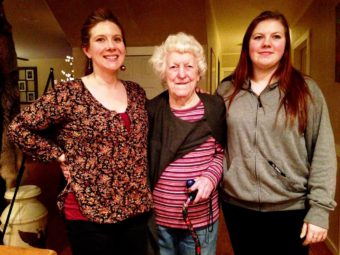
Elizabeth Tyner, 92, lives with her granddaughter, Melinda Cook, left, and great-granddaughter, Shawnee Cook, right. Tyner is among Southeast seniors aging at home. (Photo by Angela Denning/KFSK)
Elizabeth Tyner, 92, lives with her granddaughter Melinda Cook, left, and great-granddaughter Shawnee Cook, right. Tyner is among Southeast seniors aging at home. (Photo by Angela Denning/KFSK)

Some Southeast Alaska families have stayed with the tradition of helping loved ones age in place. Elders live at home, with children and grandchildren, instead of moving into assisted living or a nursing home. It’s a friendlier and lower-cost option for older residents of the region, whose numbers are growing faster than the state as a whole.

As part of CoastAlaska’s Aging Southeast series, we talk to one Petersburg family with four generations living under the same roof.

Elizabeth Tyner sits at the kitchen table in a red striped shirt, blue jeans and blue Crocs sandals.

“I’m 91 years old. I’ll be 92 in a week or so.”

Her short white hair curled, her hands clasp a tissue because she has a cold. She readily talks about her life. Over the decades, she’s sold auto parts and worked at a thermometer factory.

“What it was doing was putting the ink in there,” Tyner said. “It really wasn’t ink it was …”

“Mercury,” her granddaughter prompted.

“Yeah, Mercury,” Tyner said. “You shook the stuff down where it went up and down in there so you could tell the temperature. It was real interesting, it really was.”

Her granddaughter, Melinda Cook, is ready to fill in the details. Cook knows her grandmother well. She has lived with Tyner for nearly two years and spent a lot of time with her growing up.

“She migrated here because we migrated here,” Cook said. “Because none of us stayed where we were from. She’s originally from New York and ended up in Florida and we’re all from Florida and ended up in Alaska. ”

“And as she got older it just seemed like the natural progression for her come be with us.”

Cook uses the word “natural” a lot. She sees aging as a natural process and family helping as part of that. For Tyner, she likes the busy house of four generations.

“I got all these kids around me here (laughs) it’s wonderful … it’s wonderful!” she said. “They play on the floor and I get down on the floor and play with them and do whatever is necessary. We have a good time.”

When Tyner first moved to Petersburg in 2011, she lived in independent housing for seniors. She shared a two-bedroom apartment with a friend for $1,400 a month. Cook said that worked well for several years until the day her grandmother fell.

“She didn’t pull the alarm. She laid on the floor for four hours,” Cook said.

The Petersburg Medical Center inclused long-term care for older residents, among others (Photo by KFSK)
The Petersburg Medical Center includes long-term care for older residents, among others. (Photo by KFSK)

Tyner eventually called the family, which contacted 911. There were other signs that decision-making was becoming difficult.

But switching to assisted living, including daily food service and as-needed care, would have cost about $6,000 a month. Petersburg’s facility takes Medicaid waivers but residents can have no more than $2,000 in the bank and no assets.

That’s not Tyner’s case. She’s worked hard to build up a nest egg. But even that savings would only last a few years. So, she moved in with her family and now pays $500 a month for three caregivers, five days a week.

“Just making sure she’s drinking water, getting meals, because we started finding that that was necessary,” Cook said.

For Cook, having Tyner at home is the right thing to do. Her family has taken care of their elderly for generations.

“I mean, we all kind of have our assignments in this generation,” she said. “My cousins have their parents. I mean literally, every one of us in my generation has an elder living with them at this time.”

Like most of Southeast, Petersburg’s population is aging faster than Alaska as a whole. A recent borough study shows that in about 15 years, senior numbers will double to 28 percent.

In the village of Kake, on the next island over, there are 80 to 90 elders out of a population of about 600. Most are Alaska Natives.

The village has no assisted living or nursing homes. Families take care of their elders at home until they need medical help and have to go off-island. Many families rely on in-home caregivers.

“I think living at home is what they want the most. They don’t want to leave their homes and go to assisted-living places,” said Juanita James, site manager and cook at Kake’s senior center, which provides lunch and rides around town.

“They’d rather have their loved ones close by that don’t have much more time to live and stuff and their relatives are used to making their cultural food for them and taking them to like when they’re having Indian dance at the community doings and stuff.”

“They thrive better at home,” said Keith Smith, who works for Southeast Alaska Independent Living’s Ketchikan office.

“I think that people live longer, their minds stay healthier when they are able to stay in the midst of their life like that,” Smith said.

SAIL is a non-profit resource center that helps seniors and others with disabilities live at home and maintain independence. It has offices in Southeast’s larger communities and also serves more remote towns. SAIL helps clients problem-solve.

Smith said oftentimes, that means giving advice on structural or architectural changes to a house, getting the right home health-care provider or even just knowing about the right tools.

“One of the gentlemen I’m working with is just like overwhelmingly happy when he discovered the device … since he can’t bend over anymore. So there’s a special device that from 3 feet away you can clip your own toenails. That is huge for him,” Smith said.

For Cook’s family, it meant moving to a house with an open floor plan and remodeling a bathroom. Although Tyner is mobile right now, there is plenty of room for a walker or wheelchair if it’s ever needed.

The door opens and Cook’s 18-year-old daughter Shawnee arrives home from an evening workshop at school on financial aid for college. The teen’s 1-year-old is already asleep. Shawnee said it’s great her son can live with his great-great grandmother.

“He knows that she’s the person to go to when he wants something to eat,” she said.

“Yeah, yeah. He will,” Tyner agreed. “I’m trying to teach him a little bit about dancing. I’ve got him shaking his shoulders, you know, and moving his butt, you know, and going up and down.”

It’s not always easy. Tyner’s dementia crops up every now and again, like the time she accused one of her great-grandsons of taking a box of hers. But, at least for now, the family agrees it’s better for everyone to be sharing life under the same roof.

Also sharing space is Cook’s partner and her two sons—ages 14 and 20. That’s four generations in the same home.

“We’ve had a good time with it,” Tyner said. “I wouldn’t trade it. Would you Melinda?”

Cook answers: “No”

Hear and read all our Aging Southeast reports.


Homer rescue group sues city animal shelter alleging free speech violation

A Homer cat rescue group has filed a lawsuit against the Homer Animal Shelter, the shelter manager and the Homer Police Chief. Judy Price alleges the shelter manager started blocking her attempts to rescue cats for Clear Creek Cat Rescue after she commented on how the city-run facility could be improved. Price believes her constitutional rights are being violated.

Right after she gave constructive criticism at a public meeting about the city-run animal shelter in Homer this past January, Price says she was banned from rescuing cats there. She says she was just throwing out ideas.

“Suggestions for ways to improve the shelter – to use more volunteers, to have a more open adoption policy, to have a rescue agreement with the rescue groups. Just general ways to make a shelter work better and to get the animals adopted more quickly,” said Price.

The next day shelter manager Cheryl Bess, who runs the shelter as a contractor through Coastal Animal Care, wrote an email to a city clerk saying that Price was harsh on shelter management.

“I certainly have no intention of working with this individual, and just wanted to be clear on that,” Bess wrote.

Price has worked with Clear Creek Cat Rescue to find adoptive homes for cats in Homer for seven years. She’s been working as the rescue coordinator in Homer to find foster homes for cats for two years.

Clear Creek is a network of volunteers across the state that matches stray cats with foster homes and finds them adoptive homes. The non-profit group rescues cats from places as far away as Dutch Harbor in the Aleutian chain. They have foster homes in Anchorage, Eagle River, Wasilla, Kenai, Soldotna and Homer. Price says Clear Creek adopted out about 500 cats in 2015.

Price says she hasn’t been able to pick up rescue cats from the shelter to place into foster homes ever since the incident.

“Clear Creek Cat Rescue was denied the right to rescue at the Homer Shelter anymore, even though we have been rescuing there for a couple of years because I made comments at a public meeting,” said Price.

And that’s a violation of her constitutional right to free speech, argues Price – and to use public facilities. Price says rescue groups around the country are dealing with similar problems.

“This kind of thing has been going on across the country for years now. Rescue groups have been suing shelters. There was even the Hayden Act in California that was passed for this exact reason, saying that shelters cannot deny certified 501(c)(3) rescues the right to rescue because they spoke out about a problem at the shelter or for any reason,” said Price.

Price alleges in the lawsuit that a shelter volunteer used the city shelter Facebook page to defame her and Clear Creek Cat Rescue. Price also alleges that a cause of the lawsuit was that her written public testimony was removed from public meeting minutes at the request of the shelter manager. Price and the rescue are being represented by Price’s husband attorney Paul H. Bratton.

Price says she’s hopeful her case will be resolved quickly so that Clear Creek can begin helping cats again. She says the shelter needs new guidelines to improve their operations. One of her concerns is that animals are being euthanized at higher numbers than they would be if the shelter worked more closely with rescue groups.

“I think that Homer shelter could be a no-kill shelter. I think if we had a more open adoption policy and if the Homer Shelter manager could work with the rescue groups more freely, there would be five cats in that shelter right now instead of 30 or 40, or whatever is there,” said Price.

But she says if the situation is not resolved through the lawsuit, she’ll push for something like California’s Hayden Act in Alaska.

“I don’t think that we should have to pass a law that people can have free speech and still have access to public facilities, but if that’s what it takes, then that’s what we should have,” said Price.

The City of Homer was contacted for this story along with Police Chief Mark Robl who is ultimately responsible for the shelter – they’re both named in the lawsuit. They declined to comment for this story.

Cheryl Bess, who manages the shelter through Coastal Animal Care and is also named in the suit, returned an email saying she was surprised that KBBI was pursuing a story about the lawsuit and that she would not be commenting either. The city has until February 29th to file a response.

Over 1 million face loss of food aid over work requirements

A volunteer unloads donated baked goods at a food bank in Des Moines, Iowa. Food banks could become strained, as more than 500,000 people could lose food stamps in 22 states reinstating work requirements this winter. AP

More than 1 million low-income residents in 21 states could soon lose their government food stamps if they fail to meet work requirements that began kicking in this month.

The rule change in the federal Supplemental Nutrition Assistance Program was triggered by the improving economy — specifically, falling unemployment. But it is raising concerns among the poor, social service providers and food pantry workers, who fear an influx of hungry people.

Recent experience in other states indicates that most of those affected will probably not meet the work requirements and will be cut off from food stamps.

For many people, “it means less food, less adequate nutrition. And over the span of time, that can certainly have an impact on health — and the health care system,” said Dave Krepcho, president and chief executive of the Second Harvest Food Bank of Central Florida.

Advocates say some adults trying to find work face a host of obstacles, including criminal records, disabilities or lack of a driver’s license.

The work-for-food requirements were first enacted under the 1996 welfare reform law signed by President Bill Clinton and sponsored by then-Rep. John Kasich, who is now Ohio’s governor and a Republican candidate for president.

The provision applies to able-bodied adults ages 18 through 49 who have no children or other dependents in their home. It requires them to work, volunteer or attend education or job-training courses at least 80 hours a month to receive food aid. If they don’t, their benefits are cut off after three months.

The U.S. Department of Agriculture can waive those work rules, either for entire states or certain counties and communities, when unemployment is high and jobs are scarce. Nearly every state was granted a waiver during the recession that began in 2008. But statewide waivers ended this month in at least 21 states, the largest group since the recession.

An Associated Press analysis of food aid figures shows that nearly 1.1 million adults stand to lose their benefits in those 21 states if they do not get a job or an exemption. That includes about 300,000 in Florida, 150,000 in Tennessee and 110,000 in North Carolina. The three states account for such a big share because they did not seek any further waivers for local communities.

In Tennessee, Terry Work said her 27-year-old deaf son recently was denied disability payments, meaning he is considered able-bodied. And that means he stands to lose his food stamps, even though she said her son has trouble keeping a job because of his deafness.

“I know there’s going to be a lot of people in the county hurt by this,” said Work, founder of Helping Hands of Hickman County, a social service agency in a community about an hour west of Nashville.

Nationwide, some 4.7 million food stamp recipients are deemed able-bodied adults without dependents, according to USDA. Only 1 in 4 has any income from a job. They receive an average of $164 a month from the program.

In states that already have implemented the work requirements, many recipients have ended up losing their benefits.

Wisconsin began phasing in work requirements last spring. Of the 22,500 able-bodied adults who became subject to the change between April and June, two-thirds were dropped from the rolls three months later for failing to meet the requirements.

Some states could have applied for partial waivers but chose not to do so.

North Carolina’s Republican-led government enacted a law last fall accelerating implementation of the work requirements and barring the state from seeking waivers unless there is a natural disaster. State Sen. Ralph Hise said the state was doing a disservice to the unemployed by providing them long-term food aid.

“People are developing gaps on their resumes, and it’s actually making it harder for individuals to ultimately find employment,” said Hise, a Republican who represents a rural part of western North Carolina.

In Missouri, the GOP-led Legislature overrode a veto by Democratic Gov. Jay Nixon to enact a law barring the state from waiving work requirements until at least 2019. The three-month clock started ticking Jan. 1 for 60,000 people in Missouri, where unemployment is down to just 4.4 percent.

“We were seeing a lot of people who were receiving food stamps who weren’t even trying to get a job,” said the law’s sponsor, Sen. David Sater, a Republican whose Missouri district includes the tourist destination of Branson. “I know in my area you can find a temporary job for 20 hours (a week) fairly easily. It just didn’t seem right to me to have somebody doing nothing and receiving food stamps.”

Others say it’s not that simple to find work, even with an improving economy.

Joe Heflin, 33, of Jefferson City, said he has been receiving food stamps for more than five years, since an injury ended his steady job as an iron worker and led to mental illness during his recovery. He said he gets nearly $200 a month in food stamps and has no other income. Heflin was recently notified that his food stamps could end if he doesn’t get a job or a disability exemption.

“I think it’s a crummy deal,” Heflin said while waiting in line at a food pantry. “I think they ought to look into individuals more, or at least hear them out. … I depend on it, you know, to eat.”

Policymakers often “don’t realize a lot of the struggles those individuals are dealing with,” said Mariana Chilton, director of the Center for Hunger-Free Communities at Drexel University in Philadelphia.

Some are dealing with trauma from military service or exposure to violence and abuse, Chilton said. Others have recently gotten out of prison, making employers hesitant to hire them. Some adults who are considered able-bodied nonetheless have physical or mental problems.

A study of 4,145 food stamp recipients in Franklin County, Ohio, who became subject to work requirements between December 2013 and February 2015 found that more than 30 percent said they had physical or mental limitations that affected their ability to work. A similar percentage had no high school diploma or equivalency degree. And 61 percent lacked a driver’s license.

“There should have been more thought on how we look at employment and not thinking that people are sitting there, getting food stamps because they are lazy and don’t want to work,” said Octavia Rainey, a community activist in Raleigh, North Carolina.

Some states have programs to help food stamp recipients improve their job skills. Elsewhere, it’s up to individuals to find programs run by nonprofit groups or by other state agencies. Sometimes, that can be daunting.

Rainey said people who received letters informing them they could lose their food stamps sometimes were placed on hold when they called for more information — a problem for those using prepaid calling cards. And in Florida, food aid recipients received letters directing them to a state website for information.

“A lot of these folks, they don’t have computers, they don’t have broadband access,” said Krepcho, the Central Florida food bank executive. “That’s ripe for people falling off the rolls.”

Associated Press reporters Jonathan Drew in Raleigh, North Carolina, Travis Loller in Nashville, Tennessee, and Greg Moore in Milwaukee contributed to this report.

Site notifications
Update notification options
Subscribe to notifications