Family

Columbine Shooter’s Mother: I Carry Him ‘Everywhere I Go, Always’

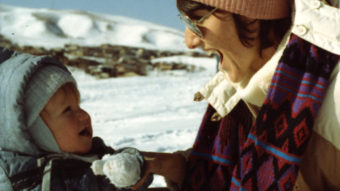
Sue Klebold plays in the snow with a young Dylan. "He's like an invisible child that I carry in my arms everywhere I go, always," she says. Courtesy of Sue Klebold
Sue Klebold plays in the snow with a young Dylan. “He’s like an invisible child that I carry in my arms everywhere I go, always,” she says.
Courtesy of Sue Klebold

On April 20, 1999, when Sue Klebold heard about a shooting incident at Columbine High School, her thoughts immediately turned to her 17-year-old son, Dylan, who was a senior there.

“In the very beginning, I didn’t know what to think,” Sue tells Fresh Air’s Terry Gross. “I was aware that there was a shooting incident occurring at the school. I didn’t know if Dylan was in danger, if someone was trying to shoot him, if he was doing something.”

Gradually the truth emerged: Dylan and his friend, 18-year-old Eric Harris, had gone on a shooting rampage at the school, murdering 13 people and injuring 24 others before killing themselves.

For a long time, Sue was in denial about her son’s role in the massacre. She told herself that Dylan had been brainwashed or coerced into the plan — or that he hadn’t really shot anyone. But then she saw the “Basement Tapes,” a set of videos Dylan and Harris had made in which they brandished guns and bragged about the destruction they were planning, and her understanding of Dylan’s role in the rampage changed.

“Seeing those tapes was one of the most shocking, dramatically traumatic things that happened in the aftermath of this, because I had been living with such a different construct to try to cope with what I believed to be true,” she says.

In her new memoir, A Mother’s Reckoning, Sue describes the guilt, despair, shame and confusion that have plagued her in the 17 years since the Columbine massacre. She hopes that her book will honor the memories of the people her son killed, and perhaps help other parents whose children may be struggling with mental health issues. (All of the author revenues from the book, minus expenses, will be donated to research and charitable foundations focusing on mental health issues).

As for Dylan, Sue says she wishes she had listened to him more carefully in the years preceding the shooting. She wonders what questions she could have asked that might have encouraged her son to open up about whatever he was feeling. She adds that despite everything, she has never stopped loving him. “I will love him until I breathe my last breath,” she says. “He’s like an invisible child that I carry in my arms everywhere I go, always.”

 Interview Highlights

On realizing that one of the “Basement Tapes” had been filmed in her house

When I saw that one of those scenes was actually shot in our home one night, and it was a night when Eric had spent the night, it was jaw-dropping. All I can tell you is I gasped out loud and I said, “That’s his room!” It was just a complete shock that something could happen like that in my own home — that I didn’t know the two of them had weapons and that Eric had brought weapons to our house.

We went back and thought about that evening, and we remembered when Eric spent the night and he had brought a big duffel bag in and we had just assumed it was, I don’t know, perhaps a video camera or a computer — we weren’t in the habit of asking guests what they were bringing over — and we had to sort of put these pieces together of what the boys had been doing that night, and it was a complete shock.

On how she believed Dylan to be posturing in the Basement Tapes

What I saw in those Basement Tapes, what appeared to me to be occurring, was that he was posturing, that he was putting on some kind of a performance to prove not only to Eric but possibly to himself that he was this tough, hateful human being, who was kind of revving himself up to do this. So that was the sense I got from those tapes, and I think one of the things that was most frightening to me when I saw those tapes, was the thought that if and when these become available to the public, how the public couldn’t possibly believe that the other child that I knew existed and was so different from the one on the tape. I knew that trying to illustrate that would be impossible, if they had seen this image of this hate-filled person.

On why she advocated for the destruction of the Basement Tapes

I advocated for their destruction because there is a great deal of research to show that making these available to the public is dangerous — that vulnerable kids will look at these and copy these and use what happened at Columbine as a benchmark for other events such as this. So there is certainly a lot of documentation to support that making them public is a very poor and very risky idea.

I had an additional reason as well as that … I knew that if people believed that someone who was going to do something as heinous as Dylan did, acted openly as Dylan did in that tape, they would develop a false sense of security to be able to say, “My loved one doesn’t act like that, therefore I am safe. My loved one is not at risk.” And I think for me, that was one of the most dangerous things about these tapes is to realize, this was not his [affectation] on a daily level, this was the two of them acting, doing theater, doing a performance, in front of a videotape, and it would be very deceptive to release that kind of information and have people expect to see behavior like that when someone was very disturbed, because that is not the truth.

On if she considered whether the Dylan in the tapes was the real Dylan

His writings tell a different story. His writings show that he was someone who was very focused on love, he was very focused on a sense of conscience, he had a secret crush on an unidentified female at his school, and his writings do not reveal the level of irrational anger that the tapes revealed. And also, the fact that I had known him, of course, all of his life and known him to be a gentle and a loving person, so from everything I have been able to learn about this, from every piece of evidence I can find, it was the behavior on the tapes that was the aberration, and it was something that he was doing, in many ways, I believe, to prepare himself to do what he was about to do.

On Dylan’s suicidal thoughts

When I refer to Dylan’s suicidal thoughts and his behavior, I want to make it very clear that I am not trying to discount the fact that he also committed murder. I perfectly am aware, always, every minute, of the lives that he took and the lives that he ruined, but murder-suicide, which is what this event was, is one manifestation of suicide. It is what can happen with a suicide. It is generally now believed more and more to be motivated by the same things that motivate a suicide rather than a homicide.

So I have done a lot of research on suicide and tried to understand Dylan’s thinking. Yes, in his writings, a full two years before he died, he is talking about being in agony, being in pain, about his thoughts, wanting to end them. He writes about wishing he had a gun. He even wrote about cutting himself at one point. So, yes, I believe that he was experiencing persistent suicidal thoughts and depression at least two years before this event grew and grew and escalated into this terrible tragedy.

On whether she blames herself for Dylan taking his own life and murdering others

I, like many survivors of loss, when someone takes their own life, do think those thoughts. I felt for a very long time that it must’ve been something I did, and I went back to ridiculous detail into our past, and I remember at one point sobbing because when Dylan turned 3 I had only put sprinkles on his birthday cake, but when his brother turned 3, I had decorated the cake with icing, thinking, “It must’ve been something like that, where he didn’t feel equally loved.” I know that sounds ridiculous — that is the kind of work that you do in your head when something like this happens.

So I examined and I questioned and I blamed, and to this day I do it still — occasionally I fall back and think, “If I had done this, if I had not done this.” But over time, with all the research I was doing into behaviors and losses due to suicide, I really began to see that these things were things within Dylan’s brain and his thinking, and that I might’ve in some way inadvertently contributed to his perception of something at a given moment, but I did not believe and still don’t believe that I caused this or caused him to have this perception of himself and his worldview.

On what she wishes she could’ve done differently as a parent

I wish that I had had the ability to delve deeper and ask the kinds of questions that would’ve encouraged him to open up more to me. I had parented my kids, in many ways, the way I had been parented, which means you listen to your kids’ problems and you try to fix them. … I think what I needed to do with Dylan more was to just shut up and listen, to try to get him to say to me what he was feeling and thinking about something, rather than to automatically jumping to a way to make him not feel that way or to fix the way he felt.

On people destroying the crosses for Dylan and Eric in a memorial of the victims

I can’t presume to even know what [the families] were experiencing and what the level of their grief was. I completely understood their need to express what they were feeling, and that their feelings were such that they could not tolerate having those memorializations there. I feel certain that I would’ve felt the same way.

But like everything after a murder-suicide event, the feelings are so complicated that you feel so many things at once. There was a part of me that felt responsible and empathetic … and there was a part of me, as a mother, that was very hurt by this expression of hatred for my son. But this is all part of why the experience was something I wanted to write about, because there are all kinds of feelings that we have, and I can understand the need to express that kind of rage, but I hope also that people will understand my need to love the child that I lost. …

What I use as my guide is that I want to educate people. I want people to know that even family members of people who do horrible, heinous things are still human beings, and that perhaps by meeting me and seeing that I am not a crazed person, that maybe it will broaden their understanding and they will have a little bit more compassion for someone else.

Copyright 2016 Fresh Air. To see more, visit Fresh Air.

Read original article – February 16, 2016 12:32 PM ET


Longtime Anchorage Rep. Max Gruenberg dead

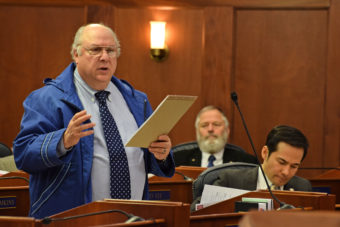
Rep. Max Gruenberg
Rep. Max Gruenberg, D- Anchorage, addresses the Alaska House of Representatives, Feb. 2, 2015. (Photo by Skip Gray/360 North)

Longtime Rep. Max Gruenberg died Sunday in Juneau. The Anchorage Democrat was 72.

Gruenberg gained bipartisan respect for his skill in crafting legislation.

He was the senior member of the House. He served during two separate periods, from 1985 to 1992 and again since 2003.

Gruenberg was born and raised in San Francisco. He was an Eagle Scout. And he served in the U.S. Navy in Vietnam.

A retired family lawyer, Gruenberg sponsored the law that provides Silver Alerts to locate missing, vulnerable adults. Another Gruenberg law requires the removal of asbestos from schools and public buildings.

Gruenberg served twice as the House majority leader. He was the minority whip in the current session.

Gov. Bill Walker ordered that flags by lowered for both Gruenberg and U.S. Supreme Court Justice Antonin Scalia.

Walker said Gruenberg’s death is a significant loss for all of Alaska.

Anchorage Democrats will submit three potential replacements to Walker, who will choose one. House Democrats will then accept or reject the choice.
Summit explores achieving racial equity in Alaska

The First Alaskans Institute hosted a Racial Equity Summit in Anchorage this week. The event’s dialogues focused on what racial equity is and how we can start to achieve it.

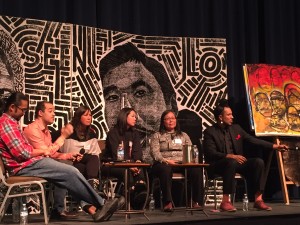
Panelists from around the world discuss steps toward achieving racial equity during a recent Anchorage Summit. (Photo by Anne Hillman/KSKA
Panelists from around the world discuss steps toward achieving racial equity during a recent Anchorage Summit. (Photo by Anne Hillman/KSKA)

Racial equity and racial equality are not the same thing. Equality means everyone is treated the same or given the same resources. It assumes that everyone starts at the same point. Equity means making sure everyone can arrive at the same point, no matter where they start.

Gyasi Ross is a member of the Blackfeet Nation and lives in Washington. He speaks on social justice and race issues and presented at the summit. He says to achieve racial equity, communities first need to acknowledge that underlying systems deny people of color equal starting points.

“We think that now we have this quote-unquote colorblind society — which doesn’t exist but even if it did exist, so what? The foundation wasn’t colorblind. The foundation wasn’t equal. And that creates a structure that’s on an unequal playing field, an asymmetrical playing field from the very start.”

He gives the example of land ownership. Black people in the United States couldn’t own land until the late 1800s. As a result, whites currently own about 850 million acres of agricultural land. Blacks — just 7 million. Ross says to change that basic inequality, people with privilege need to be OK with losing some of their privilege. But that’s not an easy thing to talk about.

“The point is that equity as a serious conversation, and there might be uncomfortable conversations and some level of displacement, and we have to be OK with that,” Ross says.

Ideas gathered during the two day racial equity summit in Anchorage. (Photo by Anne Hillman/KSKA)
Sheets of paper hold lists of ideas gathered during a two-day racial equity summit in Anchorage. (Photo by Anne Hillman/KSKA)

So how do we get beyond that discomfort? Summit speaker Jay Smooth, who speaks and writes about race and culture, says we need to change how we frame the conversation.

“We tend to frame each conversation as a referendum on whether I am a good or bad person. And if I’m a good person then I don’t need to consider whether I’m prejudice or have any blind spots toward people or whether I’m part of a system that perpetuates injustice even if I’m not consciously contributing to that.”

Smooth says people need to think beyond good versus bad and be actively looking for our own unconscious biases and the ways we perpetuate racist systems.

But for some Alaskans, like extension officer Kari van Delden from Nome, that means first identifying why the conversation is so hard to have. She’s white and helps host conversations about race in her community with Panganga Pungowiyi, the director of Kawerak’s Wellness Program.

“For a long time I was really uncomfortable talking about anything around racial issues,” van Delden says. “So I had to start trying to figure out why is this an uncomfortable conversation for me. And there were a lot of things like I would find myself feeling like I needed to defend something or feeling like somebody would misunderstand me. So I had to start understanding why I was backing away from the conversations or avoiding them before I could even start having the conversations.”

Pungowiyi says one of the first steps for talking about race is acknowledging the history of external and internalized oppression.

“True history about Alaska Native people is not taught, and when that history is kept from you and you don’t know how your families and your communities have gotten into the situation that they’re in with all these symptoms of historic trauma manifesting, like alcoholism, like abuse, like violence. All of these things. The high suicide rate. When you don’t realize there’s a reason for all these things, you become internally oppressed. You just feel inferior.”

Pungowiyi says it’s a feeling you have to heal from–it’s part of a community-wide healing process. She tries to incorporate conversations about race into all aspects of life in Nome. Because if people can talk about it, they can make systems more equitable for everyone.

The First Alaskans Institute hosted the two-day conference in Anchorage as part of its ongoing work on racial equity.

President Obama Wants More Funds To Feed Low-Income Kids In Summer

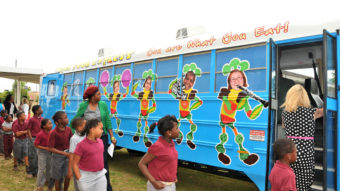
The Super Food Express bus travels to schools in Mobile County, Ala., to ensure children are fed healthy meals when school is out of session. The bus is part of the USDA's summer food program, which President Obama says needs additional funding. USDA/Flickr
The Super Food Express bus travels to schools in Mobile County, Ala., to ensure children are fed healthy meals when school is out of session. The bus is part of the USDA’s summer food program, which President Obama says needs additional funding.
USDA/Flickr

It’s a challenge making sure that low-income children who get free- and reduced-priced meals during the school year continue to get fed during the summer.

Government meal programs served 3.8 million children on an average summer day last year — far fewer than the 22 million children who got subsidized meals during the school year.

Now, the Obama administration wants to change that. The president will propose in his 2017 budget next month that families who qualify for subsidized school meals be given a special electronic benefits card that will allow them to buy an additional $45 in groceries per child each month when school is out.

“The reality is, obviously, we still have millions of kids that are not getting the help and assistance they need,” says Agriculture Secretary Tom Vilsack, who oversees the program.

Vilsack says there are many reasons for the summertime drop-off in participation. It’s hard to find sites where kids can be fed during the summer, when they’re home and schools are closed. This is especially difficult in rural areas, where children live far from any church or public space where meals can be served. They often lack the transportation needed to get there.

The USDA, states and nonprofit groups have been trying for several years now to figure out how to boost participation in a summer feeding program. They’ve experimented with offering free meals at camps and libraries, where children are likely to show up. And they’re using food trucks to deliver meals to more remote areas.

Some states have also tried electronic benefit transfer, or EBT, cards to give families extra money for food in the summertime. It’s this pilot program that the administration would like to expand to every state over the next 10 years.

“The president is suggesting the time has come to make a longer term, permanent commitment to making sure that all kids have access to meals during the summer,” says Vilsack.

But that commitment would be costly — an estimated $12 billion over the next 10 years. That’s unlikely to attract much support in the Republican-led Congress, which has been trying to cut back on such spending in recent years.

In fact, leading Republicans, such as House Speaker Paul Ryan and several presidential candidates, say they’d like to combine food aid and other safety net programs into block grants, and give states more flexibility over how to spend the money. They say the current programs discourage people from working and getting off government aid.

“I’d combine a lot of them and send that money back to the states for better poverty-fighting solutions: Require everyone who can to work. Let states and communities try different ideas. And then test the results,” Ryan said in a speech last month.

Still, historically, there’s been bipartisan support for programs to feed needy children. The Senate Agriculture Committee approved a more limited version of the EBT plan this month, at an estimated cost of about $50 million a year. The House has yet to weigh in.

Vilsack also announced that the administration is doing something else to boost participation in the free and reduced-price lunch program. It plans to allow states to start using Medicaid data to automatically enroll qualified low-income children into the program. The idea is to reduce some of the administrative paperwork in signing kids up for food aid, and to identify those who are qualified for subsidized meals, but for one reason or another haven’t been getting them.

Copyright 2016 NPR. To see more, visit http://www.npr.org/.
Read original article – January 27, 2016 6:00 AM ET

Depression Screening Recommended For All Pregnant Women, New Mothers

Untreated depression can harm the health of mothers and their children. iStockphoto
Untreated depression can harm the health of mothers and their children.
iStockphoto

Pregnant women and new mothers need more attention when it comes to screening for depression, according to recommendations issued Tuesday by the U.S. Preventive Services Task Force.

That came as part of the panel’s recommendation that all adults should be screened, in a situation where they can be provided treatment or get a referral if they are clinically depressed.

The announcement follows similar recommendations in 2002 and 2009. What’s new this time is the special shout-out for pregnant women and new moms. They need special recognition, the task force says, because of evidence showing that they can be accurately diagnosed and successfully treated, and because untreated depression harms not only the mother, but her child as well.

Depression is the leading cause of disease-related disability in women around the world. Nine percent of pregnant women and 10 percent of new moms will go through a major depressive episode, according to evidence cited by the task force. And studies have shown that babies and toddlers with depressed moms are subject to lots of problems. They may be more difficult to console, be less likely to interact or have more sleeping problems.

The independent panel’s recommendations are influential — many health insurers and health systems follow their suggestions. But the announcements often come with controversy. Recent and recurring recommendations against automatic annual mammograms for women in their 40s have generated multiple headlines.

But concerns among mental health researchers who got an early glimpse of the advice about testing for depression have been mild — mostly questions about the best depression screening test to use and the importance of emphasizing more research on treatments.

There’s no argument about the task force’s call for recognizing the needs of pregnant women and new moms. “Historically, depression in these populations has been underrecognized and undertreated,” says Evette Ludman, a clinical psychologist who studies behavioral science for Group Health Research Institute in Seattle.

Most important, she says, is the recommendation that there be access to some sort of effective care when someone is diagnosed.

Heidi Koss got no screening with the birth of her first child 20 years ago, not even an open ear when she mentioned symptoms of depression to her obstetrician at her six-week checkup. “He said ‘Oh, this is typical of a lot of moms; perhaps you should get out more, maybe buy a new dress.’ ”

“It just added to a sense of helplessness, hopelessness and isolation,” she says now. In 2011, she told NPR about several attempts to commit suicide before finally finding a sympathetic mental health counselor about a year after her first child was born.

Her experience with postpartum depression inspired Koss to get a degree in counseling. She now practices in Kirkland, Wash., and is the Washington state coordinator of a nonprofit education group, Postpartum Support International.

“Pregnancy is not from the neck down,” she says, pointing to studies that show that more women suffer from mental illness during pregnancy and after pregnancy than develop gestational diabetes or pre-eclampsia, or go into preterm labor.

And she singles out a small British study done in the late 1990s that claimed that psychiatric disorders, and suicide in particular, were the leading cause of maternal death.

The task force report notes that one of the biggest challenges is treatment.

“Because hopelessness and inertia are often part and parcel of depression, it can be challenging for persons living with depression to keep at it until finding the treatment that is right for them,” says Ludman of Group Health Research Institute. The task force notes that talk therapy (specifically a kind called cognitive behavioral therapy), drug therapy or a combination of medication and therapy may be necessary.

But the group backs off on recommending drug treatment for pregnant women with depression because of the possibility of problems associated with certain drugs called SSRIs. Some studies have shown a small risk of increased problems that include miscarriage and preterm birth. Instead, the suggestion for pregnant or breastfeeding women is for cognitive behavioral therapy or some form of counseling.

The task force’s recommendations for pre- and post-term moms appear in the current issue of JAMA, the journal of the American Medical Association. They track with advice from other groups, including the American Academy of Family Physicians, the American Academy of Pediatrics and the American College of Obstetricians and Gynecologists.

Legislation introduced in Congress last July would authorize the federal government to fund screening and treatment for pregnant women or women who have given birth within the past year.

Joanne Silberner, a former health policy correspondent for NPR, is an artist in residence at the University of Washington’s department of communication.

Copyright 2016 NPR. To see more, visit http://www.npr.org/.
Read original article –  January 26, 2016 11:06 AM ET

Doula Support For Pregnant Women Could Improve Care, Reduce Costs

A doula is trained to provide advice and support for women through pregnancy and childbirth. Mike Harrington/Getty Images
A doula is trained to provide advice and support for women through pregnancy and childbirth.
Mike Harrington/Getty Images

Childbirth historically involved a support system of women who assisted a woman from her pregnancy through the birth and in the immediate postpartum period afterward.

Today, obstetricians and midwives provide prenatal care and help a woman deliver her baby. Doulas continue to fulfill the historical role of emotionally supporting a pregnant woman through labor and childbirth, helping her advocate for herself and communicate with her caregivers.

A study published online Thursday by the journal Birth suggests that offering women the support of a certified doula could save Medicaid and perhaps private insurers real money — nearly $1,000 a birth — by reducing cesarean and preterm births.

Previous research has shown lower rates of cesarean births, more satisfaction from mothers and better newborn Apgar scores — a measure of a baby’s condition at birth — among mothers who use doula care. In fact, the American Congress of Obstetricians and Gynecologists says in guidelines for safe prevention of cesarean births that doula care is “probably underutilized.”

This is the first study, however, to show a reduction in preterm births and a net savings for public insurance. Cesarean births — about a third of all U.S. births — cost about twice as much as vaginal births, and the 1 in 10 U.S. infants born preterm (before 37 weeks) incur medical costs 10 times greater than those of full-term infants.

“What is coming together now is a research consensus and a professional consensus of the benefits of doula care,” said lead author Katy Kozhimannil, an associate professor in the University of Minnesota School of Public Health. “The barriers to access are financial, cultural and geographic. The financial barrier ought to be the first to fall.”

Her analysis compared 1,935 women in Minnesota who accepted state doula services covered by Medicaid with 67,147 Medicaid-covered women throughout the northern and midwestern U.S. who didn’t get help from doulas.The doulas visited with the mothers four times leading up to the birth, provided support during labor and delivery and made two postpartum visits to the women.

In comparing the groups, 4.7 percent of the women using doulas had preterm births compared with 6.3 percent of the women who didn’t get doula help. Similarly, 20.4 percent of doula-supported women had cesarean deliveries compared with 34.2 percent of the women without doulas All told, an estimated $986 per birth would be saved if all the women received doula services, the analysis found.

How doulas decrease the odds of a cesarean birth isn’t entirely clear. One way might be by reducing cesareans recommended out of convenience, such as during a more slowly progressing labor.

“One of the questions doulas are trained to help women remember to ask is, ‘Is this an emergency or do I have time to think about it?’ ” Kozhimannil said. “If it’s an emergency, it’s outside the doula’s scope of work. If it’s not, that’s an opportunity for the doula to help the woman come to a decision with her clinician.”

However, there is a potential risk if inadequately trained doulas practice outside their scope of care, says Aaron Caughey, chair of the Department of Obstetrics & Gynecology at Oregon Health & Science University in Portland.

“I can’t think of a lot of negatives fundamentally in the routine use of doulas,” he said. “But in my clinical experience, the one possible negative is that a lot of the time the individuals who use doulas have a certain mindset about birth, and the doula can sometimes serve to block the clinician from practicing in the way the clinician might wish.”

For example, a doula might discourage a woman from agreeing to a rupture of membranes recommended by a clinician even if breaking her waters is medically indicated, he said. If physicians, midwives and doulas work together from the start, disputes over care are less likely.

Why doula care might affect preterm birth is also uncertain but might partly result from a reduction in stress because of the support of a doula during prenatal care, Caughey said.

Kozhimannil’s team analyzed preterm births and cesarean births separately, but another analysis that combined them revealed no reduction in cesareans among preterm births. She said that’s a good thing because it means the reduction occurs among healthy deliveries and not the complicated ones more likely to need a C-section.

Although the researchers adjusted the analysis for mothers’ age and race/ethnicity and having high blood pressure or diabetes during pregnancy, the groups may still have been too different for adequate comparison, wrote Adam Powell, a health economist and president of Payer+Provider Syndicate, in an email.

He pointed out that the larger control group may have included some doula-assisted births, albeit a small number, but that the better health of the women in the doula group may not have been fully accounted for in the statistical adjustments.

“It is not surprising that the intervention group was in better health than the control group as the intervention group had to be proactive about their health in order to be included in the group,” he wrote since only 15 to 20 percent of the mothers eligible for Medicaid-covered doula services used them.

The study’s findings would be stronger if the women had been randomized through a lottery to receive doula support or not, Powell said.

Even so, insurers can look through their own claims for answers. “Medicaid programs and health care companies generally have the data to conduct these analyses with their own data,” Kozhimannil said. “There is no reason they shouldn’t consider adding doula care or at least exploring that option.”

She pointed out the importance of this study’s findings in terms of the racial disparities in poor birth outcomes in the U.S.

“It’s important in an equity context because preterm birth is so much more frequent among black women compared with white women and preterm birth is the largest contributor to infant death,” Kozhimannil said. “The infant mortality rates and the disparities in infant mortality are something we’ve been reckoning with as a country for 100 years without good progress. Any identification of interventions that can help address issues related to preterm birth and especially disparities in preterm birth is urgently needed.”

Tara Haelle is a freelance health and science writer based in Peoria, Ill. She’s on Twitter: @tarahaelle

Copyright 2016 NPR. To see more, visit http://www.npr.org/.
Read original article – January 15, 2016 4:49 PM ET
Doula Support For Pregnant Women Could Improve Care, Reduce Costs
Site notifications
Update notification options
Subscribe to notifications