Family

38K Alaska households turn to food stamps during tight times

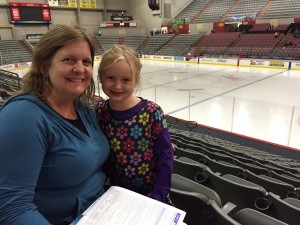
Tracy Peterson and her daughter apply for SNAP benefits during an event at the Sullivan Arena. (Photo by Anne Hillman/KSKA)

According to a new White House report, 38,000 Alaska households receive benefits from the Supplemental Nutrition Assistance Program. Two-thirds of those households have children. Half of them are in deep poverty.

Despite some issues, many people say the program is working as it should.

Tracy Peters didn’t expect to be sitting in the Sullivan Arena waiting to pick up donated food and presents for Christmas. She was working as a personal caregiver, but a month ago her hours were cut and some of her clients passed away. Then her husband lost his job as a lineman.

“(He) got laid off because of the weather,” she said. “We weren’t prepared for that because he was told he’d have winter work (and) then they laid him off.”

Peters is applying for jobs, but in the meantime, she’s also applying for SNAP. She said she’s trying to keep her family healthy.

“So many people eat a bunch of junk food because they can’t afford the healthy stuff,” she said. “That’s another reason I’m trying to apply because we’re eating a bunch of fattening foods. I’m hoping this can help us with the healthy choices instead.”

Peters has a copy of the 24-page application in her lap. It asks for detailed information about income, assets and medical history for everyone in the household.

“This is actually a lot more steps that I thought it was — a little bit more difficult than I thought,” Peters said.

Applicants have to submit a lot of paperwork — pay stubs, tax forms and rental agreements.

“I know. It’s 2016 almost and we’re paper,” says Tammie Walker, Chief of Field Operations for the state’s Department of Public Assistance, which administers the federally funded program.

Walker said she knows some people think the process is cumbersome. Though many people apply and get benefits within a month or two and don’t mind the process at all, others have stories about waiting for hours at offices or never getting called back about their applications. Walker said part of the problem is relying on physical files of paperwork that are spread out to offices around the state.

“The paper is killing us,” she said. “And our commissioner knows it. They are very aware because they see the frustration from staff and from clients.”

Walker said the department is trying to streamline the application and eventually go digital, like the Medicaid application, but it takes time. Relative to Medicaid’s backlog, the food stamps program is doing very well.

According to the Food Bank of Alaska, about 27 percent of people who qualify for the program don’t apply. Some say it’s not worth the effort if they only get about $18 per month. Benefits range widely. Others don’t know that owning a house or a snow machine that’s used for daily transportation doesn’t disqualify you.

Many of the people who apply, like Brandy Straight, say SNAP has been a lifeline. She lost her job and took over the care of her disabled brother and her four children. The household of seven is living on her fiance’s $12 per hour job. Straight said before getting benefits, they had to choose between rent and food.

“I do feel it could help better if they look more at the medical needs that people have. Because people with diabetes, you have to go to more particular foods,” Straight said. “My brother has brain damage and has seizures, so there are special diets, but I can’t really get the diets he needs because then it’s more expensive. So you have to be very careful to pick what you pick.”

But she says she’s grateful for all that she gets.

David Patterson, his girlfriend and their baby were homeless before they starting receiving SNAP and other benefits. He said the program helped him put aside enough money to find a place to rent instead of couch surfing.

“We actually got established in our own place and were able to keep food on the table. All around, it was amazing,” Patterson said.

Like 57 percent of the adults who receive SNAP benefits, Patterson is working. He said he’s a commercial fisherman and tries to get other jobs in the off-season, but he uses SNAP when he needs it to make sure he can keep a roof over his and his child’s head.

With child care shortage, local organizations offer assistance to future providers

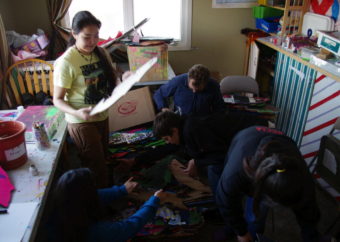
(Creative Commons photo by Kids Work Chicago Daycare)

The Auke Bay Cooperative Preschool recently closed, deepening the child care shortage in Juneau. As options for child care facilities dwindle, local organizations are encouraging potential and new child care providers with resources.

The Association for the Education of Young Children in Juneau holds a monthly meeting called the Business of Caring for anyone thinking about starting a state licensed child care home or center.

“The Business of Caring is just an opportunity for people who are thinking about becoming a licensed provider to find out more about the business, and hopefully, that just helps them think about if this is a good fit for them or not,” said AEYC early learning services coordinator Christa Womack.

Central Council of the Tlingit and Haida Indian Tribes of Alaska also offers assistance to license applicants.

Tlingit and Haida Central Council will help pay for First Aid and CPR certifications, background checks, a fire inspection, a business license, safety equipment and other costs of getting licensed. It’ll also help pay for startup costs such as learning materials, books and art supplies. The applicant doesn’t have to be Alaska Native but must commit to watching kids within Tlingit and Haida’s Central Council’s child care program.
Once licensed, AEYC provides up to 10 hours of free on-site assistance on how to set up a learning environment. Womack says up to $1,000 in funding is available for startup costs.

“Sometimes they use the funds to purchase classroom materials or supplies for their program. Sometimes it’s like playground equipment – different things like that. It’s basically to support what they need to get their program off to a good start,” Womack said.

AEYC also offers incentives for people already in the childcare business who are interested in getting further education

For more information on resources for interested or new childcare providers, call AEYC at 789-1235 or Tlingit and Haida Central Council at 463-7140.

7 Bundles Of Scientific Joy: ‘Test Tube Puppies’ Prove IVF Can Work In Dogs

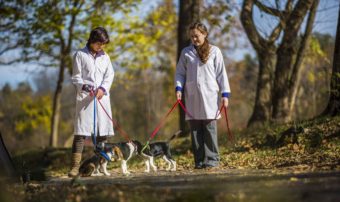
Cornell graduate student Jennifer Nagashima and Smithsonian Conservation Biology Institute research biologist Nucharin Songsasen — lead author and co-author, respectively, of a new paper on IVF in dogs — walk two of the puppies born during their research this summer. Jeffrey MacMillan/Cornell University
Cornell graduate student Jennifer Nagashima and Smithsonian Conservation Biology Institute research biologist Nucharin Songsasen — lead author and co-author, respectively, of a new paper on IVF in dogs — walk two of the puppies born during their research this summer.
Jeffrey MacMillan/Cornell University

Seven tussling puppies could bring a smile to anyone’s face. But one litter has a team of scientists beaming more than usual.

The puppies — five beagles and two “bockers,” or beagle-cocker spaniel mixes — are the first ever born through in vitro fertilization.

IVF has been used successfully in other animals — including, notably, humans — for decades. But despite numerous attempts, scientists had never succeeded in using IVF in dogs.

But this year, researchers at Cornell transferred 19 embryos into a female host dog. In July, after a scheduled cesarean section, they welcomed seven new puppies into the world.

They described the breakthrough in a paper published Wednesday in Plos One.

As NPR’s Rob Stein reported earlier this year, dogs have successfully been cloned before: In fact, for a cool $100,000, you can have your own pet dog cloned. But where cloning involves transferring one dog’s existing DNA into a donor egg, IVF involves the creation of a new genome through fertilization, so each animal has a unique set of DNA.

The first litter of puppies born by in vitro fertilization includes two bockers and five beagles, born from two fathers, three mothers and a host mother. Mike Carroll/Cornell University
The first litter of puppies born by in vitro fertilization includes two bockers and five beagles, born from two fathers, three mothers and a host mother.
Mike Carroll/Cornell University

Previous attempts to use IVF in dogs had resulted in very low rates of fertilization, and no live births at all after IVF embryos were transferred to a host.

There are numerous reasons why, the Cornell scientists explain in their paper.

First, female dogs only ovulate once or twice a year. And their eggs appear dark under a light microscope — which makes it harder to see the structures inside of the egg, the scientists note. The eggs are also released before they’re fully matured.

The Cornell researchers found that if they waited an extra day, compared to IVF procedures for other mammals, before extracting eggs, success was more likely. Adding magnesium to the environment where the sperm and egg met also helped with fertilization, the team found.

Once they had successfully created embryos, the scientists froze them until the host dog was ready to become pregnant — a key part of overcoming the difficulty of timing IVF, given how few times a year a dog can get pregnant, a Cornell press release notes.

Then, for the first time, the scientists saw IVF puppies carried to term.

The seven surviving puppies are genetically the offspring of two different fathers (a cocker spaniel and a beagle) and three different beagle mothers, carried by the same beagle host.

The achievement could eventually help endangered canine species, the scientists say: Frozen eggs and sperm from “genetically valuable individuals” could be used to continue to create offspring after the animals themselves have died.

And there are also implications for disease research, the scientists say. Successful IVF procedures will allow scientists to more efficiently explore gene editing in dogs, which could help eradicate inherited diseases.

Dogs get spontaneous cancer, like humans do, and pet dogs are exposed to many of the same environmental factors as humans, the scientists note. Overall, they say, dogs share more than 350 disorders or traits with humans — almost twice the number as any other species — so advancing research into canine disease could ultimately help treat humans.

But first the scientists had to master canine IVF. And the success was a joyful one, as one co-author of the paper told The Guardian:

” ‘We had people lined up, each with a towel, to grab a puppy and rub them and warm them up,’ said Alex Travis, a specialist in reproductive biology at Cornell University, in Ithaca, New York. ‘When you hear that first cry and they start wriggling a bit, it’s pure happiness. You’re ecstatic that they’re all healthy and alive and doing well.’

“The team used small daubs of coloured nail varnish to tell the dogs apart. Since they were born, all but one has been adopted. Their names are Ivy, Cannon, Beaker, Buddy, Nelly, Red and Green. Travis gave a home to Red and Green, and while Red’s name honours the informal name for the Cornell sports teams, Travis says Green has yet to be renamed because his children cannot reach a consensus. Nelly will be homed after she has had her own litter of puppies.”

Copyright 2015 NPR. To see more, visit http://www.npr.org/.
Read Original Article – December 9, 2015 7:44 PM ET
7 Bundles Of Scientific Joy: ‘Test Tube Puppies’ Prove IVF Can Work In Dogs

Sidney Huntington remembered for hard work, passion

Interior elder Sidney C. Huntington died Tuesday in Galena. He was 100 years old. He leaves behind not only a long list of accomplishments but an entire philosophy of life.

Sidney’s biography could go on for hours. His story is so intertwined with the story of Alaska over the past century.

His dad came to the territory of Alaska during the Klondike gold rush. He watched the villages of the middle Yukon and lower Koyukuk valleys transition from isolated, subsistence-based settlements to communities with satellite dishes, snowmachines, and multimillion dollar schools.

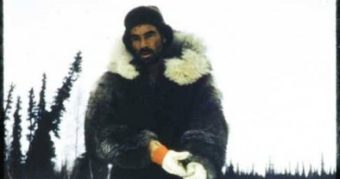
Sidney Huntington on the trapline, 1958. (Photo courtesy of Alaska State Library, Keller Family Photo Collection)

But like the villages themselves, Huntington never abandoned subsistence. As he explained in a 1996 interview for the oral history series “Raven’s Story,” Sidney took pride in living close to the land, even after his trapping days were over.

“The change in life has been dramatic. For me to say that I have changed very much … I imagine I have, to quite a degree to keep up with the times. But my variety of food, and what I do, has not changed very dramatically, only I have adapted myself to the new methods of harvesting wildlife resources. And I have a deep respect, probably a deeper respect for wildlife resources than anybody in the country.”

Never lacking in confidence, Sidney did many different kinds of work during his life: hunting, fishing, trapping, boat building, carpentry, mining, fish processing. He served on the Board of Game for 17 years and helped create predator control programs and controlled-use areas to protect moose populations in the Interior. He had a huge family.

He leaves a legacy in Galena not only in terms of what he did but how he did it.

Sidney insisted on the value of hard work and despised government handouts. He was legendary for starting his work early in the morning, working late into the night, and doing it all again the next day.

Though he only had a third-grade education, he was a strong supporter for public education in rural Alaska. Someone else in his position might say, “You don’t need to go to school. I only went through third grade and look at me now.”

He took the opposite approach. He wanted rural kids to have the formal education that he never had. He loved meeting students at Galena’s boarding school and considered himself a father to all of them. The Galena K-12 school is already named after him and has been for 10 years.

But what I think is the most interesting legacy that Sidney Huntington leaves behind is the new Alaska identity that he forged. He was half Alaska Native, half white, and didn’t consider himself a full member of either of those camps. He drew lessons from books, boarding schools and Native elders alike to build a lifestyle based on practicality, preparation, and respect.

Each of those values is on display in this outtake from “Raven’s Story,” in which he describes his wolf trapping techniques.

“I wouldn’t tell anybody how I trap wolves. That is not the historic way of doing it. They say you give your luck away and you can’t catch them anymore,” Huntington said. “Well, I’m about over the hill anyways so it doesn’t make much difference. I generally trap on glare ice, and wolf trapping I’ve found is a lot of work, a lot of work. Dedicated work. You are trapping a very cautious, wary animal. The only thing that gets him, he’s like you and me, he wants to know what is on the other side of the fence.”

Clever, iconoclastic, and ultimately — practical. That was Sidney Huntington.

And of course, Sidney left us his book, “Shadows on the Koyukuk.” It’s become more a reference book than a biography at my house, and I try to reread every year. It never ceases to be a fascinating look back at how Alaska used to be, but also an inspiration to the challenges that lie ahead of us.

I never managed to have Sidney autograph it. But we have a table he built in our cabin, and that seems good enough.

‘This Book is Gay’ dispute erupts at Wasilla library

Wasilla city officials heard public testimony Monday night about a library book that is concerning some parents. “This Book is Gay” was written by U.K. author James Dawson. Some parents say it is not appropriate content for the library’s young readers. The dispute started earlier this month.

When one mother noticed her 10-year-old with a copy of “This Book is Gay” in his hand, she was shocked. Vanessa Campbell told the Frontiersman newspaper the book contained graphic sexual descriptions and has no place in the library’s juvenile nonfiction section.

"This Book is Gay" by James Dawson.
“This Book is Gay” by James Dawson.

“This Book is Gay” is written for young readers, or any readers, grappling with questions about homosexuality. It’s tone is humorous, and it contains cartoons, but some of the content explains sexual practices and that is what concerns some Wasilla parents.

Campbell complained to library director K.J. Martin-Albright, but Martin-Albright, after review, decided not to move the book to another library area.

Campbell filed for reconsideration, a rarely used process, to get a change in what section of the library the book will be shelved. David Cheezum, the owner of Palmer’s Fireside Books, is on the committee that will make that decision.

Cheezum says the library’s young readers section is close to the young adult section, so it was easy for a person younger than the book was intended for to stumble on it.

The committee met on the issue last week. Cheezum says a number of people showed up at the meeting ready to “politicize” the meeting, but were turned away because it was not an advertised public meeting.

“(After) they left, we had a really inspiring discussion just because it was so open and honest. … I wish the people who were politicizing it just wait a little more patiently for the results to be made public,” he said.

At the Wasilla city council meeting this week, several residents spoke out against the book and it’s place on library shelves, although the issue was not on the agenda. The furor may be short-lived. Campell is not asking the library to ban the book, Cheezum says, just to move it to another section. He says the decision won’t be out until next week.

Reviews of “This Book is Gay” proliferate online ranging from “absolutely hilarious” to appreciation that adolescents who may be struggling with sexual identity can access the information. It contains chapters on bullying, dating, and at least one chapter explaining the ins and outs of gay sex. Pans of the book generally center on criticism that it focuses more on gay males and not gay females.

Asked if his store stocked copies of the book, Cheezum said, “not yet.”

“We don’t have it right at this moment, but we have a train shipment, so we will be getting it,” he said.

Wasilla librarian Martin-Albright did not return calls for comment on this story.

How To Talk To Kids About Thanksgiving

LA Johnson/NPR
LA Johnson/NPR

You know the drill: Trace your hand, then add the details. Two feet, a beak, a single eyeball. Color it in, and voila! Hand becomes turkey.

You know the rest too: The Pilgrims fled England and landed on Plymouth Rock. The native people there, the Wampanoag, taught them to farm the land. In 1621, they sat down together for a thanksgiving feast, and we’ve been celebrating it ever since.

It’s a lesson many remember from childhood, but the story has some problems.

There is evidence, in the form of a colonist’s letter, to suggest the feast did happen, but the holiday didn’t take off nationally until the civil war, when writer Sarah Hale advocated for it as a way to unite the country.

And, of course, it leaves out what happened to native communities over the next few centuries.

Bettina Washington, the Wampanoag tribal historic preservation officer, says it’s crucial to acknowledge what happened. “It’s not a pretty history by any stretch of the imagination,” she says, “but we need the story to be told truthfully.”

Each year, elementary teachers across the country search for the best way to address the elephant — or turkey — in the room.

There isn’t a guide: Social studies standards vary by state. Most are intentionally vague.

In many states, Thanksgiving is not explicitly mentioned in the standards. And yet children bring their lives into the classroom, leaving educators to decide how to tackle a holiday fraught with broken treaties and forced exodus.

Here are some of their strategies.

Shift the focus

When the 20 or so second-graders enter Crystal Brunelle’s library, she keeps the lesson simple.

“Other people celebrate Thanksgiving besides us. Some people have turkey,” says Brunelle, a library media specialist at Northern Hills Elementary in Onalaska, Wis. “Others may celebrate in a different way or not at all.”

Brunelle tells her class: “Lots of cultures have a holiday to give thanks and many cultures celebrated a thanksgiving prior to the Pilgrims.”

She focuses on the distinct ways different cultures show gratitude, from China to Mexico. And she makes sure to include readings from the nearby Ho Chunk Nation and books written by native authors — a challenge considering just 20 of the 5,000 children’s books published in 2014 were written by Native Americans.

Brunelle says second grade is a critical time.

“It’s a time when they’re still forming their opinions and they are very open and accepting of others,” she says. “I don’t want to miss that time. Later is too late.”

Make connections

Rebecca Valbuena has been teaching mostly third and fifth grade for 27 years. She has seen the whole range when it comes to teaching Thanksgiving.

“I know school districts that are very tight and there are no holidays. Other schools, they’re talking about how nice it was for those natives to share their meal,” says Valbuena, who coaches teachers in the Glendora Unified School District in California.

Valbuena says one timely strategy is to connect Thanksgiving to the Syrian refugee crisis.

“Make it relevant to today,” she says. “Turn it into a lesson of what a pilgrim really is. These people left looking for freedom. It’s a really strong connection to people of the past.”

Bettina Washington, of the Wampanoag tribe, agrees that making connections is key but says it can be as simple as emphasizing that all students have ancestors.

“We’re not using clay pots anymore. We use a stove just like you. We’re still here,” Washington says. “Where were your ancestors from? What were they wearing and how were they cooking? It’s very important to make that connection.”

Emphasize critical thinking

Brunelle and Valbuena both say Thanksgiving is an opportunity to get students to ask questions and focus on multiple perspectives.

“We want to teach children how to be historians,” Valbuena says. “We talk about reading the book but also reading behind it: Who’s the author, what’s the message, and what’s their motivation?”

With her fourth- and fifth-grade students, Brunelle pulls out a history textbook and asks students to examine the portrayal of Native Americans.

“We see Native Americans in a particular way and then we don’t see them again. They disappear,” Brunelle says. “We talk about that and look to see who is missing.”

For Washington, that disappearance is what matters most. No matter how you teach the complicated history of Thanksgiving, she says, keep students talking about it.

“We always get called in the month of November and then we’re not here the rest of the year,” says Washington, but she added: “The positive thing about this time of year is that we are thought of. That opens the door to greater learning and understanding.”

Copyright 2015 NPR. To see more, visit http://www.npr.org/.
Read Original Article – Published November 25, 20157:33 AM ET
Site notifications
Update notification options
Subscribe to notifications