Family

Tlingit elders write boarding school history for future generations

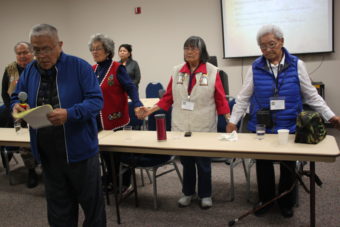
Tlingit elder Della Cheney talks during a panel discussion on boarding schools at the "Sharing Our Knowledge; A Conference of Tlingit Tribes & Clans." In the 1920s and 1930s, Cheney's parents attended Sheldon Jackson School in Sitka. (Photo by Lisa Phu/KTOO)
Tlingit elder Della Cheney talks during a panel discussion on boarding schools at the “Sharing Our Knowledge; A Conference of Tlingit Tribes & Clans.” In the 1920s and 1930s, Cheney’s parents attended Sheldon Jackson School in Sitka. (Photo by Lisa Phu/KTOO)

By talking about boarding school experiences, Tlingit elders in Juneau are turning painful memories into sources of healing – healing for themselves and generations still living with the consequences.

The nonprofit arm of the local urban Native corporation is using those stories to create a K-12 curriculum that will focus on the impacts of colonization on the Tlingit people.

Della Cheney and other elders have been meeting once a month at Goldbelt Heritage Foundation since August.

“We’re helping to write down the story of how boarding schools are affecting us and our families today, so that our children and grandchildren will know the history and realize the changes our families, our people faced,” said Cheney, who’s originally from Kake. She was part of panel of Tlingit elders during the recent clan conference in Juneau.

From the late 1800s to the mid-1900s, the federal government split up families and forced Native children into boarding schools to assimilate. Many were also raised in orphanages.

“That time is still walking with us today,” Cheney said. “The people who were raised with no love or affection in a very hostile environment also raised their children without much nurturing or affection. So today we see some of our families suffering from abuse.”

Cheney said both her parents attended Sheldon Jackson School in Sitka. Her mother was only 10 when she was brought there in 1923.

“It just breaks my heart to think that I was raised in such a loving family and to know that my mother and father weren’t,” Cheney said.

But those who went to boarding schools persevered, Cheney said. In Kake, they fought to make the village a first class city in 1951, allowing the community to operate its own school system.

Emma Shorty is from Teslin, Yukon. She was 4 years old when she was taken away from her home in 1937 to go to residential school in Carcross.

“We were never allowed to go anywhere,” Shorty said. “We had to stay in one yard. They put a fence around the school. They used to lock the fence and when we went to bed, they would lock our doors and there were no bathrooms to go to, so we got into trouble for wetting our beds.”

Shorty said she was molested at the school.

“I learned to forgive. I wasn’t always kind. Residential school just about killed my spirit. Today I forgive them,” Short said.

She fought hard to have her first daughter go to public school, even though she was turned away again and again for being Tlingit.

Tlingit elder John Martin said boarding schools "was a form of prison." (Photo by Lisa Phu/KTOO)
Tlingit elder John Martin said boarding schools “was a form of prison.” (Photo by Lisa Phu/KTOO)

John Martin went to boarding school in Eklutna and then to the St. Pius X Mission in Skagway, “but instead of Christianity, there were some ugly things that went on.” Martin said he would not speak about it.

Martin said many of the elders are still hurt.

“By putting us in boarding schools, it was a form of prison,” Martin said. “They disrupted our learning process of the language. They actually took a way of life from us when our elders were teaching us how to gather food.”

Martin said telling the stories from that time and identifying the hurt is the beginning of healing.

Developing the new Goldbelt Heritage curriculum is a multi-year process. Besides boarding schools, it will also share the history of the Douglas Indian Village burning and the Douglas Indian cemetery relocation.

The curriculum will be used during summer academic programs at Goldbelt Heritage and will be available for the Juneau School District.

Obama honors Alaskan who turned grief to service

Bonnie Carroll was awarded the Presidential Medal of Freedom Tuesday. (Photo by Liz Ruskin/APRN)

President Barack Obama this evening bestowed the Presidential Medal of Freedom on Alaskan Bonnie Carroll. She’s a military widow who founded a service organization, the Tragedy Assistance Program for Survivors, to help family members of those who die in uniform. Many of the 16 others honored with her at the White House today are household names or Hollywood icons: Willie Mays, Yogi Berra, Barbra Streisand, James Taylor and Steven Spielberg. Carroll may not be as well-known, but her life was already cinematic.

As President Obama put it, when Bonnie Carroll’s world was turned upside down, she healed by helping others.

“And each year TAPS holds seminars and workshops for military families across the country,” Obama said at a ceremony in the White House East Room. “Through their Good Grief camps they bring together children of our fallen to learn how to cope with loss, to honor the legacy of their heroes and to try to have some fun as well. As one Gold Star child who lost her father in Iraq said: Because of TAPS I know someone is by my side.”

The award is the nation’s highest civilian honor. But Carroll’s journey never lacked for superlatives. Consider her love story. In 1988, Carroll was a West Wing aide drawn into an unfolding drama in the Alaska Arctic. A family of gray whales was marooned in a rapidly freezing ocean. President Reagan asked Carroll to offer White House assistance. So Carroll called the commander of the Alaska National Guard, Tom Carroll. And he turned out to be the love of her life. Their story is a plotline in “Big Miracle,” a Hollywood movie about the whale saga.

They married, and Carroll moved to Anchorage, where she worked in the district attorney’s office. Then, in 1992, Gen. Carroll and seven other soldiers died when their plane crashed as they approached Juneau. Bonnie Carroll, speaking just before the White House ceremony, recalled how stunned she was.

“It does not sink in for a very long time that something of that magnitude is real. It’s impossible to comprehend,” she said. “You cannot possibly understand at that moment that you will never see that person again.”

At the D.A.’s office and as a volunteer, Carroll had worked with crime victims. She had even helped family members cope with a prior military plane crash.

“I thought, with all this experience and training when the Army Guard crash happened I thought, ‘Well, I’ll be able to help everybody. I’m so … prepared,’” she said.  “And that fantasy lasted about 30 seconds.”

When your heart finally allows your brain to grasp the enormity of it, Carroll says, the grief is debilitating.

“But the strongest support I found was with the other widows, who also lost their husbands on that day, in that crash,” she said.

From that experience, she founded the Tragedy Assistance Program for Survivors, in 1994. The nonprofit, like so much else, transformed after 9/11. Carroll says TAPS and the Red Cross were the only two organizations within the Pentagon’s family assistance program.

“So we were there, on the front line for those families. And today many of the Pentagon surviving families are now peer mentors, to our newly bereaved of today,” she said. “So from that, we really transitioned very quickly to a whole new organization, to a new level of response and care.”

With the wars in Iraq and Afghanistan, along with suicides, illness and accidents, Carroll says the family members helped by TAPS grew to more than 50,000.

She says she’s not sure exactly how she came to be considered for the Presidential Medal of Freedom.

“We’re very blessed to have the support of the commander in chief who personally recognizes service and sacrifice. I don’t know who actually did the nominating but I take this as recognition of the sacrifices of this nation.”

Among others honored with Carroll were Indian treaty rights activist Billy Frank, baseball great Yogi Berra, Broadway composer Stephen Sondheim,  Maryland Sen. Barbara Mikulski and violinist Itzhak Perlman.

Search suspended for missing Unalakleet elder

The search for a missing Unalakleet elder has been suspended. Alaska State Troopers had been searching for 74-year-old Vivian Foote since last Wednesday.

Foote was last seen walking near her home in the early afternoon. The community — led by the Unalakleet Search and Rescue team — conducted a preliminary search for the missing woman before notifying Troopers of her disappearance around 6 p.m. Wednesday.

Alaska State Troopers. (KNOM file photo)

Troopers arrived in Unalakleet two days later to investigate and assist with the search. As of Monday afternoon, all search efforts — including sweeps by four rescue dog teams and more than 120 community volunteers — have found no sign of Foote.

Rescue efforts escalated from door to door searches on the day Foote went missing, to shoulder-to-shoulder sweeps across city limits the day after. Rescue dog teams were flown in from Anchorage and Fairbanks after a crowdfunding campaign raised money for their charter. They were also unable to find any sign of Foote.

The dog teams left Unalakleet Sunday night to avoid the incoming winter storm, and Troopers called off their search Monday afternoon.

Middy Johnson is a coordinator with the Unalakleet Search and Rescue team. On Sunday, he said the community would continue its search with closer looks at the outskirts of town and along the water.

“It does get tiring a little bit, but right now we’re hanging in there,” Johnson said. “We’ve had plenty of calls from other communities that are on standby — just waiting for us if we want to expand it more and need more personnel. So we appreciate that, and we’ll just keep going until we’ve exhausted all our efforts or until we find her.”

Troopers say Foote may suffer from medical ailments. Anyone with information on the whereabouts of Vivian Foote should contact the Alaska State Troopers and the Unalakleet Search and Rescue Team.

In Tennessee, Giving Birth To A Drug-Dependent Baby Can Be A Crime

Brittany Crowe just completed an addiction treatment program that helped her regain custody of her children. Here she holds Allan, who was born with neonatal abstinence syndrome, as her son James stands behind them. Ari Shapiro/NPR
Brittany Crowe just completed an addiction treatment program that helped her regain custody of her children. Here she holds Allan, who was born with neonatal abstinence syndrome, as her son James stands behind them.
Ari Shapiro/NPR

In the United States, a baby is born dependent on opiates every 30 minutes. In Tennessee, the rate is three times the national average.

The drug withdrawal in newborns is called neonatal abstinence syndrome, or NAS, which can occur when women take opiates during their pregnancies.

In the spring of 2014, Tennessee passed a controversial law that would allow the mothers of NAS babies to be charged with a crime the state calls “fetal assault.” Alabama and Wisconsin have prosecuted new mothers under similar laws, and now other states are also considering legislation.

Supporters of the laws say they can provide wake-up calls to women dependent on drugs and encourage them to get help. The Tennessee law says that getting treatment for drug use is a valid defense against fetal assault charges. But critics say criminalizing the effects of a woman’s drug dependence on her newborn child makes it less likely for her to seek help when it could do the most good.

The problem of NAS is growing nationwide. Nearly 6 in 1,000 babies born in the U.S. in 2012 were diagnosed with NAS, according to a study published in the Journal of Perinatology in August. That’s nearly double the level seen in 2009.

In Tennessee, billboards on the side of highways declare, “Your baby’s life shouldn’t begin with detox,” with an image of a newborn baby’s foot attached to a medical monitor. The signs are strategically placed in areas with the biggest substance abuse problems, like Oak Ridge — a town surrounded by poor, rural communities in northeastern Tennessee.

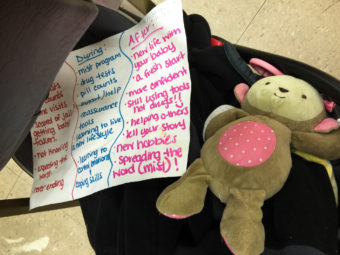
On a drizzly Monday afternoon in Oak Ridge, a group of women sits in a circle in a low brick building. Some of these women have their babies — bouncing on their knees or rocking gently in car carriers. These women are all in recovery, and some are recently out of prison for fetal assault. The group is called Mothers and Infants Sober Together, or MIST, and provides outpatient treatment for mothers addicted to drugs.

Each woman takes her turn checking in with Michelle Jones, who runs the MIST program. The women talk about their challenges and triumphs, their cravings. One pregnant woman admits to feeling guilty for being on a medicine prescribed by her doctor to ease her cravings for opiates.

“Can I say something? Don’t feel guilty,” another woman pipes up, “because it’s going to help you right now.”

Jones sits in the circle with them, week after week, asking questions and prompting them to open up. It’s not an easy task. Many of them were afraid to talk at first.

Avoiding Prenatal Care Out Of Fear

Brittany Crowe used to be one of those women. Now, she shares her story.

“I could have gone [to] a baby doctor at first, but I was scared because of the new law,” Crowe tells the group. When she was pregnant with her youngest son, she was addicted to prescription drugs and knew that if she went to a doctor, a drug test would come back positive. So she stayed away. She had no prenatal care through her entire pregnancy. She was so afraid of going to jail and losing custody of her children that she considered giving birth at home.

“I worry about that a lot now,” she told us later. “I wonder how many babies are not known about because the mothers are afraid to get help, and then they’re born at home and nobody ever knows about these babies. If they’re going through withdrawal so bad, they’re going to pass away.”

Crowe finally went to the hospital 10 minutes before she gave birth. Her son was born with neonatal abstinence syndrome. The Department of Children’s Services took him and her older children away and put them in foster care. Crowe enrolled in the MIST program to get clean.

One mother details her journey with addiction in a group therapy session at Mothers and Infants Sober Together. Mallory Yu/NPR
One mother details her journey with addiction in a group therapy session at Mothers and Infants Sober Together.
Mallory Yu/NPR

Crowe’s experience points to one reason medical professionals and social workers oppose the fetal assault law: They worry that the law will keep women from getting medical care. Dr. Jessica Young, an OB-GYN at Vanderbilt University who specializes in addiction during pregnancy, says the law has made her patients afraid.

“So now they’re making decisions on medical care out of fear rather than out of science or what is best for them and their baby’s health,” she says. “Fear makes people make rash unsafe decisions without the consultation or guidance of a physician.”

State Rep. Terri Lynn Weaver, a Republican who co-sponsored the bill, argues that critics misunderstand its intent.

“We want to get these women help,” she says. They “weren’t getting help — not going to prenatal care anyway. Their mindset is not on prenatal care. The mindset is on the next drug.” She hopes the law can act as a wake-up call to addicted women that will motivate them to seek help.

Some of the mothers at MIST told us the law did scare them into getting help. When Jessica Roberts got pregnant, the law drove her to enroll in rehab twice, but it didn’t make her quit. She relapsed both times, injecting herself with opiates.

“What finally broke me was, I was 31 weeks. I had tied off to hit myself. And I put my arm on my stomach. And [the baby] kicked my arm off. And that broke me,” she says. “To me, it was like my baby saying ‘Mom, you can’t do this anymore. I need you.’ And it hurt.”

Treatment Slots Hard To Find

When Roberts wanted help quitting cold turkey, she had a hard time finding it. Not many rehab clinics will detox a pregnant woman, and the few that do have long waiting lists. Doctors disagree on whether detoxing a pregnant woman is really best for mothers and their babies. Instead, most physicians recommend a gradual tapering of less harmful medications like methadone, paired with a comprehensive addiction treatment program. Those programs are scarce, however, and often have long waiting lists of their own.

Young’s clinic at Vanderbilt, for instance, has a waiting list of up to eight weeks, and the majority of her patients have to drive over an hour to see her.

At the state Department of Children’s Services, Connie Gardner says it feels like Tennessee is “drowning in the drug problem,” and nobody has thrown the state a life preserver. She understands why mothers view her office with distrust and fear. The department makes the decision about when babies should be taken from a mother and put into foster care.

“None of these mothers wakes up and says, ‘I’m going to abuse my child today,’ ” Gardner says. “None of them wakes up and says, ‘I’m going to be a bad mother.’ What I have to remember is that they do. They can get better. What’s frustrating, what’s disappointing is that we don’t have the tools to help them get better.”

Even the law’s advocates acknowledge that there isn’t enough help for the women who want it. Barry Staubus, the district attorney for Sullivan County in the northeast corner of Tennessee, has prosecuted more than 20 drug-using mothers this year.

“Of course I’m for funding programs and making those programs available,” he says. “There’s always the call for more funding, but we can’t let that get in the way of a good idea … or an effective program.”

Staubus believes that there need to be real consequences to women who chronically abuse powerful prescription drugs while pregnant. He says the threat of jail time would scare even the most defiant women, who had been previously unwilling to get into a program.

The Tennessee law is set to expire next year, unless state legislators renew it. So its effectiveness is under close scrutiny.

Births Of Addicted Babies Up In Nashville

At Vanderbilt Hospital’s Neonatal Intensive Care Unit in Nashville, the persistent squealing cry of newborns going through drug withdrawal provides an audible reminder that this problem is far from solved. In the year and a half since this law took effect, the numbers of NAS babies have not gone down, says Dr. Stephen Patrick, who researches neonatal abstinence syndrome at the hospital. He saw 100 cases last year, and the hospital is on track to see at least that many this year. He doesn’t think punishment is the right way to solve this problem.

NAS is a treatable condition in newborns, he says, and there isn’t enough research to know what its long-term effects on a child might be. “There was a lot of concern about the cocaine epidemic and Time magazine calling it a ‘lost generation.’ I think we should be really cautious in how we frame this moving forward,” he says. “The evidence really doesn’t support that for neonatal abstinence syndrome. And, in fact, we know that other substances, legal substances such as alcohol, are far more harmful long-term to infants.”

On a warm fall afternoon, Crowe and her children are at the park. Her older kids play in a stream as she holds her youngest on her hip. He’s 9 months old, with big blue eyes and a tuft of blond hair.

One of her boys runs up to her, a mischievous smile on his face.

“Don’t you splash me,” she warns, but there’s amusement in her voice.

He giggles and Mom gets a faceful of muddy water. She laughs as she wipes it from her eyes. He splashes her again.

Is she having second thoughts about having her children back?

“I think it’s a little too late,” she says, laughing. “I can honestly say a year ago I wouldn’t have been here.” She’s grateful to be here now. Free of drugs, and finally reunited with her children.

This is the first story in a series that was produced by All Things Considered in collaboration with Nashville Public Radio reporter Blake Farmer.

Copyright 2015 NPR. To see more, visit http://www.npr.org/.
Read original article – Published November 18, 201510:17 PM ET


11 homeless puppies arrive in Sitka

Eleven homeless pups landed in Sitka on Thursday. The dogs, recovered from Ketchikan, will be ready to adopt shortly. (Brielle Schaeffer/KCAW photo)

Meet Brandi, Peaches, Bamboo, Hunter, Chuckles, and Boomer.

There’s also Taffy, James, Bearhood, Chip and Spot. The fluffy cargo safely arrived at the Sitka Rocky Gutierrez Airport on Thursday and were promptly whisked away to the animal shelter.

The dogs are a long way from home. They are a part of a larger group rescued from a residence in Ketchikan last month after their owner passed away leaving 40-plus animals. After being recovered by Alaska State Troopers, the dogs were taken to the crowded shelter there until Sitka Animal Control Officer and shelter director Ken Buxton went to get them. And he wanted to get them collared and taken care of as soon as he got on the ground.

Buxton mobilized Sitkans to raise money to relieve the Ketchikan shelter. As of Thursday, he gathered some $1,400 to help pay for a chartered Harris airplane, but it didn’t quite cover the cost. Buxton says he hopes to raise some more funds now that he has the pups here.

“Pictures of cute dogs always help,” he said.

And they are adorable.

“The ugliest one is the cutest dog I’ve ever seen,” Buxton said.

He says the pooches are most likely terrier mixes. Some may have a touch of dachshund.

“They’re mutts,” he said. “So are we.”

Buxton says it’s hard to know their ages, but some may be around 1-year-old.

“Can’t cut them open and count the rings,” he said, “but whatever life they have left is certainly meaningful.

The dogs are related, but a few have shaggier hair. A couple short-haired, black ones have matching white tufts of diamond-shaped fur on their chests.

Some of them have skin, eye, ear and teeth problems, but Buxton is treating them with medication.

“The people in Ketchikan started their recovery and we’ll finish these particular dogs recovery over here.”

Buxton says the dogs are surprisingly well-behaved considering the circumstances. They get along well and don’t fight over food. The dogs will be open for adoption on Tuesday and ready to take home after getting spayed and neutered.

Eleven homeless pups landed in Sitka on Thursday (11-5-13). The dogs, recovered from Ketchikan, will be ready to adopt shortly. (Photo by Brielle Schaeffer/KCAW)
Eleven homeless pups landed in Sitka on Thursday. The dogs, recovered from Ketchikan, will be ready to adopt shortly. (Photo by Brielle Schaeffer/KCAW)

“We don’t have a dog problem the way the other all the Southeast communities do,” Buxton said. “And I’ve theorized on it and I’m a firm believer is that part of the reason is the vets around here performing that spay or neuter regardless of somebody’s financial standing.”

Trish and David Durham were part of a team of volunteers who picked up the dogs from the airport. The whole story is a comfort to animal lovers,” David Durham says.

“It’s nice to know that in a situation such as this communities can get together to provide homes for perfectly adoptable pets whose pet owner just happened to have a health issue,” he said.

Even better than that is the animals will be going to grateful homes in Sitka,” Trish Durham said.

“There will be lots of happy families pretty soon,” she said.

At this time, Buxton says he is not looking for foster homes for the dogs. He just needs to figure out a walking schedule.

The Sitka Animal Shelter already has a waitlist of people who want dogs. If you’re interested in adopting, call the shelter at 747-3567 to set up an appointment.

New Y-K Delta foster care program struggles to get off the ground

The Office of Children’s Services Building in Bethel. (Photo by Lakeidra Chavis/KYUK)

A new foster care program aimed at helping keep Western Alaska children in their communities is in development. It incorporates therapeutic methods to help fix behavioral issues in the home that might be affecting both the child and parent. But the program is facing problems with one major hiccup — no one has signed up yet.

Now, multiple agency officials are working to raise awareness about the program.

Fennisha Gardner, the protective services manager for the Office of Children’s Services’ Western region, says the goal of bringing therapeutic foster care to this part of the state, is simple: to keep children in the Yukon-Kuskokwim Delta.

“So out of the 56 villages, we would like to have some type of hub of therapeutic foster homes,” said Gardner. “In which case, the child would be able to stay closer to their culture, to their relatives, to their parents.”
There’s just one problem.

“I do not have a “yes,” yet,” said Gardner. “I still need the communities to come together and bring somebody forward,” said Gardner.

Therapeutic foster care carries the basic framework of regular foster care, but it’s designed to offer mental and behavioral health treatment to children who have suffered severe trauma, like abuse. The program also works to improve the behaviors of the parent.

AK Child and Family is the licensing agency for the delta.

Doug White is the agency’s director of community programs, and he says the name ‘foster care’ in the title may be bit misleading.

“They simply need a placement out of their home for a period of time, for the family and children to address any behavioral issues that they might be having,” said White.

Therapeutic foster care parents are trained on mental health issues, solutions to handling them and community resources available to assist the child.

Success in the program is measured by its ability to keep children in their communities, instead of sending them elsewhere for these types of services.

“When that link is broken is broken within the family system, it’s often very difficult to get children back,” said White. “We hear time and time again from families and elders that children leave for treatment and don’t come back for years.”

White says the factors for becoming a successful therapeutic parent are flexibility, openness and understanding. These qualities don’t necessarily equate to a certain income or education level.

But there are some barriers.

Part of the requirement of becoming a therapeutic foster parent is two-month training in Anchorage. However, the agencies are trying to find ways to have the training in a hub, like Bethel.

In general therapeutic foster care is more community-centric. Social workers conduct more house checks, and families interact with health care professionals more, they have to attend treatment-planning sessions, take the child to appointments, and complete daily reports on the child’s behavior.

Currently, OCS and AK Child and Family, among other agencies in the delta, are meeting once a month to discuss ways to increase public awareness.

They’ve focused on foster parents currently in the Delta. But to date, no one has committed to the program.

Yurii Miller, an OCS licensing manager, says reasons for not participating may in part be due to the time commitment needed for training and the amount of paperwork.

Miller acknowledged that part of the challenge is that the program is designed to work best in a bigger city, like Anchorage—a place filled with more resources. But they’ve applied this framework for the program elsewhere–like Nome.

“I will say this much, it’s been done in other communities and it’s been successful,” said Miller. “I think it just takes a lot of planning on behalf of the agency and children services. The resources are there, it’s just a matter of putting them together.”

As of September, there are 191 children in out-of-home foster care in Western Alaska. The number of foster parents in the region is 151, but this number also includes people currently applying to become a foster parent. In Bethel alone that number is 33.

The number of people applying to become foster care parents, in the region has remained steady and is mostly comprised of family members.
In Alaska, there are 43 therapeutic foster parents. But Miller says the biggest barrier in the delta, seems to be the time commitment to becoming one.

Site notifications
Update notification options
Subscribe to notifications