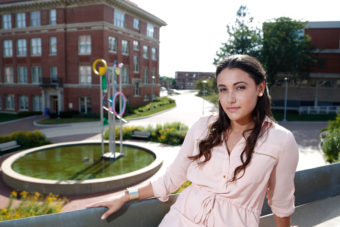
Valerie Davidson, commissioner of the state’s Dept. of Health and Social Services, led the panel on tribal-state child welfare in the AVCP region. (Photo by Anna Rose MacArthur/KYUK)
Keeping tribal children in their tribal communities is the solution to improving regional child welfare, panelists said Monday at the Association of Village Council Presidents annual convention

The panelists represented a range of local, regional and state organizations and said the approach to keeping children in their tribal communities is two-pronged.
The first is by training more foster parents in each village. There is especially a need for therapeutic foster parents. Such parents receive extra training and an additional stipend to provide behavioral health services to foster children.
Panelist Fennisha Gardner, Southwest regional director of children services, said currently there are no therapeutic foster parents in the Bethel area. Without these parents, many children are removed from their homes because they require therapeutic services not available in their communities.
Panelist Linda Ayagarak-Daney, an AVCP social worker, said many foster parents are acting in a therapeutic way by engaging their foster children in cultural practices like berry picking, subsisting and boating.
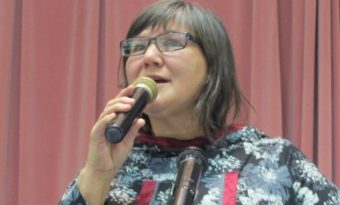
Monique Vondall-Rieke. (Photo courtesy of South Dakota State University)
Another solution panelists offered was to continue establishing and empowering tribal courts. Many panelists said tribes, not the state, know best how to care for their children.
The AVCP recently hired Monique Vondall-Rieke to help establish tribal courts throughout the region. Her vision is to create 25 to 30 new courts. To do that, she will soon begin tribal court assessments in AVCP villages.
Vondall came from working with the Chippewa Tribe in North Dakota as a tribal judge and attorney. She was also responsible for writing tribal court code.
The convention goes until Thursday at the Bethel Cultural Center.
Ken (left) and Henry were created using DNA plucked from a skin cell of Melvin, the beloved pet of Paula and Phillip Dupont of Lafayette, La. Edmund D. Fountain for NPR
It’s a typical morning at the Dupont Veterinary Clinic in Lafayette, La. Dr. Phillip Dupont is caring for cats and dogs in the examining room while his wife, Paula, answers the phone and pet owners’ questions. Their two dogs are sleeping on the floor behind her desk.
“That’s Ken and Henry,” Paula says, pointing to the slim, midsize dogs with floppy ears and long snouts. Both dogs are tan, gray and white, with similar markings. “I put a red collar on Ken and a black collar on Henry so I can tell who’s who.”
Ken and Henry are genetically identical, though not exact replicas. They’re clones of the Duponts’ last dog, Melvin — created when scientists injected one of Melvin’s skin cells, which contained all of his DNA, into a donor egg that had been emptied of its original DNA.
Ken and Henry are two of only about 600 dogs that have been cloned since scientists at Sooam Biotech, a suburban company near Seoul, South Korea, developed the technology to create cloned canines.
The Duponts sat down with Shots to explain why they decided to clone Melvin.
“He was different,” says Phillip Dupont. “Of all the dogs I had, he was completely different.”
Melvin was supposed to be a Catahoula leopard dog, Louisiana’s state dog (sometimes called a Catahoula hound). Turned out, Melvin was a mutt, probably part Catahoula and part Doberman.
“I paid $50 for him,” says Phillip. “But I wasn’t going to return it. I thought for a while I was going to put him to sleep.” Then he changed his mind. “Turned out to be the best dog I ever owned.”
The Duponts have lots of stories about what made Melvin the best dog they ever owned, including the time Melvin found car keys Phillip had lost in the tall grass. The couple trusted the dog so much they let him babysit their grandson in the backyard all by himself.
“He listened,” says Phillip. “You could talk to him and you swore he understood what you were talking about. It was weird.”
So a couple of years ago, when Melvin was about 9 and starting to show his age, the Duponts turned to a lab in South Korea. Even though the process would cost them $100,000, the couple decided to do it. They’d already spent that much on a Humvee, Phillip notes. “So, what the heck?”
He sent some of Melvin’s skin cells off to the lab — the only place in the world that is cloning dogs for pet owners. The first cloned puppy soon died from distemper. The lab tried again, this time producing two healthy clones.
For a while it was like having three Melvins. The personalities of the dogs, the Duponts say, are very similar. But less than two years later, Melvin’s time came.
“It was hard,” says Phillip, choking back tears.
Having the clones — Ken and Henry — helped the couple cope with the loss.
“They come running through the house and jump in your lap — a 75-pound dog sitting in your lap, watching TV.” They still miss Melvin, they say, but having two more dogs so similar to him has helped “quite a bit.”
Most of the dogs cloned so far have been for grieving pet owners. Some have been for police agencies looking for special skills — bomb-sniffing, for example.
But not everyone thinks this idea is so great.
“If you love dogs and you really want to have your companion animal cloned, you really do need to take very seriously the health and well-being of all the dogs that would be involved in this process,” says Insoo Hyun, a bioethicist at Case Western Reserve University.
To clone a dog you need to use a lot of other dogs to serve as egg donors and surrogates, Hyun explains, and that means many dogs are undergoing surgical procedures. Most of the time the process doesn’t work; many attempts are required to produce a single clone.
“I think there are probably better ways to spend $100,000 if you really care about animals,” Hyun says.
He also wonders about the health of Sooam’s cloned puppies. Most cloned animals end up pretty sickly — all that for a dog that isn’t even an exact replica of the original.
“All cloning does is reproduce the genome of your original pet,” Hyun explains.
“But maybe the way your dog interacted with you — and even the way it looks — was also strongly environmentally influenced.” You can never duplicate that kind of influence, Hyun says.
When pressed about how much the clones are really alike, the Duponts admit there are little differences, much as differences show up among identical twins. The white stripe on Henry’s nose is a lot wider than Ken’s, and Henry weighs a bit less. Ken is more of a loner. But that’s about it for differences, the couple insists.
“They’re so much like Melvin it’s unreal,” Phillip Dupont says. So far, he adds, both clones seem perfectly healthy.
As far as whether other dogs suffered in creating theirs — the Duponts dismiss that notion, based on what they saw at the lab when they visited twice to pick up their clones.
“Even though South Koreans eat dogs, they love their pets,” Phillip says. “They’ve got rooms for these dogs to sleep in, with beds. They’ve got technicians who sleep with the dogs. And [the dogs] are all well cared for.”
He says the lab staff told him that after dogs have served as donors or surrogates, “they’re fixed up and go to new homes.” (Sooam Biotech did not confirm or deny that assertion when NPR asked what happens to the dogs the company uses as donors and surrogates).
The Duponts also say they don’t feel bad about spending so much money to create cloned dogs, when so many other dogs need homes.
There will always be strays on the road and too many dogs at the animal shelter, because irresponsible owners don’t spay or neuter their pets, Paula says. In contrast, she says, families that clone their pets don’t do it “with the idea of producing 10 more. We’re looking at having the one special dog again.”
Or, in their case, two special dogs again, and maybe one more. The Duponts are already talking about cloning Melvin again — for their grandson.
Copyright 2015 NPR. To see more, visit http://www.npr.org/.
Read Original Article – Published SEPTEMBER 30, 2015 6:33 AM ET
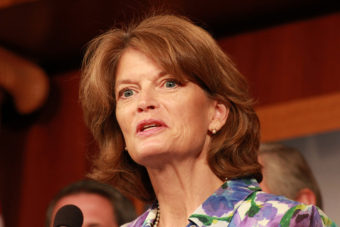
Sen. Lisa Murkowski. (Photo by Lingjing Bao/Talk Radio News)
After the Pope left the Capitol Thursday, the U.S. Senate took another procedural vote on a bill to defund Planned Parenthood, this one linked to a stop-gap measure to fund the government.
Sen. Lisa Murkowski was one of eight Republicans to vote against advancing the bill. She sided with Democrats who say cutting Planned Parenthood funds would limit access to healthcare and contraception.
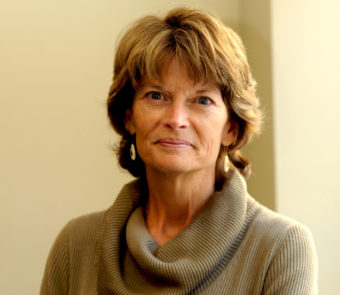
As expected, the bill failed to get enough votes to move. Senate leaders have teed up another bill to fund government, without funding Planned Parenthood.
Murkowski is unpredictable on bills related to abortion. In August, she voted to advance another bill to defund Planned Parenthood, saying she hoped to limit the bill’s effects with a later amendment.
Even a few hours before the vote this afternoon, Murkowski couldn’t say which side she would choose.
“I have made very, very clear to anyone who is within range of listening that I do not support shutting down the government. Period,” she said.
But the senator says she doesn’t believe federal funds should be cut off to all of Planned Parenthood.
“Your reality is then those facilities in Alaska that provide for the STD testing, some of the other services, will not have those resources. And that is very troubling,” she said. “The women of Alaska, and I think women around the country, need to make sure that they don’t have a disruption of service.”
Nationally, Planned Parenthood has been under fire after videos secretly recorded by anti-abortion activists surfaced. The videos show Planned Parenthood employees discussing the sale of aborted fetal tissue with the activists, who pose as representatives of a tissue procurement company.
A federal law already bans spending federal money on elective abortions, but anti-abortion groups say Planned Parenthood is able to perform more abortions because its clinics are supported with federal money.
Sen. Dan Sullivan voted with the majority of Senate Republicans, in favor of advancing the bill.
Murkowski said before Thursday’s vote she needed to see the details of the legislation.
“We’ve had a couple of different views about whether or not its complete elimination of funding of Planned Parenthood funding for the year, or whether it’s just the Title X portion,” she said. Title X refers to federal family planning programs. “That to me is important. So that’s where I’m going now, is going back (to) pull up that bill.”
Murkowski also explained why she missed a vote on Tuesday on another abortion bill, that one to ban abortion after the 20th week of pregnancy. The senator says she was in Texas, raising money for her re-election.
“I had made, months and months ago, made arrangements to do a fundraising swing, and had put in place these plans at the early part of the summer,” she said.
Murkowski says when she made her plans, she predicted the Senate would not have any votes that day, and that turned out to be the wrong call.
“I do regret not being here for the vote because that’s your responsibility,” she said.
The abortion ban also failed to get enough votes to pass. She disappointed anti-abortion groups with a follow-up statement saying she wouldn’t have supported the bill anyway. Murkowski says she could support a late-term abortion ban, as long as it had adequate exceptions.
Sen. Lisa Murkowski. (Photo courtesy of U.S. Senate Committee on Energy and Natural Resources)
A bill to ban abortions after the 20th week of pregnancy has failed to advance in the U.S. Senate. Sen. Lisa Murkowski, who has angered both sides of the abortion debate in the past, did not vote on Tuesday’s bill.
As her spokeswoman Karina Petersen explains it, Murkowski did not intentionally duck the abortion vote.
“The senator missed the vote this morning because she had prior travel commitments,” Petersen said. “She had reviewed the Senate calendar earlier this year and made travel plans based on the timing of the Jewish holidays and the fact that the Senate historically not been in session around those holidays.”
But this year, the eve of Yom Kippur coincides with the arrival of Pope Francis in Washington, and the Senate’s Republican leadership scheduled a vote on the abortion bill for the same day.
Only 54 senators voted to advance the mid-term abortion ban. That’s six short of the number needed to proceed. According to Murkowski’s spokeswoman, her presence would not have put sponsors of the bill any closer.
“Sen. Murkowski supports a woman’s right to make her own reproductive choices, however that support is not without limits,” Petersen said, reading from a prepared statement. “She opposes late-term abortion and supports restricting abortion after 20 weeks, so long as there are clear and workable exceptions, such as for victims of rape and incest and in cases where the life of the mother is threatened. While she does not support the bill that the Senate failed to advance today, she could support future legislation that meets this standard.”
Sen. Dan Sullivan did vote for the ban, as did Congressman Don Young when the bill passed the House in May. But Murkowski, who is up for re-election next year, does not fit neatly into either side of the abortion debate.
Last month, supporters of abortion rights were furious when she voted to proceed on a bill that would have defunded Planned Parenthood. Murkowski says she hoped to amend the bill to just defund affiliates if any are found to have broken laws against the sale of fetal parts. Now, the anti-abortion side is unhappy with her, too.
“We are very disappointed and … she’s clearly confused about this legislation and its popularity among her constituents,” says Mallory Quigley, communications director for the Susan B. Anthony List. The anti-abortion group ran web ads over the summer asking Murkowski to support the 20-week ban.
The Alaska Democratic Party, meanwhile, put out a press release after the vote, saying Murkowski “caved in” to right-wing interests.
So where was Murkowski traveling to or from that caused her to miss the vote?
“I don’t have that information to share. Sorry,” said Petersen, the spokeswoman. “The senator has things listed on her schedule that are listed as private. I know and am privy to the information that is official office travel and official appearances. If she’s is having dinner with her husband I wouldn’t have that information.”
Ditto, Petersen says, for fundraising events. She says Murkowski returns to Washington Wednesday night, in time for the Pope’s address to Congress on Thursday. And, it appears, in time for another procedural vote on defunding Planned Parenthood, this one linked to averting a government shutdown.
After his mother-in-law’s death, NPR’s Marc Silver found her go-to cookbook, filled with her copious annotations to recipes. He used it to piece together her take on mandelbread, a Jewish version of biscotti, and other holiday favorites. Akash Ghai/NPR
We’re welcoming an unseen guest to our Jewish holiday celebrations this fall: My mother-in-law, Jan Dale, who died in 2005.
Since her passing, I’ve tried to keep Jan a presence at our festive meals with my attempts to bake some of her favorite recipes. For instance, to mark the start of Yom Kippur Tuesday night, I’ve made a batch of Jan’s crumbly, cinnamon-scented mandelbread — that’s Yiddish for “almond bread,” a twice-baked cookie that’s the Jewish version of biscotti.
But getting here has taken a bit of detective work.
While she was alive, our family relished Jan’s holiday baking: her poppy seed cookies (a perfect blend of crisp and chewy), her moist honey cake. But I never thought to ask for her recipes. So when we said goodbye to Jan, it seemed we’d also have to say goodbye to her take on these treats.
A few days after Jan died, we went through her possessions and found her go-to cookbook, stained and dog-eared: Our Favorites … with Cocktails and Coffee. The spiral-bound book contains recipes from women in her chapter of Hadassah, a Jewish women’s volunteer group. It appears to have been printed in 1980, but it’s redolent of the 1950s, when Jan and many of her Hadassah comrades would have been raising families and cooking dinner every night.
I felt as if I’d found the Holy Grail.
As I read the cookbook, I could see that Jan was not just a follow-the-recipe baker. The book is filled with notes in her Palmer-perfect handwriting, as well as alternative versions of recipes on slips of paper. But which version did she prefer?
The author’s mother-in-law, Jan Dale, pictured with her granddaughter Maya in the late ’80s. (Maya got married this year and baked all her wedding cakes herself.) Courtesy of Marc Silver
That was just one of the questions I had. “Why did you change the oil quantity from one cup to half a cup in the mandelbread?” I wondered. (Probably she’d answer, “Who needs all that oil?”) Why did you write “wash and drain” on the poppy seed recipe, then cross the words out? And then there were the missing elements — like a pan size for the honey cake. She most likely had a cake pan she’d always use, but that sure didn’t help me.
Through trial and error, and by consulting with other cooks, I solved some of the mysteries. For example, Jan called for “one tablespoon of baking powder” for the mandelbread. When I took a batch to my mother, she took one bite and said, “Too metallic — how much baking powder did you use?” With her guidance, I reduced the amount to two teaspoons (although I’ll never know why Jan called for the larger amount).
Rose Levy Beranbaum, author of The Cake Bible and a baking blogger, helped solve the “wash and drain” instruction for poppy seeds. Apparently, folks used to think that washing poppy seeds would remove the bitterness associated with them. But in fact, poppy seeds quickly turn rancid once they’re opened, and washing won’t help.
The solution, says Beranbaum, is to store poppy seeds in the freezer for freshness. That would have appealed to Jan. I figure someone told her about washing seeds, she wrote the instruction down, then thought, “Who needs that extra step?” (she was a big believer in less is more) and crossed it out.
I love piecing back together Jan’s recipes. I feel as if I’m having a conversation with my mother-in-law about something both of us love — cooking.
As for the desserts I make during the holiday season, they definitely bring Jan back to join us. When my wife tasted the mandelbread last night, tears came to her eyes: “It’s my mother’s recipe,” she said wistfully.
But I can’t compete with Jan’s prowess. When I’ve asked my kids to judge my mandelbread attempts over the years, they’ve declared, “They taste just like Nana’s, only not quite as good.”
I guess there are some ingredients only a grandmother can bring into the mix.
Marc Silver is the senior editor and host of NPR’s Goats and Soda blog. A version of this essay was published in 2006.
Jan’s Mandelbread
“You’ll learn how your mother-in-law came up with the recipe she liked if you try the different versions,” advised cookbook author Pam Anderson. So I did. And I learned. The version that called for one-third of a cup of orange juice made the dough a little too crumbly. But the following recipe is pretty darn close to Jan’s excellent mandelbread (or “mandel,” as she called it).
Jan did not include the instruction to bake the cookies a second time after slicing the loaf. I’m sure she would say, “Too much trouble.” The result is a softer cookie that my kids like a lot. But I prefer a slightly crisper cookie, so I do a second bake, either at 250 degrees or 325 degrees for 20 minutes (flipping the slices over after 10 minutes.)
The temperature depends on how toasty you’d like the final cookie to be. One final note: Jan sometimes used maraschino cherries in the recipe. I decided to substitute dried cherries, and while they didn’t add much color to the final product, they do provide a nice burst of chewy cherry flavor.
Makes about 4 dozen cookies
3 eggs
1/2 cup oil
1/2 to 1 cup sugar (depending on how much of a sweet tooth you have)
1 teaspoon vanilla extract
2 tablespoons orange or lemon juice
3 cups flour
2 teaspoons baking powder
1 cup sliced almonds or chopped nuts (I used walnuts, which is what Jan used to do)
1 cup dried fruit (optional)
1 cup chocolate chips (optional)
Cinnamon-sugar
Preheat oven to 350 degrees.
By hand or mixer, beat the eggs, oil and sugar into a yellow, creamy-looking mixture.
Whisk in vanilla and juice.
Combine dry ingredients and mix in by hand. (Note: I substitute 1 1/2 cups of King Arthur’s mild-tasting white wheat flour for regular flour — it adds fiber but doesn’t alter the taste.) The dough should be firm and a little stiff, with the consistency of Play-Doh. If dough is too moist to handle, add up to 1/2 cup more flour.
Knead in almonds and dried fruit (golden raisins or cherries get my vote) and/or chocolate chips.
Knead into a ball. Slice the ball into four wedges.
Roll each wedge into a rope about 12-14 inches long, 1 inch in diameter.
Prepare two baking sheets with foil. Spray foil with oil.
Place two ropes on each sheet, about 4 inches apart. Sprinkle each rope of dough with cinnamon-sugar mixture.
Bake for half an hour. Remove and let cool.
Reduce oven heat to 325 degrees or 250 degrees, depending on your crispness preference.
When the loaves are cool, slice on a diagonal. You’ll get about a dozen slices per loaf.
Lay the slices flat on the foil of the baking pan. Sprinkle again with cinnamon-sugar.
Return to oven for the second baking of 20 minutes. (Flip slices after 10 minutes.) Or, if like my mother-in-law, you don’t want to bother, just dig in. They’re delicious.
Jan would store her mandelbread slices in a tin, on sheets of aluminum foil. That’s how she brought them to our house when she’d visit.
Copyright 2015 NPR. To see more, visit http://www.npr.org/.
Read Original Article – Published SEPTEMBER 22, 2015 2:28 PM ET
The Essure contraceptive device is placed in the fallopian tubes, where it causes scarring that blocks sperm from reaching eggs. Courtesy of Bayer HealthCare
After their third son was born, Tisha Scott and her husband decided they were done having kids. So Scott, 34, of Drakesville, Iowa, decided to get her tubes tied.
“As old married people, neither of us was really interested in using condoms for the rest of our life,” Scott says. “So that was the decision that we made because we knew that our family was complete.”
But instead of undergoing surgical sterilization, Scott’s doctor urged her to try something called Essure — the only available, nonsurgical permanent birth control option approved by the Food and Drug Administration.
Essure is a device comprising two tiny coils made of nickel-titanium alloy. Scott’s doctor inserted one into each of her fallopian tubes to permanently block them. Since Essure doesn’t require surgery, he said it would be a lot easier, quicker and safer.
“He felt if there was no reason to do surgery then we shouldn’t,” Scott says.
But almost immediately after the procedure Scott started getting an excruciating burning pain in her back and pelvis. “All of a sudden it hurt to have to move my body to get out of bed, to do anything,” she says.
The pain got worse and spread all over her body. Despite two operations and many tests and exams, Scott says she still lives in constant pain.
“It feels like you’ve been hit by a truck every day of your life,” she says. “For me, it’s been a nightmare. I mean, this device literally ruined my life.”
Scott is among thousands of women who blame Essure for a variety of complications, including pain, heavy bleeding, fatigue, hair loss and depression.
Because of complaints, the FDA has asked a panel of outside experts to take another look at Essure during a public hearing on Thursday.
“This device has been sold to tens of thousands — probably hundreds of thousands — of women as a very safe and easy way to permanently end any concerns about pregnancy,” says Diana Zuckerman, who heads the National Center for Health Research, a Washington-based watchdog group that has been studying Essure. “We know that’s not accurate,” she says.
Zuckerman says that Bayer, the company that makes Essure, didn’t fully inform the FDA about the problems the device can cause when it got the device approved in 2002. And while Essure is supposed to be 99 percent effective, Zuckerman says recent research suggests it may actually fail about 10 percent of the time.
“What we’d like to see is new research that’s carefully monitored that can actually tell us how often women have these serious complications from Essure and how often the product does not work to prevent pregnancy. That’s what we really need,” Zuckerman says.
Officials at Bayer defend the device.
“There’s a significant amount of data out there regarding the safety and efficacy of Essure,” says Edio Zampaglione, the company’s vice president for women’s health care.
Zampaglione acknowledges that the device can cause complications, but says they only occur rarely.
“What we believe and feel is that these women represent the small percentage of women who have had a bad experience with it,” Zampaglione says. “There’s nothing that we do or take in the medical world that is 100 percent adverse-event free,” he says.
For most women, Zampaglione says, getting sterilized with Essure is quick, easy, safe and totally reliable. That was the case for Jennifer Jenkins, 33, of Dallas. She got Essure about two years ago during a quick stop at her doctor’s office on her way to work.
“I had no problems,” Jenkins says. “My husband likes to say the only side effect I’ve experienced is that I haven’t been able to get pregnant, which has been a good thing.”
An earlier story on the questions surrounding Essure ran in Shots in July.
Copyright 2015 NPR. To see more, visit http://www.npr.org/.
Read Original Article – Published SEPTEMBER 21, 2015 5:02 AM ET