Family

Health Law Increases Coverage Rates For Women Not Yet Pregnant

The Affordable Care Act brought health insurance to 5.5 million women over the past two years, but many  women still tell of unmet health care needs that could pose risks for them or future pregnancies, a new report finds.

Researchers from the Urban Institute and the March of Dimes Foundation underscored the ACA’s long-term potential to improve health care for women in their child-bearing years, 18 to 44. The report was released Tuesday.

The health law, in addition to making insurance available to more women, also established maternal and newborn care as essential benefits for all health plans. They must also provide free preventive services, such as gynecological exams, and free supplies such as breast pumps.

Past studies have shown that costs prevent women from getting necessary medical care when they lack insurance, and that women who get services before and between pregnancies can improve their health and that of their future children.

“They’re getting the coverage they need and that’s the first step,” said Cynthia Pellegrini, senior vice president of public policy at the March of Dimes Foundation. The foundation funded the report as a first effort to monitor the health law’s impact on maternal care and birth outcomes.

Researchers drew on data from the Health Reform Monitoring Survey, a quarterly online survey that is monitoring the ACA’s impact before federal survey data is available. It is funded by the Robert Wood Johnson Foundation and the Urban Institute.

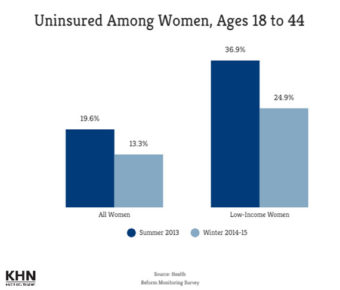
The rate of uninsured women in their childbearing years dropped to 13.3 percent in winter 2014-2015 from 19.6 percent in summer 2013, representing an increase in coverage for 5.5 million women, the report said.

Uninsured among women, ages 18 to 44Other changes: Smaller shares of women overall reported problems paying family medical bills and having unmet needs for care because of cost than in the previous year. Both trends also held true for low-income women.

Despite signs of progress, the report said more remains to be done. Low-income women in states that did not expand Medicaid under the ACA did not achieve the same gains as low-income women in expansion states.

Almost a quarter of low-income women in their childbearing years remained uninsured last winter. Nearly half of low-income women – and almost four in 10 overall — reported an unmet need for care due to cost last winter, despite improvement on that issue since 2013, the report said.

Health care postponed for financial reasons could suggest that women who can buy insurance – instead of going on Medicaid – are choosing high-deductible plans under the health law. Those charge lower premiums but require users to first meet an annual deductible – and pay thousands of dollars for health care services themselves – before insurance kicks in for subsequent services.

“You’d have a high psychological concern about cost, no question about it. You’d also have a reluctance to see a doctor,” said David Newman, executive director of the Health Care Cost Institute, a nonpartisan nonprofit.

Another possible explanation for a woman missing needed care is the expenses associated with taking time off work if she is an hourly employee and possibly paying for transportation and childcare.

“For low-income women without great benefits, there are all sorts of issues that stop them from getting to the doctor. Access to insurance isn’t going to alleviate those other problems,” said Atul Grover, chief public policy offer at the Association of American Medical Colleges.

The challenge for future health care enrollment periods will be reaching more minority and low-income women, said Claire Brindis, a professor of health policy at the University of California, San Francisco.

“We’re still at the beginning of a major upheaval,” she said.

Read Original Article – Published October 27, 2015
Health Law Increases Coverage Rates For Women Not Yet Pregnant

Ketchikan overwhelmed after 40 animals removed from home

Two of the dogs impounded at the Ketchikan animal shelter Oct. 9th. (Photo by Maria Dudzak/KRBD)
Dogs impounded at the Ketchikan animal shelter. (Photo by Maria Dudzak/KRBD)
Entering the kennel area at Ketchikan’s Pat Wise Animal Shelter, you are greeted by a chorus of nonstop barking, each dog jumping up on the kennel gate seeking attention. With the shelter at near capacity, staff is extremely busy, and volunteers have been stepping up to help. One volunteer is Susan Thompson.

Thompson is a member of the Ketchikan Humane Society board. She says she usually focuses her time with that organization, but when she heard about the overwhelming number of animals, she decided to help out. She was laundering bedding when I spoke with her.

“I feel terrible for the whole situation. I feel terrible for the woman and her family and particularly for these little animals who don’t know where they are or why they are and they’re scared and confused and need some help. And the shelter officers need help,” Thompson said.

Earlier this month more than 40 animals, mostly small dogs, were removed from a home and taken to the shelter. The question now is what to do with all the animals and how to care for them while they are waiting to be placed in homes.
On Oct. 9, Alaska State Troopers were called to a North Tongass home where they found an elderly woman in need of medical assistance. The North Tongass Volunteer Fire Department responded to the medical call and transported the woman to PeaceHealth Ketchikan Medical Center. She was later medevacked to Seattle. In the home Troopers found more than 40 animals. They contacted Ketchikan Gateway Borough Animal Protection for help.

Animal Protection Director Eddie Blackwood was one of the people who responded.

“They were living in substandard conditions,” Blackwood said. “They had some issues with medical conditions such as skin problems, eye problems, ear infections, things like that.”

Blackwood says the floor of the small, dilapidated home was covered with about 6 inches of feces. Removed from the home were 31 small dogs, 6 cats and three chickens. Blackwood says one dog, one cat and one duck were found dead in the home. At the shelter, Animal Protection moved healthy animals upstairs to make space for the dogs in the kennels downstairs.

Blackwood says because the homeowner was incapacitated and unable to verbally surrender the animals to the shelter, they are not the property of the Borough and therefore cannot be fostered or adopted at this time.

“The Alaska State Troopers are the lead investigators on this,” she said. “So we are in the process of making contact with family members to either make arrangements for these animals or have them signed over to the shelter.”

As of Saturday afternoon, surrender or transfer of ownership of the animals had not occurred.

Blackwood believes the shelter will get custody of the animals soon and, once they are declared healthy by the veterinarian, can be placed for adoption or fostering. In the meantime, Blackwood says donations are appreciated.

Disclosure: Maria Dudzak volunteers at the shelter.

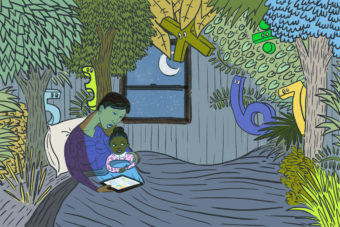
Where The Wild Fractions Are: The Power Of A Bedtime (Math) Story

Where the wild integers are
(Image by LA Johnson/NPR)

Parents who are uneasy about their own math skills often worry about how best to teach the subject to their kids.

Well … there’s an app for that. Tons of them, in fact. And a study published today in the journal Science suggests that at least one of them works pretty well for elementary school children and math-anxious parents.

A team from the University of Chicago used a demographically diverse group of first-graders and their parents — nearly 600 in all — across a wide swath of Chicago. One group got to use an iPad app called Bedtime Math, built by a nonprofit with the same name. (The app is also available for Android, but we’re told most used the iPad version) The no-frills app uses stories and sound effects to present kids with math problems that they can solve with their parents.

The control group was given a reading app with similar stories but no math problems to solve. The results at the end of the school year?

I reached out to University of Chicago psychology professor Sian L. Beilock, one of the paper’s lead authors, to find out more.

I read to my child all the time. But I don’t read bedtime math stories. After reading your study, maybe I should?

Our study suggests that doing Bedtime Math with your kids can help advance their math achievement over the school year, and this might be especially important for parents who are a little bit nervous about their own math ability.

That’s me! How big an increase and what kind of improvement did you see when kids used this iPad app?

We compared kids who used the Bedtime Math app that involved reading stories and doing math problems with their parents to kids who did a very similar app that didn’t have the math content. We showed that when kids frequently used the app with their parents, those who used the math app were three months ahead in terms of math achievement relative to kids who just did the reading app.

Your team found that the app worked even better for children whose parents tend to be a bit anxious or uncomfortable with math?

Many adults in the U.S. and around the world profess to be uncomfortable or anxious about math. Oftentimes dealing with your kid around math can be a nerve-wracking experience — whether it’s homework or just talking about it. We found that doing this Bedtime Math app with kids was especially beneficial for those kids whose parents tended to be the most nervous about math. In essence, these kids grew significantly throughout the course of the year and looked like kids whose parents weren’t anxious about math by school year’s end.

And you saw improvement even in children who used the app with parents as little as once a week?

Yes, it was somewhat surprising to us that such little use would have such important benefits. One of the ideas is that we think that when parents get comfortable with talking with their kids about math — it doesn’t have to be complex math problems, it could be anything from shapes to even counting — they likely engage in math talk even when they’re not using the app. And we know that parents who talk more with their kids about math — whether you’re counting out the number of cookies or counting the minutes to bedtime — those kids tend to achieve at higher rates in math.

Bottom line for you: A little bit of math can go a long way, at least in terms of this one study’s findings?

That’s exactly what we’re showing.

There are a lot of apps out there. Why’d you choose this app in particular? What was special about it?

There is certainly a billion dollar education app industry out there. What we’ve realized in our initial work is that a lot of it isn’t based on research. It’s unclear what the benefits are. In fact, there has been some research that shows that apps with lots of bells and whistles can actually be detrimental to kids’ learning because it distracts them. We base our investigations on learning science.

We’ve shown that, when parents interact with their kids and talk with them about math, that really impacts what kids learn. We were interested in this because it really is a no-frills app, an easy way for parents to interact with their kids, to talk with their kids about math. It’s not an app that they use by themselves. And we thought that that potentially had promise in terms of what math knowledge kids gained.

I admit I’m kind of a math-anxious parent. But when doing stuff like woodworking, I try to incorporate a little geometry and basic measurement whenever I can. “Hey, let’s measure this again! Twenty-four inches — how many feet is that?” It’s a fun way to sneak a little bit of math in.

And to realize that math is part of everything we do, and math is not something scary or that one should be anxious about. And it’s really healthy to try to incorporate that into daily life. And often, as you said, parents think about reading bedtime stories, but there is a place for thinking also about bedtime math.

Culturally and socially, it seems we don’t think about math as integral a part of parenting as reading. And few adults would say, “I’m not so good at reading.” But many people say, “I’m not so good at math.” And somehow that’s socially acceptable.

Yes, in my book, Choke, where I talk about stress and performance, I mention how you don’t hear people walking around bragging that they’re not good at reading. But very intelligent people brag about not being good at math. And it turns out that that anxiety and social acceptability has implications for our nation’s success in math and science fields. And it’s really important that we as parents and teachers and adults try to convey to our kids that math is something that’s (a) enjoyable and (b) learned. You’re not born a math person or not; it’s something that’s acquired. And every time we talk about it and we integrate it into our daily lives, children may see the importance of it and that math is not something to be fearful of.

Where do you think some of that math anxiety comes from?

Math anxiety comes likely from lots of different places. Previous work that my group has done shows that teachers who tend to be anxious about math affect their kids’ perceptions of math and what they learn across the school year. We also know that when parents are anxious about math they can transfer that to their kids, especially when they’re helping a lot with math homework. We tend to point to the schools to be the source for math knowledge. But kids spend lots of time outside of school and get lots of information from parents and from other adults. So being cognizant of how we talk about math and how we integrate it into our daily lives is important — both inside and outside the classroom.

Did you see any improvements in the parents’ math ability by any chance [laughs]?

Ha, well, that’s a really interesting question. We are just looking into those questions now. You can imagine that for parents who have a fear of math or less than optimal math training, it might take more than one school year to move the needle for them. But we are seeing improvements with their kids. And that’s a first step. And we will be looking (in future studies) at how parents think about math, how they do in math, and most specifically their attitudes when interacting with their kids.

So there is hope for me?

There is hope for all of us! And, as you said, integrating these sorts of counting and math activities into daily routines is a great way to socialize both kids and their parents to the benefits of math.

Copyright 2015 NPR. To see more, visit http://www.npr.org/.
Read Original Article – Published OCTOBER 08, 2015 2:08 PM ET


Human skull discovered in dirt pile delivered to Haines raptor center

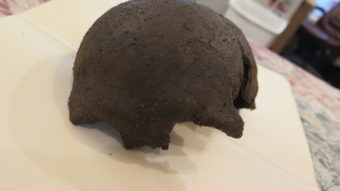
Part of a human skull was found in a dirt pile at the American Bald Eagle Foundation on Monday. (Photo courtesy Cheryl McRoberts)

A human skull was found in a pile of dirt last week in Haines. Employees at the American Bald Eagle Foundation were working on improving accommodations for raptors residing there when the skull was unearthed.

Chloe Goodson, the raptor curator at the Eagle Foundation, got quite the surprise while working outside on the property.

“We were shoveling away, there were just three of us — myself, another staff member and an intern — and suddenly we struck something that wasn’t quite breaking apart and we were sort of wondering ‘what is this object?’ One person said ‘Is this a coconut?’ another person said, ‘Is it like a clay pot or something? This is really weird.’ One of the interns said she could see traces of where blood vessels were so we were thinking ‘What kind of animal was this at some point?’ So, we turned it around and turned it around then we came face to face with a human skull. You could see the top of the ridges for the eyes and part of the bridge of the nose was still there between the eyes.”

Goodson says the dirt pile was delivered from a site at 6.5-mile Haines Highway. They were working to convert two sheds into aviaries for the raptors.

“Everyone was pretty much just in shock — eyes wide, jaws dropped. This doesn’t happen to real people, this is something that you’d only see in a movie or something,” Goodson said.

She says they stood there in utter astonishment for a moment before alerting foundation director Cheryl McRoberts and calling the police.

Interim Police Chief Robert Griffiths says the police are working with local tribal organizations.

“We have a human skull that was found that’s an ancient artifact so we’re coordinating the excavation of that site in cooperation with both of our tribes in town,” the chief said.

Haines police responded and initiated an investigation Monday afternoon. Griffiths says local anthropologist Anastasia Wiley examined the artifact and determined the skull belonged to a female Native American at least 40 years of age and likely dates to before the 1700s.

Griffiths says that the State Medical Examiner’s Office is looking at photographs of the skull. When the origin and age of the skull is determined, it will be returned to ancestors in the area for a traditional burial.

“If it’s truly an antiquity, and we believe it is based on our limited knowledge of it, then the medical examiner will simply turn it back over to us to release to the family and in this case the family would be the descendants, which, in this case, would be the local Native organizations,” he said.

When police arrived they found another small piece of bone in the pile. Goodson says watching the anthropologist examine the skull and make her observations was fascinating.

“She just came to the conclusion of older, possibly female, Native American before the 1700s and she just went into all of the explanation for that and it was just really impressive.”

Goodson says she volunteered to help go through the dirt pile with Wiley and other volunteers this weekend.
“When I took the job as raptor curator, I never thought I would dig up human remains, so that was pretty interesting.”

The site at 6.5-mile will also be excavated to see if there are other remains in the area.
Wiley was unavailable for an interview.

‘I thought he was safe,’ brother says of man found in wetlands

At The Glory Hole, James Knudson, 57, cries intermittently while talking about his brother, John Knudson, who died last month. (Photo by Lisa Phu/KTOO)
At The Glory Hole, James Knudson, 57, becomes emotional while talking about his brother, John Knudson, who died last month. (Photo by Lisa Phu/KTOO)

There are moments when James Knudson forgets his younger brother, John Knudson, is dead.

“Riding on the buses, I start looking out where we used to see him, around Switzer or A&P or down at the bus barn, places you know he hung out. I catch myself looking for him,” Knudson says.

His brother’s body was found in the Mendenhall Wetlands in mid-September. Juneau Police said he had likely been in the water and exposed to the elements for at least several days. His body was sent to the state medical examiner.

John Knudson, 56, is one of at least eight people who have died outside in the past three years. These are just the ones we know about based on the 2012 Juneau Homeless Coalition survey.

John Knudson during his younger adult years. (Photo courtesy Jennie Knudson)

Juneau Police still don’t know what caused Knudson’s death. His brother James Knudson doesn’t either, but he has a theory: “My suspicion is that he was by either Switzer Creek or Lemon Creek and fell in there and then got washed out.”

Knudson says his brother was staying with a friend in the Lemon Creek area. He assumed he was safe, even though he hadn’t heard from him in a few weeks. The two brothers had always looked out for each other.

“If somebody got in a little scrap with somebody else, somebody would show up and help out. But this time I didn’t have any feeling. I thought he was safe,” Knudson says.

Knudson is staying at the Bergmann Hotel at the moment. He says he’s been homeless for 10 years. He says his brother became homeless when he split up with his girlfriend.

“He had his issues with alcohol, like other people, like I do at times,” Knudson says. “It’s a tough life living on the streets. I’d been there and we’d both lived on the streets together at different times.”

Just one year apart, the two brothers — of seven children total — were close growing up and as adults. They were both born in Juneau but spent their early years in Hoonah.

John Knudson's school picture. (Photo courtesy Jennie Knudson)
John Knudson’s school picture. (Photo courtesy Jennie Knudson)

James Knudson’s favorite story about John is one their mom used to always tell.

“My dad had just gotten back from deer hunting, had a couple deer hanging out in the shed. That night my brother came up to me. He had a butter knife in his hand, goes, ‘Jer, let’s go hunt some deer.’ That’s what they called me, ‘Jer.’ I looked at my brother and go, ‘What if we run into a bear?’ Holding a butter knife, he goes, ‘We’ll jump on his back,'” Knudson says, laughing.

Knudson says his brother fell into the wrong crowd at a young age, got in trouble and paid for it the rest of his life. Knudson says his brother went to a mining trade school.

“The instructor thought he would be a good mine worker, but with his felony, he couldn’t get a job at the mine. I tried to talk to him about it. I guess some people can work around a felony as far as working in the mine, but my brother just wouldn’t look into it,” Knudson says.

Instead, John Knudson went into construction and mechanical work.

“He’s a real good worker. It’s just alcohol got the best of him,” Knudson says.

Knudson continues to struggle with alcohol. He’d been sober for two months, but started drinking again while planning his brother’s memorial services. He says John’s body will be cremated, his ashes spread over their parents’ graves.

John Knudson would’ve been a candidate for Juneau’s Housing First project. If the remaining $2.4 million in funding is secured by January, the project could be complete as soon as 2017.

“In the meantime, we should just not accept this as an acceptable reality, because it’s not acceptable. It’s not acceptable to have people die on the street,” says Glory Hole Executive Director Mariya Lovishchuk.

If you see someone laying outside, ask if they’re OK. If they’re not, call for help.

“We just need to treat people like human beings,” Lovishchuk says.

A memorial service will be held for John Knudson on Sunday, Oct. 4 at 6 p.m. at the Tlingit-Haida Community Council Building on Hospital Drive.


Many Former Foster Youths Don’t Know They Have Health Care

Laticia Aossey was hospitalized while a student at the University of Northern Iowa when she realized she hadn't signed up for health insurance. Matthew Putney/Courtesy of Youth Today
Laticia Aossey was hospitalized while a student at the University of Northern Iowa when she realized she hadn’t signed up for health insurance.
Matthew Putney/Courtesy of Youth Today

Laticia Aossey was flat on her back in an Iowa hospital bed with a tube up her nose, a needle for a peripheral IV stuck in one arm and monitors pasted to her body. It was early June 2014, a week after her 18th birthday, when a friend brought Aossey’s mail from home — including one ominous letter. Aossey’s health insurance was about to be discontinued.

“My heart dropped. I just wondered to myself, ‘Are they going to pull this tube out, unhook me from everything and roll me down to the street?’ ” Aossey said. “Could I get the medicine I needed?”

When children “age out” of foster care at age 18 in Iowa, they are eligible to receive Medicaid under the Affordable Care Act until they turn 26. But Aossey, a ward of the state as a foster child, had not filled out the necessary paperwork. Then she fell ill with stomach ulcers, acid reflux and cyclical vomiting.

She was in college at the University of Northern Iowa in Cedar Falls, and instead of using her dormitory address she had used a friend’s home address. The state Medicaid office sent the paperwork to complete her health care enrollment to her friend’s address in Iowa City, so she did not receive it right away.

“The first call I made from the hospital to get it straightened out, the woman said, ‘Your parents need to call,’ ” Aossey said.

“My parents? I was in foster care. I had no parents. Then she said my caseworker, an adult, my boss, somebody … [other than] me had to call. She wouldn’t talk to me. I was 18.”

Aossey’s doctors finally calmed her fears, and a couple of days later, she said, a caseworker arrived to help her complete the paperwork. She realized she could have managed that before things became complicated in the hospital.

“Be an adult,” Aossey advises other foster youth. “Find a way to do your paperwork. Do not rely on other people for something you should do.”

Aossey is one of 400,000 foster youth in the nation, and one of approximately 23,000 per year who age out of foster care when they turn 18 (or 21 in some states). They are all eligible for Medicaid, regardless of income, under the Affordable Care Act until 26.

Federal law requires states to cover former foster youth, and the federal government provides Medicaid matching funds to pay for it. But 21 states chose not to expand their Medicaid programs under Obamacare. And some states make enrollment for former foster youth easier than others.

“In some states, where the state is not embracing ACA in general, there wouldn’t be a particular incentive for them to inform young people of their eligibility,” says Celeste Bodner, founder and executive director of Foster Club, a national advocacy organization for foster youth. “If you want to call that a hostile environment, I don’t think that is a stretch.”

In California and New York, youth who age out of foster care are automatically enrolled in Medicaid. But even then, social services providers say they often need help figuring out health care.

The Jewish Child Care Association, which serves 750 foster youth of all faiths and backgrounds in New York City, puts significant resources into getting teens in foster care ready to be independent. A state-funded program includes guidance on filling prescriptions and managing health care.

“Navigating anything as a 20-year-old under the best of circumstances is tough and anxiety-provoking,” said Ronald E. Richter, CEO of the JCCA and a former commissioner of New York City’s Administration for Children’s Services. “Not all 20-year-olds come in for help with a smile on their face. Systems are not built for an anxious, stressed out 20-year-old.”

California automatically enrolls foster youth in Medi-Cal, its Medicaid program, but even that seemingly foolproof method has its glitches.

The Covered til 26 campaign, run by the advocacy organization Children Now, has tried to canvass the foster youth population, yet some slip through the safety net because of coding issues or questions about eligibility, changing addresses, incarceration, health issues and the sheer complexity of the system.

And in states without automatic enrollment, “What tends to happen when kids age out of foster care is that nobody tracks them, nobody keeps in touch with them,” said Bodner, of Foster Club. “It is extremely difficult to get word out to kids age 18 to 26 who are eligible. It can be an issue because that 18 to 26 population is really tough to find, there is no master list or a mailing list. This group is particularly transient.”

Many former foster children also would qualify for Medicaid based on income, but they may not be aware that they are eligible because of their foster status.

“It’s a complete maze,” said Bodner. “They get tracked into an income-qualification category as opposed to the automatic eligibility.”

Medicaid coverage for former foster children takes the place of insurance coverage that other young adults are eligible for through their parents, according to Jessica Haspel, a senior associate who handles welfare policy for Children Now in California.

“These are youth that have experienced abuse and neglect and the state has become their parent,” Haspel said. “It is giving them an equal protection other youth have had. It is about equity.”

Ray Glier writes from Atlanta. This story was produced by Youth Today, the national news source for youth-service professionals, including child welfare and juvenile justice, youth development and out-of-school-time programming.

Copyright 2015 NPR. To see more, visit http://www.npr.org/.
Read Original Article – Published OCTOBER 01, 2015 1:51 PM ET
Site notifications
Update notification options
Subscribe to notifications