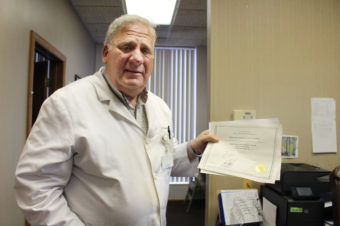
Dr. David Burkons holds the licensing certificates that allowed him to open a clinic that provides medical and surgical abortions. It took about 18 extra months of inspections, he says, to get the approval to offer surgical abortions. Sarah Jane Tribble/WCPN
Dr. David Burkons graduated from medical school and began practicing obstetrics and gynecology in 1973, the same year the Supreme Court issued its landmark abortion decision in Roe v. Wade.
Burkons liked delivering babies. But he is also committed to serving all his patients, including those who choose abortions.
On a recent day a 30-something woman comes to the clinic. She is six weeks pregnant. Her birth control failed her, she says. Burkons greets the woman warmly as she comes to the clinic for the second round of the medical abortion process, a two-dose drug regimen to end a pregnancy.
“We’re going to give you this,” Burkons says, handing the woman the pills.
“And what are these two?” asks the woman, who requested anonymity.
On this day a steady stream of women visit Burkons’ clinic for medical abortions.
Since the Roe v. Wade decision, Ohio has been a trendsetter in passing restrictions on abortion. So it is especially unusual that in a small Ohio town, an hour south of Cleveland, a new clinic that performs abortions opened its doors last year.
Burkons wanted the clinic to be personable, with minimal wait times.
Initially in his new clinic, he could only administer the pills that induce medical abortion. But this summer, after 18 months of state inspections, rejections and — finally — acceptance, he began performing surgical abortions as well.
Dr. David Burkons opened his clinic in Cuyahoga Falls, Ohio, on a busy commercial strip in early 2014. Sarah Jane Tribble/WCPN
For any woman wanting to take these pills, Ohio requires more clinic visits than medically necessary, and it makes their use illegal after seven weeks of pregnancy. In many other states that restriction comes at nine weeks of pregnancy.
Ohio’s laws are examples of how seemingly narrow rules can significantly curtail abortion. Mike Gonidakis, who leads Ohio Right to Life, says broader bills that propose stopping abortion entirely rarely get approval. “We believe in an incremental approach to both the legislative side as well as the changing [of] hearts and minds,” Gonidakis says.
Another Ohio law, similar to one in Texas, requires doctors at clinics that perform abortions to have admitting privileges at local hospitals, in case of an emergency. These laws allow hospitals to grant specific doctors access to their facilities, but hospitals aren’t required to grant the privileges. The U.S. Supreme Court may take up the Texas case in the fall.
Ohio has also proposed legislation that would make it illegal to end a pregnancy if the reason for the abortion is that the fetus has Down syndrome.
Lee Strang, an attorney and professor at the University of Toledo’s law school, says the incremental approach to rolling back abortion seems to be working across the country.
“At some point in the mid- to late ’70s, pro-life people recognized that they were in for the long haul,” he says. “Instead of trying to overturn Roe, at least immediately, they tried to incrementally undermine Roe through the judicial appointment process, and then through state and federal statutory restrictions on abortion.”
The Guttmacher Institute, a nonprofit that supports abortion rights, also tracks restrictions. In 2013 alone, the institute says, 22 states, including Ohio, enacted 70 provisions restricting access to abortion.
Jessie Hill, an attorney and professor at Case Western Reserve University’s school of law, sits on the board of a clinic called Preterm that provides abortion services. She said various legal provisions under the public radar have been used to restrict abortions for years.
“It’s hard for people to see how any one of these things in isolation impacts abortion access,” Hill says. “But when they add up, they can really constitute a major burden.”
Burkons says his work is very rewarding and that virtually all the women he treats are relieved and grateful.
“Nobody grows up saying, ‘I’m planning on having an abortion,’ ” Burkons says. “And they just assume that if it does happen, someone will be here.”
The clinic faced pent-up demand when Burkons started offering surgical abortions. He performed 16 of the procedures in three days.
About half of Ohio’s clinics that perform abortions have closed since 2010. Counting the clinic Burkons operates, there are now nine in the state.
This story is part of NPR’s reporting partnership with WCPN-Ideastream and Kaiser Health News.
Copyright 2015 Cleveland Public Radio. To see more, visit http://www.wcpn.org.
Read Original Article – Published AUGUST 31, 2015 3:32 PM ET
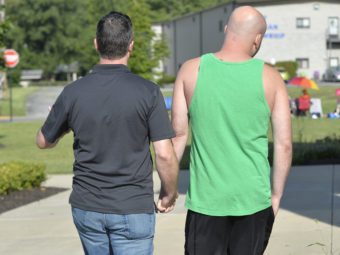
James Yates (left) and William Smith Jr. walk to the Rowan County Courthouse in Morehead, Ky., on Aug. 13 hoping to get a marriage license. They were turned away for a third time Thursday morning. Timothy D. Easley/AP
A Kentucky county clerk’s office denied a marriage license for a same-sex couple on Thursday, despite a federal appeals court ruling the night before that upheld a judge’s order compelling her to issue the licenses.
Citing religious objections, Kim Davis of Rowan County has refused to issue any marriage licenses since the Supreme Court’s ruling June 26 that legalized same-sex marriage nationwide.
She has been sued by the American Civil Liberties Union on behalf of four couples, two same-sex and two straight. A district judge had ordered her to start issuing the licenses, but Davis filed an appeal and the judge said she could wait until Aug. 31 or for a decision from the U.S. 6th District Court of Appeals — whichever came first.
The decision did, on Wednesday. In denying Davis’ bid, the appeals court wrote:
“It cannot be defensibly argued that the holder of the Rowan County Clerk’s office, apart from who personally occupies that office, may decline to act in conformity with the United States Constitution as interpreted by a dispositive holding of the United States Supreme Court. There is thus little or no likelihood that the Clerk in her official capacity will prevail on appeal.”
On Thursday morning, William Smith Jr. and James Yates were turned away for a license. It was the couple’s third try, according to The Associated Press.
The AP reports:
“A deputy clerk in Davis’ office told Smith and Yates on Thursday that the office believes [District Judge David] Bunning’s delay remains in effect until Aug. 31. He refused to give his name or give them a license.
“Davis, meanwhile, sat in her office with the door closed. She talked on the phone, ignoring the commotion as the couples, trailed by activists and reporters, poured in through the door and demanded answers.”
Davis’ attorney Mat Staver says his client is considering an appeal to the U.S. Supreme Court.
Meanwhile, another Kentucky clerk is also refusing to issue marriage licenses, calling the Supreme Court ruling on same-sex marriage a “war on Christianity.” On a West Virginia morning radio show, Casey County Clerk Casey Davis (no relation to Kim) said he was willing to “fight and die” for his cause.
“Our law says ‘one man and one woman,’ and that is what I held my hand up and took an oath to and that is what I expected,” Davis told WVHU. “If it takes my life, I will die … because I believe I owe that to the people that fought so I can have the freedom that I have, I owe that to them today, and you do, we all do.”
Copyright 2015 NPR. To see more, visit http://www.npr.org/.
Read Original Article – Published AUGUST 27, 201512:40 PM ET
People gather for the annual McPherson County All Schools Day parade. Kansas is among the states seeking to counter shrinking population in rural counties with tax incentives and other programs. (AP)
Bill Longnecker grew up in rural Nebraska and, after trying life in Kansas City, Missouri, and other urban areas, returned to his home state to start a jewelry store in Red Willow County, population 10,867.
He loves it there.
“All we need is more people,” he said. Every year when high school graduates head off to college, locals present them with a mailbox imprinted with a map of the area. “We’re hoping they’ll find their way back,” Longnecker said. Few do.
Population loss is a long-term trend in much of rural America, and it’s gotten more acute since 2010, according to a Stateline analysis. Although 759 rural counties in 42 states lost population between 1994 and 2010, more than 1,300 rural counties in 46 states have lost population since 2010.
As a result, some states with dwindling rural populations, such as Nebraska and Kansas, are trying to lure people with tax incentives, and small, shrinking localities are looking for ways to share services or cut back as the pool of taxpayers shrinks.
They’ve tried shifting schools online in Colorado, and reverting to gravel roads in North Dakota and Michigan. The 251 residents of the village of Brokaw, Wisconsin, have launched an online campaign to raise $2.5 million toward a $3.8 million budget shortfall.
“[Population losses] are immediately a slap to the local funding base for rural counties, because of the loss of property taxes,” said Arthur Scott, who works on rural issues for the National Association of Counties.
“Counties are regionalizing and sharing resources in the face of this rural flight, which is the long-term impact when the younger generation just leaves after college, because there’s no job opportunities that make it fiscally viable for you to return back home,” Scott said.
rural population loss
Enticing College Grads
Faced with declining rural populations, Kansas decided in 2011 to offer incentives to people who move to a rural county with population losses. Kansas is offering state income tax breaks to people from out of state and will repay a portion of the student loans of Kansans.
Dr. Rachael Cavenee took advantage of the program. She moved to Greeley County in 2013 after attending college in Colorado and graduate school in eastern Kansas. She started anaudiology clinic, which allows her time at home with her husband and two children.
Greeley County lost about a quarter of its population between 1994 and 2010, but has gained slightly since 2010, to about 1,300 people. Cavenee said she quickly came to love the area’s friendliness.
“My fear of moving here has evolved into a fear of ever having to move away,” Cavenee said. “This is where you can find genuine, supportive people. This is where we chose to raise our family.”
In a report earlier this year, Kansas estimated that the 330 people who got income-tax breaks in 2014 brought in more than $44 million in economic benefits. That year, 993 people got student-loan subsidies.
Some analysts are skeptical about the plan’s strategy of paying people to move to rural areas.
The program “may help a few families here and there, which is of course very important for those people and can give positive examples to some communities,” said László Kulcsár, a demographer at Kansas State University. “But we have to remember that it was designed to counter long-term depopulation, in which it is terribly ineffective.”
Nebraska started accepting applications this year for enterprise zones that would encourage new businesses in areas with declining population and high rates of poverty and unemployment.
In another effort aimed at rural Kansas, where aging business owners may have trouble cashing out when they retire, the University of Kansas School of Business has a program called RedTire that helps match college graduates to opportunities to buy rural businesses.
Michelle Reed, who moved to rural McPherson from Orange County, California, this month, said she was struck by the number of help wanted signs, businesses that closed several days a week for lack of employees, and business owners unable to cash out and retire. McPherson is a city of 13,322.
“There are older business owners who would like to sell, but there are no buyers in town,” Reed said. “We need to somehow make it hip to have chickens and farm to table in the heartland, and get the young adults to move east.”
Root Causes
Historically, despite losses in agricultural and mining areas, rural population has grown as suburbia has expanded or retirees sought scenic, low-cost destinations, according to a Junereport from the U.S. Department of Agriculture (USDA). The department excludes from itsdefinition of rural and small-town areas all commuter areas clustered around cities of 50,000 or more.
Overall, the country’s rural population dipped for the first time between 2010 and 2014, the USDA report said, as the number of people moving to economically hard-hit areas dropped. There were sharp contrasts within individual states. An oil boom gave North Dakota the largest rural population gain in the nation at 10 percent, but 16 agricultural counties on the east side of the state lost population.
Coal- and timber-dependent counties have also been hard-hit as those industries founder in the face of less expensive natural gas and as electronic, digital information reduces the need for paper.
High school students in rural Coos County, New Hampshire, a major pulp and paperproducer, were asked by researchers if it was easy for somebody their age to get a job in the county (population 31,653). In 2008, two-thirds said it was easy. Three years later, only one in five said so.
Some of the biggest rural losses are in coal country. The largest population decline from 1994 to 2010 was in West Virginia’s McDowell County, historically the state’s coal capital, which lost 38 percent. It fell another 8 percent since 2010 and the county now has about 20,000 people.
About half the rural counties in Nebraska, North Dakota and Kansas have lost more than 1 in 10 people since 1994.
Some analysts argue that simple math keeps rural college students from going home: Is there a job for me that will pay my student loans, or enough income from a small-town business or farm to support a family? Often the answer is no.
Population decline has been a fact of life in parts of Kansas for 50 years, Kulcsár, the demographer, said. What’s made it worse recently is that there aren’t enough babies to replace people who are moving out and retiring baby boomers are depriving rural areas of a large part of their workforce.
If there’s a chance to lure people back, it may be later in life, after they’ve had children, according to a USDA report released last month. This is especially true for those whose parents still live in their hometowns.
“Conversations about returning home centered on the value of family connections for child raising in a small-town environment,” the report concluded.
About 350,000 people moved out of rural counties between 2010 and 2014. In that time, only 250,000 people were born there. Counties that are more urban had more than 4 million people move in and almost 6 million births.
Effect on Government
Diminished revenue is an ongoing strain on local governments, one that the National Association of Counties thinks should be addressed by counties consolidating services and applying for grants together.
“With regional partnerships, you realize the assets of your neighbors and count on them together,” Scott said. Last year, the group put out a guide to creating regional partnerships, citing examples such as five Minnesota counties that worked to restore a railroad to get crops to market.
School has largely shifted online in Branson, Colorado, where a regional school system has just 52 students remaining in a brick-and-mortar school building, said Lori Green, the school district’s assistant business manager. The system has helped to preserve jobs in a district with shrinking enrollment, Green said. Branson is in Las Animas County, which had one of the biggest rural population losses between 2010 and 2014, with almost one in 10 of its 14,000 residents leaving.
As early as 2010, towns and counties in North Dakota and Michigan were converting paved roads to gravel—and some counties in Ohio were simply letting them erode—to save on maintenance costs, according to a Wall Street Journalreport.
Meanwhile, the residents of Brokaw, Wisconsin, which saw its population drop and tax revenue plunge since a paper plant closed in 2012, have raised $756 in their online crowdfunding effort to close the $3.8 million budget gap.
“Without money coming in, you don’t pave the roads, you don’t pick up the trash, you don’t upgrade the sewer system,” said Doug Farquhar, a program director at the National Conference of State Legislatures.
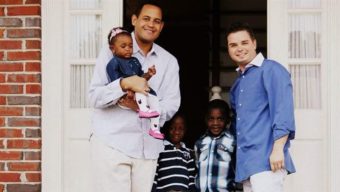
Casanova and Daniel Nurse stand with children Ava Rose, 2, and Neijal and Cameron, both 4, whom they adopted from Florida’s foster care system. Some states still have barriers for married gay couples looking to adopt from foster care. (Photo courtesy of Pew Charitable Trusts)
As soon as Daniel Nurse met baby Cameron in 2011, he knew he wanted to adopt him.
“It was just like instant love. He was so sweet and loving, and seeing him smile—it was just an instant connection,” Nurse, of Tallahassee, Florida, said of the baby, then 11 months old.
But going about adopting Cameron proved challenging for Nurse and his husband, Casanova. Florida’s 1977 ban on gay adoption had only recently been overturned when the Nurses began looking to take in foster children in 2011 with the hope of ultimately adopting them.
While same-sex couples have long been able to adopt from private, gay-friendly adoption agencies, adopting children from the foster care system has proved more difficult in some states.
The U.S. Supreme Court decision in June that made same-sex marriage legal nationwide is changing that, but not everywhere—particularly in states with laws that limit joint adoption to a husband and wife.
“Marriage doesn’t create this completely certain playing field,” said Ellen Kahn, director of the children, youth and families program at the Human Rights Campaign, which advocates for gay rights.
And some states have taken up legislation that would allow taxpayer-funded contractors that oversee state adoptions to refuse to let gay or lesbian individuals adopt children if it conflicts with the organization’s religious beliefs. Michigan passed such a law right before the court decision.
The Nurses became familiar with all these roadblocks when adopting Cameron and their two other children.
The couple found they were limited in which contractors they could work with because some wouldn’t allow gay and lesbian couples to adopt. And though Florida’s ban on gay adoption was overturned in 2010, the Nurses were unable to marry in the state until this year. Thus, they couldn’t file adoption paperwork together. The adoptions had to be filed under Daniel’s name only, and the couple faced the added time and expense of adding Casanova’s name later.
Change Comes State by State
Thirteen states—Arkansas, Georgia, Kentucky, Louisiana, Michigan, Mississippi, Missouri, Nebraska, North Dakota, Ohio, South Dakota, Tennessee and Texas—prohibited same-sex marriage before the Supreme Court decision.
All but Arkansas and Tennessee also had policies that did not allow gay and lesbian couples to adopt foster children jointly, according to the Human Rights Campaign. In Alabama, where a federal court overruled the state’s ban on gay marriage, gay couples were also not allowed to adopt jointly.
But many of those states are changing their policies in the aftermath of the Supreme Court decision. That’s the case in North Dakota, where the law allows single people to adopt but specifies that adopting couples must be “husband and wife.”
“It’s simple,” said Julie Hoffman, adoptions administrator for the state Department of Human Services. “Now that gay couples are allowed to marry, they’ll be treated like any other married couple who’s adopting.”
Georgia, Kentucky, Louisiana, Missouri, Ohio and South Dakota also are changing their practices to allow married gay couples to go through the adoption process together. Some of them said they’re starting to update their forms to make them gender neutral.
In Alabama, married gay couples will be allowed to adopt a foster child, but they’ll have to wait longer than most—the state requires married couples interested in adopting to have been married for a year before beginning the adoption process.
Mississippi is the only state that has a law that specifically bars gay couples from adopting foster children, and Julia Bryan, spokeswoman for the state Department of Human Services, said the law will be followed unless the legislature makes any changes when it reconvenes in January. However, the ban is being challenged in the courts.
The Texas Department of Family and Protective Services also will wait on the legislature before changing how it operates, according to spokeswoman Julie Moody. Gay couples in the state will have to continue to have one member of the couple formally adopt the child, she said, and then the other member has to come back later to do a second parent adoption—a similar process to a step parent adopting a stepchild.
Nebraska policy prevented unmarried couples, gay or straight, from fostering or adopting state wards until 2012, when the state started allowing gay couples to become foster parents, ultimately placing foster children with 15 same-sex couples, according to the Omaha World Herald.
A county judge recently struck down the unmarried couple ban. But the state is planning to challenge that, saying that the broad scope of the order would require its Department of Health and Human Services to treat “unrelated, unmarried adults residing together” the same as it treats individuals and married couples. A statement from the Attorney General’s Office said that would make it more difficult to make placements in the best interest of the child.
Religious Interests
Although the court decision is leading to changes in some states, others are creating new roadblocks to gay adoption.
Michigan is one of the first states to enact a law that allows groups that contract with the state to oversee adoptions to decline service to any person or couple that conflicts with their “sincerely held religious beliefs.” Similar bills were considered in Alabama, Florida and Texas.
Republican state Rep. Thomas Hooker, who worked on the Michigan bill, said he was worried that if the state didn’t pass the law, it might have lost the roughly 30 percent of adoption agencies the state contracts with that are religiously affiliated.
That has happened in other states. Some Catholic organizations in Illinois andMassachusetts shut down rather than violate their conscience by serving gay couples.
But opponents of the Michigan law say its language is too broad, giving religious organizations leeway to discriminate against not just gay couples, but single people, interracial couples, people of other faiths or anybody who they say conflicts with their faith.
“Discrimination shouldn’t be happening at all, and it shouldn’t be done using taxpayer dollars,” said Lonnie Scott, executive director of Progress Michigan, an advocacy group that lobbied against the law.
Hooker said the law doesn’t pose a disadvantage to gay couples because the organizations will have to refer anyone they turn down to an organization that is willing to serve them.
While religious groups often argue that same-sex parents could be damaging to children, nearly all research has found the opposite. A 2015 project at Columbia University assembled scholarly, peer-reviewed studies on the well-being of children with gay parents. Of 77 studies, just four found that having gay parents negatively impacts a child.
Even in states that require agencies to work with gay couples, there are no guarantees against discrimination in deciding whether to allow them to adopt.
“It’s easy to find a way to say no to a couple. It’s easy to prioritize some couples over others,” said April Dinwoodie, chief executive of the Donaldson Adoption Institute, which researches adoption policy. She said if case workers have a bias, “they can find something within a home study that doesn’t suit them or find a reason a child wouldn’t be a good fit for a home.”
‘Love Is Love’
Daniel Nurse went to Florida’s Capitol earlier this year to testify against a bill that would have protected state contractors’ ability to turn him away. He put up pictures of his family. In addition to Cameron, now 4, the couple has adopted Neijal, also 4, and Ava Rose, 2.
Nurse questioned how someone could look at faces like those and argue they didn’t deserve the home that they now have.
“Love is unconditional. Love is love, and it’s what these children deserve,” Nurse said. “A person’s lifestyle shouldn’t matter if they can provide love and compassion.”
The bill passed in the House, but later died in the Senate. It was a big year for gay rights in Florida. The legislature also passed a bill that formally removed the 1977 ban on gay adoption from law. This wasn’t just a symbolic move—it was an appellate court that overturned the ban, but the matter never came before the state’s Supreme Court.
Harley Davidson motorcycles are lined up before a recent event at the Panhandlers MC clubhouse. (Photo by Matt Miller/KTOO)
The Panhandlers Motorcycle Club has their annual Toy Run this weekend. It’s a benefit to round up toys for children at Bartlett Regional Hospital.
“People around the community have helped us so much. With open arms, they welcome the Toy Run, says Craig Fowler, president of the Panhandlers. “If you have a kid that goes into the hospital or in an ambulance and has any kind of fear, they say “What do you like? You like Barney? You like dinosaurs?” We always stockpile them every year.”
The toy run starts Sunday at 1 p.m. with the motorcycle line-up at McGivney’s and will proceed to the Douglas Fire Hall. There, ribs and pulled pork sandwiches will be served up from 2 to 4 p.m.
You can participate by donating a new stuffed toy worth at least $10 or make an equivalent cash donation.
Stuffed toys can also be dropped off at Louie’s in Douglas or the Triangle in downtown Juneau.
Elmer (l.) and Ulises Diaz were painting in the house destroyed by a landslide in Sitka Tuesday. The volunteer crew that recovered their bodies included teammates and former coaches from Sitka High School. (KCAW screenshot)
Officials have released the names of the two landslide victims recovered on Wednesday and Thursday. They have been identified as brothers Elmer and Ulises Diaz, ages 26 and 25, who were working on one of the houses on Kramer Avenue at the time of the slide.
Teams are continuing to search today for William Stortz, 62, a Sitka building official missing since Tuesday’s landslide.
Officials are hoping to finish recovery efforts today, before more rain arrives tonight. Weather forecasts are calling for significant rainfall and wind through the weekend. In a press release this morning, the city said it expects the weather will force the halt of all operations over the weekend, for the safety of the crews.
A memorial fund established for the Diaz family has raised over $12,000 by Friday morning.
Close
Update notification options
Subscribe to notifications
Subscribe
Get notifications about news related to the topics you care about. You can unsubscribe anytime.