Family

Rural Alaskans will be disproportionately affected by abortion pill lawsuit, say doctors and advocates

The building that houses the Juneau Planned Parenthood facility on May 12, 2018. (Photo by David Purdy/KTOO)

Bristelle Larsen lives in Dillingham. Twenty years ago, she became pregnant.

“I was very early on in my pregnancy and knew in my heart that I was not going to be a mom,” she said.

She worked seasonally between fish processing in Dillingham and operating ski lifts in Girdwood—jobs that require physical labor that she couldn’t manage pregnant or with an infant. So, she chose to have an abortion.

She had to travel to Anchorage, one of only three cities in the state that offers them. She was vague about her trip with employers because of the stigma that surrounds abortion.

“I just told them I needed to go to Anchorage for medical, which is really common,” she said.

She stayed at what she called a “shady” hotel because it was affordable, and she paid cash for the procedure. She says she was lucky enough to have $2,000 for travel and the bill.

She said a medication abortion, known as the abortion pill, wasn’t an option for her at that time because she didn’t live close enough to Anchorage. Her doctor didn’t want to send her hundreds of miles back to Dillingham where they couldn’t check on her. But she said she could see some benefits.

“I think it might have been less traumatic physically,” she said. “Not having to go through putting on the gown and going through the whole rigmarole.”

The rigmarole meant she had to watch her ultrasound and wait 24 hours before her procedure.

When she got home a few days later, she said she worked “light duty” at work for a week while she recovered.

That was almost 20 years ago, but the trip would be the same today. More than a quarter of people who seek abortions in Alaska travel more than 30 miles for care, according to Planned Parenthood. In rural communities off the road system, people sometimes have to fly hundreds of miles to the nearest city.

Barriers to care

Abortion is legal in Alaska, but doctors and advocates say it is not equitable or accessible because of the state’s geography and large rural population. And some say a lawsuit joined by the state’s attorney general could limit access even further by asking the U.S. Food and Drug Administration to reverse its approval of mifepristone, a drug that ends pregnancies. Doctors say it’s the most effective abortion pill on the market.

A statement from Alaska Attorney General Treg Taylor says he joined the state in the lawsuit because the federal government allows the pill to be prescribed by mail, which means even people in states where abortion is illegal can get it. That’s not the way most people in Alaska get it — Planned Parenthood, the state’s main prescriber only does so in person — but the lawsuit would still make the pill unavailable to Alaskans.

“Mifepristone is safe. It’s effective. It has been used by more than 4 million people since the FDA approved it more than 20 years ago,” said Rose O’Hara Jolley, the director of Planned Parenthood Alliance Advocates in Alaska. “So this case is baseless. There is no reason from a science standpoint, from a healthcare standpoint. It is simply about restricting access to abortion, even in states where abortion is legal.”

Geography is one of the barriers to reproductive care in Alaska. Even people in remote areas who choose to end their pregnancies with the pill usually travel because Planned Parenthood doesn’t prescribe it by mail, even though that is legal.

State data shows that roughly 1,200 – 1,300 people seek abortions per year in Alaska. The majority of them use Planned Parenthood, which is also the main provider of clinical abortions in the state. O’Hara Jolley said about half of Planned Parenthood’s patients choose the abortion pill over a clinical abortion.

“There’s so many barriers to access that removing a medically proven safe and effective way to access an abortion is going to disproportionately affect people who are already seeing barriers to care,” said O’Hara Jolley.

O’Hara Jolley said that, especially for people who live in rural areas, the cost of traveling to get care in Alaska is prohibitive. They added that about half of the people who seek abortions already have children, so those parents also have to find childcare. Safety is another barrier: Alaska has among the highest rates of intimate partner violence in the nation, and the risks only go up for pregnant people.

If the lawsuit is successful, O’Hara Jolley said Planned Parenthood will still prescribe abortion pills, but it will have to use a slightly less effective drug if mifepristone is no longer legal. Planned Parenthood would use only misoprostol, which can be up to 10% less effective. They said this will exacerbate current inequities in healthcare because people will likely need to pay more visits to the clinic.

“Abortion will still be safe and legal in Alaska,” O’Hara Jolley said. “We just will have one less method for people to choose from.”

Politics and medicine

“We need to be very aware of the direction that the legal system is going when it pertains to this sort of thing,” said Dr. Robin Holmes, a primary care provider in Homer. “The overall implication is that politicians took away physicians’ rights to prescribe medications that are safe and effective for purely political reasons.”

The clinic where Holmes works does not provide clinical abortions or prescribe abortion pills. It offers sexual and reproductive care and education for people of all income levels in the southern part of the Kenai Peninsula. It’s the only comprehensive reproductive health care for a region the size of West Virginia, Holmes said. Her role is to guide people who are pregnant through their care options, whether they want to keep their pregnancies or terminate them.

Abortion is protected in the state’s constitution through the right to privacy, but Holmes said that it can be hard to find care that feels private in small towns in Alaska.

“It’s geography, it’s insurance, it’s stigma,” she said. “Alaskans are already so limited in their access to even getting reproductive health care as far as STI screenings or long acting contraceptive options. What we don’t need is to have another political imposition to our health care access.”

She said for Alaskans who live in rural places, time-consuming travel to Juneau, Anchorage or Fairbanks is usually necessary. And for people who want to get an online prescription for the abortion pill, they might not have sufficient internet access.

Navigating options

Robin Holmes counsels people in the same situation as Bristelle Larsen was in Dillingham 20 years ago. That is, people who don’t have ready access to abortion services. Larsen says that navigating travel and care options was hard then, but shame was the biggest barrier for her.

“If you know someone who might be in this situation or opens up to you about the situation, it’s important not to assign judgment to whatever choice they’re going to make,” she said.

She said she knows people who have had abortions have gone on to have children when they were prepared and lead healthy lives.

“It’s not a sentence of doom,” she said.

A decision in the case is expected as soon as the end of this week. It could be a sentence to more medical uncertainty for rural Alaskans.


New study provides snapshot of increase in maternal deaths in Alaska

A room in Bartlett Regional Hospital’s critical care unit.(Photo by Matt Miller/KTOO)

A new study shows that twice as many pregnant or recently pregnant women died in 2021 as compared to recent years. The new data gives a more detailed view of maternal mortality at a time when Gov. Mike Dunleavy has proposed increasing Medicaid coverage for new mothers.

The Alaska Maternal Child Death Review, which produced the study, believes that many of these deaths may be preventable. The MCDR is a federally funded program that evaluates causes contributing to infant, child and pregnancy-associated deaths. The program also provides recommendations for preventing these types of deaths in the long term.

Preventable deaths occur for various reasons, notably, access to health care. Pregnancy-related deaths increased most in rural areas of Alaska where some residents seeking care were unable to access it.

“There were health care needs that these women had that they literally could not get access [to], and some of them were [for] chronic conditions,” said Melissa Bradley, an epidemiologist for the MCDR.

While the overall mortality rate has more than doubled, experts say that the number might not be telling the whole story. Many of the deaths recorded may be linked to the COVID-19 pandemic. In addition, the small numbers make it difficult to draw conclusions. The study looked at pregnancy-associated deaths in a five-year period from 2017-2021.

Factors like interpersonal violence (IPV), mental health problems, substance abuse and lack of health care contributed to the increased maternal mortality in Alaskans, the causes of which are complex, according to the MCDR.

“Social and … economic risk factors really do put people at higher risk,” said Margaret Young, the Maternal Child Health Epidemiology Unit manager for the Alaska Department of Health. She also highlighted the prevalence of historical trauma as a potentially increased risk for maternal mortality as it is closely related to IPV. Of those who died in 2021s, over half had a history of interpersonal violence.

Alaska is not the only state to see an increase in maternal deaths. The rest of the nation also saw an increase in pregnancy-associated deaths from 2018 to 2020.

While the rate of death for Alaska mothers is far too high, the MCDR hopes that its recommendations for lowering the amount of potentially preventable deaths may help decrease the overall maternal death rate in the state.

Some of the recommendations made by the MCDR include advocating for more programs to screen for potential victims of interpersonal violence and homicide, both of which are causes that led to deaths among Alaska mothers in 2021. Bradley said that increased strangulation training for health care providers may help address those at risk for preventable death. She also mentioned the importance of local care workers such as doulas and community birth workers who may be able to offer more culturally responsible care to help lower the rate of maternal deaths.

Bradley is hopeful about how the MCDR is working toward lowering maternal mortality rates in the state. “They’ve been very focused on promoting awareness and disseminating information as well as cultivating those recommendations and turning them into actionable results,” she said.

This story originally appeared in the Alaska Beacon and is republished here with permission.

Alaska joins lawsuit that would take the abortion pill off the market

Alaska Gov. Mike Dunleavy follows Deputy Attorney General Treg Taylor into a news conference at the governor's Anchorage office on Friday, Sept. 27, 2019.
Alaska Gov. Mike Dunleavy follows Deputy Attorney General Treg Taylor into a news conference at the governor’s Anchorage office on Friday, Sept. 27, 2019. (Photo by Nat Herz/Alaska Public Media)

Alaska has joined nearly two dozen states in a lawsuit that would eliminate Americans’ access to a pill used for abortions, even in states where abortion is legal.

The pill would be taken off the market if the judge sides with the plaintiffs.

On Friday, Alaska Attorney General Treg Taylor joined a coalition of states and anti-abortion groups in a lawsuit that aims to revoke the U.S. Food and Drug Administration’s approval of the abortion pill, called mifepristone.

Taylor’s office wrote in a statement that, by allowing the drug to be available through the mail, the FDA subverted the authority of states that have outlawed abortion.

“That intentional undermining of State authority by the federal government is what Alaska and the 21 states who joined the lawsuit take issue with,” the office wrote.

Abortion is legal in Alaska. But if successful, the suit will reduce access to abortions here. The pill is used for about one third of abortions in Alaska. And about a third of Alaska women live in a borough without a clinic that provides abortion services.

The defendant’s opposition says the lawsuit is “extraordinary and unprecedented” and could cause “significant harm” if successful. It argues that the courts should not tell the FDA to remove a safe and effective drug that has been on the market for more than twenty years.

Matthew Kacsmaryk, a Trump-appointed judge in Texas, will decide the case. A ruling could come as soon as the end of the month.

Weddings are resuming at Alaska courthouses — here’s how to get married in Alaska

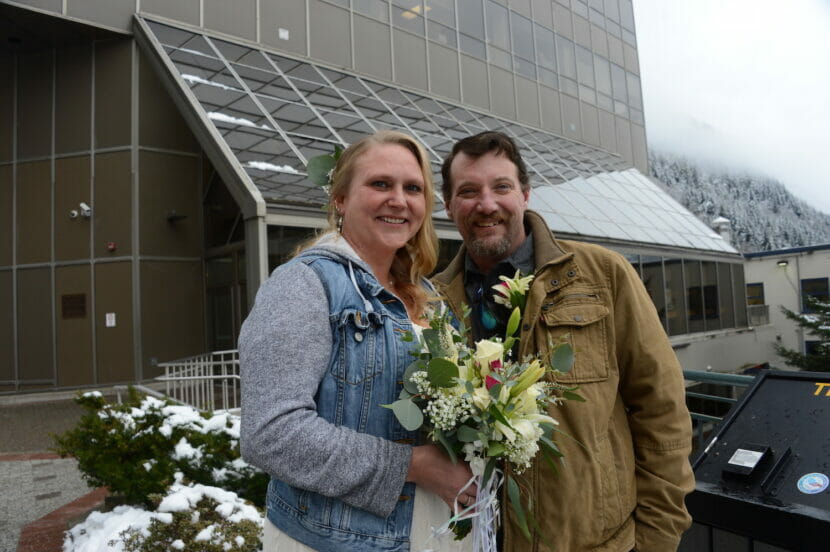
Hillary Sheehan and Joel Hughes are seen outside Juneau’s Dimond Courthouse on Friday, Feb. 3, 2023. In-person marriages are resuming at Alaska’s courthouses after the COVID-19 pandemic, and Sheehan and Hughes were among the first to take advantage. (Photo by James Brooks/Alaska Beacon)

For the Alaska Court System, Friday is wedding day.

After a break of almost three years because of the COVID-19 pandemic, in-person wedding ceremonies have resumed at Alaska’s courthouses.

Anchorage, the busiest state courthouse for weddings, resumed knot-tying Jan. 20, and Palmer will follow suit March 3. Most of the state’s other courthouses have already resumed in-person ceremonies.

Courthouse weddings make up only a fraction of Alaska’s total marriages — four years ago, 608 of the state’s 4,774 marriages were in courthouses — but the return of weddings marks a return to normal for the Alaska Court System after COVID-19 safeguards.

In his State of the Judiciary address last week, Alaska Chief Justice Daniel Winfree said state courts “are at virtually the same levels of activity and productivity” that they had before the pandemic began.

This week, Winfree is retiring and will be replaced by Justice Peter Maassen.

“It’s one of the best things we get to do, actually,” Maassen said of courtroom weddings.

Most things that take place in a courtroom are adversarial, he said. Judges enjoy weddings, adoptions or the installation of a new judge, “anything where there isn’t an adversarial relationship moving forward, where we can appreciate what are often very beautiful working spaces and celebrate something that is important.”

Before the pandemic, about one-third of Alaska’s courthouse marriages took place in Anchorage, where Judge Thomas Matthews serves on the Superior Court and is presiding judge for the state’s 3rd District, which covers Southcentral Alaska.

The court doesn’t keep statistics about who’s getting married in the courthouse, but “anecdotally, we have people who show up for marriages of all different types, all different constituencies,” Matthews said.

“We have military couples who show up for getting married for somebody who may be deploying,” he said. “We get a fair number of people who are showing up on a second or later marriage. They’ve been down the big wedding scenario once, and now that they’re older, they’re just looking for a simple ceremony. That’s a fair number of people who come in. And then there’s a whole bunch of people, I think, who simply find a courthouse ceremony to be a simple process.”

In Anchorage, various courtrooms host marriages, depending on what else is happening in the courthouse, Matthews said, but they’re almost always on Friday afternoons.

Evidentiary hearings, jury trials and most court operations shut down at noon, clearing the schedule for other work.

In Anchorage, officials can usually fit in four weddings each Friday afternoon, but the number in other courthouses can differ.

Last Friday, as a climate protest took place in the plaza next door, Hillary Sheehan and Joel Hughes waited outside the Juneau courthouse in wedding finery.

“We don’t want something big and fancy. It just costs too much money. It’s hard to get everyone in one place and expensive. And we’ve already been together 17 years. So it’s like we’ve already been married,” Sheehan said.

She and Hughes each said the process was easy and something they’d recommend.

“I think the traditional wedding now is so non-cost-effective and astronomical; you’re basically paying for a big party for everyone else,” Hughes said, “because the honeymoon is actually the party you’re waiting to go on. I feel that this is probably a more cost-effective way to save it for the honeymoon and not for the friends and family for them to drink up.”

The process

The first step to getting married in Alaska — whether at a courthouse or not — is applying for a marriage license. It’s $60, and there’s no online form: It has to be printed out, filled out, signed in the presence of a notary or a licensing official, then turned in to either a state courthouse or the licensing office in Anchorage or Juneau.

That can be done in person, or the form, copies of picture IDs, and payment can be submitted by mail to either licensing office or to the courthouse closest to where the wedding will take place. If you make a mistake while filling out the application, start with a fresh form. There are no extra steps for international visitors or noncitizens; if someone doesn’t have a Social Security number, they can leave that part of the form blank.

Some planning ahead is required — in addition to the time needed for the form to travel in the mail, it takes three days for the form to be processed.

After that, the completed license can be picked up from either licensing office or the courthouse it was submitted to.

Completed licenses can also be mailed, but the licensing office warns that regular mail can take up to four weeks, and it suggests paying an extra $9 for trackable priority mail.

Once someone picks up the license, it’s valid for 90 days. If the wedding is later, postpone picking it up — it can wait at the office for up to a year and still be valid.

No one younger than 16 can get married in Alaska, and anyone younger than 18 requires a court order. Proxy marriages — where someone stands in for one of the people getting married — aren’t allowed. If someone is getting married after a divorce, that divorce has to be final and registered with the courts before the new marriage takes place.

Under state law, a wedding needs to include only the people getting married, the person presiding over the wedding, and one witness. The law used to require two witnesses, but that was changed in 2022 by the Alaska Legislature. You can still find older, incorrect information online, including in some court system documents that haven’t been updated.

In Alaska, anyone can officiate a wedding. Religious leaders, judicial workers or elected officials can officiate for free, but everyone else has to pay $25 and fill out a form at a courthouse in order to become a marriage commissioner.

“It’s a pretty quick filing,” Matthews said. “Lots of people do this because they want some special family member or friend to do the ceremony for them, and the requirements to actually perform the ceremony are relatively simple.”

Law clerks at courthouses are trained, certified commissioners, and at many courthouses, they’re the ones who do the Friday ceremonies.

The form and process to become a commissioner varies from place to place, and courts can answer questions either in person or by email.

There isn’t a normal waiting period, but the commissioner has to wait until they have an official court order appointing them as a commissioner. Some rural courts ask that commissioner requests be submitted at least a week before the ceremony.

The actual wedding proceedings are up to the people involved. Alaska doesn’t require a particular wedding wording, ritual or ceremony.

Matthews said that if a couple does want to get married at the courthouse, they should remember that there’s no alcohol — so no champagne in the building — and there are weapons restrictions.

“So if they want to bring a cake, don’t bring a big knife in order to cut it,” he said.

For any wedding, whether at the courthouse or not, the only legal requirement is that the people getting married sign their license alongside at least one witness — such as the person conducting the wedding — and that the certificate be submitted back to the licensing office within a week of the ceremony.

The state will provide a decorative wedding certificate with the license, but getting an official certificate — something needed to prove marriages for name changes and other official actions — costs another $30 and can be requested after the wedding is recorded by the state.

Matthews, like Maassen, said the return of in-person wedding ceremonies brings a little brightness to the court system.

“For so many of us,” he said, “people who come into court are typically involved in an awful lot of conflict. And so, doing marriages, doing adoptions, it brings a little joy to people. It’s nice to have smiles on people’s faces and tears of joy instead of sadness when they’re at the courthouse.”

This story originally appeared in the Alaska Beacon and is republished here with permission.

Correction: A new state law allows a marriage to be conducted with a commissioner and one witness. The initial version of this article incorrectly stated that no additional witness was required. 

After pandemic closures and staff shortages, swim lessons are back in Juneau

Students from Juneau-Douglas High School use the pool for an athletics program on May 3, 2017.
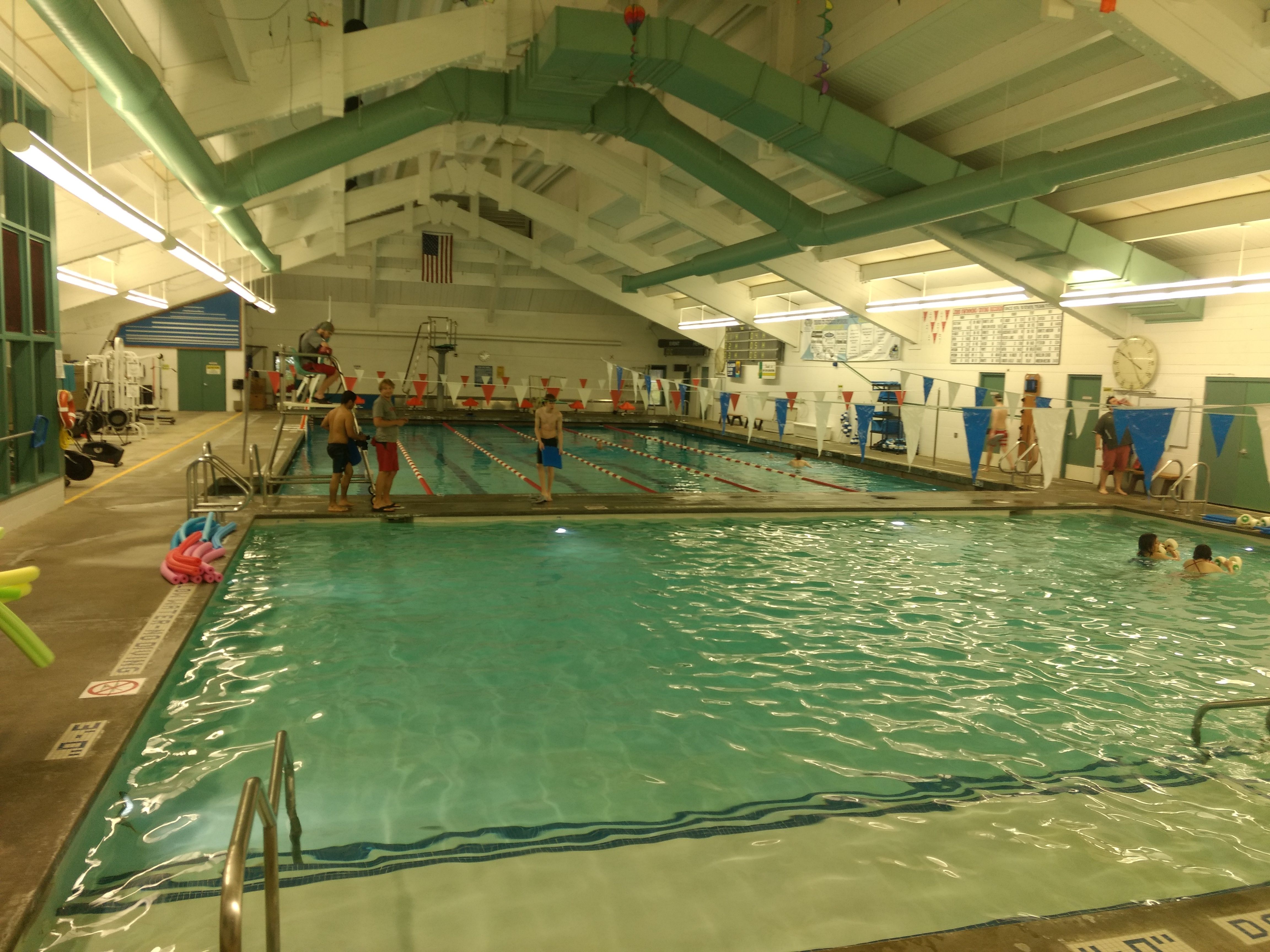
The Augustus Brown Pool in downtown Juneau on May 3, 2017. (Photo by Jacob Resneck/KTOO)

Swim lessons are in high demand as Juneau faces a shortage of lifeguards and instructors.

The city’s parks and recreation department opened registration for a parent and toddler class on Friday. The 10 spots were claimed within minutes, according to the city’s aquatics manager, Terra Patterson.

She said a shortage of lifeguards has led to a shortage of swim instructors.

“It’s really hard to offer swim lessons when a lot of your instructors are also lifeguards,” she said. “If you don’t have lifeguards to stand on the pool deck, you can’t put people in the water to teach.”

That shortage, along with pool closures during the height of the pandemic, impacted kids of all ages. The city offered a limited number of classes last year, but not enough to serve all the kids who needed them.

“In addition to all these young children who need to get into lessons to learn how to swim, we have all these kids that for two plus years haven’t been able to get into swim lessons,” Patterson said. “It’s a compounded problem.”

The city’s pool supervisors are now trained to teach new lifeguards, which has helped reduce the shortage. But more broadly, Patterson said, the pools are facing the same labor shortage as other city employers.

Patterson said getting young kids comfortable in the water is vital, especially in Southeast Alaska.

“If they are scared of the water, they don’t want to put their face in the water and they don’t feel comfortable in the water, they can’t relax enough to learn how to float,” she said. “Floating is the first stage of learning how to swim.”

The parks department will offer a second parent and toddler class at the Dimond Park Aquatic Center next month. Registration for that class will open on Feb. 16. 

Class registration for kids three and up will also open Feb. 16. Those classes will be at the Augustus Brown Swimming Pool.

The Augustus Brown pool will close for renovations from April through at least December. Those staff will move to the Dimond Park Aquatic Center, allowing the city to offer year-round lessons after school and during the summer.

Juneau already had a child care shortage. Then two more centers closed

Childcare workers interact with infants at Gold Creek Child Development Center in Juneau on May 11, 2018. State rules require certain square footage and staffing levels, which limit this center's infant care capacity to 10. New state rules being proposed may force that capacity down to 8.
Childcare workers interact with infants at Gold Creek Child Development Center in Juneau on May 11, 2018. (Photo by Jeremy Hsieh/KTOO)

Two of Juneau’s child care centers are closing after months of trying to hire new administrators. The closures will worsen Juneau’s shortage of child care options, particularly for infants and toddlers.

The Gold Creek Child Development Center and the Aurora Lights Childcare Center were two of only a handful of child care centers in Juneau that accepted kids under 16 months old. And Discovery Preschool had to close waitlist applications this week as Gold Creek and Aurora Lights families sought other options.

“Our waitlist is so long that some of these children will be in first or second grade by the time we have space available,” said Rosemary Williams, the owner and administrator of Discovery Preschool. 

Williams said the waitlist was already long, especially for their infant room. Gold Creek and Aurora Lights’ closures have added to the backlog.

“I have parents that are pregnant on the waitlist for the infant room, parents that are planning on getting pregnant asking about waitlist applications, just because the child care need in Juneau is so huge,” she said.

Closures of child care centers during the pandemic caused many workers to leave the industry. Now, as more and more parents have gone back to work in person, persistent staff shortages have kept child care scarce in Alaska and nationally.

Gold Creek closed on Friday as board members search for a new executive director. The close is temporary, and the nonprofit center’s board will try to reopen in the next 90 days while it is still licensed to operate by the state. Before the closure, between 40 and 45 students were enrolled, and others were on a waitlist. When fully staffed, it has room for 60 students. The closure meant layoffs for a dozen staff members, most of whom had worked there for less than a year. 

Gold Creek’s former executive director left in mid-November. The center’s volunteer board has offered the job to eight applicants so far, but none have accepted it, according to board member Ashley Snookes. 

She said most of them were local parents with full-time jobs who ultimately decided against the career switch.

“There’s been a lot of interest in helping us in the short term, but finding somebody who wants to make this their long-term career, I think that’s a little bit different,” Snookes said. “We just haven’t been able to find the right person.”

Gold Creek serves federal employees, including those who work for the Coast Guard, the FBI, the National Oceanic and Atmospheric Administration and the Southeast Alaska Regional Health Consortium. It will remain closed until the board hires a new executive director.

Aurora Lights Childcare Center is closing Thursday after its own search for a new administrator proved unsuccessful. They announced the closure to families and staff in mid-October and intended to stay open through March, but a drop in enrollment and loss of staff caused them to close this week.

Outgoing administrator Betty Csech said other child care centers were offering higher wages and benefits for similar positions.

“We don’t have outside resources like some of the other, bigger centers that may be funded by the state or funded by federal funds,” she said. “We work off of what we bring in from tuition, so it’s really hard to compete with others that can offer higher wages and benefits that we just cannot as a smaller facility.”

Csech said Aurora Lights had eight students and three staff members on its last day Wednesday. She’s not sure where those students will go.

This story has been updated to clarify that Gold Creek’s closure is temporary.

We want to hear more about the impact of the child care shortage on our community. Are you a parent or child care provider affected by these closures? Share your experience with us. We will contact you if we wish to use any part of your story.

Site notifications
Update notification options
Subscribe to notifications