Family

Alaska continues to rank among worst states for child well-being, report finds

Tawni Jetter created a play area for her two toddler boys amidst waiting for an opening in childcare. (Mizelle Mayo/Alaska Public Media)

Alaska ranks among the worst states for overall well-being of children. That’s the finding of a report released Wednesday by the Annie E. Casey Foundation, a national charity focused on child welfare.

Organizers of the 2023 Kids Count Data Book used several metrics to measure the welfare of children in each state, including economic well-being, education, overall health and supportive family and community connections.

Trevor Storrs is president and CEO of the Alaska Children’s Trust, a statewide organization that advocates for families. He said he thinks there are many factors impacting Alaska families, including economic stress and personal trauma, that need to be addressed collectively.

“Our perspective is when we get to parents and children and communities the knowledge, skills, support and resources to lessen that tension, we reduce the risk of not just only child abuse and neglect but homelessness,” Storrs said.

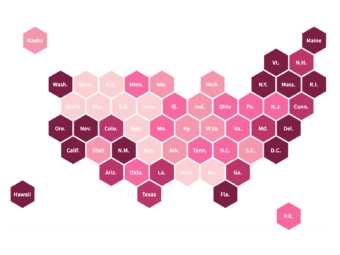
The Kids Count report is released annually, and Alaska has consistently ranked in the bottom third for overall child well-being in recent years. This year it ranked a little better — at 38th in the nation, up from 41st. It’s just above Arizona, and below Georgia. New Hampshire ranked the highest.

As for economic well-being and education, Alaska ranked in the bottom five this year. It’s below average in health, but above average in family and community connections.

Storrs said another potential driver of Alaska’s low rankings has to do with the availability and accessibility of child care. The study found that roughly 13% of Alaska children lived in families where a parent changed, quit or refused a job because of child care access or affordability.

“Basically, when you look at the annual cost of child care, it is actually higher than attending university,” Storrs said.

Storrs said there needs to be a concerted effort across multiple agencies and departments to address child care strains in urban communities and a lack of access in rural communities.

“One thing won’t solve this, because we do not have a centralized universal system, that is ensuring child care for everybody,” Storrs said. “And when you don’t have a universal system, like we have for K-12, everybody doesn’t have access.”

Storrs applauded recent efforts made by the state and local governments to tackle the child care crisis. He cited millions of dollars appropriated by the Legislature to bolster child care worker wages and Head Start programs, and the creation of a child care task force by Gov. Mike Dunleavy. Anchorage voters this spring also approved allocating marijuana taxes toward child care and early education.

Supreme Court affirms Indian Child Welfare Act

The U.S. Supreme Court heard oral arguments Wednesday, Nov. 9, 2022, in Brackeen v. Haaland, a case that will decide if the Indian Child Welfare Act is constitutional. Outside the Supreme Court Building, ICWA supporters were on site in numbers. (Photo by Jourdan Bennett-Begaye, ICT)

The Supreme Court handed down a major decision Thursday in the Haaland v. Brackeen case, affirming the constitutionality of the Indian Child Welfare Act by a 7-2 vote.

Justices Clarence Thomas and Samuel Alito were the lone justices to dissent.

The decision represents a major victory for federal Indian law and tribes across the nation.

In the opinion, authored by Justice Amy Coney Barrett, said the court “declines to disturb the Fifth Circuit’s conclusion that ICWA is consistent with” Congress’s authority under the Constitution in Article I.

“The United States, joined by several Indian Tribes, defends the law,” read the opinion. “But the bottom line is that we reject all of petitioners’ challenges to the statute, some on the merits and others for lack of standing.” Challengers cited that ICWA was against “federal authority, infringes state sovereignty, and discriminates on the basis of race.”

Justice Neal Gorsuch, the justice with extensive federal Indian law knowledge and experience of all the justices, wrote in support:

“Often, Native American Tribes have come to this Court seeking justice only to leave with bowed heads and empty hands. But that is not because this Court has no justice to offer them. Our Constitution reserves for the Tribes a place—an enduring place—in the structure of American life. It promises them sovereignty for as long as they wish to keep it. And it secures that promise by divesting States of authority over Indian affairs and by giving the federal government certain significant (but limited and enumerated) powers aimed at building a lasting peace.

“In adopting the Indian Child Welfare Act, Congress exercised that lawful authority to secure the right of Indian parents to raise their families as they please; the right of Indian children to grow in their culture; and the right of Indian communities to resist fading into the twilight of history. All of that is in keeping with the Constitution’s original design.”

Haaland v. Brackeen wasn’t the only Supreme Court case affecting Native people directly. The court also released a decision regarding Lac Du Flambeau Band of Lake Superior Chippewa Indians et. al. v. Coughlin. ICT will have more on this case soon.

The third federal Indian law case this term, Arizona v. Navajo Nation, has yet to be decided by the end of the month along with 22 other cases.

“For purposes of comparison, between June 13, 2022, and the last opinion day of the 2021-22 term (June 30, 2022), the court issued 29 decisions,” wrote former editor and reporter of SCOTUSblog Amy L. Howe.

President Joe Biden also weighed in shortly after the Haaland v. Brackeen ruling was released. He said ICWA is a vital law he is proud to support and stands with tribes.

The ruling keeps in place a vital law that protects tribal sovereignty and Native children, Biden said in a statement.

“Our Nation’s painful history looms large over today’s decision. In the not-so-distant past, Native children were stolen from the arms of the people who loved them. They were sent to boarding schools or to be raised by non-Indian families—all with the aim of erasing who they are as Native people and tribal citizens,” the statement reads. “These were acts of unspeakable cruelty that affected generations of Native children and threatened the very survival of Tribal Nations. The Indian Child Welfare Act was our Nation’s promise: never again.”

Interior Secretary Deb Haaland, Laguna Pueblo, called the decision “a welcome affirmation across Indian Country of what presidents and congressional majorities on both sides of the aisle have recognized for the past four decades.”

“For nearly two centuries, federal policies promoted the forced removal of Indian children from their families and communities through boarding schools, foster care, and adoption. Those policies were a targeted attack on the existence of Tribes, and they inflicted trauma on children, families and communities that people continue to feel today.”

Angelique EagleWoman, Sisseton Wahpeton Oyate (Dakota), described the decision as a “full circle moment” for Haaland. EagleWoman is a professor of law as well as the director of Native American Law & Sovereignty Institute at Mitchell Hamline School of Law.

“How wonderful it is to see Secretary of Interior Deb Haaland, Laguna Pueblo, have her name on a case, 7 to 2, that upholds the Indian Child Welfare Act,” she said. “I’m sure she breathed a huge sigh of relief to have her name in history in this manner.”

EagleWoman added that Gorsuch heavily relied on the investigation Haaland started through the Bureau of Indian Affairs into boarding schools to give historical context in his concurring opinion.

“We have a full circle moment here. We have cultural affirmation, we have true justice,” EagleWoman said. “So there’s a lot of good here.”

Tribes, Native organizations, advocates and allies cheered for the decision reposting sentiments like “tribal sovereignty wins” or “ICWA stands!”

Mary Kathryn Nagle, Cherokee, is a Native rights attorney and Counsel to the National Indigenous Women’s Resource Center for which she filed an amicus brief on behalf of in the case.

She emphasized what the day means to Indian Country, “we just could not have gotten better news. This is an incredible, incredible victory.”

“It’s definitely a day for Indian Country to celebrate,” Nagle told ICT.

Like many, she was still reading through the 133 page opinion as the news broke Thursday morning. She noted that there will be a number of Native attorneys and federal Indian law lawyers who will comb through the court’s opinion.

The first thing she said that jumped out at her was the overwhelming win for tribes.

“Just the fact that we won on every single issue and Gibson Dunn (the law firm representing the petitioners’) is not taking home anything,” Nagle said. “They’re not winning on a 10th amendment issue. They’re not winning on Indian as a race-based classification. They’re not winning on anything is huge.”

The Indian Child Welfare Act was enacted in 1978 and its purpose is “…to protect the best interest of Indian Children and to promote the stability and security of Indian tribes and families by the establishment of minimum Federal standards for the removal of Indian children and placement of such children in homes which will reflect the unique values of Indian culture…,” the Bureau of Indian Affairs website states.

For years, ICWA has been long seen as the “gold standard” for child welfare policy.

The Protect ICWA campaign, which includes the National Indian Child Welfare Association, the National Congress of American Indians, Native American Rights Fund and the Association of American Indian Affairs, said they are all “overcome with joy” that ICWA has been upheld.

“One thing is certain: ICWA is crucial for the safety and well-being of Native children and families and the future of Native peoples and Tribal Nations,” the campaign said in a statement. “The positive impact of today’s decision will be felt across generations.”

The campaign said they will give a deeper analysis Thursday afternoon after a legal review.

The ruling is an affirmation of rule of law and the constitutional principles of the relationship between Congress and tribes, Cherokee Nation Principal Chief Chuck Hoskin, Jr., Morongo Band of Mission Indians Chairman Charles Martin, Oneida Nation Chairman Tehassi Hill and Quinault Indian Nation President Guy Capoeman said in a statement.

They hope that this decision will slow the “political attacks” aimed at diminishing tribal sovereignty.

“By ruling on the side of children’s health and safety, the U.S. constitution, and centuries of precedent, the justices have landed on the right side of history. With these latest political attacks on ICWA now behind us, we hope we can move forward on focusing on what is best for our children,” the statement says.

Native members of Congress, Tom Cole, Chickasaw, and Sharice Davids, Ho-Chunk, shared a joint statement as co-chairs of the Congressional Native American Caucus. Echoing many, they said ICWA has protected vulnerable Native children since it was enacted and applauded the Supreme Court.

“This landmark decision rightly upholds protections for Native children and reaffirms the sovereign rights of tribal governments,” their statement reads. “We applaud the Supreme Court in rejecting these challenges and standing with Native American children and their right to remain in their own cultures.”

Indigenous peoples woke up to the news as early as 6:07 a.m. in Alaska. Social media reactions range from ICWA supporters saying they’re “really emotional” or “grateful for today.”

Charitie Ropati, Yup’ik and Samoan, wrote on Twitter, “Celebrate today, celebrate indigenous youth joy.”

Medical student and Forbes contributor Victor Lopez-Carmen, Hunkpati Dakota and Yaqui, gave kudos to the lawyers involved. “Just wanna throw a big party for all the Native lawyers who bodied this. Wow. Y’all really are incredible,” Lopez-Carmen wrote on social media.

In an April 2021 decision, the U.S. Court of Appeals for the Fifth Circuit upheld certain sections of ICWA and flagged constitutional concerns about others, prompting appeals on both sides. The U.S. Supreme Court granted petitions to review the Fifth Circuit’s decision and heard the case last November. Congressional members, 87 in total, filed a bipartisan, bicameral amicus brief defending ICWA’s constitutionality in Haaland v. Brackeen.

Oral arguments on the landmark case took place in November. Indigenous people from around the country traveled to Washington, D.C., for the hearing.

Kimberly Jump-CrazyBear, Osage and Oglala Lakota, was one of many who showed up to show support for the Indian Child Welfare Act.

“I’m just here on behalf of all of you who can’t be here today. To help lend my voice,” she told ICT before the oral arguments for Haaland v. Brackeen began. “Without our children, we don’t have a people anymore.”

While it is a day for celebration, Nagle said it is also important for tribes to stay vigilant and to support and heal one another after enduring the trauma of this long legal fight.

“They’re gonna probably try to find a different way to attack us. And so we have to celebrate, then we also have to kind of come back together and understand where the next attack is going to come from. And that’s unfortunate, but I think that’s just what it means to be Indigenous in the United States. So, but I think the first thing to do is to really celebrate because this is, I think, next to McGirt, the most incredible decision, victory we’ve gotten in the Supreme Court ever.”

This story originally appeared in Indian Country Today and is republished here with permission.

Alaska child care providers say funds approved by Legislature are crucial to staying open

The Gold Creek Child Development Center reopened in April after the search for a new executive director caused the board to temporarily close it. (Katie Anastas/KTOO)

The waitlist at the child care center Lori Berrigan runs in Palmer doubled this last year. There are 250 children on it. Berrigan said she’s running LifeWays at capacity, but the business is barely breaking even.

“We’re not profitable, even with 250 kids on our waitlist, because we’re providing quality care. And you can’t provide quality care without paying your workers well,” she said.

Berrigan said she had to increase wages 30-40% to retain her staff. That means she has to raise her rates 30% starting this June. She said pandemic-era federally funded stabilization grants helped keep her business afloat, but even with the significant increase in her rates, she would have to consider shutting down if it weren’t for help from the state.

“I’m hoping that this is going to continue to be a viable thing,” she said. “I’m going to see how this year goes. And then I may have to make hard decisions.”

Advocates for child care contacted lawmakers about funding problems statewide and the effort appears to have had an impact. The Legislature put an additional $7.5 million towards grants for child care providers in the coming year’s budget bill.

More work to be done

The funding is half the amount advocates say it would take to boost wages and stabilize the industry. Some lawmakers say they have more work to do.

Sen. Cathy Giessel, R-Anchorage, said she’s hugely supportive of funding child care centers. She’s the leader of the bipartisan Senate majority caucus.

She said that reliable, safe child care affects the mental health outcomes of the state’s population in the future.

“We save money by appropriating for these vital services now,” she said. “The Senate majority leadership certainly saw the need for that for next year.”

The Senate approved $15 million for child care, but that didn’t get enough support among the Republican led House majority caucus.

“My goal is to spend a lot more time talking with House counterparts,” Giessel said. “I didn’t communicate as effectively as I should have.”

The $7.5 million currently in the budget still needs to be approved by Gov. Mike Dunleavy, who has the authority to veto all or part of individual items in the budget.

Rep. Julie Coulombe, R-Anchorage and a member of the House majority, supported the funding. She is the liaison of the Legislature on the governor’s child care task force that Dunleavy announced in early April. Coulombe wrote a bill aimed at boosting child care, which is co-sponsored by members of the mostly Democratic House minority caucus.

“The reason why I’m trying to figure that out is because I’m pro-life, and the governor wants to be a pro-family state,” Coulombe said. “I would hate for somebody to feel like they couldn’t have a baby because there’s no support once the baby’s born. So let’s give them some support to do it.”

It didn’t pass this year, but Coulombe said she’s hopeful for more movement on the child care issue when legislators reconvene next year.

Child care and the economy

Blue Shibler is the executive director of the Southeast Alaska Association for the Education of Young Children. She said child care centers are struggling despite intense demand for services.

“Whether you’re talking about rural Alaska or cities, every single part of Alaska has a child care shortage. And that in the heart of that sort of shortage is absolutely, simply that it’s not a good business model — you can’t make a profit. In fact, you can only suffer a loss, really, at this point,” Shibler said.

She said any funding is good, but more would be better.

“I think it’s going to help,” she said. “I don’t think we’re going to see growth in the industry, which is a bummer, because we really feel like having more child care availability is what was going to be part of the answer to the workforce shortages.”

That sentiment was echoed by Department of Labor and Workforce Development Commissioner Cathy Muñoz in April. “The lack of affordable and accessible quality child care is a significant workforce challenge,” she said in a press release.

According to one study, 77% percent of Alaska parents reported missing work because of child care challenges. Forty percent of Alaskans interviewed for the study said that they or someone in their household had left a job, declined a job offer, or changed jobs because of child care issues in the last year.

Christina Eubanks has run a legacy child care center in Anchorage for the last 15 years. She said the last year has been the most stressful of her career even though demand is as high as it’s ever been.

“A woman said to me, ‘As soon as I knew my pregnancy was viable, I started looking for child care,” Eubanks recounted. “She’s literally looking at losing her job. And she’s a professional woman losing her career because she cannot go back to work.”

But to hire staff, Eubanks has had to raise wages — the minimum she pays is $16 an hour. That pay hike for her workers means that she’s raising her rate to nearly $1,700 a month per child this summer.

“There’s a limit to what people can pay,” she said. Her child care center, Hillcrest, is considering scholarships for currently enrolled families that cannot afford the increase. She said the state funding is going to help her keep the cost to families down while she invests in retaining her staff.

The $7.5 million in the state budget is the biggest boost she’s seen from the state. It would translate to about $10,000 a month for her care center — and she plans to put it all towards salaries.

This story originally appeared in the Alaska Beacon and is republished here with permission.

What the 2020 census can — and can’t — tell us about LGBTQ+ people

Source: U.S. Census Bureau, 2020 Census Demographic and Housing Characteristics File (Connie Hanzhang Jin/NPR)

States along the West Coast and in the Northeast have the highest shares of households with same-sex couples, according to the latest 2020 census results released Thursday.

The new numbers from the Census Bureau make up the most comprehensive statistics the federal government has produced to date about married and unmarried same-sex couples living together.

But many other LGBTQ+ people, including those who are not living with a partner or are in different-sex relationships, remain invisible in this key national dataset that’s used to determine political representation, enforce civil rights protections, inform research and policymaking, and guide an estimated $1.5 trillion a year in federal money for public services in local communities.

“A lot is tied to Census Bureau data,” says Kerith Conron, research director of the Williams Institute at the UCLA School of Law. “Being invisible in those systems or only sort of partially counted is, I think, problematic.”

Former President Donald Trump’s administration blocked efforts to get questions about sexual orientation and gender identity onto a Census Bureau survey that’s considered a testing ground for changes to the forms for the decennial national head count.

Now, the Biden administration has renewed that process as advocates for more official statistics about LGBTQ+ populations continue to grapple with long-standing data gaps that make it difficult to fully understand people’s needs amid rising anti-LGBTQ+ sentiment from right-wing groups.

Why are only same-sex couples who live together represented in 2020 census data about LGBTQ+ people?

While forms for the last U.S. census did include a question about a person’s sex with options for “male” and “female,” they did not ask about sexual orientation or gender identity.

The bureau, however, did provide checkboxes for a question about household relationships that allowed people to identify as a “same-sex” or “opposite-sex” spouse or unmarried partner. Those new response options were introduced to improve the agency’s data about same-sex couples, which the bureau first began collecting in 1990 by matching people’s responses about their sex and household relationship.

That way of conducting a once-a-decade census produces only “a piece of the puzzle,” says Conron of the Williams Institute, which tracks estimates of the country’s lesbian, gay, bisexual and transgender populations.

“At this point, less than 20% of LGBT people live in same-sex couple households,” Conron explains, based on the institute’s estimates. “That means we don’t know a lot about the 80% or more of LGBT people who have different-sex partners or aren’t living in a household with a partner. And that’s significant.”

For Josie Caballero, the lack of an opportunity to identify as a trans woman on the 2020 census was disappointing.

“If we’re not asking the question, if you’re trans or not, in these surveys, it is impossible for us to actually identify those disparities and make sure that funds and resources go to the communities that are desperately in need,” adds Caballero, who is the director of the U.S. Trans Survey and special projects for the National Center for Transgender Equality.

What is the Biden administration doing to get more comprehensive census data about LGBTQ+ people?

Late last year, the Justice Department sent a formal request to the Census Bureau for questions about sexual orientation and gender identity to be added to the bureau’s American Community Survey, which goes out to about 1 in 38 households every year, according to a recently released working paper by a bureau official.

“The request included citations of several statutes to justify the collection, including a need for data to properly enforce discrimination laws,” wrote Andrew Roberts, the chief of the agency’s sex and age statistics branch. Roberts also referenced a 2020 U.S. Supreme Court ruling that confirmed the Civil Rights Act of 1964 protects workers against discrimination based on their sexual orientation or gender identity.

Changes to the census questions are often tested first on experimental versions of the American Community Survey. The bureau — which has been asking about sexual orientation and gender identity on an experimental survey about how the COVID-19 pandemic is affecting households — is planning more experiments starting this year on how the American Community Survey can ask about these topics in English and Spanish after the administration requested $10 million for this research.

Are there privacy concerns related to using the census to collect more data, especially with more anti-LGBTQ+ sentiment from right-wing groups?

Federal law prohibits the federal government from releasing personally identifiable census records until 72 years after a head count’s Census Day, and it is illegal for the government to use census data against a person.

But the rise of anti-LGBTQ+ legislation and sentiment among right-wing politicians and other groups has underlined concerns about how census data can be misused and individuals can be re-identified in anonymized statistics, a risk the bureau has been trying to address through a new, controversial privacy protection system.

Protecting the confidentiality of people’s information, however, may be harder with AI and other advances in computing becoming more accessible to bad actors who may try to trace publicly available statistics back to an individual by cross-referencing different datasets, says Stephen Parry, a senior statistical consultant at Cornell University who has written about best practices for collecting gender and sex data.

“I do think that the question about privacy is important, but I also wonder whether people weight privacy as not being as important as it was in the past because they are so used to giving up their privacy and showing on social media facets of their lives that previous generations hadn’t,” Parry adds.

One of the guidelines for collecting data on sexual orientation and gender identity that the Biden administration has released is to allow survey participants to choose whether or not to respond to those kinds of questions and “make an informed decision about whether to provide this information based on its intended uses, potential risks, and their privacy preferences.”

“I think that people being given an opportunity to volunteer that information is important,” says Rebecca Moon, president of the Shoals Diversity Center, a nonprofit organization based in Florence, Ala., that offers mental health support for the LGBTQ+ community and supports increasing government data collection. “Not everyone is out, especially in the South. There’s a lot of LGBTQ hatred.”

Caballero of the National Center for Transgender Equality says it’s “a very scary time” for many transgender people living in the U.S. and not feeling comfortable reporting your gender identity to the government is “very valid.”

But, Caballero adds, those who do choose to be counted as transgender for the census, if given the chance one day, make it “easier for the next trans person to tell their story and say that they are here.”

“You can’t argue with the fact that hundreds of thousands of trans folks have been able to say in a quantitative, scientific way that we exist and this is what it looks like to live here,” Caballero says. “And if we did not have that data, it would be extremely difficult to prove that we deserve human rights.”

Edited by Benjamin Swasey

Copyright 2023 NPR. To see more, visit https://www.npr.org.

Abortion bans drive off doctors and close clinics, putting other health care at risk

Dr. Franz Theard performs a sonogram on a patient seeking abortion services at the Women’s Reproductive Clinic in Santa Teresa, New Mexico, a state that has not banned abortions. (Robyn Beck/AFP via Getty Images)

The rush in conservative states to ban abortion after the overturn of Roe v. Wade is resulting in a startling consequence that abortion opponents may not have considered: fewer medical services available for all women living in those states.

Doctors are showing — through their words and actions — that they are reluctant to practice in places where making the best decision for a patient could result in huge fines or even a prison sentence. And when clinics that provide abortions close their doors, all the other services offered there also shut down, including regular exams, breast cancer screenings, and contraception.

The concern about repercussions for women’s health is being raised not just by abortion rights advocates. One recent warning comes from Jerome Adams, who served as surgeon general in the Trump administration and is now working on health equity issues at Purdue University in Indiana.

In a recent tweet thread, Adams wrote that “the tradeoff of a restricted access (and criminalizing doctors) only approach to decreasing abortions could end up being that you actually make pregnancy less safe for everyone, and increase infant and maternal mortality.”

Medical ‘brain drain’

An early indication of that impending medical “brain drain” came in February, when 76% of respondents in a survey of more than 2,000 current and future physicians say they would not even apply to work or train in states with abortion restrictions. “In other words,” wrote the study’s authors in an accompanying article, “many qualified candidates would no longer even consider working or training in more than half of U.S. states.”

Indeed, states with abortion bans saw a larger decline in medical school seniors applying for residency in 2023 compared with states without bans, according to a study from the Association of American Medical Colleges. While applications for OB-GYN residencies are down nationwide, the decrease in states with complete abortion bans was more than twice as large as those with no restrictions (10.5% vs. 5.2%).

That means fewer doctors to perform critical preventive care like Pap smears and screenings for sexually transmitted diseases, which can lead to infertility.

Care for pregnant women specifically is at risk, as hospitals in rural areas close maternity wards because they can’t find enough professionals to staff them — a problem that predated the abortion ruling but has only gotten worse since.

In March, Bonner General Health, the only hospital in Sandpoint, Idaho, announced it would discontinue its labor and delivery services, in part because of “Idaho’s legal and political climate” that includes state legislators continuing to “introduce and pass bills that criminalize physicians for medical care nationally recognized as the standard of care.”

Amplified risks

Heart-wrenching reporting from around the country shows that abortion bans are also imperiling the health of some patients who experience miscarriage and other nonviable pregnancies. Earlier this year, a pregnant woman with a nonviable fetus in Oklahoma was told to wait in the parking lot until she got sicker after being informed that doctors “can’t touch you unless you are crashing in front of us.”

A study from University of Buffalo researchers in the Women’s Health Issues journal finds that doctors practicing in states that restrict abortion are less likely than those in states that allow abortion to have been trained to perform the same early abortion procedures that are used for women experiencing miscarriages early in pregnancy.

But it’s more than a lack of doctors that could complicate pregnancies and births. States with the toughest abortion restrictions are also the least likely to offer support services for low-income mothers and babies. Even before the overturn of Roe, a report from the Commonwealth Fund, a nonpartisan research group, found that maternal death rates in states with abortion restrictions or bans were 62% higher than in states where abortion was more readily available.

Women who know their pregnancies could become high-risk are thinking twice about getting or being pregnant in states with abortion restrictions. Carmen Broesder, an Idaho woman who chronicled her difficulties getting care for a miscarriage in a series of viral videos on TikTok, told ABC News she does not plan to try to get pregnant again.

“Why would I want to go through my daughter almost losing her mom again to have another child?” she said. “That seems selfish and wrong.”

Make birth free?

The anti-abortion movement once appeared more sensitive to arguments that its policies neglect the needs of women and children. An icon of the anti-abortion movement — Rep. Henry Hyde (R-Ill.), who died in 2007 — made a point of partnering with liberal Rep. Henry Waxman (D-Calif.) on legislation to expand Medicaid coverage and provide more benefits to address infant mortality in the late 1980s.

Few anti-abortion groups are following that example by pushing policies to make it easier for people to get pregnant, give birth, and raise children. Most of those efforts are flying under the radar.

This year, Americans United for Life and Democrats for Life of America put out a joint position paper urging policymakers to “make birth free.” Among their suggestions are automatic insurance coverage, without deductibles or copays, for pregnancy and childbirth; eliminating payment incentives for cesarean sections and in-hospital deliveries; and a “monthly maternal stipend” for the first two years of a child’s life.

“Making birth free to American mothers can and should be a national unifier in a particularly divided time,” says the paper. Such a policy could not only make it easier for people to start families, but it could address the nation’s dismal record on maternal mortality.

But a make-birth-free policy seems unlikely to advance very far or very quickly in a year when the same Republican lawmakers who support a national abortion ban are even more vehemently pushing for large federal budget cuts in the debt ceiling fight.

That leaves abortion opponents at something of a crossroads: Will they follow Hyde’s example and champion policies that expand and protect access to care? Or will women’s health suffer under the movement’s victory?

KFF Health News, formerly known as Kaiser Health News (KHN), is a national newsroom that produces in-depth journalism about health issues and is one of the core operating programs at KFF — the independent source for health policy research, polling, and journalism.

Copyright 2023 KFF Health News. To see more, visit KFF Health News.

High prices and lengthy waitlists: How families are coping with Alaska’s child care crisis

Tawni Jetter and her husband alternated their work schedule to watch their two children in Utah before they moved to Alaska. Upon arriving, Jetter found it difficult searching for child care. (Mizelle Mayo/ Alaska Public Media)

Tawni Jetter and her husband moved to Anchorage last July from Salt Lake City, and finding child care became an immediate priority. Their realtor recommended they hire an au pair, a live-in nanny who could watch their boys — 3-year-old Calvin and 18-month-old Emerson. Jetter said that worked for about five months, until their nanny broke her foot and couldn’t care for the kids.

“So we had my mother-in-law fly up,” Jetter said. “And she watched the boys for two weeks while we sort of scrambled to try to figure out what we were going to do with child care.”

Jetter said she tried everything: putting her kids on a dozen waitlists, directly reaching out to providers, asking anyone and everyone where their day care was and if there were any openings.

“You know, I started feeling like a crazy person,” Jetter said, “because I’d be at the grocery store and be like, the person checking me out kind of looks of childbearing age. Maybe she has some kids, maybe she has a day care.”

Jetter’s not alone.

Across the state, Alaska families are having a harder and harder time finding available and affordable child care. Many day cares have closed during the pandemic, and low wages have led to an exodus of workers. Families say it’s a crisis. The lack of care means some are quitting their jobs, considering moving out of state or putting a big chunk of their income toward care.

Reanna Queja, Thread Family Service Manager, talks about how there is a shortage of providers in childcare leading to a longer waitlist of family’s needing support in Anchorage. (Mizelle Mayo/Alaska Public Media)

Reanne Honemann-Queja is the family services manager at thread Alaska, a nonprofit that works to connect families to child care and advocate for early education. She said finding child care has always been a problem, but the pandemic strained the already tight system even further. The number of child care providers shrank.

“Some have left the state,” she said. “Some have retired. Some have just decided to find another career during this time. But there has definitely been a decrease in providers”

Thread has been lobbying the state for additional resources.

There are currently proposals in the Legislature to infuse the child care industry with millions in order to retain workers, though Gov. Mike Dunleavy has expressed disinterest in those proposals. Instead, he announced last month he’d be starting a task force to look at the state’s child care crisis, though the task force hasn’t been assembled yet.

In the meantime, Alaska families continue to struggle to find care. Honemann-Queja said openings fill up almost immediately, making them hard to track.

“My best advice for people who are just finding out that they’re pregnant is literally, celebrate with your family, and then start looking for childcare,” Honemann-Queja said. “Getting on waitlists as early as you can.”

Amanda Dale knows the waitlist game. She and her husband spent over a year trying to find child care for her son Ethan, who’s now 3 years old. Dale said she tracked providers on a spreadsheet and, at times, there were more than 20 kids ahead of her son on a list. After months of waiting, she was emotional when they finally got a spot last August.

“A woman from the preschool called and said, ‘We have a full time spot for your son,’ and I started crying,” Dale said. “I apologized to her, like, ‘Gosh, I must seem very weird that I’m crying about this.’ And she said, ‘Oh, no, it happens all the time. Like people are so relieved to get a call from me.’”

Even after families like Dale’s secure a spot, the challenges don’t stop. Since there’s such a tight market, child care has become increasingly expensive for families. Dale said she and her husband pay more than $1,400 a month for their son, which she compared to a mortgage payment.

“It’s almost punitive,” Dale said. “Yeah, we chose to have kids… 100%. But that’s how the world works. That’s how things keep going. And so it’s very strange to me that we would make it so hard for folks.”

Now Dale is thinking about when her 7-month-old daughter Lina will need child care, too.

“When we first enrolled him, it was two months upfront and startup fees. So we paid over $3,000 that first month, which is nuts,” Dale said. “And when she starts there’s a small discount, which is great for siblings, but it’ll essentially be about $2,700 a month.”

Jamie Smith is pregnant with her first baby and has been preparing by looking at child care before the baby is born. Smith says it has been stressful finding child care, and she has been researching and applying to child care since early March this year. (Mizelle Mayo/Alaska Public Media)

Jamie Smith is pregnant, due in October, and already getting her child on waitlists, hoping for a spot to open up early next year.

After spending years trying to conceive, Smith and her husband opted for in vitro fertilization. Blood tests are looking good, Smith said, and she and her husband are starting to prepare their home for a baby. In some ways, she said, their path to pregnancy prepared them for the process of looking for day care.

“I think the stress of infertility has really prepared me well for all these things I can’t control,” Smith said. “We can just kind of set everything up, and it’s gonna knock down how it’s gonna knock down.”

Still, she said, it’s hard not to wonder what they’ll do if they don’t find day care.

“Does my husband quit his job? Do I quit my job? Does one of us go part-time if we can only find part-time childcare,” Smith said. “And we don’t have family in the state. So then you have to think of… well, we really can’t find anywhere, do we have to leave the state and move? And then you have to sell the house.”

Jamie Smith has an ultrasound of her baby on the fridge along with a thank you letter from her friend that gave her baby toys and clothes. Smith has been trying to have a baby for years and finally has a chance to be a mother. (Mizelle Mayo/Alaska Public Media)

Even though the daunting prospect of finding child care looms over Smith and her husband, she hasn’t lost her sense of excitement for being a mother.

“Experiencing the world through the eyes of a child and teaching them kind of all the tools and skills and like attitudes that we hope to pass on, I think will be really fun,” Smith said.

For some parents, the patience of waiting for a day care spot does pay off. Jetter, the Salt Lake City transplant with two young boys, finally found a child care provider this month after one of her husband’s coworkers clued them in to an opening. She said she felt a little nervous on their first day away from home, but she’s hopeful the worst of the experience is over.

“My 3-and-a-half year old, he’s fine. I know he’s super excited about it,” Jetter said. “But my little one, you know, it breaks Mama’s heart a little bit. But she sent me a couple pictures, I think they’re doing okay.”

For other families, the search continues.

Site notifications
Update notification options
Subscribe to notifications