Family

State compiles first comprehensive account of Alaska children’s stress and trauma

(Katie Basile/KYUK)

Bad experiences in childhood are known to have lingering and negative health effects in adulthood, according to experts from the Centers for Disease Control and Prevention.

Now public health officials in Alaska have compiled what they say is the first comprehensive account of the prevalence of what are known as adverse childhood experiences, or ACEs. The information is compiled in a 49-page bulletin recently published by the epidemiology section of the Alaska Division of Public Health. The bulletin summarizes results of various surveys and studies completed over recent years in a way that should allow health officials to track trends in the future.

Adverse childhood experiences vary, ranging from relatively common events like parents’ divorces to more severe events like witnessing violence and even deaths within families. Adverse childhood events also include economic strains, such as financial hardships and homelessness. Some adverse childhood experiences are considered abuse or neglect.

Because there are different methodologies and metrics, the different datasets described in the epidemiology bulletin cannot be accurately compared with each other, said Jared Parrish, a senior state epidemiologist.

“There is no one definition of what makes up ACEs, like, what variables go into it, and so each dataset that we looked at in here as a different combination of variables that are included,” Parrish said. “But within each dataset, we learn something.”

Among the lessons is that over the past decade, the percentage of children experiencing these adverse events has remained largely constant, according to the results detailed in the epidemiology report.

One dataset, which tracked 13 types of adverse experiences between 2012 and 2020, found that 47% of Alaska 3-year-olds had at least one adverse childhood experience in their lifetimes, and 9% experienced four or more, the report said.

A different dataset that examined eight adverse childhood experiences from 2016 found that 41% of Alaska children 17 and younger had experienced at least one, an estimate consistent with national rates using the same data source.

The information covered by the report extends to adults.

One dataset detailed in the report, gathered from 2013 to 2015 and based on eight adverse childhood experiences, found that about two-thirds of Alaska adults reported experiencing at least one during childhood and 20% reported experiencing four or more. Another set of data, from 2020, also tracked eight adverse childhood experiences but solely among Alaska women; it found nearly eight of 10 reported at least once such adverse experience during childhood and about a third reported four or more.

There are different ways that bad experiences in childhood lead to bad health later in life, state officials said.

“As adverse experiences occur in a child’s life, those experiences build up levels of stress,” said Riley Fitting, a state epidemiologist who contributed to the bulletin. “Whether they happen once or more than once, that amount of stress can also accumulate into what some people might call toxic stress or toxic stress load. And that toxic stress load is associated with poor health outcomes during adulthood.”

Aside from causing mental-health impacts like depression and anxiety and behavioral problems like substance abuse, stress can diminish the condition of the body, Parrish said.  Coping behavior such as cigarette smoking, for example, can lead to heart disease and cancer, he said. Even absent such unhealthy habits, stress can cause people’s bodies to operate at a level of “hyper-awareness” that, over time, can lead to chronic physical problems, he said.

The epidemiology bulletin holds some potential positive signs about Alaska children’s conditions. The percentage of Alaska 3-year-olds without any adverse childhood experiences has increased slightly over time, according to the data compiled in the report.

Efforts are underway to help Alaska children and their families avoid such experiences or overcome them, said Emily Urlacher, a state public health specialist in early childhood education.

A key piece of that work is Alaska’s Head Start and associated Pre-Head Start program, she said.

“Instead of just sending children to a place where we educate them, it’s a support for the family as well,” Urlacher said. “You have to remember, when we’re working with families, the child and the family are together, they’re a dyad. If you want to support the child, you have to support the family. And Head Start does that.”

Funding for Head Start programs has been the subject of disagreement, however. Last year, Gov. Mike Dunleavy vetoed $2.5 million of the $5 million that the Alaska Legislature had approved in increased Head Start funding that would match federal funding.

Along with Head Start, the department promotes and is expanding its home-visiting services, which send parent-educators or nurses to families’ homes or other sites to provide support, Urlacher said. “It’s programs like that that are really crucial to coming around and breaking that generational cycle,” she said.

This story originally appeared in the Alaska Beacon is republished here with permission.

With pandemic relief money gone, child care centers face difficult cuts

Melissa Colagrosso founded A Place to Grow child care center in Oak Hill, W.Va., 28 years ago. In the pandemic, federal relief dollars allowed her to raise wages and give bonuses, offer paid sick leave and make repairs and improvements at the center. (Andrea Hsu/NPR)

For almost a year, early childhood teachers at A Place to Grow in Oak Hill, W.Va., enjoyed a $200 bonus in every paycheck just for coming to work.

“Just be here, show up, don’t call off, be on time,” the center’s owner Melissa Colagrosso told employees.

Funded through $24 billion in pandemic relief Congress approved in 2021, the bonuses made life a lot easier for the center’s teachers and staff.

But with the expiration of the federal money on Sept. 30 came the end to those bonuses.

“All of the staff have taken a $400-a-month pay cut,” says Colagrosso.

Now, she worries about how her employees will get by. She expects some of them will soon leave her for jobs elsewhere.

A pandemic lifeline disappears

It’s no exaggeration to say government money saved child care in the pandemic.

As part of the 2021 American Rescue Plan, Congress approved a total of $39 billion for child care, an unprecedented level of spending aimed at ensuring essential workers could go to work. The majority — $24 billion — was directed toward stabilizing child care centers and home-based daycares, to guarantee they’d remain open and staffed.

Katelyn Vandal is now director of A Place to Grow. Vandal’s mother Melissa Colagrosso founded the center when Katelyn was 3, in part because her daughter’s daycare had shut down. (Andrea Hsu/NPR)

Colagrosso, who opened A Place to Grow 28 years ago, poured the money into wages and bonuses, repairs and a new HVAC system, playground equipment for what had been an empty field, and even a bus to take older kids to and from school and, in the summers, on field trips.

Now that the September 30 deadline for spending the pandemic funds has passed, she and other child care providers are grappling with what they have to take back.

“We’re going to have to slow down payroll. We have to cut everywhere we can cut,” Colagrosso says.

In addition to curbing bonuses, she has ended paid sick leave for part-time staff and says she will end it for full-time staff soon. She’s eliminated a floating position, someone to help out wherever extra help was needed.

No longer will she be giving $1 an hour raises every year, as she has for the past three. She may resort to larger child-to-teacher ratios, which she says would affect quality.

Affording child care a problem up and down the wage scale

Running her center in a rural, low-income part of West Virginia has never been easy. Colagrosso says there were many months when she struggled to make payroll and found herself at the bank asking for a loan.

Close to three-quarters of the families she serves fall below 85% of West Virginia’s median income, qualifying them for state subsidies. Even those who pay full tuition can hardly afford the cost, particularly those with several young children. They worry that with pandemic relief funds gone, Colagrosso may have to raise her rates.

“We’d either have to work part-time — one of us — or one of us quit our job, which we can’t really do,” says Brittany Smith, a civil engineer. She and her husband have 1-year-old twins and a 12-year old.

Bonuses were life-changing but short-lived

Colagrosso’s immediate concerns are over her staff.

The pandemic bonuses proved life-changing for teachers including Destiny Vansickle, who saved enough money for a down payment on a two-bedroom house next to her sister — a “forever home” for her infant and her 4-year-old.

Destiny Vansickle is a teacher in the 2-year-old classroom at A Place to Grow. Thanks to the bonuses and wage increases she received in the pandemic, she was able to buy her first house. (Andrea Hsu/NPR)

“It’s been really nice to have our own place and having my boys being able to have our own yard,” she says, adding that the low-income housing they left had no yard to play in.

Tena Gee, who’s worked at A Place to Grow for 13 years, says the bonuses allowed her to give her 9- and 12-year-old daughters Christmas for the first time — new bikes, new kayaks, a baby doll with its own bassinet.

“Just being able to do anything on my own for them — not having to lean on somebody — it’s just a feeling you can’t really describe,” she says.

She also decided to do something for herself. She was tired of driving used cars that broke down all the time, so she bought herself a brand new car.

“I took on bills that I was finally able to afford because of the extra money,” she says. “It felt like the work I was doing was finally being acknowledged. Like I feel like my pay matches the hard work I put in.”

Tena Gee has worked at A Place to Grow for 13 years. Now that pandemic bonuses are over, she is considering leaving the field for a job that would pay more. (Andrea Hsu/NPR)

But that satisfaction was short-lived. Without the extra $400 a month in bonuses, Gee is already behind on her car payment.

“I guess maybe it was our fault for getting used to it, thinking maybe it was going to be more than temporary,” she says.

Now, she’s considering finding a better-paying job elsewhere.

Child care not a priority

Senate Democrats have introduced a bill to extend child care stabilization funding for five years, but the measure doesn’t have support from Republicans.

West Virginia and other states are trying to help out, finding money in their budget surpluses to alleviate some of the strain.

Still, Colagrosso is facing deeper cuts.

“You do the math like any other business, and the math doesn’t add up,” she says. “This is what I need. This is what I’m bringing in. It’s not there.”

Colagrosso says she used to think there was a lack of understanding among elected leaders about the value of child care — a lack of understanding that without affordable options, people can’t go to work.

“[Then] the pandemic hit and all this money came, and I thought, ‘Oh, they did understand all along. They understood. They just didn’t prioritize it,'” she says.

And now, after an all-too-brief of recognition of child care as critical — not just for families, but for the economy — she’s afraid the same is true once again.

Copyright 2023 NPR. To see more, visit https://www.npr.org.

Alaska education board bans transgender girls from girls’ high school sports

The Alaska Board of Education and Early Development unanimously voted to ban trans girls from competing in girls sports in Alaska. (Screenshot from Aug. 31, 2023)

The Alaska Board of Education voted unanimously Thursday to approve a ban on transgender girls participating in girls’ high school sports. The change will apply to all public high schools in the state competing under the Alaska School Activities Association.

Several board members spoke in favor of the regulation, citing safety concerns and questioning the fairness of girls competing against other athletes who were not assigned the female gender at birth.

“I’m not convinced that there isn’t a potential safety issue, or I am convinced there is a physiological difference for sure,” said board member Jeff Erickson. “I think there’s some unfairness. I think the federal law at present protects women’s sports.”

The regulation says that schools that participate in the Alaska School Activities Association — the governing body for high school sports — must limit participation on high school athletic teams to “females who were assigned female at birth.”

Board Chair James Fields said that an athlete who identifies as intersex or athletes who transitioned genders before puberty may be able to receive a waiver allowing them to participate on sports teams that match their gender identity after going through an appeal process.

There are currently 19 states with active bans on trans athletes competing in sports that match their gender identity. Courts in four other states are deciding the fate of similar bans.

The board did not take public comment during Thursday’s special meeting, and Student Advisor Felix Myers was the only board member who spoke in opposition to the proposed changes. Myers said he felt like the regulation was a distraction.

“This has not been an issue that’s occurred. It doesn’t seem like this is a problem that we need to fix currently,” he said.

Myers said the board should refocus its priorities to train coaches to recognize the signs of eating disorders that plague young athletes. He was the only board member to vote against the regulation, and military advisor Lt. Col. James Fowley abstained from voting, but neither of their advisory votes counted toward the final tally.

According to ASAA Executive Director Billy Strickland, Native Youth Olympics and downhill skiing are the only two sports in Alaska high school athletics that are not sanctioned by ASAA, and would not be subject to the regulation.
The board passed a resolution in support of the change in March, and put the changes up for public comment in June. At a July meeting, the board decided to postpone action on the proposed regulations to answer additional questions posed in the more than 1,400 pages of written testimony submitted by members of the public.

The Mat-Su school district had the only trans ban in effect in Alaska prior to the board’s vote.

Marshall’s tribal president speaks on the cultural toll of the Yukon River salmon crash

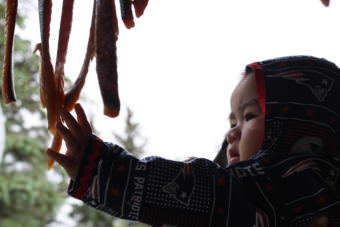
Christian Mulipola reaches for king salmon strips his grandmother, Diane Ishnook, has hung up to dry. Her king salmon were caught far downriver from Koliganek. (Photo by Avery Lill/KDLG)
Christian Mulipola reaches for king salmon strips his grandmother, Diane Ishnook, has hung up to dry. (Avery Lill/KDLG)

Salmon runs on the Yukon River have been dwindling for years. And the loss of commercial and subsistence fishing has hit communities hard. KYUK sat down with Tribal President Nick Andrew Jr. of Marshall on Aug. 9 to talk about what the salmon crash means for people who have relied on the fish since time immemorial.

Andrew has fished for salmon commercially and for subsistence since he was five. He spoke about the emotional and cultural toll that the salmon crisis has taken on his community.

Listen:

This interview has been edited for clarity and length.

Nick Andrew Jr.: My name is Nick Andrew Jr. I am a tribal citizen of Marshall. I am also the tribal president, but what I have to say is not necessarily a statement on behalf of the tribe.

I’m from Marshall, born and raised. I’ve been part of the salmon fishery, the commercial and subsistence, since I was five years old. I helped my family, my grandparents, my uncles, my aunts, my nieces, my cousins, we all worked together in the past. And yes, salmon does define who I am. It does define my ancestors, my family, my relatives, everyone on the river.

Nick Andrew Jr., Native Village of Marshall Tribal President. (Dean Swope/KYUK)

We’ve been in conservation mode for king salmon for about 40 years. And that’s a long time. I’ve seen the years of plenty. I’ve seen the years of scarcity, and it’s a political issue now.

Loss of salmon hit us really hard on the cultural side. There went our connection to the ancestors. We also lost that family connection. Because a lot of people went fishing and processing, they involve the family. And the last four years have been hard, especially the years we were in strict conservation mode. It was felt in the community and the region on the lower Yukon River. We had a sense of helplessness.

Basically, not knowing was the biggest thing. We thought that the salmon were going extinct, that was one of the thoughts. And we also had a sense of despair. We didn’t have salmon, dried salmon, smoked salmon, salmon strips, salmon dry-fish, king salmon, salted fish, and salmon for the freezer, for the winter. That took a big emotional toll on our people.

Our subsistence rights are not negotiable. We only take a small fraction of any of the runs that pass the river. And it’s not too hard to ask that more be done for the salmon. Because if nothing’s done, within 50 years we’re gonna be on the endangered list, probably extinction at the rate things are going. So we just need a voice at the table, especially on the North Pacific Fishery Management Council. Our input is important. Our traditional knowledge is important. And we, the Native peoples along the river on shore, we matter too. That needs to be kept in mind.

Francisco Martínezcuello: How has this year’s run been?

Nick Andrew Jr.: Well, when we look at the run we get information from the Alaska Department of Fish and Game on their Facebook page and the faxes we’re getting to the tribe, and they’re showing lower and lower numbers. That’s very concerning. And on a different note, we were allowed to harvest the summer chum. And that really helped a lot of people. And that put reassurance that hey, we do matter. Hey, we’ll have salmon for the winter, even though it’s not the king salmon we’ve desperately been wanting for years. So that’s where we are.

Francisco Martínezcuello: What about your memories as a kid fishing around here, to give people like me who are complete outsiders an understanding of how things used to be, especially for your people, your family?

Nick Andrew Jr.: Growing up was a different time. We had plenty of fish: king salmon, summer, fall chum, and the silvers. The village would empty. Families went to fish camp during those years. Everyone was happy. The dogs that were needed for our transportation and subsistence activities back in the day were fed, they relied on salmon too. All the bears, the birds, meaning the eagles and falcons, seagulls, they were happy too, and the world was complete then. So, on any given day, dried salmon, salted salmon were eaten three or four times a day.

Nowadays, as the salmon started to dwindle, people had to find other species. But still that left the void, the void meaning a big part of our staple was gone. And it’s still, the puzzle isn’t complete today because we got all these factors, and that affected our culture, our physiological and our mental well-being as well. You know it does weigh heavily on our minds, and our very DNA are in tune with salmon as our diet, our identity, our culture. So as the salmon continue to dwindle, that’s impacting just about everyone in our region and on the lower Yukon River because it was the common denominator that made us whole.

KYUK’s Evan Erickson helped with this story.

Alaska’s child care crisis is hitting foster families hard

Anchorage foster parent Lula Canty (left) and one of her adopted daughters. (Wesley Early/Alaska Public Media)

Anchorage resident Lula Canty has been a foster parent for 13 years. She’s taken in over 40 children, and even adopted three of them. Now she’s up against Alaska’s child care shortage.

“I would take in more if I had daycare or someone to watch the children,” Canty said. “But there’s a need.”

Canty works full time and recently had two babies placed with her, but she couldn’t find them a spot in any child care facility.

“I had two newborn babies,” she said. “And it was a hard, difficult process, because there was no openings for newborns in the daycares. Eventually, I had to find another placement with someone who could take the children.”

Canty’s not alone. For the shrinking number of Alaska foster parents, finding child care has become more and more difficult, especially for working foster parents. There are long wait lists to get into many child care facilities — and foster parents can’t wait months for a spot.

Aileen McInnis is the director of the Alaska Center for Resource Families, which helps recruit and train foster parents. She said sometimes foster parents will get a placement on a Friday and need to find child care by Monday.

“A lot of families can anticipate that they need child care, because of summer, because of starting to work, coming back from maternity care,” McInnis said. “But oftentimes foster care placements happen on an emergency basis.”

McInnis said another issue has to do with high rates of trauma among foster children. She said it can be difficult to find child care centers equipped with trauma-informed staff.

“Sometimes in child care, that behavior that might be indicative of coming from a place of trauma might be something that causes you to get kicked out of child care,” McInnis said. “And then the foster family, again, has to find a place that can be responsive to that child.”

Child care is also expensive, with the cheapest options often starting at around $1,000 a month per child. Foster parents receive about $26 a day for children under the age of 5. Canty, the Anchorage foster parent, said there are stipends from the state to help with the cost of child care, but they only range between $700 and $800.

“So when you add in Pampers, and then you can get some assistance with formula,” Canty said, “it’s a resource, but you’re still going to end up having to buy more cans of formula and diapers and paying for the extra daycare.”

State Office of Children’s Services director Kim Guay said the COVID-19 pandemic had already strained the state’s foster care system, resulting in a decline in the number of foster parents to watch Alaska’s roughly 2,600 foster children. She said the lack of child care is making it even worse.

“It’s a pretty big problem,” Guay said. “It’s exacerbating the fact that people don’t want to become foster parents.”

She said it’s even more difficult to find quality child care in rural parts of Alaska.

“You have aunties and uncles and grandparents that could step in and provide some of that care,” Guay said. “But they don’t have any of the facilities. And sometimes they’re not living in their hub communities where their family is.”

Anchorage foster parent Lula Canty (left) and one of her adopted daughters. (Wesley Early/Alaska Public Media)

She said OCS has worked on some solutions, like increasing the stipend families get for children with behavioral or mental health needs. But there’s no easy fix.

“I don’t know the answer to like, how do we solve this?” Guay said. “Who’s got the funding for it? So that I definitely worry about.”

There are also regulations in place for foster children, since they are wards of the state.

Melrina Daniels, who’s fostered more than 60 children in her five years as a foster parent in Anchorage, said OCS requires anyone watching a foster child to have a background check and have fingerprints on file, even if they’re only watching them for a short time period.

“Let’s just say I have an emergency with one kid, and I have to take that kid to the hospital or to the doctor,” Daniels said. “I can’t leave that child with, let’s say, my mom who’s retired and she’s home, because she doesn’t have a background check. And she doesn’t have a fingerprint and she’s not registered with OCS. And so then you have another layer of, ‘Oh my god, what am I going to do now?’”

Daniels helps foster families who need somebody to temporarily watch the children in their care, but the state has seen a decline in the number of people approved to provide that kind of respite care.

As a way to help solve the child care crisis that foster families face, Daniels is currently working to set up her own child care facility, specifically for foster children.

“My home is already set up because I do foster care,” she said. “And so I have a designated play area, just an entire family room that’s just designated for the kids. And so it was easy for me to just transform that into an in-home daycare.”

Daniels said she’s hoping to start up in the next three months, but as one caregiver, she’d only be able to watch up to 10 kids, depending on their age. And the need is so big. She said she’d love to see grants from the state to help other people trying to set up child care facilities. She also thinks OCS could take a stronger role in setting up similar programs.

Child care grants aim to expand access for Juneau families

Childcare workers interact with infants at Gold Creek Child Development Center in Juneau on May 11, 2018. State rules require certain square footage and staffing levels, which limit this center's infant care capacity to 10. New state rules being proposed may force that capacity down to 8.
Child care workers interact with infants at Gold Creek Child Development Center in Juneau on May 11, 2018. (Photo by Jeremy Hsieh/KTOO)

The Southeast Alaska Association for the Education of Young Children is giving out $120,000 in grants to increase the number of licensed child care spots in Juneau. 

Blue Shibler, the association’s executive director, said existing child care providers and those looking to open new centers can both apply. The funding is left over from the city’s child care provider subsidy program.

Shibler said it’s an opportunity for Juneau residents to make a difference for local families and the workforce.

“We’re having worker shortages at the school district and in medical fields and sort of all over the place, and a lack of child care is often pointed to as one of the reasons,” Shibler said.  “When you’re considering starting a child care program, you’re contributing to the overall health of the community.”

Shibler said Juneau child care centers only have capacity to meet about half of the demand. Two centers closed this winter, and one reopened in the spring.

Child care centers have a maximum number of spots depending on the type of license they have. Expanding costs money – it might require more supplies, more employees or even minor construction. But it’s one way Juneau could get more child care slots.

“A home provider who’s licensed by the state of Alaska is only allowed to have eight children,” Shibler said. “If they wanted to expand, they could expand – still in their home – to what’s called a group home status, and that would mean they could have 12 children and an employee.”

Shibler said they’re especially interested in hearing from larger employers or churches that have space they’d like to convert into a child care startup. Grant funding could help pay for upfront costs like equipment and furniture and help pay operational costs for the first few months as business owners build up enrollment.

Letters of interest are due to SEA-AEYC by 2 p.m. on Oct. 27. The form is available on their website.

Site notifications
Update notification options
Subscribe to notifications