
The organization says the project will help them serve more youth amid a growing mental health crisis that’s led to a waitlist for services.
Rachel Gearhart leads operations at JAMHI, which provides care for people with severe mental health needs. She says the need is urgent.
“If you are asking for services, you’re not asking for services a week, three weeks, a month down the road. You want services now,” Gearhart said. “So once you’re ready to do that, you want to be able to strike while the iron is hot.”
In December, the Department of Justice released findings that Alaska is failing to provide behavioral health services to youth “in settings appropriate to their needs” — leading to children being institutionalized who don’t have to be. Gearhart agrees that when patients can’t get the treatment they need in town, they may have to go to Anchorage or the Lower 48 for inpatient care.
The new facility — which will be in the former Juneau Youth Services building on Jordan Avenue — should help with that. There will be more offices where providers can see patents individually, and larger rooms for group therapy and play therapy like yoga. JAMHI will continue to use its current location on Glacier Avenue for administrative offices.
Gearhart says the organization is focused on making sure they won’t outgrow the new building, too.
“We’re spending the time right now to work with the architect and the providers and leadership at JAMHI to really decide, what does this building need to look like?” she said.
Gearhart said she doesn’t know when the money will land at JAMHI’s door, but the renovations will hopefully be completed by summer.
Correction: This story has been updated with the current name for JAMHI Health & Wellness.
The Food and Drug Administration announced it has loosened some restrictions on the pill mifepristone, allowing it to be dispensed by more pharmacies and without an in-person exam. (Charlie Neibergall/AP)
More than half of all U.S. abortions are medically induced through a two-pill regimen that requires a prescription but does not involve surgery. And since Roe v. Wade was overturned in June, rates are expected to increase.
Now, a permanent rule change by the Food and Drug Administration will allow retail pharmacies to fill prescriptions for the drugs, making the once onerous process of obtaining the abortion pills much easier in states that permit the procedure. But in places with strict anti-abortion bans, pregnant people may still find it challenging to get their hands on the medication.
What does the FDA’s new rule change?
The revision by the FDA announced on Tuesday permanently eliminates the requirement of an in-person doctor’s visit for a prescription of mifepristone, a drug that stops the hormone needed to maintain a pregnancy in the first trimester. The medication has been approved by the FDA for more than two decades but the only way to get it has been from certified clinics due to safety concerns. Retail chains were specifically barred from dispensing the medication.
The agency lifted the mandatory face-to-face with physicians at the start of the pandemic, allowing them to prescribe the pill via telehealth appointments. This week the FDA said that after a review, the restrictions were no longer necessary.
Mifepristone is used to terminate pregnancies of up to 10 weeks. It works when it is followed up with a dose of misoprostol, usually taken 24 to 48 hours later. The second pill causes the uterus to expel the pregnancy. (Doctors also use both pills during miscarriages to speed things along and minimize infection risk.)
Where will the pills be available and who will have access?
Now that big pharmacy chains are no longer barred by the FDA from carrying and filling prescriptions for mifepristone, the medication could be available at local drugstores and pharmacy retailers. They can also continue to be sent through the mail after telehealth appointments.
While no one is required to carry them, pharmacies that wish to dispense the pills would need to meet certain requirements and receive special certification from the FDA. And, in all cases patients still need a prescription. (They will not be available as over-the-counter medications.)
On Wednesday, Walgreens said it plans to pursue certification.
“We intend to become a certified pharmacy under the program,” Fraser Engerman, a spokesman for Walgreens, told NPR in a statement.
He added: “We are working through the registration, necessary training of our pharmacists, as well as evaluating our pharmacy network in terms of where we normally dispense products that have extra FDA requirements and will dispense these consistent with federal and state laws.”
CVS said it was looking at requirements in states that don’t already restrict the drugs for medication abortion.
Medical societies say it’s a step forward, especially for people who have been marginalized by the health care system.
“Many people have difficulty accessing this care because of things like transportation or having time off of work to go to a clinic to get this care so this is really going to open the doors for them,” Dr. Kristyn Brandi, a member and fellow at the American College of Obstetricians and Gynecologists told NPR.
She added that the FDA’s conclusion that patients are not at an increased risk by not seeing a doctor in-person, might pave the way for providers who may have previously been nervous about seeking certification.
“I’m hopeful that they will sign on and be able to increase access to their communities,” Brandi said.
What about states that limit abortion pill access?
Pregnant people living in states that already limit or ban abortion pill access will likely not benefit from the FDA’s new rules.
According to the Guttmacher Institute, which tracks state laws and policies surrounding abortion, 29 states specifically require physicians to administer medication abortions. Eighteen of those states have already effectively banned the pills’ use in telemedicine by requiring a clinician to be in the room when a patient takes the mifepristone. That means sometimes people have to schedule an initial appointment to get the prescription and if the office or clinic is out of stock then the patient has to return for a second visit to take the pill in front the doctor or clinician.
Meanwhile, Texas outright banned two-pill regimen after seven weeks of pregnancy.
Anti-abortion activists and legislators have driven the push against abortion medication, saying that easing prescription requirements is dangerous.
Sue Liebel, director of state affairs for the Susan B. Anthony Pro-life America, an organization that calls itself “the political arm of the pro-life movement,” called the more lax rules “a disaster waiting to happen.”
“It is just super reckless that the FDA would peel back these safety regulations [requiring] an in-person exam. I find it heartless that women’s health and safety was not taken into account,” Liebel told NPR.
She suggested that as a result, more women “will wind up in the emergency room.” But when pressed for data that might show any increases in ER visits since the FDA temporarily lifted the in-person mandate, she was unable to point to recent studies.
Liebel said she expects to hear from lawmakers in the coming days about how they intend to move forward.
“I think this next policy session is going to be very fascinating,” she said. “We’re in some new territory here with the decision. t’s going to be a mixed bag to be honest with you in terms of what states will try do and see what works.
What safety measures are in place to protect patients?
The Mayo Clinic lists excessively heavy vaginal bleeding and unusual tiredness or weakness among the more serious side effects of mifepristone that would require immediate medical attention. Still, the physicians and medical societies say medical complications are very rare.
“The people that actually need emergency care after receiving the proposal is less than 1%,”Dr. Kristyn Brandi of ACOG told NPR.
She added that forcing patients to get the pills in person does nothing to improve medical treatment or prevent a negative response.
“I would say that there’s absolutely no data that suggests that people are going in waves to seek emergency care after medication and that’s because there is a really great track record showing that they are incredibly safe,” Brandi said.
She also notes that clinical care is not going to change very much. “Patients will still be evaluated by experienced clinician. They’ll go through counseling. They’ll be able to talk about whether or not this is the best choice for them.”
The only difference, moving forward she explained, is that in the most dire situations they will no longer have to drive long distances for an exam or wait days to obtain the vital medication. “They’re just going to have much more easy access to it.”
Copyright 2023 NPR. To see more, visit https://www.npr.org.
Bobby Superb poses for a photo with his dog Jersey in the parking lot of the Carrs Safeway in Midtown Anchorage on Dec. 29, 2022. He said between his fixed income and rising prices of groceries, he’s eating less and he no longer mixes hamburger meat in with Jersey’s dog food. (Jeremy Hsieh/Alaska Public Media)
Bobby Superb left the Carrs Safeway in Midtown Anchorage last week, awkwardly carrying an armful of loose groceries: a jug of juice, some pastries, a bag of tamales and two bananas.
“Just a few items. I avoid getting a bag because they charge for it. Just, you know, odds and ends, the last of my money,” he said.
Superb said he’s a retired merchant mariner and school teacher on a fixed income. He said he’s eligible for food benefits, but hasn’t gotten them because of the state’s monthslong processing backlog.
“That was lovely during the holidays, to be left without,” he said sarcastically.
You’ve probably noticed lots of prices going up in the last year – especially groceries. Different analysts have different opinions on what will happen to them going forward. But looking back, the U.S. Bureau of Labor Statistics’ reported food prices in November were up 12% compared to the year before.
Superb said it’s forced him to eat less.
“Meat products, fresh fruit and vegetables because they’re expensive, you know?” he said. “Instead of buying six bananas, I buy two. Instead of eating a whole banana, I cut’em in half, make’em last longer.”
He’s lost a lot of weight, he said. Even his dog Jersey isn’t eating as well.
“Now he eats nothing but plain dog food. I used to mix hamburger with his food,” Superb said. “I can’t afford his little extras.”
A lot of spending habits have changed in the last few years.
“I’m more cheap now,” said Ryan Greene, who bought a gallon of milk at the Carrs last week.
Greene said he also cut back on how much meat he buys, from about twice a week to once or twice a month. Now he’s buying fewer groceries and more cheap fast food.
“I go to Costco a lot, too, where, that Costco food court — that’s the cheapest,” Greene said. “That gets me through.”
Neal Fried is a longtime economist who works for the Alaska Department of Labor. He said he’s never seen an economy like this, between pandemic restrictions, massive federal relief efforts and the recovery now.
“I’m glad I’m still an economist during this period ‘cause this was one of the most remarkable things to happen and watch and measure that I’ve ever had happen during all the decades I’ve been doing this,” Fried said.
For about a decade, inflation was about 1.5%, Fried said. For 2022, he said it’ll be around 8%.
“Most recessions and dramatic things are surprises. But that was such a fast, quick surprise – and something that we’ve never, ever had to deal with,” Fried said.
Of course, inflation affects pay, too. Are wages keeping pace with price increases in Alaska?
“It depends,” said Fried. “I mean, wages have generally increased, but overall, probably not as fast as inflation.”
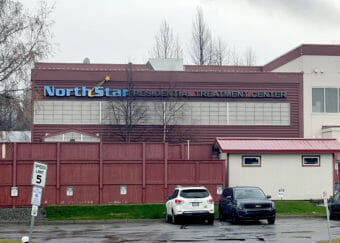
North Star Residential Treatment Center on DeBarr Road in Anchorage. (Casey Grove/Alaska Public Media)
The U.S. Department of Justice has released the findings of an investigation into the lack of adequate mental health services available to children in Alaska. The investigation found that youth in the state were forced to endure unnecessary and unduly long institutionalization in locked facilities because no alternatives exist.
Michelle Theriault Boots is an investigative reporter with Anchorage Daily News and wrote about the DOJ report.
Listen:
The following transcript has been lightly edited for clarity.
Lori Townsend: Department of Justice investigators traveled to Alaska twice. They toured facilities here and interviewed families, children and staff. What did they find?
Michelle Theriault Boots: The investigators, in their report, describe finding a lot of children and teenagers who are in facilities like North Star and other residential treatment facilities living away from their homes and families and communities who probably could and should be living at home. And that’s because the investigators found there aren’t enough supports in communities in Alaska to give them the help with mental health and psychiatric problems they need at home.
Lori Townsend: Michelle, you’ve reported on trouble at Anchorage’s North Star psychiatric hospital and children being sent outside of the state. Give us some context here of when you started reporting on the lack of service for children, and what you found or how that relates to this particular investigation.
Michelle Theriault Boots: So for many, many years – decades really – Alaska has lacked kind of a middle layer of care for kids who are suffering from mental illness. So for a long time, kids whose behaviors or who are just acutely in mental crisis, have been sent to facilities outside of the state of Alaska for care. The only facility in Alaska that can treat kids 12 and under is North Star hospital at the hospital level, and there’s a very, very limited number of beds at the Alaska Psychiatric Institute. But beyond that, and in other parts of the state, there’s really very, very little. So the problem we’ve had for a really long time in Alaska is that if a kid is having a problem at all, they kind of automatically get sent to this high-level locked psychiatric hospital, which for a lot of kids is really not appropriate, and is really damaging because it takes them away from their home, their school, their family, their community, their tribe and puts them behind locked doors, sometimes for months and even years.
Lori Townsend: Yes, there are clearly some egregious examples cited in the DOJ report – a girl from Bethel who at 12 was feeling sad and irritable, acting aggressively toward younger siblings, something that doesn’t sound tremendously unusual at that age. But she was sent to North Star and has been there for the majority of four years. The report says she’s more adjusted to institutionalized life than life at home, so such a terrible statement. This sounds like a multi-level failure. What were the recommended alternatives to this type of lockup?
Michelle Theriault Boots: A lot of the kids who end up in these institutions in Alaska and outside are in foster care. They’re in the custody of the state of Alaska. And it’s often the state Office of Children’s Services that places them in North Star or another institution. One alternative to that would be therapeutic foster homes, where people who are trained foster parents, who have special knowledge and training of helping kids with trauma, can take over and the kids can live in homes – that function like a home, not an institution – but also get a high level of therapeutic care. There’s also crisis intervention strategies that exist other places where, say, a kid is going into crisis, their parent is afraid of them or feels like they can’t be at home, well a crisis team would kind of swoop in and maybe they hold the kid for one day or two days or three days. But it’s not a long-term thing. It’s just enough time to stabilize the kid. But then the kid can go back home.
Lori Townsend: The state acknowledged that it’s cheaper to treat children while keeping them with their families than to send them to far away psychiatric facilities. But how did they respond overall to the Department of Justice findings?
Michelle Theriault Boots: You know, it’s interesting, I asked for a response and got different responses from three different agencies. I got a response from the Department of Law, who would be kind of on the other end of any kind of legal action toward the state and they said, “We’re reviewing this; we want to work with the DOJ, we may not agree with all of the findings.” And I also got responses from the now-separate Department of Health and the Department of Family Services. And they both said, “We are willing to work on this, we are willing to work with the DOJ, and you know, here’s even some things that we are doing to move in this direction already.” And I think that there is an acknowledgment that – yes, like, nobody really wants kids to be locked up in institutions, right? We want this to work. It’s just how to implement it on a scale and with Alaska’s unique challenges, with many very small rural communities who are off the road system. How do you deliver the care that kids need, wherever they are?
Lori Townsend: This report, Michelle, was just released. But have you talked with families about how these separations have affected them?
Michelle Theriault Boots: Yeah, I’ve talked to many families and many of the kids themselves, and it’s devastating. You know, there’s certainly kids out there who will say that they needed help in an institution, and that it overall was a good thing for them. But there are many who say that they felt locked away and forgotten, that they didn’t get the help they need. And for parents, it’s also really, really scary and hard to have your kid kind of go behind the doors and not necessarily have access to them, sometimes for a long period of time, and I think it’s often presented to parents as this is your only option. And we’re talking about kids that, you know, for the most part are adolescents or even younger. So kids as young as 5 and 6 are in institutions in Alaska and Outside.
Lori Townsend: Michelle, the Justice Department gave the state recommendations that there are resources available to use expanded Medicaid funds, grants and income from the state and federal sources and also income from the Alaska Mental Health Trust to help kids before they get sent away. Is the state following or has the state followed this guidance?
Michelle Theriault Boots: In 2019, Alaska had a Medicaid waiver expansion, which basically paid for a new menu of services. And so that’s an exciting thing, and that was progress. But what this report says is that that really hasn’t reached its full potential yet. You know, really, a relatively small number of children in Alaska have gotten to use these services, sometimes only in the dozens. The DOJ kind of says, “Well, Alaska has had this opportunity, but really hasn’t fully implemented it yet.”
Lori Townsend: Michelle, thanks so much for coming in and clarifying this really important issue for Alaskans through your reporting.
Michelle Theriault Boots: I appreciate you having me, Lori. Thank you.
Rebecca Trimble with her husband, John, and their three children. (Courtesy of John Trimble)
If everything goes right, former Bethel resident Rebecca Trimble will be an American soon.
It’s a moment that has taken years to reach, but her husband, John Trimble, a captain in the U.S. Army Reserve, said that they’re waiting for a final decision before they celebrate.
“You know, like, we’ve gotten so hopeful so many times along the way and then been disappointed, you know,” he said. “So now it’s, I mean, I don’t know, that’s just how I feel about it. It’s like it’s definitely exciting, but it’s, but we’ve kind of trained ourselves to not get too, too excited.”
Trimble’s story made national headlines in 2020, but it has been slowly unfolding for more than a decade. She’s been in the U.S. since she was a few days old.
“I was adopted at birth in Mexico. And then I came up from, like three days on up, to Salem, Oregon, and that’s where I grew up,” Trimble said. “Later on, in middle school, I moved up to Vancouver, Washington. I lived in Vancouver until 2017, when we moved to Alaska for my husband’s job.”
Trimble said that she didn’t knowshe wasn’t legally a citizen. She even voted in the 2008 presidential election, which is illegal for a non-citizen. This caused a lot of problems when she found out she wasn’t a citizen and started looking for legal ways to stay.
“There’s been so many ups and downs and dead ends where we’re like, ‘oh, connect with this person or do that paper. Let’s try this.’ And it’s just been a whirlwind,” she said.
Trimble first told her story to the Alaska Landmine in early 2020 after she received a letter from the U.S. Citizenship and Immigration Services saying that she had a month to leave the country. That was hard on her husband and her kids.
”They saw the hurt, and they saw me crying, and they kind of, we kind of tried to explain in the, like, soft way, how, you know, ‘Mommy was adopted.’ And you know, there’s just papers and that makes you like, who you are, where you’re born, and just like, ‘Mommy might not be here,’ you know. ‘We might have to move,’ kind of thing,” she said.
Trimble’s situation is tricky, and she said that trying to find a way to get immigration officials to understand that felt dehumanizing.
“I didn’t get approved one way because of this. So we filed a paper the other way. Then they’re like, ‘no, because we feel like you don’t fit in this way either.’ And then no one had taken the time to talk to me, and it was like ‘mail this in, and three months later you’ll hear a response to that question.’ I felt like a number at times. And if I didn’t fit that number, then, you know, then it didn’t move forward,” she said.
In 2019, the Trimbles hired Margaret Stock, an immigration attorney in Anchorage.
“The facts of Rebecca’s case are very sympathetic. I think most people understand that when you came to the United States when you were a few days old and you thought you were an American citizen your whole life, that it’s not fair for the government to come forward when you’re an adult and tell you that you need to be deported,” Stock said.
But in the end, it took a literal act of Congress to get results. Alaska’s congressional delegation had to push a private bill through Congress specifically for Trimble. A private bill allows individuals to get relief directly from federal lawmakers when they’ve exhausted all of their other options. Many of them deal with immigration. But even with high-level support from Alaska’s delegation, it has taken more than a year for that bill to work its way through the House and Senate.
Trimble’s case is unique in some ways, but the circumstances are deeply familiar to hundreds of thousands of undocumented people living in the country.
“We know the story of so many, who we refer to as the Dreamers. Young people who came into this country and very, very young, knowing no other country other than the United States, brought here by their parents, and who have been denied opportunity,” said Alaska Sen. Lisa Murkowski who sponsored Trimble’s bill in the Senate.
What’s rare about this case is that her private bill actually made it through Congress.
“But Rebecca Trimble came to us as, as really, a very special case,” Murkowski said.
Stock, Trimble’s attorney, deals exclusively with immigration cases. She said that she’d like to see a legislative fix to this problem.
“I think it’s really important for people to know about cases like this — they’re not actually that uncommon. So to help the rest of the people, I think, though, we’re gonna have to get immigration law changed,” Stock said.“Because one of the problems with private bills, of course, is they only benefit one person and they don’t fix the general laws.”
Trimble’s bill passed the Senate unanimously on Dec. 15. Now she’s waiting for President Biden to sign it, but that doesn’t mean she’s done with all of the paperwork.
“So this will grant me, I believe, permanent residency, and then I’ll have to get a green card after that. And I know that’s, you know, that’s a long process as well,” she said.
And, once she’s legally able to, Trimble said, she’ll probably vote again — even though it caused so much trouble the first time around.
“I mean, once I become a U.S, citizen I — yeah, I might vote. I don’t know yet at this point. I mean, I want to do my civic duty as a U.S. citizen,” she said.
Dr. Esgar Guarín with his mobile vasectomy clinic parked at a Planned Parenthood in St. Louis, Mo. (Sarah McCammon/NPR)
Restrictions on abortion in many states are prompting some men to rethink their reproductive health decisions. Since this summer’s U.S. Supreme Court ruling overturning Roe v. Wade, some doctors say they’re hearing from a growing number of male patients asking for vasectomies.
“It shouldn’t just be on women to step up and not have kids, you know?” says Dustin May, of St. Louis, shortly after his vasectomy procedure at a Planned Parenthood clinic. Vasectomies are outpatient permanent sterilization procedures that block sperm from being released in semen.
May and his girlfriend, Courtney Price, have known for years that they don’t want children.
“If she got pregnant, an abortion would be something that we would consider,” he said. “This is a step to prevent that.”
Price says she’s tried several types of birth control, all with unpleasant side effects. May and Price are both still in their 20’s, but Price says they knew from their first date more than three years ago that neither one of them wanted to become parents.
As of the Dobbs v. Jackson Women’s Health decision in June, abortion is illegal in Missouri and roughly a dozen other states, with Republican lawmakers in many states pushing to pass more restrictions in the future.
The Planned Parenthood clinic in St. Louis used to provide abortions, but on a recent day NPR visited, the health center was hosting a free vasectomy clinic at three different locations around Missouri over three days. Normally, if not covered by a patient’s insurance, Planned Parenthood charges up to $1,000 for the procedure, including follow-up care.
As soon as the Dobbs decision was released, Dr. Esgar Guarín says his Iowa-based vasectomy practice saw a surge in website traffic, and the number of patients coming for procedures nearly doubled from June to July.
“What has happened is that since Roe v. Wade was overturned, many men have realized that they perhaps have been absent in contraception, particularly in contraceptive decisions,” says Guarín, who assisted with the vasectomy clinic in Missouri.
Guarín’s practice isn’t alone. A spokesperson for the American Urological Association told NPR that while national data isn’t available yet, healthcare providers around the country have anecdotally reported seeing increased demand for vasectomies in recent months.
Permanent with little risk
Dr. Esgar Guarín’s mobile vasectomy clinic, pictured here parked at a Planned Parenthood in St. Louis, Mo., features images of sperm. (Sarah McCammon/NPR)
In addition to being permanent, Guarín says vasectomies are relatively quick – about 10 minutes for a skilled surgeon. They’re also less invasive than tubal ligation, a sterilization procedure that involves cutting or blocking the fallopian tubes to prevent pregnancy. They have a far lower failure rate than many other types of birth control including condoms and are more effective than some other types of contraceptives including the pill.
Dr. Sarah Vij, assistant professor of urology at the Cleveland Clinic, says vasectomies are “at sky-high, record rates” since Dobbs. At Planned Parenthood North Central States in the Midwest, CEO Ruth Richardson says the organization received a “surge of calls” after the decision.
In New York, Dr. Meera Shah, chief medical officer at Planned Parenthood Hudson Peconic, is getting similar calls from patients who’ve decided that now is the time for a vasectomy.
“They’ve been thinking about getting it for a really long time, and then what’s happening in this country has motivated them that much more to get the vasectomy,” Shah says.
Some downsides
There can be downsides, though. Shah tells patients that vasectomy reversals are sometimes possible but never guaranteed.
“If somebody is going into a vasectomy saying, ‘Oh, it can be reversed,’ then I say that they may not be a candidate for it.”
Shah says some patients choose to freeze their sperm before the procedure in an effort to keep more options open should they decide to try to have a child in the future.
Another patient at the Planned Parenthood in St. Louis, Collin Mack, says he’s been wanting a vasectomy for several years, “but I waited because I don’t like making rash decisions.”
Now, Mack says he worries about the lack of access to abortion. And he likes the idea of being in control of his fertility, rather than relying on a female partner’s contraceptive decisions.
At 24, Mack says he felt confident in his decision, but he persuaded his grandparents to help fund the cost of freezing some sperm as a “backup option” in case he ever changes his mind. Storing sperm typically costs several hundred dollars a year.
“I kind of played the card of like, ‘Do you guys want me to have kids? Because you guys seem the most upset about this procedure, you guys should invest some money in me freezing the sperm,'” Mack says. “I’m not too worried about it. I’d prefer not to have kids – I think that’s the choice that I’m going to stick with.”
Dr. Guarín says many of his recent patients have been younger men, often in their 30s, as well as couples. Many had been relying on female partners for contraception and no longer feel confident doing so.
“I hope this is an inflection point in reproductive rights in America for the participation of men,” he says.
Copyright 2022 NPR. To see more, visit https://www.npr.org.
Close
Update notification options
Subscribe to notifications
Subscribe
Get notifications about news related to the topics you care about. You can unsubscribe anytime.