Family

Alaska doctor, once the focus of outrage, reflects on past as abortion provider, with questions

A black-and-white photo of a woman in front of a large, concrete building
Dr. carolyn Brown sits outside her obstetric-gynecologic practice in Palmer with the Valley Hospital in the background. This photo was taken sometime in the mid-1980s. (Photo by Sally Mead)

This story is an adaptation of Episode 2 of the Alaska Beacon podcast, Private Right: Abortion in Alaska.

Written in large letters across a billboard displayed in the Alaska Right to Life booth at the 1981 State Fair in Palmer was this question: “Does your Doctor kill babies?” Underneath that question was a list of several names – including Dr. carolyn Brown.

This billboard along with things published in Alaska Right to Life’s newsletter — like calling Brown “baby-killer Brown” — were part of a libel lawsuit that would go on to reach the Alaska Supreme Court. She would lose the lawsuit, which touched on principles central to debates over free speech.

From the late 1970s to the late ’80s, Brown was a gynecologist and obstetrician in Palmer. She delivered thousands of babies, which she was known and praised for. She also performed abortions, which she was known and praised for — and vilified for. She remembers being told, “how bad it was, how evil it was that I was killing babies, and that God would get me for that and I would burn in hell and all the other stuff that people say to people.”

However, Brown herself has questions. As she reflects on her past as an abortion provider, she struggles with how to define the beginning of personhood. And she’s relieved she no longer has to decide when it’s OK to perform an abortion. But despite this uncertainty, she continues to support a right to an abortion.

A long interest in medicine

Brown was born in 1937 and raised in Hereford, Texas, about 50 miles southwest of Amarillo. Her parents divorced when she was around 9 and her mom left, so Brown and her brother went to live with their grandmother. She knew when she was 10 she wanted to be a doctor.

“I was working in a cotton patch and there were a whole bunch of other people working in that cotton patch and here I am this little kid with a 6-foot cotton sack that I’m pulling behind me and I decided I don’t think I want to do this all my life,” Brown said, adding that she isn’t sure why she chose to be a doctor at that time. “Maybe I’ve been to a movie. I didn’t have any books to read. My growing up and background was a little bit challenging, I will say. But I decided at that point that I really was interested in becoming a doctor.”

When she was introduced to a library at age 12, she read everything in the children’s part of the library.

“I read a lot of biographies and … I was just mesmerized with medicine. That really made more firm what I was going to do,” Brown said.

She took all the science classes that were possible for her to take in middle and high school, and went to college at Hardin-Simmons University in Abilene, Texas, where she majored in chemistry and biology, and graduated magna cum laude.

When it came to deciding what medical school to go to, Brown was sure of only one thing: “Whatever I have to do, I had to get out of Texas,” she said.

She didn’t want a big medical school and she didn’t want to go too far north, “Because I was too much of a hick. And I knew that. And I was poor as Job’s turkey,” Brown said.

Growing up, Brown did not think highly of herself.

But she got into all the medical schools in Texas at the time.  Still, she decided to go outside the state — to Bowman Grey School of Medicine in Winston-Salem, North Carolina.

Brown met her husband George Brown there, and the two doctors came to Alaska in 1965. They worked as public health doctors with the U.S. Public Health Service. They were based out of Anchorage but traveled all over the state. The two then went to Hawaii, where Brown did her first residency in public health and preventive medicine at the University of Hawaii. Afterward, they returned to Alaska.

Brown had a long list of jobs during that time, including working at the Anchorage Municipal Health Department. Brown was inundated with women who had a lot of health questions about women’s issues – questions Brown couldn’t always answer. So, she decided to go back to the University of Hawaii to do a second residency.

One of the boys

Throughout this whole time, Brown didn’t have any strong feelings about abortion. In fact, she didn’t really think about it at all during college, medical school, or her first residency. It wouldn’t come up until her second residency in obstetrics and gynecology.

It was 1975. The U.S. Supreme Court had decided on Roe v. Wade two years prior, ruling that the constitutional right to privacy includes the right to access an abortion.

The University of Hawaii wanted to teach all OB-GYN residents how to perform abortions.

“When I got there, I had a choice,” she said. “You were offered it. They suggested it. And if you didn’t want to do it, and there were some who, based on religious background, chose not to do it, then they were given other kinds of work. Grunt work, we call it.”

Brown said it was an excellent teaching program — but, as one of the first women to go through that program, she said it was also extremely misogynist. So Brown had to make a choice — was she going to be one of the boys and perform abortions, or would she go do grunt work?

She decided to be one of the boys. Even then, she still didn’t have an opinion about abortion.

“I didn’t have a decision about — What did I really think about it? I said, ‘OK,’ because I hadn’t really processed what that really meant,” Brown said.

Brown knew that she wouldn’t have an abortion. She had to ask herself: What am I doing? It weighed on her, but she didn’t have much time to dwell on it.

“Except once in a while I did think about it, and I went to church. And I did all of those things that I sort of grew up doing way back in the day. But I had to come to some peace with myself,” Brown said. “But I never could decide for myself that an egg and a sperm was a person because a person is a philosophical definition. A sperm and an egg when they come together, that’s tissue up to a certain point. And then you got the whole philosophical thing is when does the soul enter the sperm and the egg? I didn’t know and I still don’t know. But I’ve struggled with that for all of these many, many years.”

During Brown’s days at the clinic, she did 10 to 14 abortions a day.

Setting up a practice in Palmer

When she was done with her residency in Hawaii, she, her husband George Brown and their two kids returned to Alaska in 1978. The couple started Women and Children’s Health Associates, a nonprofit that operated an obstetric-gynecologic and pediatric practice in the Mat-Su Valley. Brown’s office was based in Palmer and her husband’s pediatric office in Wasilla.

Brown initially worked out of the Valley Hospital, though she didn’t have a proper office.

“But the hospital had a little front room, just off of the waiting room when you go into the hospital and it was maybe 16-by-16 square feet. And so we found a table with stirrups on it and a desk and a chair and a screen. And I didn’t have a secretary, I didn’t have an assistant, I had nothing, but the people started coming,” Brown said.

Brown had a very active OB-GYN practice. She eventually moved her office to its own building, just outside the hospital’s parking lot. She said she would work 100-hour weeks and she didn’t make payment a barrier.

“In those days, I gave stuff free. I did free C-sections, I took bear meat, I took salmon. You know, it was the old-fashioned way of doing whatever it is you had to do,” she said.

She also provided abortions. Brown saw all kinds of patients, including Medicaid recipients, and people from all over the state — like Fairbanks, the Aleutians, Kotzebue, Juneau, Utqiagvik — were referred to her.

“Literally every quadrant of the state and people would call the office or they would call whatever practitioner they knew, or from way out in the villages, they would contact the public health nurse,” Brown said.

At this time, Brown said there weren’t ultrasounds. She had to tell how far along someone was from doing a pelvic exam. It was up to her to determine if a woman was, for instance, eight weeks pregnant or 22 weeks.

In the late 1970s, doctors in Alaska could perform abortions up to 150 days, or about 21 and a half weeks. To provide an abortion beyond that, state regulation allowed doctors to use “reasonable judgment.” Brown said she stuck with the 150-day limit and was “worse than OCD on that sort of thing.” This meant she sometimes had to turn people away, like a woman who had traveled from Utqiagvik to Palmer.

“She got there and, bless her heart, when I did the exam… she was more – 150 days is 21 weeks and four days – and that was 22-weeker and I said, ‘I can’t do this. I can’t do this,’” Brown said.

By this time, Brown said performing abortions was as normal as any other OB-GYN medical procedure. Though she performed abortions up to 21 and a half weeks, Brown said more than 90% of the abortions she did were done in the first trimester – the first 13 weeks.

She estimates she did three to five abortions a week in the Valley Hospital, though there were peaks and dips. And she said she had a good safety record.

“I wasn’t having any bad events, any failures, any disasters. I was very, very, very conservative about what I did,” Brown said.

‘There goes the baby killer’

Brown and her family were part of the community. They went to the Presbyterian church. The two kids attended middle and high school in Palmer. It wasn’t a secret that Brown performed abortions. She said the board of her and George’s nonprofit was very supportive, but not everyone in the community was.

Throughout her time in Palmer, starting a couple months after they arrived, Brown recalled being harassed. She received hate mail and phone calls in the middle of the night. Air was let out of her tires. People against abortion rights went to her work place.

“When I would come to work, go in to make rounds, they would hiss and boo. That was still at a time when I had the little office in the hospital there. So they would come in and sit around and say whatever it is they had to say. And line up just like a march as it were,” Brown said.

She heard comments like, “There goes the baby killer. Is that the baby killer?”

“It was awful. It was really awful, but you have to carry on,” Brown said. “I’d come to work and get ready to go down to the other end of the hospital to do a C-section or to do whatever it was I was going to do. Well, it’s got to go on.”

She said that people’s behavior toward her was egregious and filled with vindictiveness. But she never felt unsafe. In the decades after she practiced in Palmer, several abortion doctors were murdered around the country, which led Brown to think that if she had been an abortion provider later, she might’ve been shot.

On the outside, Brown was calm and collected. But inside, she said she was a basket case. Most people didn’t know that, she said.

“Of course I had to be in charge in the operating room. I had to be in charge when a person was in labor, screaming their heads off or whatever. I got to the place where I could almost talk a woman through her delivery, just my soft voice and sitting there. And I knew that was happening and she knew that was happening. And I knew I was very good at that. But nobody knew what was going on inside. The fear of God Almighty, what if this woman dies? What if this baby dies? Oh, my God. All the horrible things that you could possibly think of, I went through them all a great deal of the time,” Brown said.

At the same time Brown was performing abortions and being called a baby killer, she was also delivering lots and lots of babies. And she was really good at it. “We never lost one,” she said.

There were also colleagues at the hospital who didn’t want to work with her.

Brown recalls a person who worked in the lab and refused to draw blood for abortion patients due to his religious objections. There were also nurses who wouldn’t work with Brown when she was providing abortions. “A few of the nurses, religious or otherwise, just simply could not help,” she said.

The lawsuit

In April 1981, Brown submitted her name to Gov. Jay Hammond for appointment to the Alaska State Medical Board. The board regulates the practice of medicine, including abortion procedures.

According to court documents, “The appointment process resulted in some confusion in the governor’s office.” A letter appointing Brown to the medical board dated in May was signed by Hammond’s signature machine. The letter wasn’t supposed to be sent until the governor actually gave his approval and it wasn’t sent; Brown never received this letter from the governor. But the governor’s press secretary announced Brown’s appointment and the lieutenant governor sent Brown a congratulatory letter. It was also reported in local newspapers.

In response, the Alaska Right to Life wrote about Brown in a June newsletter. It said: “Stop baby-killer Brown.” It called her “the Mat-Su Valley’s No. 1 Abortionist,” and instructed its readers to contact the governor to urge him not to appoint Brown to the Alaska State Medical Board.

The newsletter article said, “We cannot believe that Governor Hammond will bow to anti-life pressure to appoint an abortionist whose methods were so horrible as to cause a boycott by every nurse employed at Valley Hospital.”

Hammond eventually sent Brown a letter and apologized for the “erroneous announcement” of her appointment. He wrote that he had decided to follow his past practice of appointing a person recommended by the Alaska State Medical Association. According to court documents, the association had not recommended Brown because it thought that vacancies on the State Medical Board, which previously had been held by Anchorage doctors, should again be filled by Anchorage doctors.

In September 1981, Brown filed a lawsuit against Bill Moffatt, the primary author of the newsletter article, and Alaska Right to Life, alleging they had libeled her. In the lawsuit, Brown said that the defendants intimidated the governor and caused him to withdraw her appointment, resulting in damage to her professional reputation and career. Brown was joined by other doctors in the lawsuit.

The complaint also alleged defamation based on the state fair sign, what was written in the newsletter, and press conferences where they called Brown a “killer of babies.”

“It was very defamatory. That’s why I decided to sue them,” Brown said. “I was so horrified that somebody would say this about me because that wasn’t who I was.”

Sally Mead was horrified too. In September 1981, Mead was pregnant, and a patient of Brown’s. Mead lived in a two-story log cabin that she’d built in Bird Creek, which is south of Anchorage. Which means she’d drive past Anchorage in her hour-and-15-minute drive to Palmer for her appointments with Brown. That’s also where she delivered her baby, at the Valley Hospital.

It wasn’t an easy delivery, Mead said. It took around 12 hours and went through the night.

“And in the end, [Brown] said, ‘I think his head is bumping into your pelvic bone. So I know you didn’t really want to go into the O.R. But let’s just try and see if we can help him get out.’ So she takes me into the O.R. and of course I’m having contractions like crazy and been having them for hours,” Mead said. “she takes the forceps she puts them there, lowers the baby’s head down and – boink – out he comes. That’s all it took.”

In the moments after her son was born, as she was waiting for him to get cleaned and brought to her, Mead had a thought. She knew Brown performed abortions and she had seen the Right-to-Life display at the state fair. In her mind, Brown was being attacked. Mead had also heard about the lawsuit.

“And it was somewhere in that point of the delivery that I just had a flash. You know, this was something I could do to help. I could help to create a legal fund for her and support this effort.

Mead started the carolyn Brown Legal Fund (Brown’s legal first name begins with a lowercase “c”). At the time, Brown was paid $36,000 – just over 50% above the typical family income. Today, obstetricians on average make nearly 350% of typical incomes.

Mead made a pamphlet detailing Brown’s position, wrote letters, made phone calls and held gatherings to raise money, which she doesn’t recall as being that difficult.

“There was a large community, particularly of women but some men, who really felt this was an issue that needed to be spoken to. Because you know, we’d all go to the state fair, so we’d all see these exhibits from Right to Life,” she said.

Speech about abortion

But in that court case, Brown started to lose. In 1984, the Superior Court dismissed several of Brown’s claims against Right to Life, but not all of them. Bill Moffatt and Alaska Right to Life pushed for a summary judgment to end the rest of the case. The Superior Court denied the motion, setting up an appeal.

The matter eventually reached the Alaska Supreme Court in the case Moffatt v. Brown, which would have implications for not only Brown, but for free speech.

Besides the two parties and their lawyers, attorney John McKay was also involved in the case as a friend of the court. McKay has practiced law in Alaska since 1978, mainly representing news media. (A disclosure: The Alaska Beacon employs McKay when legal issues come up.)

McKay represented the Alaska Press Club in Moffatt v. Brown. McKay said the case could have affected the press’ ability to do its job.

“We wanted to basically take the position in the court that whatever way this came out, we wanted the court to be looking beyond the interest of Dr. Brown or the Right to Life. To say that this case, dealing with the standards in libel law, really probably affects us — the press in Alaska — really more than more than the parties in a sense; it’ll have a longer impact,” he said.

McKay said people saw Moffatt v. Brown as a case about abortion, “but I really think this is a case about talking about abortion. So it could be talking about any other issue too, but abortion was then and remains a really, you know, hot button issue. … And I think that the First Amendment and the same constitutional provision in the Alaska Constitution guarantees free speech, free press. And if you can’t talk freely about these things because you’re worried that people are going to sue you, then you’re going to be less likely to take on those important issues.”

What McKay wanted to ensure was a standard that made it clear that free speech and freedom of the press were protected.

The alleged statement of defamation the Alaska Supreme Court was looking at claimed that Brown’s abortion “methods were so horrible as to cause a boycott by every nurse employed at Valley Hospital.”

That statement was inaccurate. Some nurses wouldn’t work with Brown on abortions, but not all. However, Brown’s side also had to prove that the statement was made with “actual malice,” because according to the courts, Brown was a public figure.

“They said carolyn Brown submitted a letter to the governor asking to be put on the medical board. She put herself in that position of becoming a public figure for at least the limited purposes of dealing with … the abortion question and the issues that came up around whether she should be on the board or not,” McKay said.

In the 1964 U.S. Supreme Court case New York Times vs Sullivan, the court placed certain constitutional limitations on state defamation laws. To recover damages for libel, which is what Brown was suing for, a public figure must prove two things: first, that the statement was false, and second, that the false statement was made with “actual malice.”

Though Bill Moffatt’s assertion about “a boycott by every nurse at Valley Hospital” was not accurate, he said he did not know it was inaccurate, and the court agreed. Moffatt had gotten his information from Robert Ogden, the hospital administrator.

Robert Ogden testified in a deposition that “most, but not all, of the nurses on the nursing staff at Valley Hospital refused to participate in Dr. Brown’s second-trimester abortions.”

He described the situation as escalating gradually, that at first a number of nurses were willing to help and but as time went on, there became fewer and fewer that would help on second-trimester abortions.

Brown’s side was not able to successfully prove that Moffatt wrote the inaccurate statements with malice.

The Alaska Supreme Court sided with Moffatt and the Alaska Right to Life. The opinion again referred to the N.Y. Times case, which stressed a “national commitment to the principle that debate on public issues should be uninhibited, robust, and wide-open, and that it may well include vehement, caustic, and sometimes unpleasantly sharp attacks on government and public officials.”

John McKay said it was a good result from the perspective of the press. He explains what the judge wrote:

“This after all is not a case about whether abortion is acceptable or might be punished but about whether public speech about abortion was acceptable and could be punished,”

Learning to be at peace

In 1988, the Browns sold their Mat-Su practice, gave the profits to their nonprofit’s board and left Alaska for Vermont. There, carolyn Brown was an assistant professor of the OB-GYN department at the University of Vermont medical school, where she trained others to perform abortions.

The couple stayed in Vermont until 2001, when carolyn Brown was asked to be the assistant director for the Alaska Division of Public Health. They returned to Alaska, to Juneau this time. After about a year and a half, the new governor, Frank Murkowski, gave Brown the pink slip, so she moved on.

In 2004, George and Brown went to Kenya for two years to set up a program that cared for HIV patients. When they returned to Juneau, Brown worked at a number of clinics, but was winding down her medical career.

Now, she is very active in the League of Women Voters and AARP, and stays connected with what’s happening in the Capitol on issues like prison healthcare, suicide prevention and opioid abuse. She’s also a voracious reader.

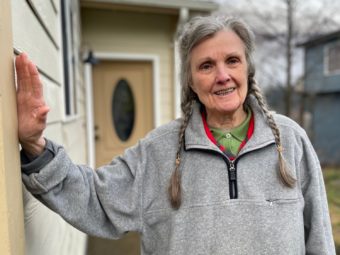
A portrait of an older woman standing outside a beige house
carolyn Brown stands outside her home in Juneau. (Photo by Lisa Phu/Alaska Beacon)

Brown said she is still learning to be at peace with what is.

“I went through a time of anger, rage, anger, vitriolic hate for the people who were the head honchos of the Alaska Right to Life. It took me a long time to get over that but I was only destroying myself by doing that, but the tincture of time does a lot of things for people,” she said.

These days, she reads a lot of philosophy and is interested in learning about different religions. One thing she doesn’t do is attend abortion-rights rallies.

“I remember when I first moved here in 2001 and we would have those rallies on Roe v. Wade day and I was asked to speak at them. I cannot do that, never could,” Brown said.

Brown said she went one year and just stood there. Brown is clear that she’s pro-abortion rights. But it’s not a simple topic to speak about.

“I don’t know. I still have to ask myself questions. What have I done? What is right? What is right? What is life? I know what life is and I know that this tissue here is human. That I know. Whether it’s a person – that’s my struggle. What’s the difference in humanity and personhood? Potential person? There’s so many unknown questions,” she said.

“I’m just glad that I don’t have to make those decisions anymore. That’s a gift to me for myself. It doesn’t mean I’m against abortions. I just don’t know what is a person. I don’t know. It’s complicated, isn’t it?” she said.

Ultimately, Brown said, abortion and what constitutes a life “is not black and white,” it’s not a yes or no question. Instead, it’s complicated and ever changing, and dependent on so many different factors – like a person’s background, spirituality, family history.

And that decision on what abortion is, what personhood is, is not for her to determine, Brown said. She doesn’t think it’s for the U.S. Supreme Court to determine either, or for all the other people who usually end up getting involved in these discussions and decisions. There’s no simple way to put it, she said; it’s just complex.

This story originally appeared in the Alaska Beacon and is republished here with permission.

Indigenous people flocked to DC for ICWA hearing

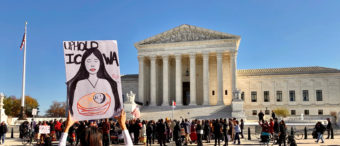
A group gathered in front of the U.S. Supreme Court building. A pair of hands is holding up a sign that says "Uphold ICWA"
The U.S. Supreme Court heard oral arguments Wednesday, Nov. 9, 2022, in Haaland v. Brackeen, a case that will decide if the ICWA is constitutional. Kimberly Jump-CrazyBear, Osage and Oglala, from Virginia, hold a sign in support of ICWA. (Photo by Jourdan Bennett-Begaye/Indian Country Today)

Kimberly Jump-CrazyBear held up a self-made “Uphold ICWA” sign across the street from the U.S. Supreme Court in Washington, D.C., on the morning of Nov. 9.

“I’m just here on behalf of all of you who can’t be here today. To help lend my voice,” she said before the oral arguments for Haaland v. Brackeen began. “Without our children, we don’t have a people anymore.” Jump-CrazyBear is Osage and Oglala Lakota who grew up in Virginia.

While Jump-CrazyBear held up and alternated her sign, a woman across the street at the rally said over the speakers: “If you take our children, you take our identity.”

Jump-CrazyBear was one of the hundreds of Indigenous peoples and allies who showed up in front of the highest court in the land to show their support for the Indian Child Welfare Act.
Approximately 60 stood in line waiting to sit inside the court to witness the oral arguments. Many sat between the Capitol and court listening to three hours of oral arguments on their headphones, and others listened to the line of speakers and songs all morning and into midday.

Haaland v. Brackeen challenges the Indian Child Welfare Act, a law that has been referred to as the “gold standard” for child welfare by many child welfare organizations. It was enacted in 1978 to “halt the unnecessary forced removal of Native kids from their families,” said Sarah Kastelic, an enrolled citizen of the Native Village of Ouzinkie and executive director of the National Indian Child Welfare Association.

""
Sarah Kastelic, executive director of the National Indian Child Welfare Association and an enrolled citizen of the Native Village of Ouzinkie, stands outside the U.S. Supreme Court with a sign in her language in Washington, D.C., on November 9, 2022. (Photo by Jourdan Bennett-Begaye, Indian Country Today)

“So in our organization, one of the things that we talk about is the recipe for colonization,” Kastelic said. This recipe is “consistently followed by colonizers to colonize Indigenous people.”

She said there are five ingredients:

“Take the land;”
“Control the natural resources, especially the water;”
“Usurp, replace Indigenous governance to delegitimize Indigenous thought;”
“Undermine Native worldview, values, traditions, beliefs;” and
And number five, “the most important ingredient,” she says, is to “sever Native children from their sense of identity, from their culture, from their sense of belonging, from that sense of connectedness to something.”

This would meet the United Nations definition of genocide.

“So when we look at what the child welfare system has done, it followed right on the heels of the boarding school policy, as federal boarding schools waned in popularity, the child welfare system took over right where the education system left off,” Kastelic said. “This is no accident, this is by design.”

Among the dozens carrying ICWA signs was Bobbie Hamilton. She traveled 1,300 miles from El Reno, Oklahoma, with 150 citizens from Cheyenne and Arapaho Tribes to show support.

Hamilton is at the frontlines of Indian child welfare. She’s an Indian child welfare case worker with the Cheyenne and Arapaho Tribes and a foster care worker. She retired from the U.S. government as a registered nurse with veteran’s affairs and the Indian Health Service.

Hearing the oral arguments hit home with her, she said.

""
Bobbie Hamilton, Cheyenne and Arapaho Tribes, traveled 1,300 miles from Oklahoma to show support for the Indian Child Welfare Act in front of the U.S. Supreme Court in Washington, D.C., on November 9, 2022. (Photo by Jourdan Bennett-Begaye, Indian Country Today)

“So every day, we face the trials and tribulations that they’re (the children are) facing. There’s trauma. There’s a lot of feelings that the children have that they are trying to deal with, and on a daily basis, and I’m there with them. I feel those feelings. I feel their frustration, and even their happiness when their happiness comes through. I’m there with them,” Hamilton said standing in front of the Supreme Court. “And so our children are very important to us and we want what’s best for our children. It’s hard to see them in situations that they’re in sometimes. Hard decisions have to be made. And I’m right there with them feeling the same thing.”

Principal Chief Chuck Hoskin Jr. of the Cherokee Nation was one of several leaders in attendance at the three hour hearing. The Cherokee Nation is the largest Indigenous nation in the country with over 430,000 citizens.

“The dispossession of Native children, from their families from tribal lands, has done a measurable damage to Native peoples in this country over the centuries,” Hoskin said during a press conference after the hearing. “We were here today collectively, as Native peoples to make our case in court, that the Indian Child Welfare Act is constitutional, and to send a message to this country that we will not stand for the dispossession of our children, and the further erosion of our Native peoples.”

""
Cherokee Nation Principal Chief Chuck Hoskin Jr. speaks outside the U.S. Supreme Court after the court heard oral arguments Wednesday, Nov. 9, 2022, in Haaland v. Brackeen, a case that will decide if the ICWA is constitutional. (Photo by Pauly Denetclaw, Indian Country Today)
""
The U.S. Supreme Court heard oral arguments Wednesday, Nov. 9, 2022, in Haaland v. Brackeen, a case that will decide if the ICWA is constitutional. After, ICWA advocates spoke to the media. (Photo by Jourdan Bennett-Begaye, Indian Country Today)

Before the passing of ICWA up to 35 percent of Native American and Alaska Native children were removed from their homes and placed in non-Native homes. Generations of Indigenous families were disrupted, causing irreparable damage to Indigenous communities as a whole.

“Keeping our children at home is where they need to be,” Charles Martin, chairman of the Morongo Band of Mission Indians. “We will do as we always have as our ancestors did, we will move forward to protect future generations.”

Fawn Sharp, vice president of the Quinault Indian Nation, described the justices questioning as “agonizing.”

“In every single generation, we’ve had to fight this fight and I’m telling you spending three hours in this courtroom with the highest court of this land, the Supreme Court and sit here and still feel that they do not get us, three hours of agonizing argument, agonizing questions where they don’t understand the basic concept, that we have inherent sovereignty, and we have inherent rights to the future of every single Native child born into this generation,” Sharp said.

As with many issues in Indian Country, ICWA has bipartisan support. Leaders noted that it would be shocking if the Supreme Court did not uphold the act. During her speech, Sharp added that dark money and special interests groups looking to attack tribal sovereignty, that this case isn’t a normal Indian child welfare case.

“There’s dark money out there that is strategically targeting our children, our natural resources, our sacred sites. They want to continue to enrich profits at our expense,” Sharp said. “We know that no matter what they do, we occupy a certain place in this life as Native people. We occupy a position of inheriting all that our Creator gifted to us. There’s not a single thing that any one of them can do to take that away from us, no legislation, no court decision. They can’t buy their way into that and they can’t regulate us. We are sovereign tribal nations from the beginning of time until the end of time.”

The Supreme Court decision on this case will come in spring 2023.

This story originally appeared in Indian Country Today and is republished here with permission.

Alaska’s two U.S. senators vote to advance federal same-sex marriage protections

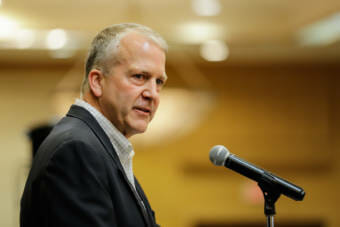
Sen. Dan Sullivan in Anchorage in July 2021. (Photo by Jeff Chen/Alaska Public Media)

Alaska’s two U.S. senators voted on Wednesday in favor of ending debate on a bill intended to protect same-sex and interracial marriage rights, advancing the bill toward final passage in the U.S. Senate.

Sen. Lisa Murkowski and Sen. Dan Sullivan, both Republicans, joined 10 other Republicans and all 50 Democratic Senators on a “cloture” vote needed to end debate. The final vote was 62-37, making final passage — which requires just 51 votes — certain.

After the vote, President Joe Biden urged members of Congress to finish work and send it to his desk.

If signed into law, the bill would not have a significant immediate effect; same-sex marriage rights were guaranteed by the U.S. Supreme Court in a 2015 decision.

Earlier this year, Supreme Court Justice Clarence Thomas wrote that the court should re-examine that decision. His remarks sparked congressional action.

If the bill becomes law and the Supreme Court reverses its 2015 decision, states would be allowed to choose whether to ban same-sex marriage but would be required to recognize same-sex marriages from other states and those performed in their states when the practice was legal.

In Alaska, the state constitution still contains an amendment prohibiting same-sex marriage; that amendment has been legally suspended since 2014 but could be reactivated if the Supreme Court reverses itself.

The bill also requires the federal government to recognize same-sex marriages. It reverses Clinton-era legislation that defined marriage as between a man and a woman.

Wednesday’s vote came after a slightly different version of the bill passed the U.S. House in July. The Senate postponed consideration until after the midterm elections.

Part of the reason for the delay was the need to gain more support from Senate Republicans. While Murkowski was among a handful of Republicans who indicated that they would vote for the House’s bill, others, including Sullivan, said they were likely to oppose it.

That presented a problem for supporters, who needed at least 10 Republican votes to advance the bill.

To garner those votes, supporters amended the bill and added provisions stating that religious organizations are not required to host, accommodate or participate in same-sex wedding ceremonies.

The bill adds a legal shield preventing lawsuits against those organizations if they refuse to host same-sex weddings.

Ben Dietderich, a spokesperson for Sullivan, said that component was the result of research by Sullivan’s staff and others, and its inclusion was key.

“By doing that, it secured the senator’s vote, and I think it also helped get other Republicans on board as well,” Dietderich said.

In a prepared written statement, Sullivan said that he continues to believe the bill is unnecessary because of the Supreme Court’s 2015 decision but believes the religion-related provisions are worth supporting.

“While I’ve long held that marriage should be an issue left up to the states, the Supreme Court nationalized the issue in Obergefell. I said then that I would respect the Court’s decision, but would also continue to fight for and respect and defend the religious liberty of all Americans. This bill makes important advances in doing that,” Sullivan said. “Finally, in the very unlikely event that Obergefell is overturned in the future, this bill would still respect state laws, like Alaska’s constitutional provision on traditional marriage, and it would only require states to provide full faith and credit recognition to all lawful marriages from other states.”

This article originally appeared in the Alaska Beacon and is republished here with permission.

Alaska could see effects of Indian Child Welfare Act challenge heard by Supreme Court

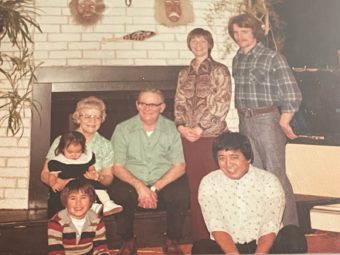
Jennifer Quinto with her family in the 1980s. (Photo courtesy of Jennifer Quinto)

The U.S. Supreme Court heard a case Wednesday that presents a major challenge to the Indian Child Welfare Act.

ICWA, as it is known, is a federal law that allows tribes to make adoption decisions for Native children, to keep them connected to their culture and to keep Native families intact.

The plaintiffs taking their case to the Supreme Court say that’s unconstitutional and racial discrimination.

Community reporting fellow Chen Chen with KTOO has been following the case — called Haaland v. Brackeen — and reporting on what ICWA means to Alaska.

And because Native children represent about 55% of all children in state custody, Chen says overturning ICWA would have huge implications for Alaska. At the same time, Native people only make up a little over 20% of the population, so there’s a disparity, she says, and a feeling that the state hasn’t done enough to implement ICWA to begin with.

Listen:

Editor’s noteThis interview was recorded prior to the Supreme Court hearing Haaland v. Brackeen.

The following transcript has been lightly edited for clarity.

Chen Chen: Yeah, so for my second story on ICWA, I interviewed a tribal court judge. And it seems that from what I’ve spoken to her about, perhaps compared to other states that have better implementation of ICWA, Alaska just hasn’t really been putting in a lot of resources to combat those figures. Not to say that there aren’t obviously many people in the system who are working to change things. But I think it’s especially tough in Alaska, because of shortages and staff and shortages and resources. So here’s how judge Debra O’Gara puts it:

Debra O’Gara: Some states are a little bit better than other states. But right now, Alaska, I would say is not doing so well. Alaska has not followed the spirit or the letter of the law. If it did, there would not be that disproportionality.

Judge Debra O’Gara pictured in 2020. She has spent over a decade working on Indian child welfare cases and directing trainings on ICWA for guardians, case workers and lawyers, in the state and Tribal court systems. (Photo courtesy of Debra O’Gara)

Chen Chen: So one of the things that Judge O’Gara really highlights is that ICWA mandates placement preferences so that resources are put in to keep families together. And then the second choice is to keep kids within their communities. And because a lot of that isn’t happening, Judge O’Gara has these criticisms for the state of ICWA right now.

Casey Grove: Yeah, let’s break that down just a little bit more, too, because there’s a preference to keep kids that are in a — you know, maybe a bad situation, or at least a perceived bad situation by Office of Children’s Services workers or whatever — there’s a preference that if they are going to be removed from a home for their own protection that they’d be then placed with another Native family or even somebody within the same family, right?

Chen Chen: Yes, there’s definitely a preference for placing the children as close to their family as possible, while their parents get time to kind of rehabilitate or figure out their problems. So one of the main things that ICWA tries to do is to help reunite families. So when kids are put into foster care, there’s resources also, that should be put in for the parents, and for the families like grandparents, to be able to take care of the child and improve their abilities as a parent and get help for the different mental and physical things that they need help for.

Casey Grove: Gotcha. Yeah. Obviously, for the children that are in the middle of ongoing cases, their identities are protected, and rightfully so. That’s confidential. But you did speak with somebody who’s a former adoptee, right? And what did she have to say about this?

Chen Chen: Yeah, I spoke to a former adoptee who was adopted in the year that ICWA was passed in 1978. So I think that was a very interesting perspective from someone, because I think a lot of those perspectives are lost when we talk about ICWA. And we talk about it as a theoretical thing, when, for many adoptees, it means a lot, and it’s a very real law for them. Jennifer Quinto was adopted from an Athabaskan family into a multicultural, Tlingit household in Juneau.

Jennifer Quinto: For me and my adoption, it was a big gamble. That law wasn’t in place, and I could have very easily been placed with another family. And how many children are there that didn’t have that protection? And like I said, there were so many adoptees that I met, that I could feel the intensity of the hurt and the anger. And all of that came from the fact that they were, you know, being raised with families that just didn’t understand the complexities.

Various indigenous groups march and dance during a parade Saturday, June 9, 2018, in downtown Juneau, Alaska. (Photo by Tripp J Crouse/KTOO)
Jennifer Quinto marches with various Indigenous groups during a parade at Celebration 2018 on Saturday, June 9, 2018, in downtown Juneau, Alaska. (Photo by Tripp J Crouse/KTOO)

Casey Grove: So she seems to be very much in favor of ICWA, at least the intentions of ICWA, right?

Chen Chen: Yeah, so ICWA has a lot of different actual ways it’s implemented in each state. But I think that from speaking to Jennifer, it seems like no matter what ICWA actually looks like in each state, just having that exist is already saying to her, like, you matter. Adoptees like you matter and your identity matters.

Jennifer Quinto: Who could ever believe that that would be taken away? You know, that’s one of the last things that is keeping our community together in the way that it has. So imagining a world where that doesn’t exist is just too, too painful.

Casey Grove: That’s definitely all interesting. And it’s good to kind of know where ICWA has come from and what the intentions of it are. But we’re here to talk about a very particular lawsuit that you’ve been following, a court case. Tell me about that. Who’s the plaintiff there? Who’s the defendant? What is the change that they’re seeking?

Chen Chen: The U.S. Supreme Court will hear a case called Haaland vs. Brackeen. And the case is trying to say the plaintiffs — including Brackeen and various other states and different parents who are trying to adopt Native children — they’re all kind of getting at how they think that it was not constitutional, because it gives preference to Native families and tribes for Native children over all other kinds of people. And in the lawsuit, they classify that as racial discrimination and violating the Equal Protection Clause. And what’s happening in the Brackeen case is that these parents from Texas who are white, adopted a child who was from a tribe while they were fostering him. And then they got into a lawsuit because they wanted to adopt that kid’s brother. And the problem was the tribe didn’t want to let that child be adopted out of the tribe. And that child’s aunt was very willing and wanted to adopt the kid. And in the end, the Brackeens did get both children but were still not happy with the terms of the lawsuit, which included that the kid had to, you know, visit their grandparents every summer. So basically, they’re the main family that’s involved, are the Brackeens.

Casey Grove: So the U.S. Supreme Court’s about to hear this case, and I guess a decision would be, you know, somewhere down the road from that, but are the people that you’re talking to, do they have guesses about how the Supreme Court might rule on this?

Chen Chen: So the two people that I mainly spoke to both don’t think it’s going to be overturned, because it’s almost too far out of, like, reality for a lot of Alaska Native (people) for ICWA to be overturned. And I think the other thing is that from other articles I’ve read about ICWA, from various perspectives outside of Alaska, it also seems that ICWA would have very far-reaching implications if it’s overturned, because that is saying that tribal sovereignty is just not a thing. Because if they rule that being Alaska Native or being Native American is a racial classification rather than a political classification, that’s a direct threat to tribal sovereignty.

Supreme Court takes up the Indian Child Welfare Act

The U.S. Supreme Court building in Washington, D.C. (Photo by Liz Ruskin/Alaska Public Media)

The words “Equal Justice Under Law” are inscribed above the U.S. Supreme Court building in Washington, D.C.

The terse phrase powerfully underscores the conviction that the nation’s judiciary occupies a special plane of existence in which momentous decisions are made in a protected sphere of legal purity.

For many Supreme Court watchers, however, the court’s recent rulings overturning abortion rights, expanding gun rights, limiting the authority of the Environmental Protection Agency and blurring the lines separating church and state reflect the alarming impact of an ultra-conservative majority among justices.

Indeed, a September 2022 Gallup poll shows that 42% of Americans think the Supreme Court is too conservative, a new high for that response.

The trend could spill over onto how justices view the Indian Child Welfare Act, a law supported by the sovereignty of tribal nations that many opponents insist is race-based.

On Wednesday, Nov. 9, the Supreme Court will begin hearing oral arguments in Haaland v. Brackeen, a case that will decide if the ICWA is constitutional.

The case has enormous implications for Indian Country, its children and the ongoing existence of tribal sovereignty, said Sarah Deer, professor at the University of Kansas and chief justice for the Prairie Island Indian Community. Deer is a citizen of the Muscogee (Creek) Nation.

“Most opposition to the ICWA focuses largely on the flawed assumption that Native people are strictly a racial category,” Deer said, “rather than citizens of independent sovereign governments.”

Broad constitutional issues

It’s not an easy, either/or decision for the court, because the case addresses several elements of constitutional law.

The ICWA, enacted in 1978 by Congress, came in response to reports that large numbers of Native children were being separated from their families and communities by state welfare officials and private adoption agencies.

The law gives tribal nations the right to be involved in child welfare cases involving their citizens, in hopes of keeping Indigenous children with their family and tribe.

The lawsuit that has reached the Supreme Court was filed by the state of Texas and several adoptive parents, claiming that the ICWA unfairly discriminated against non-Native people in the adoption process by setting a preference for Indigenous parents over non-Indigenous. The preference violates a provision for equal protection under the law in the U.S. Constitution, they argue.

Supporters, however, point out that tribal citizenship is not a racial classification but rather a political, legal status. And they argue that a ruling by the Supreme Court that the ICWA is unconstitutional based on race could take Indigenous rights back to a pre-civil rights era in which White hegemony was accepted as an indisputable norm.

Such a ruling could open the door to challenging the entirety of Indian law and tribal sovereignty, they say — which could be the point for the diverse group of people and organizations that have banded together in opposition to the act in recent years.

The law chugged along in obscurity for most Americans for about 35 years, offering guidelines for placement of Native children within the country’s child welfare systems. Mostly unnoticed and unknown by non-Native people during this time, the ICWA includes what is considered the gold standard or guiding principles for child welfare systems, including interagency collaboration, acknowledging each child’s and family’s strength and challenges, cultural competence, respect and partnership between families and professionals, and engaging community based services and accountability.

In 2013, however, the well-known Adoptive Couple v. Baby Girl case, also known as the Baby Veronica case, went before the U.S. Supreme Court, which held that the ICWA does not bar termination of the biological father’s paternal rights. Covered extensively in the , the law was often framed as draconian and race-based, unfairly depriving children of their best interests and constitutional due process.

Cases reported in mainstream media often frame the ICWA as a racist law that allows tribes to take children away from loving families because the child may have a minuscule amount of Native blood, according to Deer, the Kansas lawyer and judge.

“In fact, most ICWA cases are so conventional they don’t warrant any particular media attention,” Deer said. “Most media coverage focuses on a handful of specific, high-profile cases that actually involve a dispute … They don’t cover the successful stories.”

A tribe, for example, may choose to intervene in a child welfare case without exerting jurisdiction.

“Intervening simply means that a tribe has the ability to come in and make recommendations regarding a child,” said Stacey Lara, an assistant teaching professor at the University of Washington School of Law.

Although data is difficult to obtain since ICWA actions vary from state to state and tribe to tribe, there are many instances in which tribes choose not to intervene or exert jurisdiction at all for a number of reasons, including lack of resources.

And tribes that do intervene may recommend the child remain with a non-Native family member, Lara said.

“ICWA, at its heart, is really about a tribe being involved with decisions that affect the best outcomes for the child,” Lara said. “The law’s preference is keeping families together.”

Notably, there are no legal penalties for failing to abide by the ICWA, and oversight of the law is largely left to the court system.

Growth of ICWA opposition

Additional challenges to the law followed the widespread media coverage of the 2013 Baby Veronica case.

Organizations such as the National Council for Adoption claimed the law violated the U.S. Constitution on several counts, including denying Native children due process and equal protection, and commandeered state agencies for federal purposes, exceeding Congress’s authority in Indian affairs. Other efforts challenged ICWA’s state and federal provisions on proof for child removal, placement preferences and termination of parental rights.

As ICT reported in 2019, opposition to the ICWA has united a seemingly disparate group of organizations and interests whose ultimate goal appears to be in gaining access to Indian Country’s land and resources, including Native children. People and organizations forwarding Federalist philosophies have also joined opposition to ICWA, seeing it as an opportunity to further an agenda favoring states rights over federal policies.

In January 2021, the Fifth U.S. Circuit Court of Appeals took the unusual step of holding a special hearing of the full court and vacated an August 2020 decision by a three-judge panel that concluded the ICWA was not a race-based law and therefore constitutional.

The appeals court issued a complex, 352-page ruling in April 2021 that generally upheld Congress’ right to enact the ICWA and ruled that the law’s definition of “Indian child” doesn’t operate on the basis of race and therefore doesn’t violate Article 1 of the 14th Amendment regarding equal protection.

The ruling, however, found ICWA unconstitutional based on claims that the act violates the anti-commandeering doctrine included in the 10th Amendment. According to the doctrine, the federal government can’t make states adopt or enforce federal law, such as the ICWA. This means that the federal government can’t require state agencies to give notice to tribes or require qualified witnesses in adoption cases, or require states to keep records on Indian child welfare cases.

Many legal experts attribute claims that ICWA violates the anti-commandeering doctrine to the rise of conservative groups and politics supporting states’ rights over federal authority.

Opponents and supporters of the ICWA filed four petitions to the U.S. Supreme Court in the case. The opposing petitions raise constitutional questions that included equal protection, legal standing, anti-commandeering and nondelegation. They also claim that ICWA violates the Administrative Procedures Act.

The United States and four intervening tribes — the Cherokee Nation, Morongo Band of Mission Indians, the Oneida Nation and the Quinault Indian Nation — filed petitions defending the ICWA and its constitutionality.

The outpouring of support for the act has been substantial. Nearly 500 tribal nations, scores of Native organizations, members of Congress and child welfare organizations have signed on to 21 friend-of-the-court briefs in defense of ICWA.

Among those working to defend the landmark legislation include attorneys with the Native American Rights Fund, the National Congress of American Indians and several tribes, all of whom have banded together under the Tribal Supreme Court Project to help tribes develop litigation strategies regarding ICWA.

The goal for tribes and most Native people is simple — protecting their children.

“I am not aware of a case that has generated this much support in Indian Country,” said Dan Lewerenz, assistant professor at the University of North Dakota school of law and a contract attorney for the Native American Rights Fund.

“Our children are very important to us, so it’s heartening to see how much support we’ve gotten from outside Indian Country as well,” said Lewerenz, who is a citizen of the Iowa Tribe of Kansas and Nebraska.

Bad timing for Indian law

The cases the Supreme Court is considering this term, including the ICWA, may reflect the decidedly conservative bent of the majority of its justices. Former Republican President Donald Trump appointed three justices to the court – Neil Gorsuch, Brett Kavanaugh and Amy Coney Barrett. They join the other conservatives – Chief Justice John G. Roberts and Justices Clarence Thomas and Samuel A. Alito – for a 6-3 majority on the court.

In addition to the ICWA case, the court is also set to consider this term two voting rights cases that contend voting practices discriminate on the basis of race, challenges to affirmative action in student admissions at Harvard University and the University of North Carolina, a free speech claim from a website designer who opposes same-sex marriage, as well as a challenge to the Clean Water Act of 1972.

With the exception of Gorsuch, who wrote the majority opinion in the McGirt v. Oklahoma opinion finding that much of the eastern portion of Oklahoma remains as Indian lands, few of the other justices have experience litigating cases relating to Indian law.

Earlier in 2022, Kavanaugh delivered the Castro-Huerta v. Oklahomaopinion, which partially walked back McGirt v Oklahoma by holding that the federal government and the state have concurrent jurisdiction to prosecute crimes by non-Indians against Indians in Indian Country.

What’s ahead

The Supreme Court justices’ lack of experience in Indian law, an ultra-conservative stance on race and a demonstrated support for a federalist agenda raises the likelihood that the ICWA could be dismantled by the court, Indian law experts say.

The current Supreme Court has demonstrated it cares about states’ rights and is hostile to any programs that attempt to remediate past racial discrimination, according to Elizabeth Hidalgo Reese, a citizen of the Nambe’ Pueblo and an assistant professor at Stanford Law School.

“There are just so many ways to lose this case,” Reese said. “This doesn’t bode well for the ICWA.”

In one of the worst-case scenarios, she said, the court could rule that the law violates the U.S. Constitution’s guarantees of equal protection regardless of race.

“This would be incredibly disruptive to the rest of Indian law and tribal sovereignty,” Reese said.

A decision finding the ICWA unconstitutional based on Article 1 of the Constitution, in which Congress is granted the power to regulate commerce with Indian tribes, could be equally catastrophic. Such a decision would declare that Congress has no power to pass laws such as the ICWA, thereby calling decades of its decisions in Indian law into question.

“The scope of Congress’s power over Indians has been a cornerstone of federal Indian law for a very long time,” Reese said. “Almost every law passed by Congress involving Indians would now come under a microscope.”

Many Supreme Court watchers have also noted that Justice Clarence Thomas has expressed an interest in the Indian Commerce Clause. In Turtle Talk, the leading blog on legal issues in Indian Country, Matthew Fletcher quoted Thomas’s opinion in United States v. Lara.

“I cannot agree that the Indian Commerce Clause provides Congress with plenary power to legislate in the field of Indian Affairs,” Thomas wrote.

Fletcher, a citizen of the Grand Traverse Band of Ottawa and Chippewa Indians, is a law professor at the University of Michigan School of Law and director of the Indigenous Law and Policy Center.

If the court finds the law unconstitutional under the anti-commandeering clause, however, it’s likely that only the ICWA would be impacted. At least six states have enacted their own ICWA laws, which include provisions from the federal act.

Such a decision, Reese said, “would be about the mechanics of the specific ICWA statute which tell states how they implement the law.”

As Reese notes, the constitutional challenges to the law are very broad.

“So many people are focused on the race issue in this case; I feel like everybody’s about to get blind-sided by the court’s decision,” she said. “We need to be listening very closely during oral arguments, The outcome could be a bit of a surprise.”

This story originally appeared in Indian Country Today and is republished here with permission.

An Alaska Tribal court judge breaks down ICWA’s past, present and future

Judge Debra O’Gara pictured in 2020. She has spent over a decade working on Indian child welfare cases and directing trainings on ICWA for guardians, case workers and lawyers, in the state and Tribal court systems.  (Photo courtesy of Debra O’Gara)

On November 9th, the U.S. Supreme Court will hear Haaland v. Brackeen, a case that challenges the constitutionality and the future of the Indian Child Welfare Act (ICWA).

ICWA was established in 1978 “to protect the best interest of Indian Children” by creating federal standards for removing Native children from their families and making sure Native children were placed in homes that would reflect their culture. 

Judge Debra O’Gara has spent over a decade working on Indian child welfare cases and directing trainings on ICWA for guardians, case workers and lawyers, in the state and Tribal court systems. 

O’Gara, who is Lingít, Yupik and Irish, lives in Petersburg. She and her siblings were raised by a single mom who worked nights as a cocktail waitress.

“In one of the suburban, predominantly white neighborhoods that we lived in, there was twice in my childhood where [Child Protective Services] was called in and an investigation was conducted,” she said. “There were assumptions that we weren’t taken care of because my mom wasn’t home at night. In fact, we actually were taken care of and had somebody staying there with us. We were doing just fine.”

This was before ICWA, and these childhood experiences led O’Gara to carve out a career protecting Native families from unnecessary separation. 

The state of ICWA in Alaska

O’Gara says that some states are better than others at adhering to ICWA. 

“But right now, Alaska, I would say, is not doing so well,” she said. “The state of Alaska has not followed the spirit or the letter of the law.”

More than 20% of Alaskans are Alaska Native or Native American, but about 55% of children in state custody are Alaska Native.

Presiding Judge Debra O'Gara stands in the Juneau courtroom of the Central Council of Tlingit and Haida Indian Tribes of Alaska. (Photo by Ed Schoenfeld/CoastAlaska News)
O’Gara in the Juneau courtroom of the Central Council of Tlingit and Haida Indian Tribes of Alaska in 2017. (Photo by Ed Schoenfeld/CoastAlaska)

O’Gara said that many of these children are eventually adopted by non-Native families and often even removed from Alaska, despite the passage of ICWA.

“So what happens there is the Tribe loses their children,” she said. “And the children lose their connection to their Tribal affiliation. For those of us here in Southeast that grow up in a clan, they lose their identity as a clan, what clan they belong to, what house they belong to, what their Lingít name is or how to name who their relatives are, and that whole belonging and knowing who they are.”

O’Gara pointed to multiple factors that lead to this high percentage of Alaska Native children being removed from their homes. Some of it, she attributes to a lack of training and consistent, skilled staff in the state’s system leading to a backlog of cases in the courts. 

“Training needs to be consistent with every new staff that comes in,” she said.

Without that, she says, staff bias figures into the equation. For instance, part of many Native cultures is having many relatives living under one roof. But for the state, a house with three or four times more people living in it than if it was a non-Native or white house is considered overcrowded. 

In Southeast Alaska, clan members are considered family. 

“And that’s as that’s actually as strong as a blood relation, sometimes stronger,” O’Gara said.

To her, these multi-generational families meant that there were lots more mentoring, opportunities for teaching and sharing childcare responsibilities. 

But, because these familial structures are less common in the U.S., she says, the system often gets concerned about who is taking care of the children in these households. 

“There’s prejudices and assumptions that are made that then lead to the children being removed when they shouldn’t have been removed in the first place,” O’Gara said. “And then once you get into that system, it’s really hard to prove that there’s nothing going on.”

Where ICWA began

Before ICWA, one way Native children were systematically removed from their families was by declaring they were neglected or abused by their parents. Another way is perceived “poverty and lack of parenting by Western standards” says O’Gara.

“There was a great outcry in the 60s and 70s about the continued removal of children,” O’Gara said. “At the same time that this was happening, there were also children being removed from their communities and forced to go into boarding schools, which we in the Native community all know about.”

She added that this was especially devastating to the Native community because much of the culture is based on the land they live on and the ceremonies that are performed with their families.

“The removal of the Native children was just one of the ways to completely annihilate and disappear Native people,” she said.

When ICWA was finally passed in 1978, O’Gara says it recognized that children have the right to know who they are.  

“It also recognized that the Tribe had a legal interest in protecting the Tribe’s children,” she said.

The future of ICWA

Today, ICWA is often considered the “gold standard” for all children by child welfare experts.  

“The other thing that ICWA did is to mandate placement preferences,” O’Gara said. “And the placement preferences, I have always argued, should be universally applied to not just Native children, but to all children who find themselves in the child welfare system.” 

These placement preferences she outlined mean that children removed from their parents would first be placed with family. The next option after biological family is clan family or psychological family, which includes community members and long term friends, she said. 

“Lastly, when all of those [options] have been exhausted, and there’s no placement found, then with an appropriate non-Native family,” she said. “Often in the current child welfare system in Alaska, those first three get skipped over. And there’s efforts to continue to have those systems be improved, so that the first that the preferences can be placed.”

O’Gara believes that parents who are being accused of neglect or abuse of a child need time to seek treatment or help, but in the meantime, children shouldn’t lose their connected to their community or their family. 

The plaintiffs in the Brackeen v. Haaland case say that giving additional support to Native parents and prioritizing Native homes for Native children violates the equal protection clause.

“So one argument I’ve heard is that Native [people] should not be given special treatment,” O’Gara said. “Well, my answer to that is the guidelines should be applied to everybody equally… Because all children also have the right to know who they are, who their family is, where they belong, and some of their family history.”

She thinks that providing active efforts and services for parents and children—like those outlined in ICWA—would “benefit every child in the child welfare system.”

“We’re not just a minority like any group,” she said. “We have a special relationship with the federal government, in that we are sovereign nations.”

There have been many attempts to change or weaken ICWA in various state courts, but she also sees this as an opportunity for states to go in and strengthen ICWA. Washington state, where O’Gara grew up, has extra provisions that protect Indian children more than the federal ICWA does.

“And certainly Alaska is able to do that,” she said. “Ever since ICWA has passed, there’s been political forces that have attempted to eliminate it, and they have not yet been successful. It doesn’t mean that it’s not as strong as it was when we first passed. And at some point, we will be able to turn that tide and get back to strengthening it.”

Site notifications
Update notification options
Subscribe to notifications