Family

Domestic Violence Awareness Month: How to recognize it and get help

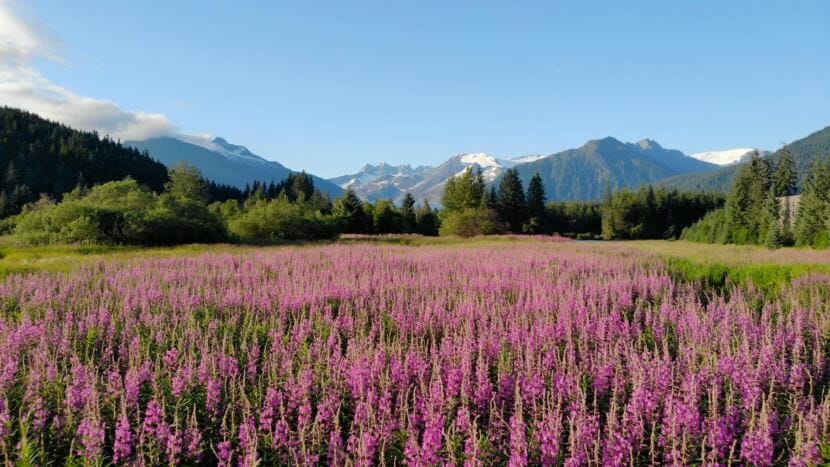
Fireweed blooms in a field near the Brotherhood Bridge in Juneau on July 19, 2018.
Fireweed blooms in a field near the Brotherhood Bridge in Juneau on July 19, 2018. (Photo by David Purdy/KTOO)

Find more resources at the end of this story.

Alaska has some of the country’s highest rates of domestic violence. Nearly 20% of women in the region are clients at SAFE Bristol Bay annually. That’s according to the organization, which is the regional advocacy center and shelter for domestic violence and sexual assault victims.

Christina Love, a senior specialist with the Alaska Network on Domestic Violence and Sexual Assault, shared some ways to recognize and address domestic violence.

Listen:

This interview has been lightly edited for length and clarity.

Christina Love: Quyana, Gunalchéesh, thank you so much for having me. My name is Christina Love. My pronouns are she and her. My family’s originally from Egegik village. My grandparents are the Kellys. I was raised in Chitina. And today I live on the Áak’w T’aaḵu Kwáan of the Tlingit Nation, also known as Lingit Aaní, also known as Juneau, Alaska. I work at the Alaska Network on Domestic Violence and Sexual Assault as a senior specialist on intersectionality and trauma.

Izzy Ross: Thank you so much for joining me. I’d like to provide people with some basic points for recognizing domestic violence and helping people who are in those situations and also preventing it.

Love: It’s important that we understand the root cause of violence and then also what prevents that, but first we’ll start with identifying it.

Domestic violence is a pattern of coercive control and manipulative behavior. That can be physical, but doesn’t have to be physical for every relationship. The main part of it is power and control. It’s rooted in power and control. And there’s lots of different ways that people can enact this: Through emotional abuse, through physical abuse, through psychological abuse, through economic, through other relationships, like children. Any part of your life and the intimate details of who you are can be used to harm you. So that’s why it’s deeply unique to each individual and can be really difficult to identify.

Abuse can take different forms

Love: Some of the most common types of abuse that we hear about are emotional escalating into physical. For emotional abuse, that looks like putting people down, that looks like embarrassing them in public. That also looks like needing to know where they are all the time and not having trust in them.

What I’ve noticed is that some of those behaviors can be perceived as, “this is how people care.” But it’s important to understand that jealousy and controlling is not necessarily a sign that somebody deeply cares about you. When it’s more escalated, then it absolutely can be really dangerous.

We see a lot more technology abuse; somebody needing to have access to your phone, to your email, to your social media accounts, having the password to everything, being able to control all of those things.

Domestic violence can progress

Love: The thing about domestic violence is is that it doesn’t happen right away. I never hear about a relationship [where] right from the beginning, they were incredibly violent. Usually, there are these phases that these relationships go through, and the one that is most recognizable is the honeymoon phase.

So when you meet somebody and you have feelings for them, there’s all of these chemicals that fill our body that makes us feel really good. And even that can be weaponized. Another term for that is called “love bombing.” So love bombing is where you are giving somebody a lot of attention, a lot of affection. Maybe you’re showering them in gifts, but it is this overwhelming way of somebody connecting with another person.

These are the red flags that we really like to teach people about what a healthy relationship looks like. And then also some things that can feel really good, but that we should really watch out for.

For most people who are perpetrating abuse, these become their own patterns in relationships. And like all violence, it’s a learned behavior. So the really beautiful thing about that is that we can unlearn these. We can heal. We can heal from the violence that we have experienced. We can also heal from violence that we have participated in, that we have perpetuated.

Signs of emotional violence

Love: Some of the things I think that I would tell people as far as emotional violence goes, is that just to be acutely aware of how you feel in people’s presence, does your partner make you feel free? Do you feel good? Do you feel lifted up? Do you feel supported? And to not ignore those.

When we try and communicate our needs, what we also see in domestic violence is a lot of gaslighting: “No, that’s not what happened. That isn’t my experience of it.” Or, “You made me do this. I wouldn’t do this if it wasn’t because of this or this or this.” And it’s important that we understand that violence is never our fault.

As those things start to escalate, a really important part of my job is helping people understand that alcohol and drug use does not cause domestic violence, that those core beliefs about our partners — that entitlement, that privilege — that comes from something else. Alcohol and drugs make those situations a lot worse. A lot of people think that it causes it because they are so closely connected. So everybody not being able to access resources leads to using substances to end their own suffering. But in the case of domestic violence, when we see those two things happening at the same time, we see increased lethality and increased injuries. So that’s the connection there.

It’s really important that we shift our perspective about why and how people come to this place when we stop asking questions about why they can’t leave and start asking questions about why people who are abusing other people are doing that, why, why are they harming them and placing the blame where it belongs, because the longer the time goes on, and the more abuse that happens It always escalates.

So it’s important that everyone is able to identify what healthy relationships are. And for people who are in unhealthy relationships, that that can’t leave that we ensure that they have access to safety – to safety planning and to other relationships that can save their life. When somebody tells us that these are the things that they’re experiencing, that we believe them and that all of us know what resources we can access.

Ross: There are a lot of different resources out there. Locally in Dillingham we have SAFE. There’s also the Alaska Network on Domestic Violence and Sexual Assault which has a lot of information. The National Domestic Violence Hotline is also available for folks to call. What can people expect when they access these resources? What does that process look like?

Love: Let’s say that you yourself are somebody who is experiencing this type of harm. First of all, I want you to know that there’s nothing that you could have ever done to deserve this, nothing, that it is not your fault at all. And whatever your life looks like, there is life on the other side of this. So however low you feel, however hopeless, or helpless, or powerless you feel, your sense of identity, all those things, they do come back. They come back.

It can be really difficult to imagine what it would look like to be free. Especially if you’ve tried to leave many times, or I think the what’s really difficult for people to understand is when you deeply love someone and your life is so interconnected with them, and they harm you, it’s not something that our brain can even fathom.

For myself and for a lot of survivors, it actually becomes compartmentalized that you have this life with them. And then there’s also this harm. Our brain cannot bring them together. Like it’s a really deeply confusing thing, especially if there’s mental abuse, anybody who has a mental health issue, or anybody who has survived trauma. So being physically harmed, being emotionally harmed is a type of trauma. And that leads to all kinds of really confusing ways that our brain and our bodies keep us alive. One of those is disassociating or being in denial. So if you if you are encountering somebody and it’s very clear to you that they’re in a place that they’re not safe but they’re not acknowledging it, just know that that’s the type of protection.

Where to get help

Love: If you are somebody who’s experiencing this, I want you to know that there are really incredible people who will work with you. And if you want to know what that help looks like, I want to walk you through that.

So you’re going to get on the phone with somebody through this hotline through your local SAFE with an advocate. And they’re going to listen and it’s completely confidential.

An advocate is a person who by law has very similar confidentiality as, as attorney client privileges. If I’m your advocate and you call me, I can’t be subpoenaed. I can’t tell anybody about anything that we’ve talked about. And this is really important for our rural communities where everybody knows everybody; we need to know that we’re going to be safe. We need to be able to build trust. Because our lives literally depend on it.

So let’s say you call me. I’m going to walk you through who I am and what my role is for you. I’m going to ask you if you’re safe in the moment. And I’m going to get an idea of your situation. I want to know really the chances of lethality, so I’m going to ask you a lot of different questions.

I’m using “he” because we see a lot more violence against women. And that’s a whole other conversation, we’ll see a lot more violence against Alaska Native people. And that’s a whole other conversation. For this purpose, I’m going to be using those pronouns.

I’m going to ask questions like, “Has he ever bit you? Has he ever strangled you?” I’m going to be asking if he’s ever harmed animals. All of those things lead to higher lethality lead to a higher chance of being murdered. So I’m going to ask you those kinds of questions and I’m gonna get an idea of how safe you are, what resources you have in your house, if he has access to your phone, if he has access to your email, if he has access to other relationships.

And also what you want to do. What are you wanting to do? Are you wanting to leave? We know that for people who are in these relationships, it takes about an average of nine times unless you have a disability, and that includes substance use and mental health, for people to try and leave.

That means that we say we are going to leave, and then they convince us to come back or they bring us back and it isn’t safe enough to leave. Or we’re still holding hope that they could make changes, that they are going to get help in one way or another, or they promised to do things differently. And that is a cycle that we see.

I might walk you through that cycle, I might go over the power and control wheel where I list off all the different ways that harm can be caused in a relationship. So I’ll name financial abuse and all the different ways to just you have control of your the bank account of the credit cards?

Emotional abuse, you know, we talked about that early on? Does he put you down? Does he embarrass you? Does he tell you that you’re fat, that you’re stupid, that you can’t do this or that, is there a lot of yelling? Is there a lot of manipulation?

I’ll go over coercion, I’ll talk about substance use, I need to know if substance use is a part of this, because it helps me understand. Also, maybe if you need Narcan, I want you to be safe in so many different ways, not just in this relationship, but also if that’s something that you’re struggling with, and we’re going to talk about that.

I want you to know that there’s no judgment here at all. My job is to keep you alive. My job is that you feel empowered, that you have somebody that you can talk to that you trust that is not ever going to tell anything about your situation.

Creating a plan

Love: Then we’ll get to creating a plan. So if there is violence and you can’t leave, then we want to know if there’s firearms in the house. I’ll talk to you about how to protect your head and your face, so curling up into a ball in the corner so that your limbs are protecting your head in your fac in the event that you can’t leave, in the event that things escalate.

How to protect your children and then also what the laws are. So if you can’t get out but there are children there, then you face the likelihood of protective services coming in and removing the children.

I have access to information and I want to make sure that you are well aware of everything, and that you know what your resources are. And together we’ll make a plan that fits you where you’re at. And it’s through those options and those resources that people really feel empowered. This is something that anybody can do at any time. So I’m trained, there’s lots of other advocates locally and nationally that are trained in this. This is something that all loved ones can do, that we really practice, listening to people and not being judgmental, and knowing that the first person that people tell is so important. That people stay in these relationships because of shame, because of isolation. And that’s how we break it. We break shame by being the kind of people that people can trust.

Resources:

SAFE Bristol Bay
https://www.safebristolbay.org/
SAFE’s listening line: 1-907-478-2316

SAFE offers confidential help through its Dillingham and village advocates.

SAFE is Bristol Bay’s shelter and advocacy agency for domestic violence and sexual assault victims. It’s based in Dillingham and also serves surrounding communities. The primary mission of SAFE is to provide immediate safety for victims of domestic violence and/or sexual assault, including safe shelter and emergency transportation.

StrongHearts Native Helpline
https://strongheartshelpline.org/
1-844-7NATIVE (762-8483)

StrongHearts Native Helpline is a 24/7 safe, confidential and anonymous domestic and sexual violence helpline for Native Americans and Alaska Natives, offering culturally-appropriate support and advocacy.

National Domestic Violence Hotline
https://www.thehotline.org/
1-800-799-SAFE (7233) and 1-800-787-3224.
The hotline provides essential tools and support to help survivors of domestic violence so they can live their lives free of abuse. Contacts to The Hotline can expect highly-trained, expert advocates to offer free, confidential, and compassionate support, crisis intervention information, education, and referral services in over 200 languages.

National Indigenous Women’s Resource Center
https://www.niwrc.org/

The National Indigenous Women’s Resource Center, Inc. (NIWRC) is a Native-led nonprofit organization dedicated to ending violence against Native women and children. The NIWRC provides national leadership in ending gender-based violence in tribal communities by lifting up the collective voices of grassroots advocates and offering culturally grounded resources, technical assistance and training, and policy development to strengthen tribal sovereignty.

Alaska Network on Domestic Violence and Sexual Assault
https://andvsa.org/
ANDVSA works to be a collective voice for victims and survivors and to support those agencies and communities working to prevent and eliminate domestic and sexual violence.

The Alaska Native Tribal Health Consortium’s website Iknowmine.org has resources for sexual health.

AWARE
https://awareak.org/
Local Crisis Line (907)586-1090 Toll Free Crisis Line 1(800)478-1090
AWARE provides comprehensive intervention services, as well as outreach, education, and primary prevention programs for domestic violence, sexual assault and child abuse. We invite you to learn more about our services and how we can support you, your friends, your loved ones, or your community.

Get in touch with the author at izzy@kdlg.org or 907-842-2200.
‘You know who you are’: One Alaska adoptee on why ICWA matters

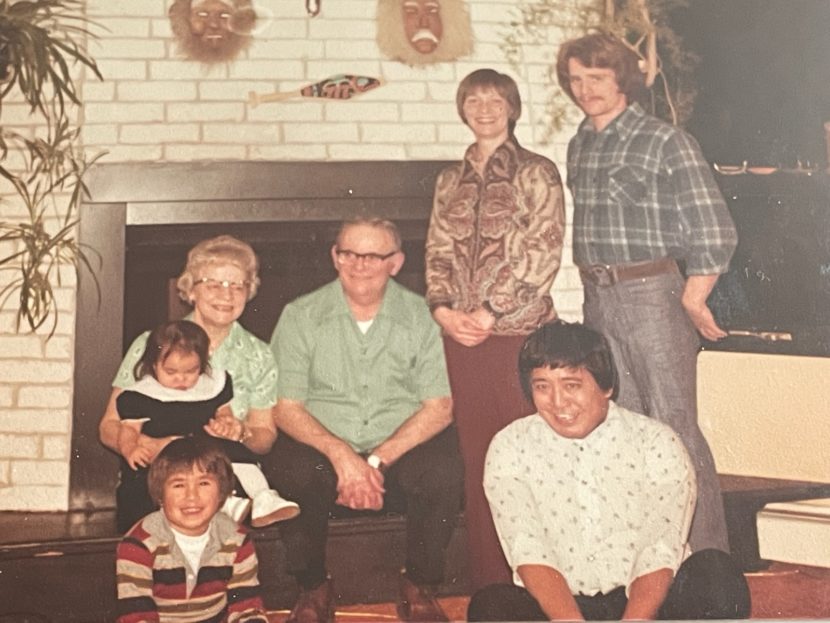
Jennifer Quinto with her family in the 1980s. (Photo courtesy of Jennifer Quinto)

On Nov. 9, the U.S. Supreme Court is set to hear Haaland v. Brackeen — a case that has been recognized as the most prominent challenge to the Indian Child Welfare Act since its creation in 1978. 

ICWA was established to grant tribal authority for adoptions of Native children in order to preserve Native families and culture. In August, a bipartisan group of 87 members of Congress — led by four senators, including Alaska Sen. Lisa Murkowsi — filed a brief to the Supreme Court in support of ICWA. 

In the case headed to the Supreme Court, several states and individual plaintiffs, including the Brackeen family, alleged that ICWA is unconstitutional and racially discriminatory.

In 1978, right around the time ICWA was passed but before it was actually enacted, Jennifer Quinto was adopted from an Athabaskan family into a multicultural Lingít household in Juneau. 

“For my adoption, it was a big gamble,” she said. “And I could have very easily been placed with another [non-Native] family. And how many children are there that didn’t have that protection?”

Her mother worked for the Alaska Legislature for 30 years, so she was close to many politicians and lawmakers. Some of them worked on the Alaska Native Claims Settlement Act, and some were strong advocates for Native women and children. 

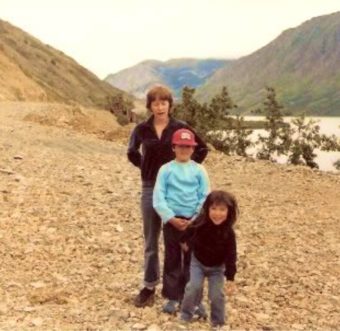
Jennifer Quinto with her mother and brother on a road trip in the Yukon. Photo provided by Quinto.

“I know that myself and my brother both benefited from certain layers of privilege that probably most likely didn’t exist for a lot of other people at the time,” Quinto said.

A sense of survivor’s guilt — for being an adoptee who had the chance to explore her Native roots — has stayed with her. 

“There were so many adoptees that I met, that I could feel the intensity of the hurt and the anger,” Quinto said. “And all of that came from the fact that they were being raised with [non-Native] families that just didn’t understand the complexities [of their identities].”

When she caught up with her childhood adoptee friends, Quinto found out that many of them were struggling with addiction and homelessness. 

“Physically they may have lived, but spiritually and emotionally, absolutely not,” she said. 

Love and family, no matter the distance

From ginger beef and adobo to Jell-O and coleslaw to smoked fish and herring eggs, childhood dinners in Quinto’s family were always a battle over what kind of food would be made. 

Her dad was part of an early Lingít-Filipino generation in Juneau and was raised in a big family. 

In his generation, the state of Alaska would deem certain Native parents to be unfit and would send their children to boarding schools. 

Only immediate family members could intervene, so his mother — Quinto’s grandmother — claimed all her nieces, nephews and distant family members as her biological children so they wouldn’t be sent away. 

Quinto felt that when her parents were looking to adopt, her dad wanted to honor her grandmother and their community. She said that they were “making sure that Native children had a safe family and were being brought back into another Native family.”

Congressional reports supporting ICWA’s establishment in 1978 found that as many as 35% of all Native children were being removed from their families. According to the National Indian Child Welfare Association, “85% of those children were placed outside of their families and communities — even when fit and willing relatives were available.”

Even today, Alaska Native youth are overrepresented in Alaska’s foster care system, at a rate of nearly three times what is proportional and expected

By the time Quinto came into the picture in 1978, the Quinto family’s Native identity had embodied all different representations. 

“We have Afro-indigenous in our family, we have LGBTQ, you know all of these different identities. And as an adoptee looking at my family, it just didn’t even occur to me that families look like each other,” she said.

These experiences gave her a different perspective on what defines family.

“Much in the same way that my grandmother erased those lines of being extended family, it’s created this ability to love people as if they are your immediate family, no matter how distant they are,” Quinto said. 

Staying close to home

By birth, Quinto is Athabaskan with a mix of Inupiaq, Japanese, Lingít and Scottish ancestry. Even with the benefits of being adopted in-state and within the Native community, exploring her identity has been a continual effort for Quinto.

“I’m sure that if there were a placement of a child across the country, they would have a harder time to be culturally connected and understood,” Quinto said. “There’s a lot of people who have the idea that there’s this pan identity for Native people, and yet, it always comes down to the individual. The greater the distance, the the harder it is.”

Quinto shared that many adoptees fear and hide their differences — something she thinks should actually be celebrated. For all families who adopt children, she believes that there has to be support to help adoptees confront their identities and learn about their cultures.  

Today, Quinto is the arts education director for the Juneau Arts and Humanities Council. Her own experiences in the Juneau School District led her to want to change how culture and representation are taught in schools. 

Various indigenous groups march and dance during a parade Saturday, June 9, 2018, in downtown Juneau, Alaska. (Photo by Tripp J Crouse/KTOO)
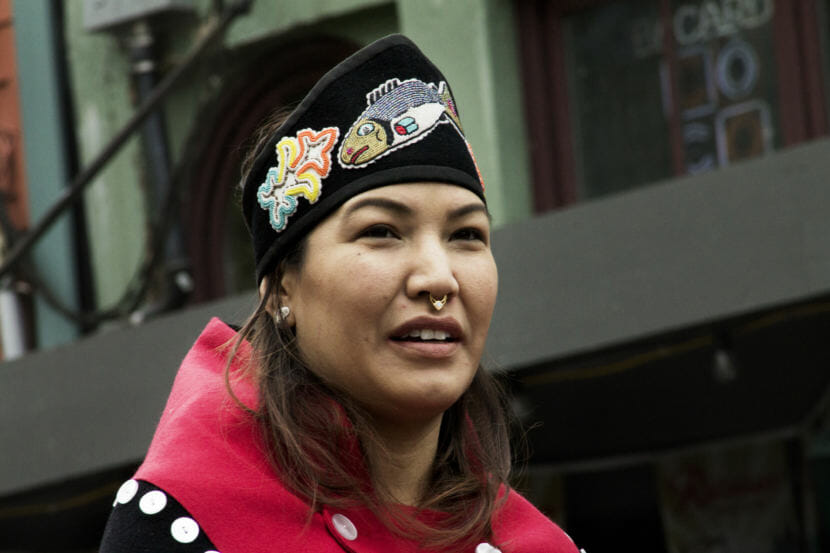
Jennifer Quinto marches with various indigenous groups during a parade at Celebration 2018 on Saturday, June 9, 2018, in downtown Juneau, Alaska. (Photo by Tripp J Crouse/KTOO)

Now that she has a daughter, she is passing on her stories and lessons of becoming confident in her multidimensional identity. 

“I’ve been insulted with all of the wrong slurs probably at this point,” Quinto said. 

She tells her daughter that “we honor all of the people who have loved us.” 

“You know who you are, you know what you’ve lived and you know your own identity,” Quinto said. “How dare anybody try to challenge that? That’s just somebody telling you that they don’t care about you enough to learn who you are.”

“Intergenerational knowledge, knowing and feeling”

The plaintiffs in the Haaland vs Brackeen case argued that ICWA is unconstitutional because non-Native people were not getting equal treatment to Native people in Native adoptions. 

For Quinto, ICWA was never about race or skin color. 

“When there’s people who say things like ’I don’t see color,’ well, they never outlawed our color,” she said. “They didn’t make us illegal for, you know, anything, but the way we dance, what we sing about, like, our foods. They outlawed our way of life.”

Quinto’s birth mother recently passed away, and she has been piecing together her birth family since then.

When her birth father heard that her birth mother’s funeral was happening, he drove 60 miles to the village and mailed Quinto a program from the services.

“One little excerpt meant everything to me,” she said. “One of the first things the program said was that my birth mom called everyone auntie and uncle, and people really appreciated it.”

Ever since Quinto was little, she always called people around her auntie and uncle. This was one of those moments that she felt like her feelings had to be coming from her ancestors because it wasn’t a value that her adopted family expressed.

“We often talk about intergenerational trauma, but not a lot of talk on intergenerational knowledge, knowing and feeling,” she said. “It’s taken me a lot to understand, but it is there and it is incredibly powerful.”

To Quinto, ICWA helps adoptees like her to stay connected to their identities and communities.

“Who could ever believe that [ICWA] would be taken away?” she said. “That’s one of the last things keeping our community together in the way that it has, so imagining a world where that doesn’t exist is just too, too painful.”

Juneau hospital event raises awareness of the challenges of childbirth and pregnancy

""
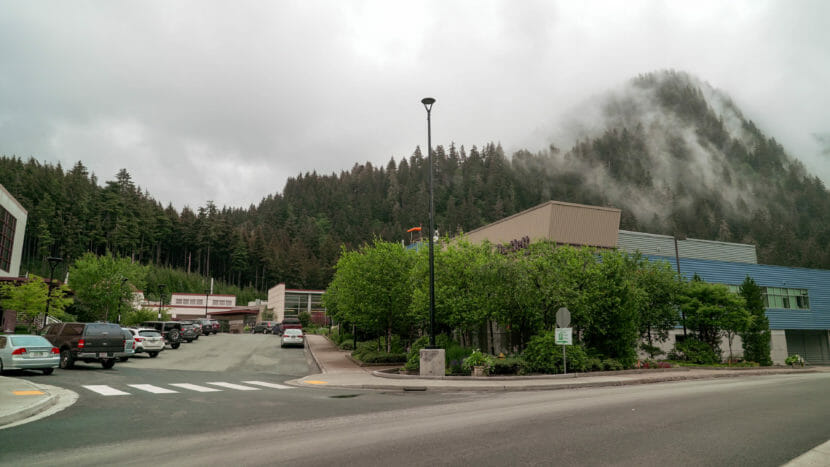
Bartlett Regional Hospital, on Aug. 7, 2022. (Photo By Paige Sparks/KTOO)

This Saturday, Bartlett Regional Hospital is hosting a walk/run event to raise awareness for mental health and trauma related to pregnancy and motherhood.

Bartlett’s obstetrics education team began offering monthly support groups for mothers in February of 2021. They call the program “Real Talk.”

Sara Gress, a nurse and educator at Bartlett, said the groups are “dedicated to having some real honest conversation about some of the parts of motherhood that are more challenging and not always discussed in some of the other spaces.”

The support groups are also offered through Zoom, so people outside of Juneau can participate. 

“Even if folks didn’t deliver with us, we’re happy to have them participate and access these resources from their communities,” Gress said. 

According to the Cleveland Clinic, 1 in 7 new parents experience postpartum depression. The National Library of Medicine estimates that up to 25% of known pregnancies end in miscarriage.

For Saturday’s race, Gress said that the race bibs will have a space to show who participants are running or walking in support of.

Juneau’s Shéiyi X̱aat Hít Youth Shelter has helped dozens in its first year

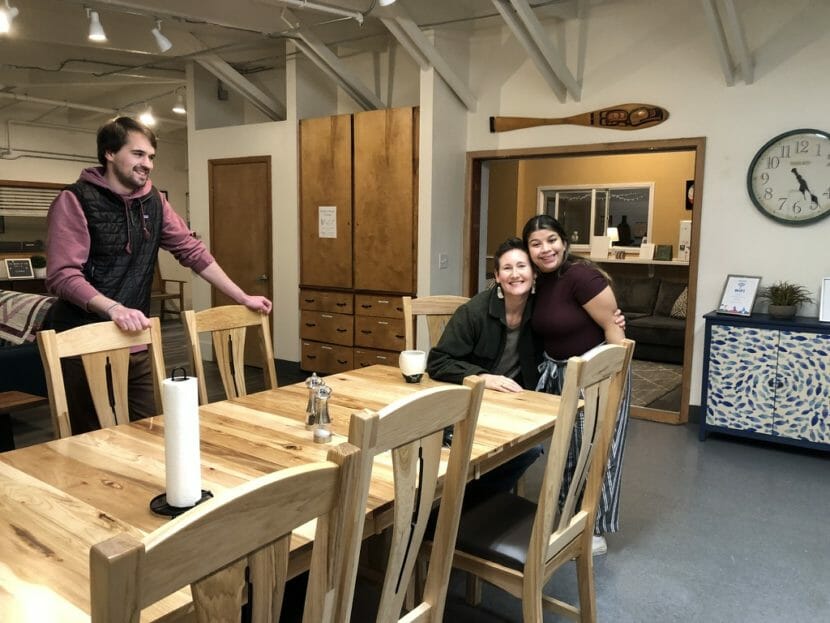
Shelter Supervisor Forrest Clough, Youth Services Manager Jorden Nigro, and Youth Action Board Member Tiana at Shéiyi X̱aat Hít Youth Shelter. Oct. 14, 2022. (Photo by Yvonne Krumrey/KTOO)

For two long years, there was no dedicated shelter for young people in Juneau who needed a safe place to sleep. But last July, Shéiyi X̱aat Hít, or Spruce Root House, opened. In partnership with Tlingit and Haida Regional Housing Authority, the city designed the shelter with input from youth who had direct experience with homelessness.

In the fifteen months since the shelter opened, Jorden Nigro says dozens of individuals have been helped. If you multiply the number of individuals by the number of nights spent at Shéiyi X̱aat Hít, it’s around 1,600.

Nigro is the youth services manager for Juneau Parks and Recreation, and she runs the Zach Gordon Youth Center and Shéiyi X̱aat Hít Youth Shelter.

“I’ve known kids who have traded, you know, sexual favors for places to stay, who have been exposed to things that they really should not have been exposed to, in order to have a place to stay,” Nigro said. “So yeah, there’s some real sad stuff that will happen when there aren’t places like this for kids to go.”

The kids use the shelter for a few different reasons, Nigro said.

“For the most part, our youth who are coming into the shelter have either run away from home or threatened to run away from home, or they are living at home in an unsafe situation,” she said. “And they come in because of abuse or neglect.”

The average time spent per youth at the shelter is about 13 days.

A large part of the role of the staff of Shéiyi X̱aat Hít is to work on family mediation, Nigro said. So far, more than 90% of the youth who have used the shelter have gone on to a safe and stable place.

“And we do these exit surveys when kids leave and ask them a bunch of questions, but one of the things is like, ‘Would you recommend this to a friend?’” she said. “And 100% of the youth have said ‘yes.’”

Before Shéiyi X̱aat Hít opened, Tiana struggled to find a safe place to stay, when her family home wasn’t safe. KTOO isn’t using her last name due to the stigma attached to homelessness.

She’s 19 now and has her own apartment. She joined the city’s Youth Action Board in 2020, where she has been sharing her ideas about what would help kids who are in situations similar to hers growing up.

The board meets weekly and is open to any youth who want to give input.

One thing that was important to her when designing the youth shelter was that each person should have their own room.

“Maybe if I was in this situation, which I was,” Tiana said. “I wouldn’t want to do that with somebody else, I would want to have the privacy of being able to be alone and sit in my room.”

Another project she pushed for on the Youth Action Board was a place for people aged 18 to 20. So the shelter also hosts transitional housing, a four-room apartment, which is currently rent-free.

Eleven people have used the apartment since the shelter opened. Usually, people stay there for about two or three months, says Nigro.

Shéiyi X̱aat Hít Youth Shelter is more than a place to stay for a while. Nigro said the staff work to foster community with youth by cooking and eating together, encouraging “normal” daily routines, and having downtime when youth can watch TV and play games together.

Nigro said about half of the youth at Shéiyi X̱aat Hít are LGBTQ+ identifying, and a quarter of them are transgender.

This is consistent with national trends: 28% of LGBTQ+ youth experience housing insecurity or homelessness. But having at least one supportive adult in their life decreases their chance of attempting suicide by 40%.

Tiana says that the adults at Shéiyi X̱aat Hít and Zach Gorden were a lifesaver for her, too.

“I know there’s a lot of kids out there who grew up, or is growing up right now that don’t have a safe place to go and don’t have people to turn to. And that was me,” Tiana said. “And these people are the people that I learned how to turn to, so being involved in this has changed my life for the better.”

Nigro says she wants more people to know about Shéiyi X̱aat Hít, so any youth who find themselves in an unstable housing situation know where they can go.

Correction: An earlier version of this story gave an incorrect age range for people eligible to stay in the apartment. It serves ages 18-20.

Orange Shirt Day in Juneau offers listening and learning for people of all ages

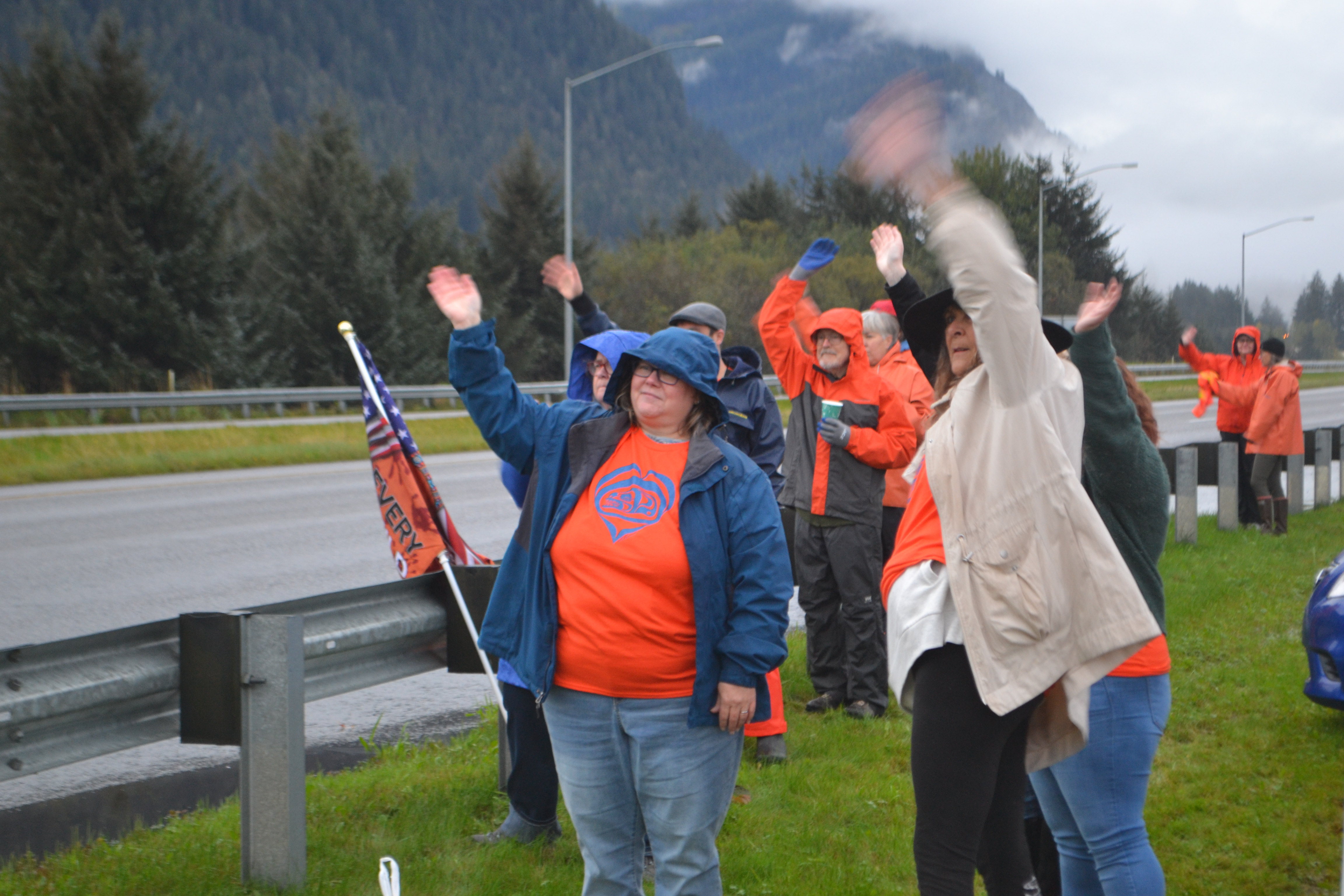
People gather in the Mendenhall wetlands along Egan Drive Friday morning for Orange Shirt Day, Sept. 30, 2022, in Juneau. (Photo by Chen Chen / KTOO)

Friday is Orange Shirt Day, a day to draw awareness to the history of Indian Boarding Schools in the U.S. and Canada.

Events are being held across both countries. In Juneau, the day started off with dozens of people drumming and holding banners along Egan Drive as residents commuted into town.

Cars honked their support as they drove by in the rain, while the gathered supporters, wearing orange, cheered and waved.

Bambi and Jessica Kinville-James were there, with the drumming group Litseeni Sháa, or “strong women.”

Orange Shirt Day is personal for them, they said.

“We have five kids. They get to stay home, they get to be with us forever,” Bambi said. “And they’re safe. We’re not going to be finding them in the ground somewhere else, or sent off to a different adoption agency just because the state didn’t want to deal with them.”

Jessica said it’s important that their kids have the connections to their culture that were severed in the boarding school era.

“And they’re not going to be ripped away from us and told that they can’t know their language, they can’t know their songs, they can’t do what we do as Lingít people, as Indigenous people,” Jessica said.

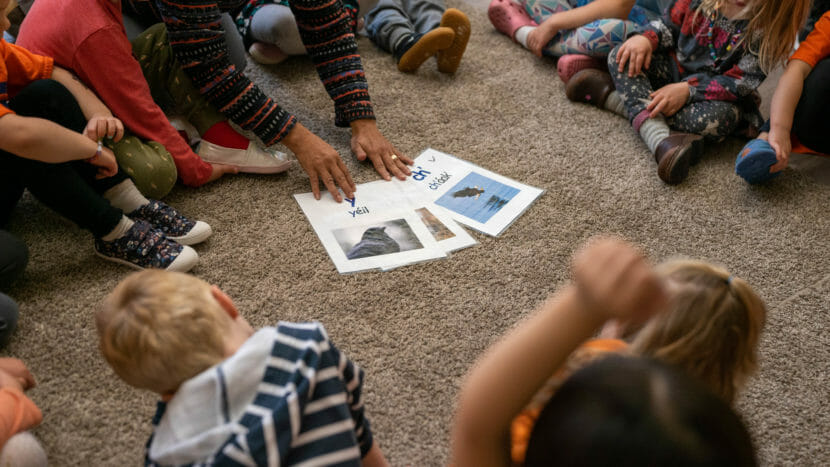
Victoria Ann Johnson teaches kids at Juneau Montessori School on Orange Shirt Day, Sept. 30, 2022. (Photo by Paige Sparks / KTOO)

Jamiann S’eiltin Hasselquist, with the Alaska Native Sisterhood, has organized many Orange Shirt Day events for Juneau.

She said days like this matter because even though the boarding school era is over, Indigenous children are still being taken from their families through the foster system and adoption, which she says a continuation of that system.

“And when we understand that system, then we can find the right tools to sort of undo some of those things,” she said.

Victoria Ann Johnson is a cultural specialist for Goldbelt Heritage Foundation. She spent part of the day working with young kids at the Juneau Montessori School, which meets in the building of the former Mayflower School run by the Bureau of Indian Affairs.

She brought cards with Ch’áak’ (Eagle), Yéil (Raven) and Guwakaan (Deer) on them.

“These were the images that we’ve learned about in the language, so I figured I could use it this way to explain about Orange Shirt Day, a little bit,” Johnson said.

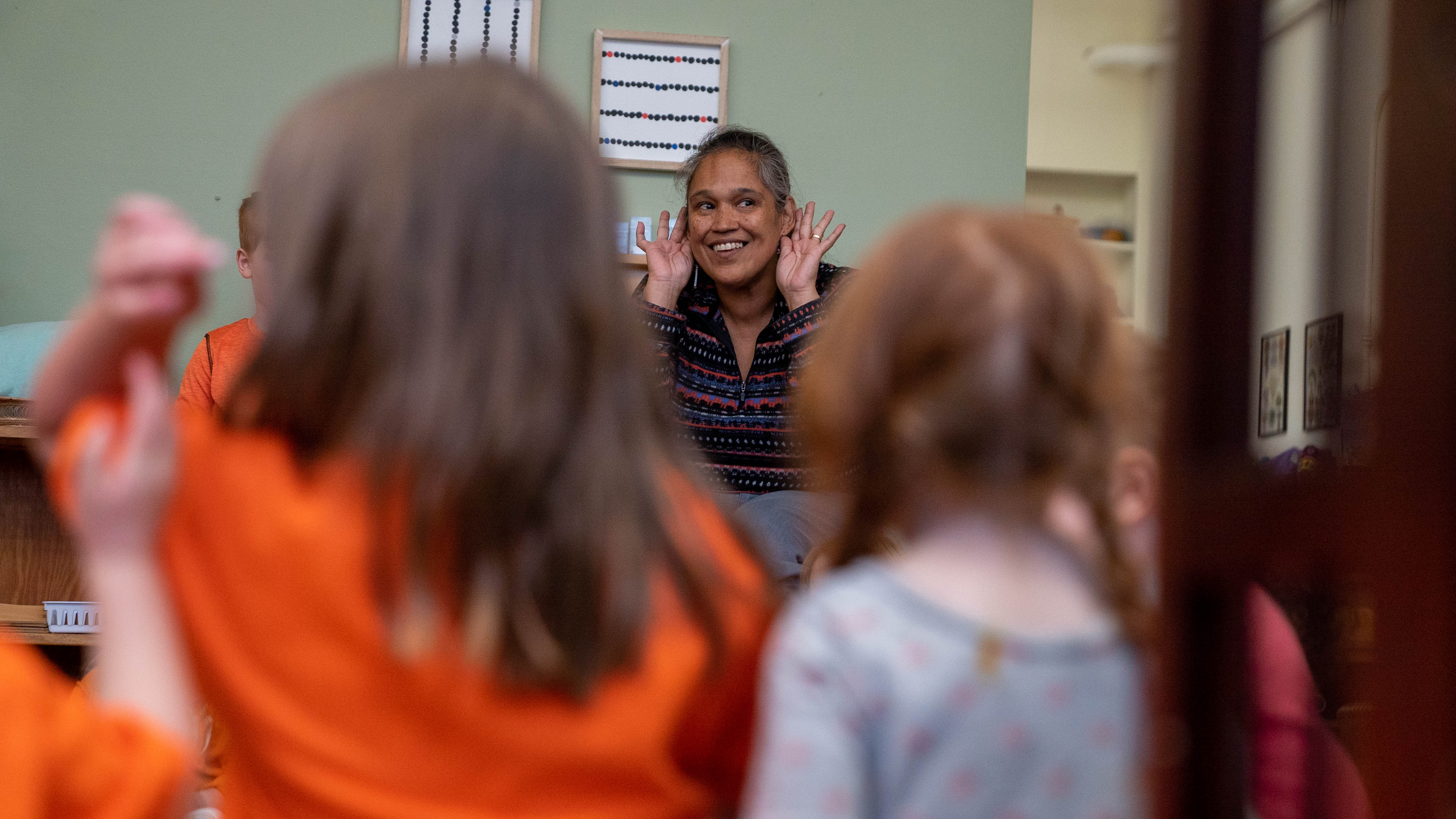
Victoria Ann Johnson teaches kids at Juneau Montessori School on Orange Shirt Day, Sept. 30, 2022. (Photo by Paige Sparks / KTOO)

“This one school was where all the Eagles went. And only the Eagles could go to that school,” she told the students. “And they got to learn lots. But in this other school over here, only these animals and other animals could only go to this school.”

That’s how she introduced the concept to kids under five.

“This is something that happened a long time ago. And that’s why today, all the animals get to go to the same school … And now that’s how we are today in our schools. We’re all learning about the different languages, the different people. And that’s why we wanted to remember this Orange Shirt Day.”

This story has been updated with details from the event at the Juneau Montessori School.

Alaskans plan to honor victims and survivors of Indian boarding schools

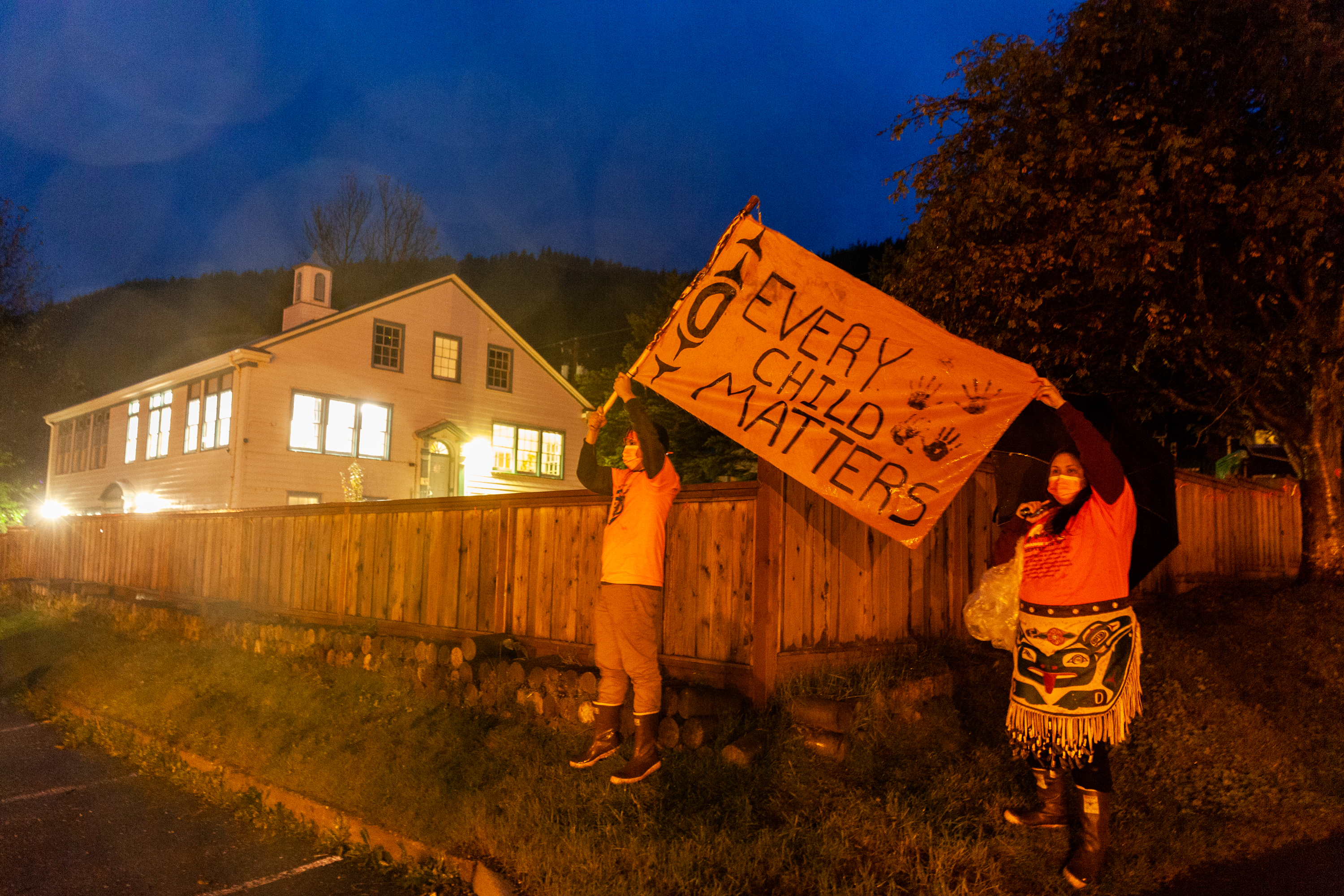
A mother and son hold up a sign for Orange Shirt Day in front of a former Bureau of Indian Affairs school on Douglas Island, on Thursday, Sept. 30, 2021, in Juneau, Alaska. (Photo by Rashah McChesney/KTOO)

Friday is a day of remembrance for Indian Boarding Schools in the U.S. and Canada, also known as Orange Shirt Day. The day of reconciliation was created by Phyllis Webstad, a boarding school survivor in British Columbia who had her favorite orange shirt taken away on the first day of school.

There were dozens of residential schools across Alaska. Generations of Alaska Native children were also taken from their homelands to attend boarding schools in other parts of the country. 

There are a number of events happening around the state to bring attention to the damage these schools did to Indigenous children, and to offer a way to honor victims and begin healing.

“Many people live here on Lingít Aani and don’t know the history of cultural genocide that has happened on this land, as well as the ways in which racism continues to impact families today,” Ati Nasiah said on Juneau Afternoon Tuesday. Nasiah works at AWARE – Juneau’s domestic violence and survivor support organization.

In Anchorage and Juneau, people will wear orange shirts and gather during morning commute times on Friday to wave at drivers and hold signs.

Nasiah said it’s a history that many Alaskans are completely unaware of. 

“Understanding what’s happened here and understanding that history allows for us to strive to tend well to the landscape that we live in,” she said. “And to each other in a way that encourages us to support things like native language revitalization.”

In the evening, there will be a formal apology prepared by the Alaska Quakers at Sayéik Gastineau School in Juneau – the site of the former Douglas Island Friends Mission School, which forcibly assimilated Lingít children.

In May of this year, Interior Secretary Deb Haaland released the first report from an investigation into the problematic legacy of federal Indian boarding schools. 

The government of Canada released a similar report in 2015 after several years of investigation by its Truth and Reconciliation Commission.

Site notifications
Update notification options
Subscribe to notifications