Health

Anchorage partners police officers with social workers to assist city’s homeless

Lt. Brian Fuchs with the Anchorage Police Department oversees the city’s Homeless Outreach Prevention and Engagement team. (Wesley Early/Alaska Public Media)

Anchorage city leaders are hopeful that a new team in the Anchorage Police Department will help keep homeless residents safe while connecting them with the resources they need.

Mayor Suzanne LaFrance touted the new pilot program, which is called the Homeless Outreach Prevention and Engagement team, at a press conference Wednesday.

“People experiencing homelessness are far more likely to become victims of crime,” LaFrance said. “The HOPE team consists of a sworn crisis intervention-trained officer and a social work navigator who work together to connect people experiencing homelessness to services and housing while improving community safety for all.”

Typically, the Anchorage Health Department has conducted homeless services and outreach. However, Police Chief Sean Case said his department operates around the clock, outside of usual health department hours. That puts the HOPE team in a good position to help support the work in addressing homelessness, he said.

“If we can deal with victimization and crime that’s happening within this population, while also connecting to resources, because we are the agency that frequently comes into contact with this population, we’re now just adding to the overall plan the Municipality has,” Case said.

The HOPE team has been running since the start of July and is headed by Lt. Brian Fuchs, who said a major goal is to have the team engaging with residents living in the city’s homeless camps.

“We want positive police contacts,” Fuchs said. “We want people to understand that the police are there to assist, the police are there to help. And in some cases, that’s connecting people to resources. In other cases, it may be taking a victim in and getting a better understanding of what they’re a victim of.”

The team is similar in concept to the Mobile Intervention Team, a program where officers are partnered with mental health clinicians to respond to mental health crises, Fuchs said. While that team responds to a variety of calls, Fuchs said the HOPE team is specifically aimed at helping residents in homeless camps.

“It’s a new concept as far as a mission, but the construct of the co-response model has been something that we’ve been doing for quite some time,” Fuchs said.

Farina Brown, special assistant to the mayor on homelessness and health, said having an officer with the social work navigator helps keep both providers and the people they’re servicing safe and helps build relationships.

“Sometimes it takes multiple contacts with someone before they even tell you their name,” Brown said. “And the HOPE team allows for that bandwidth to go in and create relationships and start to link people to services when they’re ready.”

If the pilot program goes well, city leaders said a second HOPE team could be out working on the streets next year.

Sen. Murkowski joins Democrats to support IVF bill

//
The U.S. Capitol, viewed from the east side. (Liz Ruskin/Alaska Public Media)

Alaska’s U.S. senators split their votes Tuesday on a bill that would provide federal protection and guarantee insurance coverage for in vitro fertilization.

Sens. Lisa Murkowski and Susan Collins of Maine were the only two Republicans to vote in favor of advancing the IVF bill. Forty-four Republicans, including Sen. Dan Sullivan, blocked the measure. The bill fell nine votes short of the number needed to proceed.

Democrats want to show that they are the party that backs IVF. The procedure allows tens of thousands of couples a year to overcome fertility trouble and have babies.

IVF is controversial among some conservative abortion opponents because it typically involves creating more embryos than can be implanted and carried to term.

Republicans called the bill an election-year stunt.

A spokesman for Sullivan says the senator supports IVF but the bill had unacceptable elements that raised concerns over religious liberties.

Bartlett Regional Hospital’s Rainforest Recovery Center will permanently close next week

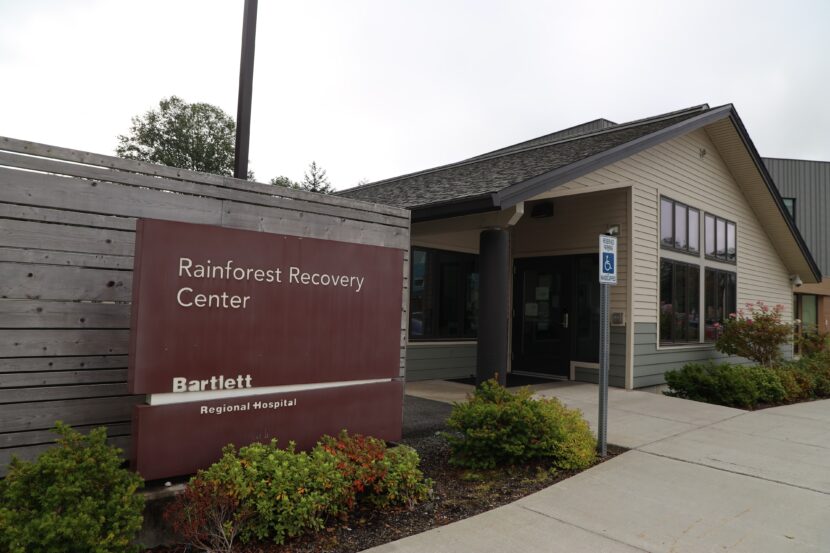
Rainforest Recovery Center on Tuesday, Sept. 17, 2024. (Clarise Larson/KTOO)

Bartlett Regional Hospital has operated the high-intensity substance misuse treatment program at Rainforest Recovery Center for over two decades.

The 16-bed facility has allowed Juneau residents and others in Southeast Alaska to access treatment faster, without having to travel to places like Anchorage or Seattle.

But this spring, the hospital shared that the program, along with a handful of other services, was draining money and contributing to a financial crisis that could close the hospital. Rainforest was expected to lose close to $800,000 next year.

In June, the hospital’s board of directors agreed that if it can’t secure subsidy money or find a third party to take over the program by the end of October, then it would be eliminated. But, late last week the hospital shared with staff that the center would be closing much earlier — by next Tuesday. 

Joe Wanner, the hospital’s chief financial officer and soon-to-be CEO, explained the decision to the Assembly at a meeting Monday night. 

“Rainforest is open through the 23rd. We’re actively discharging patients due to staffing shortages in the program,” he said. 

Some Assembly members, like Christine Woll, were taken aback by the news. Earlier this month, the Assembly discussed and indicated support to give the hospital $500,000 toward continuing the program through next June during a finance committee meeting.

“I hear the comments about not having enough staff in this current moment. If someone could walk me through how we got from not having enough staff in this current moment to closing the program permanently, that would be helpful,” she said Monday. 

Wanner said that since June, nine staff members at Rainforest have resigned. Kim McDowell, Bartlett’s chief nursing officer and chief operating officer, said that’s in large part due to the uncertainty of the program’s lifespan. 

“I think that when you have any period of uncertainty, especially for staff, they have to make what decisions is best for their families,” she said. “People decided that they needed to move on and look for different work.”

Without enough staff, McDowell said it puts patients at risk. The center currently has four patients, but they will be discharged before Tuesday. McDowell said one will finish their program before then, and the other three patients will seek treatment elsewhere. 

Rainforest Recovery isn’t the only treatment facility in Juneau. Gastineau Human Services is a nonprofit that helps people affected by homelessness or addiction. Jonathan Swinton is the executive director of Gastineau Human Services. He told KTOO on Tuesday the facility plans to partner with the hospital to expand its 19-bed substance misuse treatment program in the coming months. That program opened last year and plans to have 27 beds by early next year.

“We’re in discussions right now with Bartlett to contract with them to provide an increased level of medical assistance to the residents in our treatment program, with the goal being that those in need in the community will still get the level of service that they have been through the Rainforest program,” he said. 

Rainforest’s impending closure comes after the hospital closed its crisis care unit in July. It was a program designed to offer immediate care to adolescents in crisis. The hospital had only started offering the service last December. Hospital leaders said the closure was also due to a lack of funding and staff. 

Young people in Juneau gather to protest Dunleavy’s ‘incomprehensible’ contraceptive expansion veto

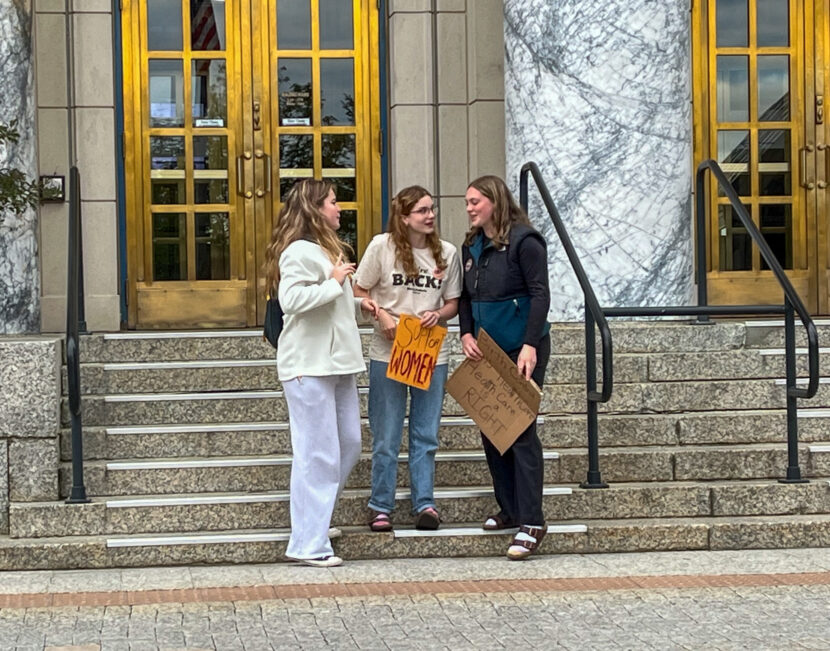
Protestors gathered at the Alaska State Capitol after Gov. Mike Dunleavy vetoed a bill that would have expanded access to contraceptives. September 11, 2014. (Photo by Yvonne Krumrey/KTOO).

Dozens gathered on the sidewalk across from the Alaska State Capitol building Wednesday holding pink and cardboard signs saying, “healthcare is a right, not a privilege” and “reproductive freedom by any means necessary.” 

And about half the group were teenagers who canʼt vote yet.

They were there to protest Gov. Mike Dunleavy’s veto of a bill that would have expanded access to birth control. 

For Juneau Douglas High School Yadaa.at Kalé senior Nova Brakes-Hines, the specter of limited reproductive care has haunted her for two years — and her family for longer.

“My mom was a teen mother and didn’t really have the right to choose, and Roe v. Wade is something that’s been affecting me since I was 15 and it got overturned,” Brakes-Hines said. “So it’s just really important to me.”

She said she wants to have control over her own future.

“I am a really hard working student, and I do a lot of things to try to make the best future for myself,” she said. “And so the idea that that could be stripped away from me at any moment, even if it’s not my choice, is really terrifying for me and a lot of young women.”

She said that when she’s old enough, she hopes to vote the politicians who are trying to take that away out of office.

Nova Brakes-Hines and friends protested Gov. Mike Dunleavy’s veto of a bill that would have expanded access to contraceptives. September 11, 2014. (Photo by Yvonne Krumrey/KTOO).

House Bill 17 would have required health insurance companies to provide birth control for 12 months at a time. Now, they only cover one to three months before patients would have to return to the pharmacy or provider. 

And while going back to the pharmacy regularly is inconvenient for people in larger cities, it can be impossible in rural communities, said Supanika Ordóñez, another protestor.

“And there’s a big difference when you can get a year’s worth of prescription versus just a month at a time, especially if you don’t have access to a pharmacy, it’s really prohibitive to have to keep going back,” Ordóñez said. 

Juneau Rep. Sara Hannan – who is a Democrat – said that for people working and living in remote communities, the delays in receiving their prescription could lead to lapses in taking the medication, which impacts its effectiveness.

“But across Alaska, the de-facto norm is mail-out prescriptions,” she said. “And we know if there’s a mail delay and you can’t get a renewal until 90 days, and they don’t send it until day 87 and the mail doesn’t get there until it’s day 92 and you’ve had a five-day gap in your contraceptive, that’s a problem.”

And Hannan said she thought the legislature had worked out any concerns with the bill in the many years itʼs spent in committee. It also had bipartisan support.

“So I think because this bill had been worked on for eight years, right?” she said. “This wasn’t its first rodeo. I’ve been in legislature three terms. It had already been there before I got elected, and I think we believed that those concerns had been addressed. This isn’t introducing any new process of techniques. It’s just giving a consumer and access to a drug that they need.”

In a statement, a spokesperson for Dunleavy told Alaska Public Media that “Contraceptives are widely available, and compelling insurance companies to provide mandatory coverage for a year is bad policy.” 

But Juneau Sen. Jesse Kiehl – also a Democrat – said the veto doesnʼt make sense, and it wasnʼt expected. 

“It was an incomprehensible veto, and you can hear people are really upset about it,” he said amid the chanting Wednesday. “They should be.”

Joe Wanner will be Bartlett Regional Hospital’s new CEO

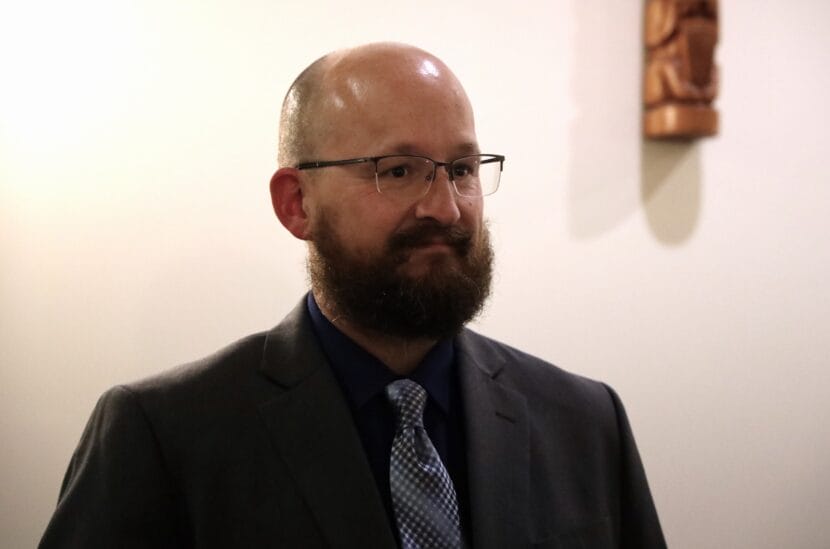
Bartlett Regional Hospital’s CFO Joe Wanner talks to staff at a meet and greet as a finalist for the hospital’s CEO position on Wednesday, Aug. 28, 2024. (Clarise Larson/KTOO)

Bartlett Regional Hospital’s board of directors has named Joe Wanner, the hospital’s chief financial officer, as its new CEO. 

Wanner was one of three finalists. He will begin the new role at the end of this month. He takes over from Ian Worden, who has held the position in the interim since last October. 

“I’ve seen what a good CEO can do to an organization and what a bad one can do. So I think I can come in and make a positive impact to the organization,” he said. 

Wanner has been the city-owned hospital’s CFO for nearly a year, but he’s moved between Juneau and Oregon for health care jobs since 2011.

His appointment as CEO is just the latest in a string of leadership turnover at the city-owned hospital. 

Last August, the hospital’s permanent CEO David Keith retired after a year on the job. His resignation — and that of the previous CFO Sam Muse — came a week after a doctor and board member said staffing and management problems were leading to inadequate care of behavioral health patients. 

Wanner said a key priority for him will be continuing the momentum of the hospital’s drive toward financial stability in recent months. 

“My vision would be that we need to get right-sized for where we’re at. So we’re going through looking at every program right now. Does it have the adequate staffing? Does it have adequate contracts, resources?” he said. “We’re still digging through all those it is a complex organization, so this isn’t something you could turn around overnight.”

This spring, the hospital’s board shared that it was facing a multimillion-dollar financial crisis that threatened to close its doors within three years without significant cuts.

The board is now in the middle of seeking subsidies or third-party providers for programs that they say are draining money. Otherwise, they will be cut at the end of next month. 

Worden will continue to assist as interim CEO through a transition period. The hospital will begin recruiting for a CFO replacement in the coming weeks. 

Governor vetoes bill that would have expanded Alaska women’s access to birth control medicine

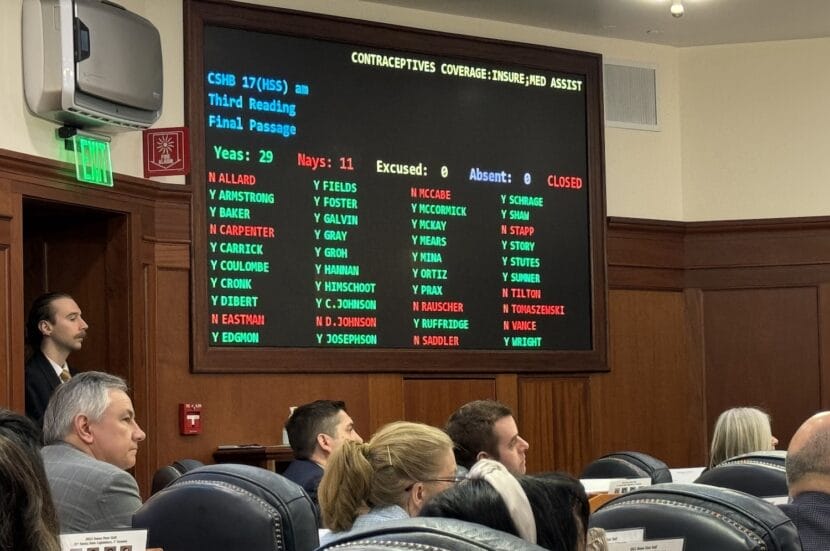
Members of the Alaska House watch for the vote tally on House Bill 17 on Thursday, March 21, 2024. (Photo by James Brooks/Alaska Beacon)

Gov. Mike Dunleavy has vetoed a bill that would have eased access to contraceptives.

Dunleavy on Wednesday vetoed House Bill 17, a measure that the Legislature passed with bipartisan support. The bill would have allowed women to receive a 12-month supply of prescription contraceptive medicine all at once. In Alaska, such medicine is typically distributed in increments of one to three months, according to the Alaska Public Health Association.

In a brief veto letter sent to House Speaker Cathy Tilton, R-Wasilla, Dunleavy said he objected to that idea.

“Contraceptives are widely available, and compelling insurance ‘companies to provide mandatory coverage for a year is bad policy,’” he said in the letter.

The bill got final passage in the House by a 26-13 margin, with all Democrats and independents, along with several Republicans, voting in favor. An earlier version passed the House by a 29-11 margin. It passed the Senate by a 16-3 margin. All the votes in opposition were from Republicans, including Tilton.

Reproductive rights advocates blasted the veto, saying it would maintain a barrier to public health.

“Vetoing HB 17 is a blatant failure of leadership and an insult to the public health of people in Alaska. Governor Dunleavy has chosen to keep barriers in place that make it difficult for all folks to access essential medication,” Rose O’Hara-Jolley, Alaska state director of Planned Parenthood Alliance Advocates, said in a statement.

Rep. Ashley Carrick, D-Fairbanks and the bill’s main sponsor, said she was frustrated by this and other Dunleavy vetoes.

“I believe there’s a growing sense of distaste for the administration. They don’t seem to want a collaborative process with the Legislature. Until the governor’s office shows a willingness to have a conversation and collaboration, it will be very hard for our state to move forward and get things done,” she said.

About half of U.S. states have passed laws requiring insurers to increase the number of months for which prescription contraceptives are distributed, according to the National Conference of State Legislatures. In those states, the usual duration is 12 months, according to the NCSL.

Site notifications
Update notification options
Subscribe to notifications