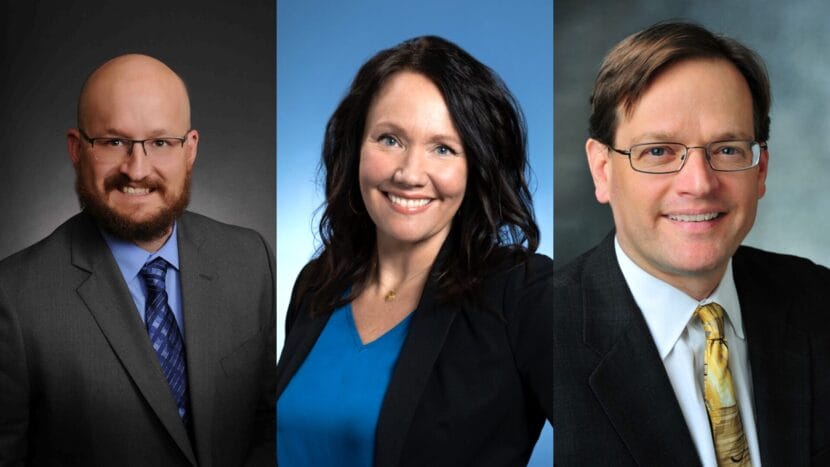
Joe Wanner (left), Melanee Tiura (middle) and Jon Friedenberg (right) were selected as finalists for Bartlett Regional Hospital’s chief executive officer position. (Bartlett Regional Hospital)
Editor’s note: The community meet and greet with Jon Friedenberg is now scheduled for Thursday, Sept. 5 at 4:00 p.m. His interview with the hospital board is now scheduled for Friday, September 6 at 8:00 a.m.
Bartlett Regional Hospital’s nationwide search for a new CEO has narrowed down to three candidates.
As Juneau’s hospital faces a multimillion-dollar deficit, it announced Thursday that the finalists are Jon Friedenberg, Melanee Tiura and Joe Wanner.
Friedenberg runs his own health care consulting business. He previously served in leadership roles at hospitals in California and at a research facility in Texas.
Tiura is the administrator of Providence Valdez Medical Center and previously worked at health care facilities in Unalaska, Dillingham and Michigan.
The finalists will be in town over the next two weeks for final interviews with the hospital board and to meet staff. There will also be opportunities for the public to get to know them. Meet and greets will be held on Bartlett’s campus starting at 4 p.m. on Monday, Aug. 26 with Tiura, Wanner on Wednesday, Aug. 28 and Friedenberg on Friday, Sept. 6.
Ian Worden is Bartlett’s current interim CEO. He was appointed last fall.
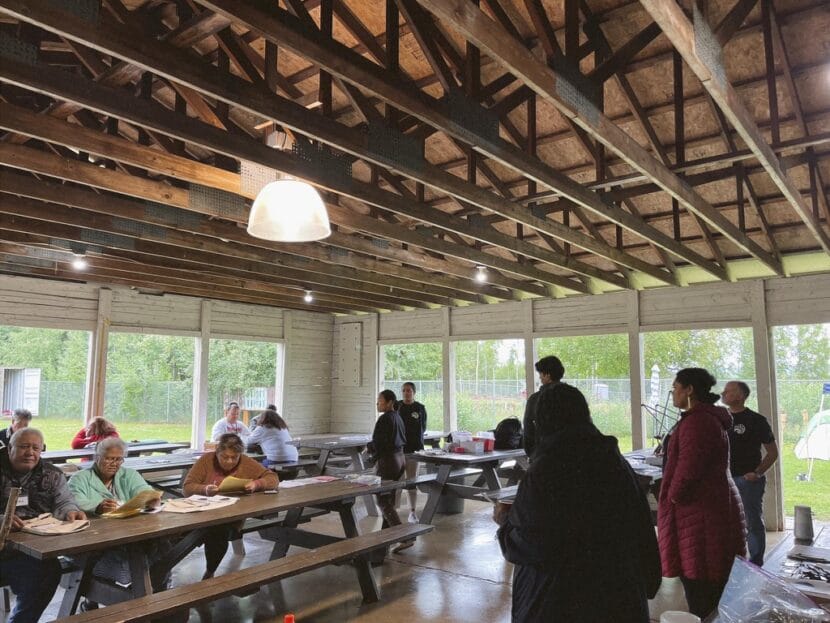
Researchers held a health fair for a Pacific Islander congregation at a campsite in Willow. The aim was to connect with and collect data from elders for Alzheimer’s research in understudied populations. (Photo courtesy of Brigham Young University)
Scientists from Brigham Young University in Utah visited Alaska in early August to research Alzheimer’s disease in Pacific Islander, Native Hawaiian, Alaska Native and American Indian elders. The research is funded by a federal grant.
Dr. Justina Tavana, a lead researcher who was raised in Samoa, said the populations they’re studying have been almost entirely left out of current Alzheimer’s research.
“When we received this grant, we were really excited… just to really understand how Alzheimer’s disease is affecting our communities, and, since we are geneticists, figure out what the genetic profile is, so that we can find ways to better diagnose and treat Alzheimer’s disease and dementia in our communities,” Tavana said.
Dr. Perry Ridge, the other lead researcher for the study, said genetic markers for Alzheimer’s may look really different in people of different races and ethnicities. He said in the little research so far on Alzheimer’s in American Indian populations, the APOE gene didn’t predict Alzheimer’s.
He said there is likely some overlap between the populations they’re studying and existing research.
“But, there will probably be some distinct things as well,” Ridge said. “And how significant those are is anyone’s guess, but we need to answer that question before we know if we can follow the same treatment path that we’re [following] based on these large data sets that are mostly people with European ancestry.”
Ridge and Tavana said their research will deepen the understanding of Alzheimer’s across all populations. The team of scientists plans to return to Alaska next year to continue their work.
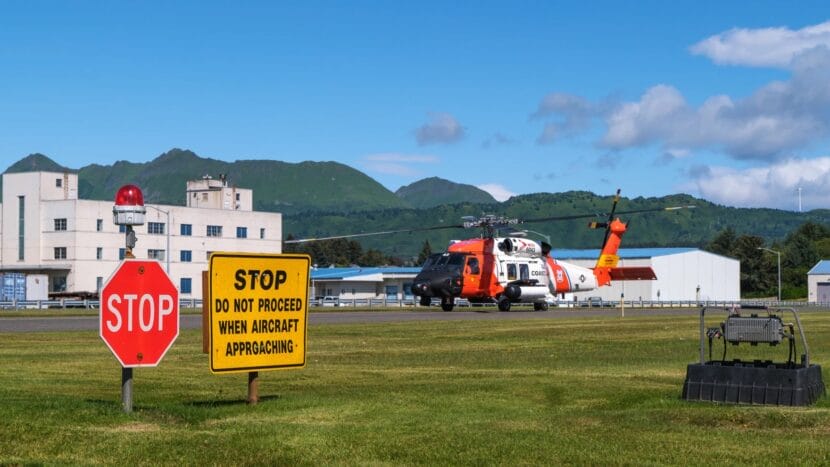
A U.S. Coast Guard rescue helicopter lands on a runway before it parks near an Air Station Kodiak hangar. (Brian Venua/KMXT)
The death of a Kodiak-based U.S. Coast Guardsman this summer has sparked a new wave of conversations about mental health on the base.
U.S. Coast Guard Air Station Kodiak held a ceremony on July 26 to honor the life and service of a rescue swimmer who died on June 25.
The Coast Guard said the investigation into the service member’s death is ongoing, but no foul play is suspected. It did however renew a push for addressing mental health in the military.
Coast Guard officials declined to say whether the death was a suicide. But a social-media group for Coast Guardsmen described it as one, urging comrades to “find something that keeps you going.”
Cameron Snell, a public affairs specialist for the Coast Guard, said Air Station Kodiak officials have been open about encouraging members to use mental health services.
“The air station had a stand-down to inform everybody working there about what had happened, and they immediately offered grief (and) loss counseling for those service members, also for the service members in the barracks,” he said.
A stand-down means operations were paused for air station staff to meet.
Suicide rates are higher within the military, and in response, mental health programs for service members have been on the rise in recent years. Now that includes pushes from the Coast Guard’s Air Station and Base Kodiak, as well as ships that are homeported on the island too.
Snell said officials have been encouraging people to use CISM, or the Coast Guard’s Critical Incident Stress Management program.
The goal is to serve members who have faced potentially traumatic experiences, like when a peer dies or after stressful search and rescue missions. He said it’s not a perfect system, but those kinds of resources are important.
“Suicide is a troubling statistic in the military,” Snell said. “And we can never completely eliminate that statistic, but we can offer as many resources as we can to prevent that at every step of the way.”
The base also provides other resources to burn stress, like borrowing boats or other outdoor equipment from its Morale, Wellness, and Recreation Department. Snell said the Work/Life Office also provides members services like financial guidance or help finding child care.
Members of the Coast Guard have mandatory mental health screenings as part of their annual health assessments and are encouraged to report their peers if they have any concerns. Snell said commanding officers can also refer members they’re concerned about to counseling.
“(This) incident was a tragedy – one being one too many here – and we hope to be able to make the resources that we have available known,” Snell said.
Mental health emergencies on or off base should be reported by calling 911.
Providence Kodiak Island Medical Center and the Kodiak Area Native Association both offer mental health counseling in town, but waitlists can take months. Providence psychiatrists can be seen much sooner though, and emergency services are always available.
The national suicide and crisis lifeline is available by calling or texting 988. The Veterans Crisis Line is available by dialing 1 during a 988 call or by sending a text message to 838255. Online chats are also available at 988lifeline.org.
The Coast Guard also has plans to promote mental health services in September for National Suicide Prevention Month.
Alaska Public Media’s Chris Klint contributed information to this story.
Carolina Sekona spent the weekend scrambling to set up a new day care in the vacant Floyd Dryden Middle School. (Photo by Anna Canny/KTOO)
On Tuesday, Issac Benson crouched down to help his two-year-old son Silas take off tiny purple rain boots. Then he scooped Silas up and carried him through the doorway of a classroom at Juneau’s former Floyd Dryden Middle School.
“I’m back,” Silas Benson said, as he entered a room full of other toddlers. But he seemed shy and confused as he looked around. Silas has been coming to this day care since he was just a baby, but the room, with its soft rugs and bins of toys, was unfamiliar.
“Let’s ease our way back in, it’s okay,” Issac Benson said. “I know it’s a big transition and change, isn’t it?”
“We stayed up all night and watched it happen, and luckily we were just high enough to not get totally inundated,” Issac Benson said. “It was still really scary.”
Their garage and crawlspace took on water. The family spent the week drying things out and helping their neighbors who were worse off, all while juggling other responsibilities. Issac Benson said it was nice to spend time with Silas at home, but seeing the Glacier Valley Kids staff on Tuesday morning was a relief.
“My wife and I were trying to still work full-time and full-time parent and I mean, those things are incongruent, right?” he said. “Without day care, without them, our lives don’t really function.”
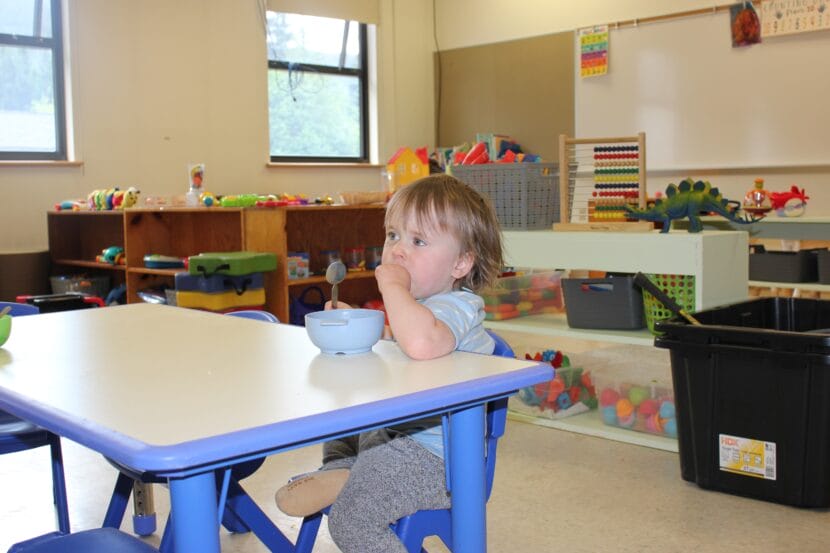
Silas Benson eats breakfast at a plastic table, which was salavaged after last week’s record-breaking glaical outburst flood. (Photo by Anna Canny/KTOO)
The opening day of this emergency child care center marks some return to normalcy for Benson and the other parents. It’s a big day for child care provider Carolina Sekona too. She’s been running Glacier Valley Kids, a state licensed day care for children under five years old, out of her home on Emily Way for years.
Last week, more than two feet of water surged in and soaked wooden furniture, blankets, rugs, toys and stuffed animals. At least half of the stuff had to be thrown away, and it was clear that the house itself was uninhabitable.
“I was crying, I didn’t know what was going on, I didn’t know what we were going to do,” Sekona said. “All I could see was my home destroyed, and my child care destroyed. And I knew it was going to be months before that could be built back up.”
It looked like Glacier Valley Kids was going to be out of commission. That wasn’t an option, said Blue Shibler, the executive director of The Southeast Alaska Association for the Education of Young Children, a nonprofit focused on supporting early childhood caregivers and educators.
“In general, we can’t afford to lose any child care spaces. There aren’t any open spaces in child care programs,” she said.
Parents that rely on Sekona have nowhere else to go. Child care in Juneau is stretched thin under normal circumstances, and even before the flood Sekona was turning parents away. She cares for twelve Juneau children, and she had at least twelve more families on her waitlist.
“If she wasn’t able to reopen, that would be 12 families that had to leave the workforce,” Shibler said. “That’s all there is to it.”
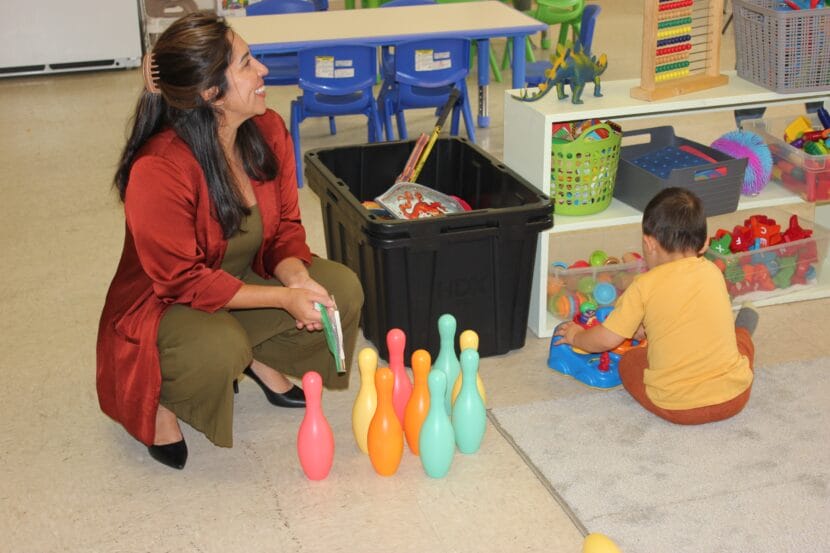
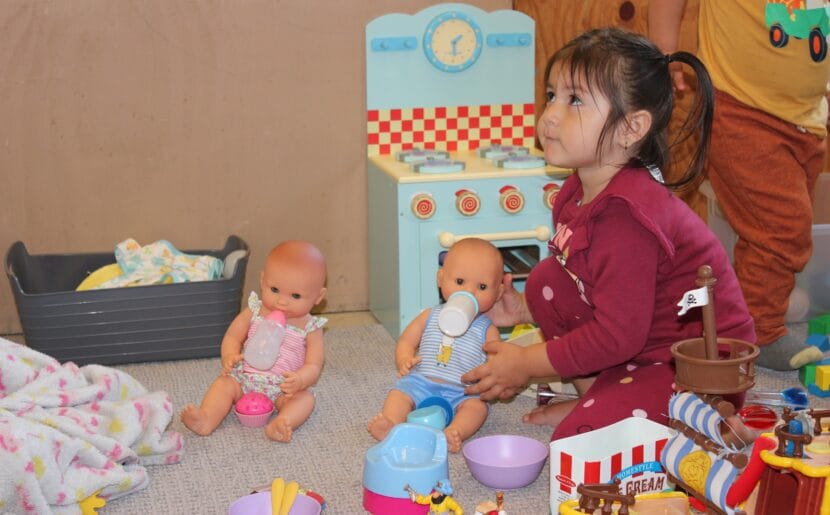
Alison Diaz plays with baby dolls and a wooden kitchen playset at the new emergency childcare center at Floyd Dryden Middle School. Many toys were thrown away after they were soaked by floodwaters. (Photo by Anna Canny/KTOO)
So Shibler’s agency pitched in some emergency money to replace the toys and other supplies. Sekona picked out a new plush campfire and a miniature wooden kitchen playset, among other things. Other day cares and schools around town donated cubbies, bookshelves, books and spare toys.
And the City and Borough of Juneau offered up the former Floyd Dryden Middle School building, which served as an emergency shelter for people who evacuated their flooded homes just last week. Then Alaska Department of Health and Social Services issued Sekona a temporary license to set up shop there.
Skye Taverez plays with blocks next to a plush campfire. Many of the plush items, including pillows, rugs and stuffed animals, had to be thrown away after the flood. (Photo by Anna Canny/KTOO)
She was grateful that it all came together so quickly.
“I need to be back at work. I have a family to support,” Sekona said.
Sekona is a single mom of four. Luckily, she moved her family into a new house this summer, one that wasn’t touched by rising water. But the house that flooded supported Sekona’s livelihood, and that of the three people she employs.
Over the weekend, they transformed two of the school’s empty classrooms. One is for mealtime and play. The other is for movies and naptime. Ever since the school building was vacated this spring, the city has been eyeing it for child care, so Glacier Valley Kids will be a trial run.
From one side of the room, Sekona watched the kids as they explored and rediscovered some of the familiar things that she was able to salvage.
A few favorite toys were spared by high shelves. The plastic tables and chairs that were designed to withstand toddlers held up pretty well against flood waters too. And on one wall, there’s a painting of a smiling lion with a rainbow mane. Sekona stopped by her gutted house on Emily Way to retrieve it.
“The kids are so visual,” Sekona said. “They’ll see it. They’ll remember: this is us.”
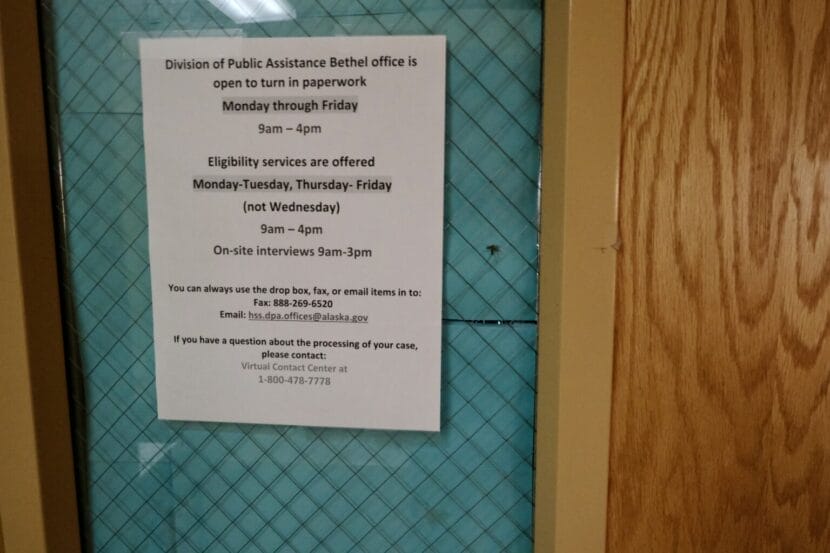
A sign posted on the door of the Division of Public Assistance office in Bethel, Alaska, on Oct. 11, 2023. The office offers full services. (Photo by Claire Stremple/Alaska Beacon)
At the height of the food stamp backlog last November, pro bono attorneys and other volunteers at Alaska Legal Services got more than 600 requests in one month from Alaskans seeking a fair hearing to get their overdue food benefits.
So the 97 requests that came in this July didn’t feel like anything the group couldn’t handle, said Leigh Dickey, the nonprofit’s advocacy director.
But the number is still alarming, she said, and it’s double last month’s requests.
Dickey said the state’s Division of Public Assistance is still dogged by the same problem: paperwork processing delays.
“Which is something the DPA, I think, is saying that they have fixed,” she said. “But we are still seeing clients coming in who have delays at recertification.”
Lawmakers and the governor have funneled more than $70 million into tech solutions and new staff, but many Alaskans say they still can’t get their paperwork processed. The Division of Public Assistance, which processes the paperwork, said it now completes 89% of applications on time. That is a significant improvement over January through April of last year, when only about 5% of food stamp recertifications were on time.
Dickey said the division also lags on responding when clients report changes in their household that affect benefits, like losing a job, and that it will ask for paperwork but neglect to file it, which can result in people losing benefits. And she said when DPA asks for paperwork to verify employment, there are often mix-ups: “The clients will gather that information and will turn it in by a certain day, but DPA will close their case anyway.”
“It’s like one hand doesn’t know what the other hand is doing,” she said.
Tech updates
The Division of Public Assistance has taken many steps to get Alaskans benefits faster. It is working to reopen offices, increase training for the staff that processes applications and it launched an online application for public assistance benefits in late July.
The goal of the online portal is to decrease the chance of paperwork mix-ups and increase the percentage of applications that are processed on time, officials say. The online application means people can apply for food stamps, renew their applications or report any changes — like a lost job or a new baby — from home.
It’s called Alaska Connect and it’s one of the first steps in the division moving entirely to a cloud-based system, said division Director Deb Etheridge.
“The primary goal is to provide better customer service to Alaskans and make it easier to access benefits and apply for benefits,” she said.
But Etheridge said it also helps reduce the administrative burden on eligibility technicians, which should reduce delays.
“It actually supports us with some administrative simplification. So if individuals have access to upload their documents and fill out their forms and fill them out completely, then that takes away the time that we have to spend getting additional information,” she said.
Alaska Connect doesn’t allow people to check the status of their applications, but that piece is coming soon, Etheridge said.
But that inability to check applications is a major pain point for some of the 97 people that filed complaints with Alaska Legal Services last month. Several of the state’s public assistance offices are still closed after pandemic shutdowns, or only allow “general inquiries,” which means people who are concerned about their benefits cannot get status updates or help problem solving when slowdowns occur.
Officials say only the Sitka office is completely closed. The Anchorage, Ketchikan and Nome offices are open only for general inquiries, which means dropping off paperwork or basic questions, but no access to eligibility workers who can process applications or problem solve lost paperwork.
Etheridge said they are working towards fully reopened offices and making progress. The Fairbanks office was the most recent to reopen, in July, and the Ketchikan office should reopen in August.
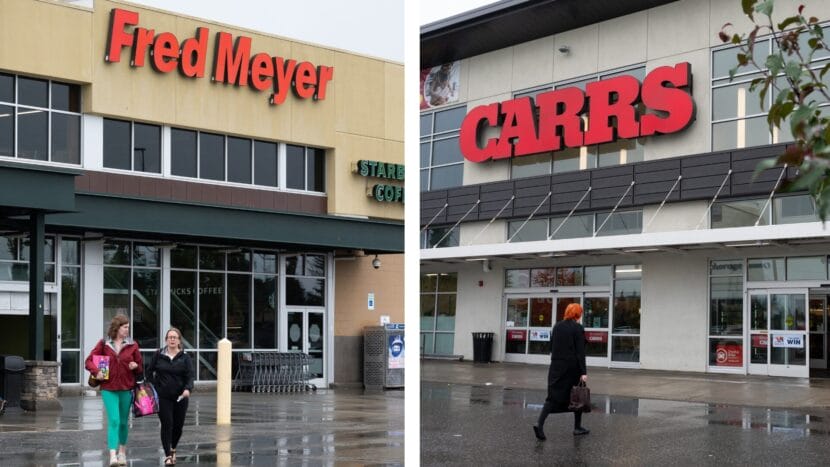
Shoppers come and go from Fred Meyer and Carrs stores that face each other across the Seward Highway in Midtown Anchorage on Thursday, Aug. 8, 2024. The parent companies of the competing businesses, Kroger and Albertsons, want to merge. (Matt Faubion/Alaska Public Media)
Most Alaskans live in a community where a Fred Meyer store competes directly with a Carrs or a Safeway, so the proposal for one parent company to buy the other for $24.6 billion has a lot of Alaska consumers worried.
Here’s what we know about where the proposal is now, after it was first announced in October of 2022.
What’s at stake?
If you take what the companies are saying in good faith, not much. They’ve made sweeping promises about the good things that will happen and the bad things that won’t if Kroger, which owns Fred Meyer, is allowed to buy Albertsons, which owns Safeway and Carrs. The companies say investors, customers, workers and communities are all supposed to benefit.
“We are confident our transaction with the proposed divestitures will mean lower prices and more choices for customers,” Kroger CEO Rodney McMullen said in a video about the proposed merger. “It will mean more opportunities for retail associates to grow their career while we secure the future of good paying union jobs.”
Here are some of the specific promises Kroger and Albertsons have made:
No store closures
No pharmacy closures
No front-line job losses with protection for worker pay and benefits
A $500 million investment in reducing prices
A $1 billion investment in employee benefits
A $1.3 billion investment to improve Albertsons stores
Kroger points to its 20-year track record that includes lowering its profit margins to keep prices down amid past acquisitions.
How can all of these promises be possible?
The idea is if Kroger and Albertsons merge, they’ll be in better shape to compete with even bigger retailers, like Costco and Walmart, as well as growing competitors, like dollar stores that now sell groceries and even Amazon. Bigger scale means bigger efficiencies, and that’s where the upside is supposed to come from.
Of course, most Alaskans live in communities where Fred Meyer competes with Carrs or Safeway. Specifically, that’s Anchorage, Eagle River, Palmer, Wasilla, Fairbanks, Juneau and Soldotna.
Federal regulators are wary of mergers because they can be anticompetitive, concentrating too much market power and hurting regular shoppers. To try to win regulators’ approval, Kroger and Albertsons say they’re prepared to sell off all 15 of the Carrs and Safeway stores in those Alaska communities, plus three more in Girdwood, Kenai and North Pole, to a company called C&S Wholesale Grocers based in New Hampshire.
The Safeways in Seward, Valdez, Kodiak, Ketchikan, Nome and Unalaska are not on the divestment list and would remain with the merged company.
Again, McMullen says these divested stores won’t close, because C&S is committed to running them as they are today.
Albertsons CEO Vivek Sankoran says C&S will make the landscape more competitive.
“Their deep industry knowledge and experience gives us great confidence in their ability to become even fiercer competitors moving forward,” Sankoran said in the video.
C&S CEO Eric Winn also says his company is playing the long game.
“We are confident this expanded divestiture package will provide the stores, supporting assets and expert operators needed to ensure these stores continue to successfully serve their communities for many generations to come,” Winn said in an April press release.
The United Food and Commercial Workers Local 555, which represents 30,000 grocery store workers in Oregon, Idaho and Washington, came out in support of the merger in February. However, the parent union, which represents 1.2 million workers, voted last year to oppose the merger. Other UFCW locals, including Alaska’s, also oppose the merger.
So what’s the problem? Why do people oppose the merge?
Basically, opponents just don’t believe the companies, and there isn’t anything in place to hold them to their promises.
“It’s a huge issue for Alaskans that resonates. It’s not a political issue, it’s a pocketbook issue,” said Veri di Suvero, executive director of the Alaska Public Interest Research Group, a statewide consumer advocacy nonprofit that also opposes the merger. “Whether or not it’s in good faith, about these spinoffs, we’ve seen over and over again that they don’t work.”
The seventh, at the University Center mall in Midtown Anchorage, survived and became a different grocery store, Natural Pantry, which eventually outgrew the space and built its current, standalone location off 36th Avenue.
Fast forward to 2015, and Safeway got swallowed up by Albertsons. Federal regulators approved that deal after the companies agreed to divest 168 stores. 146 went to a small Washington grocery retailer called Haggen.
Di Suvero is also concerned about how unique Alaska’s supply chain is, particularly its heavy dependence on a single port. Di Suvero and other opponents question if C&S has the expertise and wherewithal to step in and run its new grocery stores successfully.
So critics think C&S is setting itself up for failure, like Haggen?
Yes.
C&S isn’t a national player in the world of retail groceries. It owns the Piggly Wiggly brand and runs some Piggly Wiggly stores directly, but most are independently owned and operated under a franchise license. It also runs 11 Grand Union markets.
But C&S is a big deal nationally in grocery wholesaling, supplying more than 7,500 supermarkets. Forbes says it’s an industry leader in supply chain innovation, the largest wholesale grocery supply company in the country and the eighth biggest privately held company in the country. So C&S is in a totally different league from Haggen.
That said, the Federal Trade Commission says C&S doesn’t have its own store brand product lines, loyalty programs or e-commerce platforms it needs to successfully compete.
Does Alaska figure prominently into the overall merger?
No.
Kroger and Albertsons combined have 36 stores in the state. That’s 11 Fred Meyers, and 24 Carrs or Safeways plus Crow Creek Mercantile in Girdwood. Across the country, they have about 5,000.
And unlike in the Safeway-Carrs merger in 1999, the governor’s office has been hands off. Gov. Mike Dunleavy has not weighed in. The state Department of Law, which has its own consumer protection unit, says it’s monitoring the merger and the Federal Trade Commission’s legal fight to stop it.
Outside of Alaska, eight states and the District of Columbia have joined the FTC’s lawsuit in federal court in Oregon.
And the attorneys general of Colorado and Washington have their own similar lawsuits.
What happens if the merger gets shot down?
There’s a lot invested in this merger. A reporter with WCPO in Cincinnati, where Kroger is headquartered, dug through financial filings and found that through March, the two parent companies had already spent $864 million in merger-related expenses.
WCPO also found that Kroger had agreed to pay Albertsons $600 million if the merger fails.
So that’s a big incentive for Kroger to appeal if these legal fights don’t go its way.
Hearings in the FTC case at the U.S. District Court of Oregon begin Aug. 26. This case is important, but won’t necessarily make or break the merger. The judge there is supposed to rule on whether or not to pause the merger, while more substantive arguments go before an administrative law judge in Washington, D.C.
The trial in the Washington state court is scheduled to begin Sept. 16, and, separately, a Colorado state judge last month imposed his own order to pause the merger, pending a legal challenge there. That trial is scheduled to begin Sept. 30.
Close
Update notification options
Subscribe to notifications
Subscribe
Get notifications about news related to the topics you care about. You can unsubscribe anytime.