An unused COVID-19 at-home test kit. (Rachel Cassandra/AKPM)
Alaska is experiencing a summer COVID wave, fueled by the new so-called “FLiRT variants,” new Omicron variants of the COVID-19 virus.
Joe McLaughlin, an epidemiologist with the state’s division of public health, said the wave is partly due to waning immunity. He said only about 18% of Alaskans got a COVID vaccine this past year.
“Anytime you get these variants that are driving the wave, typically, what’s happening is they’ve had some sort of a mutation, at least one or a couple, that typically will give them the capability to evade prior immunity better than other strains that are circulating,” McLaughlin said.
McLaughlin said vaccination and boosters can help with immunity and that growing evidence shows vaccination helps reduce the risk of long COVID.
McLaughlin said it now may take two to three days for people with COVID-19 to test positive with at-home test kits. And anyone over 12 years old is eligible for prescription antivirals like Paxlovid, if their healthcare provider feels they’re at a higher risk of complications. Antivirals can reduce the strength of COVID symptoms and lower risks of hospitalization and death.
He said recommendations for how people should isolate if they get COVID have changed. He said now people should stay home 24 hours after their symptoms, including a fever, resolve without fever-reducing medications like acetaminophen.
“That’s the general recommendation,” McLaughlin said. “It’s not five days. It’s not 10 days. It’s really based on your symptoms.”
McLaughlin said people over 65 years old and people who are immunocompromised are eligible to get a second COVID booster vaccine this season. He said people should wait at least four months between boosters and Alaskans can expect a new COVID booster to be released in the next two to three months.
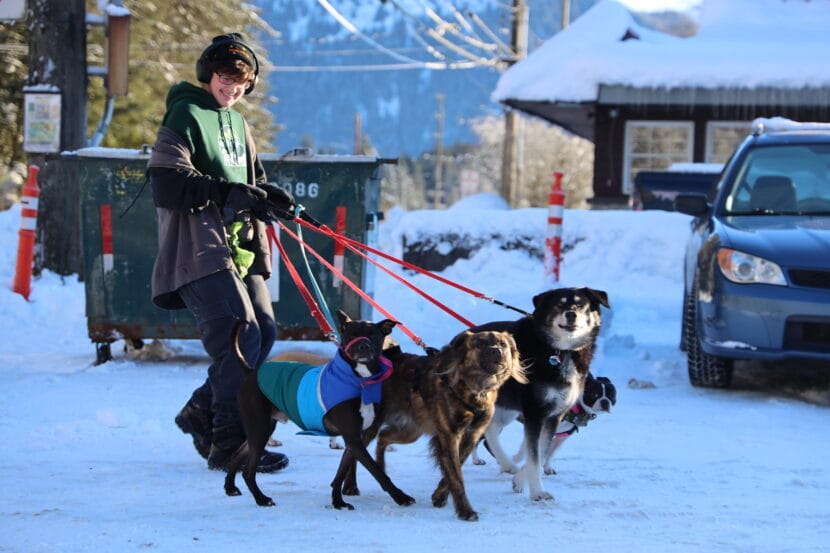
A Juneau Animal Rescue employee takes dogs out for a walk on Thursday, Jan. 18, 2024. (Clarise Larson/KTOO)
The Centers for Disease Control’s new regulations for bringing dogs into the United States went into effect on August 1.
Back in May, the agency announced there would be changes for dogs crossing the border on August 1, including forms signed by a veterinarian and proof of rabies vaccination. But before those regulations went into effect, the agency released an update for bringing dogs into the United States to try and simplify the new rules.
The organization said its updated rules “incorporated the feedback received from the public, industry partners, and various countries on the dog importation rule.”
“I didn’t know [the update] was coming,” said Alaska’s State Veterinarian Sarah Coburn. “[The CDC] elected to simplify those requirements for dogs from low risk countries for canine rabies.”
The newly updated rules
The CDC categorizes countries as either high risk or low risk.
“They’ve had some restrictions for what they consider high risk countries,” Coburn said. “It’s based on prevalence control programs that they do or don’t have in that particular country.”
While rabies is found in several wildlife species in the United States (including bats, foxes, raccoons, and skunks), the U.S. has been free of dog rabies since 2007. The agency’s importation regulations aim to prevent the reintroduction of this type of rabies.
“Canada, has a similar control program and prevention program and vaccine requirements, that allows our country to be in what they would consider a low risk country….For our purposes here in Alaska – Canada and the U.S. have the same status,” Coburn said.
Dogs need to be at least six months old and in good health, as well as an import form filled out from their owner as opposed to the form filled out by a veterinarian as was the case before this latest update.
“The vaccine requirements are much simplified, they don’t even officially have a vaccine requirement listed now,” Coburn said.
Dogs, however, are required to have a microchip.
“So basically, if a universal microchip scanner will scan the chip, it’s fine. They don’t have to be revaccinated. You don’t have to re-chip the dogs, is my understanding. And previous to [the update] they were going to be asking for a USDA endorsed rabies vaccine as proof that the dog was vaccinated in the US, they removed that requirement,” she said.
Confusion over the new policy
The policy has not only been confusing to some, it’s been frustrating to many, including Alaska’s Congressional Delegation. In a recent press release Sen. Lisa Murkowski, R-Alaska, said “this rule does not work for Alaskans who travel with their pets. Many Alaskans go through Canada to get to the Lower 48 with their pups in tow, and this rule will add unnecessary expense and complication for travelers.”
Murkowski along with Sen. Dan Sullivan, and U.S. Representative Mary Peltola sent the CDC a letter just a day after the agency announced the latest update. It outlines how the rules fail to account for Alaska’s unique geography and sled dog culture, and details the negative impacts the rule will have on the state.
CDC spokesperson David Daigle stated in an email that he has not seen the delegation’s letter but said “We’ve been working with various partners – including the public, industry partners, and various countries – to ensure as smooth a transition as possible. We will continue to do so now that the rule is in effect. We recommend travelers plan ahead to ensure their dog meets all the requirements to enter the U.S.”
Alaska is not alone when it comes to challenging the CDCs new rule.
The nonprofit Sportsmen’s Alliance Foundation – an Ohio based organization with a mission to protect and defend America’s wildlife conservation programs and the pursuits, put out a press release on July 29, saying that prohibiting dogs under six-months of age and dogs without microchips from entering the country violates the Public Health Service Act and the Administrative Procedure Act. The organization threatened to sue if the rule is not delayed and withdrawn.
“There are a number of problems with the rules. We have members who hunt with dogs, all over the North American continent that includes Americans, who often will go to Canada to hunt and or engage in field trials,” said Vice President of Government and Special Affairs Ted Adkins.
He said a lot of people residing in the U.S. purchase puppies from Canadian breeders.
“All of that is immediately problematic because of this new CDC rule. [We have] folks who hunt birds with dogs. They duck hunt with a dog or they might have hounds that they use for bears. Or mountain lion hunting or coon hunting. Or they might have beagles that they utilize for rabbit hunting, they might have fox hounds they use for fox hunting,” he said.
He argues that the CDC’s new rules are too broad, particularly for northern border crossings because Canada doesn’t have a rabies problem. This also impacts working dogs like cattle dogs, sled dogs, etc. The first six months are important for their development.
“The initial socialization that the puppy needs to engage in with its new family, its new owner and the training that needs to occur before that puppy is six months old, is critical. Everybody knows this. Instead of understanding that reality, CDC just says ‘Now, here’s our new rule, we’re going to ban all puppies less than six months old,’” he said. “It’s not going to happen.”
Adkins also takes issue with the way this rule was implemented.
“The problem with this one is they issued a final rule back in May…Since that time, they have now issued a couple of press releases, which suggests that everything they spoke about in the final rule is not going to be the final rule. They’ve issued these press releases, and they’re like ‘Well, it turns out, we’re just going to require this one form.’ Now, it’s not a big deal. After everybody complained about the final rule, there was a lot of confusion,” he said. “Well, all that’s done is exacerbated that confusion.”
When asked about the Sportsmen’s Alliance Foundation position, the CDC declined to comment.
Meanwhile Alaska’s state veterinarian’s office said its requirements for entering have not changed.
“We still require a rabies vaccine,” Coburn said. “That’s been in place for many, many, many years, and also a health certificate within the 30 days prior to coming into the state.”
Bartlett Regional Hospital on Tuesday, June 25, 2024. (Clarise Larson/KTOO)
Juneau’s city-owned hospital and its employee union are headed to arbitration after failing to come to an agreement over a new contract. They met with a federal mediator earlier this week.
Bartlett Regional Hospital’s employee union represents roughly 70% of all hospital staff. It has more than 550 members. The union’s previous three-year contract expired July 1.
Shutney Frisbie, the president of the International Longshore and Warehouse Union Healthcare Unit 2201, said the major issue that’s halting negotiations for a new contract is wages. The union wants to see pay increase by 12% over the next three years, but Bartlett is only willing to offer 8.25%.
The difference between the two equates to about $5.2 million in costs to the hospital.
“This is our next step is to kind of reach out to the public and say, ‘Hey, we need you to support your community hospital and support people living locally and working at your community hospital,’” she said. “In order to do that we need to be able to afford to live.”
This comes as the hospital faces a multimillion-dollar budget crisis that threatens to close its doors. Right now, its board is seeking financial help for a handful of services it says are draining money. But, if it can’t find that money, or another entity to take over the services, they will be cut come the end of October.
The hospital board’s president, Kenny Solomon-Gross, said he believes the wages the hospital is offering to union members are fair. He said with the tight spot the hospital is already in, increasing wages above what is being offered could mean more cuts in services or positions.
“Those are the two things that always get hit — services or employees — so that’s a very possible possibility,” he said.
But Frisbie said the union has already lowered its demands since negotiations began months ago and acknowledges the financial position the hospital is in. But, she said the demands are what they believe is the amount needed to make sure employees can afford to live in Juneau.
“There are competitive wages and a lower cost of living all over the United States. And, no real reason to stay in Juneau,” she said. “If you can’t afford to live here, and you can afford and you can make a better wage, up north or down south and afford housing.”
She said the increase will also ensure Bartlett can retain permanent staff. Last fiscal year, it spent more than $9 million on contract labor for the hospital and Wildflower Court.
Chad Brown is the executive director of human resources at the hospital.
“We want to get to an agreement, we want to get to something we can to get the hospital to take care of financially, that won’t put us further in a hole that we can’t dig out of,” he said.
Brown said despite the current situation, he’s confident that there will be no impact on the quality of care people receive when they come to the hospital during this time. According to city bylaws, union members can’t go on strike.
“I have the absolute utmost confidence in every member of our team, whether they’re union or not to continue to provide the highest quality of patient care that we have been known for,” he said.
Once the arbitrator makes a recommendation, which is likely months away, it will be sent to the Juneau Assembly for the final decision. There, members will weigh each group’s arguments alongside the recommendation. Then, they’ll make a decision.
Freshly made beds are seen in an unoccupied room at the Fairbanks emergency shelter, Interior Alaska center for Non-Violent Living on Oct. 14, 2023. (Claire Stremple/Alaska Beacon)
The Alaska Legislature recently increased state funding for domestic violence and sexual assault efforts, but a leading advocate says the effort doesn’t go far enough to meet the need.
One of the main federal funding sources for Alaska’ domestic violence and sexual assault prevention efforts and programs has dropped over the years, creating a hole in service providers’ budgets as state funding has remained the same for seven years.
Lawmakers plugged that hole with a $3.7 million budget boost for the state’s Council on Domestic Violence and Sexual Assault, the body that distributes state grants to local agencies, this year. Previously, CDVSA filled the gap with one-time funding and COVID relief dollars, said MaryBeth Gagnon, the council’s director.
The increase is intended to stabilize the nonprofits that run victim’s services and prevention programs throughout the state. It is the first increase to CDVSA’s state funding since 2017, but some program managers say it doesn’t go far enough to keep one of the state’s most vulnerable populations safe.
Brenda Stanfill, director of the state’s network of service providers, the Alaska Network on Domestic Violence and Sexual Assault, told the council that the nonprofits that administer the state’s response need a $20 million investment to make inroads on addressing and preventing domestic and sexual violence.
“It is the only part of the criminal justice system not fully funded by the State of Alaska or a local community government. They are still expected to host galas and do bake sales,” she said.
“This is concerning, with the high rates of domestic and sexual violence in our state, and distracts from the core mission of these agencies, which is to provide safety and support for victims of crime.”
Stanfill said the state needs to invest in its core programs and prevention efforts to reduce the growing need for services. She said funding has not kept pace with inflation and wage increases — and the result is affecting what shelters can provide.
“They are having to reduce services. Some have had to limit how many people they can help come into shelter at a time. Some have had to cut their outreach services,” she said.
Stanfill said she appreciates the recent budget increase, which means programs are less likely to have to cut services in the future, and points to data to show that increases to funding for treatment and prevention are good investments for the state.
The rate of domestic violence in Alaska fell between 2010 and 2015, and Stanfill credits former Gov. Sean Parnell’s Choose Respect campaign and his investment in domestic violence prevention programs for the drop.
But since then, as investment has waned, the rate of domestic violence and sexual assault has crept back up, according to the the Alaska Victimization Survey, a comprehensive statewide survey conducted by the University of Alaska Anchorage’s Justice Center, which measures domestic and sexual violence.
$20 million
Twenty million dollars is a lot of money. It would roughly double the amount of money the Council on Domestic Violence and Sexual Assault works with.
CDVSA distributes money that comes from multiple state departments, so to get the funding increase Stanfill said the state needs, several commissioners would have to advocate for funding increases, and Gov. Mike Dunleavy would have to agree.
Stanfill said most of her proposed increase — nearly $14 million — is necessary to maintain agencies operating at the necessary level by adjusting for inflation and offsetting funds that will expire or be lost next year. Of that, $4 million would be to offset the end of a federal appropriation secured this year by Sen. Lisa Murkowski, R-Alaska. Roughly $3.5 million would adjust for inflation for current programs and it would take another $1.25 million to make up for continued decreases in federal funds. Just under $2 million would bolster child advocacy centers as the Department of Justice ceases funding them, and another $3.3 million to adjust their cost for inflation.
More than $6 million would go towards prevention and rehabilitation. Stanfill hopes the Department of Health will put $4.25 million towards prevention efforts. “Batterer intervention” programs need $2 million, she said, and suggested it come from the Department of Corrections. Batterer interventions are programs aimed at teaching nonviolent alternatives to people who have used violence.
CDVSA is a part of the Department of Public Safety. Commissioner James Cockrell has been an outspoken supporter of related issues, including increasing law enforcement presence in rural areas of the state, adding law enforcement positions to address the state’s crisis of Missing and Murdered Indigenous People and taking action to hire and retain enough staff to address human trafficking. Department spokesperson Austin McDaniel said DPS is working with the governor’s office to come up with a budget, but said the funding decision ultimately comes from the administration.
“Providing resources to the groups and programs that care for victims of domestic violence and sexual assault remains a top priority for Commissioner Cockrell and the Department of Public Safety,” McDaniel wrote in an emailed response to questions.
He did not say if the department plans to seek more money for CDVSA, but said the public will find out how much of the DPS budget will go to CDVSA when the governor’s office announces its proposed budget in December.
Stanfill said that from the law enforcement perspective, the cost of addressing domestic violence is very high. And she said that survivor services are a large, unsung part of the state’s response to violence and crime that should be considered alongside village public safety officers and state troopers.
“We have looked at supporting troopers and police departments; we looked at the support for VPSOs and making sure their wages were increased. But oftentimes we forget that survivor services is a core part of our first response,” she said. “We really want to elevate attention and talk about this issue, because oftentimes the victim of the crime gets forgotten in the process of it all.”
Stanfill admits that a $20 million boost is a lot more than ANDVSA has asked for in the past. And she said the results of the increase would take time to measure, just as the results of the Choose Respect campaign are most visible more than a decade later.
But she didn’t apologize for asking state commissioners to reach a big goal:
“I think I probably caught all of them a little bit off guard. But I do want us to think big. I do want us to think about, how do we end this in Alaska?”
A jury convicted Brian Steven Smith of murder in February for killing two Alaska Native women, and a judge in mid-July sentenced him to 226 years behind bars. In their sentencing memorandum, prosecutors included photos from one of Smith’s cellphones showing another woman who appeared to be unconscious or dead, along with a forensic artist’s sketch of her.
Now, Cassandra Boskofsky’s family says she is the woman in the photos, and they want answers about where her remains are located and why police haven’t identified her as Smith’s third victim.
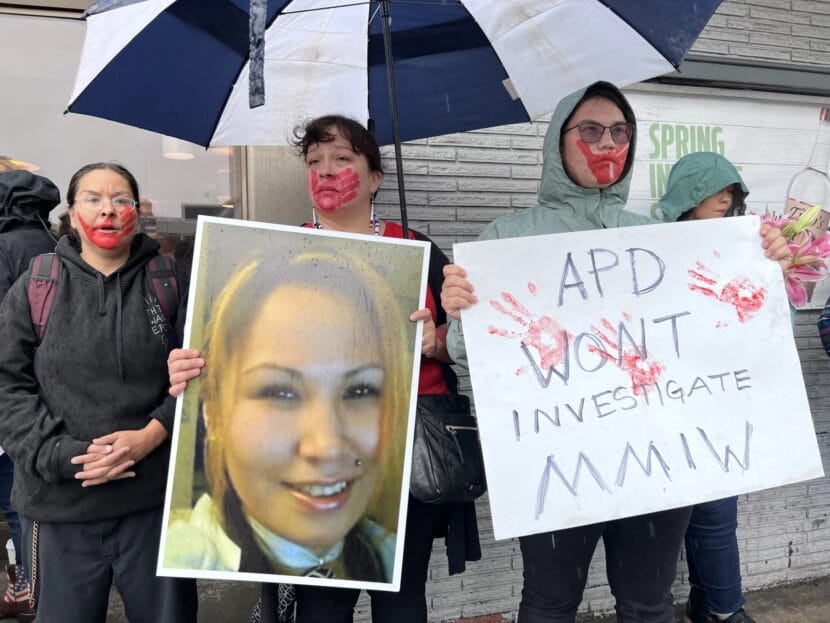
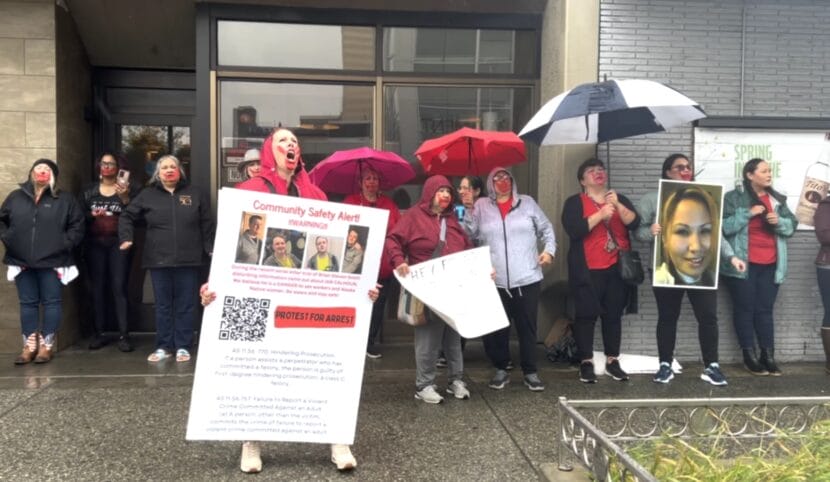
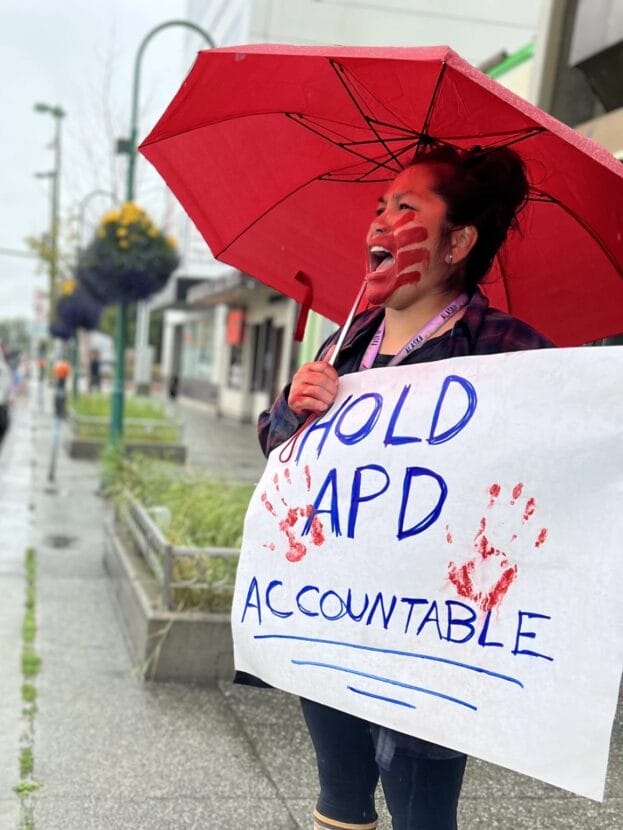
Protesters led by Amber Batts, one of the main organizers of the demonstration, chanted “Justice for Cassandra,” and “Where is Cassandra?” They stood for about an hour outside the Anchorage Police Department at noon on Friday. They called for police to fully investigate the disappearance of Cassandra Boskofsky, who is believed to be killer Brian Smith’s third victim. Batts represents CUSP, Community United for Safety and Protection, an advocacy group for sex workers. (Rhonda McBride/KNBA)
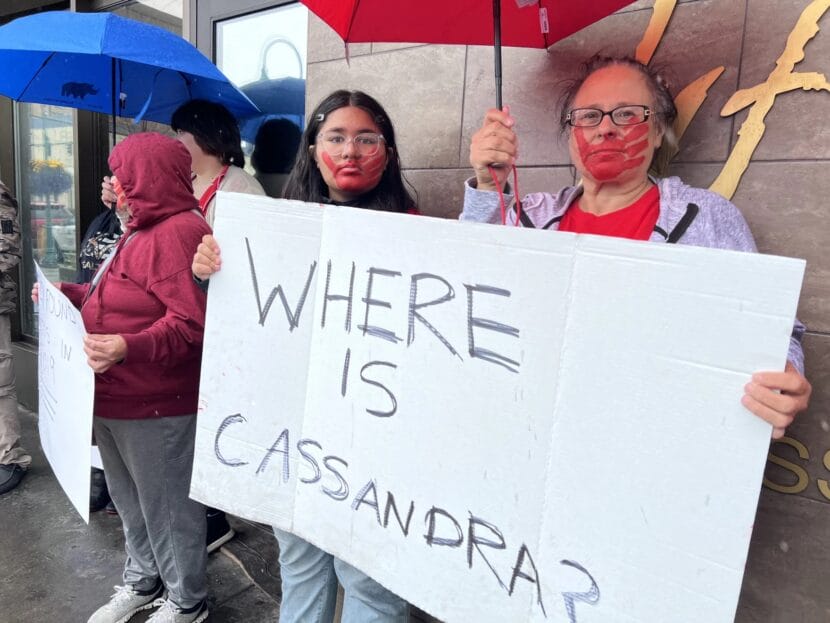
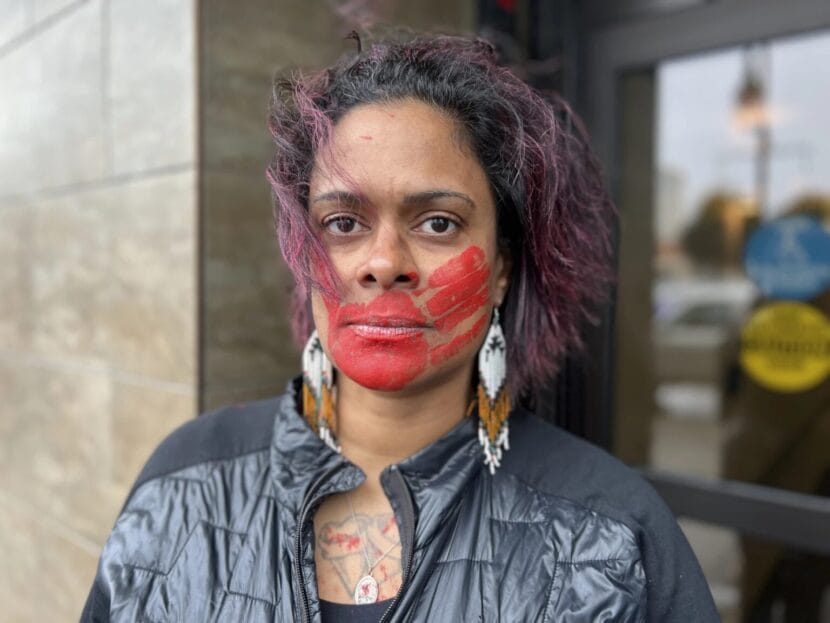
Protestors stood in the rain across from the Anchorage Police Department at noon on Friday. Their faces were stamped with red handprints, a symbol of solidarity in the Missing and Murdered Indigenous People movement.
They carried signs that said, “Where is Cassandra?” and “Bring Cassandra home.”
Raindrops streamed like tears on a poster-sized photo of Cassandra Boskofsky’s face. She was 38 when her family reported her missing in August 2019.
Lisa Ann Christiansen and her daughter joined Friday’s demonstration across the street from the Anchorage Police Department’s headquarters downtown. Christiansen was Cassandra Boskofsky’s aunt. (Rhonda McBride/KNBA)
Detectives seized the phone from Smith, when they took him in for questioning in another case, about a month after Boskofsky disappeared.
That was almost five years ago. In February, a jury convicted Smith of the murders of Kathleen Jo Henry and Veronica Abouchuk. Both were from remote coastal communities in Western Alaska. Evidence in Smith’s trial included video of him taunting and killing Henry.
Prosecutors said in their sentencing memo that the woman in the newly released photos was likely another of Smith’s victims, and they used them to make a case for a harsher sentence. Their recommendations prevailed, with Smith receiving the equivalent of two life sentences.
But Cassandra Boskofsky’s family still wants justice for their loved one.
Marcella Bofskofsky-Grounds is Boskofsky’s cousin, and said they were raised together like sisters when they were small. It was Bofskofsky-Grounds who reported her missing, shortly after her disappearance in 2019.
When Marcella Boskofsky Grounds was five years old, she watched after her cousin, Cassandra, whose mother had been killed in an ATV accident. She last saw her in August of 2019. (Rhonda McBride/KNBA)
Bofskofsky-Grounds said she doesn’t understand why police kept the photos a secret for so long and why they waited to share them only days before Smith was sentenced. She said she recognized Boskofsky instantly and felt shocked, distraught and angry with police.
“She didn’t matter. That’s how I felt, like she didn’t matter to them,” Bofskofsky-Grounds said, “because they only brought it up to our attention, a week before his sentencing.”
So far, Anchorage police have not confirmed that the unidentified woman in Smith’s cell phone photos is Boskofsky.
It’s the department’s policy not to comment on active investigations, according to APD Detective Brendan Lee. Police try to avoid contacting a victim’s family until they have physical evidence, to avoid causing them grief over a case of mistaken identity, he said.
“APD takes the families affected into account and does not want to give information until it is 100% confirmed,” Lee said in an email. “Telling a family member that a loved one is missing or deceased without being 100% accurate can be just as mentally detrimental to them.”
Antonia Commack, an MMIP advocate, who has a video blog on her Facebook page, was one of the organizers of the protest, along with Amber Batts, who represents CUSP, Community United for Safety and Protect. CUSP advocates for laws to keep sex workers from harm. (Rhonda McBride/KNBA)
Antonia Commack, a Missing or Murdered Indigenous Persons activist, isn’t satisfied with that explanation. Once the photos and the artist’s sketch went public, she said, it was easy to identify the images on Smith’s cellphone.
“I knew of a lot of (MMIP) cases statewide, and I knew, I knew immediately, that that was Cassandra,” she said. “When regular people can just look at a photo and identify it immediately, that’s really poor investigation.”
Police should be held accountable for their failure to act, Commack said. If they had made an artist’s sketch of Smith’s victim public shortly after they found the photo of the unknown woman on his phone, Boskofsky might have been identified a long time ago, she said.
But there’s often more going on behind the scenes than police can share with the public, said Lee, the detective.
“APD does not give out all details about ongoing investigations in order to preserve the investigation and not compromise it,” Lee said.
Cassandra Boskofsky’s aunt, Terrie Boskofsky, was one of about eight family members at the protest who chanted, “Where is Cassandra?” and “Justice for Cassandra.”
Her message to police: Their work is far from over.
“I want them to help find the remains,” she said, “so we can put her to rest.”
Grief over Boskofsky is widespread, she said.
“She came from a very large family,” Terrie Boskofsky said. “She had 14 aunts and uncles on my side.”
Cassandra Boskofsky holding one of her seven children. (Courtesy Boskofsky family)
Boskofsky was raised in Ouzinkie and Old Harbor, two communities near Kodiak, where she has dozens of extended family members who will feel her loss, made more painful by knowing the difficulties she faced throughout her whole life. Boskofsky lost her mother in an ATV accident when she was small, and as an adult, her family said, she struggled with addiction. She had seven children, and all were adopted out.
But despite that, another aunt, Lisa Ann Christiansen, said people loved her niece for her good qualities, like the way she enjoyed the outdoors and helping others.
Family members say Cassandra Boskofsky was happiest when she was outdoors. (Courtesy Boskofsky family)
“She had really pretty, dark, long hair,” Christiansen said. “Dark eyes. The high cheekbones. Dimples. Just beautiful.”
Boskofsky enjoyed showing off pictures of her children, Christiansen said.
“You know, she loved her family,” she said. “Even though she didn’t have her kids, she loved them.”
People always hoped Boskofsky would eventually turn her life around, Christiansen said, but Smith cheated her of that opportunity to find her way.
Smith, who moved to Alaska from South Africa, worked at a Midtown Anchorage hotel as a maintenance man. During his trial, the jury saw a video Smith made of torturing and killing Henry in a room at the hotel. In an interview with police, he admitted that he specifically targeted vulnerable women, who could be lured away with offers of alcohol, food or shelter. The Carrs grocery store on Gambell Street was one of his preferred spots to pick up women.
MMIP activists have offered two separate $500 rewards, one for information leading to the recovery of Cassandra Boskofsky’s remains and a second that asks for information leading to the arrest of Ian Calhoun, a man prosecutors said was a friend of Smith’s. In the sentencing memo, prosecutors said they believe Calhoun probably knew about one of the murders. So far, he has not been charged in the case.
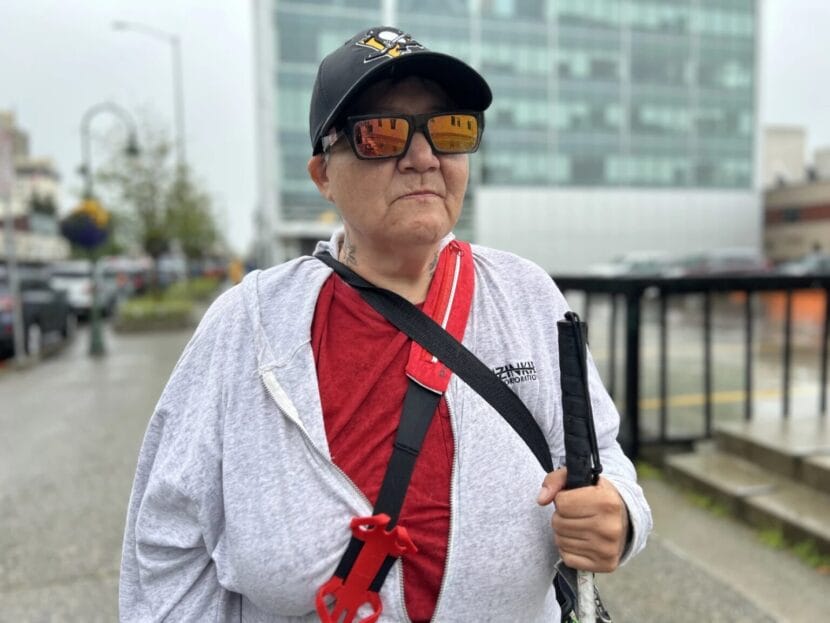
A woman named Amber, who asked that only her first name be used for this story, stood in the back of the group of protesters. She said she once lived on the streets and could have easily been one of Smith’s victims. Amber also said she was friends with Henry and Boskofsky.
A woman who asked to be only identified as Amber says she became friends with Cassandra Boskofsky and Kathleen Jo Henry, who was murdered by Brian Smith. (Rhonda McBride/KNBA)
Amber is half Black and half Lingít and was raised mostly in Anchorage. She said she grew up marginalized and that she and her friends, including Henry and Boskofsky, shouldered the burdens of past traumas.
Their loss will be felt in small villages across the state and even by those who didn’t know them, because many families have loved ones who have disappeared, she said.
“Their story is my story. It’s their story. It’s a community story,” Amber said. “We put ourselves in some dangerous situations, especially those of us who are looking for love and acceptance.”
“And I come from that. I come from the streets,” she said. “It’s so easy to get into the wrong person’s vehicle, and you don’t even know it.”
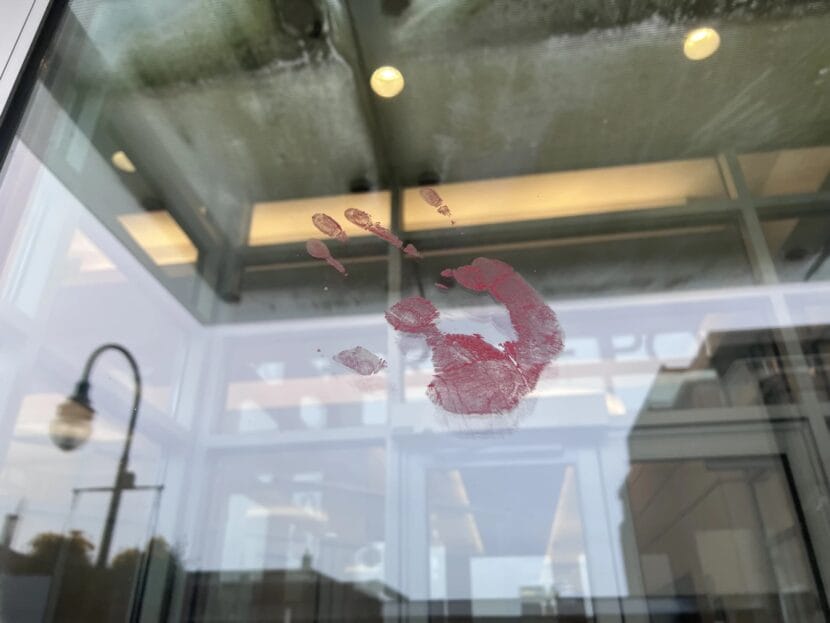
Before Amber left the protest, she rubbed red paint on her hands and crossed the street to leave imprints on the police department’s glass doors, a reminder of Cassandra Boskofsky, she said, and of all the “missing sisters whose voices have been silenced.”
A handprint on the front door of the downtown Anchorage Police Department’s headquarters, left by Amber, one of the protestors. (Rhonda McBride/KNBA)
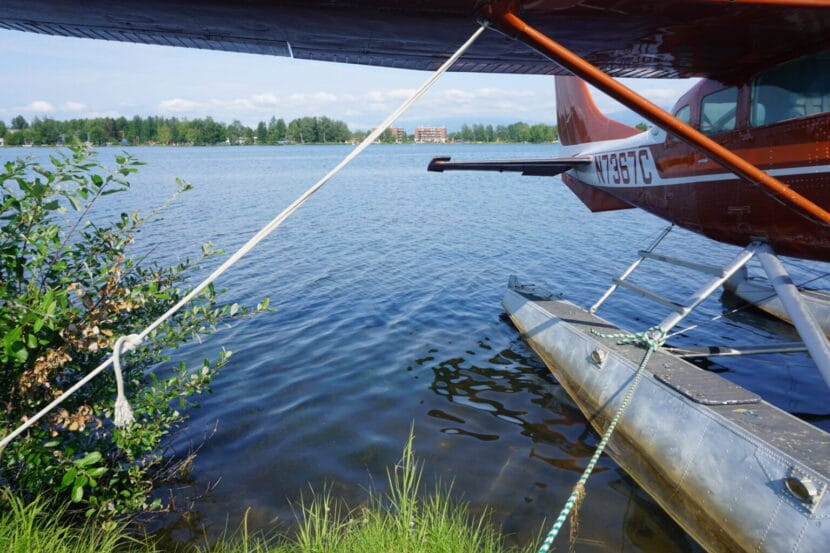
Waters of Anchorage’s Lake Hood and, beyond it, Lake Spenard are seen on Wednesday behind a parked seaplane. The connected lakes, located at the Ted Stevens Anchorage International Airport, comprise a busy seaplane center. A study by Alaska Community Action on Toxics published last year found that the two lakes had, by far, the highest levels of PFAS contamination of several Anchorage- and Fairbanks-area waterways the organization tested. (Yereth Rosen/Alaska Beacon)
Alaska firefighting departments will have to stop using fire-suppression foams containing contaminants known as “forever chemicals,” under a law that went into effect on Monday.
The new law is the product of a bill, Senate Bill 67, that legislators passed nearly unanimously. It went into effect without Gov. Mike Dunleavy’s signature.
The compounds number in the thousands and have been widely used since the mid-20th century in a wide variety of consumer and industrial products, including cookware, textiles, building materials, body care products like shampoo and dental floss and packing material. They have seeped into the environment – in water bodies, soil and the air – and are found in the blood of people and animals around the world, according to the EPA.
The number of PFAS compounds now exceeds 12,000, according to Alaska Community Action on Toxics.
For Alaska and for much of the nation, the biggest source of PFAS contamination in the environment is from industrial firefighting foams, generally used at airports and military bases. In the past, the Federal Aviation Administration required PFAS-containing foams to be used at the airports it certifies. That requirement was dropped in 2021 at the direction of Congress. The FAA and U.S. Department of Defense have been working on transitions to firefighting foams without PFAS chemicals, some of them still in development.
In addition to mandating that Alaska fire departments switch to non-PFAS foams, the new law creates a system for small rural villages to get rid of the PFAS-containing foams stored there. The villages are to be reimbursed by the Department of Environmental Conservation for that work, under the law.
The new PFAS law is the product of years of work by environmental and health organizations, notably Alaska Community Action on Toxics, which has conducted detailed research on contamination in Alaska. The bill’s prime sponsor was Sen. Jesse Kiehl, D-Juneau, whose district includes Gustavus, a small community where PFAS compounds created significant contamination of drinking water sources.
“We have worked for more than six years to pass this legislation with strong support from affected communities throughout Alaska, firefighters, and health professionals,” Pamela Miller, the organization’s executive director, said in a statement released by the Senate’s bipartisan majority caucus.
“We commend Senator Kiehl, co-sponsors, and the overwhelming bi-partisan support in the Legislature for the bill. It is an important step toward protecting the health of Alaskans from the harm caused by these dangerous chemicals.”
Although it had wide support, the PFAS bill took an unusual route to becoming law.
The substance of the bill was approved by the legislature last year, by a near-unanimous vote. At the time, the PFAS provisions were bundled in a separate House measure, House Bill 51, aimed at phasing out the use of another type of chemical, hydrofluorocarbons, known as HFCs. HFCs are used as refrigerants, but they are potent greenhouse gases.
Houses along the Salmon River in Gustavus are seen on July 1, 2016. Gustavus, the small town that serves as a gateway for visitors to Glacier Bay National Park and Preserve, is one of the Alaska communities that contended with significant PFAS contamination in drinking-water sources. (Photo by K. Boomer/National Park Service)
Dunleavy last year vetoed the combined PFAS-HFC bill.
During this year’s session, the bill that ultimately passed was the stand-alone version that Kiehl introduced in 2023. That bill, which passed unanimously last year in the Senate, was modified when it reached the House Finance Committee this year. That modified version was what passed.
There was one significant change made in the House Finance Committee, Kiehl said: a switch from a mandate that the state safely dispose of PFAS foams accumulated in small villages to the new procedure in which the villages will be reimbursed for safe disposal. Money for that reimbursement was appropriated in the just-approved capital budget for the current fiscal year, he noted.
Another minor change tweaked a word, he said. Instead of mandating the end to use of PFAS-containing firefighting substances, the new law uses the word “foam,” which addresses some scientific uncertainty about how certain gases should be classified, he said. However they are defined, those gases do not contaminate water, he said.
Jeff Turner, Dunleavy’s communications director, said he did not have any information as to why the governor declined to sign the bill. Kiehl said he had no information on that, either.
“That’s not something he shared with me,” Kiehl said. “Ultimately, the work gets done, so I’ve got no objection.”
To qualify for disposal reimbursement from the state, villages seeking to get rid of their accumulated PFAS-containing foams must have fewer than 2,000 residents and be off the road system, according to the law.
The Department of Environmental Conservation is preparing a website that will have information for villages on both how to get rid of their PFAS substances and how to submit requests to to be reimbursed for their costs, said Stephanie Buss, the department’s contaminated sites program manager.
“We should be able to start receiving reimbursement requests by Jan. 1,” she said.
There are in numerous options for safe collection, treatment and disposal of PFAS materials, some of them within Alaska and some requiring shipment out of state, she said.
There are some exceptions to the Jan. 1, 2025, ban on PFAS foams. Fire crews at oil facilities, where fires can be particularly explosive, will have more time to phase in alternative foams. Those sites will be required to switch to non-PFAS foams once they become available and are certified as safe and effective by the state fire marshal, under a provision in the new law.
Close
Update notification options
Subscribe to notifications
Subscribe
Get notifications about news related to the topics you care about. You can unsubscribe anytime.