The most recent recommendation of the U.S. Preventive Services Task Force is that all women 40 to 74 get mammograms every other year. A previous recommendation said screening should start at 50. One doctor suggests that people “test smarter, not test more.” (Heather Charles | Tribune News Service via Getty Images)
New research makes the case for educating women in their 40s — who’ve been caught in the crossfire of a decades-long debate about whether to be screened for breast cancer with mammograms — about the harms as well as the benefits of the exam.
After a nationally representative sample of U.S. women between the ages of 39 and 49 learned about the pros and cons of mammography, more than twice as many elected to wait until they turn 50 to get screened, a study released Monday in the Annals of Internal Medicine found.
Most women have absorbed the widely broadcast message that screening mammography saves lives by the time they enter middle age. But many remain unaware of the costs of routine screening in their 40s — in false-positive results, unnecessary biopsies, anxiety and debilitating treatment for tumors that left alone would do no harm.
“In an ideal world, all women would get this information and then get to have their further questions answered by their doctor and come up with a screening plan that is right for them given their preferences, their values and their risk level,” said social psychologist Laura Scherer, the study’s lead author and an associate professor of research at the University of Colorado School of Medicine.
Of 495 women surveyed, only 8% initially said they wanted to wait until they turned 50 to get a mammogram. After researchers informed the women of the benefits and the harms, 18% said they would wait until 50.
“We’re not being honest”
Learning about the downsides of mammograms did not discourage women from wanting to get the test at some point, the study showed.
The benefits and the harms of mammography came as a surprise to nearly half the study’s participants. More than one-quarter said what they learned from the study about overdiagnosis differed from what their doctors told them.
“We’re not being honest with people,” said breast cancer surgeon Laura Esserman, director of the University of California San Francisco Breast Care Center, who was not involved with the research.
“I think most people are completely unaware of the risks associated with screening because we’ve had 30, 40 years of a public health messaging campaign: Go out and get your mammogram, and everything will be fine,” she said in an NPR interview.
Esserman sees women who are diagnosed with slow-growing tumors that she believes in all likelihood would never harm them. In addition, mammography can give women a false sense of security, she said, like it did for Olivia Munn.
The 44-year-old actress had a clean mammogram and a negative test for cancer genes shortly before her doctor calculated her score for lifetime breast cancer risk, setting off an alarm that led to her being treated for fast-moving, aggressive breast cancer in both breasts.
Toward a personalized plan for screening
Esserman advocates for a personalized approach to breast cancer screening like the one that led to Munn’s diagnosis. In 2016, she launched the WISDOM study, which aims to tailor screening to a woman’s risk and, in her words, “to test smarter, not test more.”
The National Cancer Institute estimates that more than 300,000 women will be diagnosed with breast cancer and 42,250 will die in the U.S. this year. Incidence rates have been creeping up about 1% a year, while death rates have been falling a little more than 1% a year.
For the past 28 years, the influential U.S. Preventive Services Task Force has been flip-flopping in its recommendations about when women should begin mammography screening.
From 1996 until 2002, the independent panel of volunteer medical experts who help guide physicians, insurers and policymakers said women should begin screening at 50. In 2002, the task force said women in their 40s should be screened every year or two. In 2009, it said that 40-something women should decide whether to get mammograms based on their health history and individual preferences.
The new study was conducted in 2022, when the task force guidelines called for women in their 40s to make individual decisions.
New guidelines
In 2024, the panel returned to saying that all women between the ages of 40 and 74 should be screened with mammograms every other year. Rising breast cancer rates in younger women, as well as models showing the number of lives that screening might save, especially among Black women, drove the push for earlier screening.
An editorial accompanying the new study stresses the need for education about mammography and the value of shared decision-making between clinicians and patients.
“For an informed decision to be made,” states the editorial written by Dr. Victoria Mintsopoulos and Dr. Michelle B. Nadler, both of the University of Toronto in Ontario, “the harms of overdiagnosis — defined as diagnosis of asymptomatic cancer that would not harm the patient in the future — must be communicated.”
PepsiCo said sales of its Frito-Lay snacks slumped in the most recent quarter as shoppers became more sensitive to rising prices. (Justin Sullivan | Getty Images North America)
Grocery prices are no longer climbing as much as they did in the last two years — but many Americans are still frustrated by what it costs to put food on the table.
Some people have apparently hit their limit. One of the biggest snack makers said this week that its sales fell this spring as grocery shoppers became more sensitive to rising prices.
Here are three things to know about food prices these days — and why it still feels more expensive at the checkout lane of your favorite grocery store.
What is going on with food prices?
It may not feel like it, but grocery prices have actually leveled off for the most part.
The latest consumer inflation report, out this week, showed grocery prices rose just a little over 1% in the last 12 months. That’s a big improvement from the previous year, when prices jumped nearly 5%, and the year before that, when they soared by double digits.
However, leveling off is not the same as prices coming down, and the U.S. is still feeling the cumulative effect of those earlier increases.
And that leads to frustration for shoppers like Cindy Seinar, a retired autoworker in Lynchburg, Virginia.
“You go in for one thing, and you come out and it’s $45,” she says, describing her experiences at the grocery store.
And for Seinar, just like for many other Americans, the frustration is compounded by “shrinkflation.” That’s when companies reduce package sizes, meaning you get less than you used to for the same or sometimes even higher prices.
“Sugar is only 4 pounds,” Seinar says. “You’re not even getting a 5-pound bag anymore.”
Grocery prices are particularly noticeable because they are such a significant chunk of the typical family’s budget, accounting for about 8% on average, according to government data. For lower-income families, it’s often more than that.
How are people adjusting to higher prices?
For a while, many people just gritted their teeth and paid up — but Americans are starting to push back.
PepsiCo, which reported earnings this week, said sales of its Frito-Lay snacks actually fell during the most recent quarter. Some of that is because shoppers are balking at the higher prices by cutting back on chips altogether or by switching to cheaper store brands.
Amanda Whitworth stocks grocery shelves at a Target store in Florida. She often finds herself steering customers to the in-house bargains at the discount retailer.
“You may not ever have considered the Market Pantry bread, but it’s $1.39 for a big loaf of it,” Whitworth says, referring to Target’s private label. “While that may not be someone’s first choice, it’s a quarter of the price of some loaves.”
Grocery prices rose just a little over 1% in the last 12 months, according to the latest consumer inflation report, out this week. (Frederic J. Brown | AFP via Getty Images)
Whitworth also does the food shopping for her family and says she has made similar substitutions of her own.
“Before, we would have bought a big bag of frozen chicken nuggets for our son. And the particular bag went up three extra dollars,” Whitworth says. “So we started making homemade chicken nuggets, which we’ll probably never switch back because they’re so good.”
That sends a message to the big food producers. When PepsiCo and others start losing market share, they grow more cautious about pushing up prices. In some cases, they start to offer discounts — and that’s one reason grocery prices aren’t climbing as fast as they had been.
So are grocery prices finally going to come down?
To some degree.
The prices of some individual grocery items have come down. Fruit and vegetable prices have dropped over the last year, for example. So have milk and cheese prices.
However, the overall cost of groceries is unlikely to fall substantially.
But there is a silver lining. As grocery inflation slows, wages are catching up.
Over the last year, average wages have risen 3.9%, or about three and a half times as fast as grocery prices.
The typical worker now has to work about the same number of hours to buy a week’s worth of groceries as in 2019, before the COVID-19 pandemic.
That’s good news — even if for many Americans it doesn’t feel that way.
Transcript:
SCOTT SIMON, HOST:
How much would you pay for a bag of potato chips? Well, some people are apparently hitting their limit. One of the biggest snackmakers say that its sales fell this spring because of rising prices. Grocery prices are not climbing nearly as fast as they had been, but many Americans are still frustrated by what it costs to put food on the table. NPR’s Scott Horsley joins us. Scott, thanks for being with us.
SCOTT HORSLEY, BYLINE: Good morning. Good to be with you.
SIMON: Of course, a lot of people will be in supermarkets this weekend. What kind of prices might they see?
HORSLEY: Well, the good news is supermarket prices have largely leveled off. We got an inflation report this past week showing grocery prices rose just a little over 1% in the last 12 months. That is a big improvement from the previous year, when prices jumped almost 5%, and the year before that, when they soared by double digits. But leveling off is not the same as coming down, and we are still dealing with the cumulative effect of all those earlier price increases. When we asked NPR listeners, where do you feel the sting of inflation most? – a lot of people said the supermarket.
CINDY SIENAR: I think that groceries stand out the most just because we’re always at the grocery store, and you have to eat.
HORSLEY: Cindy Sienar is a retired autoworker who lives in Virginia. Like a lot of people, she’s bothered by what economists call shrinkflation and the feeling she’s paying more and getting less.
SIENAR: You go in for one thing, and you come out, and it’s $45. And sugar is only four pounds. You’re not even getting a five-pound bag anymore.
HORSLEY: And people notice because, you know, they buy groceries week after week. It’s a significant chunk of the typical family’s budget, about 8% on average. For lower-income families, it’s often more than that.
SIMON: And how are people reacting to these higher prices?
HORSLEY: You know, for a while, they just grit their teeth and paid up, but we are starting to see more pushback now. Pepsi, which reported its earnings this past week, said, sales of FritoLay snacks were actually down during the most recent quarter, which suggests we have reached the crunch point on tortilla chips. You know, maybe shoppers are cutting back altogether or they’re switching to cheaper store brands.
Amanda Whitworth stocks grocery shelves at a Target store in Florida. She often steers customers to the discount retailer’s in-house bargains.
AMANDA WHITWORTH: I like being able to point people in certain directions and be like, well, you may not have ever considered the market pantry bread, but it’s $1.39 for a big loaf of it. And you know, while that might not be someone’s first choice, you know, it’s a quarter of the price of some loafs.
HORSLEY: Whitworth also does the food shopping for her family and says she’s made some substitutions of her own.
WHITWORTH: Before, we would have bought a big bag of frozen chicken nuggets for our son, and the particular bag went up three extra dollars, and at that point, I was like, oh, goodness. So we started making homemade chicken nuggets, which – we’ll probably never switch back ’cause they’re so good.
HORSLEY: That sends a message to the big food producers. You know, when Pepsi and others start losing market share, they get more cautious about raising prices, and, in some cases, they start to offer discounts.
SIMON: Scott, are food prices, grocery prices, likely to come down any time soon?
HORSLEY: You know, the price of some individual items will certainly come down. We’ve seen that over the last year with fruits and vegetables and milk and cheese. But in terms of what you pay at checkout for the whole grocery cart, that’s not likely to drop very much.
The good news is as grocery prices level off, wages are catching up. Over the last year, average wages have risen about 3 1/2 times as fast as grocery prices. So one way to think about this is, how long do I have to work to buy a week’s worth of groceries? For the typical worker, it now takes about the same number of hours as it did back in 2019, even if it doesn’t yet feel that way.
Elvia Elena Nunez and her grandson Esteban spent several months this spring in the Kith and Kin program. (Andrea Hsu | NPR)
A half dozen women — in their 30s, 40s and 50s — gather in a classroom in Phoenix for a few hours on a weekday morning.
They are all caregivers of young children.
There’s Yosbri Rojas. When her own 8-year-old is at school, she takes care of two younger children, whose father works with Rojas’ husband installing fiber optic lines.
“I like that the children feel happy with me,” Rojas says in Spanish.
Graciela Cruz is also here. She works early mornings in a warehouse, from 4 to 9 a.m. During the day, she parents her own 2-year-old daughter and also watches her neighbors’ 1-year-old while the child’s parents are at work cleaning houses and offices.
Cruz and Rojas are participants in an Arizona state-funded initiative called Kith and Kin. The 12-week program aims to give family, friend and neighbor caregivers the kind of training and support that licensed caregivers are required to have.
Licensed or not, caregivers make work possible
While most federal and state funding for child care in the U.S. goes to licensed settings, Arizona is one of a number of states that have long recognized the importance of informal caregiving arrangements that are allowing millions of parents go to work.
Such arrangements, which can be paid or unpaid, are especially common in immigrant communities and communities of color, where many parents hold jobs with nontraditional hours and prefer caregivers who share their language and culture.
A half dozen women gather to discuss caregiving issues with their instructor Idely Valenzuela as part of the Kith and Kin program. (Andrea Hsu | NPR)
A study in the south Phoenix area found that 60% of children from birth to 5 years old were being cared for outside of licensed child care settings.
That study led the nonprofit organization Candelen to launch Kith and Kin in 1999.
“There was the high need to provide both training and support” in communities where families with young children live, says program director Angela Tapia.
Now, 25 years later, programs like Kith and Kin are getting renewed attention in the wake of the pandemic, which put a spotlight on the fragile state of the child care industry.
There’s increased urgency from federal and state policymakers and businesses to ensure communities have access to affordable, high-quality child care, paving the way for parents — especially women — to work, an essential element of a robust and well-functioning economy.
A crash course in caregiving fundamentals
The aunts and grandmothers and neighbors who attend the Kith and Kin classes often don’t think of themselves as caregivers, says Tapia, much less as contributing to the economy.
“It’s more something they do out of love and to help their family and friends,” she says.
But caregiving requires more than love, and that’s where the program come in.
Over 12 weeks, the caregivers, who are predominantly women (though they do see the occasional grandfather or uncle) undergo training in basic health and safety, including CPR, as well as more advanced topics such as child development, positive discipline and injury prevention.
The women share personal challenges, ask for advice and offer comfort and support.
Funding comes from Arizona’s tobacco tax
The sessions are paid for in part by Arizona’s tobacco tax. Candelen estimates it trains about 1,000 caregivers a year.
Melinda Gulick, CEO of Arizona’s early childhood agency First Things First, says the funding is recognition that all children, regardless of where they spend their first years, deserve a high quality early childhood experience.
“Being ready on the first day of Kindergarten is the biggest indicator of academic success and success in life as well,” she says.
Gulick points out, in some rural parts of Arizona, there is no licensed child care, and even where there are options, Arizonans are known for wanting choice.
“This is a liberty and freedom state,” she says. “For many parents, the best place for [children] to be is with their auntie or their grandmother or in a co-op in their neighborhood.”
Cynthia Diarte with her 2-year-old son Esteban in front of their home in Phoenix. (Andrea Hsu | NPR)
Keeping caregiving in the family
That’s certainly how Cynthia Diarte felt when she had her son Esteban. He’s now two and a big fan of Bluey, the beloved children’s television character.
Diarte, a teacher, grew up on the Texas-Mexico border, cared for by her grandmother while her mother went to work at an airport restaurant.
Diarte says it was never a question who would watch her children when she became a mother herself. Her mother, Elvia Elena Nunez, insisted she be the one, carrying on their family tradition.
“As his grandmother, my love is different from any other caregiver,” Nunez says in Spanish.
As a Kith and Kin participant, Nunez has appreciated learning new ways to keep Esteban entertained without screens. She also cherishes the community she’s built with the other caregivers and the enrichment Esteban has gotten through the program.
While class is in session, Esteban is with other toddlers, singing songs and playing games in the child care room down the hall.
“He’s bringing more vocabulary. He’s starting to speak up a little bit more,” says Diarte. “He really needed that social aspect, the relationship with other kids.”
And she expects those relationships to endure. A side benefit of the Kith and Kin classes is how close the caregivers become.
“They end up becoming like the madrinas, like the godmothers, the godparents, to each other’s children,” says program director Tapia. “They stay connected throughout the years.”
Transcript:
JUANA SUMMERS, HOST:
Caregivers are often spoken of as the workforce behind the workforce. They include millions of moms, grandmas, aunts, friends and neighbors who watch other people’s kids while parents go to work. In Arizona, a nonprofit has long worked to get these informal caregivers everything they need to do that job well. NPR’s Andrea Hsu reports from Phoenix.
(CROSSTALK)
ANDREA HSU, BYLINE: A half-dozen women, from their 30s to their 50s, gather for a few hours on a weekday morning. They are all caregivers at least part of the time. Take Yosbri Rojas, who has a son in elementary school. During the mornings…
YOSBRI ROJAS: (Speaking Spanish).
HSU: She offered to take care of two preschoolers while their dad, who works with Rojas’ husband, is off installing fiber-optic lines. Graciela Cruz is also here. She works early mornings in a warehouse from 4 to 9 a.m. So during the day, she also watches two children, one of them her own.
GRACIELA CRUZ: I have a 2-year-old daughter, and I take care of a 1-year-old.
HSU: The child of her neighbors, who clean houses and offices for a living. Cruz and Rojas are part of a 12-week program called Kith and Kin. It’s one of many initiatives Arizona is turning to to address a child care shortage in the state, but it was actually created 25 years ago to introduce standards to informal caregiving. Program director Angela Tapia says the program grew out of a study that looked at where children, birth to 5, were being cared for in the South Phoenix area.
ANGELA TAPIA: Sixty percent of children are actually in family, friend and neighbor care. And so there was a high need to provide both training and support in the communities that these families live.
HSU: Communities like this predominantly Spanish-speaking one, where parents often hold jobs with nontraditional hours and prefer caregivers who share their culture and language. The caregivers are playing a crucial role in the economy, enabling so many parents to go to work. Still, Tapia says, they often don’t see themselves that way.
TAPIA: It’s more something they do out of love and to help their family and friends.
HSU: Of course, caregiving is about much more than love. Over the 12 weeks, the women learn about everything from basic health and safety to more advanced topics, including one of Graciela Cruz’s favorites – child development.
CRUZ: Brain development – I never, like, thought it was so much for a baby. I’m glad I took this class.
HSU: Now most government funding for childcare goes to licensed providers, but Arizona has long supported these unlicensed caregivers, too. Kith and Kin is paid for in part by the state’s tobacco tax. Melinda Gulick is with the state agency, First Things First, that administers those funds.
MELINDA GULICK: It’s that recognition of the family, friend and neighbor – the home care centers that we really want to support so that all the children are getting a quality early learning experience, No. 1. And No. 2, parents can go to work.
HSU: Which has become a huge priority since the pandemic. Gulick says, in some rural parts of the state, there is no licensed child care. And even where there are options, Arizonans are known for wanting choice.
GULICK: This is the Wild West, right? This is a liberty and freedom state. And so for many parents, the best place for them to be is with their auntie or their grandmother or in a co-op in their neighborhood.
HSU: That’s certainly how Elvia Nunez feels about her grandson, Esteban.
ELVIA NUNEZ: (Speaking Spanish).
HSU: She says when her daughter, who’s a teacher, gave birth, she insisted that she be the one to watch the baby.
NUNEZ: (Speaking Spanish).
HSU: “As his grandmother,” she says, “my love is different from any other caregiver.”
Nunez says she’s gotten a lot out of the Kith and Kin class, including learning all kinds of ways to keep the 2-year-old entertained without screens.
NUNEZ: (Speaking Spanish).
HSU: She says technology isn’t good for him at this age. Meanwhile, while she’s in class, Esteban gets to be with other kids in the child care room down the hall.
UNIDENTIFIED GROUP: (Singing) Hello, hello.
UNIDENTIFIED PERSON #1: (Speaking Spanish).
UNIDENTIFIED GROUP: (Singing) Can you stomp your feet?
HSU: It’s helped him hit milestones around language and socialization.
ESTEBAN: (Vocalizing).
UNIDENTIFIED PERSON #2: (Inaudible).
ESTEBAN: (Vocalizing).
UNIDENTIFIED PERSON #2: Yeah.
HSU: At the end of the 12 weeks, the women mark milestones of their own with a graduation ceremony.
(CHEERING)
UNIDENTIFIED PERSON #3: Bravo. (Speaking Spanish). Bravo.
HSU: And then they go back to work, nurturing the next generation and doing their part for the economy.
Bartlett Regional Hospital on Tuesday, June 25, 2024. (Clarise Larson/KTOO)
The board for Juneau’s city-owned hospital plans to seeksubsidies for services it says are contributing to a financial crisis that could close the hospital within three years.
Bartlett Regional Hospital’s board is giving itself just a handful of months to convince the city or other entities to subsidize some services that are draining money. If it can’t secure that money by the end of October, or find a third party to take them over, the services will be eliminated.
Max Mertz, the hospital board’s finance committee chair, explained the seriousness of the situation at a board meeting on Tuesday.
“We’re burning cash and we’ve got to do something to address that,” he said. “It’s urgent — this is not something that we can kick the can down the road on.”
The hospital hasn’t been making enough money to cover its costs since 2019. And since mid-2020, it’s been losing about $1 million a month.
Hospital leaders said that without significant cuts, Bartlett will run out of money within three years.
On Tuesday night, the hospital’s board unanimously voted to seek subsidies or third-party providers to take over services like the Rainforest Recovery Center, and adult and adolescent crisis services — services it says are losing between $800,000 and $1.2 million annually. It’s that, or else cut them come Oct. 31.
But Bartlett will keep running home health and hospice services, provided the hospital can come up with a five-year plan for getting the program’s finances back on track. That program was previously under consideration for closure.
Mertz said the decision didn’t come easy. Though no one gave public testimony at the meeting, the hospital got more than 60 pages of written comments, and dozens more in-person comments at previous public meetings. Most of that was in support of keeping the services alive in some form.
“The public has really weighed in on this and obviously there’s a lot of passion and support around these programs in the community and we’re left with, of course, a very hard decision,” he said.
The plan now heads to the Assembly, which will have to decide if — and how — the city should fund the programs.
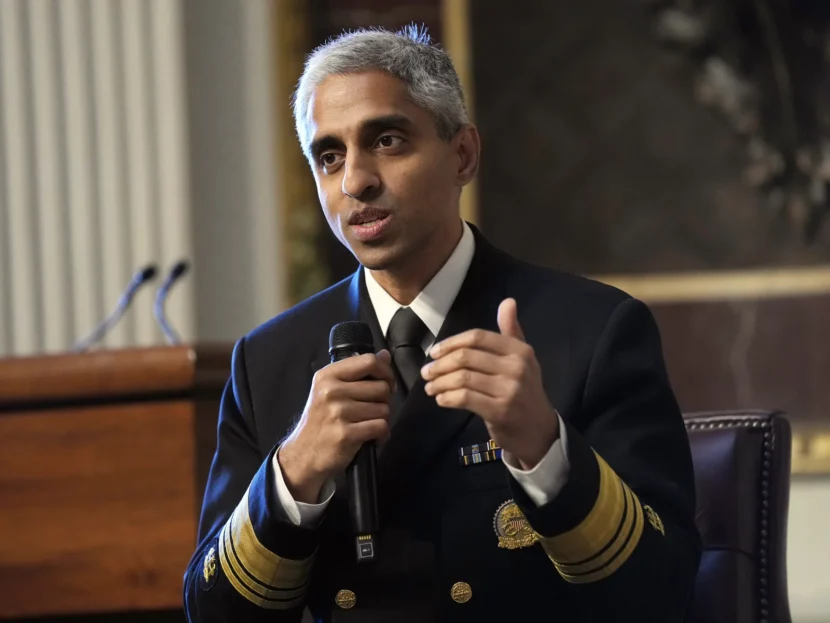
Surgeon General Dr. Vivek Murthy speaks during an event on the White House in April. The nation’s top doctor has issued an advisory about the public health risks of widespread gun violence. (Susan Walsh/AP)
America’s top doctor issued a first-of-its-kind advisory on Tuesday declaring gun violence a national public health crisis and recommending it be treated as such.
The 40-page publication from U.S. Surgeon General Vivek Murthy outlines the scope of firearm violence, its impact on victims and communities and a slew of policy suggestions for lawmakers, community leaders and health systems.
A public health approach, Murthy said in the report, can guide the nation’s strategy and actions “as it has done in the past with successful efforts to address tobacco-related disease and motor vehicle crashes.”
“It is up to us to take on this generational challenge with the urgency and clarity the moment demands,” he added. “The safety and well‑being of our children and future generations are at stake.”
The advisory notes that firearm-related injury has been the leading cause of death for U.S. children and adolescents since 2020 — when it surpassed car accidents — and that ever-common instances of gun violence are taking not only a physical but also a mental toll on survivors, families and community members at large.
A recent national survey found that 54% of U.S. adults or their family members have experienced a firearm-related incident. And, linking gun violence to mental health, the advisory also notes that nearly 6 in 10 U.S. adults say they worry either sometimes, almost every day or daily about a loved one becoming a victim.
Some of the advisory’s recommendations — which, despite being strongly worded, are not enforceable — include increasing federal funding for gun violence prevention research, more community investment in educational programs and mental health resources and nationwide policy changes like an assault weapons ban and universal background checks.
Murthy, who has served as President Biden’s surgeon general since 2021, has issued advisories over the years warning about the risks of loneliness, health misinformation and social media on youth mental health.
But this is the first time the Office of the Surgeon General has ever published a warning focused on gun violence, a political minefield in the U.S.
The National Rife Association has long opposed the framing of gun violence as a public health issue and successfully lobbied for legislation that effectively froze federal funding into gun violence research over the last three decades. NRA opposition to Murthy, over his support for a federal assault weapons ban, also nearly cost him the nominationwhen then-President Barack Obama first picked him for the job in 2014.
The advisory comes after a second consecutive weekend of mass shootings across the U.S., two days before the first presidential debate between Biden and former President Donald Trump and a week after the Supreme Court upheld a federal ban on guns for domestic abusers, its first major gun ruling in two years.
The advisory lays out the problem …
Police investigate the scene of a shooting on June 15 at the Brooklands Plaza Splash Pad in Rochester Hills, Michigan, where a gunman wounded nine people. (Bill Pugliano/Getty Images North America)
The document begins by painting a grim picture of gun violence in the U.S.
Among the stark statistics: 48,204 people died from firearm-related injuries (including suicides, homicides and unintentional deaths) in 2022, after that number reached a near three-decade high the previous year.
The rate of firearm-related suicide grew by 20% between 2012 and 2022, with the highest increases among young people between 10 and 34 years old.
The advisory also notes the disproportionate impacts of gun violence across demographic groups.
Black Americans had the highest age-adjusted firearm homicide rates across all ages (27 per 100,000 in 2022). The firearm suicide rate was highest among white individuals older than 45 (14.8 per 100,000 in 2022) and American Indian and Alaska Natives under 45 years old (12.3 per 100,000).
Gun violence also disproportionately impacts veterans, male children and men — though firearms are used in about 50% of intimate partner violence-related homicides, of which more victims are female.
Mass shootings only represent about 1% of all firearm-related deaths in the U.S., but their number is increasing: The country experienced more than 600 mass shooting incidents each year between 2020 and 2023, according to the Gun Violence Archive. The organization defines a mass shooting as any incident in which four or more people are shot, not including the perpetrator.
The advisory also depicts the problem as uniquely American.
It points to 2015 data from the Centers for Disease Control and Prevention and World Health Organization that found the overall firearm-related death rate was 11.4 times higher in the U.S. compared to 28 other high-income nations.
It goes on to detail the collective toll that the exposure to gun violence takes, even on those who do not experience bodily harm themselves.
“There is increasing evidence that exposure to firearm violence can contribute to elevated stress levels and mental health challenges and threaten the sense of well‑being for entire communities,” it reads.
Examples include healthcare and community workers suffering secondary traumatic stress, adults avoiding certain places or events out of fear of a possible mass shooting, children experiencing long-term mental and behavioral problems, and a studied increase in psychiatric disorders among family members of victims.
… And prescribes recommendations
Murthy then discusses some of the factors that contribute to the problem, namely socioeconomic, geographic and racial inequities and the lethality and availability of guns, before recommending a “public health approach” to fixing it.
“A public health approach is designed to prevent and reduce harm by changing the conditions and circumstances that contribute to risk of firearm violence as measured by deaths, injuries, as well as the reverberating mental health and emotional impacts detailed in this Advisory,” it reads.
The advisory recommends more investment in firearm prevention research, which receives less federal funding than causes of death with relatively comparable mortality, like sepsis and drowning.
In the meantime, it says, communities can invest in interventions and educational programs to try to support populations with increased risk of gun violence involvement, including by organizing them into workplace safety trainings. It similarly recommends communities do more to increase access to quality mental health care, substance-use treatment and trauma-informed resources.
And, addressing public health leaders and policymakers, it suggests a number of prevention strategies that can “build distance in terms of time and space between firearms and people who are at risk of harming themselves or others.”
Those include requiring safe and secure firearm storage (including child access prevention laws), implementing universal background checks, banning assault weapons and large-capacity magazines for civilian use and regulating the safety of firearms like any other consumer products.
And even though a majority of Americans are in favor of stricter gun laws, as several 2023 surveys found, a deeply divided Congress has struggled to pass them. It passed its first major gun law legislation in 30 years in 2022, which Biden signed one month after the Uvalde school shooting. It extended background checks on prospective gun buyers between 18 and 21 years old and further incentivizes states to pass red flag laws, among other provisions.
Murthy’s advisory cites two examples of successful public health approaches in the past: tobacco use and motor vehicle safety.
They have contributed to a more than 70% decline in the prevalence of cigarette smoking among U.S. adults since the 1960s, and a more than 93% decrease in the mileage death rate over the past century, according to the report.
“Taking such an approach to firearm violence prevention has the potential to curb the alarming trends of firearm‑related injury and death in America and the resulting health impacts,” he adds.
Congress would have to act on the surgeon general’s recommendations to make them a nationwide reality. (Jemal Countess/Getty Images North America)
How much power does an advisory have?
Calls to address gun violence as a public health issue rather than a political problem are not entirely new, and this advisory amplifies them even louder.
Tuesday’s publication was released alongside statements of support from 10 different medical, public health and children’s groups, applauding the advisory for raising awareness and calling for policymakers to act.
“Firearm violence is indeed a public health crisis, and the data now show it touches the majority of U.S. adults,” said the American Medical Association. “We applaud the Office of the Surgeon General for issuing this Advisory and for outlining an evidence‑based public health approach to addressing firearm violence.”
Opposition came from the NRA, which released a statement slamming the advisory as “an extension of the Biden Administration’s war on law-abiding gun owners” and blaming “a crime problem caused by criminals,” in a familiar refrain for the gun lobby.
Whether Tuesday’s publication will lead to legislation or policy changes at the state and federal level is unclear.
The advisory explains that is just that: “A public statement that calls the American people’s attention to an urgent public health issue.”
“Advisories are reserved for significant public health challenges that require the nation’s immediate awareness and action,” the introduction reads.
Advisories tend to be shorter and more urgent than the office’s full reports. Its landmark 1964 report on smoking and health for example, is credited with saving an estimated 8 million lives in half a century.
Dr. Deborah Prothrow-Stith, a physician who has spent decades defining youth violence as a public issue, used the analogy of cigarette smoking to explain prevention strategies in a 2023 interview with NPR.
She remembered how ubiquitous smoking was when she was younger, and that it took roughly half a century after the first report on its health effects for the public understanding to follow — and hopes something similar will happen with guns.
“It is time again to treat this epidemic, reduce our rates and stay with it,” she said. “We’ve done it before. We can do it again.”
During COVID, shortages of tests led to backlogs in getting tested. Experts worry that the U.S. hasn’t learned from those mistakes and wouldn’t be prepared for a major bird flu outbreak. (Rebecca Blackwell/AP/AP)
It’s been nearly three months since the U.S. government announced an outbreak of the bird flu virus on dairy farms. The World Health Organization considers the virus a public health concern because of its potential to cause a pandemic, yet the U.S. has tested only about 45 people across the country.
“We’re flying blind,” said Jennifer Nuzzo, director of the Pandemic Center at the Brown University School of Public Health. With so few tests run, she said, it’s impossible to know how many farmworkers have been infected, or how serious the disease is. A lack of testing means the country might not notice if the virus begins to spread between people — the gateway to another pandemic.
“We’d like to be doing more testing. There’s no doubt about that,” said Nirav Shah, principal deputy director of the Centers for Disease Control and Prevention. The CDC’s bird flu test is the only one the Food and Drug Administration has authorized for use right now.
Shah said the agency has distributed these tests to about 100 public health labs in states. “We’ve got roughly a million available now,” he said, “and expect 1.2 million more in the next two months.”
But Nuzzo and other researchers are concerned because the CDC and public health labs aren’t generally where doctors order tests from. That job tends to be done by major clinical laboratories run by companies and universities, which lack authorization for bird flu testing.
Clinical labs say they’re ‘stuck on the bench’
As the outbreak grows — with at least 114 herds infected in 12 states as of June 18 — researchers said the CDC and FDA are not moving fast enough to remove barriers that block clinical labs from testing. In one case, the diagnostics company Neelyx Labs was on hold with a query for more than a month.
“Clinical labs are part of the nation’s public health system,” said Alex Greninger, assistant director of the University of Washington Medicine Clinical Virology Laboratory. “Pull us into the game. We’re stuck on the bench.”
The CDC recognized the need for clinical labs in a June 10 memo. It calls on industry to develop tests for the H5 strain of bird flu virus, the one circulating among dairy cattle. “The limited availability and accessibility of diagnostic tests for Influenza A(H5) poses several pain points,” the CDC wrote. The points include a shortage of tests if demand spikes.
Researchers, including former CDC director Tom Frieden and Anthony Fauci, who led the nation’s response to COVID, cite testing failures as a key reason the U.S. fared so poorly with COVID. Had COVID tests been widely available in early 2020, they say, the U.S. could have detected many cases before they turned into outbreaks that prompted business shutdowns and cost lives.
In an article published this month, Nuzzo and a group of colleagues noted that the problem wasn’t testing capability but a failure to deploy that capability swiftly. The U.S. reported excess mortality eight times as high as other countries with advanced labs and other technological advantages.
A COVID test vetted by the WHO was available by mid-January 2020. Rather than use it, the United States stuck to its own multistage process, which took several months. Namely, the CDC develops its own test then sends it to local public health labs. Eventually, the FDA authorizes tests from clinical diagnostic labs that serve hospital systems, which must then scale up their operations. That took time, and people died amid outbreaks at nursing homes and prisons, waiting on test results.
In contrast, South Korea immediately rolled out testing through private sector laboratories, allowing it to keep schools and businesses open. “They said, ‘Gear up, guys; we’re going to need a ton of tests,’” said Frieden, now president of the public health organization Resolve to Save Lives. “You need to get commercials in the game.”
Nuzzo and her colleagues describe a step-by-step strategy for rolling out testing in health emergencies, in response to mistakes made obvious by COVID. But in this bird flu outbreak, the U.S. is weeks behind that playbook.
Ample testing is critical for two reasons. First, people need to know if they’re infected so that they can be quickly treated, Nuzzo said. Over the past two decades, roughly half of about 900 people around the globe known to have gotten the bird flu died from it.
Although the three farmworkers diagnosed with the disease this year in the United States had only mild symptoms, like a runny nose and inflamed eyes, others may not be so lucky. The flu treatment Tamiflu works only when given soon after symptoms start.
The CDC and local health departments have tried to boost bird flu testing among farmworkers, asking them to be tested if they feel sick. Farmworker advocates list several reasons why their outreach efforts are failing. The outreach might not be in the languages the farmworkers speak, for example, or address such concerns as a loss of employment.
If people who live and work around farms simply see a doctor when they or their children fall ill, those cases could be missed if the doctors send samples to their usual clinical laboratories. The CDC has asked doctors to send samples from people with flu symptoms who have exposure to livestock or poultry to public health labs.
“If you work on a farm with an outbreak and you’re worried about your welfare, you can get tested,” Shah said. But sending samples to public health departments requires knowledge, time, and effort.
“I really worry about a testing scheme in which busy clinicians need to figure this out,” Nuzzo said.
Labs ask for ‘right to reference’ but federal agencies’ response is slow
The other reason to involve clinical laboratories is so the nation can ramp up testing if the bird flu is suddenly detected among people who didn’t catch it from cattle. There’s no evidence the virus has started to spread among people, but that could change in the coming months as it evolves.
The fastest way to get clinical labs involved, Greninger said, is to allow them to use a test the FDA has already authorized: the CDC’s bird flu test. On April 16 the CDC opened up that possibility by offering royalty-free licenses for components of its bird flu tests to accredited labs.
Several commercial labs asked for licenses. “We want to get prepared before things get crazy,” said Shyam Saladi, chief executive officer of the diagnostics company Neelyx Labs, which offered COVID and mpox tests during shortages in those outbreaks. His experience over the past two months reveals the types of barriers that prevent labs from moving swiftly.
In email exchanges with the CDC, shared with KFF Health News, Saladi specifies the labs’ desire for licenses relevant to the CDC’s test, as well as a “right to reference” the CDC’s data in its application for FDA authorization.
That “right to reference” makes it easier for one company to use a test developed by another. It allows the new group to skip certain analyses conducted by the original maker, by telling the FDA to look at data in the original FDA application. This was commonplace with COVID tests at the peak of the pandemic.
At first, the CDC appeared eager to cooperate. “A right of reference to the data should be available,” Jonathan Motley, a patent specialist at the CDC, wrote in an email to Saladi on April 24. Over the next few weeks, the CDC sent him information about transferring its licenses to the company, and about the test, which prompted Neelyx’s researchers to buy testing components and try out the CDC’s process on their equipment.
But Saladi grew increasingly anxious about the ability to reference the CDC’s data in the company’s FDA application. “Do you have an update with respect to the right of reference?” he asked the CDC on May 13. “If there are any potential sticking points with respect to this, would you mind letting us know please?”
He asked several more times in the following weeks, as the number of herds infected with the bird flu ticked upward and more cases among farmworkers were announced. “Given that it is May 24 and the outbreak has only expanded, can CDC provide a date by which it plans to respond?” Saladi wrote.
The CDC eventually signed a licensing agreement with Neelyx but informed Saladi that it would not, in fact, provide the reference. Without that, Saladi said, he could not move forward with the CDC’s test — at least not without more material from the agency. “It’s really frustrating,” he said. “We thought they really intended to support the development of these tests in case they are needed.”
Shah, from the CDC, said test manufacturers should generate their own data to prove that they’re using the CDC’s test correctly. “We don’t have a shortage such that we need to cut corners,” he said. “Quality reigns supreme.”
The CDC has given seven companies, including Neelyx, licenses for its tests — although none have been cleared to use them by the FDA. Only one of those companies asked for the right of reference, Shah said. The labs may be assisted by additional material that the agency is developing now, to allow them to complete the analyses — even without the reference.
“This should have happened sooner,” Saladi told KFF Health News when he was told about the CDC’s pending additional material. “There’s been no communication about this.”
Flashback to early COVID response
Greninger said the delays and confusion are reminiscent of the early months of COVID, when federal agencies prioritized caution over speed. Test accuracy is important, he said, but excessive vetting can cause harm in a fast-moving outbreak like this one. “The CDC should be trying to open this up to labs with national reach and a good reputation,” he said. “I fall on the side of allowing labs to get ready — that’s a no-brainer.”
Clinical laboratories have also begun to develop their own tests from scratch. But researchers said they’re moving cautiously because of a recent FDA rule that gives the agency more oversight of lab-developed tests, lengthening the pathway to approval. In an email to KFF Health News, FDA press officer Janell Goodwin said the rule’s enforcement will occur gradually.
However, Susan Van Meter, president of the American Clinical Laboratory Association, a trade group whose members include the nation’s largest commercial diagnostic labs, said companies need more clarity: “It’s slowing things down because it’s adding to the confusion about what is allowable.”
Creating tests for the bird flu is already a risky bet because demand is uncertain. It’s not clear whether this outbreak in cattle will trigger an epidemic or fizzle out. In addition to issues with the CDC and FDA, clinical laboratories are trying to figure out whether health insurers or the government will pay for bird flu tests.
These wrinkles will be smoothed eventually. Until then, the vanishingly slim numbers of people tested, along with the lack of testing in cattle, may draw criticism from other parts of the world.
“Think about our judgment of China’s transparency at the start of COVID,” Nuzzo said. “The current situation undermines America’s standing in the world.”
KFF Health News is a national newsroom that produces in-depth journalism about health issues and is one of the core operating programs at KFF—an independent source of health policy research, polling, and journalism.
Close
Update notification options
Subscribe to notifications
Subscribe
Get notifications about news related to the topics you care about. You can unsubscribe anytime.