Health

Alaska’s Little Norway keeps old culinary traditions alive

Sharon Wikan and her daughter, Katrina Miller, make waffler for Petersburg’s Little Norway Festival on May 13, 2024.
(Shelby Herbert/KFSK)

Alaska’s Little Norway celebrated Norwegian Constitution Day in mid-May with a week-long festival. For some families in the community, that meant many hours spent cooking heaps of treats from the Old Country, often using recipes that have been passed down for generations.

The air inside Petersburg’s Sons of Norway Hall was thick with the smell of cardamom, vanilla, and melted butter. Volunteers labored over portable stoves and bowls of batter. Sally Dwyer is the director of Petersburg’s Sons of Norway chapter, and she’s the mastermind behind the cooking operation.

After directing the volunteers to their stations, Dwyer fired up her griddle and, a few moments later, handed this reporter a delicate, cone-shaped waffle cookie — something called a krumkake. It melts in your mouth just as fast as it disintegrates in your hands.

As the crumbs fell away, Dwyer demonstrated her krumkake system.

“I am pouring approximately a tablespoon of krumkake batter into the krumkake iron, which has beautiful imprints of flowers and scroll-ey thingies,” she said. “I want it to spread out and be crispy, then I’ll put them on my roller and roll them into the cone shape, and then set them here to rest while making the next one.”

She would repeat that process hundreds of times that day. All the volunteers were making heaps of traditional treats to raise money for Petersburg’s Sons of Norway chapter at an annual buffet-style bake sale, called “Kaffehus.”
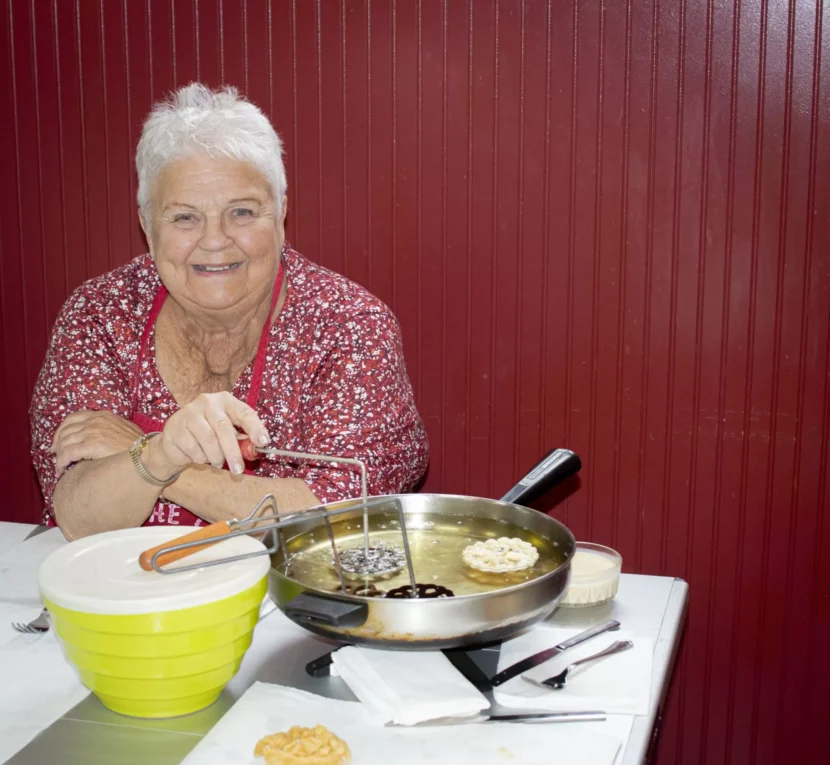
Vava Wikan fries up rosettes in Petersburg’s Sons of Norway Hall on May 13, 2024. (Shelby Herbert/KFSK)

In another corner of the room, Margaret Newlun was making rosettes. That’s a little more involved — and dangerous. Newlun wielded a long, thin metal rod with a flower-shaped cookie cutter at the end. She dipped the cookie cutter into a bowl of batter, and then turned around to face a ripping hot pan of oil.

“It just takes a while to make ‘em,” Newlun said. “You gotta fry ‘em in oil and you can’t set [the rod] down in the oil, because it’ll ruin the cookie!”

At another table, Katrina Miller was making waffler with her mom — that’s basically a tiny waffle sandwich. Miller’s grandmother taught her how to make it. Miller said waffler is an all-occasion thing that the next generation of her family has bonded over.

“It’s just kind of always been our thing and it brings us all together,” Miller said. “And it’s fun! We do it for Christmas, we do weddings, funerals… And then, sometimes, just because we want waffler.”

Miller’s mom, Sharon Wikan, offered a piece of waffler smeared with a type of caramelized goat cheese, called gjetost. She thinks that’s the best way to eat waffler, but not everybody in her family agrees.

“These are my grandkids’ favorite,” Wikan said. “But they don’t like the goat cheese. My kids don’t like the goat cheese. Just grandma — nobody else does.”

A line of customers outside Petersburg’s Sons of Norway Hall on May 18, 2024.
(Shelby Herbert/KFSK)

After hours of work, the volunteers’ tables were piled high with dozens upon dozens of pastries, which they started squirreling away for Kaffehus.

Days later, the dainty desserts reappeared in the Sons of Norway Hall, arranged on long buffet tables. A line of hungry festival-goers stretched around the outside the building, in the rain. But Bob Martin, who had been standing there for around 45 minutes, said it was all worth it.

“Lefse! It’s hard to find these days,” Martin said. “The ladies wearing bunads — they know the secrets!”

Lefse was one of the big draws — it’s a soft flatbread often filled with butter, sugar, and spices. It’s classic Scandinavian fare, but there’s been some drift over the years. Here, it’s taken on some American flavor.

A line of customers outside Petersburg’s Sons of Norway Hall on May 18, 2024.
(Shelby Herbert/KFSK)

Dwyer said her family’s lefse is a great example of how the town’s Norwegian forebears came up with new ideas after they started their lives in Petersburg.

“According to [our] family legend, Grandma Tora put sugar in her lefse after she buttered it, she used powdered sugar for the first time in Petersburg,” Dwyer said. “The granulated sugar — most of us think it’s like sand! So, most of us here use powdered sugar. Women were innovators back then!”

But the day’s visitors weren’t there to quibble over authenticity. They were there for the sugar rush. Plates of lefse — filled with both granulated and powdered sugar — got wolfed down, along with all the other fruits of the volunteers’ labor — another successful Kaffehus in the books.

This story has been updated to correct Vav Wikan’s identity in a photo caption.

A new lawsuit over Alaska’s Medicaid backlog asks a judge to order faster processing

A mostly empty hospital hallway
A hospital hallway is seen on April 7, 2020, in Juneau, Alaska. (Rashah McChesney/KTOO)

Just days into his life, Sierra Ott’s infant son Liam took a turn for the worse. His doctors thought he might need surgery. He took an emergency flight from Fairbanks.

“While he was there, they determined that he had hemophilia based on a heel prick that never stopped bleeding,” Ott said in a phone interview Friday. “He was diagnosed with severe hemophilia A, and from there, the hospital encouraged us to apply for TEFRA.”

TEFRA is a form of Medicaid, the federally funded, state-run insurance program, set aside for children with disabilities. It’s named for the Tax Equity and Fiscal Responsibility Act of 1982, the law that created the program.

So Ott applied on her son’s behalf in October. She was told it would be processed within 90 days.

But those 90 days ran out six months ago — in January. Every so often, she’d call the Division of Public Assistance to check on her application. She said they’d tell her to check back later, or that it’s in the hands of another agency.

Thousands of Alaskans are facing a similar struggle. Last month, state officials told Alaska Public Media more than 15,000 Medicaid applications were caught in a backlog that the state blamed on the expiration of pandemic-era requirements that prevented states from removing people from the insurance program. The Department of Public Assistance said the state’s outdated computer systems made it difficult to comply with new federal requirements preventing children from being kicked off Medicaid, leading the state to temporarily pause application processing.

Today, Liam is an 11-month-old getting ready to crawl.

“He does really well with the medication he does have to take, even though it’s an injection,” Ott said. “He handles it like a champ.”

But it’s not cheap. Hemophilia treatments are notoriously expensive. Ott estimated she’d be paying something like $8,000 per month out of pocket.

Ott said she’s lucky. Her husband is a retired veteran with coverage through the federal program for servicemembers, and that covers most, but not all, of her son’s medical expenses.

But Ott knows not everyone is so fortunate. And that’s left her to wonder.

“If we didn’t have our insurance, what would we be doing? We would have to have the conversation every week of, are we paying for this, or are we paying for my son’s medication?” Ott said. “If we’re having this conversation, I know that there’s families who are living this conversation out.”

So she filed a class action lawsuit demanding the state adhere to the deadlines in state and federal law surrounding Medicaid.

In most cases, the state is required to act on an application within 30 days, and for people like Liam who require a disability determination, the state has 90 days.

Internal data shows the state processed just about 40% of new and renewing Medicaid applications on time in the fiscal year that ended last June.

Ott’s case involves a disability determination, and the Department of Health said through a spokesperson that the agency has a limited amount of control over how long that process takes. Disability determinations are split between the federal Social Security Administration and the state Department of Labor, the spokesperson said. The Department of Labor did not return a call by Friday afternoon asking for more details.

And state-run Social Security disability determination offices across the country are backed up. As of November, new applicants had to wait an average of more than seven months to hear whether their disability claims were approved, according to government data aggregator USAFacts.

Division of Public Assistance Director Deb Etheridge told Alaska Public Media last month the state is working on its side of the issue. She said the division is hiring new staff, working overtime and upgrading the computer system issues that were one reason for the division’s backlog. And new internal data shows the state has made some progress. For the year ending June 30, the state has processed 45% of new applications on time, and 55% of renewals. But still, roughly half are not meeting legal deadlines.

Medicaid coverage can be retroactive once it’s approved.

“Even if we haven’t provided an eligibility determination, Medicaid will go backwards and pay those medical expenses back to the date of application,” Etheridge told Alaska Public Media last month. “And in some circumstances, we can look retroactively an additional three months if you had medical expenses.”

But that falls short of allowing people to actually access health care, said Ott’s lawyer, James Davis, a partner at the civil rights firm the Northern Justice Project. Davis said he’s been getting calls about this issue for months, and he said telling Medicaid families to beg doctors to wait months for payment — or float the bills themselves— is not a workable solution.

“That’s why they’re applying for Medicaid. They don’t have that kind of money,” he said by phone Thursday. “The retroactive coverage pretends that the person is going to get health care in the meantime. But … the fact of the matter is, the person won’t get health care coverage in the meantime.”

It’s just the latest in a long string of issues preventing low-income families from accessing benefits they are entitled to by law, Davis said.

Thousands were caught in backlogs in the state’s Supplemental Nutrition Assistance Program as recently as this year, spurring a separate lawsuit from Davis’s firm. And the Alaska Beacon reported in March that the state has also struggled to stay up-to-date on its heating assistance program.

Davis said the families hit the hardest are the ones who can least afford it.

“All I have to tell you is that if the people in Turnagain, or on the Hillside in Anchorage, didn’t get their Permanent Fund dividends on time, and they had to wait months and months and months, holy hell would come down,” Davis said. “Heads would roll.”

In cases where payment is needed ahead of time, DPA director Etheridge told Alaska Public Media that folks can ask for their application to be expedited and approved in a matter of hours. Many applicants can also be automatically approved online at Healthcare.gov if they meet income requirements.

But Ott never asked for her application to be expedited. She didn’t know it was an option. People applying for benefits shouldn’t have to say a couple of magic words, like “expedite my application,” to get their coverage, Davis said — the state should just follow the law.

How much fish do Alaskans eat? Enough to require new water pollution rules, EPA says

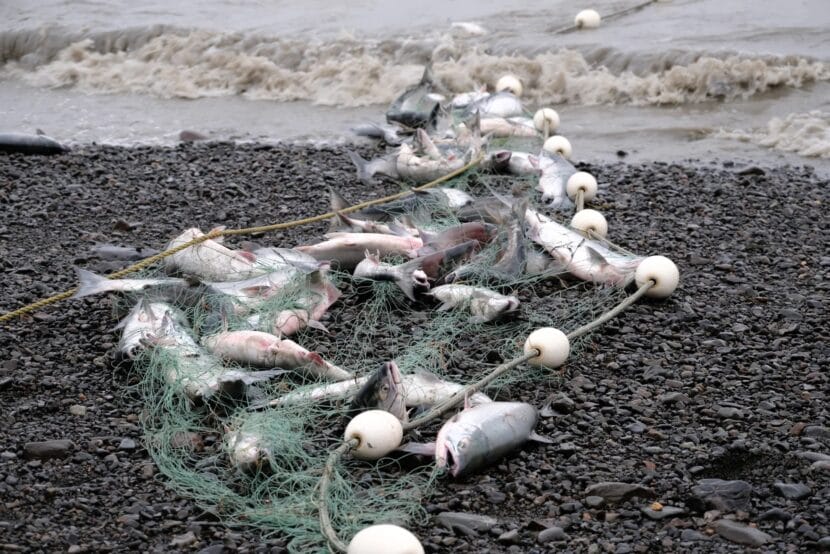
Water washes over fish in a subsistence net on Kanakanak Beach in Bristol Bay. (Brian Venua/KDLG)

Alaskans eat a lot of fish. So many, in fact, that the federal government announced Thursday that the state needs to update its water quality standards.

The Environmental Protection Agency is giving the state Department of Environmental Conservation six to 12 months to come up with new or revised standards for more than 100 pollutants in state waters. That’s based on data showing that Alaskans eat 30 to 60 times more fish than the state’s water quality rules currently assume.

“Alaska needs to revise its limits on toxic pollutants in the state’s waters to ensure that fish-eating and use of its water bodies for other uses support healthy people and communities,” said Caleb Shaffer, the acting director of the EPA’s water division for the Pacific Northwest, reading from a prepared statement. “New standards will reduce the amount of pollution that industries and wastewater treatment plants will be allowed to discharge from their pipes into local waters.”

The state’s water quality rules, last updated in 2003, assume Alaskans eat about seven ounces of fish per month. That’s based on a national average calculated in 1992.

But the EPA cites studies from a variety of sources, including the Sun’aq Tribe of Kodiak, the Seldovia Village Tribe and the state of Alaska itself, that say Alaskans eat at lot more: seven to 14 ounces per day.

Maggie Rabb leads the Southeast Alaska Conservation Council, which, alongside the Chickaloon Village Traditional Council, petitioned the EPA to force the state to update its standards in 2015.

“If you’re eating a lot more seafood, your seafood needs to have less pollution in it,” she said in a phone interview. “You need to be more thoughtful about what you’re allowing into the water here in Alaska, because we’re eating a lot more of the seafood that’s coming out of that water.”

Rabb said the state has long known that its water quality standards underestimate how much fish Alaskans eat, and Alaska Department of Environmental Conservation spokesperson Kelly Rawalt said the EPA’s findings were not a surprise.

“There’s nothing in the EPA’s release today that we didn’t know,” she said by phone. “We’ve been working on updating that criteria for several years now to reflect current science and science policies pertaining to the protection of human health and state water quality standards, so we’re absolutely working with the EPA on this topic.”

Rawalt said the state is “committed” to meeting the EPA’s six- to 12-month timeline. She said the state sought feedback on new rules in 2023 and plans to submit a new plan to the EPA soon. The new standards would then go out for public comment before they’re implemented.

“We’ve got lots of very capable subject matter experts in our department that have been working for many years on this topic and care a lot about it,” Rawalt said. “We’re hoping to come up with a plan that balances all those that are impacted and is the best solution for Alaskans.”

But if the state fails to address the issue, the EPA said it’s prepared to step in and issue its own rules.

Juneau’s hospital hears from the community as budget crisis threatens service cuts

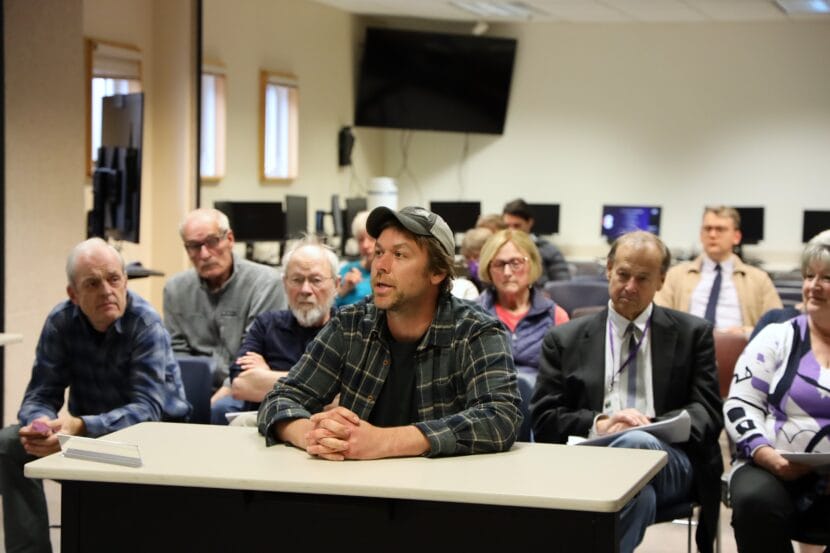
Aaron Surma, the executive director of the National Alliance on Mental Illness Juneau, gives testimony at a Bartlett Regional Hospital meeting on Tuesday, June 4, 2024. (Clarise Larson/KTOO)

As the board for Juneau’s city-owned hospital begins hearing public testimony on services it might cut or reduce, residents say there could be damaging consequences for the community if they’re gone. 

At a public meeting Tuesday night, Leslie Chandler Holzman spoke in support of the Home Health and Hospice services run by Bartlett Regional Hospital. 

“I just have to say — do not give up on this thing,” she said. “The reward to this community is immeasurable.” 

That service and others — like the Rainforest Recovery Center and adult and adolescent crisis services — could be discontinued as the hospital tries to address a major budget crisis. 

This year, the hospital is absorbing a $7.5 million budget deficit by pulling from its savings. But hospital leaders say they can’t do that for much longer. They say that if they don’t find ways to significantly cut costs, the hospital will run out of money within the next three years. 

Hospital Board member Hal Geiger explained the dilemma like this.

“The decisions we have before us, they’re like the decisions we would have if we were gonna drive on a long car trip and we don’t have any gas in the car, and we don’t have any money to buy gas,” he said. 

The services that the board is discussing cutting or reducing are considered “non-core” services, and they’re costing more money than they’re making.

The home health program gives intermittent in-home care for people recovering from an illness or surgery, and hospice is for patients who have a life expectancy of six months or less. Bartlett began offering the services last summer, taking over the role after Catholic Community Services stopped providing it in 2022. 

Those services are expected to lose a combined $1.3 million next fiscal year.

The Rainforest Recovery Center is a substance misuse treatment center the hospital has operated since 2000. It’s expected to lose close to $800,000 next year.

The board says other options could be on the table, like subsidizing the programs with city dollars or handing them over to other providers. But if that doesn’t happen — and soon — cutting the services may be the only option left. 

At the meeting, National Alliance on Mental Illness Juneau Executive Director Aaron Surma said that demand for adult and adolescent crisis services in Juneau is high, and the effects of cutting them would be widespread. 

“You all inherited a financial situation that no individual person here created, but I think you also inherited an obligation to provide that service,” he said.

The crisis center is expected to lose $1.2 million next year. But the hospital only started offering the services last December after the building that houses it, the Aurora Behavioral Health Center, was completed. 

The board says that if the service is cut or moved, they would repurpose the new building to house other programs.

But Surma said he wants the board to make sure the service does remain available – whether that’s with Bartlett or with a different organization that takes it over. 

The meeting Tuesday night was the first of two in-person opportunities for the public to share feedback on what they’d like to see happen. The next meeting is June 10 at the hospital’s campus. Public comments can also be submitted electronically or via mail until June 19. As of Tuesday, the board says they have already received 25 emails offering feedback. 

The board is expected to give a final recommendation on June 25 on how to move forward.

What to make of the new COVID variants, FLiRT

Dr. Ashish Jha says the U.S. is seeing typically two COVID waves a year. (Justin Sullivan/Getty Images)

As much as we would all love to ignore COVID, a new set of variants that scientists call “FLiRT” is here to remind us that the virus is still with us.

The good news: as of last Friday, the CDC says that the amount of respiratory illness in the U.S. is low.

The not-so-great news: the U.S. has often flirted with summer COVID waves because of travel and air-conditioned gatherings.

Dr. Ashish Jha, the dean of the Brown University School of Public Health and former White House COVID-19 response coordinator, returned to All Things Considered to speak with host Ailsa Chang about what the new variants could bring.

Interview highlights

Ailsa Chang: So how concerned would you say scientists are about whether these FLiRT variants come with increased transmissibility or increased disease severity, compared to previous variants?

Ashish Jha: We’re seeing exactly what we have expected: The virus continues to evolve to try to escape the wall of immunity we have built up through vaccines and infections. Is this more transmissible? It is. That’s why it has become more dominant. But the really important question is, is it going to get people to become more sick than previous versions? And all the evidence right now we have is no. If you have been vaccinated, or you had previous infections – or you’re one of the majority of Americans who have had both – you are likely to have a mild infection and not get particularly sick. Obviously, we have to continue monitoring every new variant, but this is pretty expected.

Juneau’s hospital is bleeding cash. City leaders are considering cutting services to stop it

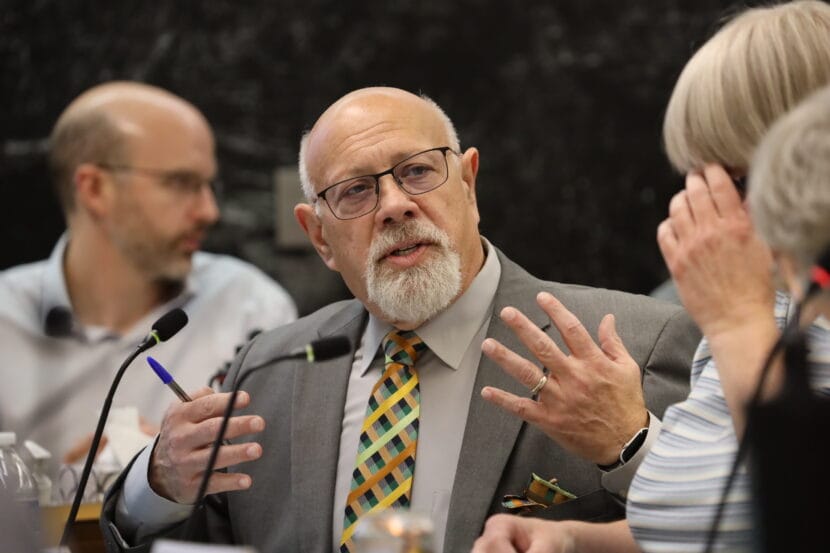
Bartlett Regional Hospital Board President Kenny Solomon-Gross talks during a meeting with the Assembly on Wednesday, May 29, 2024. (Clarise Larson/KTOO)

Bartlett Regional Hospital is in a tough spot. It’s facing a $7.5 million budget deficit for the next fiscal year, and will have to dip into savings to cover the shortfall. But its board says that’s not sustainable.

Max Mertz, the hospital board’s finance committee chair, explained how the hospital got into such a hole — and what it will take to get out of it — during a joint meeting between the board and the Juneau Assembly Wednesday night.

“We have three years of cash left from today before we’re closing the doors, essentially. We’re not able to make payroll without a significant adjustment to the way that we’re operating,” he said. 

Mertz explained that the hospital’s budget crisis didn’t happen overnight. Since 2019, it hasn’t been making enough money to cover its costs. And since mid-2020, it’s actually been steadily losing about $1 million a month.

Hospital leaders attribute that loss to higher labor costs, temporary pandemic relief funding drying up, staff and leadership turnover and low insurance reimbursement rates. Efforts in the past to correct course – like hiring restrictions and overtime reductions — just haven’t been enough. 

“We’re left with very stark choices about how we want to move forward,” he said.

Now the board is considering cutting or reducing “non-core” services that are draining money — things like the Rainforest Recovery Center, Home Health and Hospice, crisis services and support for children with autism.

The board said cutting services will be the last resort – and they’re trying to find ways to subsidize the programs via city dollars, handing them over to other providers, or any other creative efforts to get out of the red. 

But, nothing is off the table at this point. Board President Kenny Solomon-Gross said that in the coming weeks, the board will host public meetings and ask for input from the community.

“One of the best things about having a community hospital that we all own, is we as a community get to choose what services we want for us,” he said. 

At the meeting, a handful of residents and hospital staff were there to advocate for some of the services potentially on the chopping block. 

Juneau resident Mary Alice McKeen said that Home Health and Hospice provides critical services that need to continue. Bartlett began offering the services last summer, taking over the role after Catholic Community Services stopped providing it in 2022. 

The home health program gives intermittent in-home care for people in recovery from an illness or surgery, and hospice is for patients who have a life expectancy of six months or less. McKeen says both are needed.

“I can’t imagine a city of 30,000 people not providing  — as part of its health care system — hospice care, and it’s inconceivable to me that we would go back to where the only option people had was dying in the hospital or dying at home without expertise or without help,” she said. 

Mertz says those programs are expected to lose a combined $1.3 million next fiscal year.   

Testifiers said the Rainforest Recovery Center’s services also must continue.

Bartlett has operated the substance misuse treatment center since 2000, but it’s been steadily losing money as grants and tax revenue have run dry. Next year, the hospital expects it to lose close to $800,000.

Jeni Brown said cutting the center would affect more than just people in Juneau.  

“I’m here to advocate that these services are vital to everybody in Southeast – everybody in Alaska. This is needed — this is needed to save people,” she said.  

She said Juneau is a regional hub for services like these for other communities in Southeast Alaska that don’t have them. And, for Juneau residents, it means they can get treatment faster and don’t have to travel to places like Anchorage or Seattle.

Brown said as someone who once struggled with addiction and was formerly incarcerated,  services like these mean people struggling with addiction have a fighting chance — and they’re why she’s alive today. 

“This is something that needs to stay open. This is survival for some of us. This is the resources we need to be able to take the next step to come back into the community,” she said. 

Residents testified in support of other programs, too, like the adolescent and adult crisis services. 

Assembly members shared little about their opinions on what services should be prioritized. Mayor Beth Weldon said she’s interested in hearing what the community thinks.  

The public will be able to provide testimony on the process at upcoming meetings on June 4 and June 10 at the hospital campus. Public comment can also be submitted electronically or via mail until June 19.

The board is expected to give a final recommendation in late June on how to move forward. Mertz said it’s important that the board gets community input before decisions are made, but noted that they need to move quickly.

“We don’t have time to kick the can down the road, we just don’t have that time,” he said.

Site notifications
Update notification options
Subscribe to notifications